




Abstract
Background:
In a society increasingly committed to promoting an active life in the community, new resources are needed to respond to the needs of citizens with Alzheimer’s disease and other forms of dementia. The potential of several individual cognitive interventions to be provided by caregivers has been explored in the literature.
Objective:
To synthesize the best available evidence on the effectiveness of caregiver-provided individual cognitive interventions in older adults with dementia.
Methods:
Systematic review of experimental studies on individual cognitive interventions for older adults with dementia. An initial search of MEDLINE and CINAHL was undertaken. Another search for published and unpublished studies was performed on major healthcare-related online databases in March 2018 and updated in August 2022. This review considered studies that included older adults with dementia, aged 60 years and over. All studies that met the inclusion criteria were assessed for methodological quality using a JBI standardized critical appraisal checklist. Data were extracted using a JBI data extraction form for experimental studies.
Results:
Eleven studies were included: eight randomized controlled trials and three quasi-experimental studies. Caregiver-provided individual cognitive interventions had several beneficial effects in cognitive domains, including memory, verbal fluency, attention, problem-solving, and autonomy in activities of daily living.
Conclusion:
These interventions were associated with moderate improvements in cognitive performance and benefits in activities of daily living. The findings highlight the potential of caregiver-provided individual cognitive interventions for older adults with dementia.
Keywords
INTRODUCTION
Dementia is an umbrella term for a particular group of behavioral and psychological symptoms. It is characterized by a decline in memory, language, problem-solving, activities of daily living (ADLs), and other cognitive functions [1]. Alzheimer’s disease (AD) is the most common form of dementia, corresponding to 60–80% of cases. Different types of dementia are associated with distinct symptom patterns and brain abnormalities, such as vascular dementia, dementia with Lewy bodies, frontotemporal lobar degeneration [1]. There are 55.2 million people worldwide living with dementia, which accounts for 5.2% of the population over the age of 60. This number is expected to rise to 79 million by 2030 and 139 million by 2050 [2]. The number of people living with dementia is rising rapidly in low- and middle-income countries and decreasing in high-income countries, probably due to improved cardiovascular health, nutrition, and education. The global cost of dementia was estimated to be US$ 1 trillion in 2018 and is expected to double to US$ 2 trillion in 2030 [3]. Despite the economic and social burden of these diseases, no drugs or treatments are currently available to stop or delay their progression. Lecanemab, a monoclonal antibody that binds to amyloid-beta (Aβ) soluble protofibrils, resulted in a moderately less decline in cognition measures in a double-blind, phase III trial involving people with early AD, but adverse events were also reported. Further trials are needed [4].
On the other hand, non-pharmacological interventions have attracted more research attention and gathered more scientific support [5–8] due, in part, to the growing concerns with pharmacological safety, namely the lack of effective therapies, and the difficulty in controlling the behavioral and psychological symptoms that typically characterize this disorder [7, 9]. Thus, non-pharmacological interventions, namely cognitive interventions (CIs), have gained particular relevance given the increased number of people living with dementia [10–13]. The benefits of CIs may include neuroplastic changes [14–17] and an increase in cognitive reserve [18, 19], which facilitate coping with brain diseases.
Individual CI has been explored as a potential therapy to be provided by caregivers, one-to-one, in a home-based context [20–26]. Individual CIs can include cognitive stimulation (CS), cognitive training, and cognitive rehabilitation with an individualized approach [20–29]. Cognitive rehabilitation refers to a set of interventions that aim to improve a person’s participation in their daily routine. They are implemented by a professional in partnership with the person with dementia, their families, and caregivers [13, 31]. Cognitive training aims to improve impaired cognitive functions, including attention, memory, problem-solving, and executive functions, through the reorganization or creation of new neurological pathways in collaboration with caregivers/family members [7, 31]. CS refers to the implementation of several activities aimed to stimulate various domains, including attention, thought, memory, language, and calculation, among others, through a psychological approach [7, 33].
In this systematic review, to avoid terminology issues, individual CI refers to these three approaches and their techniques when applied one-to-one, that is, by a caregiver to an older adult with dementia (with some type of support from a health professional). There has been growing research interest in caregiver-provided individual CIs [21, 34]. Previous studies have shown that this therapy is of great practical value due to its feasibility and adaptability to different contexts besides the home setting [20, 33]. In addition, individual CIs are a suitable alternative for people with reduced mobility or those who do not have access to this type of intervention or dislike group interventions [20, 33].
Caregiver-provided individual CIs have shown positive results in several cognitive domains, such as immediate recall, verbal fluency, orientation, and problem-solving skills [22–25, 29]. Other studies have reported that individual CI allows for controlling behavioral and psychological symptoms and delaying institutionalization [24, 35]. Given that these symptoms, such as verbal and behavioral agitation, aggressive behavior, delusions, hallucinations, and apathy, aggravate cognitive deterioration [5, 36] and are associated with worse outcomes, they should be controlled in a home environment [5].
Older adults with dementia require integrated care and proximity to health care professionals so that their actual needs are met. Therefore, interventions that increase their potential for self-care and promote their maximum autonomy should be a priority [33, 35]. Considering the importance of this issue in a rapidly growing population and the privileged position of nurses and other health professionals in community settings to establish caring relationships with older adults with dementia and their caregivers, it is important to identify the most successful interventions and clarify how and when to use them.
Hence, a systematic review (SR) was conducted on the effectiveness of caregiver-provided individual CIs in improving general cognitive functioning and cognitive domains such as memory, attention, verbal fluency, and problem-solving, as well as behavior, mood, ADLs, and quality of life (QoL) in older adults with dementia [37]. Given that dementia is a significant health issue affecting older people worldwide, this systematic review aims to synthesize the best available evidence on the effectiveness of caregiver-provided individual cognitive interventions for older adults with dementia.
MATERIALS AND METHODS
This review followed JBI SR procedures [38]. It is an update and synthesis of the SR entitled “Effects of caregiver-provided individual cognitive interventions on cognition, social functioning, and quality of life in older adults with major neurocognitive disorders: a systematic review” [37]. A preliminary search of the JBI Database of Systematic Reviews and Implementation Reports, Cochrane Database of Systematic Reviews, PROSPERO, CINAHL (via EBSCOhost), MEDLINE (via PubMed), and Epistemonikos was carried out between February and March 2016. No SRs of evidence of efficacy on this topic of interest were identified. The full protocol was published [39]. Its PROSPERO registration number is CRD42016053294.
Aim
This review aimed to synthesize the best available evidence on the effectiveness of caregiver-provided individual CIs in older adults (aged 60 years and more) with dementia. More specifically, this review focused on the following question:
- How effective are of caregiver-provided individual CIs in improving general cognitive functioning and cognitive domains such as memory, attention, verbal fluency, and problem solving, as well as in improving behavior, mood, ADLs, and QoL in older adults with dementia?
Inclusion and exclusion criteria
This review considered studies with any experimental design, including randomized controlled trials (RCTs), quasi-experimental studies, and before and after studies that focused on caregiver-provided CIs for improving cognition, social functioning, and QoL in older adults with dementia. The inclusion criteria were as follows: Participants: community-dwelling older adults aged 60 years and more, with dementia confirmed by specific criteria, tests, or instruments used for diagnosis [40, 41]. Intervention: this review included studies, within a one-to-one approach, with one or more types of CIs (CS, cognitive rehabilitation, and cognitive training), and one or more techniques or combinations of techniques (e.g., mnemonics, visualization, association, and use of manual-based programs), based on a structured program provided by a caregiver. For the purpose of this review, a caregiver is defined as any family member or friend who is interested in applying the intervention in a home setting. The intervention may be provided with or without supervision, but it should include at least initial guidance or training delivered by healthcare professionals. For instance, the caregivers may receive training on how to deliver the intervention program from a team of experts, be provided with support materials, and have an opportunity for discussion and resolution of any issues that may arise. Additionally, the dyad may receive guidance on selecting the best family member to apply the intervention, such as a spouse, child, or grandchild. Studies in which the caregiver implemented the CI in less than four sessions were excluded. Comparator: usual care, wait-list control group, or alternative therapeutic interventions were considered. Usual care was defined as routine or standard treatment received by older adults. Outcomes: outcomes included general cognitive functioning and cognitive domains such as memory, attention, verbal fluency and problem-solving, as well as behavior, mood, ADLs, and QoL, measured by any validated and reliable instruments, scales, or indexes.
Search strategy
A three-step search strategy was utilized in this review. An initial limited search of MEDLINE via PubMed and CINAHL via EBSCO was undertaken, followed by an analysis of the words contained in the title and abstract and of the index terms used to describe the article. A second search using all identified keywords and index terms was then undertaken across all included databases. Thirdly, the reference lists of all identified reports and articles were searched for additional studies. The search strategy aimed to locate both published and unpublished studies. Studies published in English, Spanish, and Portuguese were considered for inclusion. The database search was performed in March 2018 and updated in August 2022 using the same strategy. Full details of the search strategy are published in Silva et al. [37]. The databases used were MEDLINE via PubMed, CINAHL via EBSCOhost, Scopus, Cochrane Central Register of Controlled Trials, SciELO, PsycINFO, RCAAP–Repositório Científico de Acesso Aberto de Portugal, OpenGrey, and Banco de teses da CAPES.
Study selection
Search results were assessed for relevance based on the title and abstract (RS, EBC, PSC, DC) using Rayyan’s online application (Qatar Computing Research Institute, Doha, Qatar). Then, the full-text version of eligible studies was analyzed, and independent reviewers (PSC, RC, JB, ES, IA, RL) selected the studies. Finally, studies that met the inclusion criteria were assessed for methodological quality (RS, EBC) using the JBI Critical Appraisal Checklists for RCTs and for Quasi-Experimental Studies of the JBI Meta-Analysis of Statistics Assessment and Review Instrument [38]. Any disagreements were resolved through discussion, with a third reviewer (JA), or by consulting the original authors. The search results were reported in full using the Preferred Reporting Items for Systematic Reviews and Meta-Analyses (PRISMA) flow diagram [42].
Data collection
One reviewer (RS) extracted details regarding interventions, populations, methods, and outcomes relevant to the review question and specific objectives using the standardized data extraction tool from the JBI System for the Unified Management, Assessment and Review of Information (JBI SUMARI; JBI, Adelaide, Australia) [43]. A second reviewer (EBC) checked the accuracy of the data. If some of these details were missing, study authors were contacted to provide the necessary information.
Data synthesis
The broad differences in population, intervention, comparators, and presentation of outcomes of interest prevented the direct comparison of results. Thus, statistical pooling was not performed. Data were presented in narrative and tabular formats.
RESULTS
Study selection
The search identified 3,045 (search 2018 – 2,257; search 2022 – 788) potentially relevant studies. Of these, 793 studies were excluded for being duplicates (search 2018 – 527; search 2022 – 266), 2,175 after title and abstract analysis (search 2018 – 1680; search 2022 – 496), one due to the lack of a full-text version, and 11 for being abstracts from conferences/posters that did not meet the eligibility criteria after contacting the authors. Sixty-five studies were assessed for eligibility (search 2018 – 39; search 2022 – 29), and 11 studies, published from January 1995 to May 2021, answered the objectives of this review (search 2018 – 10; search 2022 – 1) [21–23, 44–49]. Figure 1 describes the study selection process using the PRISMA flow diagram [42].
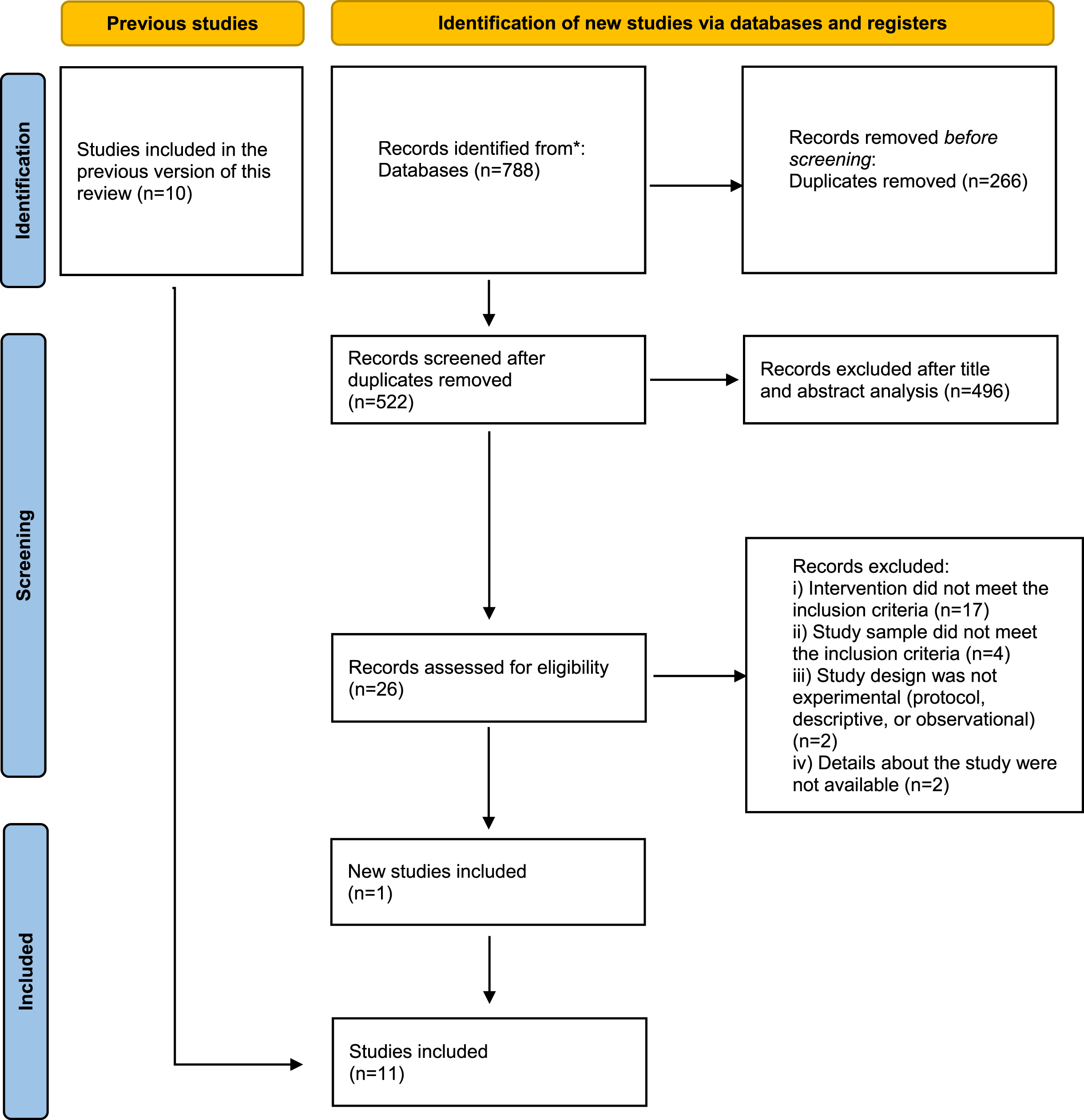
Study selection process using a PRISMA flow diagram [42].
Methodological quality
Eight of the 11 studies included in this review are RCTs [22, 48] and three are quasi-experimental studies [21, 49]. None of the RCTs complied with the 13 items assessed in the RCT critical appraisal checklist. Only item 10, ensuring the outcomes were measured in the same way between groups (internal validity), was complied with in all RCTs. Items 4 (participants blind to treatment assignment) and 5 (those delivering treatment were blind to treatment assignment) were not met in any of the RCTs [22, 48].
In quasi-experimental studies [21, 49], three items were met: items 1 (identification of cause-and-effect variables), 5 (measurement of the outcomes of interest pre- and post-intervention), and 7 (the outcomes of participants included in any comparisons were measured in the same way). However, none of the studies met item 3 (the participants included in any comparisons receiving similar treatment/care, other than the exposure or intervention of interest) or item 8 (outcomes measured in a reliable way).
Study characteristics
Four studies were conducted in the United States of America [23, 46], one in Canada [48], and another in Brazil [45]. The remaining five studies were carried out in European countries, including England and Wales [35], Scotland [21], Sweden [47], Italy [22], and Belgium [49]. In ten studies [21–23, 44–49], participants were recruited from various community settings, such as psychiatry/mental health units, Alzheimer evaluation units/the Alzheimer Society, and memory clinics. Quayhagen and Quayhagen [29] did not provide information about the recruitment context.
Participants
The 11 studies included in this review presented data on 894 dyads. The number of dyads in the studies ranged from 16 [45] to 356 [35]. All studies reported the participants’ gender, but only seven reported the caregivers’ gender [21–23, 47]. Of the 894 participants with dementia, 51% were women. The gender distribution among caregivers was less balanced. Approximately 69% of the caregivers in the studies, with information on sociodemographic characteristics, were women.
All studies provided information on the mean age of participants with dementia. In seven studies [21–23, 45], the authors considered the total sample for this calculation, ranging from 73.6 (SD = 8.00) [44] to 78.2 (SD = 7.49) [35] years. The mean age for each treatment group was reported in four studies [46–49], ranging from 68.67 years (SD = 3.86) [46] to 80.00 years (SD = 6.14) [48]. Concerning the caregivers’ age, two studies [22, 47] provided data on mean ages, ranging from 55.1 (SD = 13.9) [22] to 75.3 (SD = 8.5) years [47]. Five studies [21, 44] provided the mean ages for the total samples, ranging from 65.73 (SD = 12.92) [35] to 72.57 (SD = 1.51) years [29].
Three studies reported the mean educational level of participants with dementia [23, 44], ranging from 12.60 (SD = 4.1) [44] to 14.57 (SD = 0.3) years [29]. Five studies [22, 49] calculated the mean educational levels separately for each group. The minimum and maximum values reported were 5.50 (SD = 3.27) [45] and 15.06 (SD = 3.86) years [46], respectively. Another study reported only partial data, with approximately 60% of the sample, between 14 and 16 years of education [35]. Concerning the caregivers’ educational level, three studies [23, 44] reported values ranging from 14.10 (SD = 2.7) [44] to 14.42 (SD = 0.3) [44] years. One study reported that approximately 44% of caregivers had completed 14 and 16 years of schooling [35].
As for the causes of dementia, seven studies [22, 49] included participants with possible AD, and four studies [21, 47] included participants with other forms of dementia.
Interventions
The included studies focused on CS [21, 44], neuropsychological/cognitive rehabilitation [45, 49], reality orientation therapy [22], collaborative memory intervention [47], and cognitive interventions stimulating attention [46]. Four of these interventions were carried out exclusively at home by caregivers [21, 35]. The remaining seven interventions were also carried out at home, with the support of research team members or health professionals [23, 44–49].
In all studies, caregivers received training to implement intervention programs. The sessions were supervised in eight studies [21, 44–48]. The duration of the interventions ranged from four weeks [48] to one year [49]. The sessions were run from one [45] to six times a week [44, 46]. The caregiver-provided sessions varied between 30 minutes [22, 46], 40 minutes [45] and one hour [29, 47].
Ten studies reported using control conditions for comparison purposes [22, 44–49]. These conditions included individually-promoted activities, such as (i) neuropsychological rehabilitation performed by health professionals [45], (ii) collaborative memory intervention without caregiver involvement [47], (iii) dyad-directed emotional counseling interventions [23], (iv) group emotional support [23], (v) placebo condition (including individual appointments [46], or passive CS activities [44]), (vi) usual care [35], and (vii) waiting list control group [23, 48]. In three studies [22, 49], the control condition was considered the absence of intervention.
Outcome assessment characteristics
In seven studies [22, 49], the outcomes of interest were assessed twice (at baseline and at the end of the intervention), with intervals of measurements ranging from five weeks [46] to one year [49]. In three of the studies [21, 44], three assessment sessions were considered. Two of these studies [21, 35] assessed the outcomes of interest at baseline, during the intervention (at week 8 [21] or 13 [35]), and at the end of the intervention (week 16 [21] or 26 [35]). In the third study, assessments were performed at baseline, at the end of the intervention, and at a 6-month follow-up [44]. Another study included four time points of assessment: baseline, post-intervention, and two follow-ups (at weeks 9 and 13) [48].
Clinical outcomes
Table 1 describes effects of caregiver-provided CIs on clinical outcomes.
The effectiveness of the interventions described in the included studies considering the outcomes
n, participants ADAS-Cog, Alzheimer’s Disease Assessment Scale –Cognitive Subscale; B-ADL, Bayer-Activities of Daily Living Scale; BADLS, Bristol Activities of Daily Living Scale –Older Adults Version; BRS-CAPE, Behaviour Rating Scale of the Clifton Assessment Procedures for the Elderly; CDR, Clinical Dementia Rating; COWAT, Controlled Oral Word Association Test; DAD, Disability Assessment for Dementia; DEMQOL, Dementia Quality of Life Instrument; DMT, Direct Measure of Training; DOORS, Doors subtest of the Doors and People test; DRS-2, Dementia Rating Scale –2; F.A.S. Test, The verbal fluency score was based on a composite of the number of words recalled in 1 minute for the letters F, A and S; GCS, The Geriatric Coping Schedule; GDS, Geriatric Depression Scale; HAM-A, Hamilton Anxiety Rating Scale; IADL, Instrumental Activities of Daily Living; MADRS, Montgomery –Åsberg Depression Rating Scale; MBPC, Memory and Behavior Problems Checklist; MDRS 5 subscales, Mattis Dementia Rating Scale subscales measuring attention, verbal initiating / perseveration, visuospatial construction, conceptualization of verbal and nonverbal relationships and verbal and nonverbal memory; MDRS, Mattis Dementia Rating Scale; MMSE, Mini-Mental State Examination; MQDL, Memory Questionnaire of Daily Living –Older Adult Version; NPI, Neuropsychiatric Inventory; QLA-P, Quality of Life Assessment –Patient; QOL, Questionnaire of Quality of Life –subtest for Patients; QoL-AD, Quality of Life-Alzheimer’s Disease scale; RBMT –RR, Rivermead Behavioural Memory Test –Route Recall subtest; RBMT, Rivermead Behavioural Memory Test; RMF, Recognition Memory Test for Faces; RMW, Recognition Memory Test for Words; SD, standard deviation; SRT, Selective Remind Test; VSAT, Verbal Series Attention Test; WAIS-R DS, Wechsler Adult Intelligence Scale–Revised - Digit Span subtest; WMS-R –FM, Wechsler Memory Scale-Revised - Figural Memory subtest; WMS-R –LM I, Wechsler Memory Scale-Revised - Logic Memory subtest I; WMS-R –LM II, Wechsler Memory Scale-Revised - Logic Memory subtest II; WMS-R –VR I, Wechsler Memory Scale-Revised –Visual Reproduction subtest I; WMS-R –VR II, Wechsler Memory Scale-Revised –Visual Reproduction subtest II; WMS-R DS, Wechsler Memory Scale-Revised Digit Span; WMS-R VMS, Wechsler Memory Scale-Revised –Visual Memory Span.
General cognitive functioning
Three studies described the effectiveness of caregiver-provided CIs on general cognitive functioning [22, 49]. Onder et al. [22] found beneficial effects of reality-oriented therapy on cognition. Further analysis of moderate and severe dementia subgroups revealed that the impact of the intervention depends on symptom severity [22]. Older participants with moderate-level dementia improved their scores on the Alzheimer’s Disease Assessment Scale –cognitive subscale (ADAS-Cog) [22]. Quayhagen et al. [44] analyzed the changes between the three groups (Active CS group, Placebo activity group, and Wait-list control group). They found a significant increase in the Mattis Dementia Rating Scale (MDRS) score immediately after the intervention in the Active CS group. Kurth et al. [49] reported that the MMSE scores (a global cognitive measure) slightly but significantly decreased in both CI and control groups, demonstrating worsening of cognitive function (see Table 1 for more details).
Memory
Four studies [23, 47] found beneficial effects of caregiver-provided CIs on memory. Three studies [44, 47] reported a positive impact on verbal memory. Davis et al. [46] also found a significant improvement in delayed memory scores in both the intervention and placebo groups. Furthermore, the between-group analysis did not indicate any significant interaction between the two groups [46]. Thus, they found that the experimental intervention was no more effective than the placebo [46].
One study [47] revealed significant improvements in the verbal memory domain among participants who participated in the caregiver-provided intervention. No improvements were observed in the performance of the older adults in the other two groups (home-based individual intervention and no intervention) [47]. In another study [44], the between-group analysis did not show any significant changes in the intervention group; however, the older adults in the two control groups significantly decreased their performance in verbal memory tasks [44].
Two studies [44, 46] reported the beneficial effects of caregiver-provided interventions on non-verbal memory. One of these studies [46] reported post-intervention improvements in immediate and delayed memory tasks in both the intervention and placebo groups. However, the between-group analysis did not indicate any significant interaction between times 1 and 2 across the two groups [46]. Quayhagen et al. [44] also reported improvements in the recall of non-verbal material. This study demonstrated the beneficial effects of the caregiver-provided intervention through an analysis of condition-by-time effects [44].
Memory changes evaluated through both verbal and non-verbal memory tasks were reported [44]. The between-group analysis showed the main time effect for delayed memory [44]. The comparison from baseline to post-intervention showed a significant positive change in delayed memory scores in the caregiver-provided CS group [44]. This change was not observed in the tasks assessing immediate memory [44]. This study [44] reported also positive changes in the general memory score after receiving a caregiver-provided intervention. These positive changes were reported in comparison with the placebo activity group and inclusion in a waiting list [44] (see Table 1 for more details).
Attention
Two studies [44, 46] assessed the impact of individual CIs on attention. The analysis of within-group changes showed significant improvements in the Verbal Series Attention test in both the intervention and the control groups [46]. The exploratory analysis revealed a significant decrease in the time needed to complete the test for the intervention group but not for the control group [46]. The participants in the second study [44] received active CS in comparison with two control conditions (placebo activity and wait-list). Between-group analysis showed no significant improvements in the intervention group [44]. However, in both control groups, a significant decrease was observed in the performance in attention tests (see Table 1 for more details).
Verbal fluency
Five studies [21, 46] analyzed the impact of caregiver-provided individual CI on verbal fluency. All of them reported significant improvements in the performance of the intervention group in verbal fluency tests [21, 46]. In two studies [23, 44] examining the impact of individual CS, the main effect of time was reported, with the intervention group showing better performance than the placebo group [44] and the wait-list group [23, 44] immediately after the intervention. In the study by Quayhagen and Quayhagen [29], between-group changes (individual CS, dyadic counseling, cognitively oriented community-based programs, waiting list) were not significant [29]. However, the within-group analysis showed a significant improvement from baseline to post-intervention in the performance of older adults who received individual CS [29]. A similar improvement was not observed in the other groups [29]. Two studies [21, 45] examined the beneficial effects based on the within-group comparison. One study [21] examined the impact of a 16-week CS intervention and showed significant improvements in the verbal fluency test from intermediate assessment to final assessment. The other study [45] found positive changes from baseline to post-intervention in both groups. Between-group analysis showed no significant differences in post-intervention in the intervention and placebo groups (five-week individual CI with individual clinic visits in comparison to individual clinic visits consisting of unstructured conversations). For more details, see Table 1.
Problem-solving skills
Two studies [23, 29] showed gains in problem-solving skills. Quayhagen and Quayhagen [29] reported positive changes in the CS group but not in the wait-list control group. Quayhagen et al. [23] used four different control groups for comparison purposes and reported an improvement over time in the CS group. However, no significant differences were observed in the between-group comparison. For more details, see Table 1.
Behavior
Six studies assessed behavioral changes [21, 48]. Only one study reported that caregiver-provided active CS had beneficial effects on the behavioral performance of older adults with dementia immediately after the intervention [44]. For more details, see Table 1.
Mood
Four studies [21, 46] analyzed the effects of caregiver-provided individual CI on mood. All studies focused on depressive symptoms, and one analyzed anxiety [45]. No significant changes in these domains were observed in any of the included studies. For more details, see Table 1.
ADL
Four studies [22, 49] examined the impact of CI on ADLs. Of these, only Thivierge et al. [48] and Kurth et al. [49] found significant improvements in trained ADLs, both in the short- and long-term. For more details, see Table 1.
Quality of life
Five studies [21, 48] examined the effectiveness of caregiver-provided CIs on the QoL of people with dementia. However, none of the studies revealed significant changes in QoL between pre- and post-intervention. The changes observed in the follow-up periods were also not statistically significant. For more details, see Table 1.
DISCUSSION
In favor of more inclusive societies, it is necessary to make new therapeutic tools available or to monetize existing ones, but above all, it is necessary to study the effectiveness of these therapeutic options and help researchers and health professionals, in particular, to choose the most appropriate interventions. Thus, this review examined the effectiveness of caregiver-provided CIs, such as cognitive/neuropsychological rehabilitation, cognitive training, reality orientation, errorless learning, and spaced-retrieval techniques for improving general cognitive functioning and cognitive domains (such as memory, attention, verbal fluency, and problem-solving), QoL, and ADLs in older adults with dementia.
The differentiating factor of this review is the focus on the family caregivers who implement the intervention in part or in full [21–23, 44–49]. When exploring the level of effectiveness of these CIs/programs, two studies stand out due to the positive effects identified after the implementation of the intervention [44, 46]. Quayhagen et al. [44] identified positive effects on cognitive functioning, particularly on memory, attention, and verbal fluency. Similar results were obtained by Davis et al. [46], who explored the effectiveness of CIs focused on the attention process and found significant changes in memory, attention, and verbal fluency after the intervention [46]. Both programs [44, 46] are well structured and have some similarities. Both were planned to be administered by caregivers six times a week, caregivers’ guidance and training are well organized, the dyad receives supervision during the sessions, and caregivers receive weekly support [44, 46]. In both studies, the dyads and the professionals responsible for guidance and training worked closely together [44, 46]. Five other studies [21–23, 47] showed promising positive effects of caregiver-provided CIs on older adults with dementia, namely on their verbal fluency, memory, problem-solving, and general cognitive functioning [21–23, 47]. In line with several other authors, caregivers and older adults with dementia require proximity care and personalized interventions based on their needs [25, 50]. Systematized monitoring of this clinical status characterized by deterioration and rapid changes is essential for the success of this intervention.
The analysis of the sociodemographic characteristics of the participants who benefited the most from these interventions [44, 46], showed that they are, on average, younger and have a higher educational level than those with fewer benefits. In those studies [45, 48] that found no positive effect on the outcomes explored, the participants’ mean age and educational level did not fit this pattern. Based on these results, it seems that participants’ behavioral and psychological responses to the caregiver-provided CI also depend on their age and educational level. Low levels of education and advanced age can influence intervention response [51] and even interfere with the older person’s willingness to be cared for. Increasing age is inversely associated with a decrease in life goals, motivation, and willingness to act, as well as directly associated with the worsening of depressive states.
These results also show that those who require CIs the most seem to respond less effectively to the intervention because the higher the degree of dementia, the lower the response to the intervention [22, 53]. Therefore, it is essential to prevent cognitive deterioration in younger adults, enhancing their skills and the possible beneficial effects of this intervention. Furthermore, implementing these interventions in older people with more severe cognitive decline and lower educational levels is an even more difficult task for most caregivers, demotivating them and resulting in low adherence and high drop-out rates [54, 55].
Although it can be concluded that CIs improve the cognitive performance of people with mild to moderate dementia, these positive effects tend to disappear over time [44]. As already reported in the literature, the gains in cognitive performance tend to disappear within weeks after the end of CIs [13], indicating that the intervention should be maintained.
The positive impact of a clinical CI program was obtained for adapted ADLs, and remained up to one year after the intervention, even if global cognition declined [49].
A limitation of this review was that the included studies had heterogeneous interventions with different activities, focuses, types, program length, session frequency and length, which limited data generalization. Training and supervision procedures, training material, and the support provided to caregivers/dyads also differed across studies. Moreover, the included studies had small sample sizes and heterogeneous samples in terms of participants’ age, diagnosis of the type of dementia, and level of cognitive deterioration.
Concerning the “right dose at the right time", some studies were conducted over long periods of time (6 months to 1 year) [35, 49] and others only provided sessions during a few weeks [48].
Furthermore, some studies did not ensure that older adults received the caregiver-provided intervention as intended. Maintaining participant adherence to the intervention also proved to be a challenge. Even though, the included studies showed expected drop-out rates for interventions with highly vulnerable populations.
Finally, the studies included in this review had several methodological weaknesses, which may increase the risk of selection, performance, and detection bias.
Although the search was updated (from 2018 to 2022), the level of evidence remained very low because only one more study met the inclusion criteria. Therefore, the low level of evidence is another limitation, which can be overcome by expanding the inclusion criteria [56] and encouraging more and better research.
CONCLUSION
Population dynamics calls for an urgent need to involve citizens as active partners in care. For this reason and the need to promote care within the community, caregiver training for the development of CIs may be a suitable strategy for some dyads/families.
This review concluded that the benefits of the intervention are more evident in younger adults with higher educational levels. Thus, this last variable is also relevant to the effectiveness of caregiver-provided interventions. Other factors that seem to influence the results are the training received to implement the program, the weekly frequency of the sessions, and the proximity between caregivers/dyads and health professionals.
Knowledge about the effectiveness of caregiver-provided individual CIs on the cognitive performance, such as memory, problem-solving ability, and verbal fluency, of community-dwelling older adults is now more accessible to the professionals who implement these interventions and the researchers who want to improve existing evidence. Therefore, this SR provides a broader understanding of the positive effect of individual CIs, demonstrating the potential of this intervention and the need for further studies. Therefore, the findings synthesized in this review can be used to enhance current programs, develop new initiatives, and incorporate new tools with the support of Information and Communication Technologies. Also, these programs can be applied in digital formats, increasing their reach and applicability.
In terms of implications for practice, this SR provides some recommendations: The caregiver-provided individual CI for community-dwelling older adults with dementia is an effective intervention for improving general cognitive functioning, memory, verbal fluency, attention, and problem-solving. Thus, based on current evidence, caregivers are strongly recommended to implement this intervention to improve cognitive functioning in older adults with dementia (Grade A). The individual caregiver-provided CI for community-dwelling older adults with dementia had an impact on behavior and ADLs during the intervention. Thus, based on current evidence, caregivers can provide cognitive interventions to improve behavioral and ADL performance in older adults with dementia (Grade B). The caregiver-provided individual CI for community-dwelling older adults with dementia had no impact on depression, anxiety, and QoL. Thus, based on current evidence, the recommendation that a caregiver-provided CI improves mood or QoL in older adults with dementia is not supported.
Another recommendation for practice is that professionals should refer older adults with an early diagnosis of cognitive deterioration to non-pharmacological interventions and raise caregivers’ awareness of the need to play a more proactive role during the disease process. They should also play a key role in training caregivers to implement CIs, ensuring accessibility and supervision throughout the intervention. Finally, community awareness should be raised that the earlier CI is implemented (at a younger age, in a less advanced degenerative process), the more effective it may be.
In terms of recommendations for future research, more extensive and robust primary studies with quality designs (e.g., using CONSORT [Consolidated Standards of Reporting Trials] guidelines) are needed to confirm, consolidate, or refute the findings of this review on the effectiveness of caregiver-provided individual CIs.
Footnotes
ACKNOWLEDGMENTS
The authors wish to acknowledge the support of the Health Sciences Research Unit: Nursing (UICISA: E), Nursing School of Coimbra, Portugal, and the Portugal Centre for Evidence-Based Practice: a JBI Centre of Excellence, Portugal (PCEBP).
FUNDING
This project received funding from the Foundation for Science and Technology (FCT). This systematic review is also part of the “Cognitive stimulation in elderly: intervention on cognitive frailty and promotion of self-care” project which has received funding from the Nursing School of Coimbra (Portugal).
CONFLICT OF INTEREST
The authors declare they have no competing interests.