




Abstract
This paper provides a formal description of two legal domains. In addition, we describe the generation of various artificial datasets from these domains and explain the use of these datasets in previous experiments aligning learning and reasoning. These resources are made available for the further investigation of connections between arguments, cases and rules. The datasets are publicly available at
Introduction and context
The resources described here are made available for the further investigation of connections between arguments, cases and rules. This topic is gaining increased relevance in artificial intelligence in general, in particular by the widespread acceptance that explainable approaches to machine learning are needed, with argumentation-based machine learning as a relevant new angle of research [3,8]. In particular, the learning of knowledge used for reasoning in structured domains remains a relevant topic of research. Here we focus on two example domains in the field of law.
Argumentation in AI & Law is typically based on two kinds of sources: legislation and precedents. Concretely, legislation often provides the grounding for the arguments used in rule-based reasoning, and precedents for those used in case-based reasoning. However, in actual legal reasoning, many hybrid combinations appear (cf. also research on the comparison of various legal systems [11,12]), which has inspired AI & Law research on hybrid rule-based/case-based approaches already for a long time (e.g., [17]). The datasets and domains that we describe can be used to investigate a variety of approaches including neural networks [4,19], rule mining [9,10,24] and inductive logic programming [14], or other relevant techniques.
Resource description
We artificially generate datasets based on two legal domains: a fictional Welfare benefit domain and the tort law domain. Both domains are defined by clear knowledge structures. These datasets contain instances with various features and an output label that is determined by these features as defined by the knowledge structure of the domain. All instances in the datasets are therefore valid in the sense that their output labels follow from evaluating the knowledge structure that defines the domain. An overview of the two domains alongside their key characteristics can be found in Table 1, which are explained in the upcoming sections.
An overview of the two domains. Listed are the number and type of features, the number and type of conditions to be learned, whether or not all cases are covered by the datasets (complete) and whether the domain is fictional or real
An overview of the two domains. Listed are the number and type of features, the number and type of conditions to be learned, whether or not all cases are covered by the datasets (complete) and whether the domain is fictional or real
The Welfare benefit domain was first introduced by Bench-Capon in an experiment investigating whether neural networks can learn rules from data [4]. It has later been used in several applications (see Section 3) including argument based machine learning [14] and argumentation dialogue based on association rules [24]. It is a fictional legal domain that concerns the eligibility of a person for a welfare benefit to cover the expenses for visiting their spouse in the hospital. It is defined by six conditions:
The person should be of pensionable age (60 for a woman, 65 for a man);
The person should have paid contributions in four out of the last five relevant contribution years;
The person should be a spouse of the patient;
The person should not be absent from the UK,
The person should have capital resources not amounting to more than £3,000;
If the relative is an in-patient the hospital should be within a certain distance: if an out-patient, beyond that distance.
These are meant to represent a variety of types of conditions found in such benefits. They were also expected to present a range of challenges to the neural networks in [4]. In order of expected difficulty the conditions can be seen as examples of the following functions:
A positive Boolean function (3);
A negative Boolean function (4);
A numeric threshold function (5);
A symmetric Boolean function, where a certain number of variables need to be true, in no particular order (2);
A numeric threshold function with the threshold dependant on another feature (1);
A numeric XOR function with the polarity dependant on another feature (6).
These conditions can be formalised as follows:
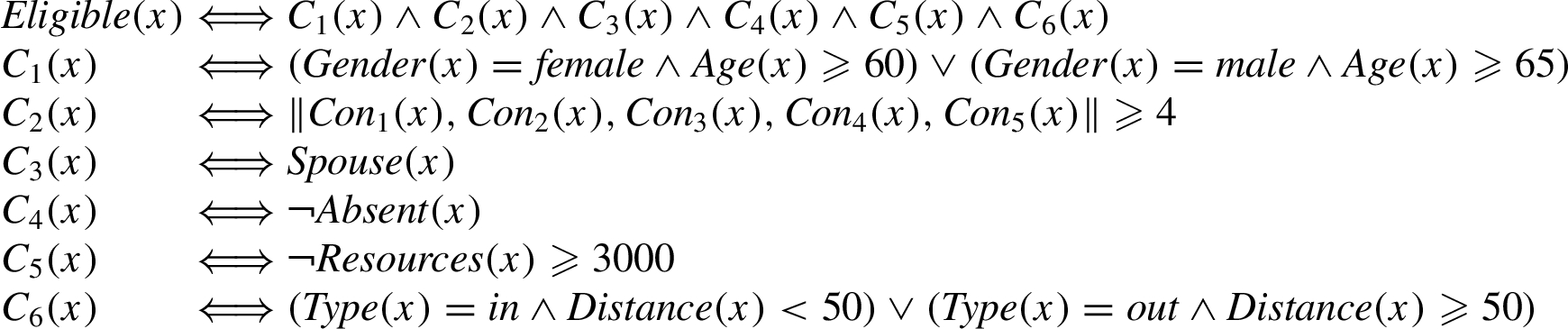
Features in the Welfare benefit domain
Features in the Welfare benefit domain
Using these conditions, we can generate artificial datasets. The six independent conditions for eligibility are defined in terms of 12 variables, which are the features of the generated datasets. These features and their possible values are shown in Table 2. Note that one can easily change the upper and lower bounds of the integer values of the features in our source code. In [4], a further fifty two irrelevant noise features were added to discover whether the neural net could identify the twelve relevant features and thus sort the wheat from the chaff.
To generate a Welfare benefit dataset using our code, one must specify three function parameters: the number of instances, the number of noise features and the label distribution. By default, the number of noise features is set at 52, just as in [4], yielding a total of 64 features plus an eligibility label for each instance. These noise features have integer values ranging from 0 to 100, unrelated to eligibility. By default, exactly half of the instances in these datasets are eligible, creating a balanced label distribution, as is common practice in machine learning experiments.
For the eligible instances, feature values are generated (randomly where possible) such that they satisfy the conditions
Our second domain concerns a fragment of the real life legal domain of Dutch tort law. Articles 6:162 and 6:163 of the Dutch civil code describe when an action is wrongful and resulting damages must be repaired [21]:
1. A person who commits an unlawful act toward another which can be imputed to him, must repair the damage which the other person suffers as a consequence thereof. 2. Except where there is a ground of justification, the following acts are deemed to be unlawful: the violation of a right, an act or omission violating a statutory duty or a rule of unwritten law pertaining to proper social conduct. 3. An unlawful act can be imputed to its author if it results from his fault or from a cause for which he is answerable according to law or common opinion.
There is no obligation to repair damage when the violated norm does not have as its purpose the protection from damage such as that suffered by the victim.
The arguments and attacks regarding this ‘duty to repair’ (
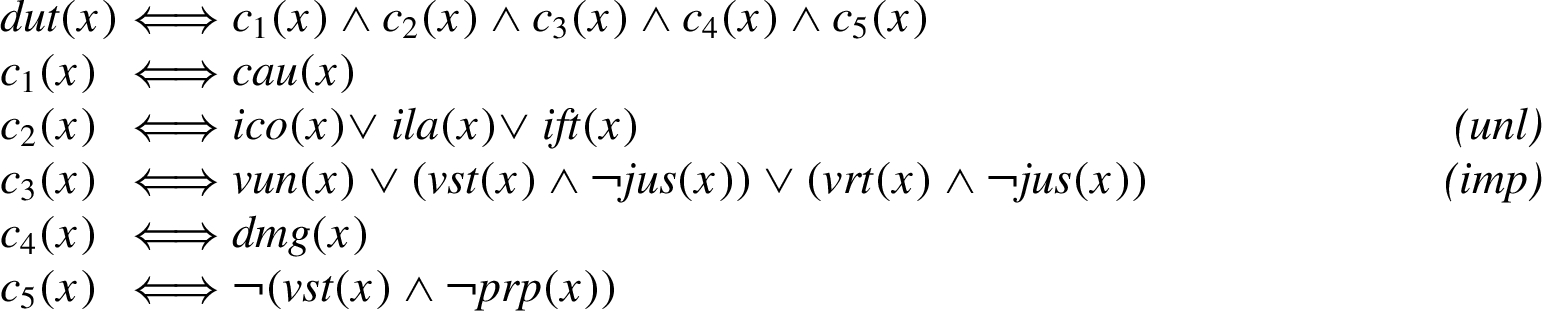
Here the elementary propositions are provided alongside an argumentative model of the law in Fig. 1 [21], and conditions
The Dutch tort law domain is captured in 5 conditions for duty to repair (dut), based upon 10 Boolean features. Each condition is a disjunction of one or more features, possibly with exceptions. The feature capturing a violation of a statutory duty (vst) is present in both condition
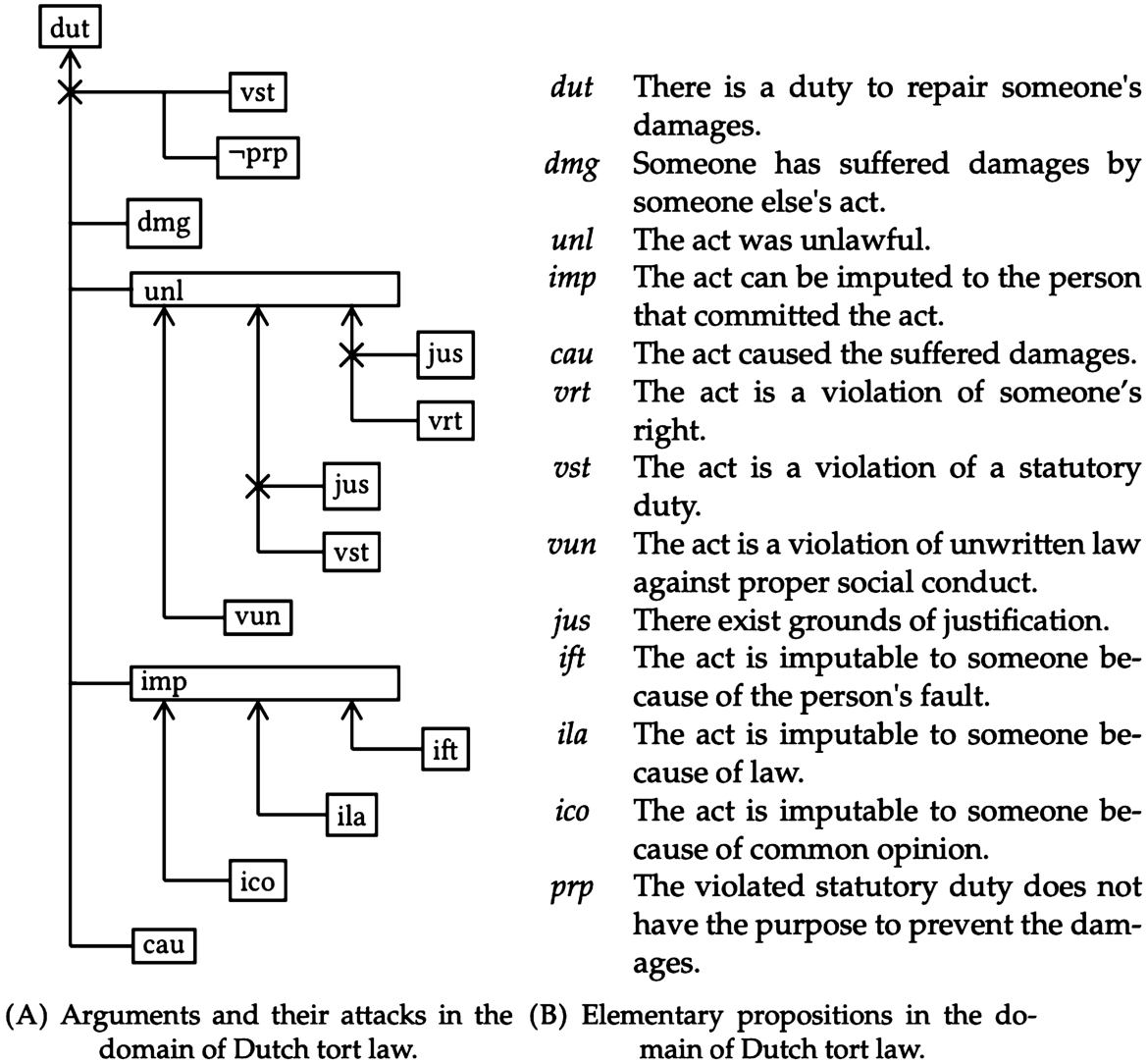
Arguments and attacks (A) and their elementary propositions (B) in Dutch tort law [21].
The tort law domain with its 10 Boolean features captures
To generate a tort law dataset using our code, one must specify two function parameters: the number of instances and the label distribution. By default, datasets of the tort law domain are generated such that dut is true in exactly half of the instances. They are generated by sampling uniformly from all unique cases, such that each possible case is represented equally within the given label distribution. Note that the Tort law domain only contains 1024 unique cases and therefore datasets with more than 1024 instances are guaranteed to contain duplicates.
The datasets described above were used to introduce a method for evaluating and potentially improving the decision-making of machine learning models [19] and to illustrate the utility of the method in a set of experiments [18]. Machine learning models were trained on the datasets and tasked with predicting eligibility in the Welfare benefit domain and a duty to repair damages in the Tort law domain. These trained models were then investigated to examine whether their decision-making matched the knowledge structures that defined the domain. The datasets were also used in follow-up experiments wherein the method for rationale evaluation was compared to explainable AI techniques [20]. These experiments used additional datasets for which further details can be found in the original publications.
Previous use of the Welfare benefit domain
The Welfare benefit domain was introduced in [4] to investigate neural networks in problems of open texture. The aims were to discover whether a neural net could accurately predict the outcome of legal cases represented as feature vectors without any guidance from domain knowledge, and more importantly to see whether it would apply the correct rationale in predicting these outcomes. This meant using a dataset where the rationale was known, and so a dataset was generated from a set of rules. The question was then whether the neural net would correctly discover these rules. The results showed that while performance was good, neither the pensionable age nor the distance conditions were satisfactorily recognised. The relevant features were mostly identified, although two of the irrelevant features were accorded more significance than sex, distance and patient status, reflecting the inability to discover the last two conditions. Following its creation for [4], the dataset was made available to and reused in several subsequent projects.
An experiment to determine whether association rules [1] could be mined from a set of legal cases represented as feature benefits was described in [5]. This exercise used the Welfare benefit dataset from [4]. The algorithm used to mine the rules [9] worked only on Boolean data. Hence the data was pre-processed to assign the numeric features to two or more bins. Where available, the ranges for these bins was determined using domain knowledge, thus age was either less than 60, 60-64, or greater than 64. If the knowledge is not available, a number of arbitrary ranges could be used as in [27]. The pre-processing also stripped out the irrelevant features. Even with the pre-processing, success was only partial. In particular the condition relating to distance and patient status presented difficulties.
[10] describes HeRo, a greedy, best-first, branch-and-bound algorithm designed to induce defeasible logic theories from large datasets, similar to Inductive Logic Programming [16] algorithms designed to produce standard Horn clause theories. The paper included comparisons with other approaches and previous work, including [4], which used the original dataset. The resulting theory was said to achieve a high degree of accuracy, but did not contain any reference to the condition regarding the paid contributions. An interesting feature was that it gave award of benefit as a default, with sufficient conditions for non award, rather than six necessary conditions for award of benefit, as originally stated in [4]. This approach of looking for a reason to withhold benefit rather than determining that all the required conditions are satisfied may well be a better approach.
In Argument Based Machine Learning (ABML) [13,14], a standard rule induction algorithm (CN2 [7]) is augmented with arguments from an expert to explain why misclassified cases fail. In this experiment. like [10], the most problematic condition was the contributions condition. However, after six misclassified cases had been explained, a set of rules giving a very high accuracy was achieved, the only blemish on the rules being a slightly inaccurate threshold for the distance condition. A feature of this work was that it also investigated the effect of some items in the dataset being incorrect – an ever present possibility in the Welfare benefit domain where there is often a high error rate in the actual decisions [24]. The experiments, which modified the dataset by changing the classifiction in a set proportion of cases, showed that ABML is in fact highly robust in the face of incorrect data.
The idea behind Arguing from Experience [24,26] is to mine arguments for and against a classification from a data set, and then to deploy these arguments in a dialogue to refine them and then determine which classification should win. The arguments were based on association rules, and the moves in the dialogue on argument moves in case based reasoning: cite, distinguish and counter example (e.g., [2]). This approach was applied to a variety of classification problems, including the Welfare benefit dataset. It operated both on a single dataset (PADUA [24]) and multiple datasets, to represent discussion between people with different sets of examples (PISA [25]). Strategies for deploying the moves were also proposed and evaluated. The project reported high accuracy and, like [14], high tolerance to a proportion of incorrect information.
[15] addressed the problem of finding explanations for a collection of cases where an explanation is a labelled argumentation graph consistent with the cases, and a case is represented as a statement labelling. The Welfare benefit dataset was used in two experiments to evaluate the approach.
Previous uses of the Tort law domain
In [23], Dutch tort law was used as a case study of the modeling of argumentation in a realistic setting. The study focused on analyzing aspects of informal legal arguments and showing their connections to logical tools.
Dutch tort law was also used as a case study to show the formal connections between arguments, rules, and cases in [21]. The rules of the Dutch tort law domain play the role of knowledge in knowledge-based AI, and cases that of examples in data-driven AI. A case model was developed based on the rule-based arguments and attacks in Dutch tort law, illustrating how statutory, rule-based law can be formalized in terms of cases. The formalization that we use in creating our tort law datasets is based on the arguments and defeating circumstances described in [21].
In [22], the claim is made that we need to study AI as law in order to achieve trustworthy, social, responsible, humane, and ethical AI. It is argued that the solutions proposed in the field of AI & Law, such as argumentation, schemes and norms, rules and cases, have the potential to support the development of good AI in other applications as well. The Dutch tort law domain was used to illustrate the connection between knowledge-based AI and data-driven AI.
Rule-based, case-based and argument-based reasoning are explored in [28]. The relationship between these three major types of modeling legal reasoning are investigated and illustrated using the Dutch tort law domain.
In [6] a dataset was created for US rather than Dutch tort law. Cases from Illinois tort law were translated from natural language into predicate representations with the specific aim to create a domain representation and associated datasets to be used in AI research.
Availability
All of the datasets were artificially generated and can be generated again for future research. Jupyter notebooks that illustrate and explain the data generation process, alongside a few example datasets, can be found in a publicly accessible Github repository.1
