




Abstract
We present an analysis of ethical argumentation and rhetorical elements in an article on the debate about growing genetically modified food (GMF), an issue of current interest in environmental ethics. Ethical argumentation is argumentation that a certain action is permissible, forbidden, or obligatory in terms of ethical intuitions, principles, or theories. Based on analysis of argumentation in the article, we propose several argumentation schemes for descriptive modeling of utilitarian arguments as an alternative to using more general schemes such as practical reasoning and argument from consequences. We also show how the article promoted its pro-GMF stance using rhetorical elements such as quotation, argument from expert opinion, and ad hominem attacks. Pedagogical and computational implications of the analysis of argumentation and rhetoric are discussed.
Keywords
Introduction
Environmental policy debates (e.g., on climate change and genetic engineering) may involve scientific and engineering arguments as well as ethical arguments. By ‘ethical argument’ we mean an argument that a certain action is ethically acceptable (permissible), or not acceptable (forbidden), or obligatory [21] in terms of ethical intuitions, principles, or theories. In this paper we present an analysis of ethical argumentation in “The Truth about Genetically Modified Food: Are Engineered Foods Evil?” (henceforth referred to here as TAGMF) [17],1
Also available at
“Scientific American is the award-winning authoritative source for the science discoveries and technology innovations that matter. With ahead-of-the-curve reporting, Scientific American continues to cover groundbreaking events in science and technology. First published in 1845, Scientific American is the leading source and authority for science, technology information and policy for a general audience.” Quote from
Quote from
Quote from
The field of applied ethics includes biomedical ethics [7] and engineering ethics [20]. Emerging as a newer subfield of applied ethics in the 1970s, environmental ethics is concerned with humanity’s moral relationship to the environment, including the non-human beings and non-living things in it [11]. Early environmental ethicists challenged anthropocentrism, which places greater value on human beings than other creatures or the environment. In the anthropocentric view, nature has only instrumental value, i.e., its value derives from its usefulness to humans “as a means to an end,” while humans have intrinsic value as “ends in themselves”. Various other environmental “isms” have challenged anthropocentrism. For example, biocentrism recognizes the intrinsic value of all living things [9]. Ecocentrism extends intrinsic value from all living things to ecosystems and species as a whole [36].5
We cannot do justice to the history and scope of environmental ethics here. For more information see, e.g., [9,11,24].
General, normative ethical theories relevant to environmental ethics include consequentialism, deontological ethics, and virtue ethics [11]. Consequentialism evaluates the goodness of an action based solely upon its consequences. Utilitarianism is a form of consequentialism that holds that an action is morally right if and only if it maximizes ‘utility’, the balance of good over bad consequences. Classical utilitarianism rejects the intrinsic value of nature, viewing its role solely in terms of its utility to human beings. Deontological theories view the rightness of an action to be dependent upon whether it is in accordance with certain duties or rules, regardless of its consequences. Biocentrism has been justified by arguing that we have a duty to preserve and protect wild living things as ends in themselves, rather than for their instrumental value to humans. In contrast to consequentialism and deontological theories, virtue ethics evaluates the moral character, or virtues (such as honesty and wisdom), of an agent. In environmental ethics, respect for nature has been suggested as a virtue to cultivate [6].
Covered in Section 2, the main contribution of our paper is the definition of some argumentation schemes for the descriptive modeling of utilitarian arguments such as the pro-GMF argument in TAGMF. Although such arguments might be analyzed using more general argumentation schemes, we present reasons for adopting utilitarian schemes. In Section 3, we outline how the debate over GMF is presented in TAGMF by means of rhetorical elements such as quotation, argument from expert opinion, and ad hominem attacks. This rhetorical analysis has implications for the ethical application of state-of-the-art natural language processing techniques. Section 4 describes related computational work in corpus-based and ethical agent-based approaches, and future computational applications of the utilitarian argumentation schemes.
This section presents argumentation schemes for describing the main pro-GMF argument in TAGMF and related utilitarian arguments. The proposal is based on analysis of the article, as well as background reading on the debate about GMF, e.g. [10,37,38,42], and utilitarian arguments on other topics such as the COVID-19 pandemic [33], the obligation to be vaccinated [18], and climate change [12]. Section 2.1 covers the organization of TAGMF. (For more about the presentation of the pro-GMF argument see Section 3.) Sections 2.2 and 2.3 cover the argumentation schemes proposed for modeling the utilitarian argument in TAGMF and some variants. Section 2.4 discusses our proposal compared to past proposals for modeling ethical argumentation and practical reasoning using more general argumentation schemes.
Organization
The format of TAGMF follows guidelines for science feature articles [3]. The opening, or ‘lead’, of TAGMF seems designed to “hook” the reader with this conundrum: “Proponents of genetically modified crops say the technology is the only way to feed a warming, increasingly populous world. Critics say we tamper with nature at our peril. Who is right?” In science feature articles, ‘nutgraphs’ (‘nutshell paragraphs’) following the lead “introduce the underlying problem and tell the reader what they can expect to read about” (p. 116). In TAGMF, the problem is described as continuing opposition to GMF “despite overwhelming evidence that GM crops are safe to eat.” The introduction ends with a suggestion of the resolution to come later in the article: “So who is right: advocates of GM or critics? When we look carefully at the evidence for both sides and weigh the risks and benefits, we find a surprisingly clear path out of this dilemma.” Following the introduction, the article is divided into the following sections. “Benefits and Worries” describes benefits of GMF, and a history of opposition to GMF. “A Clean Record” provides reasons that it is safe to eat GMF and rebuts some objections of critics about safety. “Persistent Doubts” covers further objections of critics. The final section, “A Way Forward”, resolves the question raised in the lead by presenting the author’s suggested compromise.
Modeling the main utilitarian argument in TAGMF and related variants
The mainstream approach to GMF has been characterized as a “fairly straightforward adaptation of utilitarian philosophy” [38, p. 44]. In utilitarianism, “an act is morally right if and only if that act maximizes the good, that is, if and only if the total amount of good for all minus the total amount of bad for all is greater than this net amount for any other incompatible act available to the agent on that occasion” [35]. 6
There are many varieties of utilitarianism. See [35].
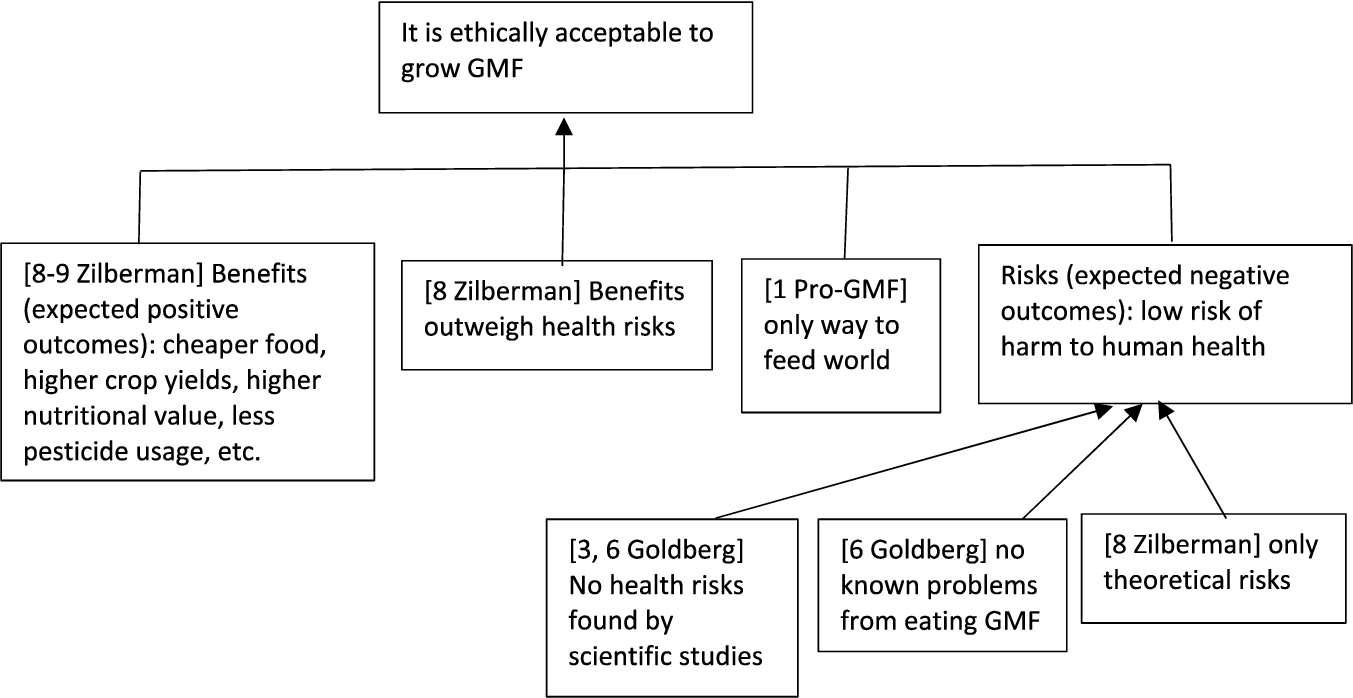
Utilitarian argument in introduction and “Benefits and Worries” section of TAGMF. Paragraph number and attributed source are shown in square brackets. Single-headed arrows represent support.
A model of the author’s utilitarian argument for growing GMF, presented in the introduction and the “Benefits and Worries” sections of TAGMF, is shown in Fig. 1. A number of expected benefits are cited by David Zilberman in paragraphs 8 and 9. He also claims that “the benefits of GM crops greatly outweigh the health risks, which so far remain theoretical.” Further supporting the claim that the risk is low, in paragraphs 3 and 6 Robert Goldberg notes that numerous scientific studies have found no health risks, and in paragraph 6 that people have been eating “billions of meals” containing GMF without any known problems. According to the first sentence in TAGMF, proponents claim that growing GMF is the best of all available actions for feeding the world (e.g., compared to growing non-GMF crops by conventional or organic farming methods). The implicit conclusion of this argument, that it is ethically acceptable to grow GMF, responds negatively to the ethical question posed in the subtitle: “are engineered foods evil?”.
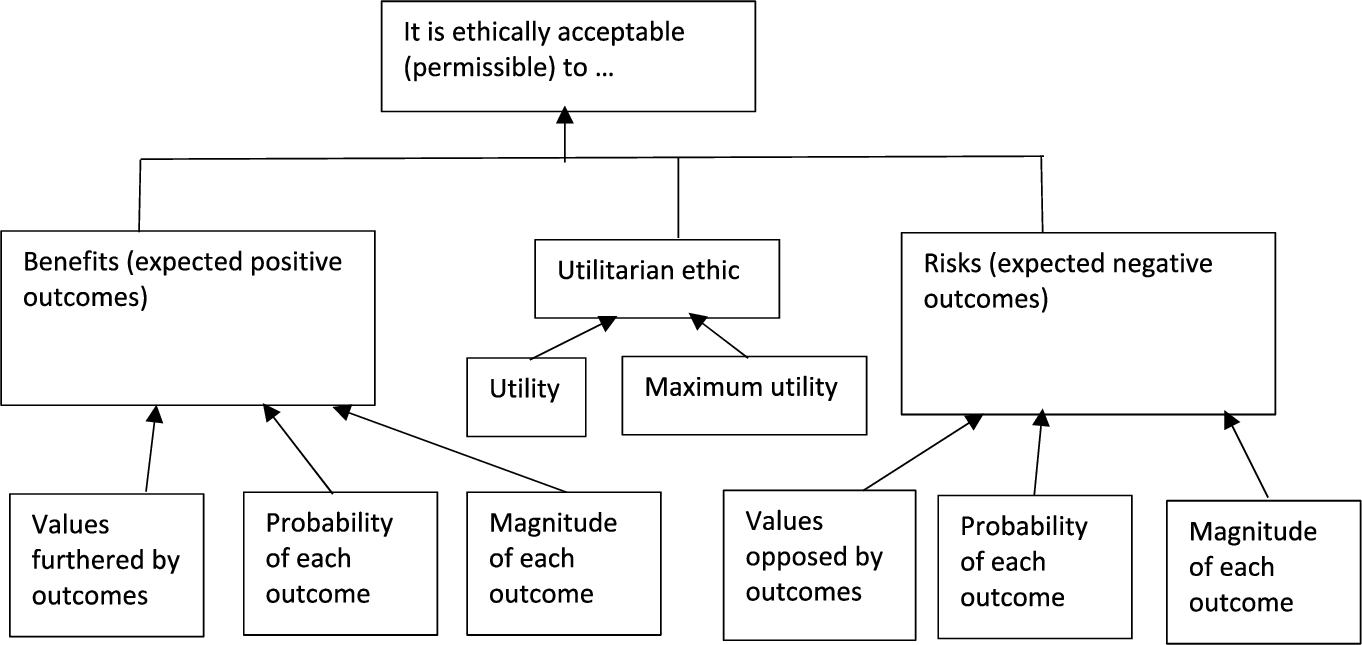
Elements of deconstructed Risk-Benefit argument.
Although the opponents’ objections to GMF presented in TAGMF are mainly concerning the health risks of eating GMF (see Section 3), there are other possible avenues of attack on the above argument. As shown in Fig. 2, benefits or expected positive outcomes can be deconstructed into values furthered by the outcomes, and the magnitude and likelihood of each expected outcome. Values furthered by the benefits cited by Zilberman include human health (by a reduction in starvation and diseases of malnutrition), profitability for farmers (by increasing crop yields), environmental health (by reducing the use of pesticides), etc. Note that opponents of GMF may discount any of these values, or they may disagree with the magnitude or likelihood of an expected outcome. For example, they may disagree about the expected impact of growing GMF on reducing hunger in developing nations [38]. As shown in Fig. 2, risks or expected negative outcomes can be deconstructed similarly.
In Fig. 2, the utilitarian ethic is represented in the Utility and Maximum utility premises. The calculation of utility differs among utilitarian theories. One way of calculating utility involves considering the magnitude of benefit
An argumentation scheme describing utilitarian arguments in general can be summarized as follows, where A is an action such as growing GMF. The Benefits and Risks premises describe expected positive or negative outcomes (states of affairs), respectively. The Utility premise claims that Benefits outweigh Risks (according to whichever utilitarian calculus is presupposed). The Maximum utility premise is that A has the maximum utility among all available actions in the situation.
Risk-Benefit argumentation scheme (permissible version)
Premises:
Benefits: A has certain expected positive outcomes furthering certain values, where each outcome has a magnitude
Risks: A has certain expected negative outcomes opposing certain values, where each outcome has a magnitude
Utility: The Benefits outweigh the Risks (by some calculus).
Maximum utility: A has the maximum utility of all available actions.
Conclusion: It is ethically acceptable (permissible, not prohibited) to do A.
Note that the conclusion, that it is ethically acceptable (permissible) to grow GMF, is not explicitly stated in TAGMF. A stronger version of the conclusion of the argumentation scheme would be that it is obligatory7
As a reviewer noted, a strict utilitarian would argue that the selected action is obligatory. However, it is not clear whether the author of TAGMF is arguing for that strong of a conclusion.
Risk-Benefit argumentation scheme (obligatory version)
Premises:
Benefits: A has certain expected positive outcomes furthering certain values, where each outcome has a magnitude
Risks of doing A: A has certain expected negative outcomes opposing certain values, where each outcome has a magnitude
Risks of not doing A: Not doing A (i.e., doing another available action, including not acting) has certain expected negative outcomes opposing certain values, where each outcome has a magnitude
Utility: The Benefits of doing A and Risks of not doing A outweigh the Risks of doing A (by some calculus).
Maximum utility: A has the maximum utility of all available actions.
Conclusion: It is obligatory (ethically required) to do A.
Another possible variant of the Risk-Benefit argumentation scheme, having the conclusion that it is not ethically acceptable (is forbidden) to do A, could be defined by the following “negative version”. The scheme forbids an action whose risks outweigh the benefits as long as there is an available action that has a higher utility (i.e., there is a “lesser evil” than A).
Risk-Benefit argumentation scheme (negative version)
Premises:
Benefits: A has certain expected positive outcomes furthering certain values, where each outcome has a magnitude
Risks: A has certain expected negative outcomes opposing certain values, where each outcome has a magnitude
Utility: The Risks outweigh the Benefits (by some calculus).
Higher utility: There is some available action with a higher utility than A has.
Conclusion: It is not ethically acceptable (is forbidden) to do A.
Some objections to growing GMF raised in TAGMF can be described by means of the following proposed critical questions of the permissible and obligatory Risk-Benefit schemes:
Equity/justice: Is there a fair distribution of risks and benefits to all who might be affected by the action? The claim that the distribution of risks and benefits in utilitarianism is not fair is a common criticism [7,20]. A related criticism of GMF specifically is that, despite the potential benefits to most of the population, certain GMFs may contain proteins that cause adverse allergic reactions in some persons [38].
Informed consent/autonomy: Has everyone who might be affected by the action given informed consent? This is another common criticism of utilitarianism [7,20]. As for GMF specifically, opponents have sought mandatory labeling so that consumers can make informed choices [38].
Horrific consequences: Is there some potential harm of the action such that
In addition, the following critical questions of practical reasoning and argument from consequences [28], rephrased for consistency with our Risk-Benefit schemes, are applicable.8
For further discussion on these schemes, see Section 2.4.
Critical questions of Risk-Benefit from practical reasoning and argument from consequences:
Feasibility: Is A feasible to do? In TAGMF, resistance to GMF is cited as a problem that may block the future development and distribution of GMF.
What evidence supports the claim that the cited (positive/negative) expected outcomes will occur? In TAGMF, much of the debate that is presented concerns the lack of evidence for negative consequences of growing GMF.
What is the evidence for the risks? Does tight coupling/complex interaction raise the risk of unexpected negative outcomes? In engineering, [20, p. 134] these are characteristics of high-risk technologies such as in nuclear reactors, where processes “are connected in such a way that one process is known to affect another,” there is “little likelihood of confining a failure to one part of the system” and “parts of the system can interact in unanticipated ways.” In TAGMF, critics raise this sort of objection: “changing a single gene [could have] unexpected ripple effects” and “the kinds of alterations caused by the insertion of genes from other species might be more impactful, more complex or more subtle than those caused by conventional breeding.”
In the introduction to TAGMF, continuing opposition to GMF is cited as a problem that will be resolved in the article: “When we look carefully at the evidence for both sides and weigh the risks and benefits, we find a surprisingly clear path out of this dilemma.” The last section of TAGMF, “A Way Forward,” begins, “There is a middle ground in this debate. Many moderate voices call for continuing the distribution of GM foods while maintaining or even stepping up safety testing on new GM crops
An argumentation scheme for this argument can be defined by the following Risk-Benefit-Compromise scheme. This scheme is unusual in that it presupposes another argument, a Risk-Benefit argument for another action A (growing GMF), where A is infeasible; and supports an alternative, compromise action C (growing GMF with added testing etc.). Presumably, C has (most of) the same benefits of A while mitigating the risks of A, and is more feasible than A by addressing some of the concerns of the opponents of A. Like A, C is subject to the Maximum utility constraint of utilitarian ethics.
Risk-Benefit-Compromise argumentation scheme
Premises:
Compromise: Given a Risk-Benefit argument for action A that is infeasible, C is a member of the set of alternative available actions (Compromises) that are expected to achieve a significant amount of the benefits of A, mitigate the risks of A, and are more feasible than A,
Benefits: C has certain expected positive outcomes furthering certain values, where each outcome has a magnitude
Risks: C has certain expected negative outcomes opposing certain values, where each outcome has a magnitude
Utility: The Benefits of C outweigh the Risks of C (by some calculus),
Maximum utility: C has the maximum utility of the set of Compromises.
Conclusion: It is ethically acceptable to do C.
The anti-utilitarian critical questions of the Risk-Benefit argumentation scheme apply to C. One could still question the fair distribution of risks and benefits to all who might be affected by C and whether they have given informed consent. Or one might raise the question of horrific consequences of C. Also, the feasibility critical question is raised in TAGMF for C. The article mentions the possibility that some GM proponents may not be willing to accept the compromise since “Stepped-up testing would place a burden on GM researchers, and it could slow down the introduction of new crops.” On the other hand, the author claims that the compromise is acceptable to “many moderate voices,” and that even the anti-GM critic Schubert finds it acceptable.
Role of ethics in argumentation theory
Argumentation theorists have modeled ethical argumentation using general schemes that do not themselves specify particular ethical approaches.
Walton [39] proposed a layered model for evaluating ethical argumentation in biomedical ethics case studies.9
The case studies represent a different genre than TAGMF. They are relatively short and are intended, according to Walton, to stimulate ethical reflection.
Fairclough and Fairclough [16] modeled political deliberation in terms of practical reasoning and argument from negative consequences. They proposed adding a Circumstances premise to practical reasoning, where the premise could include moral values or norms constraining the agent.
More recently, Macagno and Walton [28] proposed that deliberative argumentation could be modeled using a structure of argumentation schemes. At the top level, an action is justified using practical reasoning, argument from consequences, and/or argument from rules. The conclusion of each of these schemes is that the agent should bring about a certain action, where ‘should’ is intended in the prudential sense as in [39]. At the second level [28], “the evaluation of the distinct alternatives (in case of practical reasoning) and the consequences of an action are represented” using two argumentation schemes: argument from consequences to an evaluation (“a variant of argument from consequences whose outcome is a judgment on the desirability of the concerned action” and argument from values. At the deepest level, an argument from classification can be used when “a state of affairs needs to be classified in a certain fashion in order to become a premise in an argument from rules, from consequences, or from values.” A structure built from these argumentation schemes can be used to model a complex argument, making its presuppositions and implicit premises available for questioning. This approach was illustrated by analyzing two foreign policy arguments.
So, does the modeling of utilitarian arguments require argumentation schemes like those proposed in the preceding sections? We would argue that there are several pedagogical and computational reasons for adopting them. Utilitarian arguments are a recurrent, recognizable type of argument. Although it might be possible to model them using a combination of general schemes, various utilitarian-specific features would have to be supplied by the human analyst/student or computer application. The schemes that we have proposed explicitly represent the intended sense of ‘should’ (permissible, obligatory, or forbidden) and have premises tailored to the intended sense. Also, we have identified several critical questions tailored to utilitarianism.
The general schemes do not capture these features explicitly. To illustrate how one might propose to model ethical arguments for and against growing GMF using practical reasoning (PR) and argument from negative consequences, consider Fig. 3. The PR argument on the left is based on the models of PR in [16] and [28]. The goal, elimination of all human hunger, furthers the value of human health. Growing GMF is the means to the goal (the Means-end premise in [16] or the alternatives and selection premises in the instrumental practical reasoning with necessary conditions scheme in [28]). The Circumstances premise stipulates the moral obligation to prevent suffering (hunger, death, etc.). (As shown in Fig. 3, support could be added for this premise, e.g., the biomedical principle of nonmaleficence [7].) However, the conclusion does not specify the intended the moral sense (obligatory or permissible) of ‘should’.
An argument from (negative) consequences [28] is shown on the right in Fig. 3. In the phrasing of that scheme, “if an agent A brings about B [the growing of GMF], then C [loss of biodiversity] will occur. C is a bad outcome (from the point of view of A’s goals), and bad outcomes should [be] avoided by not bringing about their causes. Therefore, B should not (practically speaking) be brought about.” (As shown in the figure, support could be added for the claim that loss of biodiversity is bad; it is bad according to environmental ethics theories such as ecocentrism and biocentrism [6].) However, the conclusion does not specify the intended moral sense (not permissible) of ‘should’.
In addition to failing to specify the intended moral sense of ‘should’, this approach fails to take the magnitude and probability of consequences explicitly into account. Furthermore, treating each expected positive outcome (goal in PR) and set of negative consequences (in argument from consequences) separately, it fails to represent the aggregate utility of all expected positive outcomes versus expected negative outcomes.
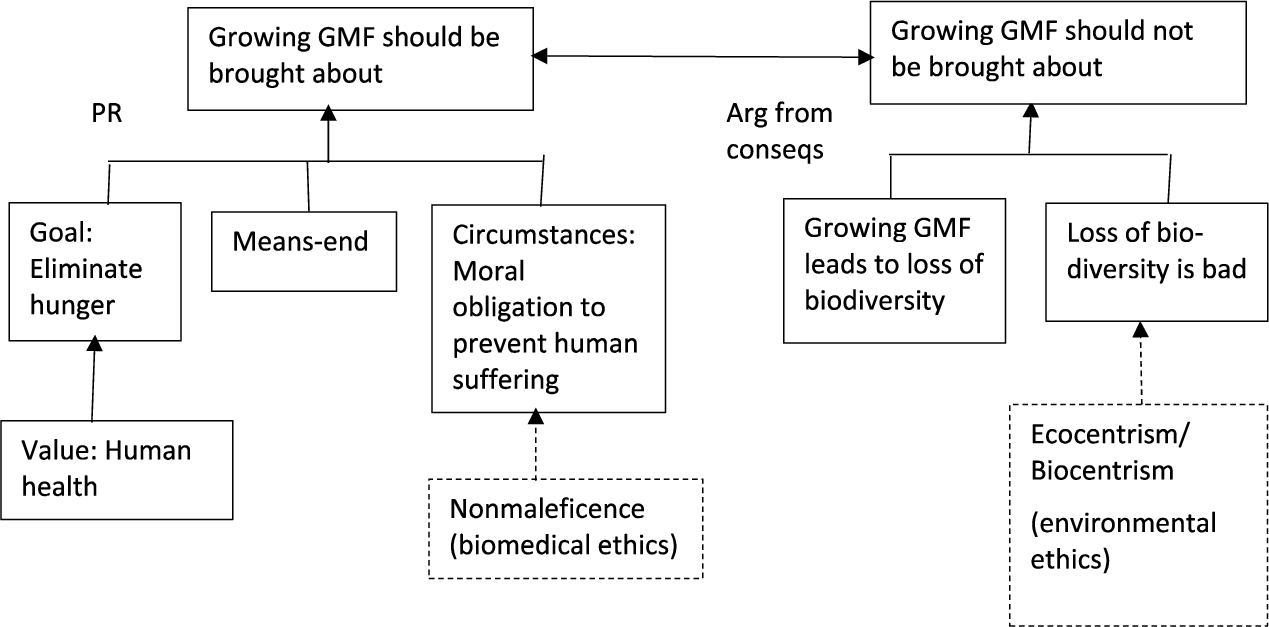
An argument for growing GMF analyzed as practical reasoning is shown on the left. An argument against growing GMF analyzed as argument from negative consequences is shown on the right. Support from ethical principles (not part of the PR and argument from consequences argumentation schemes) is shown in the dashed boxes.
Note that the analysis in Fig. 3 suggests that it may be useful for pedagogical or computational purposes to define moral variants of argument from consequences and practical reasoning also. For instance in a moral variant of the argument from negative consequences, the conclusion could specify that the action is forbidden, and the negative consequence premise could specify that the negative consequence is bad from an ethical point of view (e.g., biocentrism). Similarly, in a variant of practical reasoning the conclusion could be modified to explicitly specify that the action is ethically acceptable, and an explicit premise could specify the moral circumstances. Then, for example, one could represent an argument that it is ethically acceptable to grow GMF, where the goal is to increase agribusiness profit and the moral circumstances are that it is ethically acceptable to increase such profits, according to a moral perspective such as libertarianism.
In this section, we examine rhetorical elements in TAGMF, and show how they support the writer’s pro-GMF stance. It is important to consider such elements in teaching students to analyze argumentation, as well as when designing strategies for computer applications that process natural language arguments. (However, readers who are not interested in rhetoric may wish to skip this section.)
Quotation, argument from expert opinion, and ad hominem arguments
One prominent feature of TAGMF is the use of direct and indirect quotation, which serves several purposes. In guidelines for writing science features [3], Angler recommends use of colorful quotations and “cinematic” descriptions in the lead. In paragraph 2 of TAGMF, the proponent Goldberg is portrayed sympathetically: “Robert Goldberg sags into his desk chair and gestures at the air. ‘Frankenstein monsters, things crawling out of the lab,’ he says.” The lead continues with the author’s tongue-in-cheek observation that Goldberg “is not battling psychosis. He is expressing despair at the relentless need to confront what he sees as bogus fears over the health risks of genetically modified (GM) crops.” Although the lead continues with quotations from a GM critic, David Williams, they lack the humor, visual description, and sympathetic portrayal given with the Goldberg quotes.
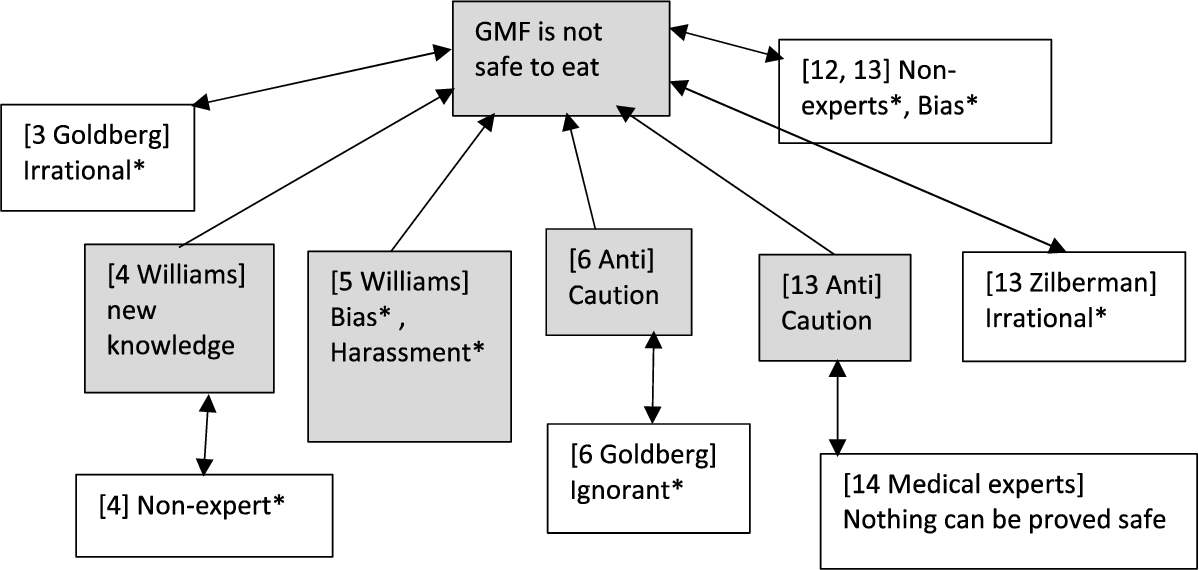
Arguments in introduction and “Benefits and Worries” section of TAGMF against the safety of GMF. Paragraph number and attributed source are shown in square brackets. Anti-GMF claims are shaded. Single-headed arrows represent support. Double-headed arrows represent conflicting views. Ad hominem attacks are indicated by asterisks.
Another use of quotation is to support a claim, i.e., to make an argument from expert opinion [40]. In that type of argument, a claim is deemed plausibly true if an expert asserts that it is true. One critical question of the scheme is whether the person making the claim is a credible expert in the domain of the claim. As shown in Fig. 1, Zilberman (“an agricultural and environmental economist
The Consistency critical question, whether the expert’s claim is consistent with what other experts say, is addressed in the “A Clean Record” section of TAGMF (paragraph 21), which lists support from scientific organizations and academic review studies.
A third, frequent use of quotation in TAGMF is in the attribution of an ad hominem attack, which is a way of disputing a claim by disparaging the character of the agent making the claim [40]. As shown in Fig. 4, Goldberg (paragraph 3) disparages GMF opponents as irrational (holding “bogus fears”). In paragraph 5, Williams claims that research on health risks of GMF has been discouraged due to harassment by GMF supporters and pro-GMF bias in research funding, i.e., the reason that so much research has supported GMF could be due to the suppression of research with the potential to oppose it.11
Another critical question of argument from expert opinion, Trustworthiness, is whether the expert is reliable as source, e.g., unbiased.
Individuals quoted directly or indirectly in article
Attributing an ad hominem attack to an expert may add legitimacy to the attack and distance a writer from responsibility for it. However, the author of TAGMF also makes ad hominem attacks. As shown in Fig. 4, in paragraph 12 the author lists environmental activists and celebrities (“Greenpeace, the Sierra Club, Ralph Nader, Prince Charles and a number of celebrity chefs”), i.e., non-experts, who have publicly opposed GMFs. In paragraph 13, the author cites European bias (“resentment of American agri-business”), and Zilberman cites irrationality (“they
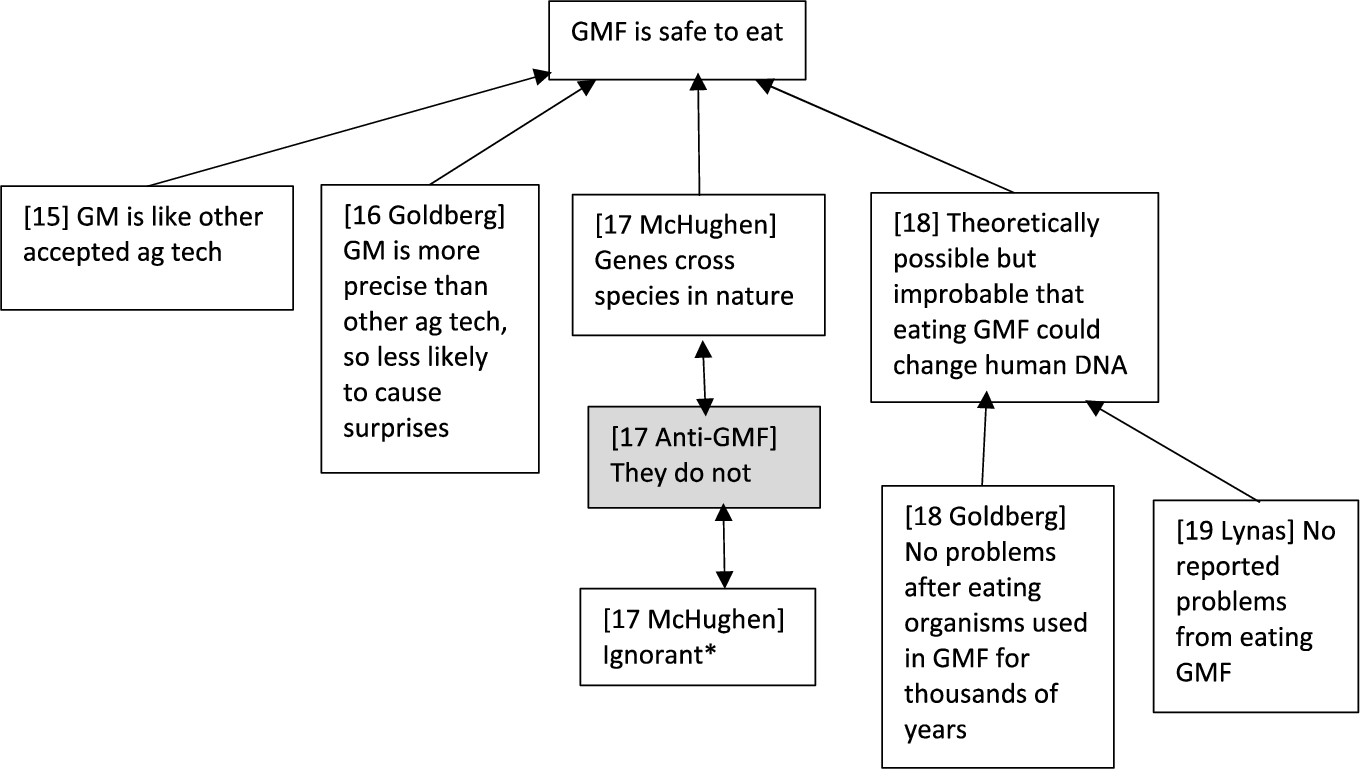
Arguments for safety of GMFs in first five paragraphs of “A Clean Record” section of TAGMF. Paragraph number and attributed source are shown in square brackets. Anti-GMF claims are shaded. Single-headed arrows represent support. Double-headed arrows represent conflicting views. Ad hominem attacks are indicated by asterisks.
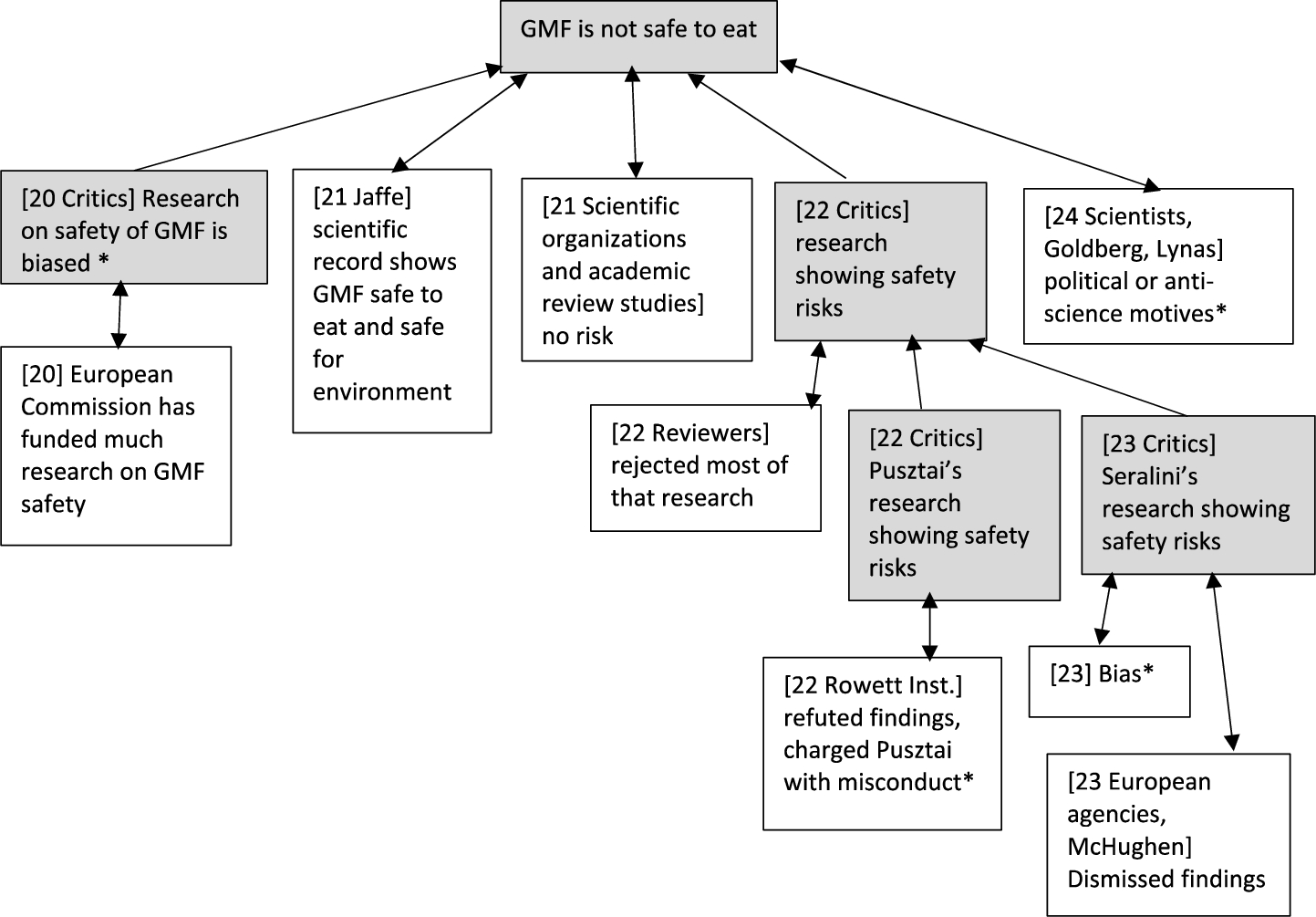
Arguments against safety of GMFs in last five paragraphs of “A Clean Record” section of TAGMF. Paragraph number and attributed source are shown in square brackets. Anti-GMF claims are shaded. Single-headed arrows represent support. Double-headed arrows represent conflicting views. Ad hominem attacks are indicated by asterisks.
The frequent use of argument from expert opinion and ad hominem attack continues in the next two sections: “A Clean Record” and “Persistent Doubts” (Figs 5–7.)
As shown in Fig. 5, the first five paragraphs of “A Clean Record” argue that GMF is safe to eat. One reason given is that other agricultural technologies that alter plant genomes have been in use without objections or known problems (paragraph 15). In paragraph 16, Goldberg suggests that GM technology might be safer since it manipulates fewer genes. Another expert, Alan McHughen (“a plant molecular geneticist”), objects to “GM critics [who] say that genes don’t cross the species barrier in nature, that’s just simple ignorance” (paragraph 17). In paragraph 18, the author gives some reasons that it is unlikely that eating GMF could change human DNA. The claim is further supported by Goldberg “We’ve been eating this stuff [plants with altered genes] for thousands of years [without ill effect]” (paragraph 18), and Mark Lynas (“a prominent anti-GM activist who last year publicly switched to strongly supporting the technology”), who points out that there have been no reported ill effects of eating GM foods (paragraph 19).
As shown in Fig. 6, in the last five paragraphs of “A Clean Record”, some anti-GM arguments against the safety of GM foods are dealt with. In paragraph 20, it is reported that “critics often disparage U.S. research on the safety of genetically modified foods, which is often funded or even conducted by GM companies
Paragraph 22 opens with a seeming concession to GM critics that ends in a refutation of their position: “Opponents of genetically modified foods point to a handful of possible safety problems. But reviewers have dismantled almost all of those reports.” (Note that if “almost all” of a “handful” have been “dismantled,” there must be few remaining credible reports.) To illustrate some research that was discredited, a study by Pusztai is described in paragraph 22 as “so sloppy that [Pusztai’s institution] refuted the findings and charged Pusztai with misconduct.”
In another example, Séralini is described in paragraph 23 as potentially biased having “long been an anti-GM campaigner.” His research findings of safety risks were rejected by the European Food Safety Authority and “several other European agencies.” McHughen adds, “Séralini has been refuted by everyone who has cared to comment.” The last paragraph of the section ends in ad hominem attacks: objections to GM safety are claimed by Goldberg and other scientists to arise from political or ideological motives, and Lynas is noted as “labeling the anti-GM crowd ‘explicitly an antiscience movement’.”
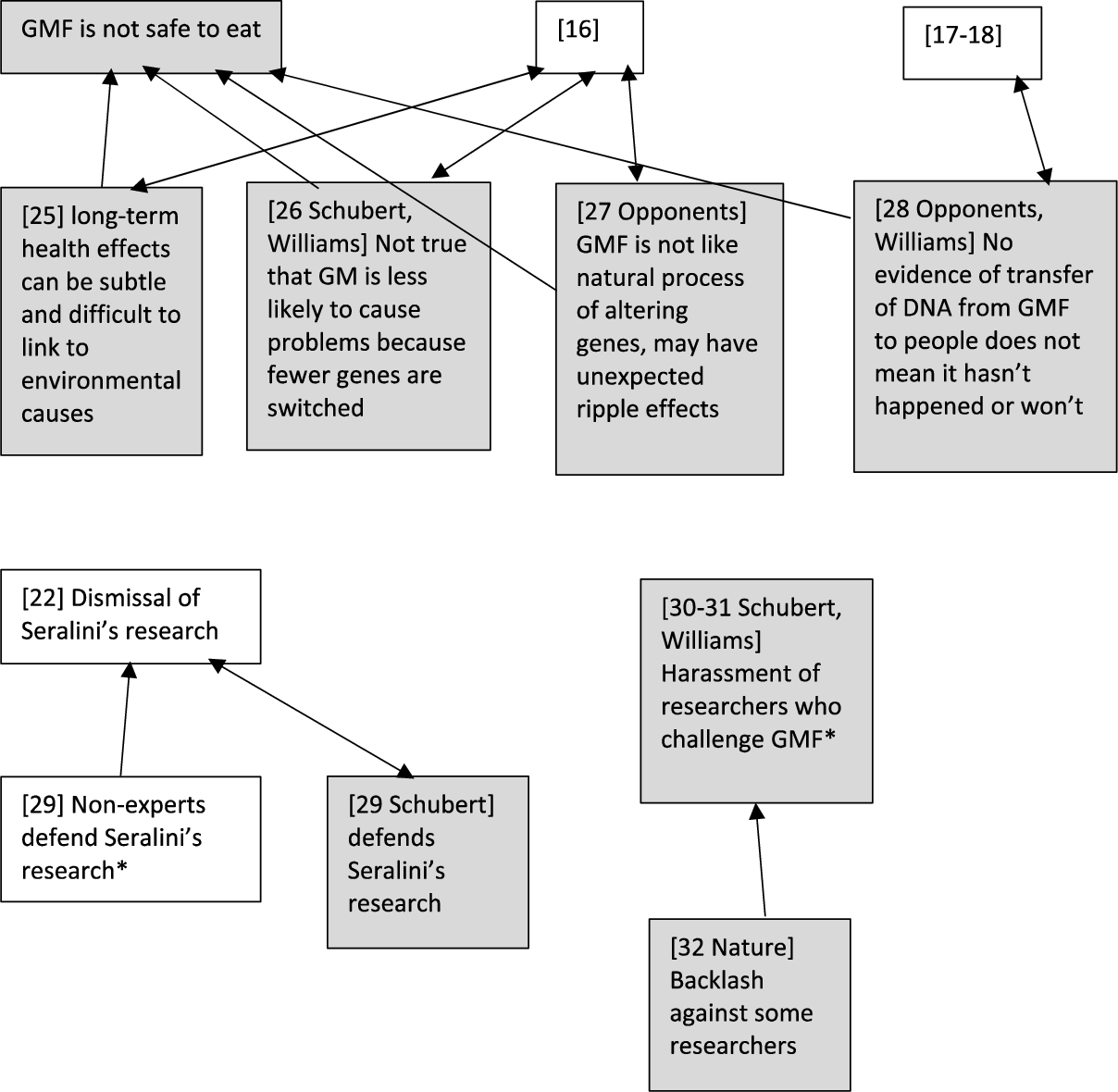
Arguments in “Persistent Doubts” section of TAGMF. (Paragraphs 16–18 and 22 refer to claims in previous section which are challenged in this section.) Paragraph number and attributed source are shown in square brackets. Anti-GMF claims are shaded. Single-headed arrows represent support. Double-headed arrows represent conflicting views. Ad hominem attacks are indicated by asterisks.
As shown in Fig. 7, the next section of the article, “Persistent Doubts”, presents some objections of the anti-GM side to claims given in previous sections of the article. Paragraphs 25–27 provide objections to paragraph 16 of the previous section, citing Williams and David Schubert (an Alzheimer’s researcher). Paragraph 28, again citing Williams, responds to pro-GM claims in paragraphs 17–18. In paragraph 29, the author concedes that there has been some harassment of anti-GM critics by pro-GM scientists and that “even Séralini has his defenders” (paragraph 29). However, challenging the defenders’ expertise, the author characterizes “most of them” as “nonscientists, or retired researchers from obscure institutions, or nonbiologist scientists.” Nevertheless, a defense by Schubert of Séralini’s research methods is presented. The section ends with three paragraphs (30–32) on bias in pro-GM research and the harassment of anti-GM researchers attested by Williams, Schubert, and an article in the journal Nature.
In summary, Figs 4–7 show that the article presents a contentious debate on the safety of eating GM foods. Claims are supported by attribution to experts (argument from expert opinion), but some claims are discredited by attribution to less qualified individuals. Most of the quoted experts are pro-GM (as shown in Table 1). The anti-GM side accuses the pro-GM side of bias and harassment throughout the article. However, most of the ad hominem attacks in the article come from the pro-GM side (including the author) and are used to discredit anti-GM researchers.
In media studies [31], a ‘frame’ is defined as a way of presenting a complex issue that highlights certain of its aspects. The persuasiveness of an argument depends on how well its frame matches the values of the target audience. Nisbet identified these frames in science policy debates on climate change and biotechnology: social progress (“a means of improving quality of life or solving problems”), economic development and competitiveness, morality and ethics, scientific and technical uncertainty (“a matter of expert understanding or consensus; a debate over what is known versus unknown; or peer-reviewed, confirmed knowledge versus hype or alarmism”), Pandora’s box/Frankenstein’s monster/runaway science (“a need for precaution or action in face of possible catastrophe”), public accountability and governance, middle way/alternative path (“a third way between conflicting or polarized views of options”), and conflict and strategy (p. 18).
Frames are evoked by ‘frame devices’, e.g., certain catch phrases and metaphors. For example, “creating green jobs” has been used to evoke the economic development frame in discussions of climate change [22]. In TAGMF the Pandora’s box frame is evoked by certain phrases (e.g., “tamper with nature at our peril”, “Frankenstein monsters”) to characterize (or mock?) views of GM critics. The social progress frame is evoked in “Benefits and Risks.” In the final paragraph of the introduction, the two major frames of the article are evoked: “When we look carefully at the evidence for both sides and weigh the risk and benefits [scientific and technical uncertainty frame], we find a surprisingly clear path out of this dilemma [middle way/alternative path frame].”
According to Kaplan [23], the scientific narrative or frame common in the environmental ethics literature in the U.S. “is based on the presumption that methodological precision and empirical evidence are the only ways to secure not only objectivity but also reasoned consensus about human actions on the environment. The main actors are the scientists themselves
Lastly, another important rhetorical element in TAGMF is word choice [15]. Use of humorous sarcasm (“not battling psychosis”), exaggeration not to be taken literally (“hundreds of millions of genetic experiments”), and slang (“bogus”, “creepy”) is designed to be entertaining. Also, use of value-laden words (‘evil’ and ‘truth’) in the title of TAGMF seems to mock ethical concerns of certain opponents of GMF. Although the question of ‘evil’ is not explicitly addressed further in the article, the utilitarian argument in TAGMF, that it is ethically acceptable to grow GMF, provides a negative response to the question, is GMF evil?
Discussion
The rhetorical elements in TAGMF play an important role in promoting the author’s pro-GMF stance. However, they present some challenges for summarization of the debate, whether by students or computer applications. The first challenge is to recognize certain rhetorical devices, such as use of sarcasm, exaggeration, and slang, which may be acceptable in a science feature article but not in serious science communication. Nevertheless, this challenge may not be insurmountable; students and computers [22] may be trained to recognize these devices.
The second challenge is the lack of balance in appeals to expert opinion, as GMF proponents are quoted more often and more of them are quoted than GMF critics. Note that the lack of balance may be appropriate on some topics. According to science communication recommendations, “it can be confusing – or even misleading – for the public if each side is given equal weight just to make a story appear ‘balanced.”’ Instead, journalists should report if “there is a consensus view among leading researchers or mainstream professional scientific organizations,” and “do some value-added consideration of who has the stronger case for the question at hand” [32, p. 29]. While students may be guided by their human teachers as to when a lack of balance is appropriate, how should a computer application handle this issue?
Another challenge is the frequent use of ad hominem attacks against the anti-GM side. Martini [29, p. 163] contends that ad hominem arguments to rebut false claims in “pseudo-scientific controversies” [such as the anti-vaccination movement are] “legitimate insofar as they do not attempt to prove the point of the matter (e.g., vaccinations are safe), but are meant to bring focus to the circumstances of the utterance – i.e. the utterer is not a legitimate expert, or the utterer is not interested in facts but in advocacy.” Once again, students may be guided by their teachers. However, how can a computer application determine when ad hominem attacks in a text are justified?
These rhetorical challenges should be kept in mind by those who would use current technology to construct ethical arguments without human intervention. Suppose a chatbot is asked, is it ethically acceptable to grow GMF? The chatbot might base its response on an article that quotes only biased pro-GMF scientists and that refutes anti-GMF claims with unfair ad hominem attacks. Without understanding the unfairness of the argument used as the basis for its response, the chatbot’s constructed argument would be an “unethical ethical” argument, i.e., an unethical deployment of technology.
Related computational work
Corpus-based approaches
Several corpus studies of science journalism have addressed areas related to our analysis of TAGMF. August et al. [5] created a corpus of university press releases, science blogs, and science magazines. Sentences in the corpus were annotated with one of the following science writing strategies: lede, main (findings), impact (of findings), explanation (of scientific topic, word, methods, etc.), analogy, story, personal (details about researchers), jargon, active (voice), passive (voice). The corpus is being used by August et al. to develop machine learning (ML) classifiers to recognize writing strategies. Another corpus, consisting of New York Times science articles, was annotated for level of writing quality in order to develop ML models for predicting quality [27]. Choi et al. [14] created a corpus of 200-word, pro- and anti-GM articles from websites in order to study whether hedge detection could be used to recognize scientific framing.
Kobbe et al. suggested that automatic identification of moral beliefs or values could aid in argument mining: “Being able to distinguish between arguments with similar stance and sentiment but framed according to different moral categories can help to identify new arguments and can improve camp detection” [25, p. 30]. In order to develop ML classifiers to predict “moral sentiment,” they added annotations for moral values derived from Moral Foundations Theory to a corpus of on-line debates on non-science topics previously annotated for argument quality. Moral Foundations Theory classifies moral beliefs along dimensions of Care-Harm, Fairness-Cheating, Loyalty-Betrayal, Authority-Subversion, and Purity-Degradation. Card et al. [13] created a corpus of news articles on policy issues (immigration, smoking, and same-sex marriage) annotated with 15 issue-independent framing dimensions such as Economic, Morality, and Quality of Life.
Ethical agent approaches
While the goal of the corpus studies in Section 4.1 was to apply ML to natural language texts to recognize certain features of scientific writing or of argumentation, another field of research related to ethical argumentation is implementation of artificial agents. An explicit ethical agent is an artificial agent that reasons about the ethical acceptability of its action using an explicit representation of ethical principles [30]. It is desirable to develop explicit ethical agents since an autonomous agent may encounter situations requiring ethical decision making that were not anticipated by the agent’s creators. Moreover, it is possible to examine the ethical justification for an explicit ethical agent’s actions [1,34].
In a “bottom-up” approach [43] to building an ethical agent, its actions are governed by encoded ethical principles, whereas in a “top-down” approach, ethical principles are derived by learning from previous or hypothetical cases. For example, Arkin [4] has implemented autonomous agents for military applications by encoding military principles such as the Laws of War and Rules of Engagement, which are based on Just War Theory [41], as constraints on the agent’s proposed actions. In the domain of healthcare, Anderson et al. [2] have implemented explicit ethical agents such as EthEl, a medication-reminding robot. The agents implement the following prima facie duties of biomedical ethics [7]: beneficence (e.g., promoting a patient’s welfare), nonmaleficence (e.g., intentionally avoiding causing harm), justice (e.g., healthcare equity), and respect for the patient’s autonomy (e.g., freedom from interference by others). Since prima facie duties may conflict in certain situations, they created a process for training their system using inductive logic programming to derive rules that generalize the decisions of medical ethicists on training cases.
While the above could be described as deontological approaches, Bench-Capon has proposed a virtue ethics approach based on an implementation of an argumentation scheme for value-based practical reasoning (VBPR) [8]. In that approach, actions are generated using the VBPR argumentation scheme. Next, counter arguments are generated using the critical questions of the VBPR scheme. After removal of successfully attacked arguments, the remaining actions are evaluated using the agent’s hierarchy of values.
Computational applications of this work
The specification of argumentation schemes, as in [40], has been very influential in computational approaches to argumentation. The schemes described in our paper add to those schemes in a way that is necessary for computational applications in ethical argumentation.
Although our main purpose in defining utilitarian argumentation schemes was to provide theoretical tools for analyzing natural language texts, not to generate ethical actions in autonomous agents, our proposal has more in common with the modeling of ethical agents than with the ML approaches to natural language processing (NLP) in Section 4.1. Nevertheless, there are some possible future NLP applications of the utilitarian schemes. First, they may be useful in generating natural language explanations of a utilitarian agent’s decision-making. Second, they may play a role in natural language interpretation of arguments by computer applications. For example, frame devices in a text such as “weigh the risks and benefits” could trigger an attempt to fill in a utilitarian argument template (based on the proposed utilitarian argumentation schemes) with propositions conveyed in the text. Similarly, critical questions could function as templates for identifying challenges in the text. Note that since the schemes distinguish between the different moral senses of ‘should’, the schemes provide a means for inferring the intended sense even when it is not explicitly provided in the text. Although proposition-level interpretation of text is beyond the current state of the art in NLP, that may not always be the case. Furthermore, the templates could be applied to existing corpora whose propositions have been created by human analysts, such as AIFdb [26].
Another computational application of the utilitarian argumentation schemes is for use in educational systems that provide tools for students to critically analyze arguments. Previously, in a prototype educational system, AIED [19], we provided ethical argumentation schemes and their critical questions for healthcare and military agents based upon the deontological approaches described in Section 4.2. In future work, we would like to revisit those schemes in light of the utilitarian argumentation modeled in the present work.
Conclusion
We have presented an analysis of argumentation in a science feature article on the debate about genetically modified food, as an entry point to the descriptive modeling of environmental ethics argumentation. Based on the analysis, we proposed several utilitarian argumentation schemes as an alternative to more general schemes such as practical reasoning and argument from consequences. The schemes specify aspects of utilitarianism that are not explicitly represented in the more general schemes: the intended moral sense of ‘should’ and premises and critical questions tailored to the intended sense, as well as certain elements implicit in the calculation of utility. Utilitarian arguments are a recurrent, recognizable type of ethical arguments. Making their elements explicit may be beneficial to students learning to analyze environmental ethics arguments, as well as to future NLP applications that search for and/or summarize ethical arguments. We also showed, in detail, how the article promoted its pro-GMF stance using rhetorical elements such as quotation, argument from expert opinion, and ad hominem attacks. It is important to consider such elements in teaching students to analyze argumentation, as well as in designing NLP applications.
Footnotes
Acknowledgements
I thank the Argument and Computation reviewers for many helpful critiques and suggestions.