




Abstract
Deontological ethics views the morality of an action based upon its accordance with duty or rights, regardless of its consequences. In previous work, we presented some argumentation schemes for descriptive modeling of utilitarian ethical arguments. The premises of those schemes refer to utilitarian concepts such as maximum utility. Here we extend that approach by proposing some argumentation schemes for analysis of arguments based on deontological ethics. The premises refer to deontological concepts of duty, rights, and justice. The conclusions specify whether an action is morally required, forbidden, or permitted. The critical questions are based upon common challenges to deontological ethics. These schemes provide semantic templates for recognizing implicit or explicit premises and conclusions of deontological arguments. Our approach to ethical argumentation is an alternative to current approaches using argumentation schemes of practical reasoning (reasoning about what to do). In addition to proposing novel argumentation schemes, in this paper we examine ethical argumentation in “Letter from a Birmingham Jail.” The analysis shows that deontological argumentation schemes as well as ethical variants of some “standard” schemes and rhetorical devices play a major role.
Keywords
Introduction
The following excerpt contains ethical argumentation based upon concepts of moral responsibility, just laws, and morally right action 1 :
One may well ask: “How can you advocate breaking some laws and obeying others?” The answer lies in the fact that there are two types of laws: just and unjust. I would be the first to advocate obeying just laws. One has not only a legal but a moral responsibility to obey just laws. Conversely, one has a moral responsibility to disobey unjust laws. … All segregation statutes are unjust because segregation distorts the soul and damages the personality. … Thus it is that I can urge men to obey the 1954 decision of the Supreme Court, for it is morally right; and I can urge them to disobey segregation ordinances, for they are morally wrong.
Deontological ethics views the morality of an action based upon its accordance with duty or rights, regardless of its consequences.2–4 “Deontology is commonly used in moral philosophy to refer to nonconsequentialist moral conceptions. The most distinctive feature of deontological moral conceptions is that they define fundamental principles of right and justice in terms other than taking the most effective means to promote maximum good.” 3 Deontology is a moral theory about which actions are morally required, forbidden, or permitted. 2
Utilitarianism, a consequentialist ethical theory, is an alternative to deontological ethics. 5 In Green, 6 we presented some argumentation schemes for descriptive modeling of utilitarian arguments. The premises of the schemes refer to utilitarian concepts such as maximum utility. Here we extend that approach by proposing some argumentation schemes for analysis of arguments based upon deontological ethics. The premises refer to deontological concepts of duty, rights, and justice. The conclusions specify whether an action is morally required, forbidden, or permitted. The critical questions (CQs) are based upon common challenges to deontological ethics. These schemes provide semantic templates for recognizing implicit or explicit premises and conclusions of “everyday” deontological arguments on topics such as vegetarianism and social justice. In addition to defining novel argumentation schemes, in this paper, we examine ethical argumentation in “Letter from a Birmingham Jail.” 1 The analysis shows that deontological argumentation schemes as well as ethical variants of some “standard” schemes and rhetorical devices play a role.
Our approach to ethical argumentation is an alternative to current approaches using argumentation schemes of practical reasoning (PR).7–9 One limitation of that approach is that those schemes’ conclusions specify that an agent should (or should not) bring about some action, in the “prudential” (reasonable or practical) sense of “should.” In contrast, the conclusions of the deontological schemes that we propose specify whether an action is morally required, forbidden, or permitted. The premises of both the standard PR schemes and our proposed schemes are independent of particular arguments. Whereas the former are phrased in terms of goals, values, consequences, etc., the latter are phrased in terms of duty, rights, and justice.
In the next section, we discuss current PR-based argumentation schemes for modeling ethical argumentation in more detail. Then in Section 3, we propose several deontological argumentation schemes, illustrated with examples from arguments about vegetarianism and social justice. In Section 4, we provide an analysis of a classic text of the civil rights literature 1 that contains examples of ethical argumentation and associated rhetorical devices. In Section 5, we discuss the relationship of our proposed treatment of deontological arguments to our previous treatments of utilitarian arguments. In the last section, we summarize our approach to modeling ethical argumentation and discuss some implications.
Current PR-based argumentation schemes for modeling ethical argumentation
Ethical reasoning has been modeled in terms of “practical reasoning,” i.e., reasoning about what to do. In Walton, 7 Walton models ethical reasoning in medical case studies as “abductive”: rational but defeasible, and open to challenges and critical questioning. The typical retrospective medical case study consists of two layers. The deliberation layer models the agent's decision making as PR, i.e., using the means-end PR or argument from consequences argumentation schemes. The claims of this layer are that it would be “prudential” (practical or reasonable) for an agent to carry out a certain action. The purpose of the second, maieutic [“Maieutikos … is known to philosophers as the function supposedly performed by Socrates in the Platonic dialogues where he, through argumentative discussion, assisted the other party in a dialogue to give birth to new ideas. So the maieutic function is the new insight on an issue brought about by engaging in argumentative discussion of the issue with another party who holds a different viewpoint on the issue.” 7 , p. 52], layer is to provide insight into the ethical issues involved in the case. The minor premise of a retrospective [In “prospective” reasoning, 7 , p. 113 the premise is that “Action x is right (wrong) and the conclusion is that “you (the addressee) should (not) do x.” It is not clear whether Walton intended the prudential or moral sense of ‘should’ here. Prospective reasoning is not addressed further in the book]. ethical inference is a factual claim about an action such as Bob stole Helen's purse; the major premise is a general rule such as theft is wrong; and the conclusion is an ethical judgment such as Bob did something wrong. These ethical rules are generally based on opinions about what is right or wrong, a person's “system of values” (p. 114), rather than foundational ethical axioms. The rules may conflict or may be overruled in case of exceptions. 10
In addition, Walton notes that the maieutic layer may involve arguments about the proper classification of an action, e.g., whether what Bob did could be considered as theft. It also may involve emotive language and persuasive definitions, definitions whose purpose is to persuade an audience to accept some proposition. For example, the definition, The death penalty is murder, might be used to persuade an audience that the death penalty is wrong. Persuasive definitions such as this transfer the negative connotations of one concept (e.g., murder) to another (e.g., the death penalty). Other types of argument commonly used for persuasion include appeal to expert opinion, argument from analogy, appeal to popular opinion, and ad hominem arguments. Argumentation in the maieutic layer may be evaluated by questioning implicit or explicit premises and asking CQs. Ultimately, an ethical discussion might not resolve conflicts of opinion, i.e., might not “prove” that one side of an issue is right, but should be considered successful if it provides insight into the ethical issues of the case study.
Value-based practical reasoning (VBPR) 8 has been proposed to model the role of values in PR: “the value … is the reason why the agent desires the goal” (p. 49). Values are “fundamental social or personal goods that are desirable in themselves” (p. 48). A VBPR argumentation scheme is formulated as follows: “In the circumstances R, we should perform action A to achieve new circumstances S, which will realize some goal G which will promote some value V” (p. 49). Different actions may realize the same goal, but may differ in which value is promoted by the action. For example, two agents might share a goal to go to Paris, but differ in their value preferences. An agent who prefers speed may be persuaded to fly to Paris, while another agent who prefers the comfort of train travel may be persuaded to take the train. In medical decision making, different treatments may be selected according to preferences among values of safety, cost, and efficacy. VBPR models ethical dilemmas as value conflicts. One example is whether it is justifiable to steal insulin from one person (Carla) who is not in immediate need of it to give to another person (Hal) to save his (Hal's) life, and money is necessary to replace Carla's supply of insulin. This dilemma is modeled in terms of the value “life, which is demoted when Hal or Carla ceases to be alive, and [the value] freedom, which is demoted when Hal or Carla ceases to have money” (p. 59).
As an alternative to VBPR, Macagno and Walton 9 propose a set of argumentation schemes that can be composed in a hierarchical structure to model justification for an action. The top level makes use of schemes for (means-end) PR, argument from consequences, and argument from rules. At the next level, “argument from consequences to evaluation” is distinguished from “argument from values.” The former scheme is “a variant of the … argument from consequences whose outcome is a judgment on the desirability of the concerned action.” In the latter scheme, the agent's interpretation of a state of affairs as positive (negative) according to some value V is a reason for (not) preferring an action. For example, an agent might evaluate pursuing an affair with a married woman as desirable under the positive value of pleasure or undesirable under the negative value of vice. The lowest level of analysis involves argument from classification. An advantage of using this three-level structure for analysis is to reveal implicit premises and to allow specific parts of the deep analysis to be challenged by CQs. To illustrate this approach, Macagno and Walton analyze an argument against supporting Assad, the leader of the Syrian government. The top level is modeled as means-end PR, one premise of which is that supporting Assad is not desirable. At the second level, the analysis uses argument from values to model the view that supporting Assad is not morally justifiable. Thus, as in VBPR, this ethical argument is modeled in terms of PR and values [It was not explained how the separate deliberative and maieutic layers of Walton's earlier work on ethical argumentation 7 fit into this approach].
As we stated earlier, a general limitation of these PR-based approaches to ethical argumentation is that their schemes’ conclusions fail to specify whether an action is morally required, forbidden, or permitted. This may pose a problem for computer applications that retrieve ethical arguments automatically, when the conclusion is implicit in a text. Furthermore, the PR approach “overloads” the role of values, i.e., it conflates values with various types of ethical justification. Note that we do not dispute the role of values in PR in cases not involving ethics, such as the above example about choice of transportation mode based upon conflicting values of speed and comfort. However, analyzing ethical argumentation solely in terms of values—which are treated in VBPR essentially as partially ordered sets of binary features—ignores the complexity of ethical argumentation and its grounding in centuries of ethical thought.
In philosophy, van Berkel and Wagemans 11 distinguish PR and practical argumentation (PA). In PR, “reasoning is an individual, cognitive process in which an intelligent agent draws a particular conclusion from certain premises”; in PA, “arguing is primarily a social, communicative process in which someone, the ‘arguer’, tries to convince someone else, the ‘addressee’, of the acceptability of a particular conclusion by offering certain premises in support,” i.e., PA “can be conceived as inviting an audience to reason about a practical problem” (p. 514). According to Van Berkel and Wagemans, a limitation of most philosophical approaches to PR is that “they only consider reasoning from the first-person perspective (FPP), concluding in ‘I should (not) do X’, as practical” (p. 518). PA, however, also considers practical arguments from the second-person perspective (SPP) and third-person perspective (TPP), analyzing the conclusions of PA as “action-inducing” speech acts such as commands (“Do X!”). (Note that although the above three approaches using argumentation schemes to model ethical arguments use the term “practical reasoning,” they can be characterized as modeling PA since they provide examples of SPP and TPP as well as FPP).
Van Berkel and Wagemans present a new philosophical approach to the analysis of PR/PA, the stakeholder commitment approach (SCA). The SCA considers the various possible roles of stakeholders in an argument: “problem-related roles—problem holder and problem solver—and communicative roles—arguer, addressee, and third party,” where “the role of third party is assigned to those stakeholders absent in the activity of arguing but present in the subject of argumentation” (p. 520). For example, in “You and I want climate change to stop, so the government should reserve more of its annual budget for reducing CO2 emissions” (p. 520), the problem-related roles of “you” and “I” are problem holder and “the government” is problem solver; in the communicative roles, “I” is arguer, “you” is addressee, and “the government” is third party. In the SCA, “an instance of argumentation is practical (to some degree) whenever there is a problem holder and problem solver identifiable in the argumentation” (p. 521). The relevance of SCA stakeholders to our analysis of deontological argumentation is covered in Section 4.
Deontological argumentation schemes
Here we present some (“practical”) argumentation schemes based on deontological ethics. The conclusions of these schemes specify an ethical constraint on action, i.e., that an action is ethically required (obligatory), ethically prohibited (forbidden), or ethically permitted (permissible). The premises of the schemes involve concepts of duty, rights, and justice.
Various reasons given in support of vegetarian diets may be classified as environmental, health-related, or ethical.12–15 Environmental arguments, such as factory farming of animals for meat is harmful to the environment, or health-related arguments, such as a vegetarian diet is better for your health, can be modeled using means-end PR or argument from consequences. To illustrate an ethical argument, some would argue that an agent has a moral duty to not harm animals and that eating meat is tantamount to doing harm to animals; therefore, it is forbidden for the agent to eat meat. Alternatively, some would say that an agent has a moral duty to prevent animal suffering and following a vegetarian diet is tantamount to preventing animal suffering; therefore, it is obligatory for the agent to follow a vegetarian diet. The permissible version of argument from duty is required for the case where an action is neither obligatory nor forbidden, e.g., if eating fruit is neither obligatory nor forbidden then eating fruit is permissible. These arguments can be modeled with the following schemes.
Argument from duty-forbidden (obligatory)
Premises:
Agent has duty D to not do (to do) Action. Doing X is tantamount to doing Action in the current situation S.
Conclusion: It is forbidden (obligatory) for Agent to do X in S.
Argument from duty-permissible
Premises:
Doing X in current situation S is neither obligatory nor forbidden.
Conclusion: It is permissible for Agent to do X in S.
One may challenge these arguments with CQ1–CQ3. To illustrate CQ1, someone in favor of vegetarianism may argue that eating meat is permissible in certain situations, e.g., to avoid starvation. To illustrate CQ2, one may argue that it is permissible to eat meat because one has a right to choose what to eat, overriding the duty to not harm animals. The problem of conflicting duties or rights is a well-known issue in deontological ethics.2–4,10,16 To illustrate CQ3, first consider an argument against releasing greenhouse gases into the atmosphere based on the premises that (1) it is one's duty to protect the earth, and (2) releasing greenhouse gases is harmful to the earth's environment; using CQ3, an opponent could argue that it is not obligatory to stop emitting greenhouse gases because the causal connection between greenhouse gases and harms such as global warming is uncertain.
CQ1. Is the current situation an exceptional circumstance? CQ2. Is there a higher precedence duty or right that is applicable? CQ3. How strong is the connection from doing X to doing Action?
Whereas duties constrain actions, rights license them. “Rights are entitlements (not) to perform certain actions, or (not) to be in certain states; or entitlements that others (not) perform certain actions or (not) be in certain states.” 16 The following Right to Do scheme describes when it is permissible to do (or not to do) something, based upon a right. For example, an agent's right to choose what to eat may license the agent's action of eating meat. In addition to having rights to do things, an agent may have a right to be (or not to be) in a certain state, as reflected in the following Argument from Right to Be. For example, if an agent has a right to not be hungry and eating meat prevents their hunger then it is permissible for them to eat meat.
Argument from right to do
Premises:
Agent has right R to (not) do Action. Doing X is tantamount to (not) doing Action in the current situation S.
Conclusion: It is permissible for Agent (not) to do X in S.
Argument from right to be
Premises:
Agent has right R to (not) be in state Z. Doing X brings about (prevents) state Z in the current situation S.
Conclusion: It is permissible for Agent (not) to do X in S.
One may challenge the above arguments with CQ1–CQ3. For example, a vegetarian might assert that a person's right to choose what to eat would infringe on a higher precedence right, an animal's right to live without being used as human food. (The rights of others also are involved in schemes related to distributive justice, below).
The following schemes distinguish the concepts of negative rights (e.g., the right to vote) and positive rights (e.g., the right to access to healthcare). “The holder of a negative right is entitled to non-interference, while the holder of a positive right is entitled to provision of some good or service.” 16 The roles specified in the following schemes are that of (1) Grantor, one who has the obligation to refrain from interfering or to provide a certain benefit, and (2) Grantee, one who will experience the interference or benefit, respectively.
Argument from negative right
Premises:
Grantee has negative right R to be free of burden B. Grantor has obligation to ensure Grantee is free of B. Grantor doing X would bring about Grantee's experience of B in the current situation S.
Conclusion: It is forbidden for Grantor to do X in S.
Argument from positive right
Premises:
Grantee has positive right R to receive benefit B. Grantor has obligation to ensure Grantee receives B. Grantor doing X would bring about Grantee's receipt of B in the current situation S.
Conclusion: It is obligatory for Grantor to do X in S.
For example, one might argue that it is forbidden for a government to pass or enforce slave-owning laws because people have a negative right to not be enslaved and the government has an obligation to ensure that people are not enslaved. Similarly, one might argue that it is obligatory for a government to pass and enforce anti-pollution laws because people have a positive right to live and work in a healthy environment. Again, CQ1–CQ3 may be used to challenge these arguments.
The next group of schemes is derived from two distinct notions of justice: “[distributive] justice as a principle for assigning distributable goods of various kinds to individual people, and [corrective or compensatory] justice as a remedial principle.” 17 Distributive justice “assumes a distributing agent, and a number of persons who have claims on what is being distributed … according to some relevant criterion, such as equality….” 17 The argument from distributive justice can be used to argue that it is forbidden for the Grantee to receive a certain benefit. For example, some in the UK have argued that it is unjust for bankers to receive disproportionally higher salaries than most other people in the UK. 18
Argument from distributive justice
Premises:
Others have right R to be treated the same as Grantee with respect to B. Grantee receiving (not receiving) B in the current situation S is not consistent with R.
Conclusion: It is forbidden (obligatory) for Grantee to receive B in S.
Corrective and compensatory justice involves the fair allocation of rewards and retribution (where retribution could be punishment or victim compensation). For example, some in the UK have argued that bankers’ extremely high pay is justified as a reward for their hard work. 18 Also, it is a commonly voiced sentiment today that political figures should receive the same punishments for crimes as ordinary citizens (“no one is above the law”). CQ1–CQ3 also may be used to challenge the distributive and corrective/compensatory justice arguments.
Argument from corrective/compensatory justice
Premises:
Grantee has right to reward/retribution B if earned. Grantee has earned (has not earned) B in the current situation S. Grantor has obligation to ensure Grantee will receive (will not receive) B when (if not) merited. Grantor doing X will bring about B in S.
Conclusion: It is obligatory (forbidden) for Grantor to do X in S.
How do the proposed ethical argumentation schemes compare to certain schemes in Walton et al.? 19 That is, could deontological arguments be represented in terms of previously defined schemes? [We thank an anonymous reviewer of an earlier work-in-progress paper delivered at CMNA 2023 20 for suggesting that we address this question.] For instance, one might argue that arguments modeled by argument from duty forbidden/obligatory and argument from right to do could be represented in terms of argument from commitment. The premises of the latter are (1) if “an arguer a has committed herself to proposition A … then it may be inferred that she is also committed to proposition B” and (2) “Arguer a has committed herself to proposition A…”; the conclusion is that “At some later point … where the issue of B arises, arguer a may be said to be committed to proposition B”. 19 , p. 134 In the proposed deontological schemes, the premise “Doing X is tantamount to doing Action” might be construed to be equivalent to premise (1) above, i.e., that if an arguer is committed to doing Action, then she is committed to doing X. There are several problems with replacing the proposed schemes with argument from commitment. First, note that “commitment” is defined as a speaker's position that can be inferred from their previous dialogue contributions. However, the deontological schemes are not necessarily restricted to use in dialogue. (To override this objection, one could reply that in monologic text there is a tacit dialogue between reader and writer and a writer's position could be inferred, not only from the preceding text, but from the larger context, e.g., current debates on vegetarianism). Another reason for not replacing the proposed schemes with argument from commitment is that the premises of the deontological schemes make the existence of duties or rights explicit, which permits one to challenge those premises. Furthermore, the proposed deontological schemes specify in the conclusion the moral status of an action (obligatory or forbidden), whereas the conclusion of argument from commitment refers to the speaker's commitment.
Another possible replacement for the proposed argument from duty forbidden/obligatory and argument from right to do schemes is argument from an established rule. Its premises are (1) “If carrying out types of actions including the state of affairs A is the established rule for x, then (unless the case is an exception), x must carry out A” and (2) “Carrying out types of actions including the state of affairs A is the established rule for a; the conclusion is “Therefore, a must carry out Z.” 19 , p. 71 However, Walton 7 contends that ethical rules are generally based opinions rather than ethical principles.
Another potential challenge to the need for deontological schemes is whether the schemes argument from positive/negative right are merely special cases of argument from consequences. One might contend that the premise of the deontological scheme, “doing X would bring about Grantee's experience of B,” where B is characterized as a benefit or burden, is essentially equivalent to the premise in argument from consequences that “if A is brought about, then good (bad) consequences will (may plausibly) occur.” 19 , p. 407 However, similarly to the case of argument from duty, the premises of the deontological schemes make concepts of positive/negative rights explicit, which permits one to challenge those premises. Also, the proposed deontological schemes specify in the conclusion the moral status of an action (obligatory or forbidden), whereas the conclusion of argument from consequences, asserts that the action should (not) be brought about, in the “prudential” sense of “should.”
In short, we are not denying that there are resemblances between the proposed schemes and previously defined schemes, but that there are benefits of using deontological schemes to model certain arguments. The schemes enable an analyst or computer program to more precisely represent an argument, to infer missing premises or conclusions from the scheme, and to raise certain ethics-related CQs.
Some ethical argumentation in “Letter from a Birmingham Jail”
Dr Martin Luther King Jr. wrote “Letter from a Birmingham Jail” 1 to respond to a statement from clergymen in Birmingham, Alabama calling his civil rights activities there “unwise and untimely.” The following analysis of the first 15 paragraphs of the letter illustrates how ethical argumentation involving duty, rights, and justice can be described via deontological argumentation schemes covered in the previous section, as well as certain other argumentation schemes and rhetorical devices [Although definitions are provided for some of the less familiar rhetorical devices, the reader may wish to consult 21 for a more thorough discussion].
The letter's address, “My Dear Fellow Clergymen,” and the declaration in paragraph 1 (“I feel that you are men of genuine good will and that your criticisms are sincerely set forth”) can be interpreted as an
However, paragraph 3 provides a deontological But more basically, I am in Birmingham because injustice is here. Just as the prophets of the eighth century BC left their villages and carried their “thus saith the Lord” far beyond the boundaries of their hometowns, and just as the Apostle Paul left his village of Tarsus and carried the gospel of Jesus Christ to the far corners of the Greco Roman world, so am I compelled to carry the gospel of freedom beyond my own home town. Like Paul, I must constantly respond to the Macedonian call for aid.
Paragraph 3 also makes use of two instances of
Paragraph 4, in an Moreover, I am cognizant of the interrelatedness of all communities and states. I cannot sit idly by in Atlanta and not be concerned about what happens in Birmingham. Injustice anywhere is a threat to justice everywhere. We are caught in an inescapable network of mutuality, tied in a single garment of destiny. Whatever affects one directly, affects all indirectly. Never again can we afford to live with the narrow, provincial “outside agitator” idea. Anyone who lives inside the United States can never be considered an outsider anywhere with its bounds.
The paragraph ends with an
Paragraph 5 admonishes [According to Fahnestock,
21
, p. 298 admonishing is one of many types of speech acts which may be used in sermons] the clergymen for inconsistency, a kind of indirect
Paragraph 6 repeats the claim that injustices exist in Birmingham (“racial injustice engulfs this community”). This claim is supported by the rhetorical figure of Birmingham is probably the most thoroughly segregated city in the United States. Its record of brutality is widely known. Negroes have experienced grossly unjust treatment in the courts. There have been more unsolved bombings of Negro homes and churches in Birmingham than in any other city in the nation. These are the hard, brutal facts of the case.
Paragraphs 7 and 8 recount the events leading up to the decision to take “direct action” at a point in time when it could be “delayed no longer.” Paragraph 9 explains the concept of nonviolent direct action and gives an …Just as Socrates felt that it was necessary to create a tension in the mind so that individuals could rise from the bondage of myths and half truths to the unfettered realm of creative analysis and objective appraisal, so must we see the need for nonviolent gadflies to create the kind of tension in society that will help men rise from the dark depths of prejudice and racism to the majestic heights of understanding and brotherhood . . .
As was noted for the arguments from analogy in paragraph 3, the conclusion of this argument from analogy is that a certain action is obligatory. Also, citing Socrates (a Greek classical philosopher), he provides an
Paragraph 10 responds to the criticism that they should have given the new city administration time to act with an One of the basic points in your statement is that the action I and my associates have taken in Birmingham is untimely. Some have asked: “Why didn't you give the new city administration time to act?” The only answer that I can give to this query is that the new Birmingham administration must be prodded about as much as the outgoing one, before it will act … My friends, I must say to you that we have not made a single gain in civil rights without determined legal and nonviolent pressure. Lamentably, it is an historical fact that privileged groups seldom give up their privileges voluntarily. Individuals may see the moral light and voluntarily give up their unjust posture; but, as Reinhold Niebuhr has reminded us, groups tend to be more immoral than individuals.
Paragraph 11 provides a similar (moral) We know through painful experience that freedom is never voluntarily given by the oppressor; it must be demanded by the oppressed. Frankly, I have yet to engage in a direct action campaign that was “well timed” in the view of those who have not suffered unduly from the disease of segregation. For years now I have hear the word “Wait!” It rings in the ear of every Negro with piercing familiarity. This “Wait” has almost always meant “Never.” We must come to see, with one of our distinguished jurists, that “justice too long delayed is justice denied.”
The first part of paragraph 12 continues supporting this claim with a number of rhetorical devices to support the conclusion “I hope, sirs, you can understand our legitimate and unavoidable impatience”:
Next, in paragraph 12, there is a shift in topic to the issue of the anti-segregationists’ “willingness to break laws.” There follows in the rest of the paragraph and continued in paragraph 13 two parallel, contrasting arguments, one for disobeying unjust laws such as segregation statutes (Figure 1) and one for obeying just laws such as those enforcing desegregation (Figure 2). (The lines below have been numbered for reference in the figures.)
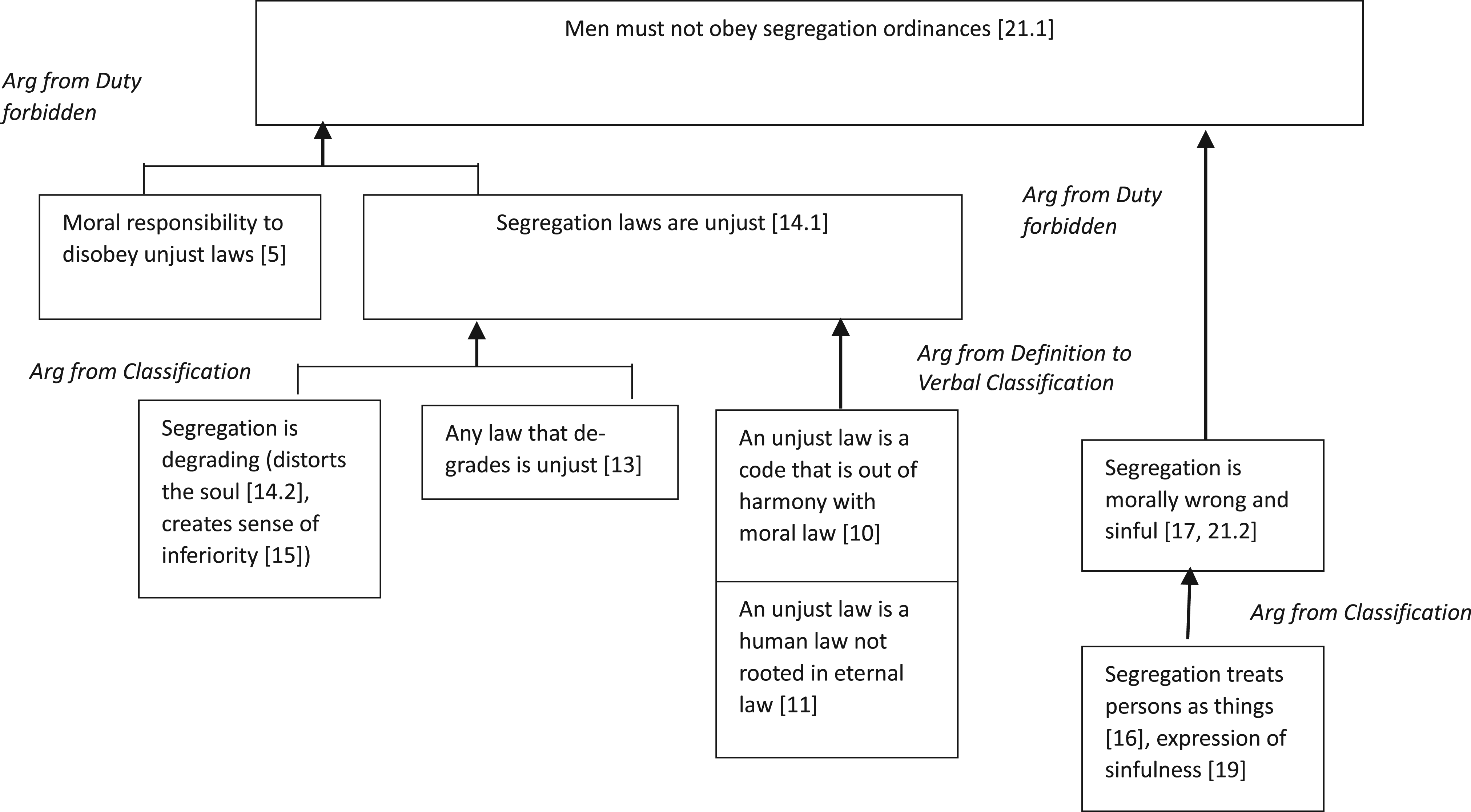
Argument for disobeying segregation ordinances in paragraphs 12–13.
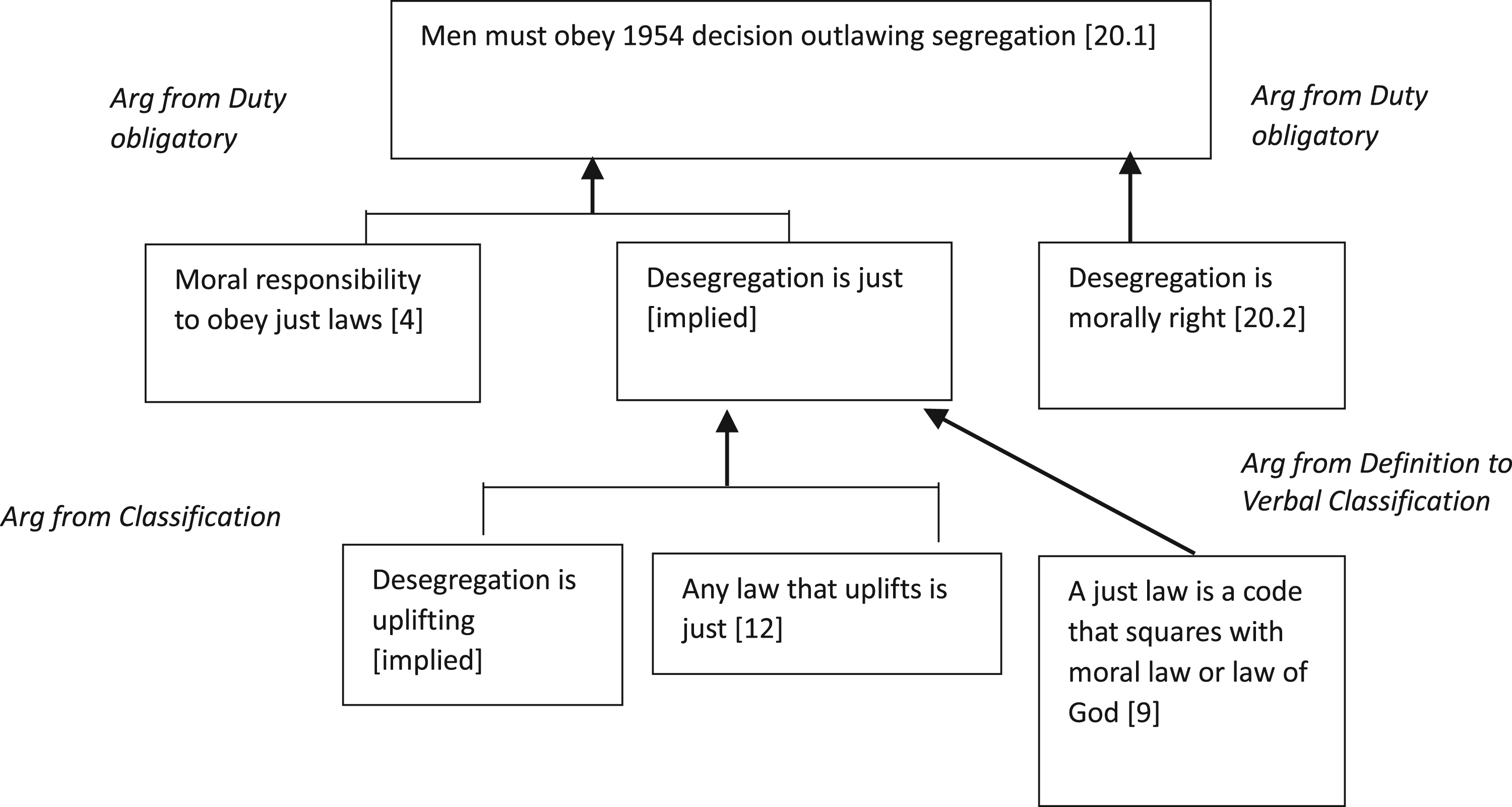
Argument for obeying desegregation decision in paragraphs 12–13.
Rest of paragraph 12:
One may well ask: “How can you advocate breaking some laws and obeying others?” The answer lies in the fact that there are two types of laws: just and unjust. I would be the first to advocate obeying just laws. One has not only a legal but a moral responsibility to obey just laws. Conversely, one has a moral responsibility to disobey unjust laws. I would agree with St Augustine that “an unjust law is no law at all.”
Paragraph 13:
Now, what is the difference between the two? How does one determine whether a law is just or just? A just law is a man-made code that squares with the moral law or the law of God. An unjust law is a code that is out of harmony with moral law. To put it in the terms of St Thomas Aquinas: An unjust law is a human law that is not rooted in eternal law and natural law. Any law that uplifts human personality is just. Any law that degrades human personality is unjust. All segregation statutes are unjust because segregation distorts the soul and damages the personality. It gives the segregator a false sense of security and the segregated a false sense of inferiority. Segregation, to use the terminology of the Jewish philosopher Martin Buber, substitutes an “I it” relationship for an “I thou” relationship and ends up relegating persons to the status of things. Hence, segregation is not only politically, economically, and sociologically unsound, it is morally wrong and sinful. Paul Tillich has said that sin is separation. Is not segregation an existential expression of man's tragic separation, his awful estrangement, his terrible sinfulness? Thus it is that I can urge men to obey the 1954 decision of the Supreme Court, for it is morally right; and I can urge them to disobey segregation ordinances, for they are morally wrong.
As shown in Figure 1 [Figures 1 and 2 are diagrammed in the notation used in Walton et al.
19
], two instances of
As shown in Figure 2, the argument for obeying the desegregation decision parallels the argument for disobeying segregation ordinances. In addition, the arguments shown in Figures 1 and 2 make use of
Also, note that various interpretations of each argument in Figures 1 and 2 can be modeled in terms of SCA (discussed in Section 2). On both readings, the arguer is M.L.K., the addressees are the letter's addressees, and the problem holders are those affected by segregation. On the literal, FPP reading, the problem solver is M.L.K. and the third party is “men” (“I can urge men to obey…,” “I can urge them to disobey”). However, on a TPP reading derived by pragmatic inference, “men” must act, i.e., they are to be the problem solvers.
Paragraphs 14 and 15 continue to elaborate on the difference between just and unjust laws to show that segregation laws are unjust. Paragraph 14 makes use of …An unjust law is a code that a numerical or power majority group compels a minority group to obey but does not make binding on itself. This is difference made legal. By the same token, a just law is a code that a majority compels a minority to follow and that is willing to follow itself. This is sameness made legal. Let me give another explanation. A law is unjust if it is inflicted on a minority that, as a result of being denied the right to vote, had no part in enacting or devising the law. Who can say that the legislature of Alabama which set up that state's segregation laws was democratically elected?
Paragraph 15 makes use of
To sum up our analysis, first, it illustrates the key role of a deontological argumentation scheme defined in Section 3, argument from duty, as well as ethical variants of some standard argumentation schemes: argument from consequences, argument from commitment, and argument from analogy. In these variants, the conclusion is that a certain action is obligatory. Interestingly, of the three schemes, only argument from consequences has been considered to be a “practical” scheme (about what to do). Second, just as Macagno and Walton 9 claimed that certain ethical arguments can be analyzed using a structure with means-end PR at the top level supported by argument from classification, we showed that ethical argumentation in paragraphs 12–13 can be represented in structures with a deontological argumentation scheme, argument from duty, at the top level, supported by classificatory arguments. Third, just as Walton 7 noted that ethical argumentation may involve schemes such as argument from classification, argument from expert opinion and ad hominem arguments for persuasive purposes, we found similar examples. In addition, we found that a variety of rhetorical strategies (appeal to ethos, induction, appeal to empathy, concession) and rhetorical figures (especially antithesis) were used to make the arguments more persuasive. Lastly, the analysis suggests that argument mining approaches relying on the presence of certain lexical features (e.g., “should”) 25 may have difficulty recognizing use of deontological argumentation schemes or distinguishing them from standard PR schemes (means-end PR or argument from consequences). On the other hand, the presence of certain terms (“just/unjust,” “moral/immoral,” etc.) may be useful signs of ethical argumentation.
In Green, 6 we proposed an argumentation scheme to describe utilitarian arguments used in the debate about growing genetically modified food (GMF), as well as on other topics such as vaccination and climate change. In utilitarianism, “an act is morally right if and only if that act maximizes the good, that is, if and only if the total amount of good for all minus the total amount of bad for all is greater than this net amount for any other incompatible act available to the agent on that occasion.” 5 A variant of the argumentation scheme was defined for each possible constraint on an act: obligatory, permissible, and forbidden. The obligatory version was defined as follows, where A is an action such as growing GMF [For a description of the critical questions and the permissible and forbidden variants of this scheme, see Green. 6 ]. The Benefits and Risks premises describe expected positive or negative outcomes (states of affairs), respectively. In addition to the risk of doing A, it is necessary to consider the risk of not doing A, since an obligatory action is an action that is “good to do and bad not to do.” 26 Benefits and Risks may be further described in terms of Magnitude and Probability. The Utility premise claims that Benefits outweigh Risks. The Maximum utility premise is that A has the maximum utility among all available actions in the situation.
Utilitarian argumentation scheme (obligatory version)
Premises:
Benefits: A has certain expected positive outcomes furthering certain values, where each outcome has a magnitude M(b) and probability Pr(b). Risks of doing A: A has certain expected negative outcomes opposing certain values, where each outcome has a magnitude M(h) and probability Pr(h). Risks of not doing A: Not doing A (i.e., doing another available action, including not acting) has certain expected negative outcomes opposing certain values, where each outcome has a magnitude M(n) and probability Pr(n). Utility: The Benefits of doing A and Risks of not doing A outweigh the Risks of doing A (by some calculus). Maximum utility: A has the maximum utility of all available actions.
Conclusion: It is obligatory (ethically required) to do A.
To illustrate some problems with use of VBPR or argument from consequences as an alternative to the utilitarian schemes that we proposed, first, consider an argument for the claim that one should grow GMF presented in Freedman. 27 In a VBPR scheme, the goal would be to feed humanity, promoting the value of human welfare. The means-end premise would be that growing GMF will bring about this goal. An opposing argument could be described using argument from consequences in which environmental harm is given as a potential negative consequence of growing GMF. However, this approach does not fully represent the argument in favor of growing GMF, namely, that the potential benefits to humanity outweigh the risks to the environment. One might remedy this by the addition of a circumstances premise to means-end PR representing the context in which a decision is made 18 ; then one might include the (magnitude and probability of the) benefits, the (magnitude and probability of the) risks, a calculation of utility based on these benefits and risk, and perhaps even a similar calculation for all other available actions, showing that the action of growing GMF has maximum utility. However, this tactic simply moves the utilitarianism-specific attributes from the scheme to the instantiations of a scheme.
There are analytical and computational reasons for adopting the utilitarian schemes. Although it might be possible to model them as described above, the utilitarian-specific features would have to be supplied by the human analyst or computer application. The schemes that we have proposed explicitly represent the intended sense of “should” (permissible, obligatory, or forbidden) and have premises and several CQs tailored to utilitarianism. Note that even if the conclusion is implicit, recognition of the appropriate variant of the utilitarian scheme allows inference of the intended sense of ”should.” The deontological schemes proposed in Section 3 above are an extension of this approach to ethical argumentation. Another benefit of representing ethical argumentation with utilitarian and deontological schemes is that they can be used to model when the source of disagreement between two sides is a clash of normative ethical philosophies, rather than disagreement over specific goals, values, consequences, and/or means.
Conclusion
Our main goal was to define argumentation schemes to model deontological arguments. (A guiding assumption was that argumentation schemes would be useful for computational 28 as well as analytical purposes.) Thus, extending our previous work on argumentation schemes for representation of utilitarian arguments, 6 we defined a set of argumentation schemes for deontological arguments. While developed from analysis of particular utilitarian arguments on growing GMF and particular deontological arguments on vegetarianism and social justice, the schemes do not contain topic-related concepts. Instead, the schemes refer to general normative ethics-related concepts from consequentialism (e.g., utility) and deontology (e.g., duty, rights, and justice).
One benefit of using these schemes to represent ethical argumentation is that their conclusions specify whether an action is obligatory, forbidden, or permissible. Thus, even when such a conclusion is not explicitly stated, recognition of the underlying scheme can be used to infer the intended moral status of the action. Also, their CQs suggest ways to challenge an argument based on common challenges to the underlying ethical theories, i.e., utilitarian or deontological approaches. Another benefit of representing ethical argumentation with utilitarian and deontological schemes is that they can be used to model when the source of disagreement between two sides is a clash of normative ethical philosophies, rather than disagreement over specific goals, values, consequences, and/or means. In general, recognizing that an argument is an instance of a particular ethical argumentation scheme can provide a “deeper” understanding by referencing the scheme's underlying ethical theory.
Another goal was to examine the use of deontological argumentation schemes in a classic text of the civil rights literature. Our analysis of “Letter from a Birmingham Jail” revealed uses of a deontological argumentation scheme (argument from duty) as well as of variants of some “standard” schemes (argument from commitment, from analogy, and from consequences) to argue that certain acts are morally required or forbidden. An interesting theoretical issue is how should these variants of the “standard” schemes be represented and recognized? Analysis of the “Letter” also showed that rhetorical devices play a major role. This complements our previous work on utilitarian argumentation schemes in which the analysis of a text in favor of growing GMF contained not only the utilitarian argument for it, but also relied heavily on rhetorical devices for persuasive purposes. This suggests that for computer applications that produce ethical arguments, it is important to provide appropriate rhetorical support.
Our work could be extended in the future in several ways. One is to model argumentation that is based on other ethical approaches. Also, we would like to revisit the argumentation schemes we specified for AI agents [As a pedagogical tool for an AI Ethics course 29 on the design of explicit ethical agents, 30 we developed argumentation schemes 28 for modeling the ethical acceptability of an AI agent's action in healthcare applications, incorporating issues that ethicists and AI researchers31,32 have raised for these domains. (An explicit ethical agent is an artificial agent that reasons about the ethical acceptability of its action using an explicit representation of ethical principles 33 ] to see how they could be modeled using ethical argumentation schemes. Such schemes are important, not only for pedagogical applications, but also as a possible basis for enabling AI agents to justify their actions.
Footnotes
Acknowledgments
We thank the anonymous reviewers for many helpful suggestions.
The author received no financial support for the research, authorship, and/or publication of this article.
The author declared no potential conflicts of interest with respect to the research, authorship, and/or publication of this article.