




Abstract
It is often necessary and reasonable to justify preferences before reasoning from them. Moreover, justifying a preference ordering is reduced to justifying the criterion that produces the ordering. This paper builds on the well-known ASPIC+ formalism to develop a model that integrates justifying qualitative preferences with reasoning from the justified preferences. We first introduce a notion of preference criterion in order to model the way in which preferences are justified by an argumentation framework. We also adapt the notion of argumentation theory to build a sequence of argumentation frameworks, in which an argumentation framework justifies preferences that are to underlie the next framework. That is, in our formalism, preferences become not only an input of an argumentation framework, but also an output of it. This kind of input-output process can be applied in the further steps of argumentation. We also explore some interesting properties of our formalism.
Keywords
Introduction
Argumentation is one of the mainstream approaches dealing with inconsistent information in intelligent systems. Dung’s argumentation framework (AF) consists of a set of arguments and a binary attack relation between them [11,31]. A semantics is used for identifying acceptable arguments and drawing plausible conclusions. A set of arguments identified by a semantics as acceptable is called an extension. The attack relation in an AF can represent inconsistency of information and an extension identified by a semantics represents the ability of an AF to model inferences to plausible conclusion under inconsistent information.
In the field of argumentation theory, there has been a general consensus that arguments may not have the same strength [3,17] and the preferences should be considered in the evaluation of the successfulness of argument attacks [56,59]. Preferences are so important in evaluating arguments that preference-based (and value-based) AFs (PAFs) cover a crucial part of the spectrum of the existing argumentation formalisms. In a PAF, a preference ordering over the set of arguments is set to filter out the attack relation between arguments. A semantics is applied to the remained attacks. When we set a preference ordering over the set of arguments of an AF, some decision problems that may be intractable in the standard AF become very easier to solve. Preference-based (and value-based) AFs can be employed in the wide range of applications and domains such as merging conflicting knowledge bases [5], modeling dialogues [4,49], practical reasoning [13,57], legal reasoning [14,16] and even moral reasoning [10,63].
In this paper, our primary concern is to develop a model that enables not only reasoning from preferences but also justifying the preferences before applying them to reasoning. In practice, different people have different preferences and often a different context calls for different preferences. Therefore, any given preference ordering is not a ‘universally accepted assumption’ and may be questioned. This advises a rational agent to justify preferences before applying them to reasoning.
Indeed, every preference ordering comes from the criteria behind it. Any preference ordering is based on comparative evaluations, which “cannot begin until you come up with one or more classes or categories to which the objects of comparison can belong.” Then, the class or category will provide the criterion for the comparative evaluation. Such a criterion “may amount to an ideal definition of the class” [16, p.244]. Therefore, justifying a preference ordering is reduced to justifying the criteria. Several papers have emphasized the need to support a given preference ordering in an AF [15,38,43]. Furthermore, there may be more than one criterion behind a preference ordering. That is why multi-criteria decision-making (MCDM) is dominant in the field. Multiple criteria may cooperatively produce a single preference ordering over different objects.
Although justifying multiple preference criteria before applying them to reasoning follows a general pattern by which we think, such formalisms have not been widely studied. Most of the existing preference-based AFs take a preference ordering over the set of arguments as its input, but make no justifications for the preference ordering or criteria behind it. The audience-dependency of selecting a preference (value order) was addressed by Bench-Capon and his colleagues in their value-based AF [13,15]. Thus, in their framework, a specific audience, which is defined as a total ordering over a set of values, can be regarded as a criterion from which a preference ordering over arguments is produced. Modgil has integrated reasoning about preferences with reasoning from the preferences mainly in his so-called extended argumentation framework [43,44]. He employed recursive attacks as the means of reasoning about preferences, thus his framework enables not only reasoning from preferences, but also reasoning about preferences. Sedki [58] suggests the use of an AF for preference elicitation with an approach based on the association between a given PQCL (Prioritized Qualitative Choice Logic [18]) theory and a value-based AF.
Integrating justification for preferences with reasoning from the justified preferences has been done in the field of recommender systems. Teze et al. proposed a recommender system with dynamic multiple criteria by extending DeLP-server [60]. Their system embeds multiple preference criteria in a DeLP-query and justifies them by generating a derivation from a DeLP-program. However, the selection of an appropriate criterion is derived from facts and strict rules. In other words, the selection of a criterion in their system is based on perfect information, thus can never be doubted. However, in everyday and legal argumentation, the selection of a criterion can often be doubted and be in conflict. Like all human judgments and actions, the selection of a criterion may be based on imperfect, especially inconsistent information rather than perfect and consistent information. Since argumentation is an effective approach dealing with inconsistent information, we can justify a preference criterion by means of an argumentation-based approach.
The legal reasoning, where a lawyer must demonstrate the priority of a legal norm to other conflicting norms [38], backs up our idea of this integration. In our proposal, an AF is not only used for drawing plausible conclusions, but also used for justifying preferences. Therefore, a preference ordering over a set of arguments becomes both output and input of an AF. In order to represent the condition under which a preference criterion is justified, we borrow the notion of guard from [60]. The guard of a preference criterion is defined as the information which must be drawn from an AF in order to justify the criterion. If the guard of a criterion is empty, the preference criteria can be said to be always justified, thus, applicable, under any condition.
To develop a model that enables not only reasoning from preferences but also justifying preferences, we choose ASPIC+, which is structured and preference-based, as the basic formal framework [39,46,55]. ASPIC+ has been proposed on the basis of several former works on rule-based argumentation [54,56,64] cognitive science [52,53], classical logics and contemporary argumentation schemes [62,65–67]. It has also been proven that this formalism satisfies rationality postulates stipulated in [27] even when applying preferences under some assumptions.1
The former ASPIC framework satisfies rationality postulates only when preferences are not taken into account.
Traditional preference-based argumentation formalisms including the ASPIC+ framework have only one repairing step where the attack relation is filtered through preferences. But our proposal has two or more repairing steps. One, where the attack relation is filtered through preferences whose criteria have empty guard, is for selecting appropriate preference criteria. The other, where the attack relation is filtered through justified preferences, is for drawing plausible conclusions taking into account the justified preferences. Then, the justified preferences are the output of the first step and the input of the second step. If repairing an AF twice through preferences is not enough for resolving conflicts between extensions, then our framework enables further repairing steps.
The remainder of this paper is organized as follows: Section 2 briefly reviews Dung’s abstract AF and PAF and some basic definitions of the ASPIC+ formalism are together with it interesting property. In Section 3, we give some motivations for developing the model that is able to not only reason from preferences but also justify the preferences. Section 4 is dedicated to integrating justification for preference criteria with reasoning from the justified preferences. In Section 5, the results and properties of our formalism are deeply discussed with some decision-making examples. Section 6 shows some related works, and finally we conclude the paper in Section 7.
In this section, we briefly review preference-based AF that is an extended version of Dung’s abstract AF and the well-known ASPIC+ framework.
Preference-based argumentation framework
Let us first recall Dung’s notion of abstract argumentation framework. An abstract argumentation framework (AF) is a pair
A set
A set
A set
A set
A set
Remember that given an AF
In several works, the abstract AF has been extended into preference-based AFs (PAF) by adding a preference ordering over a set of arguments in order to model the generally accepted idea that arguments may not be equally preferred [3,17] and that argument preferences should be taken into account while determining whether an attack is successful or failed [56,59].
Formally, a PAF is a triple
A preference ordering over the set of arguments of an AF is useful for filtering the attack relation, that is, removing the (preference-dependent) attacks where the attackee is preferred to the attacker.2
In ASPIC+, only preference-dependent attacks can be removed (see the next subsection). However, in other formalisms such as deductive argumentation [9] or assumption-based argumentation with preferences (ABA+) [28], any attack should be removed from the framework if the attackee is preferred to the attacker and then the reversed attack is added.
Although, by means of PAFs, we are able to not only model real-world argumentation, but also make many decision problems that have been proved to be intractable in Dung-style AFs much easier, such an approach gives rise to an unintuitive result. According to this approach, if one argument asymmetrically attacks another, but fails, then these two arguments become conflict-free. This is problematic since whether an attack is successful or failed is irrelevant to determining a conflict. A conflict between arguments is only the matter of their incompatiblity [46]. As a result, some formalisms that takes preferences or values into account lead to violating rationality postulates stipulated in [27].
To address this shortcoming, three main solutions have been proposed. These proposals aim to guarantee conflict-freeness of a PAF extension whether or not an attack is successful. One solution is to add preferences at semantics level, not attack level [7]. Another suggestion is to inverse the direction of failed and asymmetric attacks [9]. The ASPIC+ formalism has found the way to avoid losing the conflict-freeness of an extension in distinguishing between preference-dependent and preference-independent attacks [45,46,55]. Amgoud & Vesic [7] argue that their approach is more general than ASPIC+. However, everything has merits and demerits and we have found that, ASPIC+’s way of distinguishing between preference-dependent and preference-independent attacks has a very useful property which we will proceed to study in the next section.
In ASPIC+ framework, arguments are defined as inference trees formed by applying two kinds of inference rules: strict rules representing generalizations which do not allow exceptional cases like “A mammal is an animal” and defeasible rules representing commonly-hold generalizations with exceptional cases like “Mammals generally live on land”. This naturally leads to three ways of attacking an argument: attacking a premise, a conclusion and an inference, which are respectively called undermining, rebutting and undercutting. In order to characterize the structure of arguments and the nature of the attack relation, we need to make a minimal assumption on the logical language that certain well-formed formulae are a contrary or contradictory of certain other well-formed formulae. Now, let us present some basic definitions of the framework.
(Argumentation system [46]).
An argumentation system (AS) is a tuple if else if each ⩽ is a partial preorder on
A set
The framework also defines the notion of knowledge base from which arguments can be constructed, inspired by [37] where they classified premises of an argument or an argumentation scheme into several categories.
(Knowledge base [46]).
A knowledge base of an AS
The ASPIC+ framework defines the notion of an argument as an inference tree formed by applying strict and defeasible rules to premises that are well-formed formulae. Below, the ASPIC+’s definition of an argument can be found. For any argument A,
(Arguments [55]).
An argument A on the basis of a knowledge base φ if
In addition, an argument is called strict iff
Consider a knowledge base
We construct 10 arguments from
Given two argumentation theories
As we can see in Definition 3, since arguments are inference trees, three kinds of argument attacks are possible: undermining, rebutting and undercutting attack.
Argument A undercuts argument B (on Argument A rebuts argument B (on Argument A undermines argument B (on φ) iff
(cont.).
In the above definition, argument attacks are divided into three categories according to what part of the attackee the attacker attacks on. Moreover, the ASPIC+ framework distinguishes preference-dependent attacks from preference-independent attacks. If an attack is one of undercutting, contrary-rebutting or contrary-undermining attack, it is a preference-independent attack, and otherwise it is a preference-dependent attack. Therefore, it seems likely to us that Kaci et al.’s famous formula “defeat = conflict + preference”3
In [41], actually, “attack = conflict + preference” appears, but in this paper, we replace the term “attack” with “defeat”, because in the original paper, the term “attack” stands for “successful attack”, not “failed attack”.
As one can notice,
The notion of argument defeat can be defined on the basis of the definition of preference-dependent and preference-independent attack as follows:
(Defeat [46]).
Let A and B be arguments. Then A defeats B on A undercuts, contray-undermines, or contrary rebuts B on A rebuts B on A undermines B on φ and
A strictly defeats B iff A defeats B, but B does not defeat A.
Below, we define the notion of argumentation theory that is the basis for constructing arguments and determining attack relations among the arguments.
(Argumentation theory [46]).
An argumentation theory is a pair
Finally, argumentation theories can be linked to PAFs.
(PAF corresponding to an argumentation theory [46]).
A PAF corresponding to an argumentation theory
Given an argumentation theory
An argument ordering is a partial preorder ≼ on arguments (whose strict counterpart is ≺) and is admissible iff firm and strict arguments are strictly preferred to defeasible or plausible ones and a strict inference rule cannot make an argument weaker or stronger. In this paper, we do not include an argument ordering ≼ in the notion of argumentation theory as in [55] because it always follows from the underlying argumentation system and knowledge base. We rather include the argument ordering in the notion of PAF corresponding to an argumentation theory as in [46]. Such an inclusion is more appropriate to develop a model which integrates justifying preferences with reasoning from the justified preferences.
An AF
Generally, two ways of deriving argument orderings from orderings on rules or ordinary premises (last-link and weakest-link principles) have been recognized. Those two principles employ a general definition of a partial order if if if if
The last-link principle prefers an argument A over another argument B if the last defeasible rules used in B are less preferred (wrt.
(Last-link and weakest-link principles [46]).
if both A and B are strict, then if both A and B are firm, then
Modgil and Prakken also define the notion of maximal fallible subarguments and strict continuations of arguments that are useful for proving some propositions (An argument is fallible if it is plausible or defeasible). The maximal fallible subarguments of an argument are those with the ‘last’ defeasible inferences in that argument or else (if the argument is strict) they are the argument’s ordinary premises [46].
(Maximal fallible subargument [46]).
The set the top rule of there is no
(Strict continuations of arguments [46]).
For any set of arguments
It has been shown in [46] that ASPIC+ satisfies the postulates of Closure under subarguments and strict rule application unconditionally. However, the postulates of Direct Consistency and Indirect Consistency hold only under the assumption of reasonable argument ordering. An argument ordering is reasonable if it satisfies properties that one might expect to hold of orderings over arguments composed from fallible and infallible elements [55]. Formally:
(Reasonable argument ordering [46]).
An argument ordering ≼ is reasonable iff:
for all A and B such that A is strict and firm and B is plausible or defeasible, it holds that for all A and B such that B is strict and firm, it holds that for all A, Let
An argumentation theory is said to be (directly) consistent if the set of conclusions of all arguments in an arbitrary extension of the PAF built over the theory is consistent; an argumentation theory is indirectly consistent if the closure of the set of conclusions of all arguments in an arbitrary extension of the PAF built over the theory under strict rule application is consistent [46,55].
Now, it is time to define the notion of the output of a PAF whose input is an argumentation theory. For any argumentation theory and the PAF corresponding to the theory, let
The set of credulously justified conclusions is
The set of skeptically justified conclusions is
Remember that
Interestingly, a preferred/stable extension of the PAF built over a standard ASPIC+ argumentation theory is also a preferred/stable extension of its original version or its subset. This property, which is very useful for developing a model which is capable of justifying preferences, can be formalized as follows:
Let
In Fig. 1, graphical representation of the PAF built over the argumentation theory
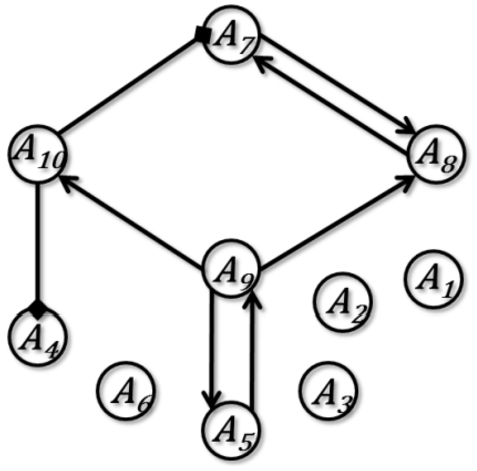
Preference-dependent and preference-independent attacks.
Now, let us extend
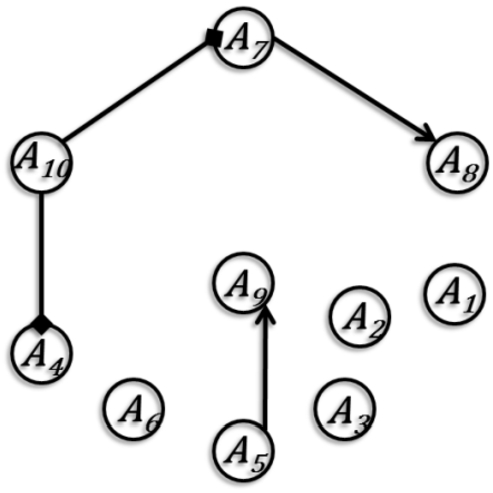
Filtering extensions through preferences.
The original AF has two preferred/stable extensions:
The above proposition shows that the preferences in a PAF corresponding to an ASPIC+ argumentation theory not only filter the attack relation but also filter the set of extensions under preferred/stable semantics. According to Amgoud & Vesic, preferences play two roles in an AF [8,9]. They may be used for handling an attack where the attackee is preferred to the attacker or may be used for refining the result of a PAF. Interestingly, in the ASPIC+ framework, preferences handle failed attacks and simultaneously, refine the set of extensions of the original AF under preferred/stable semantics.
Note that the refinement role which preferences play in ASPIC+ has more or less different meaning from that in Amgoud & Vesic’s deductive argumentation. In [9], preferences are used for refining the result of a repaired AF, while the above proposition shows that preferences have the ability of refining the result of an original framework. Moreover, in Amgoud & Vesic’s formalism, filtered extensions are exactly of those of a PAF. But, in our formalism, filtered extensions may get smaller, that is, lose some arguments as the result of filtering (under preferred semantics). Some extensions pass the filter bed of preferences without any loss of arguments and some fail to pass. We can also see that some extensions that pass the filter bed lose some arguments, and as a result, get smaller.
Let us consider a PAF
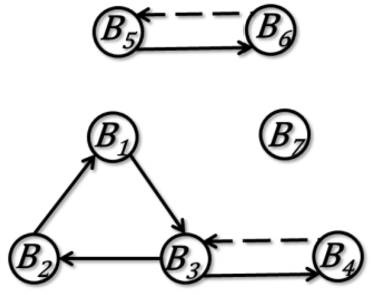
Reduction in an extension.
One might think that preferences play the role of refining the extensions of an original framework in any preference-based argument formalism. However, several preferences-based formalisms [1,2,8,9,13,28,43] fail to make the preference ordering over arguments play the role of refining the extensions of an original framework. For example, consider an AF formalized in [1] where argument A attacks B and B is preferred to A. The original framework has one preferred extension
In a PAF, a preference ordering over the set of arguments is used for filtering the attack relation, in turn, producing a defeat relation and defining plausible conclusions. In most cases, such preferences over arguments come from the defeasible rule priorities those arguments are based on, as in ASPIC+ framework. However, why should we apply such orderings? Are all those orderings undeniable facts or axioms? Probably, most of them are not. Therefore, a rational agent may not only reason from preferences, but also have to justify those preferences. There are few preference orderings that are taken for granted. Most preference orderings should be the outcome of justification in order to be applied.
In practice, preference orderings over a set of objects vary from person to person. This audience-dependency of selecting a preference (value order) was already explored by Bench-Capon in their value-based AF [13,15]. Furthermore, preferences may vary from context to context even for a single agent. An agent has several preference orderings over a set of objects in its mind and applies them to reasoning. Then, which preference ordering to apply depends on the particularity of a given context. Therefore, in order to persuade others to do something or prove that something is right or good, we should first try to convince them of the preferences behind an advice or a claim that we propose. The context-dependency of preference application leads us into the topic of justifying preferences in an AF.
First of all, justifying a preference ordering is justifying the criteria behind it. Any preference ordering is based on comparative evaluations, which “cannot begin until you come up with one or more classes or categories to which the objects of comparison can belong.” Then, the class or category will provide the criterion for the comparative evaluation. Such a criterion “may amount to an ideal definition of the class” [33, p. 244].
Regarding preference criteria, several points should be made clear. Not only one, but several preference criteria are applicable to a set of objects. For example, when we produce a preference ordering over houses, criteria such as size, distance to working place and location are applicable. And when we produce a preference ordering over the beauty of some things (aesthetic evaluation), multiple criteria such as proportion, slight distortion, contrast, harmony, craftsmanship, association and so on can be applied [33]. More importantly, preference orderings on the same set of objects differ according to the criteria. The preference ordering over a set of houses according to their size may be different from that according to the distance to working place. Incidentally, different context recommends different criteria. For this reason, even a single person’s preferences may vary from context to context.
Second, two preference criteria may be incompatible over a set of objects. The criteria size and distance to working is said to be incompatible over a set of houses
Note that, for a rational agent, selecting a criterion is justifying the criterion. A selected criterion in a context is one that is justified with respect to the information available in the context. For instance, suppose, among two criteria size and distance, an agent prefers size to distance and has decided to live in
Third, multiple criteria may cooperatively produce a single preference ordering. That is why the approach of multi-criteria is dominant in the field of quantitative decision-making. For example, if the size criterion produces preference ordering
Criterion may not define total preference ordering over a set of objects. The size criterion and the price criterion in this example define a partial order over
One way to adapt to multiple preference criteria is to use a meta-preference ordering over a set of criteria. When evaluating a house, we may prefer size to distance to work. However, where does this meta-preference come from? The meta-preference and the criteria behind it should also be justified.
Like all human judgments and actions, justifying criteria to generate a preference ordering must be based on imperfect, especially inconsistent knowledge. Therefore, the selection of a criterion may be doubted, uncertain or even be in conflict. Actually, we can see that there are debates on whether it is reasonable to apply a certain criterion to evaluating something. For instance, perfect proportion and slight distortion have been billed as two of key criteria in aesthetic evaluation, but artists and aestheticians may dispute on whether they should apply perfect proportion or slight distortion.
In this paper, we are interested in implementing an elaborate mechanism that allows to justify preference criteria in a PAF. Moreover, we know that argumentation is an effective approach for dealing with inconsistent information. Therefore, the conflict among available preference criteria can be resolved through an argumentation. The mechanism that is capable of justifying preference criteria may be the AF itself in which the mechanism should be implemented. An AF can be used for justifying preferences as well as defining plausible conclusions. The core of this section is to introduce the idea that the preference ordering embedded in a PAF should also be justified by another PAF with the same arguments and attack relations.
We find that especially legal reasoning, where a lawyer may have to justify the priority of a certain norm to its conflicting norms, resonates with our idea of using AF for justifying preferences. As mentioned in [38], a conflict between legal norms from different sources or promulgated at different times may arise in legal reasoning. However, most lawyers neither have power to change any of the conflicting norms, nor have control to change established evidence in a case. The only way to resolve the conflict is to introduce a preference ordering over the legal norms. In the legal literature, three major principles which are used to set a preference ordering over conflicting norms are identified. Those are Lex Superior which prefers a norm whose legislative source is higher in the legislative source hierarchy, Lex Posterior which prefers a norm promulgated more recently and Lex Specialis which prefers a more specific norm. Thus, Lex Superior, Lex Posterior and Lex Specialis can be regarded as three main criteria, by which a preference ordering over legal norms can be generated. However, the application of one of these criteria should also be justified. If you would like to resolve a conflict between legal norms by applying Lex Superior, then you must justify why we should apply only Lex Superior, not Lex Posterior nor Lex Specialis. That is because if we apply another criterion, the opposite judicial decision may be drawn.
Along the everyday life, it seems that a human has a number of criteria in his mind and attaches a condition to every criterion, under which the application of the criterion is justified. That is, a human justifies a preference criterion by proving the satisfaction of the condition attached to the criterion. For example, a person not only knows that both perfect proportion and slight distortion can be the criteria against which we assess the beauty of something like clothes, but also knows that he should promote either of them based on looking into what is all the rage this season. A lawyer also knows that Lex Superior, Lex Posterior and Lex Specilis are the criteria from which a preference ordering over legal norms may be produced. He applies some of those criteria for resolving conflicts among legal norms and knows under which condition application of one of those criteria can be justified. On the basis on such an intuition, diverse user’s preference handling models have been proposed [24,25,29]. Our formalism will conform to this intuition of a preference-based reasoning that every preference ordering comes from criteria and the adoption of criteria should be justified with regard to a certain context.
In this section, we give a definition of a preference criterion on the basis of [60]’s notion of guard and modify the notion of ASPIC+ argumentation theory in order to model the way in which preferences are justified by an AF.
Justifying preferences
Criteria behind a preference ordering is so essential that justifying the preference ordering boils down to justifying the criteria. Teze et al.’s notion of guard is useful for modeling the way in which a criterion is justified with regard to a certain context since a context can always be modeled by terms of a set of literals which are true in the context [60]. Our model needs to select an appropriate preference criteria depending on certain conditions, thus, the notion of guard, which offers a special way of associating these conditions to a preference criterion, plays an important role. A guard could be viewed as a way of guiding the choice of a criterion [60]. We define a guard as a set of literals that should be justified by a given AF to apply the associated criterion. Therefore, we can define a preference criterion as follows:
(Preference Criterion).
A preference criterion is a pair
The term “preference information” means that
To apply preferences to our example, we take four criteria
In the above example, criterion
Let
(Justifying a Criterion).
Let
While justifying preference criteria by a PAF corresponding to APSIC+ argumentation theory, we usually adopt preferred or stable semantics because under such semantics, our model has some desirable properties (see Section 4.3)
A criterion should usually be justified from the skeptical viewpoint, since, as we will show in what follows, such viewpoint does not allow inconsistent criteria to be justified simultaneously. We also say that a criterion is justified by an extension under a given semantics. Let
A criterion whose guard is ∅ is justified by any PAF under any semantics.
We call a criterion whose guard is ∅ an absolute criterion in the sense that this criterion can be applied without justification. In a certain domain of reasoning, we can think of an absolute criterion such as specificity of defeasible rules.
The criteria
A pair of criteria may or may not be compatible. The incompatiblity of criteria can be defined as follows:
(Incompatible criteria).
Let
Here,
A set of preference criteria is inconsistent if and only if it includes at least two incompatible criteria. Otherwise, it is consistent. Note also that a set of preference criteria
We cannot apply two incompatible preference criteria in the same context. Thus, the guards of incompatible criteria should also be incompatible, namely, should not be justified, with respect to the argumentation theory available in the context. Otherwise, a PAF built over an argumentation theory may justify two incompatible criteria simultaneously. In such a way, we can resolve conflicts among preference orderings, since any set of incompatible criteria cannot belong to a single extension. The notion of valid criteria set reflects this idea.
Let
Let
The requirement reflected in Definition 15 may seem too strong since the difficulty of reasoning preferences is prominent in the fact that rational agents cannot avoid dealing with inconsistent preference criteria that are justifiable in the very same context. For example, in moral or aesthetical reasoning, a rational agent may face dilemmas in which there are no clear-cut solutions to eliminate incompatible preference alternatives. Then, we can adopt credulous standpoint for modeling such dilemmas.
The following corollary directly comes from the above proposition.
A preference criterion that is incompatible with a criterion whose guard is ∅ cannot be justified by any AF.
One can easily see that
Reasoning from justified preferences
The selection of a criterion may be doubted or even be in conflict, and, in turn, be in need of justification. Since argumentation is an effective approach dealing with imperfect information, the selection of a certain criterion can also be justified by an argumentation.
Traditionally, a PAF filters the attack relation through its preferences. The result of this step of argumentation is called repaired framework. Nevertheless, most of the existing PAFs including ASPIC+ have only one repairing step because they provide a mechanism only for reasoning from preferences, i.e. the preferences are only the input of the framework. Our proposal is to have two (or more than two) repairing steps because an intelligent agent should not only reason from preferences, but also justify the preferences before reasoning from them. One repairing step is for justifying preferences, the other is for reasoning from those preferences. We consider both justifying preferences and reasoning from the justified preferences in an integrated way, as it accords with human-style argumentation. For the sake of justifying preferences with regard to a certain context, we first need to revise the notion of argumentation theory should be revised in terms of preference criteria.
(Argumentation theory with preference criteria).
Argumentation theory with preference criteria (ATPC) is a pair
Below, we elaborate our proposal where justifying preferences and reasoning from the justified preferences are integrated. An AF with justified preferences can be seen as having those two steps. Notice that there are two repairing steps.
Building the primary PAF over an ATPC, with preferences whose criteria guard is ∅8 As a criterion whose guard is the empty set is justified by any AF, we can take it as input for determining justified preference criteria.
Building the advanced PAF, with justified preferences and concluding or defining the justified conclusions.
Let Let
In determining justified preference criteria, the skeptical standpoint should usually be adopted because incompatible criteria cannot be skeptically justified by any PAF under valid criteria set as shown in Proposition 2. When reasoning from justified preferences, the original AF should be repaired twice by primary preferences whose guard is ∅ and advanced preferences whose criteria are justified by the primary framework. Note that primary preferences are justified by any AF.
Let
To generalize, in our formalism, the primary PAF is the result of the first filtering with preference criteria whose guards are empty set, while the advanced PAF is the result of the second filtering with preference criteria whose guards belong to the output of the former primary PAF. However, what can we do if the conflict between extensions still remains unresolved even after the second filtering, that is, if the advanced PAF has two or more conflicting (preferred/stable) extensions? In such a case, if possible, we can do further third, fourth,
Let
The result of the first filtering is the primary PAF corresponding to
Let

The nth filtering.
We call the preference criteria whose guards are empty set the first preference criteria. The preference criteria that are justified by the result of the nth filtering are called the
We suggest using a PAF for the sake of justifying preferences, by which the attack relation is filtered, in turn, the output of the PAF is also changed. In the above sequence of PAFs, the output of a PAF determines which preferences to select and the selected preferences affect the output of the next PAF (see Fig. 4). The first preference criteria determine the output of the primary PAF and the primary PAF determines preferences that are to be adopted by the advanced PAF. In the same way, the nth preference criteria determine the output of the result of the nth filtering, which, in turn, determines the
From Proposition 2, we can see that inconsistent preference criteria set cannot be justified by a PAF, if the argumentation theory over which the PAF is built has valid criteria set. Since a preference criterion that is incompatible with a criterion whose guard is empty set cannot be justified by any PAF, the second preference criteria cannot include a criterion incompatible with one of the first criteria. However, if
Let
Fortunately, ASPIC+ bears a desirable property that other structured argumentation formalisms do not have (Proposition 1). As aforementioned, we modify ASPIC+ argumentation theory with the notion of preference criteria, so as to build a sequence of PAFs, by which we can not only justify preferences but also reasoning from the justified preferences. Then, thanks to the desirable property of ASPIC+, we can ensure consistency between preferences from which we reason and those that we justify.
The following proposition, which reveals the relation between the extensions of a primary PAF and those of its advanced version, is useful for showing that the sequence of PAFs built over an ATPC does not allow inconsistency between input and output preferences of a PAF in it.
Let
Let us consider an ATPC
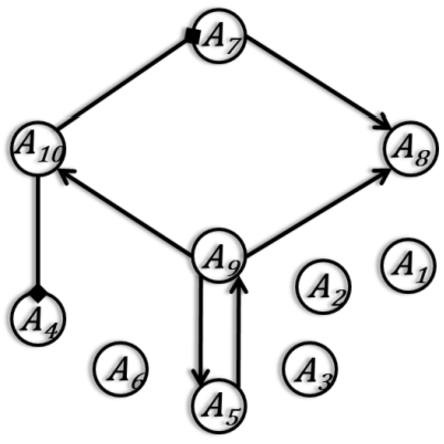
A PAF filtered through primary preferences.
The attack
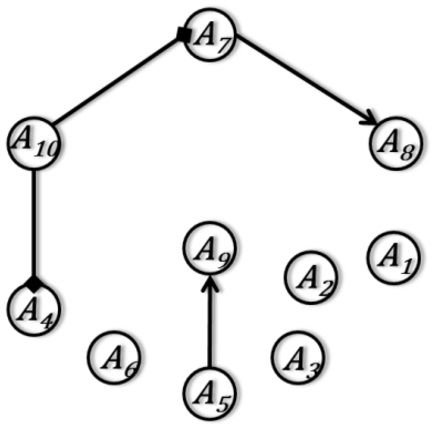
An AF filtered through advanced preferences.
The PAF
The following proposition shows that any inconsistency cannot be found between advanced preference criteria and those justified by the advanced PAF built over an ATPC.
Let
Some other argumentation formalisms, namely, deductive argumentation [9] and assumption-based argumentation with preferences (ABA+ for short) [28], which take preferences take into account, inverse the direction of a failed attack in order to guarantee conflict-freeness of extensions with respect to the attack relation. For this reason, in such formalisms, the extension of a PAF is not that of the original AF under stable semantics (or a subset of an extension of the original AF under preferred semantics). As mentioned in Section 2, Amgoud and Vesic also made preferences refine extensions [9]. However, in their formalism, the extensions refined are those of the repaired framework, and thus the extensions of the PAF may deviate from those of the original AF. In a word, Proposition 1 does not hold in deductive argumentation or ABA+. It may give rise to inconsistency between the outputs of the PAF and the original AF. Therefore, if we built such a sequence of PAFs based on deductive argumentation or ABA+, then we would not guarantee consistency between the preferences that we reason from and those that we justify.
Now, it is time to generalize Proposition 3.
Let
The above proposition, differently from Proposition 3, is conditioned on the antecedent
Now, let us revise Example 2 with some modifications in order to illustrate it. Suppose that the argument preference
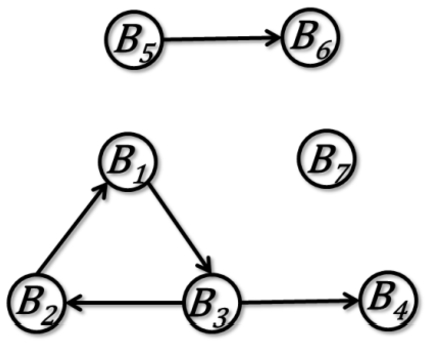
How can a sequence of PAFs fall into an endless loop?
The advanced PAF also has two preferred extensions
The above example shows that if the framework filtered through a preference may not justify the preference over which it is built, it may lead us to unprofitable and endless loop.
However, under stable semantics (or even under preferred semantics if the PAFs built over an ATPC do not contain any odd length cycles of attack),10
It is shown that the stable and the preferred semantics coincide when the AF does not contain any odd length cycles of attacks [31].
The following proposition (generalization of Proposition 4) shows that the standard ASPIC+ prohibits inconsistency between the input and output preference criteria of a PAF in a sequence of PAFs.
Let
In the above proposition,
An important issue that arises here is when we should stop the filtering in a sequence of PAFs? The proposition below will be the answer to this question.
Let
The above proposition teaches us that if the result of a present filtering is the same as the previous filtering, then the next filtering must also be the same, thus, there is no need of further filtering. Therefore, under such circumstances, it will be more helpful to enrich the underlying argumentation theory with more preference criteria rather than repeating the unprofitable filtering, since the added criteria may contribute to resolving conflicts among the extensions.
It is reasonable to justify preferences before reasoning from them in everyday argumentation. Thus, we propose using the ASPIC+ framework to integrate justifying preferences with reasoning from those preferences. Our proposal includes a somewhat meta-perspective on arguments within AFs themselves, which is novel in the literature. In this section, we investigate the formalism more closely.
An argumentation, as a mechanism for reasoning from inconsistent information, can be used not only for defining plausible conclusions, but also for selecting appropriate preference criteria. If a preference criterion is justified by the argumentation built over the information available in a context, the criterion is selected as an appropriate one to the context. Then, the selected criteria are used for repairing the previous argumentation and finally defining conclusions.
Using argumentation for justifying preferences conforms the way in which we ordinarily reason and argue. The reason why argumentation becomes a powerful paradigm of AI is that it is capable of not only modeling non-monotonic reasoning, but also providing rational explanations identified plausible conclusions. For example, argumentation-based decision support systems can explain why the recommended choices are desirable [6,26,68]. Nonetheless, preferences may underlie such decisions or belief. In everyday discussions and debates, people may have to justify the desirability of a course of action or the acceptability of a judgment by appealing to preferences such as value orders or rule priorities. However, if a preference that underlies one’s argument is not self-evident to everyone, it should also be justified like other statements. Our proposal makes it possible to employ multiple preference criteria and justify some of them as appropriate for a context by adopting an argumentation-based approach. The notion of valid criteria set is used to resolve conflicts between incompatible preferences, since an arbitrary pair of incompatible criteria in such a set cannot belong to a single extension. Consider the following decision-making example that was described in [34].
A robotic agent performs a cleaning task (Fig. 8). The robot should decide which boxes to carry first to the specified place called store (grey area in the figure). There are four boxes (box1, box2, box3, box4) in the environment, which are of different sizes and in different locations.
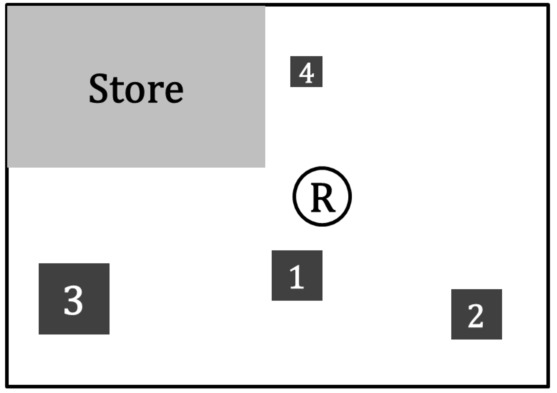
The robotic environment: scenario 1.
Because of the difference in their size (box3 is the biggest and box4 is the smallest), the agent cannot carry any two of box1, box2, box3 at the same time, but can carry box1 and box4 or box2 and box4 at the same time. The agent cannot carry box3 and box4 together. Several preference criteria for selecting boxes may be applicable, for example, the robot may prefer boxes nearer to it or prefer boxes nearer to the store. However, the robot applies these criteria only when some conditions are satisfied. When the robot is near to the store, then it will prefer boxes nearer to the store. Once the robot load itself with box4 (recall that it can carry box1 or box2 with box4 at the same time), it will prefer the box nearer to box4 (to save energy). Here, we will use first-order predicate language. Now, consider an ATPC
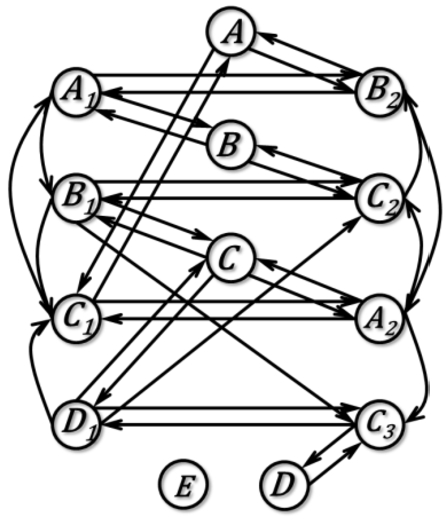
Primary PAF.
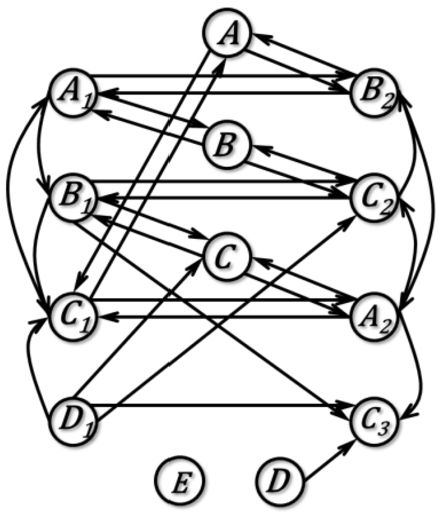
Advanced PAF.
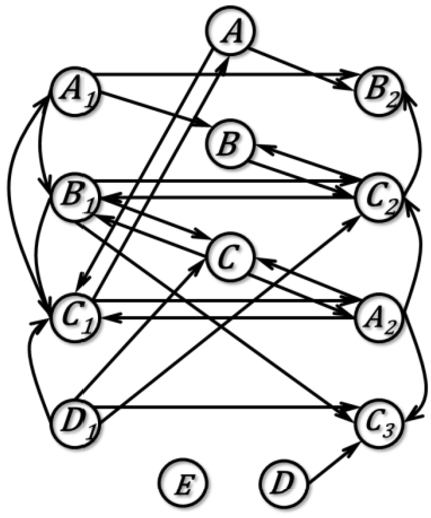
Third PAF.
The third PAF based on
In this example, we built a sequence of three PAFs based on an ATPC. As we can see, the multiple extensions are subsequently filtered through justified preferences. As it shows, the proposed model makes it possible to provide justifications for the preferences that underlie established belief or selected decisions.
Nevertheless, the credulous standpoint allows incompatible criteria to be simultaneously justified in our formalism. In such a case, another preference criterion which stores meta-preference information may be useful. For example, given two incompatible preference criteria
An extended argumentation theory with preference criteria (EATPC) is a tuple
We present another scenario featuring a cleaning robot reasoning about its environment. In this scenario, there are four boxes too, but we should also take their weights into account as well as sizes and locations. We have the ordering in weight: box2, box3, box1, box4 (that is, box2 is the biggest and box4 is the smallest, see Fig. 12).
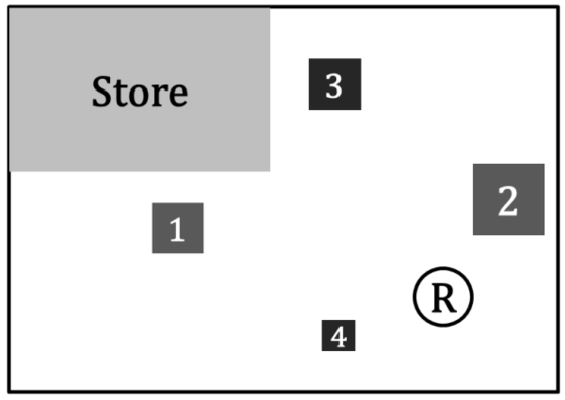
The robotic environment: scenario 2.
Because of their size, the robot cannot carry the pair of box1 and box2 or the pair of box2 and box3 at the same time. Moreover, the robot cannot carry box3 and box4 together because they are too heavy (in Fig. 12, the dark grey color represents that the box is heavy). The robotic agent’s context-sensitive preference criteria are as follows: if the robot selects box1, then it will prefer box3 to box2 or box4 and if it selects box3, then it will select box1 rather than box2 or box4 (because both box1 and box3 are nearer the store); if the robot chooses box2, then it will select box4 next rather than box1 or box3 and if it chooses box4, it will also prefer box4 to box1 or box3 (because both box2 and box4 are farther from the store). The robot also has mete-preference criteria that is also context-sensitive: if the robot is near the store, then it will prefer
The primary PAF (Fig. 13) has two preferred/stable extensions:
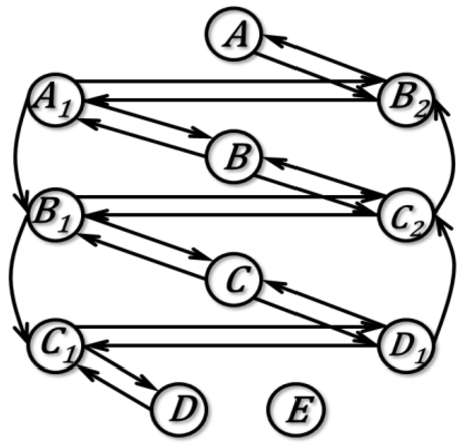
PAF without meta-preference.
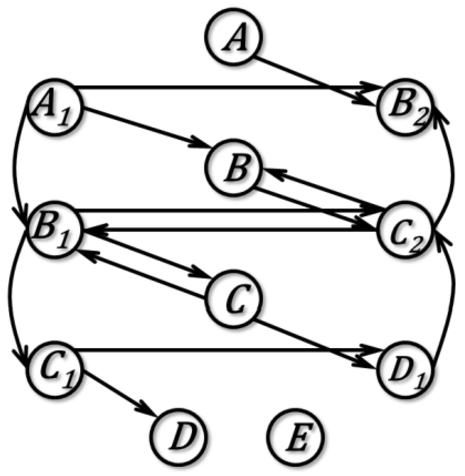
PAF with meta-preferences.
As the above example shows, when the credulous standpoint allows inconsistent preference criteria, we may make use of meta-preferences, but they should also be justified. Several argumentation-based decision-making systems trade on a single meta-preference criterion. For example, the decision-making system based on dynamic argumentation system includes a meta-preference (a strict total order over the preferences) as a component of their so-called abstract decision framework [35].
Furthermore, our formalism enables an extension to have a support for preferring itself. In Dung-style AFs, although the principle of argument acceptability and the concept of an admissible set of arguments seem straightforward enough, it turns out that intricate formal puzzles loom-it can happen that an argument is both admissibly provable and refutable [61]. This formal puzzle is due to an AF having two or more conflicting preferred/stable extensions. The symmetric attack often makes it the case that an AF has more than two conflicting preferred/stable extensions, thus, violate rationality postulates when the credulous viewpoint is adopted. In the literature, to resolve such conflicts among extensions, a preference ordering over a set of arguments has been introduced. However, there was no justification for given preferences. Preferences over a set of arguments are neither undeniable facts nor axioms that are taken for granted. In our proposal, the AF built over a theory is used not only for defining plausible conclusions, but also for justifying appropriate preferences as in Example 1. As we have mentioned in Section 4.2, some of the preference criteria are selected and justified by the primary PAF. Then, the advanced PAF is built based on the justified criteria and used for drawing plausible conclusions. In the traditional PAFs, the preferences are used for calculating extensions, but the extensions are not used for justifying the preferences. In a word, the relation between a preference and an extension has been mono-directional. However, in our proposal the relation between a preference ordering and an extension may be bi-directional, that is, the preferences are used for calculating extensions, and simultaneously, the extensions can be used for justifying the underlying preferences. When two preferred/stable extensions are in conflict, one of them may provide a support for preferring itself to the opposite one. Let us consider the following example.
Let us consider an AF
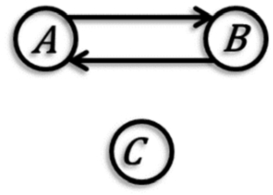
Self-preferring and self-discarding extensions.
In the above example, the extension of the advanced PAF is calculated on the basis of the preference (
Let This definition can also be extended for the resulting PAF of the nth filtering.
In Example 1, the extension
The extensions over which we set a preference ordering are those of an original framework. In other words, let
When we justify preferences in an AF, we usually adopt the skeptical viewpoint (Example 1 and 3), since it ensures that incompatible criteria are not justified simultaneously. However, what should we do if the skeptically justified criteria do not have adequate preference information for resolving the conflict between extensions? Meta-preference criteria may be useful. Then, what if we have no meta-preference criteria? In such a case, an alternative approach may be to look at the extensions of an AF and to consider that each extension give rise to different justified preferences, which in turn give rise to different PAFs. Then, instead of a sequence of PAFs, a (two-level) tree structure of PAFs comes into being, where every leaf represents different possibilities.
Let the root node holds for every leaf
In the above definition, it can be easily noticed that an extension of a leaf PAF coincides with or belongs to an extension of the primary PAF (root PAF) from Proposition 1 under preferred/stable semantics. Hence, every set of preference criteria justified by an extension of a leaf PAF is also justified by an extension of the root PAF. As a result, it seems needless to further branch the tree structure with preferences justified by an extension of a leaf PAF.
Sometimes, the preferences justified by an extension of a leaf PAF may be enough for resolving the conflict. Or sometimes, the leaf PAFs may share one or more extensions. If the leaf PAFs share only one extension, the extension may be chosen by the user. Consider the following examples.
Let us consider a scenario where an agent should decide whether to buy a laptop computer or not. It is clear that he should buy a computer of which CPU speed is high, RAM capacity is large and battery is good. However, the computer that he is thinking of buying does not seem to have all of these three properties. The salesperson who is a computer expert says that the CPU speed of the computer is incredibly high, while a window-shopper, who represents himself as another computer expert, says that CPU speed of the computer is not high. Then, the agent thinks that the window-shopper is not trustworthy and pretends to be an expert. The agent also believes that the RAM capacity is large and the battery is not good. He does not have any total preference ordering over the three attributes (CPU speed, RAM capacity, battery), but he knows that the high CPU speed should be backed up by large RAM capacity. Therefore, in the context where the actual CPU speed is high, the agent prefers RAM capacity to battery, while in the context where the CPU speed is not high, the agent prefers battery to RAM capacity.
Then, let
Making decision without preference criteria.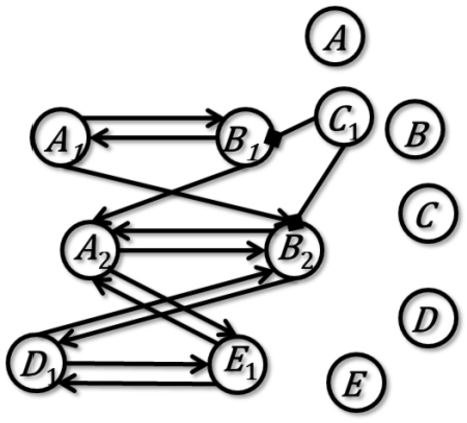
Making decision with justified preference criteria by an extension.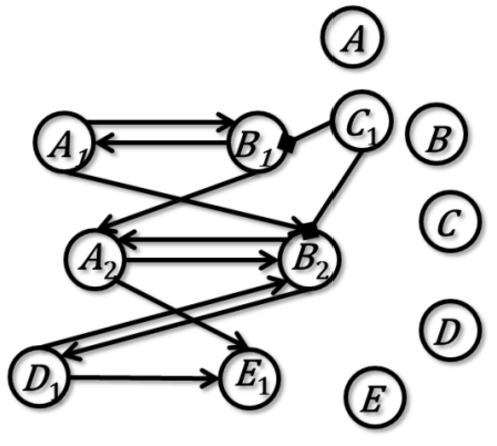
Note that the AF above has two conflicting preferred/stable extensions:
The examples show that our proposal sometimes produces interesting results where an extension provides a support for preferring itself and rejecting its rival extensions.
Consider an ATPC, over which the primary PAF
What if the primary PAF skeptically justifies no preference criteria?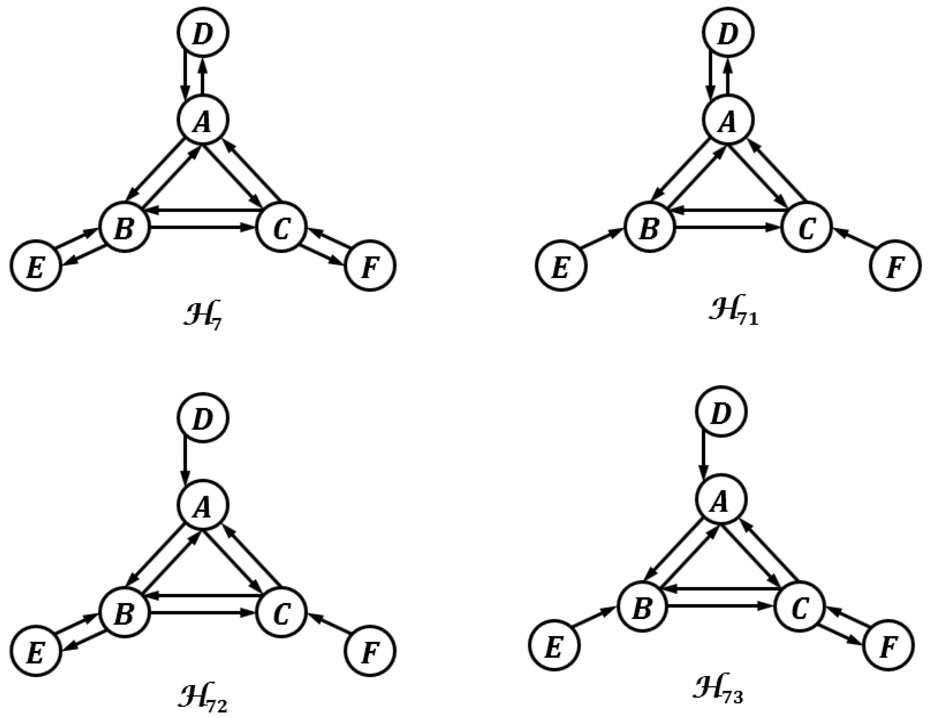
The primary PAF has four preferred/stable extensions:
A tree structure of PAFs.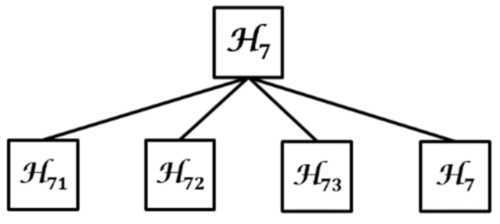
In Fig. 19, the primary PAF
As shown through the examples, if a sequence of PAFs is impossible due to lack of skeptically justified preference criteria, we can enumerate possible alternative conclusions by means of a tree structure of PAFs.
Preference is a common topic in the field of artificial intelligence (for more details, see [51]). Preferences can also be embedded into an AF that can serve as a core engine for reasoning under imperfect and inconsistent information in intelligent systems. In a PAF, a preference ordering over the set of arguments is embedded to filter the attack relation between arguments. However, some early PAFs [1,2,13,15,43] do not guarantee conflict-freeness of extensions. Since if one argument asymmetrically attacks another and the attackee is preferred to the attacker, then this attack is counted as failed one, and thus should be removed from the AF. This gives rise to a very unintuitive result where two conflicting arguments are in the same extension if the attack is failed. Therefore, several works [7,9,46] have been done to guarantee conflict-freeness in a PAF and make PAFs satisfy rationality postulates presented in [27].
One proposal is to define the notion of conflict-freeness in terms of attack (including failed attacks) rather than defeat (excluding failed attacks) in ASPIC+ framework. Modgil & Prakken argued that since attacks indicate the mutual incompatibility of the information contained in the attacking and attacked arguments, then intuitively one should continue to define conflict-free sets in terms of those that do not contain mutually attacking arguments [46]. Defining conflict-freeness of an extension in terms of attack, not defeat, make the framework satisfy rationality postulates, but violate Dung’s fundamental lemma. Thus, they defined a ‘reasonable’ argument ordering to make their framework satisfy Dung’s fundamental lemma. Another proposal which was made by [7] is to introduce preferences into the semantics level, not attack level. Instead of changing original attacks, they take into account preferences when determining the acceptability of arguments, i.e. at the semantics level. They define a semantics as a dominance relation on the powerset of the set
Amgoud & Vesic [8,9] also identified two roles that preferences may play in an AF: (1) handling failed (critical) attacks and (2) refining the result of a PAF. To make the preferences in their system play the second role, they defined two preference relations (called democratic and elicit) over the powerset of arguments. These relations are used to return the best among the extensions of the repaired AF. In this paper, we classify extensions into three categories: self-preferring extensions, self-discarding extensions and extensions that are neither self-preferring nor self-discarding. We can also set a preference ordering over these three categories. Our classification and ordering can be compared to Amgoud & Vesic’s preference relation over a powerset of arguments. Furthermore, Proposition 3 shows that our formalism makes preferences play two roles simultaneously.
The need to justify preferences before introducing them to reasoning has recently been emphasized in [38]. According to them, we do not have control over legal norms and their modification, but we can rather argue that one norm instead of another should be applied to a specific case. Governatori et al. also gave an example where a conflict between norms occurs and different criteria prefer different norms [38]. In legal reasoning, a lawyer should not only make an appeal to some of three criteria (Lex Superior, Lex Posterior and Lex Specialis which are appeared in Section 4.1), but also justify the criteria if a conflict between those criteria occurs as in their example.
For the sake of justifying preferences before reasoning from them, Booth et al. employ the model of so-called property-based preferences, where a preference ordering over arguments is derived from preferences over properties of the arguments. [23] Therefore, it can be regarded that, in [23], preferences are justified by the information on properties of arguments and change as the result of moving to different motivational states, which also bring about some change in argument properties. In ASPIC+, argument orderings are derived from the preferences over defeasible rules and ordinary premises, which are components of arguments. In our approach, those preferences over defeasible rules and ordinary premises are also justified by AFs. Furthermore, while Booth et al. deal with the justification of preferences in abstract argumentation [36], we integrate justifying preferences with reasoning from preferences in structured argumentation.
A proposal to use AFs for preference elicitation has appeared in [58]. Sedki explores the correlation between a given PQCL theory and a value-based AF and discusses using value-based AF for preference elicitation. Recently, Oguego et al. has proposed to use argumentation to manage user preferences [48]. They explore a generalized framework that can be used to handle conflicts among user preferences in ambient intelligence.
Preference learning has been a substantial topic in the field of artificial intelligence [50,51]. Learning or eliciting preferences means to acquire preference information in either direct or indirect way, from preference statements, critiques to examples, observation of user’s clicking behavior, etc. [51] However, learning preferences is different from justifying (or reasoning about) preferences. An agent rarely has a preference that holds under any condition. The agent rather has a preference that holds under a certain condition (for example, Yong Chol prefers red wine to white wine, given that the second course is fish). Therefore, learning preference not only means acquiring preference information (preference for red wine to white wine), but also stipulating the condition (given that the second course is fish) under which such preference information is justified. Nevertheless, a justified preference means that the condition attached to the preference has been satisfied. That is, justifying preference means proving that such condition attached to a preference has already been satisfied. Therefore, learning preferences is prerequisite to justifying preferences.
Modgil has acknowledged the non-prespecificity of the preference ordering of an AF [43]. As a result, he has proposed an extended argumentation framework (EAF) that enables even reasoning about preferences. He adopted recursive attack as the means of producing a preference ordering over two conflicting arguments. He extended Dung’s AF by adding a recursive attack relation which ranges from an argument to an attack between two arguments. His framework is powerful especially in resolving conflicts between incompatible preferences because it regards two arguments as being in a symmetric attack if they respectively attack an attack and the reversal of the attack. Later, the EAF has been extended to structured extended argumentation framework (SEAF), which satisfies rationality postulates for bounded hierarchical EAFs [44].
SEAFs allow a special kind of rule whose head is a rule (or ordinary premise) priority, and thus make it possible to construct arguments expressing preferences over other arguments. As a result, we can reason about preferences with SEAFs. On the other hand, SEAFs determine the recursive attack relation based on the rule priorities, which are conclusions of arguments. Therefore, we can also reason from preferences with SEAFs.
Here, four main points are worth remarking to compare our model with SEAFs. First, as already remarked, failed attacks are recursively attacked in SEAFs. This leads to finding a special set of defeats called a reinstatement set to determine whether an argument is acceptable or not with respect to a certain set of arguments. A reinstatement set for a defeat ensures that the defeat succeeded in surviving the recursive attack on it (for the definition of reinstatement set, see [43]). In our formalism, failed attacks are removed from a framework as in some others such as deductive argumentation and ABA+.
The second difference concerns the fact that our formalism adopts the notion of preference criteria, while SEAFs use the special kind of rule in order to model the way in which we justify or reason about preferences. In fact, every preference criterion can be converted into one or more rules whose heads are rule (or ordinary premise) priorities.13
Since every preference criterion can be converted into the special rules, justifying preferences and reasoning about preferences, we think, can be seen as having the same meaning if they are broadly understood. They all mean giving support or reason for applying the preferences or explaining why the preferences should be adopted. In this paper, we use the term “justifying” instead of “reasoning about” simply for differentiating our model from SEAFs.
Intuitively, it should be avoided that inconsistent preferences are justified together and thus applied to an AF. If an argumentation formalism allows rules whose heads are rule priorities, it should also include the special kind of strict rules regarding rule priorities. For example, Modgil and Prakken’s extended argumentation theory contains strict rules axiomatising partial orders such as
In our formalism, since preference criteria are employed, the conflicts among arguments due to preferences are usually concealed. In Example 5, it looks like that, intuitively, there is a conflict between B and C because C demotes B, but this is not a part of this AF. Nevertheless, SEAFs makes such a kind of conflicts come to the fore by means of recursive attack (if we had built EAF, we could produce a recursive attack from C to
Third, SEAFs should allow collective attacks (or joint attacks as coined by the others [36,47]), while our model does not. As noted earlier, an argument ordering is derived from the preferences over defeasible rules or ordinary premises in both SEAFs and our framework. Then, single argument may contain more than one defeasible rules or ordinary premises. Therefore, a defeasible rule (or ordinary premise) priority that is the conclusion of a SEAF argument may not be enough for determining that an argument is preferred to another. Therefore, it becomes possible for two or more arguments to collectively (and recursively) attack an attack in order to undermine the success of the latter as defeats [44].
Fourth, we can contrast our model with Modgil and Prakken’s SEAFs, in which all reasoning about preferences is catered for in a single EAF. In contrast, an ATPC is used for building a sequence of PAFs, where a PAF plays the role of the reasoning mechanism for justifying preferences that the next PAF is to rest on.
In fact, it has shown that some EAFs can be converted into hierarchical AFs
Here, it is remarkable that our approach can be closely related with dynamics of AFs [21,22]. Let
Given two AFs
It is central issue in dynamics of AFs to stipulate some principles, by which we can expect the outcome of a changed AF. Such principles are usually of the form “If an argument (or an attack) is removed (or added), such that a given property
One of the important problems of AF dynamics is a semantical defect of an agent’s AF which prevents her from drawing any plausible conclusion in the sense that no argument is accepted, or prevents her from drawing enough conclusions in the sense that the accepted arguments are not enough for giving answers she wants [12].15
In [40], Baumannn and Ulbricht define a semantical defect of an AF as a situation where it is impossible to draw any plausible conclusion because no argument is accepted. In this paper, I have broadened the meaning of semantical defect. A semantical defect of an agent’s AF may also include a situation where it is impossible to draw enough conclusions for giving needed answers even though the AF includes arguments which gives such answers. This kind of situations usually comes into being when an AF has multiple extensions and thus skeptically accepted arguments are not enough for giving the answers an agent wants. For instance, in Example 3, only E is skeptically accepted, which concludes that the robot is near the store. However, this is not an answer that the agent wants. The robotic agent should decide which boxes to carry first.
EAFs and SEAFs have also been carefully studied under the grounded semantics. It is shown that the grounded extension of a special kind of EAF called bounded hierarchical EAF is the least fixed point of its characteristic function.16
Generally, given an AF
Let
The above proposition shows that the sequence of PAFs built over an ATPC brings about a monotonic increase in grounded extension as the justified preferences change. As a result, in the sequence, an accepted argument by a PAF under grounded semantics cannot be rejected by the subsequent PAFs.
Bench-Capon et al. has also recognized the non-prespecificity of a value order and proposed a novel solution to the problem of producing value orders [15]. According to them, ‘we cannot assume that the parties to a debate will come with a clear ranking of values: rather these rankings appear to emerge during the course of the debate.’ They defined a dialogue process for evaluating the status of arguments in a value-based AF. The dialogue process can be used to construct positions by which the orderings of values will be determined. They adopted the dialogue framework that was developed to prove the acceptability of arguments in AFs [15, Section 6].
The audience-dependency of preferences (or value orders) in an AF was addressed in value-based AFs [13,15]. Perrussel et al. also defined multiple PAF to model the intuition that different agents have different preferences [49]. However, even a single agent may promote different preferences in different contexts. An agent will select a preference criterion only if he notices that the condition, under which the criterion is justified, is satisfied in a specific context. Our formalism reflects this intuition by borrowing the notion of guard from [60]. Teze et al. proposed a recommender system which uses justified preference criteria [60]. They introduced the notion of conditional-preference expressions (somewhat like the notion of a conditional preference network [29]) that represents IF
Many successful preference-based and value-based AFs prove the usefulness of preferences or value orders taken as an input of the AF. Nonetheless, preferences in an argumentation or value orders in a practical reasoning are not ‘universal presuppositions’, thus, they should also be an output of an argumentation or reasoning [15]. This leads us to building a model where both justifying preferences and determining acceptable conclusions by taking the preferences into account are possible. In this paper, we have argued that a PAF built over an argumentation theory should adopt preferences that have been justified by another framework with the same arguments and attack relations. Hence, we propose to build a sequence of PAFs over an argumentation theory, where a PAF justifies preferences that the next PAF is to be based on.
On the other hand, justifying preferences is reduced to justifying criteria behind them with available information in a context. Accordingly, we modify the notion of APSIC+ argumentation theory with preference criteria and as a result, an ATPC is defined
It is very interesting that in a standard ASPIC+ framework, preferences may not only be used for filtering the attack relation, but also for filtering the extensions of the original AF (Proposition 1). It also makes it possible for us to build such a sequence of PAFs over an ATPC.
The sequence of PAFs built over an argumentation theory with preference criteria (ATPC) involves two or more individual PAFs: primary PAF, advanced PAF, third PAF and so on. The primary PAF is for justifying preferences and the advanced PAF is for concluding or determining acceptable statements. The primary PAF takes into account only the preference criteria whose guards are empty set, while the advanced PAF takes into account the preference criteria justified by the primary PAF. Our formalism has also been thoroughly discussed through some examples. Especially, Example 6 shows that our proposal accords well with practical wisdom when some attributes of an object that is under consideration depend on each other. Let us consider Example 6 again.
(cont.).
Let us replace the theory
When we decide which object or course of action to choose, their attributes should be considered. The selection of an object or a course of action derives from an ordered set of their attributes. For example, if a house is close to work but not large and an agent prefers size to distance to work, then the agent will not choose the house, although it is close to work. In contrast, if the agent prefers distance to work to size, then he will choose the house, although, it is not large. Deriving preferences over objects from ordered sets of their attributes was deeply studied in [40]. However, sometimes, some attributes of an object or course of an action may be dependent each other. Here, dependence of attributes means that one attribute is helpless without the presence of the other attribute. For example, the highness of a computer CPU is dependent on the largeness of its RAM. The high CPU of a computer should be backed up by a large RAM, that is, if the RAM capacity of a computer is not large, its CPU whose speed is high is helpless.17
Here, the term “helpless” does not mean that the CPU is useless, but means that the high CPU speed is useless (i.e. even low CPU speed is OK). That is, when the RAM capacity is not large enough, it will be rather better off using a cheaper CPU whose speed is low, instead of high and expensive CPU.
Footnotes
Acknowledgements
I would like to thank the anonymous reviewers for their comments and suggestions that helped me to improve the paper.