






Abstract
John Pollock (1940–2009) was an influential American philosopher who made important contributions to various fields, including epistemology and cognitive science. In the last 25 years of his life, he also contributed to the computational study of defeasible reasoning and practical cognition in artificial intelligence. He developed one of the first formal systems for argumentation-based inference and he put many issues on the research agenda that are still relevant for the argumentation community today. This paper presents an appreciation of Pollock's work on defeasible reasoning and its relevance for the computational study of argument. In our opinion, Pollock deserves to be remembered as one of the founding fathers of the field of computational argument, while, moreover, his work contains important lessons for current research in this field, reminding us of the richness of its object of study.
Introduction
John Pollock (1940–2009) was an influential American philosopher who made important contributions to various fields, including epistemology and cognitive science. In the last 25 years of his life, he also contributed to artificial intelligence (AI), first to the study of defeasible reasoning and then to the study of decision-theoretic planning and practical cognition. In his work on defeasible reasoning, Pollock developed one of the first formal systems for argumentation-based inference and he put many issues on the research agenda that are still relevant for our community today. This paper reviews the relevance of Pollock's work on defeasible reasoning for the computational study of argumentation.1 We will confine ourselves to argumentation-based inference, since Pollock never studied argumentation-based dialogue.
There are many reasons to remember and acknowledge Pollock's work in this journal. Many important topics in our field were first studied by Pollock, or first studied in detail, such as argument structure, the nature of defeasible reasons, the interplay between deductive and defeasible reasons, rebutting versus undercutting defeat, argument strength, argument labellings, self-defeat, and resource-bounded argumentation. Another reason to remember Pollock is that, these days, several lessons to be learned from his work tend to be forgotten and several important issues that he studied tend to be neglected for the sake of technical simplicity but at the expense of cognitive adequacy – especially in two current research strands: namely, work on abstract argumentation and work on classical and deductive argumentation. This is particularly unfortunate since a central virtue of an argumentation approach is its grounding in natural and intuitive concepts; if conceptual naturalness is sacrificed for technical simplicity, then our field is in danger of becoming sterile and inward looking and failing to realise its high potential. A secondary aim of this paper, therefore, is to use Pollock's legacy to remind the research community of the richness of its object of study.
A concise quote that summarises Pollock's view on defeasible reasoning is as follows: Defeasible reasoning is,
Pollock thus depicts arguments as inference trees, where the nodes are statements, with the leaf nodes being premises, and the links are applications of ‘reasons’. He thus regarded reasons as inference rules, but he did not identify inference rules with deductive inference rules alone. Pollock strongly emphasised the importance of Pollock varied in his terminology: in his earlier papers, he exclusively spoke of ‘conclusive’ and ‘prima facie’ reasons, while later he also referred to ‘deductive’ and ‘defeasible’ reasons (and sometimes to ‘inference rules’ instead of ‘reasons’). We will speak of deductive and defeasible reasons/inference rules. By ‘deductive argumentation’, we mean argumentation where all arguments are built with deductive inference rules, and by ‘classical argumentation’, we mean the special case of deductive argumentation where the inference rules consist of all valid propositional or first-order inference rules. It is supposed that defeasible reasoning is less secure than normal reasoning, and should be countenanced only for the sake of computational efficiency. Its use is not just a matter of computational efficiency. It is logically impossible to reason successfully about the world around us using only deductive reasoning. All interesting reasoning outside mathematics involves defeasible steps. (Pollock 1995, p.41) … we cannot get around in the world just reasoning deductively from our prior beliefs together with new perceptual input. This is obvious when we look at the varieties of reasoning we actually employ. We tend to trust perception, assuming that things are the way they appear to us, even though we know that sometimes they are not. And we tend to assume that facts we have learned perceptually will remain true, as least for a while, when we are no longer perceiving them, but of course, they might not. And, importantly, we combine our individual observations inductively to form beliefs about both statistical and exceptionless generalizations. None of this reasoning is deductively valid. (Pollock 2009, p. 173)
Starting in the 1980s, Pollock set out to formalise this view of defeasible reasoning and then to implement it in an automated reasoner that he baptised as OSCAR. Besides giving a general account of the structure of arguments and of the interplay between deductive and defeasible inferences, he also formalised particular defeasible reasons that he found important in human cognition. In particular, he formalised reasons for perception, memory, induction, the statistical syllogism, and temporal persistence, as well as the so-called undercutting defeaters for these reasons. Pollock extensively studied the problem of identifying the justified beliefs generated by a set of arguments and their defeat relations, and his various solutions to this problem predated much current work on argumentation-based semantics.
In what follows, we first give a historic sketch of Pollock's work and its relation with other work in philosophy and AI. We then review the essentials of his formal models, after which we critically examine some of the current work on deductive argumentation in light of Pollock's work. We end with some observations on Pollock's way of working and thinking and a summary of his contributions to our field.
In modern philosophy, the study of defeasibility and defeat originated in legal philosophy, in the work of Hart (1949), who pointed out, first, how otherwise binding contracts might be compromised by the presence of defeating conditions and later emphasised the defeasible nature of legal rules in general. The concept of defeasibility – echoing Ross's notion of prima facie rules Ross (1930) as well as some of Wittgenstein's ideas – was originally studied solely within legal philosophy, practical reasoning, and ethics. It made the jump from ethics to epistemology in the work of Chisholm (1957), who appealed to the idea in both fields, and later in the work of Pollock, beginning with his (1970) and developed in a number of articles leading up to his (1974) and beyond.
Pollock's work on argumentation originated as an attempt to make formal sense of the intuitive notion of defeasible reasoning that seemed to be at work in these papers and books. In fact, the task had been attempted before. There is an early paper by Chisholm (1974), a heroic effort whose failure is no surprise given the limited tools available at the time. Still, in spite of the blossoming of philosophical logic in the 1960s and 1970s, the logical study of defeasible reasoning had received almost no attention at all. It is fair to say that Pollock, working in isolation, was the first philosopher working in the field of philosophy, as opposed to computer science, to outline an adequate framework for defeasible reasoning
Pollock's initial paper on the topic was his classic (1987). By the time that paper was published, several researchers in AI had independently begun to explore an argument-based approach to defeasible, or non-monotonic, reasoning. This early research includes the work of Touretzky (1986) on inheritance systems, later developed along with several collaborators (Horty, Thomason, and Touretzky 1987, 1990; Touretzky, Horty, and Thomason 1987), as well as the work of Nute (1988) and Loui (1987). And of course, by the late 1980s, the field of non-monotonic reasoning more generally, of which the argument-based approach was only a part, had been recognised as an important subfield of AI. Although Pollock's ideas originated in his efforts to understand defeasible reasoning in a philosophical context, it was the formation, within AI, of a community of researchers focused on non-monotonic reasoning that led to the publication of these ideas. Concerning his 1987 paper, Pollock later wrote that he first developed the idea in 1979, but that he did not initially publish it because, as he says, ‘being ignorant of AI, I did not think anyone would be interested’ (Pollock 2007b, p. 469). It is interesting to note that if Pollock had published this idea when it first occurred to him, the result would have been not only the first argument-based theory of defeasible reasoning, but also one of the first systems of any kind for non-monotonic reasoning.
In any case, the paper was eventually published and then several successive papers or books on argumentation and defeasibility (Pollock 1992, 1994, 1995, 2002, 2007a,b, 2009, 2010), and Pollock began a fruitful period of interaction with researchers in non-monotonic reasoning, AI more generally, and of course, argumentation. Although Pollock learned much from these communities, they also learned much from him. Research in non-monotonic reasoning, at the time, was motivated by a set of concerns from planning, logic programming, knowledge representation, and database theory. Pollock brought a fresh set of concerns, from his earlier work in traditional epistemology, along with some fresh ideas. The most important of these may have been the distinction, introduced by Pollock (1970) between two separate kinds of defeat: rebutting and undercutting. In fact, something like this distinction had emerged independently in the field of knowledge representation, in the ‘uncancel’ links from Fahlman's (1979) semantic networks; but the idea quickly evaporated in the formal treatments of these networks, for reasons of theoretical simplicity. It was Pollock's insistence on the importance of this distinction, for reasons of descriptive adequacy, that reintroduced it into the fields of non-monotonic reasoning and argumentation, where it has remained vitally important, for example, in representation problems involving legal reasoning. Indeed, Pollock's idea of an undercutting defeater is closely related to the notion of an exclusionary reason, first introduced by Raz (1975), who himself cites Pollock; for more recent work linking the two ideas, see Horty (2012).
A closer look at Pollock's work on defeasible reasoning
Let us now take a closer look at Pollock's approach to modelling defeasible reasoning. His first paper with a formal system for argumentation-based defeasible reasoning was his (1987), but he published several later versions, notably his (1992, 1994, 1995, 2002, 2009), largely because he changed his mind on several design issues, especially on the characterisation of defeasible inference, and on the notion of argument strength.
Constant features
There are several constant features in Pollock's formalisation of defeasible reasoning. Reasoning proceeds from a knowledge base of classical-logic formulas by chaining reasons into inference trees, where all reasons are either deductive or defeasible. Only applications of defeasible reasons can be defeated, and there are two kinds of defeaters:
Pollock's technical presentation of his system differs with his different publications, but the basic ideas can be sketched as follows. Technically, Pollock considers sequences of
The
Defeat among argument lines and arguments
An argument line An argument
Consider by way of example the following (informal) version of the well-known Tweety example, with the arguments displayed in tree form (as is well known, each deduction can be converted into an inference tree, while each inference tree can be converted into several deductions, each capturing an order in which a reasoner can construct the tree). Figure 1 shows three (maximal) arguments: two arguments for the conclusions that Tweety flies, respectively, does not fly, and an argument denying that the reason used to infer the first of these conclusions applies.
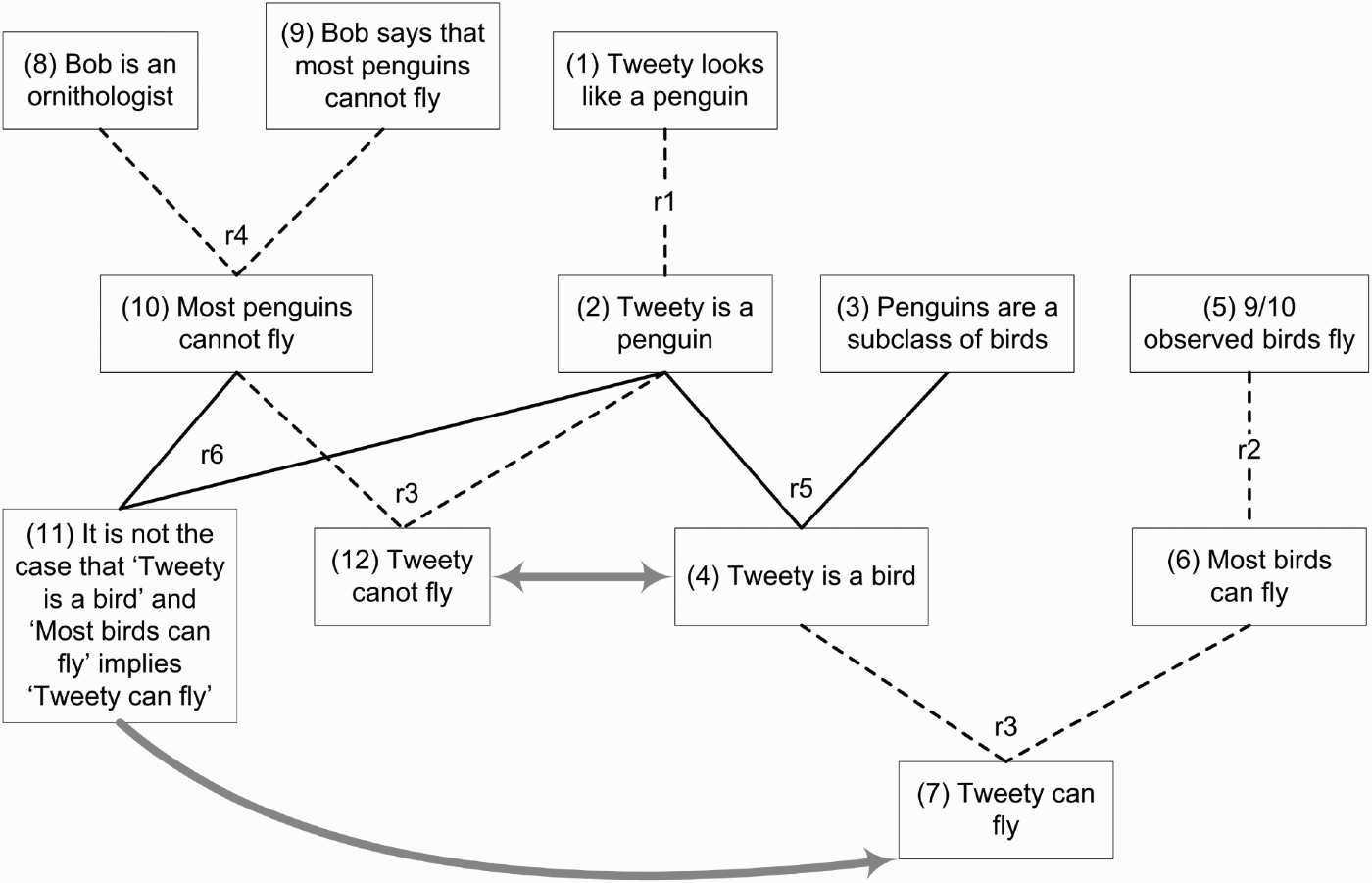
An example.
Figure 1 assumes four defeasible inference rules, informally paraphrased as follows:
That an object looks like having property
That
That most
That an ornithologist says ϕ about birds is a defeasible reason for believing ϕ
Rule
Moreover, Figure 1 assumes an obvious strict inference rule plus an undercutting defeater for
That
That
Rule
With these inference rules made explicit, the three arguments can be formally represented as follows (ignoring strength, so that argument lines can be depicted as triples rather than as four-tuples):
(Tweety looks like a penguin, fact, ∅) (Tweety is a penguin, (Penguins are a subclass of birds, fact, ∅) (Tweety is a bird, ( (Most birds can fly, (Tweety can fly, (Tweety looks like a penguin, fact, ∅) (Tweety is a penguin, (Penguins are a subclass of birds, fact, ∅) (Bob is an ornithologist, fact, ∅) (Bob says that most penguins cannot fly, fact, ∅) (Most penguins cannot fly, (¬ (Tweety looks like a penguin, fact, ∅) (Tweety is a penguin, (Bob is an ornithologist, fact, ∅) (Bob says that most penguins cannot fly, fact, ∅) (Most penguins cannot fly, (Tweety cannot fly, In systems like the
Note that these arguments have several ‘subarguments’, since any sequence of lines of which all elements are a fact or inferred from previous elements in the sequence is an argument.3
In Figure 1, deductive, respectively, defeasible, inferences are visualised with, respectively, solid and dotted lines without arrow heads, while defeat relations are displayed with arrows. Naming arguments according to their last line, it can be seen that argument
As should be apparent from this example, Pollock's notion of an argument as a tree or sequence of inferences is quite natural; its only remarkable features are that arguments interleave application of deductive and defeasible inference rules and that arguments can have varying strengths. His notion of defeat is also quite natural. First, given that deductive reasons provide conclusive support for their conclusion, it is natural that their application cannot be attacked: one cannot at the same time rationally accept the premises and deny the conclusion of a deductive inference. Second, Pollock's distinction between rebutting and undercutting defeat, while new when he introduced it in 1970, has meanwhile proven its value.4 Although some terminological confusion has arisen since others (Krause, Ambler, Elvang-Gøransson, and Fox 1995, Besnard and Hunter 2001, 2008, Amgoud and Cayrol 2002) have used it for attack on a premise instead of on the application of a defeasible inference rule.
While, throughout his career, Pollock left his notions of argument construction and defeat essentially unchanged, he more than once changed the semantics for his system. For Pollock, a
In his initial paper (Pollock 1987), after specifying an argument as
Semantics of Pollock 1987
All arguments that are not self-defeating arguments are An argument is An argument is
In the example shown in Figure 1, all displayed arguments are
Dung (1995) proved that if there are no self-defeating arguments, then Definition 3.1 is equivalent to his grounded semantics. More precisely, Dung first observed that the ideas from Definition 3.1 can be defined in terms of a operator that, for a given set of arguments, returns the set of arguments undefeated by any argument in that set. Dung then proved that his ‘characteristic function’ of argumentation frameworks, which for a given set of arguments returns all arguments all of whose defeaters are themselves defeated by some argument from that set, can be defined as a double application of this operator. Finally, Dung proved that Pollock's own level construction yields the least fixed point of this characteristic function, leading to what Dung calls the grounded extension.
After his initial semantics, Pollock later (1994, 1995) turned to a labelling-based approach, which, moreover, does not refer to arguments but instead relies on the notion of an The theory of defeasible reasoning adumbrated in this book is an ‘argument-based’ theory, in the sense that it characterizes defeasible consequence in terms of the interactions between the inference steps of all possible arguments that can be constructed from a given set
Pollock's new definition moves through the idea of a partial defeat status assignment, which again labels nodes as in or out, to that of a maximal defeat status assignment, which is as complete a status assignment as possible. Arguments are then characterised as ultimately undefeated, defeated outright, or provisionally defeated depending upon their behaviour in the various maximal status assignments.
Semantics of Pollock 1994, 1995
σ assigns σ assigns σ assigns
A
In the example shown in Figure 1, lines 1, 3, 5, 8, and 9 must be assigned
Jakobovits (Jakobovits and Vermeir 1999; Jakobovits 2000) proved Definition 3.3 to be equivalent to another of Dung's proposals, the preferred semantics. Indeed, it is easy to see that the conditions on defeaters in (2) and (3) are the same as the conditions of preferred labellings in the sense of Caminada (2006). Such labellings label arguments of a Dung-style abstract argumentation framework as in, out, or undecided, in a way that satisfies the following constraints:
An argument is An argument is An argument is
A labelling is
The main reason for Pollock changing his mind between 1987 and 1994 was to refine his treatment of self-defeating arguments. While in his (1987) semantics, they were all unable to affect the status of other arguments, Pollock later realised that there are two kinds of self-defeating arguments, one of which should still be capable of preventing other arguments from being ultimately undefeated. The first kind of self-defeat he considered results in a situation in which two arguments for contradictory conclusions rebut each other (see Figure 2; in the examples given below, we assume for simplicity that all arguments are of equal strength).
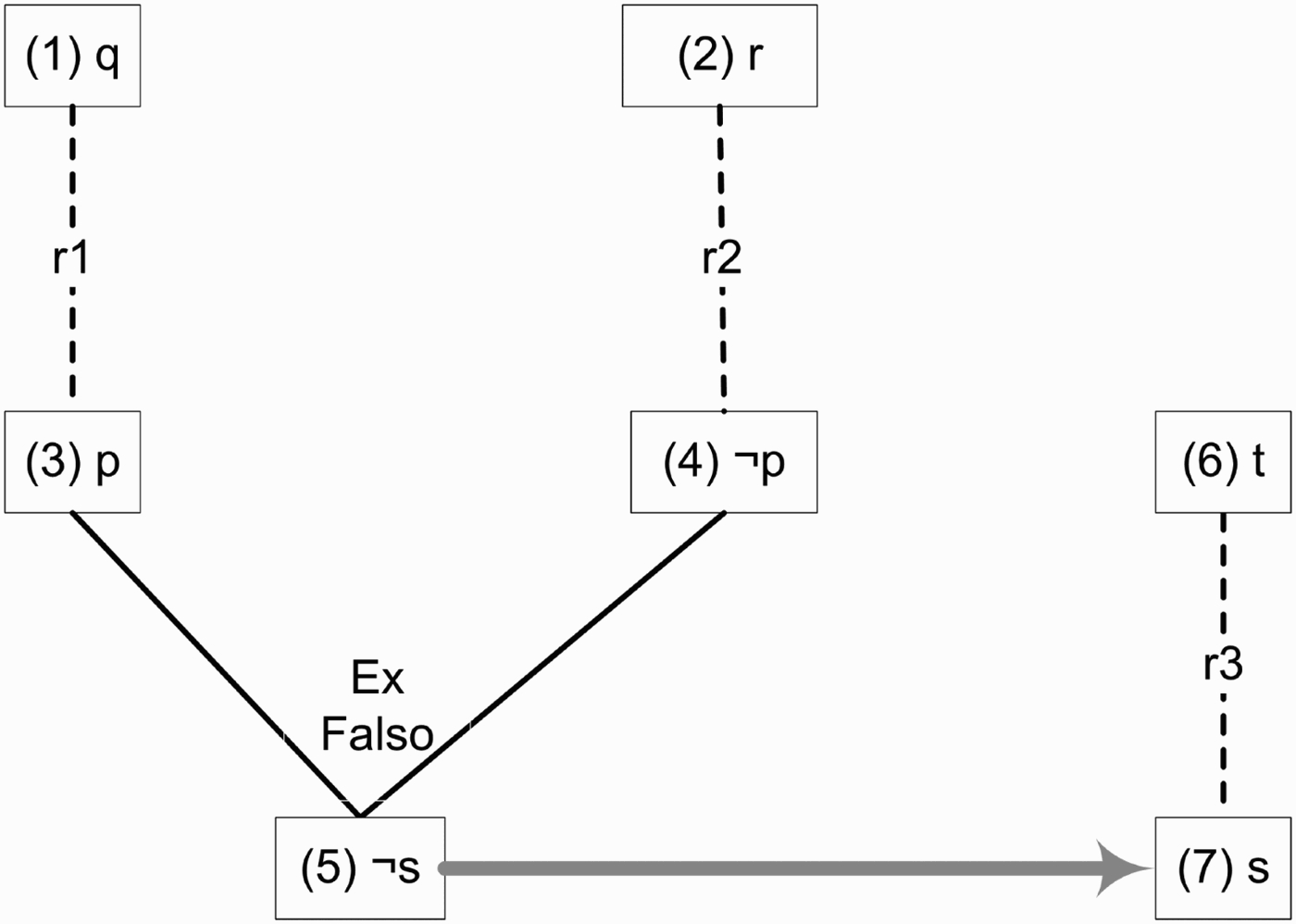
Parallel self-defeat.
Here,
However, there is a second kind of self-defeating argument, which should be able to prevent other arguments from being justified. Consider the following version of the argument scheme from witness testimony plus an undercutter in case the witness is incredible:
That a witness says ϕ is a defeasible reason for ϕ
That a witness is incredible is a deductive reason for ¬
Assume as given that Witness John says that he is incredible. Then (again ignoring strength), we can construct the following argument (on the left of Figure 3):
(Witness John says he is incredible, fact, ∅) (John is incredible,
Indeed, it violates Caminada and Amgoud's (2007) rationality postulate of closure of argument extensions under deductive inference. (Witness John says that the suspect stabbed the victim, fact), ∅) (The suspect hit the victim, In fact, Caminada (2005) showed that this treatment of self-defeat is not yet optimal. Consider again two rebutting arguments combined with Ex Falso to an argument for any proposition. Pollock thought that always at least one of the rebutting subarguments would be
The argument up to line 3 is self-defeating, since line 3 undercuts line 2. Thus, according to Definition 3.1, the argument up to line 3 is at no level
According to Definition 3.1, line 5 is ultimately undefeated, while yet it is based on a statement of a witness who says of himself that he is incredible. This seems counterintuitive. By contrast, according to Definition 3.3, line 5 is also defeated outright, since its status is undefined.6
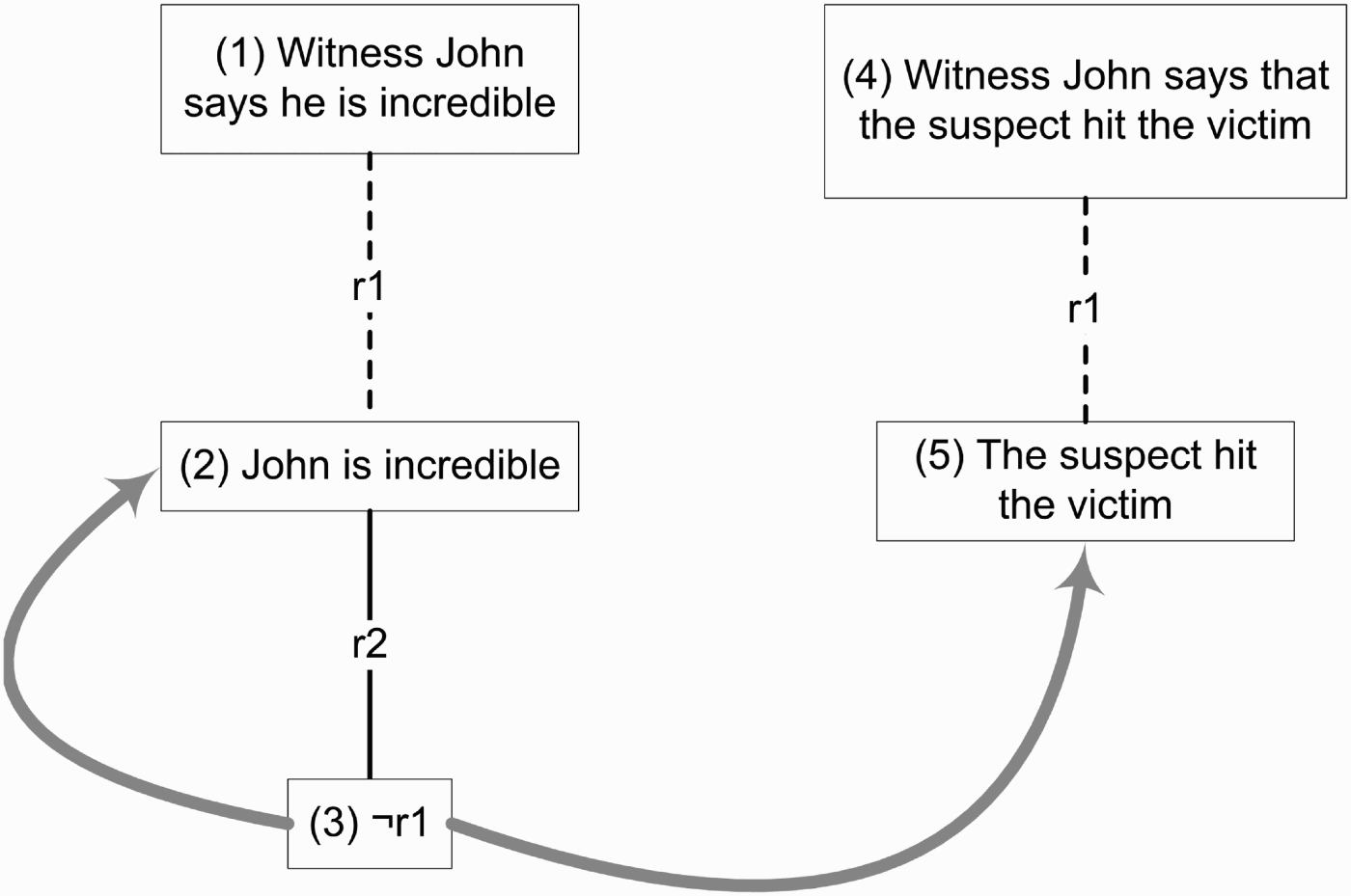
Serial self-defeat.
In conclusion, Definition 3.3 captures that there are two classes of self-defeating arguments, which are both always defeated outright, but one of which still has the power of preventing other arguments from being ultimately undefeated. This observation also implies that self-defeating arguments cannot simply be ruled out from consideration by definition.
In one of his last publications (2009), Pollock again revised his semantics, motivated by concerns similar to those of Baroni and Giacomin (2005). He realised that his (1994) and (1995) distinction between two types of self-defeat in fact also gave different treatments to odd and even defeat cycles of arbitrary length, and he regarded that as counterintuitive. Let us extend the above example by replacing the single self-defeating witness with first an even defeat cycle of two witnesses and then an odd defeat cycle of three witnesses (Figure 5). Suppose first we have two witnesses Albert and Bob, who say of each other that they are unreliable, thus undercutting each other. Imagine also that Albert and Donald rebut each other on the issue whether the suspect hit the victim. We then have two maximal labellings: in one, lines 3 and 8 are in, while lines 6 and 10 are out, so both lines 8 and 10 are provisionally defeated and we can believe neither Bob nor Donald on whether the suspect hit the victim. However, consider next three witnesses Albert, Bob, and Carole, where Albert says that Bob is unreliable, Bob says that Carole is unreliable, and Carole says that Albert is unreliable, while Albert and Donald still rebut each other on whether the suspect hit the victim (Figure 6). Then, there is only one maximal labelling, in which line 10 is in while line 8 is out (and all of 3, 6, and 13 undecided). We cannot create a labelling in which we believe both Albert and Carole but not Bob or Donald, since Albert and Carole are involved in an odd defeat cycle. So, this yields that line 10 is ultimately undefeated while line 8 is defeated outright, so we can believe Donald that the suspect did not hit the victim. Thus, the justification status of Donald's testimony depends on whether its attacker, Albert, is involved in an odd or an even defeat cycle. Baroni and Giacomin (2005) and Pollock (2009) regard this as counterintuitive.7 Against this this, Bench–Capon, personal communication, has argued that odd and even defeat cycles are logically different. According to him, odd defeat cycles are paradoxes, while even defeat cycles are dilemmas. If he is right, then a different treatment of odd and even defeat cycles is justified and Pollock would not have needed to revise his (1994, 1995) semantics.
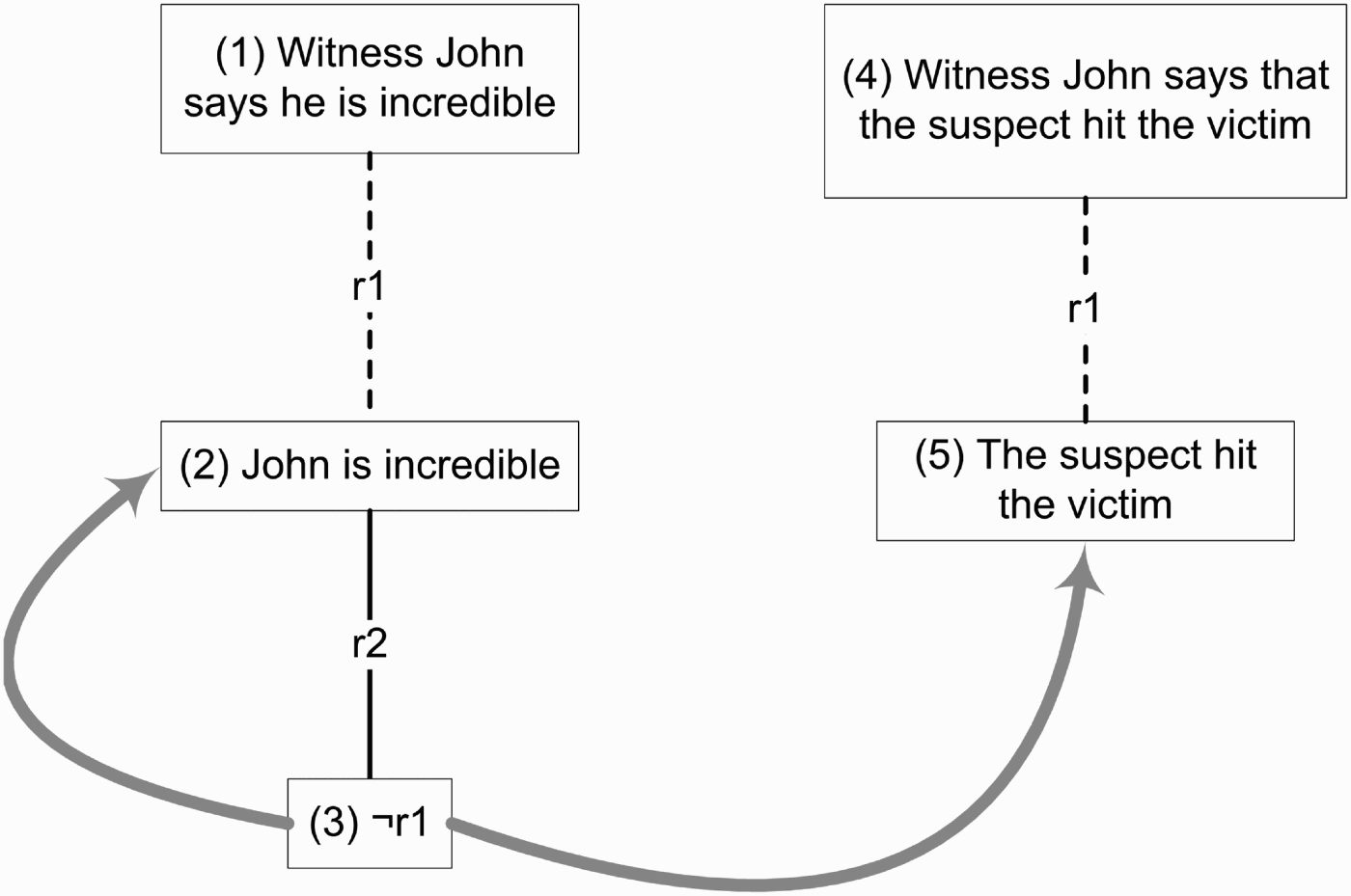
A self-defeating witness.
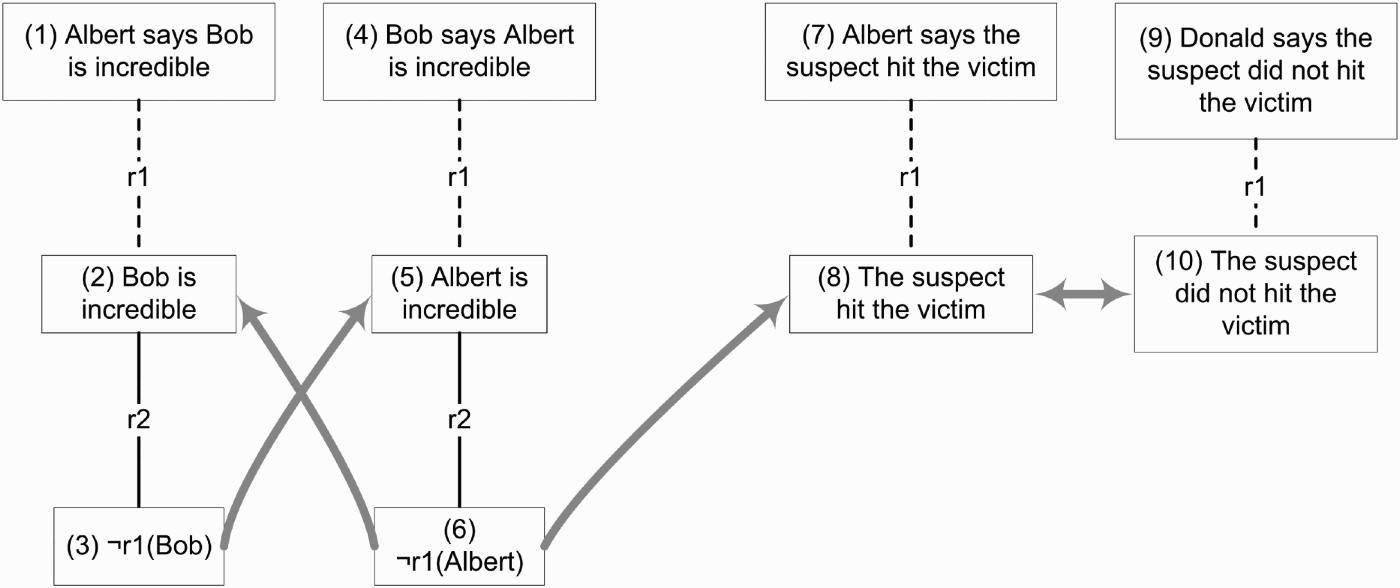
An even defeat cycle.
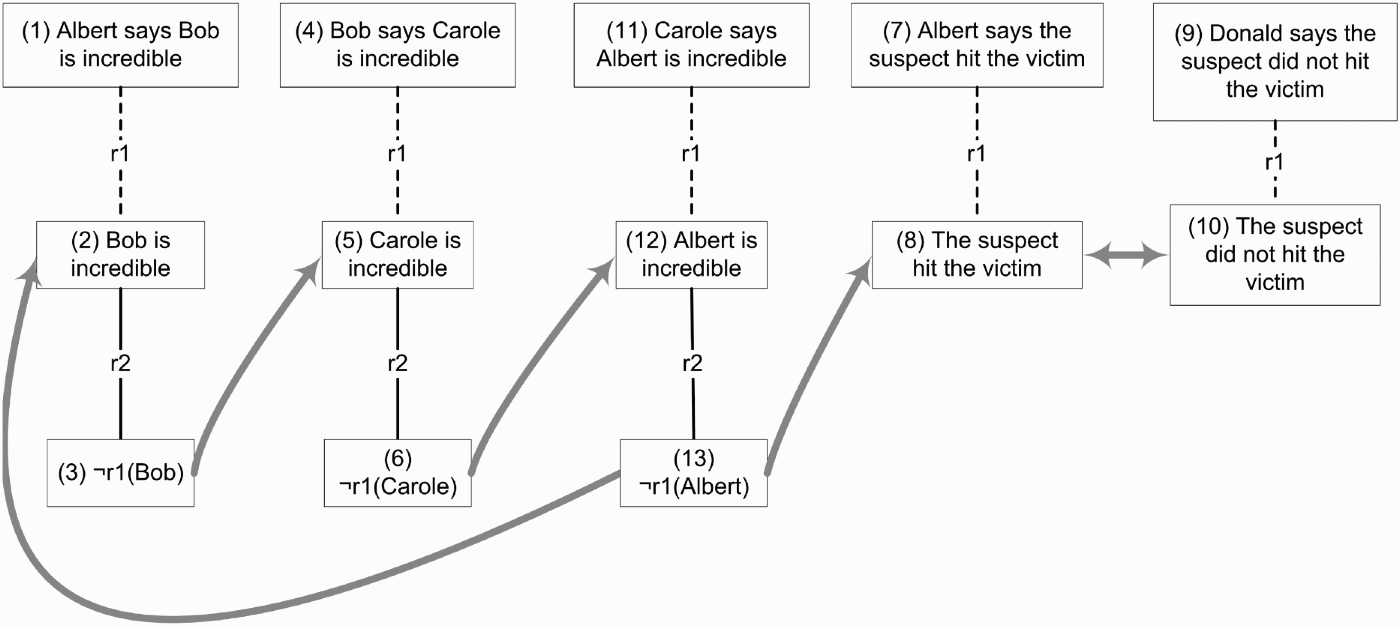
An odd defeat cycle.
Although Pollock's earliest system, from 1987, did not yet include a notion of strength, Pollock later took the notion of strength of arguments very seriously. Since his system was meant for epistemic reasoning, he always formulated strength in terms of numerical degrees of belief. He was interested in computing the degree of justification of a statement
In his papers published in 1994 and 1995 (Pollock 1994, 1995), Pollock used a weakest-link approach to compute the strength of arguments: the strength of each conclusion is the minimum of the strengths of the inference with which it was derived and of the premises or intermediate conclusions from which it was derived. While these arguments can have various strengths, defeat is still an all-or-nothing matter in that defeaters that are weaker than their target cannot affect the status of their target at all. In consequence, the justification status of a proposition for which arguments can be constructed is three valued: arguments can be ultimately defeated, ultimately undefeated, or provisionally defeated. However, in his (2002, 2007a, 2010), Pollock explored the idea that weaker defeaters can still weaken the justification status of their stronger targets. To formalise this, he now made the justification status of statements a matter of numerical degree, being a function of the strengths of both supporting and defeating arguments. In fact, Pollock seemed not fully sure that his 2002 account was the right one, witness the following quote: In my (1995) I extended the above semantics to deal with reason strengths, but I am now convinced that the (1995) proposal was not correct. I tried again in my (2002), and that semantics or a minor variation of it may be correct, but I have not yet implemented it in OSCAR. (Pollock 2007b, p. 459)
Defeasible reasons and argumentation schemes
An important distinguishing feature of Pollock's account of defeasible inference rules is that he meant them to be general patterns of reasoning. While in AI there is a tradition to let defeasible inference rules express domain-specific information, as in, for example, default logic of Reiter (1980), Pollock's defeasible reasons are general patterns of epistemic defeasible reasoning. In particular, he formalised reasons for perception, memory, induction, temporal persistence and the statistical syllogism, as well as undercutters for these reasons. Here is how he contrasted his work with default logic: In spirit, the theory of defeasible reasoning seems close to Reiter's default logic 34, with prima facie reasons and defeaters corresponding to Reiter's defaults. But there are also profound differences between the two theories. First, prima facie reasons are supposed to be logical relationships between concepts. It is a necessary feature of the concept red that something's looking red to me gives me a prima facie reason for thinking it is red. (To suppose we have to discover such connections inductively leads to an infinite regress, because we must rely upon perceptual judgments to collect the data for an inductive generalization.) By contrast, Reiter's defaults often represent contingent generalizations. If we know that most birds can fly, then the inference from being a bird to flying may be adopted as a default. In the theory of defeasible reasoning, the latter inference is instead handled in terms of the following prima facie reason schema: Most A's are B's, and this is an A is a prima facie reason for B … This is the statistical syllogism … (Pollock 1992, p. 9).
There is an interesting connection here with the literature of argumentation schemes (Walton, Reed, and Macagno 2008). Argumentation schemes are stereotypical non-deductive patterns of reasoning. Their use in building arguments is evaluated in terms of critical questions specific to a scheme. In the literature on argumentation theory, many collections of argumentation schemes have been proposed, for both epistemic and practical reasoning. Pollock's defeasible inference rules can in fact be seen as formalisations of some epistemic argumentation schemes. This also suggests a way to formalise reasoning with argumentation schemes (Prakken 2010b): they can be seen as defeasible inference rules and critical questions can be regarded as pointers to counterarguments. Some critical questions challenge an argument's premise and therefore point to premise attacks, others point to undercutting attacks, while again other questions point to rebutting attacks. Pollock's emphasis on the general nature of defeasible reasons plus his distinction between rebutting and undercutting defeat provided a basis for a formal framework for modelling reasoning with argumentation schemes; the
Suppositional reasoning
In his earlier work, Pollock extended his system with suppositional reasoning, by allowing sets of assumptions to be introduced into and retracted from lines of argument just as in natural deduction. This validates, for example, a defeasible derivation of the material implication
Partial computation
Pollock also addressed the issue of partial computation. To deal with the intractability of the full version of his system, he suggested several alternative notions of defeat status, all making his system non-monotonic not just in the set of input beliefs but also in the amount of computation. One of these notions, ‘justification’, simply computes defeat status relative to the inference graph computed at a certain moment. Pollock also developed an alternative notion of adequacy of algorithms for defeasible reasoning, given that to be tractable, they cannot be sound and complete with respect to the ideal, that is, with respect to the set of all arguments that can be computed. For the details, we refer the reader to (Pollock 1995, chap. 4).
A critique of current computational models of argument in light of Pollock's work
Much current formal and computational work on argumentation is on abstract argumentation, as introduced by Dung (1995). However, to be useful and realistic, abstract models must be combined with accounts of the structure of arguments and the nature of attack and defeat. While this should be obvious, it is less obvious what such accounts should be. While almost all early work on argumentation in AI made a distinction between deductive (or ‘strict’) and defeasible inference rules, currently there is a growing body of work that models argumentation as inconsistency handling in classical or, more generally, deductive logic. In this section, we shall argue that Pollock's work strongly suggests that deductive argumentation is of limited applicability and that many, if not most, forms of argumentation can only be naturally modelled by combining deductive and defeasible inference rules.
As we have seen above, Pollock strongly emphasised the importance of defeasible reasons in argumentation. According to him, any full theory of argumentation should give an account of the interplay between deductive and defeasible reasons. In the 1980s and early 1990s, this view was quite in agreement with most of the then current research on non-monotonic logic.8 Although Pollock's study of reasons as
Nowadays, however, there is a growing body of work that models argumentation as inconsistency handling in either classical logic or some other standard deductive logic (Besnard and Hunter 2001, 2008; Amgoud and Cayrol 2002; Parsons, Wooldridge, and Amgoud 2003; Amgoud and Besnard 2009; Gorogiannis and Hunter 2011). In Pollock's terms, this work regards all reasons as deductive. Accordingly, in these approaches arguments can only be attacked on their premises. If such a reduction is possible, then there is no need for new logics but just for a proper way of modelling inconsistency handling in deductive logic, which, so it is said, has the advantage that it is well understood (Besnard and Hunter 2008, p. 16).
Pollock did not include premise attack in his work, since he was only interested in what can be defeasibly inferred from a consistent body of information. When arguments are constructed with defeasible reasons, they can be attacked even if all their premises are accepted, since the premises only presumptively support their conclusion: it is rationally possible to accept all premises of a defeasible inference but still not accept its conclusion (at least if there are good reasons for not accepting it). Here, the philosophical distinction between
This question is not new. The current attempts to model argumentation on the basis of ordinary deductive logic have their parallel in the history of non-monotonic logic, in which there have been several attempts to reduce non-monotonic reasoning to some kind of inconsistency handling in classical logic; see, for example, Israel (1980), Poole (1988), Brewka (1989), and Baker and Ginsberg (1989).9 Assumption-based argumentation (Bondarenko, Dung, Kowalski, and Toni 1997; Dung, Kowalski, and Toni 2009) is similar but more general; on the one hand, it only allows for premise attack and, on the other hand, it does not commit to classical or deductive logic as the source of its inference rules.
Now whether such a reduction is possible or not, it should at least be clear that it is a somewhat unnatural way to model defeasible reasoning, since the very idea of defeasible inference rules is that it is rationally possible to accept all their premises but still deny their conclusion. Consider the following well-known example: it is given that Quakers are normally pacifists, that Republicans are normally not pacifists, and that Nixon was both a Quaker and a Republican. There is nothing inconsistent in these givens – indeed, it is natural to think that they are all true. The reason is that ‘If
Typical reductions of defeasible reasoning to inconsistency handling express such default assumptions as additional premises with a lower status than the rest of a knowledge base and model attacks on a defeasible inference as an attack on such premises. However, these approaches have been criticised for producing counterintuitive results due to the use of the material implication, which is claimed to be logically too strong for representing defeasible conditionals; see, for example, (Brewka 1991; Ginsberg 1994). While a review of this discussion goes beyond the scope of this paper (see for more details Prakken forthcoming), we can at least conclude from the existence of this debate – together with the vast body of work on defeasible reasons in philosophy, non-monotonic logic, and argumentation theory – that the study of defeasible reasons deserves a central place in the formal and computational study of argumentation. One of Pollock's main contributions to our field is the first formal account of defeasible reasons that is both technically mature and philosophically grounded. What he did not address, however, was the integration of defeasible with plausible reasoning, since he left no room for premise attack. Such an integration is one aim of the current
In this section, we present some brief observations on Pollock's way of working and thinking.
A remarkable aspect of Pollock's work, especially given that he was a philosopher, is that he always implemented his theories of defeasible reasoning. Moreover, while most AI researchers have teams of graduate students to do their coding, Pollock mostly wrote his own code, in Common Lisp.
It is sometimes said that Pollock's formalism for defeasible reasoning is too complex, but we do not think that this criticism is entirely fair. The main reason for the complexity of Pollock's work is that his primary aim was not to design elegant and simple formalisms but to formalise defeasible reasoning in its full complexity. Therefore, the option to oversimplify formalisms just to be understood or to score theorems was not open to him. Moreover, as discussed above, several relations have been established between his work and Dung (1995)’s influential work on abstract argumentation, so that the place of his formalisms in the spectrum of argumentation approaches is now quite well understood.
However, an admirable aspect of his writings is that Pollock was always exceptionally clear and explicit about the reasons for and against his design choices. This relates to an equally admirable aspect of his thinking, namely his willingness to keep re-thinking and re-thinking his approach to defeasible reasoning. When he saw what he recognised as an error, Pollock was always willing to re-think even the most fundamental aspects of his existing theories. This is, for example, true for his final paper Pollock (2010), where he rejected his (1994, 1995) semantics and proposed an alternative. It is hard not to admire his intellectual honesty and his willingness, even at this late stage, to reformulate fundamental ideas in the face of a perceived difficulty.
A summary and evaluation of Pollock's contributions to the field of computational argument
In summary, Pollock's main contributions to the formal and computational study of argument are as follows:
He proposed one of the first non-monotonic logics with explicit notions of argument and defeat. He introduced the important and now familiar distinction between rebutting and undercutting defeat. He was the first in AI to regard defeasible reasons as general principles of reasoning. He thus grounded his formalism in his work on epistemology and laid the basis for formalising argumentation schemes. The grounding of his theory in his work on epistemology allowed him to show that a full model of reasoning must include defeasible reasons and that defeasible reasoning cannot in general be reduced to inconsistency handling in deductive logic. He was the first to use a labelling approach in the semantics of argumentation (although derived directly from Doyle 1979). He took self-defeating arguments more seriously than anyone else, showing that they cannot simply be ruled out by definition but that some self-defeating arguments can still prevent other arguments from being justified. He took argument strength seriously and raised the issue of modelling degrees of justification.
His work also has some limitations.
Some aspects of his work have not survived, such as his work on suppositional reasoning and on resource-bounded reasoning. While Pollock took argument strength seriously, he did not explicitly distinguish between attack and defeat, which sometimes leads to confusion (this matter is fully discussed in Horty 2012). Currently, there is a trend to clearly separate attack and defeat, e.g. Bench-Capon (2003), Prakken (2010a), Amgoud and Vesic (2011), Modgil and Prakken (2011), which, among other things, allows for clean explicit modellings of arguments about relative argument strength (Modgil 2009). In his work on argumentation, Pollock only modelled epistemic reasoning. He fully ignored normative reasoning and modelled practical reasoning (in his words ‘rational decision-making and practical cognition (including decision-theoretic planning)’)10 http://oscarhome.soc-sci.arizona.edu/ftp/publications.html, accessed on 28 November 2011. A related limitation is that since Pollock was focused on probabilistic strength of epistemic arguments, he always assumed that defeasible reasons can be arranged in a linear order of strength and never thought of incomparable strengths or about defeasible reasoning about the strength of defeasible arguments.
In conclusion, we can say that, above all, Pollock deserves to be remembered as one of the founding fathers of our field. Moreover, despite some limitations and imperfections, his work has historically been very influential while it still contains some important lessons for current research. Most importantly, Pollock's work reminds us of the richness of our object of study, sometimes ignored in current work on, for example, abstract or deductive argumentation.