




Abstract
Explainable artificial intelligence has become a vitally important research field aiming, among other tasks, to justify predictions made by intelligent classifiers automatically learned from data. Importantly, efficiency of automated explanations may be undermined if the end user does not have sufficient domain knowledge or lacks information about the data used for training. To address the issue of effective explanation communication, we propose a novel information-seeking explanatory dialogue game following the most recent requirements to automatically generated explanations. Further, we generalise our dialogue model in form of an explanatory dialogue grammar which makes it applicable to interpretable rule-based classifiers that are enhanced with the capability to provide textual explanations. Finally, we carry out an exploratory user study to validate the corresponding dialogue protocol and analyse the experimental results using insights from process mining and argument analytics. A high number of requests for alternative explanations testifies the need for ensuring diversity in the context of automated explanations.
Keywords
Introduction
Explainability in the context of Artificial Intelligence (AI) has long attracted attention of researchers from computer science [57] and argumentation [21]. The first explanation generation methods turned up in the 1980s along with the so-called Expert Systems [74]. More precisely, the first explainers addressed the challenge of explaining the output of expert systems and logic programs [7], which eventually led to the emergence of the research field that we now call Computational Argumentation. Recent years have witnessed a new boost of interest in developing eXplainable AI (XAI), as novel machine learning (ML) algorithms produce highly accurate yet oftentimes poorly explainable predictions [1]. As defined at present, XAI aims to (1) generate explainable models preserving a high level of accuracy and (2) enable the end user, e.g., a client of a bank or a patient of a hospital, with the opportunity to understand, trust, and manage the given AI-based systems [2,29] (e.g., querying a bank loan management system to identify reasons for the loan application being rejected or a hospital information system to receive treatment-related recommendations).
The obscure nature of the underlying reasoning of the state-of-the-art predictive algorithms has given way to the so-called “right to explanation” [80]. The corresponding legal regulations are being increasingly adopted worldwide [87]. For example, the European Union (EU)’s General Data Protection Regulation (GDPR) acknowledges the right of the user “not to be subject to a decision evaluating personal aspects relating to him or her which is based solely on automated processing and which produces adverse legal effects concerning, or significantly affects, him or her” [51]. In addition, current EU’s legal regulations in, for example, the financial domain require that algorithmic transparency be provided for automatic trading techniques (see the Directive 2014/65/EU on Markets in Financial Instruments, commonly known as MiFID II [52] for details). Being a controversial topic of primary importance for numerous stakeholders, its juridical basis is constantly updated. Thus, the newly proposed EU’s AI Act (AIA) [53] establishes a taxonomy of AI-based systems and requires that high-risk AI applications offer explanations for their decisions or recommendations to their end users.
In order to mitigate algorithmic transparency issues of the state-of-the-art AI algorithms, a use of interpretable models is advised [59]. Interpretable rule-based models (such as, e.g., decision trees (DT) or decision rules) are known to provide user-friendly explanations [47]. Remarkably, DTs can be used as part of more complex model-agnostic explainers that are able to justify predictions of other arbitrary classifiers if they are, for example, trained on a local synthetically generated neighbourhood around the test instance [28]. Despite the fact that only few XAI frameworks offer explanations in natural language [12], DTs have also been shown to be a powerful tool for communicating textual explanations to end users, e.g., by engaging the user in an explanatory dialogue [70,79].
Explanations are claimed to have to necessarily be embedded in a dialogical interaction so that the end user is able to challenge the aspects of an explanation that have not been understood [63]. For illustrative purposes, let us consider a beer style classification problem (see Table 1 for details). Given a number of predefined classes (i.e., beer styles) and an instance of beer, the classifier (System) makes a prediction on what beer style the test instance is (move
An illustrative explanatory dialogue
An illustrative explanatory dialogue
As follows from Table 1, we consider two types of explanations: factual and counterfactual. Assuming knowledge of the feature space, factual explanations (illustrated with move
This paper introduces an explanatory dialogue game for communicating factual and counterfactual explanations for interpretable rule-based classifiers. We assume that the classifier is associated with an explainer that is capable of providing textual (rule-based) explanations. Based on the dialogue typology proposed by Walton and Krabbe [82], we model the information-seeking type of explanatory dialogue equipping it with a specific collection of locutions tailored for the aforementioned types of explanation that the user may ask the system. As a starting point, we consider the typology of dialogue moves proposed by Budzynska et al. [9]. In our work, we extend this typology of dialogue moves with a repertoire of locutions allowing for communication of factual and counterfactual explanations to enable the end user to interactively explore the explanation space. Then, we propose a context-free dialogue grammar to generalise the formal structure of the resulting dialogue model. Despite an empirically shown strong need in both factual and counterfactual explanations [41] and at least a hundred of counterfactual explanation generation methods proposed by now in the context of XAI, less than a third of these methods are evaluated in user studies [37]. To address this issue, we subsequently perform a pilot user study to evaluate the proposed dialogue model. Moreover, we analyse the collected dialogue transcripts treating instances of explanatory dialogue as processes using the state-of-the-art techniques from process mining and argument analytics [43].
As a result, we bridge the gap between ML practitioners and the argumentation community by making the following contributions:
we model information-seeking explanatory dialogue based on the fundamental notions from the argumentation theory and apply the dialogue model in the context of XAI;
we propose a set of original dialogue locution types that are found specifically suitable for effective communication of factual and counterfactual explanations;
we demonstrate the explanatory utility of the proposed dialogue protocol via a human evaluation study based on three use cases for an interpretable rule-based classifier leaving open-source implementations of the dialogue game and the human evaluation toolkit available for public use;
we suggest formal means for extending the proposed protocol to make it applicable to modelling dialogic human-machine interaction for classification tasks in other applications.
The rest of the manuscript is structured as follows. Section 2 introduces the classification problem formally and outlines the common properties of explanations claimed to be essential for explaining solutions to such a problem. In addition, we subsequently discuss possible discrepancy between automatically generated explanations and user-preferred explanations. Section 3 defines an explanatory dialogue game as an interface between an explanation generation module and the end user. Section 4 introduces essential process mining concepts and shows how we apply them to explanatory dialogue analysis. Section 5 presents the experimental settings of the human evaluation study carried out to assess the utility of the proposed dialogue protocol. Section 6 reports the experimental results obtained from the human evaluation study. Section 7 discusses the dialogue model validation results. Section 8 presents an overview of related work regarding formal explanatory dialogue models as well as recent argumentation-based techniques for explanatory dialogue modelling. Finally, we outline prospective directions for future work and conclude in Section 9.
In this section, we first outline a definition of the classification problem and assumptions about the nature of classifiers and explainers that we are driven by (see Section 2.1 for details). Then, we formally define essential explanation-related concepts that we utilise throughout the manuscript in Section 2.2. Finally, we draw reader’s attention to possible discrepancies between the user-preferred explanations and those offered to him or her by the explainer in Section 2.3.
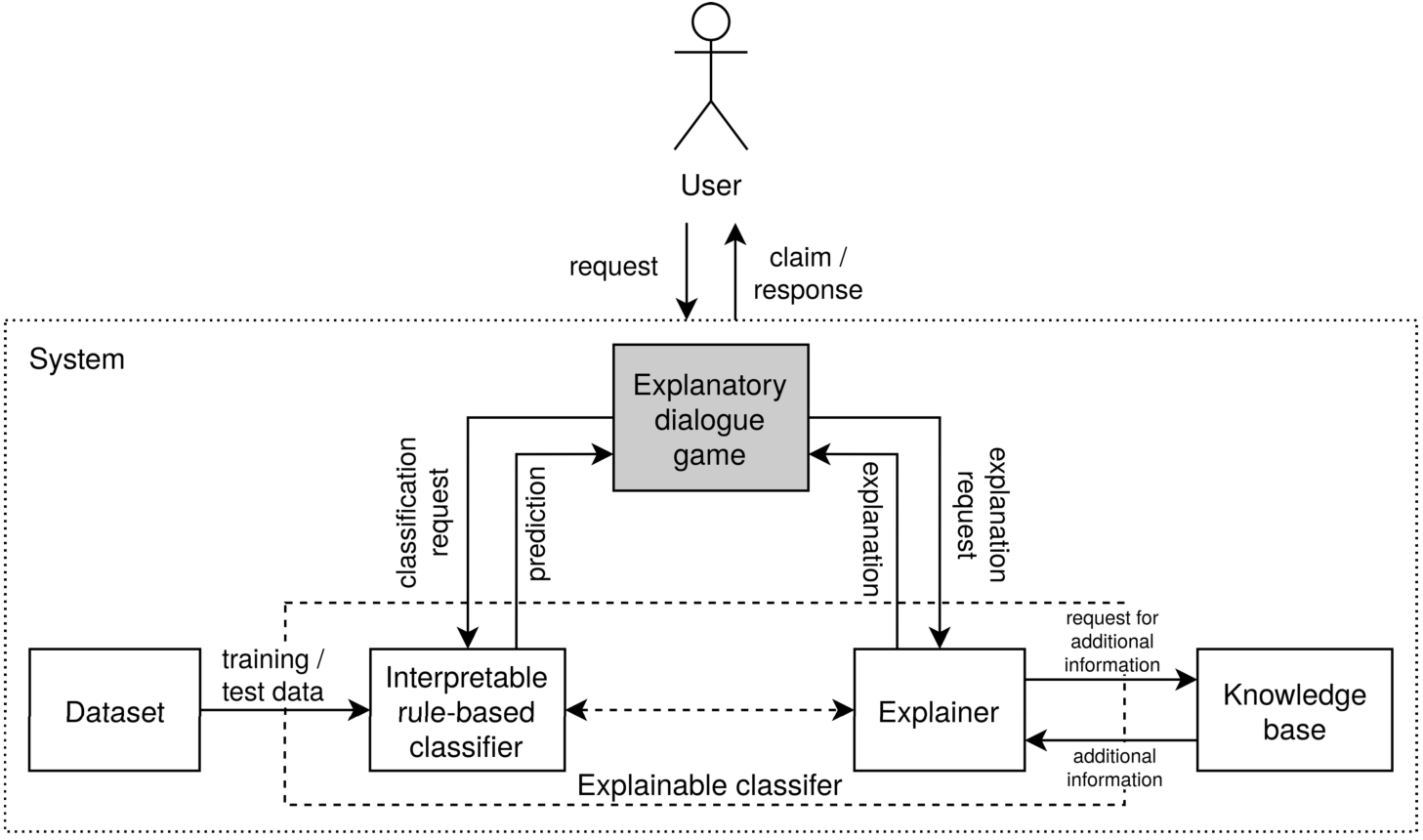
A schema of the modelled system-user explanation communication process. This paper focuses on designing an explanatory dialogue game for communication of factual and counterfactual explanations for interpretable rule-based classifiers (the shaded block).
As outlined in Section 1, we focus on communicating to the end user automated explanations for the output of an interpretable rule-based ML classifier. Figure 1 depicts a general architecture of the modelled explanation communication process. The System is assumed to include, at least, the following core components: an interpretable rule-based classifier, an explainer, a knowledge base, and a dataset that the classifier is trained on. The User starts the communication process by sending a classification request for a specific test instance to the System in form of the test instance’s characteristics (i.e., features). The classifier is pretrained on a given dataset
In this work, we assume knowledge of the feature space: the dataset is said to contain linearly scaled numerical features. In addition, all the numerical feature values are said to be mapped to the corresponding feature-dependent linguistic variable [86]. Therefore, each data instance
The classifier predicts the class label
Explanation to the classification
The upsurging need for explaining a classifier’s output is raising interest in the mere nature of the explanation. For instance, social sciences testify that explanations are expected to be contrastive, selected, and social [45]. First, the property of contrastiveness implies establishing a relation not only between the cause and effect of the phenomenon under consideration but also another relation between the cause and a given non-observed effect (i.e., another alternative effect). Second, explanations are as well argued to be selected, i.e., only the most relevant causes should make part of a specific explanation. Third, explanations are claimed to be social, i.e., they are a product of interaction between the explainer and the explainee.
Contrastiveness plays an important role when explaining a solution to the classification problem, as different classes are opposed to the others on the basis of distinctive feature values. Further, contrastiveness is inherent to counterfactual (CF) explanations (or counterfactuals, for short). In the context of XAI, counterfactuals suggest minimal changes in feature-value pairs for a different outcome to be obtained [71]. CFs are said to be post-hoc (i.e., they are generated for pretrained classifiers) and local (i.e., they explain the classifier’s output w.r.t. a specific test instance) [27]. CFs may be (1) model-agnostic if they operate only on the given input (i.e., a test instance) and output (i.e., a prediction) of the classifier or (2) model-specific if they utilise the internals of the classifier to explain the given output [47,71].
CF explanations are claimed to have a number of desired properties against which CF explanation methods can be evaluated [27]. For example, CFs should be valid (i.e., CFs should truly lead to the desired hypothetical outcome), proximate (i.e., CFs should suggest only minimal changes to the test instance w.r.t. the selected distance metric), sparse (i.e., CFs should minimise the number of features whose values are to be changed), actionable (i.e., CFs should suggest feasible changes), and diverse (i.e., CFs should offer multiple alternatives). An exhaustive list of such properties can be found in recent surveys on CF explanation generation and evaluation [27,49,78]).
A large number of explanation generation methods are evaluated using automatically computable metrics that assess the aforementioned properties of CF explanations [49]. However, such metrics oftentimes do not take into consideration user feedback at all. Whereas considering the social factor may not be necessary when, e.g., measuring validity, estimating CF diversity may have to directly involve capturing effects of the interaction between the system and the user. Indeed, CF explanations suggesting minimal changes in feature values may not always be equally appreciated by end users. Given a variety of potential CFs, different users may prefer distinct CFs for the same hypothetical output. Further, the social aspect of explanation becomes crucially important when two alternative automatically generated pieces of explanation are deemed equally explanatory (e.g., when the distances from the test instance to two or more closest CF data points are the same or when two CF sets have the same coverage). As the state-of-the-art AI technologies are shifting towards being user-centric [83], it appears indispensable to enhance existing explanation generation modules with a system-user communication interface that would allow end users to produce such inquiries for alternative CFs in the course of an explanatory dialogue, even if the user is not aware of the dataset-related peculiarities.
Various state-of-the-art CF explanation generation frameworks are known to offer diverse CFs ([15,17,35,49,60,62,75,85], among others). However, the format of such CFs raises several important concerns. First, most of such frameworks lack any interaction with end users leaving the users without further guidance when interpreting the generated explanations. Second, some explainers output a set of distinct CFs altogether [49,60]. In these settings, the Grice’s maxim of quantity [25] may be violated, as only a subset of the offered explanations can be sufficient for the end user. Third, a large number of diverse CF explanation generation frameworks provide their output in tabular form [15,17,35,49,62,75]. Whereas natural language generation tools can be used to transform tabular data into text, a taxonomy of necessary explanation-related requests and responses remains missing. To address these issues, we propose a transparent explanatory dialogue model for diverse factual and counterfactual explanation communication that allows the end user to explore the explanation space iteratively until he or she can make an informed decision on whether the system’s prediction can be trusted.
In light of the aforementioned considerations, a classifier’s prediction can be explained factually and/or counterfactually. As we focus on the social factor of explanation generation in this paper, we assume that an explainer provides us with automatically generated textual factual and CF explanations operating in the settings described in Section 2.1. Below, we define both aforementioned types of explanation in terms of their linguistic realisation.
Driven by the assumptions above, both factual and CF explanations can be represented in two forms: using linguistic terms or numerical values (intervals). On the one hand, a purely textual explanation may be more intuitive and comprehensive to the explainee (e.g., “The test instance is of class Blanche because colour is pale and bitterness is low” or “The test instance would be of class Porter if colour were brown and strength were high”). On the other hand, explanations that incorporate numerical information may offer more detailed (and, perhaps, more precise) information while possibly requiring additional domain knowledge (e.g., “The test instance is of class Blanche because
A high-level explanation
Hereinafter, [
A low-level explanation
Paired explanations of both modalities may be found complementary to each other, as they may target different groups of end users. High-level explanations may facilitate understanding thereof by lay users. In turn, low-level explanations may be necessary for expert users to be able to further verify the validity of the offered explanation without linguistic ambiguity. Hereinafter, we assume that both factual and CF explanations to be paired two-level structures. To meet the requirement of being selective [45], all such explanations should be designed to reflect only the most characteristic features of the test instance that influence the classifier’s prediction or its hypothetical counterpart. Let us now define factual and CF explanations in terms of their high- and low-level components.
A factual explanation
The given test instance’s prediction can be explained in a (possibly, infinite) number of ways. At the same time, different explanations for the same phenomenon may have distinct degrees of explanatory power. Hence, all possible factual explanations are assumed to be ranked by an explainer in terms of their relevance to the test instance. Importantly, the notion of relevance in Definition 3 is determined by peculiarities of the explanation generation method, which falls outside the scope of this paper. The set of all factual explanations
A counterfactual (or, shortly, CF) explanation
Similarly to factual explanations, all possible CFs are assumed to be ranked by their relevance to the test instance in accordance with a preselected criterion (for example, the distance metric from the test instance to the closest data point that the explanation includes). Then, the set of all the CF explanations for the given CF class is defined as follows:
Altogether, all ranked candidate factual and CF explanations for the given prediction are assumed to be unique and said to constitute an explanation space for the given prediction. The explanation space therefore contains all the pieces of factual and CF explanations that the system can offer to the end user w.r.t. the given test instance. Consequently, a given classifier’s prediction cannot be explained by any piece of explanation that the explanation space does not contain. An explanation space
Whereas any single piece of explanation may be satisfactory for the given user, it may have to be combined with other explanation instances for other users. For example, the end user may (1) request and be satisfied with the offered (factual and/or counterfactual) piece of explanation, (2) request and not be satisfied with the offered explanation, or (3) not request any explanation for, e.g. an alternative CF class, at all. In addition, not all the most relevant pieces of explanation from the system’s point of view may seem as relevant to the user. To inspect the differences between such combinations of explanations, we therefore introduce the notions of explainer-preferred and explainee-preferred explanation. Explanation rankings provided by the explainer allow us to single out the most relevant pieces of CFs for each CF class from the system’s point of view:
Then, an explainer-preferred explanation is said to comprise all the most relevant (both factual and counterfactual) pieces of explanation from the explainer’s point of view.
An explainer-preferred explanation is the union of the most relevant automatically generated factual explanation for the predicted class and the most relevant explanations for each of the CF classes:
An explainer-preferred explanation may be claimed to comprehensively explain the output of the given classifier to any end user. Given a set of multiple candidate factual and/or counterfactual explanations from the explanation space, the explanation generation module ranks them by relevance to the test instance (e.g., a distance metric) and subsequently presents the most relevant pieces of explanation to the end user. However, the explanation generation module output ignores end user preferences in these settings. Therefore, we define an explainee-preferred explanation as follows.
An explainee-preferred explanation is the union of all the pieces of explanation that the explainee finds the most satisfactory, as he or she explores the explanation space
For illustrative purposes, consider the classification task for a dataset of four classes:
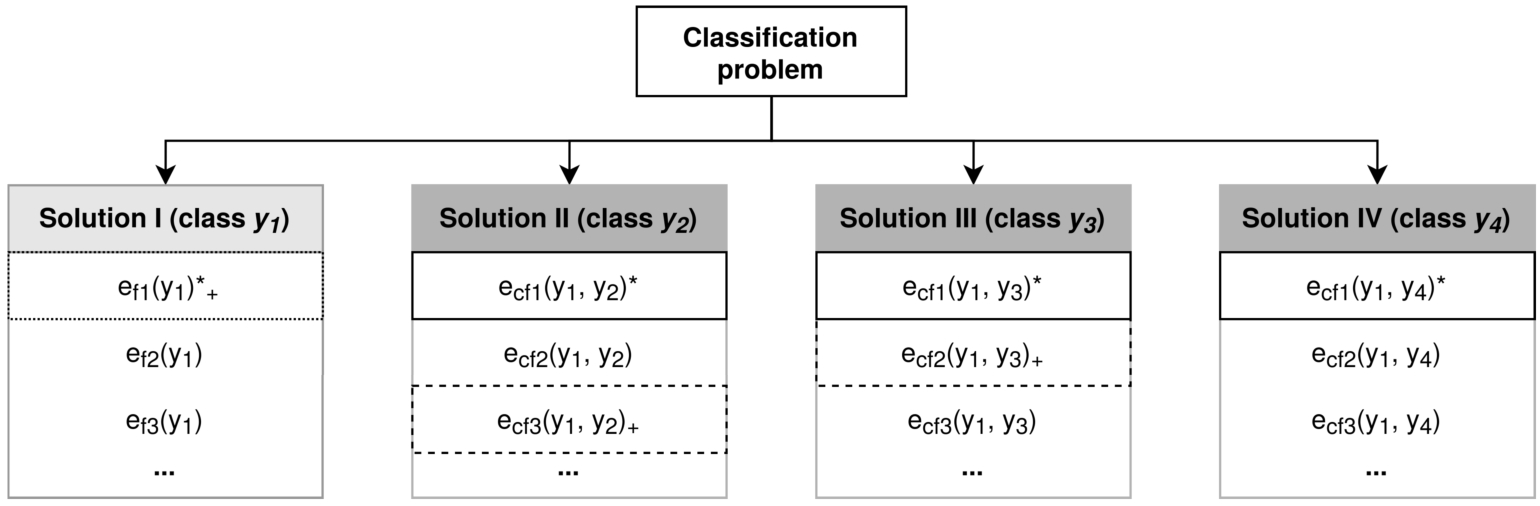
A schema of a classification problem. Class
The explainee may consider (a part of) the offered explanation irrelevant, redundant, or poorly explanatory. Figure 2 illustrates a possible discrepancy between the automatically generated and some user-preferred explanations. Whereas the factual explanation may be satisfactory for him or her, the explainee may find optimal the third most relevant CF explanation (from the explainer’s point of view) for class
As shown in the example above, there may exist only a slight overlap between the most relevant explainer-preferred explanation and that expected by the explainee. It therefore appears indispensable to provide end users with a means of interaction with the explanation generation module to enable them to interactively explore the explanation space and, subsequently, shape the explanation in accordance with their preferences. To do so, it is helpful to consider the classifier’s reasoning from the argumentative point of view. Argumentation is regarded as an effective mechanism to communicate explanation in natural language [8]. Thus, various argumentation frameworks are shown to be particularly useful in the field of XAI for their ability to generate explanations of different modalities (e.g., textual, graphical, hybrid) [16]. Further, recent work on argumentation-based explanation generation shows that such frameworks provide efficient explanatory interfaces between AI-based systems and users of such systems, particularly, in the form of dialogue [77]. In addition, argumentation is shown to logically connect with, for example, abductive reasoning tools that are widely used for counterfactual reasoning [11].
In these settings, a prediction may be treated as a claim proposed by the classifier. Such a claim is then supported by the decisive feature value pairs (either specific values or intervals of values) that led the classifier to make the corresponding prediction (see Fig. 3(a)). However, ground-truth data-based premises cannot be attacked directly, as they can by no means be claimed invalid. Therefore, it appears necessary to introduce an intermediate explanation layer that approximates the premises and serves as an attackable natural language interface between the premise and the claim (see Fig. 3(b)).
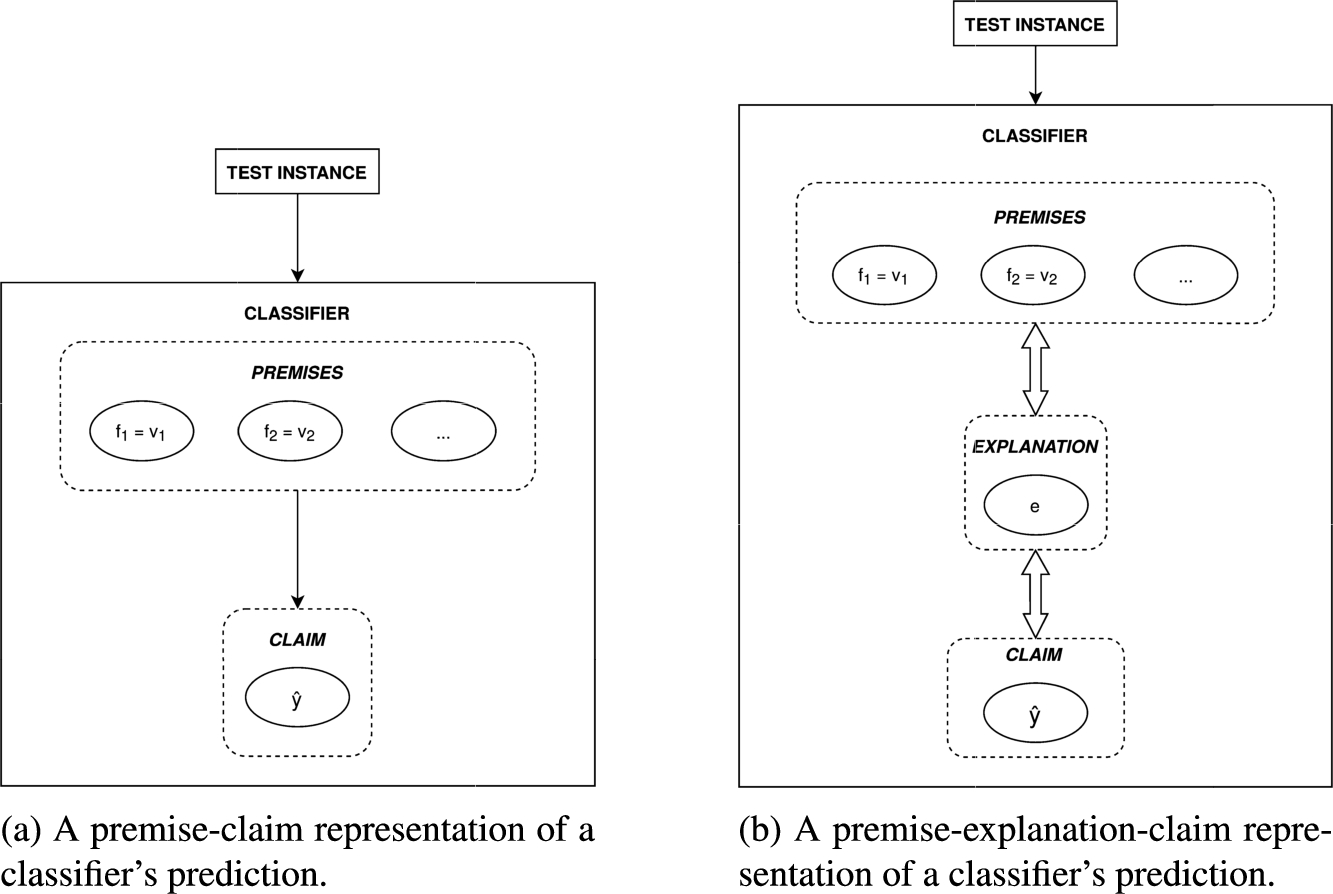
Schematic representations of classifier’s reasoning from the argumentative point of view.
Throughout this paper, we claim that rule-based explanations from interpretable classifiers serve this purpose well. First, they reflect the features retrieved from the data that the classifier is trained on. Second, their natural language representation allows the end user to construct a comprehensive mental representation of the underlying data. Following Hempel’s definition of explanation [31], explanations themselves can be regarded as arguments. In the context of explanatory dialogue between the system and the user, explanations can then be attacked in the dialogic intercourse between the dialogue parties. In this manner, the end user is given the opportunity to interactively inspect explanations from the explanation space that do not make part of the explainer-preferred explanation by arguing over the initially (and, if necessary, also subsequently) offered pieces thereof.
In this section, we formally define a dialogue game that serves to communicate explanation(-s) generated automatically by an explanation generation module (paired with the corresponding interpretable rule-based classifier) to its end user. Thus, Section 3.1 proposes formal components of explanatory dialogue. Subsequently, Section 3.2 presents an example of an explanatory dialogue modelled in accordance with the principles outlined in Section 3.1. Finally, Section 3.3 generalises the proposed approach to explanatory information-seeking dialogue modelling in form of an explanatory context-free dialogue grammar.
Formal description of explanatory information-seeking dialogue
In order to construct a communication channel between the system and the end user, we propose that explanatory dialogue be modelled on the basis of the so-called “dialogue game” approach to argumentation [54]. Taking into consideration the aforementioned requirements to explanation, we formally define an explanatory dialogue between the explanation generation module and end user as a 10-tuple D
P is the set of dialogue participants;
M is the set of dialogue moves that the dialogue participants make in the course of a dialogue;
R is the set of requests and responses that specify allowed utterances in the course of explanatory dialogue;
Pr is the dialogue protocol governing the flow of the conversation in accordance with the set of predetermined locution rules specifying types of legitimate utterances;
K is the knowledge store, i.e. the dynamically populated set of all the pieces of explanation that the user requests and receives during his or her interaction with the system;
E is the explanation store, i.e. the dynamically updated set of the last offered pieces of explanation for each class under consideration;
DET is the detailisation store, i.e. the set of features of the actually processed piece of high-level explanation whose values (i.e., linguistic terms) can be inspected for further details;
CLAR is the clarification store, i.e. the set of features of the actually processed piece of explanation whose definitions can be requested;
CFS is the CF class store, i.e. the set of CF classes whose explanations can be potentially offered to the end user;
KB is a knowledge base containing the domain knowledge for the addressed problem.
Let us now define each component of the proposed explanatory dialogue model in detail.
Driven by the assumption that high- and low-level explanations may accommodate both expert and lay users and inspired by previous work on formal explanatory dialogue modelling [9], we distinguish four types of user requests and responses that form the corresponding set
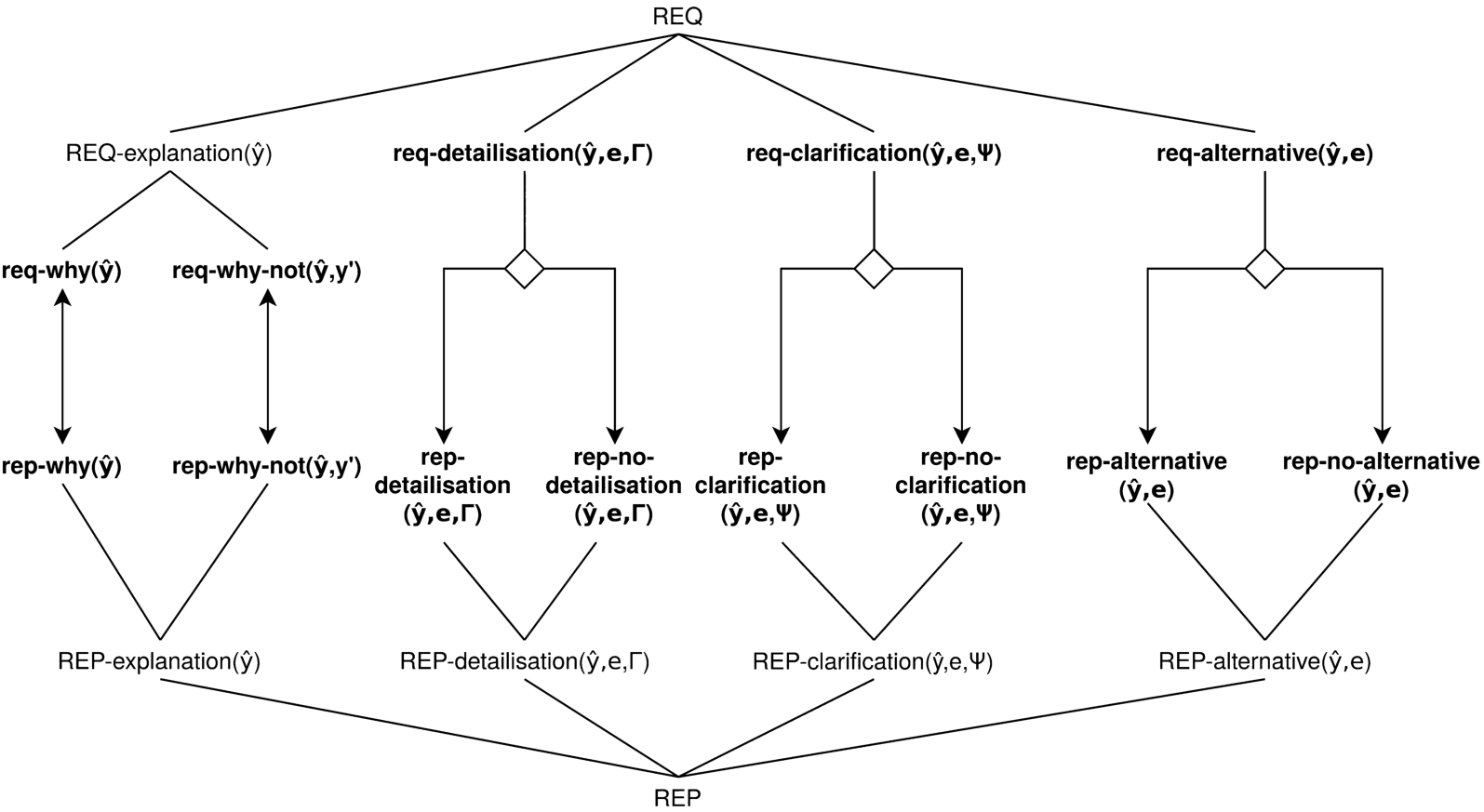
A typology of requests and replies. Individual requests/responses are in bold. In addition, sets of request/responses are named with uppercase letters (i.e., REQ-/REP-).
On the one hand, the set of requests from the user to the system REQ={REQ-explanation(
Sets of requests are denoted using uppercase letters (as in, e.g., REQ-explanation) whereas single instances of requests are denoted using only lowercase letters (as in, e.g., req-detailisation).
REQ-explanation(
req-detailisation(
req-clarification(
req-alternative(
Further, the set of user explanation requests REQ-explanation(
req-why(
req-why-not(
On the other hand, the set of responses (replies) that the system sends back to the user REP={REP-explanation(
REP-explanation(
REP-detailisation(
REP-clarification(
REP-alternative(
In addition, the set of replies to requests for (initial, non-alternative) explanation REP-explanation(
rep-why(
rep-why-not(
The set of replies to detailisation requests REP-detailisation(
rep-detailisation(
rep-no-detailisation(
The set of replies to clarification requests REP-clarification(
rep-clarification(
rep-no-clarification(
The set of replies to alternative explanation requests REP-alternative(
rep-alternative(
rep-no-alternative(
Having introduced the proposed formalism for explanatory information-seeking dialogue modelling, let us now illustrate it taking the previously considered example for reference (see Table 1 for details). Thus, we are considering the beer style classification problem for the beer dataset that contains the following classes:
A move-by-move formal description of the stores governing the example of explanatory dialogue from Table 1
A move-by-move formal description of the stores governing the example of explanatory dialogue from Table 1
Initially, the system claims that some instance of beer is of class Blanche (move
Once the factual explanation is offered, the user may commit to the factual explanation offered and inquire a CF explanation for some CF class. In the present example, the user seeks, at this stage, to know why the classifier did not predict the given beer to be Stout (
Table 3 generalises the presented example of explanatory dialogue for any dataset where features, linguistic terms, and classes serve as dataset-specific variables. It is possible to generalise any explanatory dialogue modelled in accordance with the proposed framework using the suggested template utterances. Noteworthy, three main building blocks of such explanatory dialogue (C – claim, E – explanation, and T – termination) can be distinguished. Figure 5 presents the corresponding (partial, for illustrative purposes) parse tree of such a generalised explanatory dialogue.
An example explanatory dialogue schema
In the left-hand side column (“Block”), C stands for claim, E – for explanation, T – for termination).
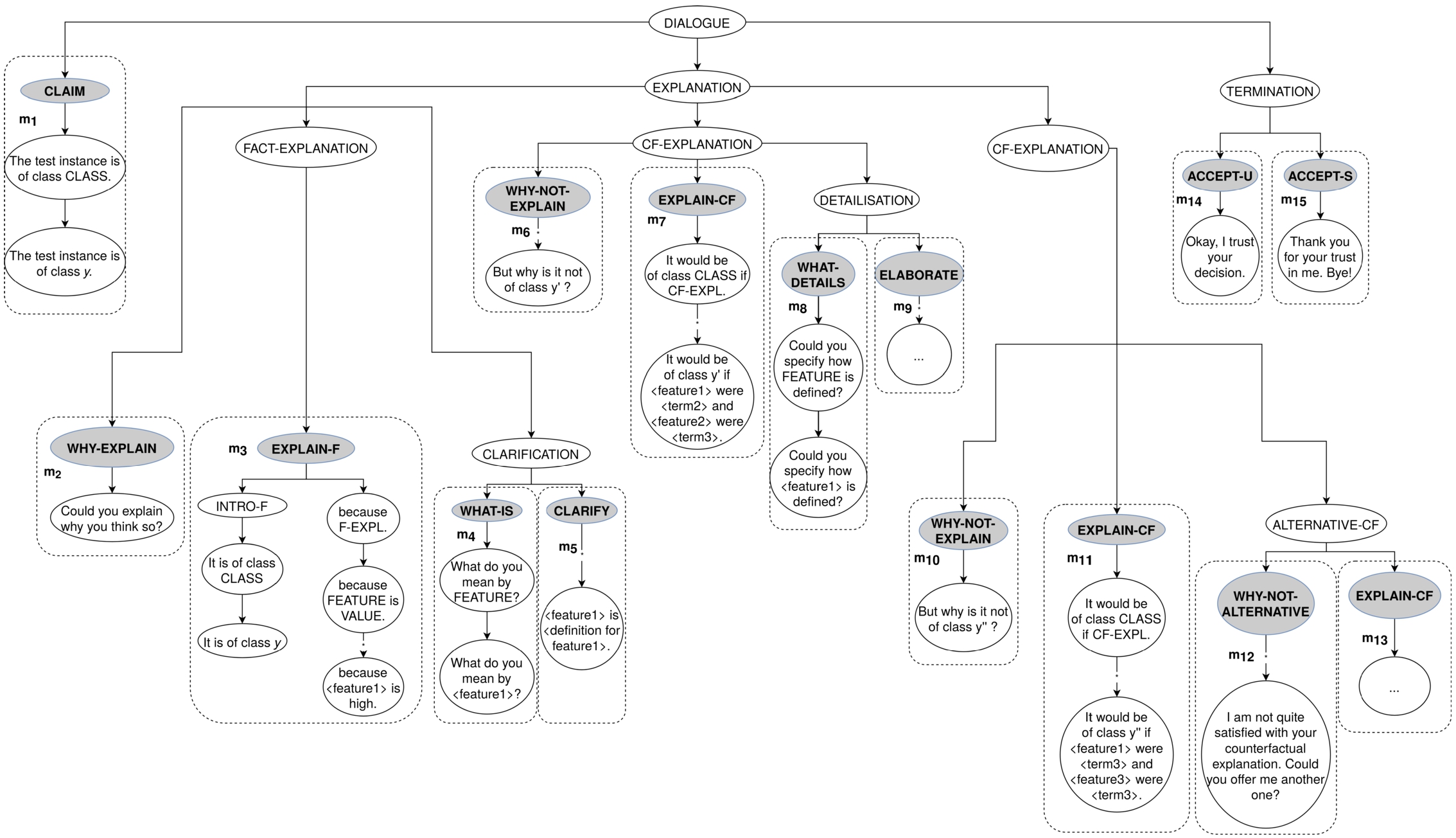
A parse tree of the example of explanatory dialogue. Shaded nodes are non-terminals corresponding to specific speech acts. The subtrees in the dashed regions represent dialogue moves.
As follows from the example of dialogue presented in Section 3.2, the proposed dialogue model has a hierarchical structure with respect to its main building blocks. This observation allows us to reflect the modular composition of explanatory dialogue (following our model) in a context-free dialogue grammar. As the transitions between the states of the dialogue are finite and predefined, the use of the corresponding EDG allows us to (1) generate any explanatory dialogue that is valid in accordance with the dialogue protocol restrictions and (2) parse any actually valid explanatory dialogue or make a conclusion that the present explanatory dialogue is invalid with respect to the dialogue model constraints. Further, a grammar-based dialogue model can take into account modifications in the dialogue protocol if those are deemed necessary.
In light of the above, we define an EDG following Chomsky’s definition of a context-free grammar as a tuple
Process mining for dialogue analytics
The proposed model of explanatory dialogue is designed in a top-down manner, which signals certain shortcomings. Thus, the dialogue protocol bases on the assumption that the taxonomy of requests and responses proposed in Section 3 inspired by findings from the literature exhaustively covers user’s needs and system’s abilities when engaged in an explanatory dialogue. However, in the absence of any empirical evaluation, such assumptions may result being purely speculative. For example, specific requests may be utilised to a very limited extent or even not utilised at all. Alternatively, there may exist requests that are not included in the original model, which may nevertheless be considered essential for human-machine interaction by the explainees. Either way, modifications to the model should be grounded on the data obtained from the end users. As such data-driven conclusions on the utility of the top-down dialogue model can only be made upon empirical evaluation, a user study is necessary to validate the proposed model.
In addition to analysis of free-form user feedback, evaluation of a dialogue model can be automated by inspecting dialogue patterns in the collected dialogue transcripts. In these settings, dialogues can be treated as iterative processes whose key patterns allow us to discern strengths and weaknesses of the dialogue model. To analyse dialogues as processes, we propose a use of process mining techniques.
Process mining is the subfield of data science that aims to provide tools for discovering insights into operational processes and thus supports process improvements [76]. Following the process mining terminology [50], an instance of a process (i.e., a specific explanatory dialogue) is denoted as a trace τ. Subsequently, each trace consists of the set of activities A (in this case, locutions). In turn, a specific instance (realisation) of an activity
An example of an event log (the activities in bold are those produced by the system; the user-produced activities are those in italics)
An example of an event log (the activities in bold are those produced by the system; the user-produced activities are those in italics)
An example of an event log basing on a collection of explanatory dialogues is depicted in Table 4. It contains two traces (i.e., Dialogue1 and Dialogue2) that represent instances of the recorded explanatory dialogues between (possibly, different) user(-s) and the given system (i.e., an interpretable rule-based classifier). In total, the process model contains 22 events each of which is essentially a specific dialogue move paired with the corresponding locution. Figure 6 illustrates the corresponding process model graph. The visual representation of the process model facilitates detection of the activity patterns (i.e., subprocesses characterising common parts of distinct dialogues) taking place in the collection of dialogues.
A dialogue protocol can be represented as a finite state machine whose nodes are the locutions modelled, edges being legitimate transitions between different states of the dialogue (e.g., from a request to all possible responses). In terms of process mining, one can represent the dialogue protocol as the so-called process model – a directed graph
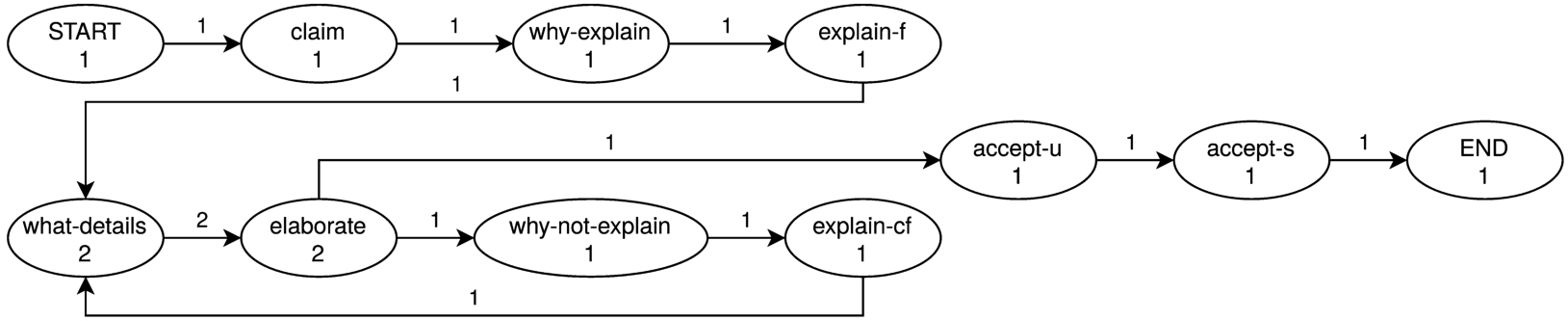
The graphical view of the process model corresponding to the example Dialogue1 in Table 4.
To analyse the actually recorded dialogues quantitatively, we suggest that the so-called conformance checking procedure be applied. In process mining, conformance checking is applied to relate the events in the actually registered processes and the process model in order to identify commonalities and discrepancies between the former and the latter. In the case of evaluating the proposed dialogue game, all the moves made by both dialogue game players follow the previously defined dialogue protocol. Hence, no deviation from the protocol can be observed. Instead, conformance checking allows us to highlight the most (and the least) frequent dialogue patterns in the event log and evaluate it against the process model (i.e., the dialogue protocol). Conformance checking can lead to obtaining data-driven knowledge of the least frequently submitted requests and/or dialogue state transitions, which can be used to modify the originally proposed dialogue protocol in order to increase its quality.
To sum it up, the proposed dialogue model can be evaluated in two complementary ways: qualitatively and quantitatively. On the one hand, qualitative free-form user feedback (e.g., in the form of a post-experiment survey) can point to missing requests or transitions between existing requests in the dialogue protocol. On the other hand, the least frequent dialogue patterns may signal their futility for explanatory purposes of the dialogue model. In process mining, a frequency threshold value can, for example, be set to subsequently optimise the process model by removing the least observed model patterns. Similarly, the least frequent requests or responses may be removed from the dialogue protocol if the empirically grounded threshold value is available and set prior to evaluation. As a result, process mining is shown to serve as a methodological basis for quantitative evaluation of the proposed dialogue model. In combination with free-form user feedback for qualitative evaluation of the dialogue protocol, process mining is able to provide us with further insights w.r.t. the quality of a dialogue model.
In order to evaluate the proposed model of explanatory dialogue following the aforementioned evaluation framework, we carried out an exploratory user study. In the remainder of this section, we describe the setup of the human evaluation study. Thus, Section 5.1 describes the datasets used as the basis for training the classifiers for the study. Section 5.2 outlines technicalities of the explanation generation method used in the given experiment. Section 5.3 outlines the distinctive characteristics of the classifiers trained on the aforementioned datasets. Section 5.4 discusses the stimuli selection as well as the design of the dialogue system used in the experiment.
Datasets
In our study, we used the following three datasets: basketball player position [3], beer style [13], and thyroid disease diagnosis [19]. All three datasets serve to solve a multiclass classification problem in three different application domains. First, the basketball players position dataset presupposes five classes related to the following player positions:
To guarantee consistent and comparable results, only numerical continuous features were used for training the corresponding classifiers. Further, all the features were mapped to linguistic terms as follows. The beer style dataset was annotated by an expert brewer, therefore it contains original feature-value partitions. The features from the other datasets were split in three uniform intervals of equal length, each of which was mapped to the following linguistic terms: ⟨low, medium, high⟩ (except for the feature height, which is described with 5 linguistic terms, in the basketball player position dataset). Table 5 summarises information on the features from all the datasets as well as the corresponding linguistic terms, with the numerical intervals attached.
Numerical intervals of the features as well as the corresponding linguistic terms
Numerical intervals of the features as well as the corresponding linguistic terms
To evaluate the dialogue game proposed in this paper as a communication interface between the system and the user, we generate multiple factual and CF explanations using the XOR method [72]. This explanation generation method operates on the rule base (i.e., a set of decision paths to each class) of a rule-based interpretable classifier (e.g., a fuzzy rule-based classification system or a decision tree DT where branches are first transformed into a list of rules). All automatic explanations follow the structure of the decision path (in the case of the factual explanation) or the minimally different decision path leading to the given CF class (in the case of the CF explanation). The following pipeline of four steps constitutes the explanation generation process:
For DTs, factual explanations are essentially the feature-value intervals aggregated along the decision path. This explanation generation method presupposes that alternative factual explanations cannot be generated because alternative decision paths leading to the same predicted class would not adequately explain the exact reasoning of the DT for the given test instance. On the contrary, alternative CF explanations are considered for explaining hypothethical, non-predicted outcomes. Once the explainer generates an explanation, it is then passed on to dialogue system upon request.
Classifiers
In our human evaluation study, we use DTs as classifiers. Notably, DTs offer interpretable rule-based explanations that can be retrieved from their readily available internal structure. Three variants of DTs (J48, RandomTree, REPTree) were generated using the data mining tool Weka [30] and inspected for all the considered datasets. All the DTs were trained using 10-fold cross-validation.
It turns out that only the RandomTree algorithm generates at least two decision paths to all the classes in all the datasets under consideration (except for classes Blanche and Belgian Strong Ale in the beer style dataset). First, this guarantees the existence of at least one CF explanation for any class in each dataset for any test instance selected. Subsequently, it provides at least one alternative explanation for the given CF class. Since the other inspected DT algorithms did not provide at least one alternative CF explanation for the considered datasets, the RandomTree-based DTs were selected for all the use cases as classifiers whose predictions were to be explained in the study. Table 6 summarises main characteristics of the DTs used in the human evaluation study. Table 7 indicates numbers of decision paths for each CF class for each dataset.
Main characteristics of the datasets and the corresponding classifiers used in the experiments
Main characteristics of the datasets and the corresponding classifiers used in the experiments
Number of decision paths and CF classes for each dataset under consideration
In order to execute human-machine interaction governed by means of the dialogue game proposed, we designed and implemented an online evaluation system. The corresponding ethical considerations are outlined in Appendix A. Figure 7 presents an example screen of the implemented software tool.3
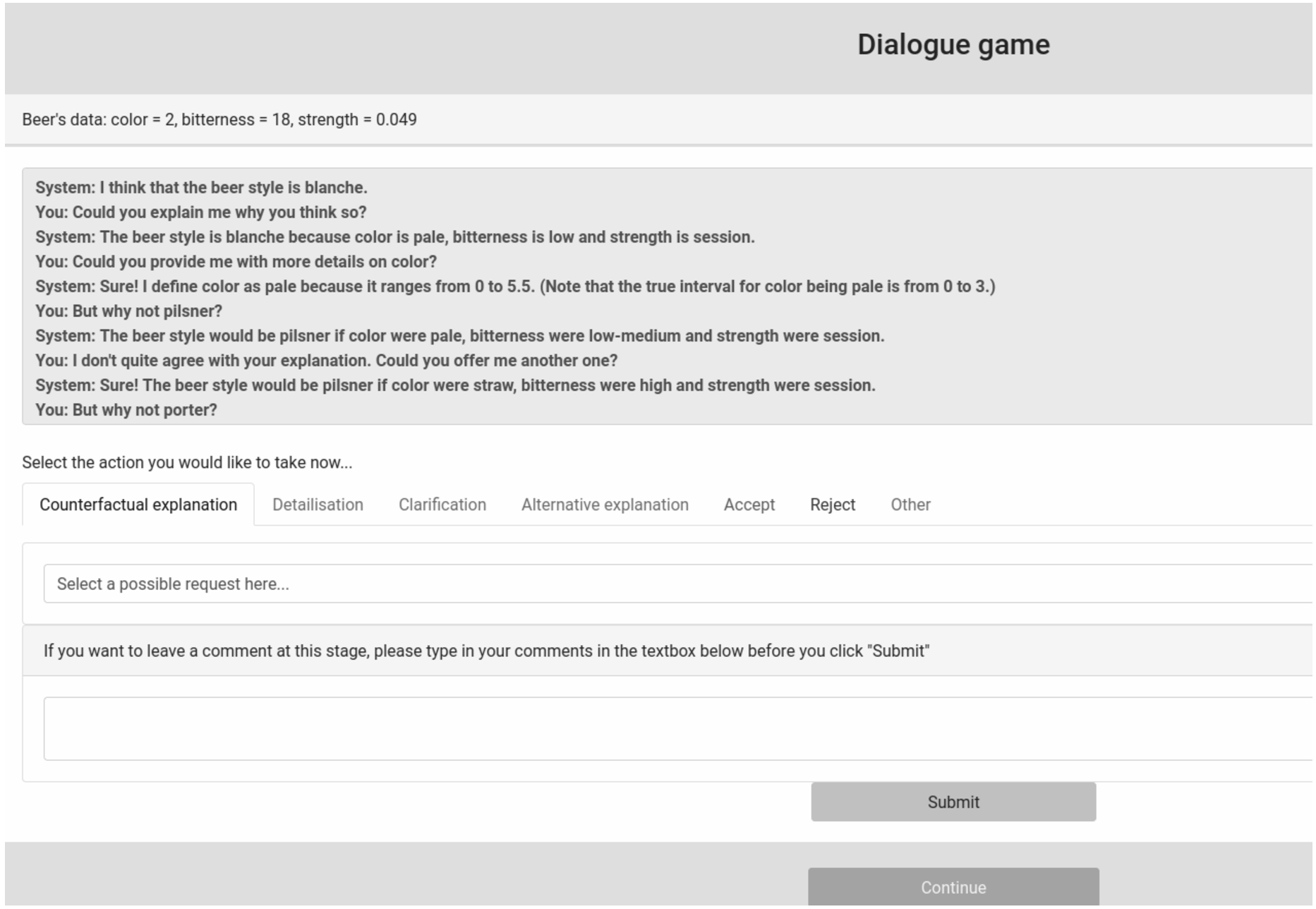
An example of a dialogue game human evaluation survey (the beer style dataset scenario).
In the course of the study, the participants were presented the characteristics of a test instance following the chosen scenario (dataset). The participants did not have any prior knowledge about the dataset. They were asked to interact with the system until they could make an informed decision on acceptance or rejection of the system’s claim. The participants determined the flow of the dialogue, as they requested necessary information to make a final decision.
Test instance characteristics
Three test instances (one per dataset) were selected so that they would represent correctly predicted real data. Table 8 outlines the characteristics of the test instances used in the study. The following factual explanations were generated for the considered test instances:
Similarly, all the high-level automatically generated CF explanations contained only textual descriptions of the features involved. As all the features are numerical (either integer or real-valued), responses to detailisation requests would provide subjects with intervals to which the linguistic terms are mapped. Further, the users were then informed about the classifier’s numerical intervals found for the given feature along the given decision path. These details were assumed to facilitate matching the system’s claim with the feature-value pairs of the test instance.
Noteworthy, the same study participants could select multiple datasets to play the dialogue game. Therefore, the numbers of records for each dataset do not represent unique users. For this reason, whenever we hereinafter mention the study participants (subjects), we refer to the actually collected transcripts of explanatory dialogues.
Upon completion of the experiment, the study participants were asked to optionally provide their demographic data and leave free-text responses to the following questions and/or suggestions:
“If you could add other types of requests to the system, what would those be?”;
“Did the interaction with the system change your initial (dis-)belief in the system’s prediction? Why (not)?”;
“If you have any other comments for us, please leave them in the textbox below.”
Last but not least, all the collected dialogue transcripts were transformed into event logs. On the basis of the event logs, process models were then constructed for each use case. In addition, a global process model of all the event logs was calculated.
In this section, we report the collected human evaluation results. Section 6.1 presents the quantitative results of the study (i.e., descriptive analytics of the collected dialogues and insights from the process models). Section 6.2 reports the qualitative results of the evaluation study (i.e., the free-form feedback that the study participants left optionally after their interaction with the dialogue system).
Dialogue analytics
A total of 60 dialogue transcripts have been collected in the course of the empirical study. In particular, 14 (23.33%) of the records relate to the basketball player position dataset. In turn, 37 (61.67%) transcripts are composed as the result of interaction with the classifier trained on the beer style dataset. In addition, 9 (15.00%) records reflect user interaction with the thyroid dataset-based classifier. All the collected dialogue transcripts were converted into event logs. The event logs were subsequently used to generate two process models: (1) the one related to the main building blocks of the modelled explanatory dialogue (i.e., claim, explanation, and termination) and (2) the one covering all the locutions produced by the study participants. Process model (1) gives a high-level overview of the user behaviour whereas process model (2) provides insights w.r.t. specific moves made by the study participants.
On average, it took the dialogue game participants around 14 moves for the users to make their final decision with respect to the system’s claim. As for the time taken to complete the dialogue game, the study participants spent about 7 minutes to either accept or reject the claim. Table 9 reports average numbers of dialogue moves and the time taken to complete the dialogue for each dataset under consideration.
General properties of the collected dialogues
General properties of the collected dialogues
Figure 8 illustrates the process model corresponding to the three main building blocks of the proposed dialogue game (i.e., claim, explanation, and termination). Thus, all but three participants required (at least, factual) explanation for the given prediction. Almost all of them eventually accepted the system’s claim. In the remainder of this section, we are analysing only those transcripts where explanations were requested.
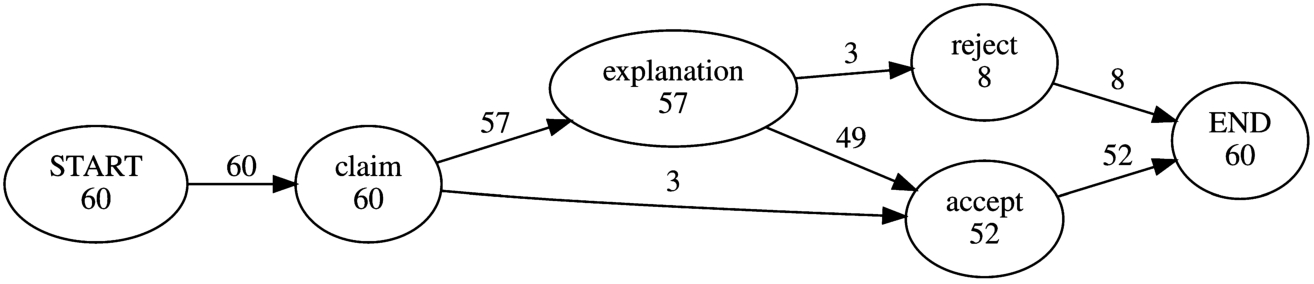
The process model of all the collected explanatory dialogues based on the main EDG building blocks. The block “termination” is split into “accept” and “reject”.
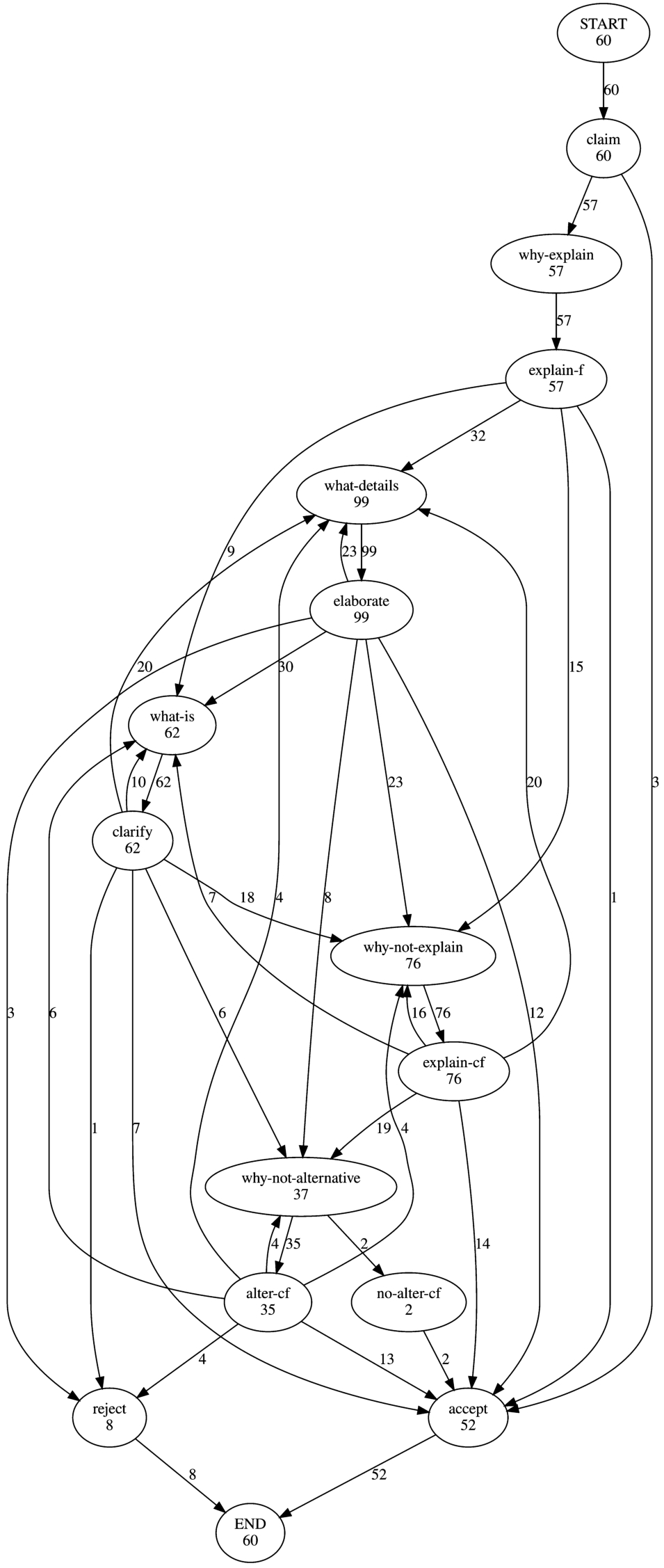
The full process model of all the collected explanatory dialogues. For illustrative purposes, pairs of termination nodes, i.e. {accept-u, accept-s} and {reject-u and reject-s}, are merged into accept and reject, respectively.
Figure 9 depicts the process model of the collection of explanatory dialogues that displays all the locutions produced. Thus, 331 explanation-related requests (all those covered by the EXPLANATION non-terminal in EDG) have been registered from the 57 participants who required explanation for the system’s claim. The edge labels for the explanation-related requests in Fig. 9 show that the study participants actively exploited all the explanation-related requests that were designed in the original protocol. On the one hand, a majority of the participants submitted further explanation-related requests (in this case, detailisation or clarification) upon receiving the factual explanation. On the other hand, a quarter of all the study participants considered the factual explanation sufficiently comprehensive to immediately request a (set of) CF explanation(-s).
The locution-level process model (see Fig. 9 for details) allows us to observe the answers to which requests were the most decisive for the participants to make their final decisions. Thus, the system’s claim was mainly accepted immediately after CF explanations (including those alternative) were presented whereas only one participant accepted the system’s claim did so as soon as the factual explanation was offered. The other explanation-related requests (i.e., detailisation and clarification) are found to have contributed less to immediate acceptance of the system’s claim. As for claim rejections, alternative CF explanations happen to most frequently trigger negative user decisions. Notably, alternative CF explanations were requested for nearly a half of all 76 CF explanations offered. In most cases, study participants stopped exploring the explanation space for the given CF class after the second-best ranked CF explanation was offered. However, third-best ranked CFs were requested to a limited extent.
It is worth noting that further insights into the quantitative results for individual use cases can be found in Appendix D.
In this section we present all the free-form comments that the study participants left upon finishing their interaction with the system and summarise the most informative of them. Recall that study participants were encouraged to leave answers to two questions (Q1 and Q2) and/or indicate their free-form suggestions (Q3) unrelated to Q1 or Q2 after their interaction with the implemented dialogue system. The collected responses to Q1–Q3 are presented in Tables 10–12. As all the comments shown are original, some may contain grammatical, lexical, and/or orthographic errors. All the users’ statements are codified as follows: “
Table 10 presents all the answers to Q1 (“If you could add other types of requests to the system, what would those be?”) that we collected throughout the study. Two comments (C1.1 and C1.2) are related to the basketball player position. Six statements (C1.3–C1.8) were made as a result of interaction with the system in the beer style case settings. One study participant left his or her comment (C1.9) after playing with the thyroid disease diagnosis scenario.
Study participants’ answers to Q1 (“If you could add other types of requests to the system, what would those be?”)
Study participants’ answers to Q1 (“If you could add other types of requests to the system, what would those be?”)
Regarding Q1, the study participants would like to extend the actual dialogue model so that it could inform them about the second most probable decision, or the technicalities of the decision-making system (e.g., the accuracy of the system). In addition, further definitions of notions related to the domain knowledge (see Comment C1.6, Table 10) were desired. Notably, concerns were raised about the inability to post-process the pieces of explanation that had already been discussed (see Comment C1.8, Table 10).
Table 11 shows all the collected answers to Q2 (“Did the interaction with the system change your initial (dis-)belief in the system’s prediction? Why (not)?”). Five study participants (C2.1–C2.5) answered Q2 after making their decision on the automatic basketball player position classification. Ten statements (C2.6–C2.15) were made as a result of interaction with the system in the beer style case settings. Two study participants (C2.16–C2.17) commented on their interaction with the system, as the thyroid disease classification scenario was executed.
Study participants’ answers to Q2 (“Did the interaction with the system change your initial (dis-)belief in the system’s prediction? Why (not)?”)
Regarding Q2, a fair number of commentators found the offered automated explanations convincing and satisfactory. Comment C2.5 (Table 11) illustrates that this was, in part, achieved due to the possibility to opt for factual explanations. In addition, some study participants positively assessed the ability to query the system for CF explanations (see Comment C2.8, Table 11) and further details and clarifications (see Comment C2.3, Table 11). Some of the commentators whose initial (dis-)belief in the system’s claim did not change in the course of their interaction with the system remarked that the explanations offered were nevertheless satisfying (see Comment C2.2, Table 11) and supportive enough w.r.t. the system’s claim (see Comment C2.11, Table 11).
Table 12 presents all users’ free-form suggestions (Q3: “If you have any other comments for us, please leave them in the textbox below.”). One comment (C3.1) was left after a dialogue with system w.r.t. the basketball player position classification whereas two statements (C3.2–C3.3) were made as a result of interaction with the system in the beer style case settings.
Study participants’ suggestions w.r.t. to Q3 (“If you have any other comments for us, please leave them in the textbox below”)
Regarding Q3, one study participant commented that the system’s responses were too fast (see Comment C3.1, Table 12). In addition, another participant pointed out the need for supportive visualisation tools, a clearer distinction between detailisation and clarification requests, and different structures for alternative explanations for the same CFs (see Comment C3.2, Table 12). Finally, predictions for other data instances are found desired to be inspected to develop big picture thinking about the reasoning of the system (see Comment C3.3, Table 12).
The findings reported in the previous section enable us to outline several remarkable observations. As expected, high numbers of detailisation and clarification requests have been registered from the users interacting with a classifier in the settings where they did not have any prior knowledge of the dataset that the classifier had been trained on. As the users started their interaction with the system only having feature-value pairs of the test instance at their disposal, they oftentimes required not only an explanation to the system’s claim but, perhaps, more importantly, definitions of the features that made part of the explanation or the numerical ranges over which the features were defined. The fact that a high number of requests for alternative explanations have been registered across all the use cases confirms that the most relevant explanation from the system’s point of view may be far from the most relevant (or satisfactory) from the user’s point of view.
As the same prediction can be explained in different ways, it turns out to be particularly important to extend the protocol so that it does not only offer the opportunity to rephrase the initially offered explanation but also enables the system to send requests to the user. For instance, if two pieces of explanation are deemed equally relevant by the explanation generation module, requiring additional information from the user about his or her preferences may be crucially important for successful fine-tuning of the explanation being processed. On the one hand, both such explanations can be presented simultaneously. Then, the user is to decide the format and/or ordering of the output explanations. On the other hand, the system can submit a request to the user to infer the actual user’s needs taking into consideration the known differences between two explanations.
The qualitative results of the human evaluation study allow us to suggest a number of empirically-driven critical questions (CQ) to the system’s prediction. Recall that our factual and CF textual explanations (in the simplest form) follow the templates “The test instance is [CLASS] because [FEATURE] is [VALUE]” and “The test instance would be [CLASS] if [FEATURE] were [VALUE]”, respectively. We can therefore address CQs both to the prediction (variable CLASS in the example above) and to (components of) the explanation (the variables FEATURE and VALUE in the example above). Driven by the registered user feedback, the prediction-related CQs (CQ1, CQ2, and CQ3) can be exemplified as follows:
Is the system’s prediction correct?
What is/are the accuracy/precision/recall/F-score of the system that predicted [CLASS]? (following C1.7 from Table 10);
How were the accuracy/precision/recall/F-score calculated? (following C1.7 from Table 10).
In turn, the features and values of the given explanation may give rise to explanation-related CQs. For example, the feature values may be subject to explanation-related CQs that may occur when processing responses to detailisation requests (CQ4 and CQ5) while the definitions of the features themselves may be questioned upon performing clarification requests (CQ6):
What data justify [VALUE] for [FEATURE]? (in the case of high-level explanations);
Is [VALUE] consistently defined for [FEATURE] in [INTERVAL]? (where [VALUE] is the linguistic term of some high-level explanation’s feature and [INTERVAL] is the corresponding numerical interval of the low-level explanation);
Is the source of information of the definition of [FEATURE] credible?
The proposed dialogue model has a number of limitations. As it can be applied directly only to interpretable rule-based classifiers enhanced with explainers providing textual explanations, the communication between the system and the user may appear overly restricted. In light of the assumptions made in Section 2, parts of the protocol may have to be adjusted when dealing with, for example, categorical variables or a poorly interpretable feature space. In addition, the structure of the protocol may have to be made more flexible, as handling the previously processed explanations (for example, those for other CF classes) is not permitted.
Remarkably, the set of locutions included in the presented protocol is by no means exhaustive. The qualitative results of the human evaluation study signal a number of desired extensions to the proposed dialogue model. The users would, for example, appreciate to know more about the definitions of the linguistic terms. The modular architecture of the EDG production rules allows for adapting the dialogue game for developer’s as well as user’s needs. In this regard, the clarification requests can be made applicable not only to the features themselves but also to the values of the linguistic variable that appear in high-level explanations as well as domain knowledge-related terms. In addition, the proposed dialogue protocol might as well incorporate visual information (e.g., pictures of the domain knowledge available upon request) for detailisation requests.
Related work
A variety of computational argumentation models have proven to be efficient tools for explanatory dialogue modelling in the context of XAI. For instance, Arioua et al. [4] propose a formal model of argumentative explanatory dialogue to acquire new knowledge in inconsistent knowledge bases. Calegari et al. [10] implement a mechanism of reasoning over defeasible preferences using elements of abstract and structured argumentation. Groza et al. [26] model explanatory dialogues combining rule-based arguments extracted from both ML classifiers and expert knowledge in favour or against a given classification of retinal disorder. Subsequently, the arguments are used to persuade the other parties in multi-agent system settings.
Argumentative explanatory dialogues are of particular interest among XAI researchers, as they provide means for customisation of automated CF explanations in light of the collected user feedback [70]. There exist a large number of distinct techniques that allow for integrating user feedback to personalise initially generated CF explanations. For example, Suffian et al. [73] operate on user’s preferred features and the corresponding ranges of values to fine-tune the originally generated explanation. Their FCE method first generates synthetically a set of CF data points where the preferred features range in the selected intervals. Then, the model aims to detect the most relevant (yet personalised) CF by searching for the minimally different (in terms of distance) CF data point from the generated synthetic data. Behrens et al. [6] propose a dynamically updated framework for user-specific explanation generation for knowledge graphs. More precisely, the user expresses his or her preferences by selecting two desired sets of graph nodes and, subsequently, ordering the selected generated meta-paths (i.e., sequences of alternated nodes and edges). Ghazimatin et al. [24] collect user feedback on explanations themselves for a recommender system to improve its performance. In this case, the user feedback is essentially a binary value signalling the similarity of an explanation to the recommendation. De Toni et al. [18] consider the problem of causal CF explanation generation as algorithmic recourse (i.e., overturning unfavourable ML-based model’s prediction). In their reinforcement learning-based model, the user is asked to choose the best subsequent action from the so-called “choice set”. The user’s responses are then used to optimise the model’s weights via Bayesian estimation and update the user’s state.
Early computational models of explanatory dialogue stress that the context of explanation should depend on user’s familiarity with the concepts presented to him or her [14]. Further, the end user is argued to necessarily build a sound mental model of the system to successfully interact with it [84]. However, only a few of argumentative explanatory dialogue implementations allow for direct dialogic interaction between an AI-based system and a given user for explanation customisation. Despite little evidence, human evaluation of the automatically generated explanations may lead to groundbreaking conclusions. For instance, Rago et al. [56] emphasise the need for multi-modality of the generated argumentative explanations, as users are found to generally prefer tabular explanations over textual ones but also textual over conversational. In addition, explanations containing a greater number of features (aspects) are, in general, found to be preferred.
Formal dialogue games provide an intuitive transparent tool of information exchange between the agents involved [54]. They have been extensively used in a wide range of AI applications, such as multi-agent systems [44] and recommendation systems [42]. Dialogue games have shown to have great potential for explanatory dialogue modelling [36]. The first dialogue games for (computational) explanatory dialogue modelling trace back to works by Walton [81] and Modgil and Caminada [46]. Arioua and Croitoru [5] propose a dialogue game to formalise Walton’s dialectical system of explanatory dialogues. However, their formalism does not take into account some key properties of explanation (contrastive, selected, and social) as well as user-specific needs addressed in the field of XAI. On the other hand, Shao et al. [67] explain a neural network’s classification output enabling the user to adjust the classifier’s prediction by enabling the user to prove feedback on the arguments correcting the prediction. Shaheen et al. [65] design two dialogue game-based protocols for generating and communicating explanations for satisfiability modulo theory (SMT) solvers. Thus, their approach distinguishes between a passive explanatory dialogue game where the explainee only inquires explanation and an active game where the user is explicitly asked to confirm or refute the system’s assertion. Unfortunately, both protocols lack any empirical evaluation. Alternatively, Sklar and Azhar [69] perform a user study to evaluate a dialogue game-based framework for making cooperative actions in the treasure hunt game. They show that explanations communicated using a dialogue game-based communication protocol lead to above-average user satisfaction. Shams et al. [66] design a dialogue game to explain and justify the best agent’s plan in normative practical reasoning settings. Finally, argumentative dialogue game-based models have been proposed for generating model-agnostic local explanations to justify given predictions [55]. To the best of our knowledge, no other dialogue games (including those aforementioned) have ever been evaluated (quantitatively) using process mining techniques like those introduced in this paper.
The previously mentioned protocols were mainly proposed for modelling information-seeking or inquiry explanatory dialogues. However, the formalism of dialogue games is also suitable for (and extensively applied to) modelling persuasive explanatory dialogues. Thus, Sassoon et al. [61] center explanatory dialogue around instances of a domain-specific argumentation scheme guided with the corresponding critical questions. Depending on the degree of agreement between the agents, the explanatory dialogue is then modelled in one of the three following modalities: information-seeking, deliberation, or persuasion. Morveli-Espinoza et al. [48] propose a protocol for persuasive negotiation dialogues where agents exchange explanatory and rhetorical arguments. Similarly to our approach, they consider alternative responses to be, in part, attacks to the previously uttered arguments. However, their protocol does not tackle CF explanations.
Last but not least, a large body of research has attempted to formalise dialogue by means of dialogue grammars [32,58]. Thus, they have been regarded as a natural interface between the underlying speech acts and actually produced utterances [64]. Dialogue grammars have been shown to disambiguate between distinct dialogue flow patterns (e.g., elaboration, digression, problem resolution, to name a few) [33]. In addition, dialogue grammars facilitate induction of task-based dialogue systems [22]. Beneficially, such grammars can be learned from dialogic data in an unsupervised manner [23]. Further, dialogue grammars are scalable yet universally induced from any domain [38]. Subsequently, the grammar-based approach to dialogue modelling has been enhanced with methods of corpus-based query generation for natural language understanding [34].
Dialogue grammars are found to model human-human dialogue [68] as well as human-machine dialogue [39]. Thus, dialogue grammars appear particularly useful for multimodal human-machine interaction. For instance, hybrid multiset grammars are proposed to govern speech and textual input jointly [20]. On a similar note, Kottur et al. [40] propose a dialogue grammar for visual co-reference resolution. In contrast to the aforementioned approaches where the explanatory dialogue is formalised by means of dialogue grammars, our EDG allows for producing natural language output only. However, a high degree of modularity that dialogue grammars offer makes it possible to extend the dialogue model so that it also outputs visual data (e.g., saliency maps) if such visual explanations are included in the set of terminals of the grammar.
Conclusions and future work
In this paper, we presented a new approach for explanatory dialogue modelling. Namely, we designed a dialogue game for the task of communicating explanations for predictions of interpretable rule-based classifiers. Unlike previous approaches, the dialogue protocol proposed in this work allows for effective communication of both factual and CF explanations for expert and lay users. The protocol offers a transparent means of conveying personalised textual rule-based explanations. Its use can be extended to other interpretable rule-based classifiers (e.g., other DT algorithms or fuzzy rule-based classification systems).
Subsequently, we validated the dialogue protocol by carrying out a human evaluation study. The quantitative results (i.e., the reconstructed process models) confirm the necessity in all the proposed requests for explanatory dialogue between the classifier and its user and therefore proves them indispensable for explanatory dialogue modelling. Thus, detailisation and clarification requests are found particularly useful when natural language explanations are presented in the settings where users have no prior knowledge of the dataset. In addition, end users show a high degree of interest in CF explanations in addition to their factual counterparts. Further, they appear to appreciate the possibility to question the initially offered CF explanations across different application domains. Provided that such CF explanations are generated automatically and presented to the user in accordance with their relevance to the test instance (e.g., the distance from the test instance), the proposed protocol allows the explainer to communicate multiple explanations. Hence, it favours diversity of the offered explanations, which is shown to increase their explanatory power. Moreover, the qualitative results show that the proposed dialogue game appears to be an effective tool to convey appealing explanations which were convincing enough for a good number of users. In this sense, the set of the proposed requests and replies turns out to be a potentially effective tool for measuring the effectiveness of (counter-)factual explanation generation frameworks outputting textual explanations in the course of interaction with end users. Finally, the protocol is flexible enough to be adapted in the near future for estimating the trustworthiness, satisfaction, or persuasive capability of automatically generated explanations while preserving the original structure of the given explanatory dialogue modelled. Nevertheless, the proposed protocol may be found somewhat overrestrictive, as it does not enable end users to submit explanation-related requests for the pieces of explanation whose processing is considered finalised.
The present piece of research opens the door for several lines of future work. Importantly, the proposed dialogue model should be adapted to handle other types of classifiers including those that do not reveal any interpretable information about their internals. In many settings, knowledge of the feature space is unavailable or hard to interpret. Then, the detailisation requests may result being of little utility unless additionally adapted to the functionality of the given classifier. In addition, we intend to enlarge the argumentative potential of the proposed dialogue model by developing further methods of capturing user’s preferences. Further work is also necessary to incorporate explanations of other modalities (e.g., visual) for dialogic communication. Whereas the concept of explanation space may be directly applicable to other settings (e.g., a prediction can be explained by means of different pieces of visual information), this may require redefinition of sub-components of the explanation space.
Another important line of future work consists in extending the actual protocol to incorporate explanations of different content and tasks. For instance, it is of peculiar interest to test the applicability of the dialogue protocol in the settings of regression, recommendation, or planning tasks. Finally, we aim to design and carry out further human evaluation experiments on the trade-off between the limitations of the protocol (e.g., underrepresentated locution types) and the persuasive power of explanations that it communicates. Such experiments (e.g., disabling users to perform specific acts) would allow us to estimate the impact of specific requests and further shape the protocol.
Footnotes
Ethical considerations
All the information collected from the human evaluation study participants was in agreement with the European Union’s General Data Protection Regulation (GDPR). In addition, this piece of research has been approved by the Ethics Committee of the University of Santiago de Compostela (Spain). Human evaluation was based solely on non-personal or anonymous data. Further, all the participants gave informed consent confirming the following:
the participant reached the age of majority; participation in the study was completely voluntary; participation in the study could be terminated at any time; participant’s anonymous responses would be used for research purposes in accordance with GDPR.
Dialogue protocol
In our model, any explanatory dialogue is modelled in accordance with the protocol outlined below. Thus, the protocol presupposes the following rules:
An explanatory dialogue is governed in accordance with the aforementioned rules. Table 13 summarises and exemplifies the dialogue protocol outlined above.
Explanatory dialogue grammar productions
Recall that an EDG can be formalised by means of a context-free grammar
(1) DIALOGUE → CLAIM EXPLANATION TERMINATION
(2) CLAIM → The test instance is of class CLASS.
(3) EXPLANATION → FACT-EXPLANATION (CF-EXPLANATION)* | ϵ
(4) TERMINATION → ACCEPT-U ACCEPT-S | REJECT-U REJECT-S
(5) ACCEPT-U → Okay, I trust your prediction.
(6) ACCEPT-S → Thank you for your trust in me. Bye!
(7) REJECT-U → I don’t trust your prediction and you won’t convince me.
(8) REJECT-S → Sorry for my poor explanatory capacities. Bye!
(9) FACT-EXPLANATION → WHY-EXPLAIN [EXPLAIN-F | NO-EXPLAIN-F]
(10) WHY-EXPLAIN → Could you explain why you think so?
(11) EXPLAIN-F → SURE INTRO-F [B|b]ecause F-EXPL (and F-EXPL)*. [DETAILISATION | CLARIFICATION | ALTERNATIVE-F | ϵ]
(12) INTRO-F → It is of class CLASS | ϵ
(13) F-EXPL → FEATURE is VALUE
(14) NO-EXPLAIN-F → Sorry, I don’t have a factual explanation for you.
(15) SURE → Sure! | ϵ
(16) CF-EXPLANATION → WHY-NOT-EXPLAIN [EXPLAIN-CF | NO-EXPLAIN-CF]
(17) WHY-NOT-EXPLAIN → But why is it not of class CLASS?
(18) EXPLAIN-CF → SURE It would be of class CLASS if CF-EXPL (and CF-EXPL)*. [DETAILISATION | CLARIFICATION | ALTERNATIVE-CF | ϵ]
(19) CF-EXPL → FEATURE were VALUE
(20) NO-EXPLAIN-CF → I don’t have an explanation for why it is not of class CLASS.
(21) DETAILISATION → WHAT-DETAILS [ELABORATE | NO-ELABORATE] [DETAILISATION | CLARIFICATION | ALTERNATIVE-F | ALTERNATIVE-CF | ϵ]
(22) WHAT-DETAILS → Could you FURTHER specify how TERM FEATURE is defined?
(23) ELABORATE → Sure! FEATURE is defined to be TERM because it lies in the range RANGE.
(24) NO-ELABORATE → Sorry, I don’t any FURTHER details on the requested term. [CLARIFICATION | ALTERNATIVE-F | ALTERNATIVE-CF | ϵ]
(25) FURTHER → further | ϵ
(26) CLARIFICATION → WHAT-IS [CLARIFY | NO-CLARIFY]
(27) WHAT-IS → What do you mean by FEATURE?
(28) CLARIFY → FEATURE is DEFINITION. [DETAILISATION | CLARIFICATION | ALTERNATIVE-F | ALTERNATIVE-CF | ϵ]
(29) NO-CLARIFY → Sorry, I cannot clarify the term FEATURE. [DETAILISATION | ALTERNATIVE-F | ALTERNATIVE-CF | ϵ]
(30) ALTERNATIVE-F → WHY-ALTERNATIVE [EXPLAIN-F | NO-EXPLAIN-F]
(31) ALTERNATIVE-CF → WHY-NOT-ALTERNATIVE [EXPLAIN-CF | NO-EXPLAIN-CF]
(32) WHY-ALTERNATIVE → REQ-ALTERNATIVE-BEG EXPL-TYPE-F REQ-ALTERNATIVE-END
(33) WHY-NOT-ALTERNATIVE → REQ-ALTERNATIVE-BEG EXPL-TYPE-CF REQ-ALTERNATIVE-END
(34) REQ-ALTERNATIVE-BEG → I am not quite satisfied with your
(35) REQ-ALTERNATIVE-END → explanation. Could you offer me another one?
(36) EXPL-TYPE-F → factual | ϵ
(37) EXPL-TYPE-CF → counterfactual | ϵ
Further details on human evaluation use cases
This appendix outlines the quantitative results of the human evaluation study. First, we report the demographic data of all the study participants who decided to disclose it. Recall that 60 people participated in the evaluation of the proposed dialogue game. All in all, 52 out of all the 60 (86.67%) study participants disclosed their demographic data. In summary, the overall collection of dialogue transcripts is gender-balanced. In addition, the participants who reported their education level had at least a Bachelor degree. Further, all the subjects had at least the B2 level of English proficiency. Table 14 summarises all the self-reported demographic data collected from all the participants.
Subsequently, we provide the reader with the demographic data of the study participants and the process models grouped by use case. Thus, Section D.1 presents the results for the collection of the basketball dataset-related data. Section D.2 displays the results for the beer style classification explanatory dialogues. Section D.3 highlights the results collected for the thyroid disease classification scenario.
Acknowledgements
Ilia Stepin is an FPI researcher (PRE2019-090153). This work was supported by the Spanish Ministry of Science, Innovation and Universities (grants PID2021-123152OB-C21, TED2021-130295B-C33 and RED2022-134315-T) and the Galician Ministry of Culture, Education, Professional Training and University (grants ED431G2019/04 and ED431C2022/19). These grants were co-funded by the European Regional Development Fund (ERDF/FEDER program). Katarzyna Budzynska was funded in part by POB CyberDS of Warsaw University of Technology within the Excellence Initiative: Research University (IDUB) programme under grant 1820/1/Z01/POB3/2021 and in part by VW foundation (VolkswagenStiftung) under grant 98 542. In addition, the authors would like to express their gratitude to Dr. Elena Musi for her invaluable support in gathering experimental data.