






Abstract
Carneades is a recently proposed formalism for structured argumentation with varying proof standards, inspired by legal reasoning, but more generally applicable. Its distinctive feature is that each statement can be given its own proof standard, which is claimed to allow a more natural account of reasoning under burden of proof than existing formalisms for structured argumentation, in which proof standards are defined globally. In this article, the two formalisms are formally related by translating Carneades into the ASPIC+ framework for structured argumentation. Since ASPIC+ is defined to generate Dung-style abstract argumentation frameworks, this in effect translates Carneades graphs into abstract argumentation frameworks. For this translation, we prove a formal correspondence and show that certain rationality postulates hold. It is furthermore proved that Carneades always induces a unique Dung extension, which is the same in all of Dung's semantics, allowing us to generalise Carneades to cycle-containing structures.
Keywords
Introduction
Argumentation involves the construction of arguments in favour of and against statements, selecting the acceptable arguments, and in the end determining which statements hold. How arguments support their conclusion depends on the knowledge they use and the inference rules they apply, so any full theory of argument evaluation should take the structure and content of arguments into account. One way to do so is to define a defeat relation between arguments that takes into account the structure and content of arguments and (if available) information on their relative strength. This approach thus results in an abstract argumentation framework in the sense of Dung (1995), so that the full theory of abstract argumentation can be applied. Two frameworks for structured argumentation that are designed following this approach are assumption-based argumentation (Bondarenko, Dung, Kowalski, and Toni 1997, Dung, Kowalski, and Toni 2009) and
However, there have also been advances in structured argumentation that diverge from this approach. A recent application in legal reasoning is the Carneades argumentation system, both a logical model (Gordon, Prakken, and Walton 2007, Gordon and Walton 2009b) and a software toolbox for structured argument evaluation, construction and visualisation (Gordon 2010). Carneades innovates models of structured argumentation by allowing varying proof standards to be assigned to individual propositions. It is claimed that this allows for a more natural account of reasoning under burden of proof than existing formalisms for structured argumentation, in which proof standards are defined globally (Atkinson and Bench-Capon 2007, Bench-Capon, Doutre, and Dunne 2007). This makes the Carneades formalism potentially very attractive, as signified by the large number of citations due to its proof standards.
Recently, Brewka and Gordon (2010a) translated Carneades into Brewka and Woltran's (2010b) abstract dialectical frameworks. Moreover, Brewka, Dunne, and Woltran (2011) have proved a formal correspondence between abstract dialectical frameworks and Dung's abstract argumentation frameworks. By combining these results, a formal relation between Carneades and Dung's semantics can be obtained. However, this relation is rather indirect. In this paper, we therefore take a different approach, by translating Carneades into the
This article is structured as follows: first we will review the necessary background in Section 2, namely, Dung's abstract argumentation frameworks and Prakken's
In this section, we briefly review Dung's abstract argumentation frameworks (Dung 1995), followed by an introduction to the structured argumentation frameworks of Prakken (2010). For a recent in-depth introduction to Dung's frameworks, see Baroni and Giacomin (2009).
Abstract argumentation frameworks
In 1995, Dung introduced his seminal theory of argumentation, with which he, due to its abstract nature, was able to model logic programming and several of the contemporary approaches to non-monotonic reasoning. By showing that these forms of reasoning can be represented as a form of argumentation, the relationship between these approaches was clarified.
Dung's abstract argumentation frameworks consist of a set of arguments ordered by a binary relation of defeat.2
Dung calls it “attack” but to unify terminology we rename it to “defeat”.
An abstract argumentation framework is a tuple
Let
S is called conflict-free iff An argument A∈Args is acceptable w.r.t. S iff The characteristic function of an AF, FAF is a function such that
A conflict-free set of arguments S is admissible iff every argument A∈S is acceptable w.r.t. S, that is,
Given a conflict-free set of arguments S and an argumentation framework AF:
S is a complete extension iff
S is a grounded extension iff it is the least fixed point of FAF.
S is a preferred extension iff it is a greatest fixed point of FAF.
S is a stable extension iff it is a preferred extension defeating all arguments in
Finally, we use Dung's definition of a well-founded argumentation framework. A well-founded AF is an AF without cycles or an infinite defeating chain of arguments. We will later prove the translation of Carneades to be well-founded.
Well-founded argumentation framework
An argumentation framework is well-founded iff there does not exist an infinite sequence of arguments:
The differences between the semantics collapse in an argumentation framework in which there are no cycles.
Theorem 30 of Dung (1995)
Every well-founded argumentation framework has exactly one complete extension which is grounded, preferred and stable.
Structured argumentation frameworks
The abstract argumentation frameworks by Dung (1995) keep the structure and nature of arguments and the attack relation unspecified. This allows for general reasoning about the acceptability status of arguments, but provides no guidance for the modelling of actual argumentation problems. Other research has therefore taken a structured approach to argumentation (Amgoud 2005, Gordon et al. 2007).
Structured argumentation frameworks (
Prakken (2010) calls the general argumentation model, defined by Dung (1995), argumentation frameworks. This is in contrast to the use of Dung, where an argumentation framework is a specific set of arguments and defeat relation. Instantiations of the abstract argumentation model by Dung are in
The basic building block of a structured argumentation framework is the concept of an argumentation system, extending the standard notion of a proof system. In argumentation systems, the logical language is left unspecified except for the existence of a contrariness relation (generalisation of logical negation to asymmetric conflict). Inference rules are divided into strict and defeasible rules, respectively, of the form
An argumentation system is a tuple ℒ is a logical language, − is a contrariness function from ℒ to if otherwise, ≤ is a partial preorder on ℛ
d
.
Since this definition leaves the nature of the logical language and the inference rules largely unspecified, it is possible to reformulate specific argumentation systems as instances of
With the argumentation system defined, we can now look at the construction of arguments by means of a knowledge base in an argumentation system. The set of rules contains both a strict and defeasible kind and the knowledge base can be inconsistent. In addition to the possible inconsistency, the knowledge base also contains four different types of facts, inspired by a similar distinction of Gordon et al. (2007). Similar to the axioms in deductive logic, there are (unattackable) premises called necessary axioms (𝒦 n ), (attackable) ordinary premises (𝒦 p ), assumptions (𝒦 a ) – which are a weak type of premise always defeated by an attack – and issues (𝒦 i ) – which are premises that are not acceptable unless backed by further argument.
Knowledge base (Prakken 2010, Def. 3.5)
A knowledge base in an argumentation system
With the knowledge base and inference rules defined as above, the construction of arguments can be defined by adopting Vreeswijk's (1993, 1997), definition of an argument. The smallest argument is simply a fact from the knowledge base. More complex arguments can be constructed by chaining inference rules on previous arguments, resulting in an argument in tree form (containing sub-arguments).
Arguments (Prakken 2010, Def. 3.6)
An argument A on the basis of a knowledge base φ if
Given an argumentation system and a knowledge base in that argumentation system with the following rules and facts (where
Arguments using issue premises will result in not being acceptable. Therefore, to produce a possibly acceptable argument for t after evaluation, we will want to derive an argument for s instead of using the issue premise. Such an argument for t can be seen in Figure 2. Here double lines indicate a defeasible inference. This argument contains several sub-arguments which can formally be written as follows:
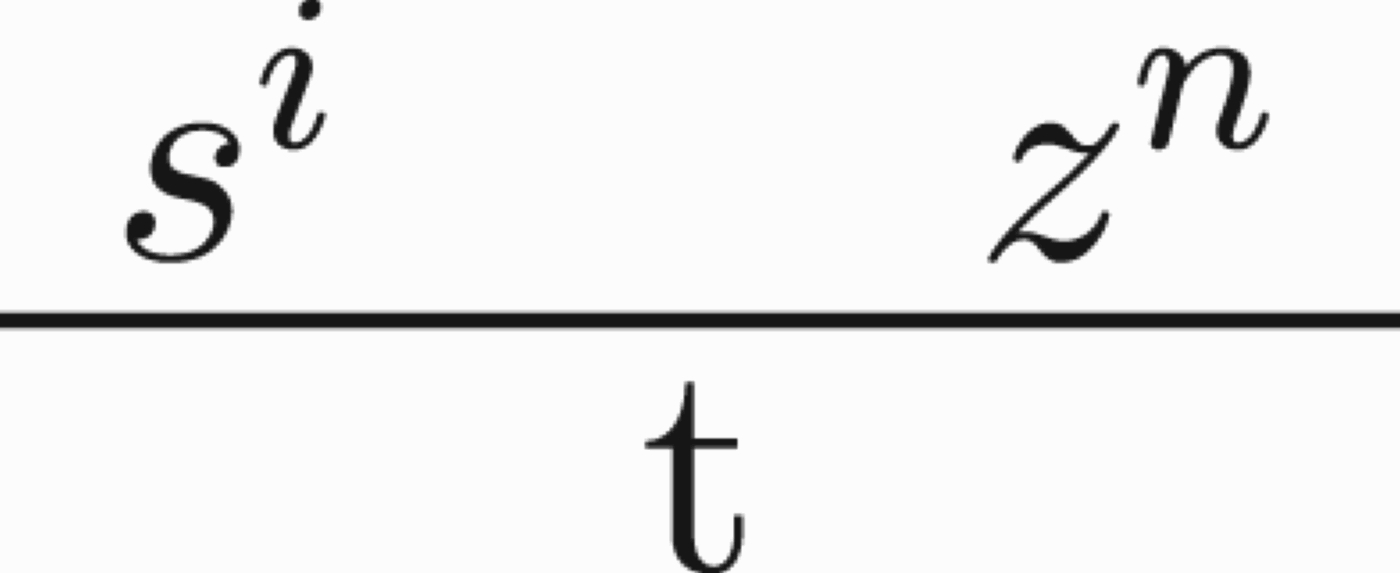
An argument for t using an issue premise.
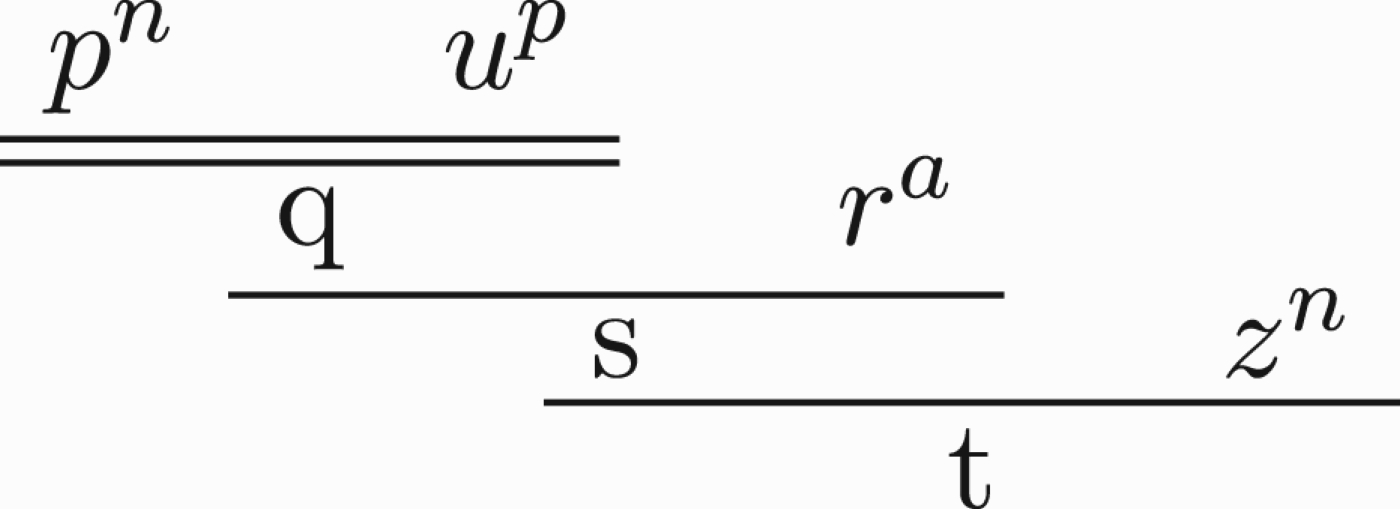
Another argument for t.
Now we can define the notion of an argumentation theory.
An argumentation theory is a triple
With the internal structure of arguments defined, it is now possible to distinguish between types of attack.
Undermining attack is an attack on the premises on an argument and is the only attack possible in the context of strict rules. An undercutting attack is an attack on the (defeasible) inference step and is a way to provide “exceptions to the rule”. Finally, a rebutting attack is done by constructing a contrary or contradictory conclusion for the attacked argument's (sub)conclusion.
Types of attack (Prakken 2010, Def. 3.16, 3.11, 3.14)
Argument A undermines argument B (on φ) iff Argument A undercuts argument B (on B′) iff Argument A rebuts argument B (on B′) iff
The types of attack can be combined with an argument ordering to define the notion of defeat. Similar to contraries, an undercutting attack does not take the ordering into account and hence always results in defeat. Intuitively, the undercutter contains an argument for an exception to the rule of the attacked argument, otherwise an undercutter and the attacked argument using that rule could be in the same extension.
Types of defeat (Prakken 2010, Def. 3.19, 3.20)
Argument A successfully rebuts argument B if A rebuts B on B′ and either A contrary-rebuts B′ or Argument A successfully undermines argument B if A undermines B on φ and either A contrary-undermines B or
The previous notions can be combined in an overall definition of defeat.
Defeat (Prakken 2010, Def. 3.21)
Argument A defeats argument B iff no premise of A is an issue and A undercuts or successfully rebuts or successfully undermines B. Argument A strictly defeats argument B iff A defeats B and B does not defeat A.
To deal with issue premises, an argument is acceptable only if it contains no issue premises; therefore, changing Definition 2.2 to the following.
An argument A∈Args is acceptable with respect to a set S of arguments, or alternatively S defends A, iff A contains no issue premises and for all arguments B∈S: if
This slightly changes the definition of Prakken (2010), disallowing arguments with issue premises to be acceptable at all, instead of only excluding them from extensions.
With arguments and the defeat relation fully defined, it is possible to link the argumentation theories of the structured approach to Dung's abstract argumentation frameworks, thereby formally making the correspondence between the structured and abstract approach.
An abstract argumentation framework AF corresponding to an argumentation theory AT is a pair
Args is the set of arguments on the basis of AT as defined by Definition 2.8,
defeats is the relation on Args given by Definition 2.13.
Finally, the acceptability of conclusions (of a mathematical language ℒ) is defined in the corresponding argumentation framework.
Acceptability of conclusions (Prakken 2010, Def. 3.23)
For any semantics S and for any argumentation framework AF and formula (1) φ is sceptically S-acceptable in AF if and only if all S-extensions of AF contain an argument with conclusion φ; (2) φ is credulously S-acceptable in AF if and only if there exists an S-extensions of AF that contain an argument with conclusion φ.
Given an argumentation system and a knowledge base in that argumentation system with the following rules and facts (where
For this argumentation framework, we have one complete (and thus one grounded, preferred and stable) extension, namely
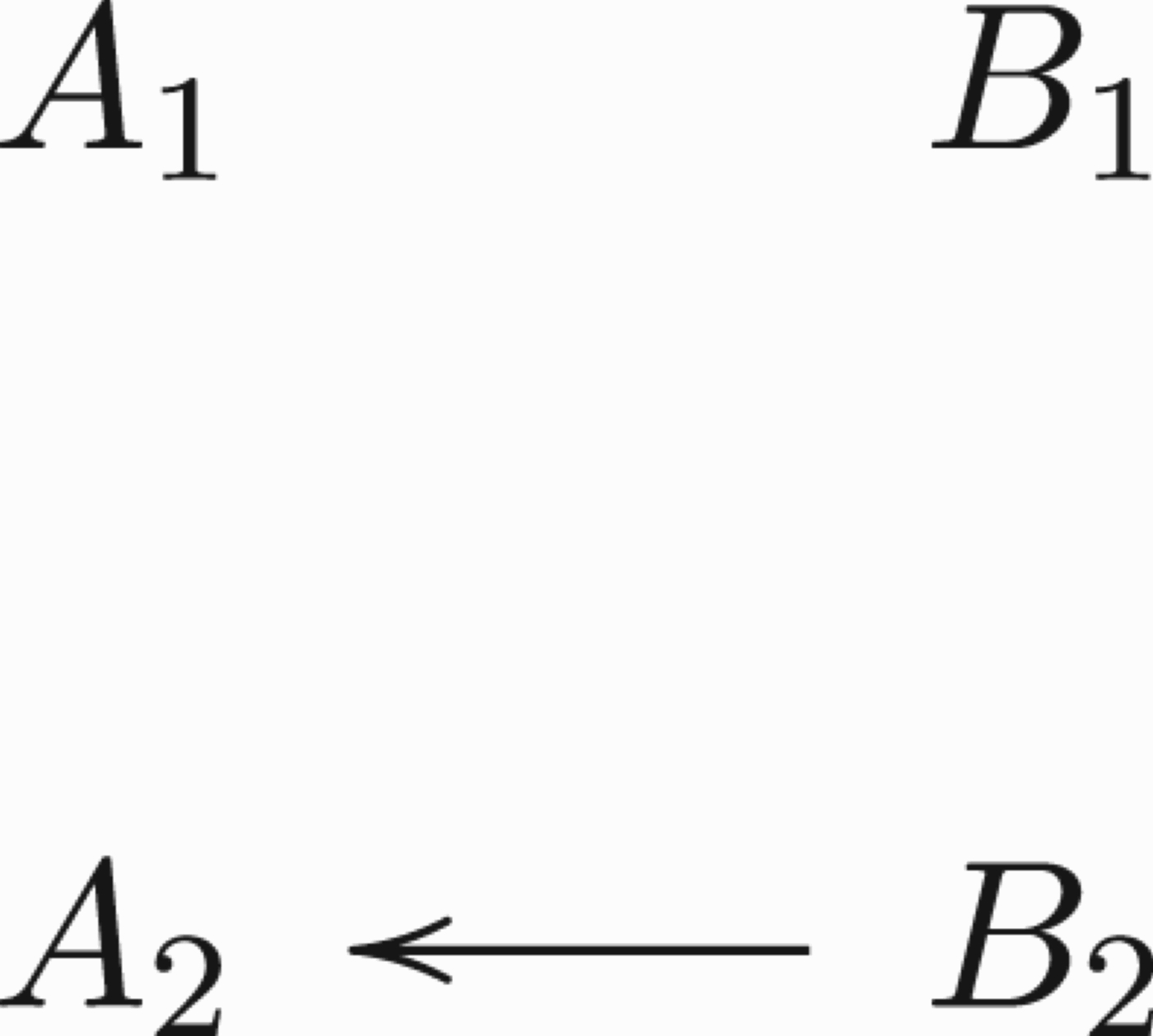
Corresponding argumentation framework.
Carneades is a formal model of argumentation incorporating both static and dynamic aspects of argumentation. In Carneades, argumentation is seen as a dialogical process, determining the acceptability of arguments by applying proof standards, where the assignment of proof standards to arguments is determined by the various proof burdens. The version of Carneades that we will discuss is the stage-specific part of the most recent version by Gordon and Walton (2009b). It is of primarily interest to us because of the existing reduction to abstract dialectical frameworks Brewka and Gordon 2010a; Brewka and Woltran 2010b). Contrary to how Carneades has been introduced in the literature (Gordon et al. 2007; Gordon and Walton 2009b), but similar to Brewka and Gordon (2010a), we will introduce proof standards to be part of the static, evaluative part of Carneades.
We will start with an introduction to Carneades’ concept of arguments. Similar to structured abstract argumentation frameworks introduced in the previous section, arguments in Carneades are not left abstract but given certain structure. Arguments are constructed by linking premises and exceptions to a conclusion. The Arguments pro and con and conclusions are later aggregated and evaluated through proof standards.
Arguments (Gordon and Walton 2009b, Def. 1)
Let ℒ be a propositional language. An argument is a tuple
In Carneades, a dialogue is a sequence of stages but for evaluating arguments in a specific stage the other stages are irrelevant. As in Brewka and Gordon (2010a), we therefore only consider stage-specific CAES. To define them, the concepts of an audience and an acyclic set of arguments must be introduced.
Audience (adapted from Gordon and Walton 2009b, Def. 3)
Let ℒ be a propositional language. An audience is a tuple ⟨assumptions, weight⟩, where
In contrast to how it was presented by Gordon and Walton (2009b), the weight function will not be partial. Evaluation of arguments without weights was, in exception of the rare case that the standard was scintilla for both c and c¯, undefined, and therefore the partiality of the weight function will be assumed to be incorrect.
Carneades is defined with an acyclic set of arguments to simplify the definitions and time needed for the evaluation of arguments.6
A possible generalisation to cyclic structures was left as future work (Gordon and Walton 2009b). This restriction was lifted in the translation done to abstract dialectical frameworks by Brewka and Gordon (2010a) and we will see that similar results hold for our translation done in Section 4.3.
Instead, we will use the more general concept of a dependency graph to determine acyclicity of a set of arguments, based on the definition of Brewka and Gordon (2010a).
A set of arguments is acyclic iff its corresponding dependency graph is acyclic. The corresponding dependency graph has nodes for every literal appearing in the set of arguments. A node p has a link to node q whenever p depends on q in the sense that there is an argument pro or con p that has q or q¯ in its set of premises or exceptions.
The previous definitions can now be combined to define Carneades’ concept of an evaluation structure.
Stage-specific CAES (adapted from Gordon and Walton 2009b, Def. 4)
A(stage-specific) CAES is a tuple
In the (legal) dialogues that Carneades models, proof burdens, such as the burden of production or the burden of persuasion, can be assigned to a propositional literal. Intuitively, an assigned proof burden obliges a participant of the dialogue to provide proof for that proposition, under the condition that the proof satisfies a certain standard of proof. In the model, the assignment of the proof standard is determined by the function standard provided in the previous definition. This proof standard can be evaluated in a specific stage and thus can be taken as a static part of Carneades. Proof standards included in the Carneades model, originating from the work of Freeman and Farley (1996) and Farley and Freeman (1995), are a scintilla of evidence, preponderance of the evidence, clear-and-convincing evidence, beyond-reasonable-doubt and finally dialectical-validity. A proof standard is a function that given a literal p aggregates arguments pro and con p and evaluates to true or false depending on a specific audience.7
This slightly generalises Carneades in that we allow complementary literals to be given different proof standards, in contrast to Gordon et al. (2007) and the implementations of Carneades.
A proof standard is a function mapping tuples
Given a CAES and the concept of a proof standard, we can define the acceptability of a literal. The acceptable set of literals can be seen as the collection of literals for which the proof standard is satisfied.
Acceptability of literals (adapted from Gordon and Walton 2009b, Def. 5)8
This (stage-specific) definition fixes a small technical error in the original definition by Gordon and Walton (2009b). The function standard returning a proof standard was instead directly called with the arguments for a proof standard.
This (stage-specific) definition fixes a small technical error in the original definition by Gordon and Walton (2009b). The function standard returning a proof standard was instead directly called with the arguments for a proof standard.
Given
All proof standards defined depend on the concept of argument applicability and thus this needs to be defined first.
Applicability of arguments (adapted from Gordon and Walton 2009b, Def. 6)
Let
p∈P implies p is an assumption of the audience or [p¯ is not an assumption and p is acceptable in C and
e∈E implies e is not an assumption of the audience and [ē is an assumption or e is not acceptable in C.
Now we can turn to the definition of Carneades’ proof standards. There is one subtle matter concerning the first proof standard, scintilla of evidence. A literal that is assigned scintilla of evidence as its proof standard obliges the party who puts forward an argument for this literal to produce an applicable argument. So to satisfy the scintilla of evidence standard only an applicable argument needs to be constructed; contradictory arguments do not influence the acceptability, thus allowing both p and its contradiction p¯ to be acceptable in a given CAES.
Proof standards
Given a CAES scintilla
preponderance
clear-and-convincing
preponderance
the weight for A exceeds the threshold α, and the difference between the weight of A and the maximum weight of the applicable con arguments exceeds the threshold β. beyond-reasonable-doubt
dialectical-validity
The theory of a (stage-specific) CAES is constructed by combining the acceptable literals in that CAES with the assumptions of the audience. In Carneades, the propositional logic is assumed as the logical language, so the theory is taken to be closed under propositional inferences.
Theory of a CAES
Let C=⟨arguments, audience,
Let
We can visualise these arguments (arrows denote premises/inferences and open circles denote exceptions) (Figure 4).
Then we have that argument a2 is not applicable because
The conclusion c (of argument a1) is not acceptable because
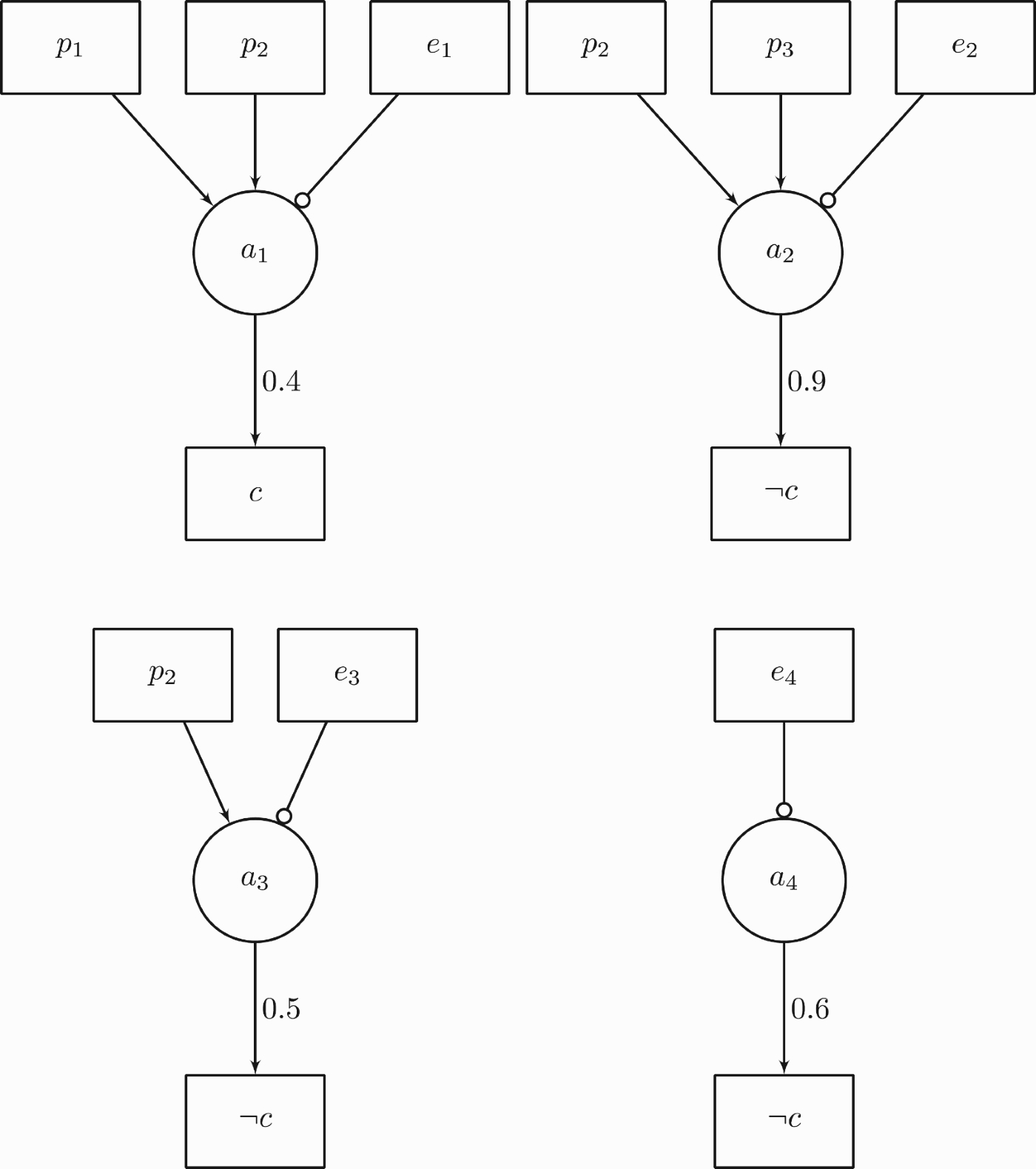
Arguments in Carneades.
In the next subsections, Carneades will be related to Dung's model. First we will translate the static, stage-specific part of Carneades to structured argumentation frameworks. We will study properties of our translation, for instance, proving correspondence results and showing that the translation does not violate rationality postulates. Then, we will generalise our translation of Carneades, allowing to lift the restriction of acyclicity on a CAES. Finally, we will relate our translation to the existing translations of Carneades to ADF's (abstract dialectical framework) and the defeasible logic (Brewka and Gordon 2010a; Governatori 2011).
Translation of stage-specific Carneades
We will start with relating the premises and exceptions of the arguments in Carneades to a knowledge base in an argumentation system. The assumptions of the audience in a CAES are propositional literals which are unattackable and furthermore, as can be seen in Definition 3.9, part of the logical theory. Combining these characteristics, assumptions in Carneades are closely related to the concept of axioms in a knowledge base and thus will be modelled as necessary axioms, 𝒦
n
, in our knowledge base. Next, the use of conclusions as a premise in a later argument is similar to the chaining of sub-arguments to construct more complex arguments and can, therefore, be handled by the argument generation part of
Combining these insights, we can now define the knowledge base corresponding to a CAES.
Knowledge base corresponding to a CAES
Given a CAES
There is no need to differentiate in the strength of premises, making our preference relation on premises just the reflexive closure on non-axiom premises.
As shown in our visualisation of Carneades’ arguments in Example 3.10, the link between the premises, the exceptions and the conclusion is a two-part inference. The first part – applicability of the argument – is solely determined by the acceptability of the premises and exceptions. The second step – acceptability of the conclusion – requires the argument to be applicable and furthermore to satisfy the demands of the proof standard that is assigned to the conclusion.
So for every argument
The idea to make the applicability step explicit by means of an argument node is adapted from Brewka and Gordon (2010a).
Exceptions in Carneades’ arguments express exceptions to inferring the conclusion. If we have an argument containing an exception that is acceptable or assumed by the audience, then that argument is made inapplicable, so the argument cannot make the conclusion acceptable. Given an acceptable argument containing exception p¯, it is not implied that p can be assumed to be true; so two arguments with conflicting exceptions can both be acceptable. This use of exceptions, similar to the concept of justifications in default logic (Reiter 1980), implies that negations of exceptions cannot be modelled as an assumption, but instead need to be modelled as an undercutter to the inference rule. So in our translation of argument a, for each exception e∈E, an undercutter
Although it might seem natural to include the negation relation of Carneades into the contrariness relation of the corresponding argumentation system, this does not actually work. With scintilla of evidence as a proof standard that can determine acceptable literals of a CAES, both p and p¯ are allowed to be acceptable, for example,
This is probably a technical mistake of Gordon and Walton (2009b). It can be fixed by slightly changing the definition of applicability of arguments, including the additional demand “there is not an assumption, c¯ in the audience that is contradictory to the conclusion, c, of the argument”.
Given a CAES
− consists of all tuples specified below,
For every argument
To illustrate the translation of one proof standard, notice that in a CAES, an argument a with standard clear-and-convincing evidence is unacceptable if either
Having built up the corresponding argumentation system, we can now relate an argumentation theory and consequently an argumentation framework to a CAES.
Argumentation theory corresponding to a CAES
Given a CAES AS is the argumentation system corresponding to C according to Definition 4.2, KB is the knowledge base in the argumentation system AS corresponding to C according to Definition 4.1,
Argumentation framework corresponding to a CAES
Given a CAES
To demonstrate our translation, we will show in detail how the CAES in Example 3.10 can be translated into its corresponding argumentation system, generating the corresponding argumentation framework.
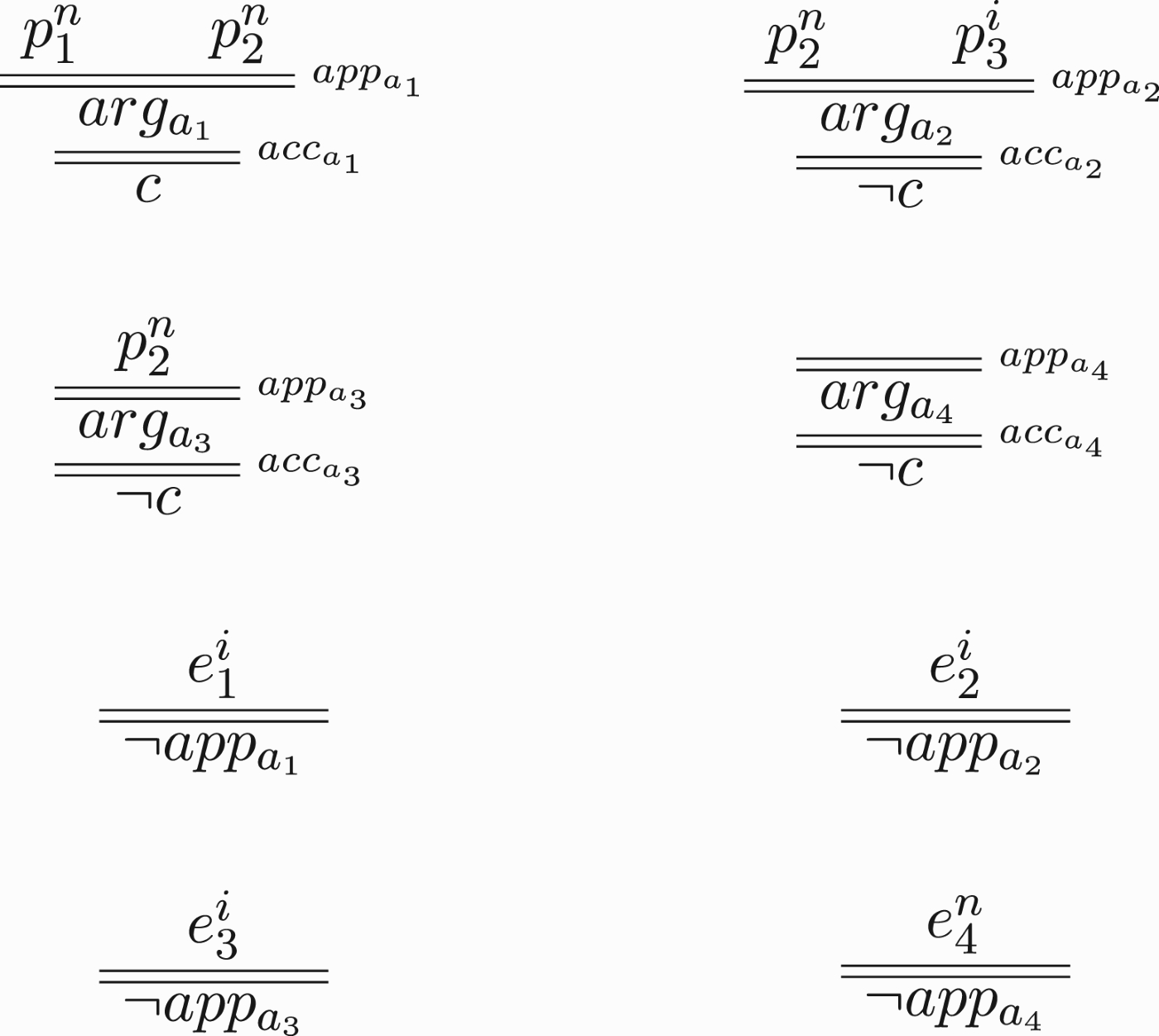
Structured arguments corresponding to Example 3.10.
First consider how the knowledge base in our argumentation system would correspond to the CAES given in Example 3.10. We have
Next we define the rules, ℛ, of the corresponding argumentation system. Every argument has a corresponding rule for applicability and for the acceptability of the conclusion, arguments containing an exception will have a corresponding inference rule, generating an undercutter and finally rules with the proof standard clear-and-convincing or beyond-reasonable-doubt can have a strict rule undercutting the acceptability, if the weight of the argument is below α. For example, argument a2 will generate
What remains is the translation of the defeat relation, for which we will consider argument A4, related to a1 in the CAES. The argument A4 first of all is undercut on
Although there are some defeaters present that do not directly correspond to the original CAES, that is, the exception
Now that we have defined the argumentation framework corresponding to a CAES, we can look at some interesting properties of the translation.
Well-foundedness
First of all, we will show that an argumentation framework corresponding to a CAES contains no cycles and therefore is actually a well-founded argumentation framework. From this property and a proposition proved by Dung, we can then immediately deduce that every argumentation framework corresponding to a CAES induces a unique Dung extension.
Every argumentation framework corresponding to a (finite) CAES according to Definition 4.4 is well-founded.
The next result follows directly from Proposition 4.6 and Theorem 2.5:
Every argumentation framework corresponding to a CAES according to Definition 4.4 has exactly one complete extension which is grounded, preferred and stable.
Here we can see that contrary to the claim of Brewka and Gordon (2010a) – namely that modelling Carneades in Dung's approach could not be done cycle-free – we have proved that an argumentation framework corresponding to a CAES is well-founded and thus cycle-free. This means that the corresponding argumentation frameworks always induce a unique Dung extension which is the same in all Dung's semantics. Carneades’ semantics is therefore essentially a single-status assignment approach.
We have seen that in Carneades the defeat relation that is generated through the translation depends on the audience and the proof standards. This use of audience is very similar to (and inspired by) the approach taken in value-based argumentation frameworks (Bench-Capon et al. 2007). More interestingly, just as the uniqueness of preferred extensions in VAF's (value-based argumentation framework) with respect to a single audience is guaranteed, in the translation of Carneades there is also a unique complete extension.
The time to compute the extension of a well-founded argumentation framework can be determined to quadratic, by verifying that it is possible to topologically sort the acyclic dependency graph in
Exponential explosion
Consider a class of CAES with 2n arguments, such that
Now consider the corresponding defeasible rules (leaving out rule names):
This exponential explosion is caused due to the implicit linking of arguments in Carneades that is made explicit when constructing arguments from the corresponding argumentation system. However, due to the acyclicity of the arguments, this explicit linking is not needed to compute the acceptable conclusions. The exponential explosion can be solved by the following (sketched) polynomial algorithm.
CAES argument generation
sortedArgs = Topological sort of arguments on its dependency graph.
while
pick the first argument in sortedArgs. Remove all arguments from sortedArgs that have the same conclusion, c, and put them in argSet; translate argSet and generate arguments, building on previously generatedArgs as sub-arguments, and put the generated arguments in tempArgs; if present, pick one acceptable argument in tempArgs that has the conclusion c and add it to generatedArgs;
We leave it to future work to formally verify the complexity results of the translation.
This exponential explosion also sheds some light on the complexity of evaluation in Carneades. An important concept in the definition of Carneades is the “concept of a proof”, where evaluating a proof (a CAES) should be possible in a tractable time. This tractability can now be proved by verifying the polynomiality of the translation.
Correspondence results
We can now prove the main theorem of this article, namely that every argumentation framework that corresponds to a CAES preserves the properties we would expect.
Let C be a CAES, An argument
A propositional literal
From Part 2 of Theorem 4.10, we can directly relate the theory of a CAES with the corresponding argumentation framework:
A proposition p is part of the theory of C iff p is contained in the closure under propositional logic of the complete extension of AF .
We have now formally shown that the argumentation framework corresponding to a CAES keeps the properties we wanted to preserve. This proves, in contrast to what was claimed by Gordon et al. (2007), that Carneades can be faithfully modelled in Dung's argumentation frameworks.
It can even be argued that it is too faithful a correspondence, keeping inconsistencies of the original model in the final translation. The inconsistencies caused by the use of the scintilla of evidence proof standard might suggest a change in the definition of proof standard in Carneades, for instance, by disallowing proof standards that make contradictory conclusions true at the same time.
Regardless, the intermediate translation of a CAES into an argumentation system allows for an easy reparation. We can import the original negation relation of the CAES, generating attacks for any conflicting conclusion. To be precise, given an argumentation system AS corresponding to a CAES, we can make the new contrariness relation:
The stage-specific part of Carneades can be called “ambiguity-blocking” in contrast to “ambiguity-propagating” (see Gordon, Prakken, and Walton 2007, Section 7.1). Here a non-monotonic logic is ambiguity-blocking if, when a conflict between two lines of reasoning with contradictory conclusions cannot be resolved, both lines of reasoning are cut-off and neither of the conclusions can be used for further reasoning. In such logics, it may happen that other lines of reasoning remain undefeated even though one of the cut-off lines of reasoning interferes with it and is not weaker.
Consider the following example, containing an ambiguity between q and ¬ q that does not interfere with the inference of ¬ s even though ¬ q is used as an argument for s.
Consider the CAES
With the proof standard of q, ¬ q, s and ¬ s being preponderance, we can see that q, ¬ q and s will not be acceptable, but ¬ s will be acceptable. Now consider a naive, direct translation of the arguments into defeasible inference rules in
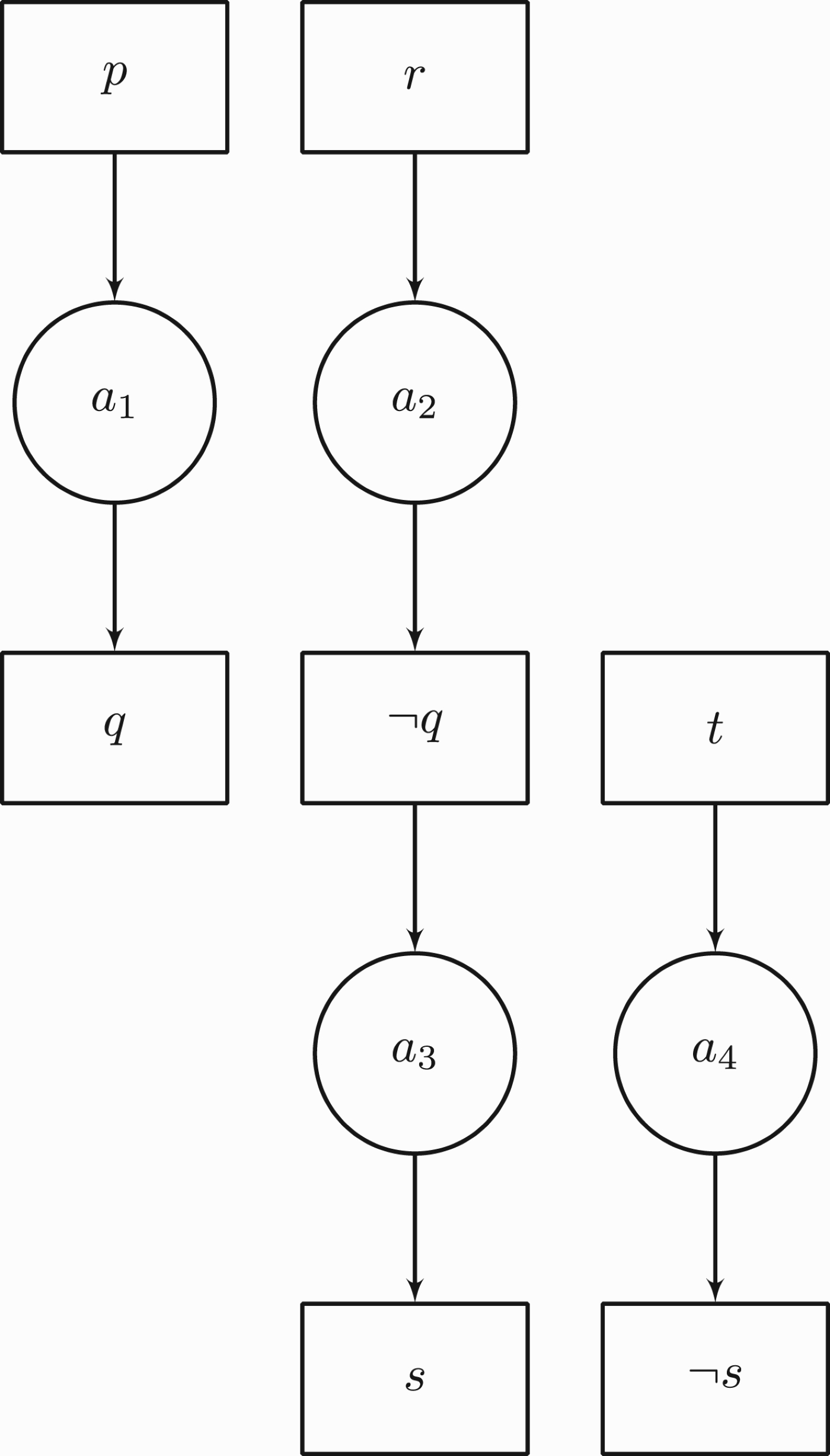
Ambiguity-blocking in Carneades.
The main difficulty in finding the translation of Carneades to
The abstract argumentation model by Dung provides a basis for argumentation systems. The structure imposed, a set of arguments and a defeat (attack) relation, gives rise to multiple semantics to evaluate argumentation frameworks. These semantics, extensions of acceptable arguments, can be seen as rationality constraints on how to evaluate argumentation frameworks. Therefore, when additional structure is imposed on arguments, as done in Section 2.2, more rationality constraints can be imposed on the evaluation. This approach was taken by Caminada and Amgoud (2007), who introduced a set of rationality postulates for argumentation systems with more structure. Caminada and Amgoud argued that extensions of these systems should satisfy postulates regarding consistency and closure. We repeat here four postulates11
The results of the other postulates follow directly from these four.
Closure under sub-arguments: for every argument in an extension all its sub-arguments are in the extension.
Closure under strict rules: the set of conclusions of all arguments in an extension is closed under strict-rule application.
Direct consistency: the set of conclusions of all arguments in an extension is consistent.
Indirect consistency: the closure of the set of conclusions of all arguments in an extension under strict-rule application is consistent.
We have shown in Section 4.1 that Carneades can be reduced to an
Given an argumentation theory AT with language ℒ, then
AT is closed under contraposition iff for all AT is closed under transposition iff for all AT is axiom-consistent iff AT is well formed iff if ϕ is a contrary of ψ then
Given a CAES C with corresponding argumentation theory AT and corresponding argumentation framework AF, then the four rationality postulates hold for the unique extension of AF.
An important thing to note here is that although we have proven consistency for the extension of a corresponding argumentation framework, this consistency is relative to the contrariness relation of the argumentation theory. The achievement of gaining consistency in an argumentation framework corresponding to a CAES is mainly due to leaving out the negation relation of that CAES, in a sense circumventing the problem.
Important future work mentioned by Gordon and Walton (2009b) is to generalise Carneades to cycle-containing structures. Although it was claimed by Brewka and Gordon (2010a) that Carneades would need a cyclic representation in other frameworks, such as Dung's argumentation frameworks, our translation of Carneades translates to cycle-free, or well-founded argumentation frameworks. This same well-foundedness allows for an easy extension of Carneades's argument set to a possibly cycle-containing structure.
Since our translation of a CAES to an argumentation framework does not depend on possible cycles in the set of arguments, we can use the same translation for cycle-containing CAES and deal with the resulting cycles by using the standard Dung semantics.
Given a CAES An argument A propositional literal
We will demonstrate our generalisation of Carneades by translating Example 2 of Brewka and Gordon (2010a) to an argumentation framework, showing intermediate steps.
Assume, we have two possible destinations in mind for a summer vacation, Greece and Italy, but cannot afford to visit both destinations. We could formalise this as follows. Let
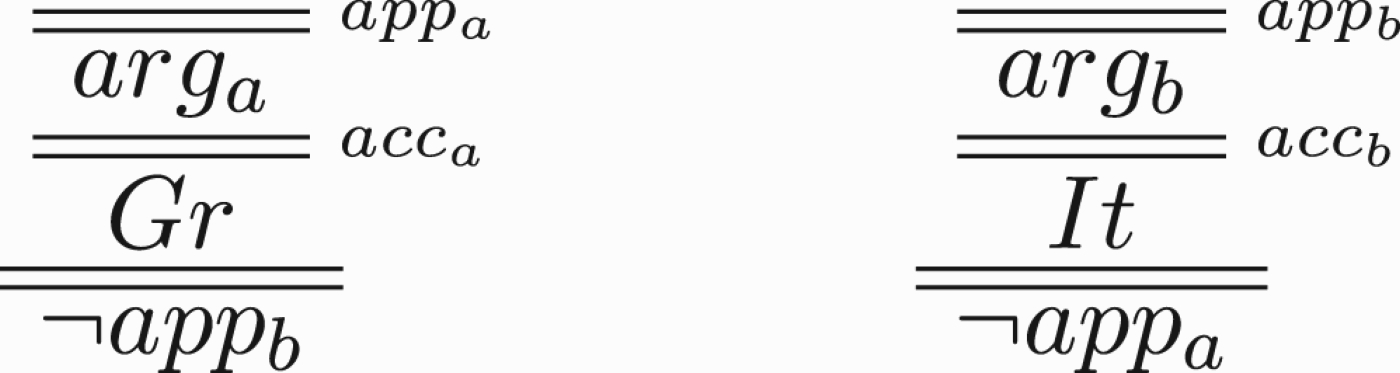
Greece versus Italy argument trees.
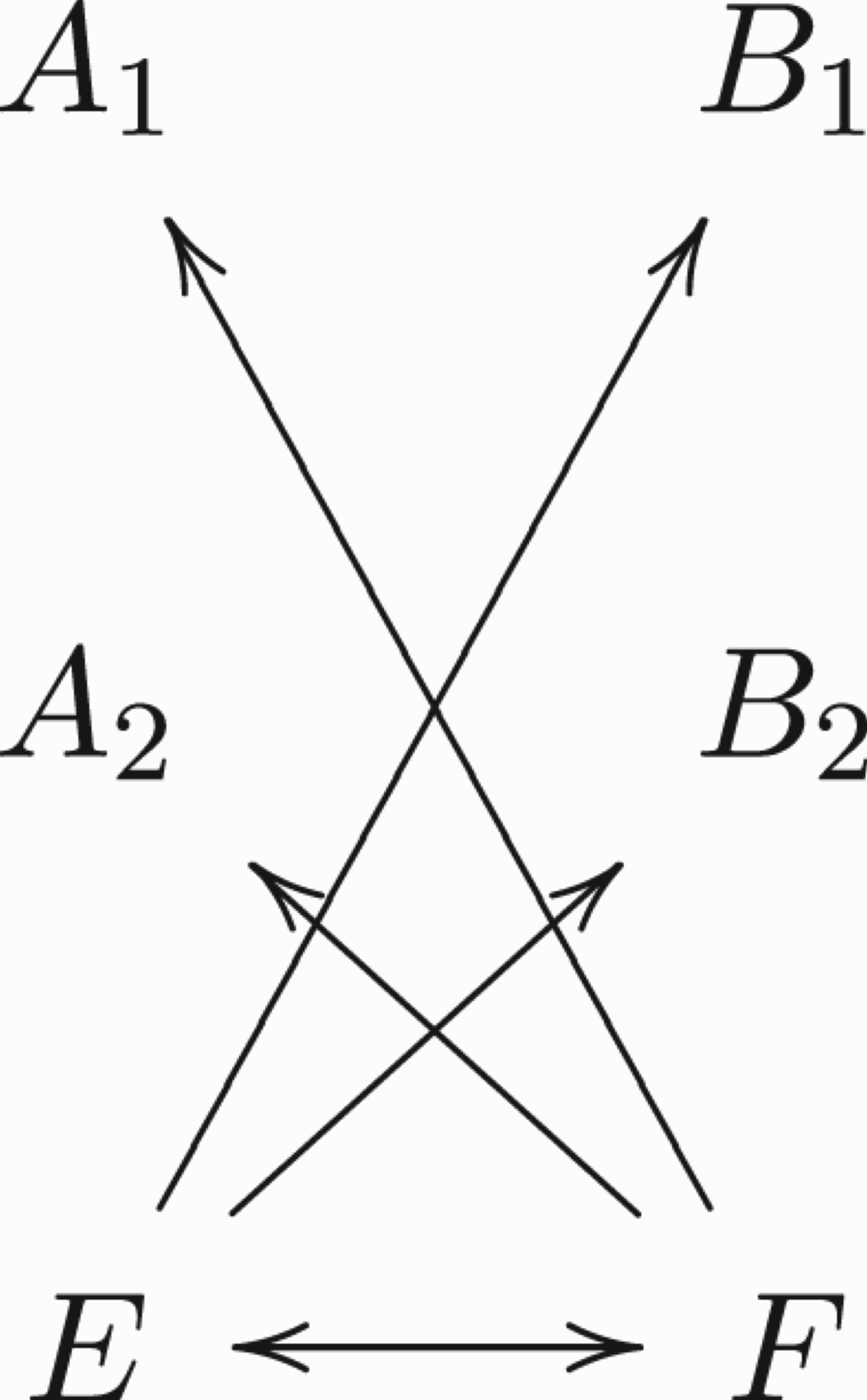
Greece versus Italy argumentation framework.
Concurrent to the work done in this article and the paper by van Gijzel and Prakken (2011), there have been translations of Carneades to other argumentation approaches. First of all, there is the translation of Carneades to abstract dialectical frameworks by Brewka and Gordon (2010a). In this translation, premises and exceptions, respectively, have a support and attack relation with the argument node, much in the same way that sub-arguments and undercuts are used in our translation. Carneades’ proof standards are encoded as acceptance conditions from the argument node, supporting the conclusion and attacking the contradictory conclusion.
Although the translation of Brewka and Gordon clarified the relation between Carneades and abstract argumentation by relating it to ADFs, one of the main concerns about this translation was that it needed the full power of abstract dialectical frameworks, thus obscuring the direct relation with Dung's argumentation frameworks. This connection has now been made explicit by the paper of Brewka et al. (2011), developing a translation of ADFs to AFs, using Boolean networks (Dunne 1988). The paper concerns itself mostly with the computational complexity of the translation, to keep a polynomial complexity in both size and time. However, this translation introduces additional technical nodes in the final argumentation framework that have no intuitive meaning. So even though the translation gives a formal connection between the two argumentation models, the intuitive relation is mostly lost.
Very recently, Carneades has been translated to defeasible logic (Nute 1994) by Governatori (2011). Defeasible logic is a computational approach to non-monotonic reasoning with an argumentation-like flavour. Defeasible logic has the possibility to handle both ambiguity-blocking and ambiguity-propagating behaviour, allowing for a rather direct representation of Carneades’ proof standards. The translation by Governatori maps proof standards to a single inference mechanism, giving a natural representation of the proof standards.
While Governatori thus establishes an intuitive relation between Carneades and defeasible logic, he only partly relates Carneades to abstract argumentation, since only the ambiguity-propagating part of defeasible logic has an established direct formal relation with Dung's argumentation frameworks. Its ambiguity-blocking variant has instead been translated to a Dung-like semantics using a different notion of acceptability (Governatori, Maher, Antoniou, and Billington 2000).
Conclusion
This article has shown that Carneades can be reconstructed, through
An important property of our reconstruction of Carneades is that our modelling gives a cycle-free argumentation framework, thus always inducing a unique Dung extension which is the same in all Dung's semantics. This shows that Carneades is essentially a single-status assignment approach. This property allowed us to generalise Carneades to cycle-containing structures by using Dung's standard grounded, preferred and stable semantics, thereby addressing the issue put forward by Gordon and Walton (2009b). This generalisation is done much in the same way as by Brewka and Gordon (2010a).
Finally, we note that our translation enables a standard Dung semantics for an “ambiguity-blocking” non-monotonic logic (see Gordon et al. 2007, Section 7.1); to our knowledge, we are the first to have achieved such a result.
Future work
Through this article and by the work of Prakken (2010), several approaches to structured argumentation have been developed and subsequently related through a single framework called
The translation of Carneades to
Our results raise the question whether it would now be better to use ASPIC+ directly, instead of Carneades, to model argumentation when variable proof standards and the other features of Carneades are required. The answer depends on whether Carneades is sufficient as a model of reasoning with variable proof standards. Prakken and Sartor (2011) claim that Carneades’ ambiguity-blocking nature prevents an adequate modelling of the distinction between the burdens of production and persuasion. If they are right, then there is reason to change Carneades in the direction of ASPIC+.