




Abstract
Argumentation is a mechanism to support different forms of reasoning such as decision making and persuasion and always cast under the light of critical thinking. In the latest years, several computational approaches to argumentation have been proposed to detect conflicting information, take the best decision with respect to the available knowledge, and update our own beliefs when new information arrives. The common point of all these approaches is that they assume a purely rational behavior of the involved actors, be them humans or artificial agents. However, this is not the case as humans are proved to behave differently, mixing rational and emotional attitudes to guide their actions. Some works have claimed that there exists a strong connection between the argumentation process and the emotions felt by people involved in such process. We advocate a complementary, descriptive and experimental method, based on the collection of emotional data about the way human reasoners handle emotions during debate interactions. Across different debates, people’s argumentation in plain English is correlated with the emotions automatically detected from the participants, their engagement in the debate, and the mental workload required to debate. Results show several correlations among emotions, engagement and mental workload with respect to the argumentation elements. For instance, when two opposite opinions are conflicting, this is reflected in a negative way on the debaters’ emotions. Beside their theoretical value for validating and inspiring computational argumentation theory, these results have applied value for developing artificial agents meant to argue with human users or to assist users in the management of debates.
Introduction
Understanding how humans reason and take decisions in debates and discussions is a key issue in cognitive science and a challenge for social applications. Moreover, with the growing importance of the Web, this issue is complicated by the fact that in such a hybrid space heterogeneous actors, both human and artificial, interact. As a typical example, Wikipedia is managed by users and bots who constantly contribute, agree, disagree, debate and update the content of the encyclopedia. In this context, several dimensions of the interaction affect the reasoning and decision making process, i.e., the arguments that are proposed online, the emotions of those who propose such arguments as well as the emotions of those reading these arguments, the social relationships among the involved actors, the writing of their messages, etc. This underlines the need for multidisciplinary approaches and research for Web applications in general and for detecting and managing the emotional state of a user in particular to allow artificial and human actors to adapt their reactions to others’ emotional states. It is also a useful indicator for community managers, moderators and editors to help them in handling the communities and the content they produce.
In this paper, we argue that in order to apply argumentation to scenarios like e-democracy and online debate systems, designers must take both the argumentation and the emotions into account. In order to efficiently manage and interact with such a hybrid society, we need to improve our means to understand and link the different dimensions of the exchanges (e.g. social interactions, textual content of the messages, dialogical structures of the interactions, emotional states of the participants). Beyond the challenges individually raised by each dimension, a key problem is to link these dimensions and their analysis together with the aim to detect, for instance, a debate turning into a flame war, a content reaching an agreement, a good or bad emotion spreading in a community.
In this paper, we aim to answer the research question: What is the connection between the argumentation and the emotions in online debate interactions? Such question breaks down into sub-questions:
How are the arguments and their relations correlated with the polarity of the detected facial emotions?
Is the relation between the kind and the amount of arguments proposed in a debate correlated with the mental engagement and workload detected for each participant in the debate?
How do personality traits and opinions affect participants’ emotions during the debate?
To answer these questions, we propose an empirical evaluation of the connection between argumentation, personality traits, and emotions in online debate interactions. This paper describes an experiment with human participants which investigates the correspondences between the arguments and their relations put forward during a debate, the emotions detected by emotions recognition systems in the debaters, and the personality traits of the debaters. We designed an experiment where 12 debates were addressed by 4 participants each. Participants were asked to discuss about 12 topics in total proposed by moderators, e.g., “Religion does more harm than good” and “Cannabis should be legalized”. Participants argue in plain English proposing arguments, that are in positive or negative relation with the arguments proposed by the other participants and by moderators. During these debates, participants are equipped with emotion detection devices, recording their emotions. Moreover, each participant filled in a questionnaire for Big Five personality traits [26]. We hypothesize that mental engagement and emotions are correlated to the argumentation holding in the debates, namely to the number of arguments that are proposed, and the kind of relations connecting them (i.e., support or attack). Moreover, we hypothesize that personality traits of debaters and debaters’ opinions regarding the discussed topics modulate their emotional experiences during the debates.
A key point in our work is that, up to our knowledge, no user experiment has been carried out yet to determine what is the connection between the argumentation addressed during a debate, the emotions emerging in the participants, as well as their personality traits. An important result of the work reported here is the development of a publicly available dataset, capturing several debate situations, annotated with their argumentation structure and the emotional states automatically detected.
It is worth highlighting that bipolar abstract argumentation is used in our experimental setting to pair the arguments, connect them with the appropriate relation (either support or attack), and combine them in bipolar argumentation graphs. This structure allows for further reasoning activities over the data, where for instance the acceptability of the arguments depends on the mental engagement associated to their conception by their proposer, or a ranking is established over the acceptable arguments depending on the emotions (mostly positive, mostly negative, neutral) they generated in the audience. The definition and evaluation of these reasoning processes are not in the scope of the present paper, and we left them for future research. It is worth clarifying also that, in this paper, we are not interested in verifying explanation and reasoning theories proposed in cognitive psychology like, among others, those of Lombrozo and colleagues [48] about explanations in category learning, and Keil and colleagues [27] about explanatory reasoning through an abductive theory. We rely on bipolar argumentation for representing the debates, and to foster the application of reasoning techniques.
The paper is organized as follows. In Section 2 we describe the main insights of the two components of our framework, namely bipolar argumentation theory and emotion detection systems, then in Section 3, we describe the experimental protocol and the questionnaires we proposed to the debaters during the experiment, and our research hypotheses. In Section 4, we provide a detailed analysis of the experimental results, and we compare this work with the relevant literature in Section 5. Conclusions end the paper, and Appendix 1 presents the Big Five personality traits questionnaire.
The framework
In this section, we present the two main components involved in our experimental framework: i) computational argumentation theory, and more precisely bipolar argumentation theory, i.e., the formalism used to analyze and represent the argumentation elements from the debates, and ii) the methodologies and tools used to detect the degrees of attention, engagement, and workload of each participant involved in the debate, as well as her facial emotions.
Argumentation theory
Argumentation is a very fertile research area in Artificial Intelligence, defined as the process of creating arguments for and against competing claims [39]. What distinguishes argumentation-based discussions from other approaches is that opinions have to be supported by the arguments that justify, or oppose, them. This permits a greater flexibility than in other decision making and communication schemes since, for instance, it makes it possible to persuade other persons to change their view of a claim by identifying information or knowledge that is not being considered, or by introducing a new relevant factor in the middle of a negotiation, or to resolve an impasse.
Computational argumentation is the process by which arguments are constructed and handled. Thus argumentation means that arguments are compared, evaluated in some respect and judged in order to establish whether any of them are warranted. Roughly, each argument can be defined as a set of assumptions that, together with a conclusion, is obtained by a reasoning process. Argumentation as an exchange of pieces of information and reasoning about them involves groups of actors, human or artificial. We can assume that each argument has a proponent, the person who puts forward the argument, and an audience, the persons who receive the argument.
A highly influential framework for studying argumentation-based reasoning was introduced by [14]. A Dung-like argumentation framework (
In order to analyze from the argumentation point of view the debates in which the participants to our experiment have been involved, we rely on abstract bipolar argumentation. In this way, we do not need distinguish the internal structure of the arguments (i.e., premises, conclusion), but we consider each argument proposed by the participants in the debate as a unique element, then analyzing the relation (positive or negative) it has with the other pieces of information put forward in the debate. The following example extracted from one of the debates addressed in our experiment shows how the arguments are connected to each other through a defeat or a support relation. Consider the following three arguments proposed by the participants of the debate about “Religion does more harm than good”. We have that the issue of the debate is also our first argument whose proponent is the debate moderator, then the other two arguments are proposed by two different participants:
Religion does more harm than good.
During all the existence of the human being, religion makes a lot of issues. It makes more hurts than cures.
I think for people, religion is a refuge against the horrors of the world.
Given such a kind of debate, we have that three arguments are proposed (namely Argument 1, Argument 2 and Argument 3) whose relations with each other are as follows: (Argument 2) supports (Argument 1), (Argument 3) attacks (Argument 1), and (Argument 3) attacks (Argument 2).
Note that in this paper we are not interested in applying natural language processing techniques to detect automatically the relations among the arguments. On the contrary, we have manually built our data set of argumentation and emotions from the data retrieved during the debates of our experiment. Experiments with natural language processing approaches will be part of future work.
Emotion detection
Human emotion analysis during traditional face-to-face or computer-mediated interaction has always been a challenging and attractive task mainly because of how emotions are closely associated to human behavior and experience. Several theories state that emotions serve as an adaptive function to our behavior, e.g., [19,25,31,42]. Following these theories, the appraisal of an experience and the intention to act to maintain, adjust or change a condition related to this experience is impacted by emotions. During a debate, emotional reactions provoked by others’ arguments could be, for example, a trigger for developing attacking or supporting arguments.
Emotion recognition methods can be categorized into three groups, each of them defining one level of how a usual emotional response is displayed, namely, experiential, behavioral and physiological [22]. For example if an individual is annoyed by someone else’s argument, the subjective experience could be the anger; the behavioral response will be displayed through a higher voice tone (during a face-to-face conversation) or an angry facial expression; and the physiological response will be activated by an increasing level of heart rate. Usually, the experiential methods use subjective self-report instruments (such as surveys and questionnaires) to determine the emotion relative to a specific event. The behavioral methods are based on external observable clues detected from the individual’s behavior (such as gestures, body movements, facial expression, voice tone and pitch, etc.) that can indicate the type of the emotion. The physiological methods rely on physical sensors (such as EDA, EEG, heart rate, respiration rate, temperature, etc.) to measure specific physiological shifts and patterns that can be related to specific emotions. In a computer-mediated context, the use of self-report surveys to recognize the individuals’ emotions could be inconvenient. If these surveys are administrated at frequent intervals during the task, it could be disrupting for the task performance. However, non-frequent administration intervals of the survey could result into an undetailed and ambiguous assessment of the different emotions experienced during the task. Therefore, growing research interest has arisen towards using and combining behavioral and physiological methods for emotion recognition [28,29,37]. These methods allow automatic, objective and reasonably precise emotional recognition level.
In our study, we selected a behavioral method to extract the emotional manifestations. We used a set of webcams (one for each participant in the discussion) whose recordings have been analyzed with the FaceReader software2
Detecting emotions from facial expressions. The emotional detection from facial expression is one of the most commonly and predominantly used methods [1,24,47]. In fact, facial expressions of basic emotions are widely believed to be naturally and universally expressed and recognized. In this study, we used the FaceReader software (version 6.0) to automatically extract the emotional reactions from the frame-by-frame videos recoded by the webcam. The FaceReader software launched by Noldus Information technology is able to recognize six basic emotions, namely, happy, sad, angry, surprised, scared and disgusted with an accuracy reaching 87%. The detection process is performed by extracting and classifying in real-time 500 key points in facial muscles of the target face. These key points are provided as input to a neural network trained on a dataset of 10000 manually annotated images corresponding to these six basic emotions. In addition to the probability of the presence of these six emotions, the software output also contains the probability of the neutral state as well as the valence, and the arousal of the emotional state. Information about the emotional valance defines the nature of the emotion and is ranging from
In this study, at each second in the debate, a dominant emotion is computed for each one of the four participants. This dominant emotion corresponds to the emotion (among the six detected by FaceReader) with the highest probability. Moreover, information about the valence and arousal of this emotion as well as their class (pleasant or unpleasant for the valence, high or low for the arousal) was also considered.
Emotiv EPOC EEG headset. In order to record physiological data of the participants during the debate sessions, we used the 4 Emotiv Epoc EEG headsets (one for each participant). This device contains 14 electrodes spatially organized according to International 10–20 system.3
International 10–20 system is an internationally recognized method to describe and apply the location of scalp electrodes in the context of an EEG test or experiment.
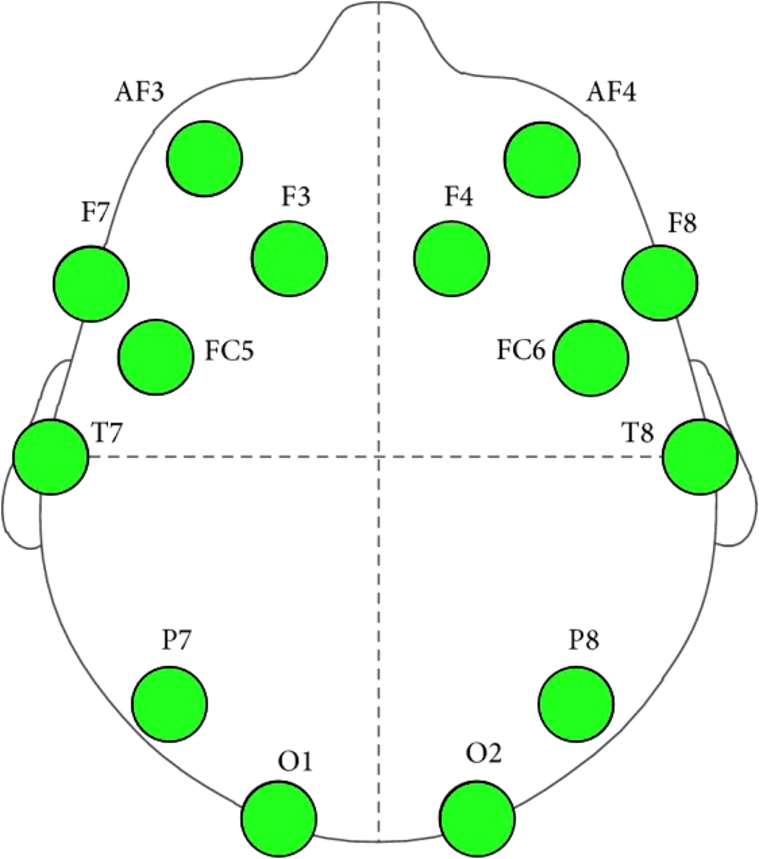
Emotiv Headset sensors/data channels placement.
Extracting the engagement index. The term mental engagement refers to the level of attention and alertness during a task. The engagement index used in our study is based on the findings of [36] and [18]. In their study, it was found that the user’s performance improved when an EEG index is used as a criterion for switching between manual and automated piloting mode. This index is computed from three EEG frequency bands: α(8–12 Hz), β(12–22 Hz) and θ(4–8 Hz):
This index is computed each second from the EEG signal. To smooth the values of this index and reduce its fluctuation, we used a moving average on a 40-second mobile window. More precisely, the value of the index at time t corresponds to the total average of the ratios calculated on a period of 40 seconds preceding t. The extraction of the frequency bands (namely α, β and θ) was performed by multiplying every second of the EEG signal by a Hamming window (to reduce the spectral leakage) and applying a Fast Fourier Transform (FFT). As the Emotiv headset measures 14 regions at the same time, we used a combined value of α, β and θ frequency bands by summing their values over all the measured regions. To examine participants’ engagement, we extract their minimum, average and maximum values during the debate, and we use such values to identify the range of engagement (High, Medium, Low) of every participant. Since its development by Pope and his colleagues, this engagement index has become a very important and popular technique for real time or offline tracking and analysis of individuals’ engagement in several laboratory studies. In the educational sittings for example, this engagement index was used for monitoring learners’ engagement and adapting learning activities according to their level of mental engagement by [44] and [11]. In robotics, this index was also used to leverage the interaction between a robot and a user by providing the robot real-time information about the user’s engagement while the robot is speaking to him by [43]. The robot was successfully able to detect when the user is not anymore engaged in listening to him and tried to regain his attention by employing verbal and nonverbal techniques. This engagement index was also selected as a criterion for adapting a game’s difficulty according to the player’s level of engagement, showed promising results [9].
Extracting the workload index. The term workload (or cognitive load in a learning context) refers to a measurable quantity of information processing demands placed on an individual by a task [35]. The mental workload is generally related to the working memory and could be viewed as a mental effort produced to process the quantity of information involved in the task.
Unlike the engagement index which is directly extracted from the EEG data, the EEG workload index was based on pre-trained predictive model [10]. This model was trained using a set of EEG data collected from a training phase during which a group of seventeen participants performed a set of brain training exercises. This training phase involved three different types of cognitive exercises, namely: digit span, reverse digit span and mental computation. The objective of these training exercises was to induce different levels of mental workload while collecting the learner’s EEG data. The manipulation of the induced workload level was done by varying the difficulty level of the exercises: by increasing the number of the digits in the sequence to be recalled for digit span and reverse digit span, and the number of digits to be added or subtracted for the mental computation exercises – we refer to [10] for more details on the procedure. After performing each difficulty level, the participants were asked to report their workload level using the subjective scale of NASA Task load index (NASA_TLX) [23]. Once this training phase was completed, the collected EEG raw data were cut into 1-second segments and multiplied by a Hamming window. A FFT was applied to transform each EEG segment into a spectral frequency and generate a set of 40 bins of 1 Hz ranging from 4 to 43 Hz (EEG pre-treated vectors). The dimensionality of the data was then reduced using a Principal Component Analysis (PCA) to 25 components (the score vectors). Next, a Gaussian Process Regression (GPR) algorithm with an exponential squared kernel and a Gaussian noise [40] was run in order to train a mental workload predictive model (the EEG workload index) from the normalized score vectors. Normalization was done by subtracting the mean and dividing by the standard deviation of all vectors. In order to reduce the training time of the predictive model, a faster version of GPR the local Gaussian Process Regression algorithm was used [15]. The evaluation of this model showed a correlation with the participants’ subjective scores NASA_TLX reaching 82% (mean correlation 72%). This same approach was used within an intelligent tutoring system called (MENTOR) fully controlled by this workload index to automatically select the most adapted learning activity for the learner. The experimental results showed positive impact of using such index on learners’ performance and satisfaction.
The reader may question about the reliability of such kind of neural metrics. Actually, many contributions have tackled the issue of predicting human behavior from neural metrics, e.g., [3,16,30], by collecting EEG data to detect cognitive interest, emotional engagement and decision making of consumers towards communication messages or advertisements in order to optimize them.
This section details the experimental session we set up to analyze the relation between the emotions and the argumentation process. More precisely, we detail the protocol we have defined to guide the experimental setting, and the resulting datasets we have manually annotated in order to combine the arguments proposed in the debates with the detected emotions. Finally, we specify the hypotheses we aim at verifying in this experiment.
Protocol
The general goal of the experimental session is to investigate the relation (if any) holding between the emotions detected in the participants during a debate session and the argumentation flow of the debate itself. The idea is to associate the arguments and the relations among them to the participants’ mental engagement and workload detected via the EEG headset, and the facial emotions identified via the Face Emotion Recognition tool.
More precisely, starting from an issue to be discussed provided by the moderators, e.g., We have to ban animal testing, the aim of the experiment is to collect the arguments proposed by the participants on the topic, as well as the relations among them (i.e., support or attack), and to associate such arguments/relations to the mental engagement and workload states and to the facial emotions expressed by the participants. During a post-processing phase on the collected data, we synchronize the arguments put forward by the different participants at time t with the emotional indexes we retrieved. Finally, we build the resulting bipolar argumentation graph of each debate, such that the resulting argumentation graphs are labelled with the source who has proposed each argument, and the emotional state of each participant at the time of the introduction of the argument in the discussion.
The first point to clarify in this experimental setting is the terminology. In this experiment, an argument is each single piece of text that is proposed by the participants in the debate. Typically, arguments have the goal to promote the opinion of the debater in the debate. Thus, an opinion in our setting represents the overall opinion of the debater about the issue to be debated. The opinion is promoted in the debate through arguments, that will support (if the opinions converge) or attack (otherwise) the arguments proposed in the debate by the other participants.
The experiment involves two kinds of persons:
Participant: she is expected to provide her own opinion about the issue of the debate proposed by the moderators, and to argue with the other participants in order to make them understand the goodness of her viewpoint (in case of initial disagreement).4
Note that, in this experimental scenario, we do not evaluate the connection between the emotions and persuasive argumentation. This analysis is out of the scope of this paper and it is left for future research.
Moderator: she is expected to propose the initial issue to be discussed to the participants. In case of lack of active exchanges among the participants, the moderator is in charge of proposing pro and con arguments (with respect to the main issue) to reactivate the discussion.
The experimental setting of each debate is conceived as follows: there are 4 participants involved in each discussion group, and 2 moderators. Each participant is placed far from the other participants, even if they are in the same room, while moderators are placed in another room. Moderators interact with the participants uniquely through the debate platform, and the same holds for the interactions among participants. The language used for debating is English.
In order to provide an easy-to-use debate platform to the participants, without requiring from them any background knowledge, we decide to rely on a simple IRC network5
The procedure we follow for each debate is:
Participants are firstly equipped with the EEG headset and the good connection of the headset is verified;
Participants are familiarized with the debate platform;
The debate starts – Participants take part into two debates each, about two different topics for a maximum of about 20 minutes for each debate:
The moderator(s) provides the debaters with the topic to be discussed;
The moderator(s) asks each participant to provide a general statement about his/her opinion on the topic;
Participants expose their opinion to the others;
Participants are asked to comment on the opinions expressed by the other participants;
If needed (no active debate among the participants), the moderator(s) posts an argument and asks for comments from the participants;
The variables measured in this experimental setting are the following: (i) engagement and workload indexes (measurement tool: EEG headset), and (ii) facial emotions, i.e., Neutral, Happy, Sad, Angry, Surprised, Scared and Disgusted (measurement tool: FaceReader).
The post-processing phase of the experimental setting involves the following steps:
manual annotation of the support and attack relations holding between the arguments proposed in each discussion, following the methodology described in Section Dataset;
manual annotation of the opinion of the participants at the beginning and at the end of the debates they participated in, and synchronization with the debriefing questionnaire data;
synchronization of the argumentation (i.e., the arguments/relations proposed at time instant t) with the emotional indexes retrieved at time t using the EEG headset and FaceReader.
Participants. The experiment was distributed over 6 sessions of 4 participants each; the first session was discarded due to a technical problem while collecting data. We had a total of 20 participants (7 women, 13 men), whose age range was from 22 to 35 years. All of them were students in a North American university, and all of them had good computer skills. Since not all of them were native English speakers, the use of the Google translate service was allowed. They have all signed an ethical agreement before proceeding to the experiment.
Participants have been asked to complete a short questionnaire about their viewpoints on the discussed topics. Thus, after each debate session, a debriefing phase was addressed. The questionnaire contained the following questions:6
Such material is available at
What was your starting opinion about the discussed topic before entering into the debate?
What is your final opinion about the discussed topic after the debate?
If you changed your mind, why (i.e., which was the argument(s) that has made you change your mind)?
These questions allowed us to know what is the opinion of the participants about the specific topics they debated about, without the need to infer it from the arguments they propose in the debates. The answers participants provided to these questions have been then used to correlate their opinions with the emotions they felt during the debates.
Finally, participants have been asked to fill in a questionnaire for Big Five personality traits. More precisely, participants filled in a questionnaire of 50 items of the kind:
I get stressed out easily; I don’t like to draw attention on myself; I spend time reflecting on things; …;
where the possible values range over a typical five-level Likert scale: Totally Disagree, Disagree, Neutral, Agree, Totally Agree. The complete Big Five personality traits questionnaire is reported in Appendix. Such information allowed us to extract the OCEAN personality dimensions, i.e.:
Openness, Originality, Open-mindedness
Conscientiousness, Control, Constraint
Extraversion, Energy, Enthusiasm
Agreeableness, Altruism, Affection
Neuroticism, Negative Affectivity, Nervousness
These dimensions have been analyzed with respect to their correlation with the detected emotions of participants during the debates. More details about this analysis are provided in the Results Section.
In this section, we describe the dataset of textual arguments we have created from the debates among the participants. The dataset is composed of four main layers: (i) the basic annotation of the arguments proposed in each debate (i.e. the annotation in xml of the debate flow downloaded from the debate platform); (ii) the annotation of the relations of support and attack among the arguments; (iii) starting from the basic annotation of the arguments, the annotation of each argument with the emotions felt by each participant involved in the debate; and (iv) starting from the basic annotation, the opinion of each participant about the debated topic at the beginning, in the middle and at the end of debate is extracted and annotated with its polarity. In the reminder of this section, we describe the annotation process of the four layers and the resulting inter-annotator agreement to ensure the reliability of the produced linguistic resource.
The basic dataset is composed of 598 different arguments proposed by the participants in 12 different debates. The debated issues and the number of arguments for each debate are reported in Table 1. We selected the topics of the debates among the set of popular discussions addressed in online debate platforms like iDebate7
The annotation (in
The second level of our dataset consists in the annotation of arguments pairs with the relation holding between them, i.e., support or attack. To create the dataset, for each debate of our experiment we apply the following procedure, validated in [4]:
the main issue (i.e., the issue of the debate proposed by the moderator) is considered as the starting argument;
each opinion is extracted and considered as an argument;
since attack and support are binary relations, the arguments are coupled with:
the starting argument, or
other arguments in the same discussion to which the most recent argument refers (e.g., when an argument proposed by a certain user supports or attacks an argument previously expressed by another user);
the resulting pairs of arguments are then tagged with the appropriate relation, i.e., attack or support.
To show a step-by-step application of the procedure, let us consider the debated issue Ban Animal Testing. At step 1, we consider the issue of the debate proposed by the moderator as the starting argument (a):
Then, at step 2, we extract all the users opinions concerning this issue (both pro and con), e.g., (b), (c) and (d):
At step 3a we couple the arguments (b) and (d) with the starting issue since they are directly linked with it, and at step 3b we couple argument (c) with argument (b), and argument (e) with argument (d) since they follow one another in the discussion. At step 4, the resulting pairs of arguments are then tagged by one annotator with the appropriate relation, i.e.:
To assess the validity of the annotation task and the reliability of the obtained dataset, the same annotation task has been independently carried out also by a second annotator, so as to compute inter-annotator agreement. It has been calculated on a sample of 100 argument pairs (randomly extracted). The complete percentage agreement on the full sample amounts to 91%. The statistical measure usually used in NLP to calculate the inter-rater agreement for categorical items is Cohen’s kappa coefficient [5], that is generally thought to be a more robust measure than simple percent agreement calculation since κ takes into account the agreement occurring by chance. More specifically, Cohen’s kappa measures the agreement between two raters who each classifies N items into C mutually exclusive categories. The equation for κ is:
The dataset of argument pairs resulting from the experiment
Table 1 reports on the number of arguments and pairs we extracted applying the methodology described before to all the mentioned topics. In total, our dataset contains 598 different arguments and 263 argument pairs (127 expressing the support relation among the involved arguments, and 136 expressing the attack relation among the involved arguments).
The dataset resulting from these three layers of annotation adds to all previously annotated information the player characteristics (gender, age and personality type), FaceReader data (dominant emotion, Valence (pleasant/unpleased) and Arousal (activated/inactivated)), and EEG data (Mental Engagement levels).9
The datasets of textual arguments are available at
An example, from the debate about the topic “Religion does more harm than good” where arguments are annotated with emotions (i.e., the third layer of the annotation of the textual arguments we retrieved), is as follows:
Finally, the fourth annotation task starts from the basic one, and it selects for each participant one argument at the beginning of the debate, one argument in the middle of the discussion, and one argument at the end of the debate. These arguments are then annotated with their polarity with respect to the issue of the debate: negative, positive, or undecided. The negative polarity is assigned to an argument when the opinion expressed in such argument is against the debated topic, while the positive polarity label is assigned when the argument expresses a viewpoint that is in favor of the debated issue. The undecided polarity is assigned when the argument does not express a precise opinion in favor or against the debated topic. Selected arguments are evaluated as the most representative arguments proposed by each participants to convey her own opinion, in the three distinct moments of the debate. The rationale behind this annotation is that it allows to easily detect when a participant has changed her mind with respect to the debated topic. An example is provided below from the debate “Ban partial birth abortions”, where Participant4 starts the debate being undecided and then turns to be positive about banning partial birth abortions in the middle and at the end of the debate:
The experiment we have carried out aims at verifying the link between the emotions detected on the participants of the debate, and the arguments and their relations proposed in the debate. Our hypotheses therefore revolve around the assumption that the participants’ emotions arise out of the arguments they propose in the debate:
The argumentation process in a debate requires high mental engagement and generates negative emotions when the interlocutor’s arguments are attacked. The number of arguments and attacks proposed by the debaters are correlated with negative emotions. The number of expressed arguments is connected to the degree of mental engagement and social interactions. The personality of the participants modulates their emotional experiences during the debates. The debaters’ opinions regarding the discussed topics have an impact on their emotions.
Results
In order to verify the above mentioned hypotheses, we first computed the mean percentage of appearance of each basic emotion across the 20 participants. Results show (with
With regard to the mental engagement, participants show in general a high level of attention and vigilance in
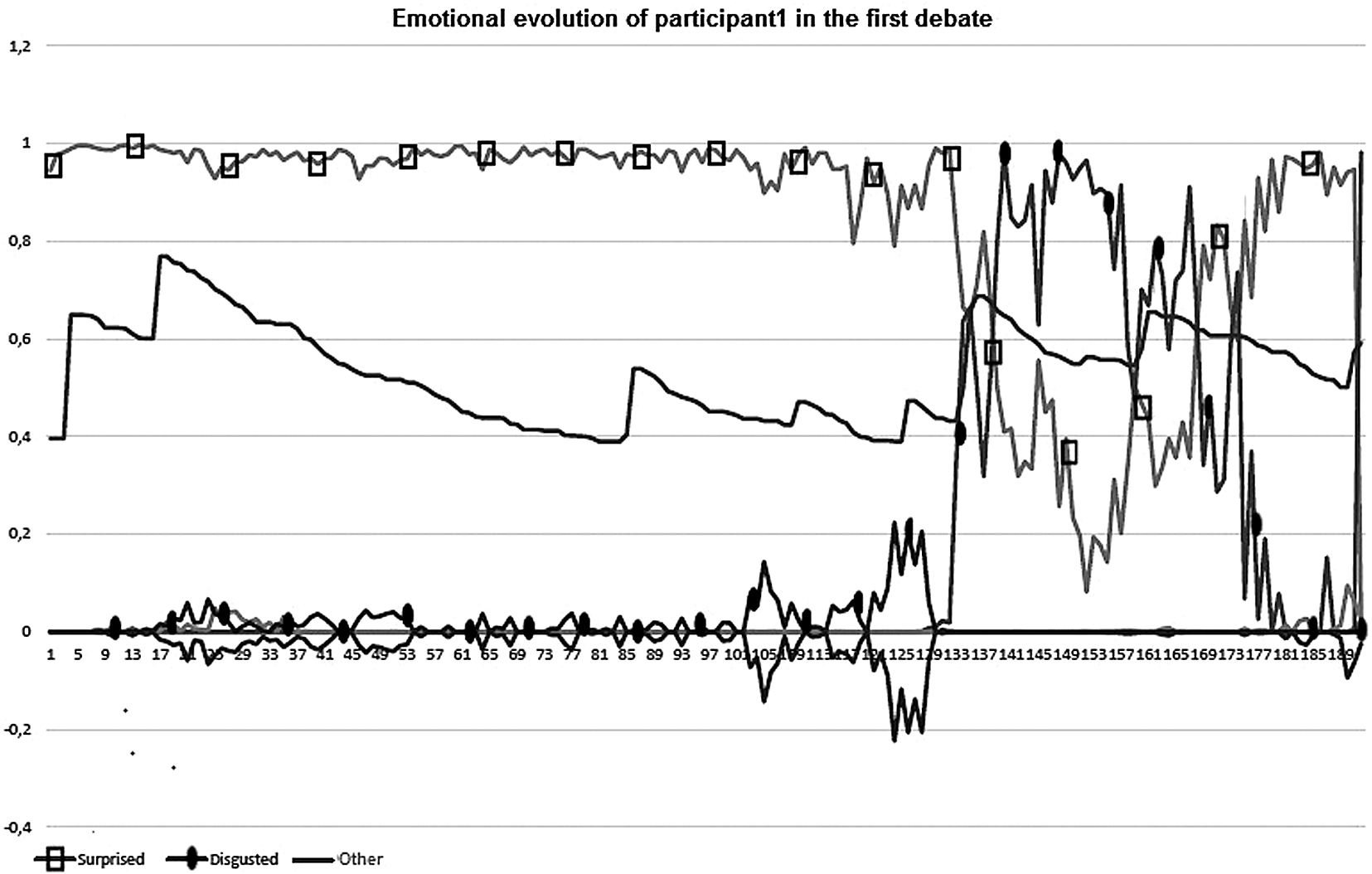
Emotional evolution of Participant 1 in Debate 1 (lines with squares and circles represent, respectively, the surprise and disgust emotions).
Figure 2 shows an evolution of the first participant’s emotions at the beginning of the first debate. The most significant lines of emotions are surprise and disgust (respectively, the line with squares and the line with circles). The participant is initially surprised by the discussion (and so mentally engaged) and then, after the debate starts, this surprise switches suddenly into disgust, due to the impact of the rejection of one of her arguments; the bottom line with circles grows and replaces the surprise as the participant is now actively engaged in an opposed argument (thus confirming our hypothesis 2). Finally, the participant is calming down. In this line, Fig. 3 highlights that we have a strong correlation (
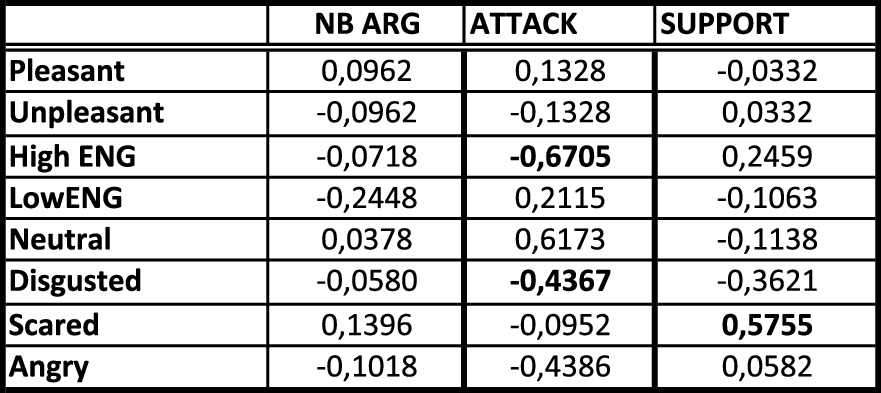
Correlation table for Session 2 (debated topics: Advertising is harmful and Bullies are legally responsible.
In the second part of our study, we were interested in analyzing how emotions correlate with the number of attacks, supports and arguments. We have generated a correlation matrix to identify the existent correlations between arguments and emotions in debates. Main results show that the number of arguments tends to decrease linearly with manifestations of sadness (
By positive social behavior, we mean that a participant aims at sharing her arguments with the other participants. This attitude is mitigated if unpleasant emotions start to be felt by the participant.
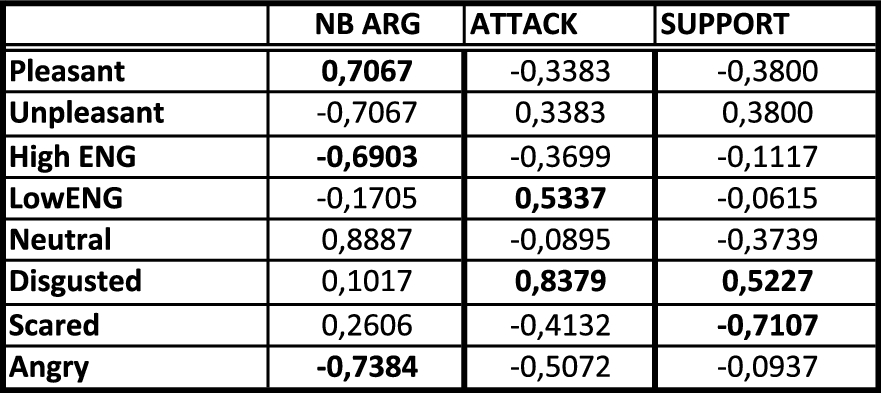
Correlation table for Session 3 (debated topics: Distribute condoms at schools and Encourage fewer people to go to the university).
Figure 5 shows the most significant correlations we detected. For instance, the number of supports provided in the debate increased linearly with the manifestation of high levels of mental engagement (
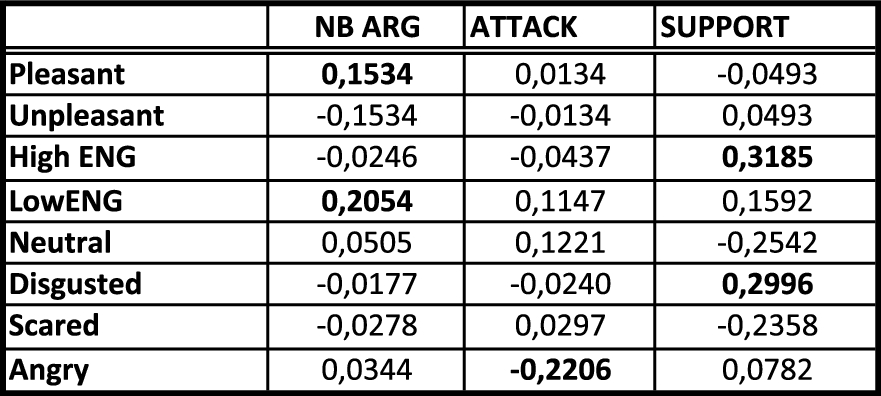
General correlation table of the results.
Our next objective was to check whether participants’ emotions during the debates were modulated by their personality. In other words, we wanted to see whether there was any impact of the debaters’ personality on their emotional responses in terms of facial expressions, valence, engagement and cognitive load indexes. The Big Five inventory data [26] were considered for this analysis. Participants were classified according to each of the five OCEAN personality dimensions, namely openness (imaginative vs. more pragmatic participants), conscientiousness (conscientious vs. non conscientious), extroversion (extroverted vs. introverted), agreeableness (compassionate toward others vs. more antagonistic), and neuroticism (anxious vs. emotionally stable). Multivariate analyses of variance (MANOVA) were run with the OCEAN personality traits as fixed factors and the debaters’ emotions as dependent variables. These included the following combined measures: (1) the proportions of occurrences of the six facial expressions, i.e. happiness, anger, fear, sadness, disgust, and surprise, (2) the proportions of negative and positive emotional valence, (3) the proportions of high, medium and low levels of mental engagement, and (4) the proportions of high, medium and low workload. In total, 20 MANOVA were conducted, crossing the 5 personality traits with the 4 dependent variables.
Three statistically reliable MANOVA were found, showing significant relationships between the debaters’ personality traits and emotional responses:11
A Bonferroni correction (0.05 divided by the number of dependent variables) has been applied within the MANOVA follow-up analyses to account for multiple ANOVAs being run.
Extroversion and facial expressions (
Conscientiousness and workload (
Neuroticism and mental engagement (
To summarize, these results validate our fourth hypothesis: the personality has an important impact on the debaters’ emotional responses. Inner emotions (brain activity) seem to be modulated by the neuroticism and the conscientiousness temperament traits. Outer emotions (facial expressions) were modulated by the extroversion traits. Neuroticism and conscientiousness have both a negative impact on the debaters’ brain indexes, with respectively, a reduced mental engagement index and an increased cognitive load. For facial expressions, we have particularly found that the emotion of surprise was more frequent among the debaters with an extroverted temperament. This is an important aspect considering that this expression was the least observed during our experiments. Indeed when analyzing the debaters’ emotions with FaceReader, we observed that the expression of surprise was hardly dominant (compared with neutral) during the discussions. The dominance of the other facial expressions, namely anger, fear, sadness and disgust does not seem to be influenced by the participants’ personality.
Our next concern was to investigate if there were any differences in terms of emotional experiences (facial expressions, emotional valence, mental engagement and workload) during the debates according to the participants’ opinions on the discussed topics. These opinions were given during the debriefing as previously mentioned. Each participant was either for or against the topic of the debate: for means that the participant agreed with the subject of the debate (e.g. for distributing condoms to students), and against means that the participant disagreed with the addressed topic (e.g. against distributing condoms in schools). A participant could also have no particular opinion (no-opinion) regarding the topic of the debate if he was neither for nor against. Moreover, each participant was asked to give a starting opinion, before the discussion, and a final opinion, after the debate. The goal was to assess the impact, if any, of changes in opinions on the debaters’ emotions. Table 2 enumerates participants’ initial and final opinions.
Number of opinions before and after the debates (in bold the number of debaters who kept the same opinion)
As for the previous hypothesis, distinct MANOVA were performed to analyze the proportions of occurrence of (1) facial expressions: happy, sad, angry, surprised, scared and disgusted; (2) valences of emotions: positive and negative; (3) engagement levels: high, medium and low; and (4) cognitive load levels: high, medium and low. First, we wanted to check whether there were any significant differences in terms of emotions between the participants who kept the same opinion during the debates (
The two participants who did not have an opinion throughout the debate were discarded since they have reported they could not follow the discussions because of their lack of understanding of English.
No statistically reliable effect was found in any of the performed analyses (
In addition to these analyses, the debaters’ starting and final opinions were studied independently. That is, we checked whether either the former or the latter opinions had (independently of each other) an impact on the emotions expressed during the debates. Again no statistically significant effect was found. This has led us to conclude that neither the initial nor the final opinions had an impact on the debaters’ emotional states. To summarize, the emotional experience during the debates does not seem to be related to the opinion of the debaters regarding the addressed topics. Emotions are rather depending on the person’s temperament and the dynamics of the debate (i.e. arguments, supports and attacks).
In this section we provide some examples of correlations among the emotions and the argumentative elements emerging from the single debates. The goal is to provide a more detailed analysis, given the fact that some debates have been more passionate than others because of the personal involvement of the participants in the subject of the debate. It is worth noticing that as the number of instances involved in our debates is 4, these correlations cannot be considered as significative. However, we believe that these examples may show interesting insights to be investigated in our future experiments. The categories of correlations we investigate are the following: engagement vs argumentation; engagement vs emotions; workload vs argumentation; workload vs emotions; pleasant/unpleasant vs argumentation; Big5 vs emotions. Correlation values are comprised between
Debate: Advertising is harmful. Number of arguments in the debate: 71 (64 from participants and 7 from moderators).
The more the participants feel surprised, the higher the workload is high (
Participants with a high degree of agreeableness are more inclined to be surprised (
Debate: Students are legally responsible for bulling. Number of arguments in the debate: 71 (66 from participants and 5 from moderators).
On the one side, we have a strong correlation between the high engagement and the emotion happy (
Strong correlation between positive valence (pleasant) and the number of arguments proposed in the debate (
Participants with a high degree of extroversion or of agreeableness are more inclined to externalize that they fell surprised about the ongoing debate (correlations
Debate: Distribute condoms in schools. Number of arguments in the debate: 68 (63 from participants and 5 from moderators).
Strong correlation between the high engagement and the emotion angry (
Strong correlation between a high degree of workload and the number of supports among the arguments (
The more the participants feel disgusted, the higher the workload is (
Participants with a high degree of extroversion are more inclined to externalize that they fell surprised about the ongoing debate (
Debate: We should fear the power of government over the Internet. Number of arguments in the debate: 41 (37 from participants and 4 from moderators).
Strong correlation between the high engagement and the emotion disgusted (
Strong correlation between a low degree of workload and the number of supports among the arguments (
The more the participants feel angry, the lower the workload is (
Strong correlation between negative valence (unpleasant) and the number of attacks between arguments (
Participants with a high degree of extroversion are more inclined to externalize that they feel happy about the ongoing debate (
Note that this study is dealing with correlation between the nature of the arguments and their relations (support/attack) and the participants’ emotions, and we are not claiming to have found a direct causal relation between the arguments and such users’ emotions – which is out of the scope of this current study. It is however an interesting direction for further work with larger sample size using [21]’s causality test.
Discussion
We have learnt several lessons from the realized experiment. First, the different debates and participants have confirmed the correctness of our hypotheses. Debates constitute the underlying framework for generating emotions which evolve with the argumentation flow. The difference of opinions is the starting point of the rise and successive transformation of specific emotions. However, so far we have not taken into account the initial emotional state of the participants (i.e. before starting the discussion on the topic), that can influence the participants reactions during the debate. We will have to consider this in further studies.
Facial emotion recognition and EEG measures allowed us to identify not only the type of emotion generated, but also the intensity and the evolution of emotions. Associated with the workload index, this also allowed us to detect how the participant is engaged in the discussion and so, how he holds on to his arguments. Being strongly convinced by an opinion provokes the birth of a mental energy strong enough to increase the workload and develop a justification. Contradictions with the flow of arguments generate anger which evolves progressively into disgust if the participant’s arguments apparently cannot convince the opponents. In the classification of emotion, disgust (which is close in terms of emotion) is a normal evolution of anger and appears when the participant feels a dual feeling for two reasons: 1) he is not pleased with himself for not having convinced the opponent (internal feeling), and 2) he has a very low opinion of the opponent (external feeling). We highlighted the evolution of this emotion in several debates showing the important consequence of the argumentation by provoking internal evolution of emotions. This can be explained by the impact of a contradiction on an in depth conviction. The more a participant is convinced of the merits of his position, the more he will be subject to a strong emotion.
The three dimensions of our evaluation framework (emotion recognition, engagement and workload) allowed us to assess more precisely the impact of argumentation on emotional response throughout the debate. Workload decreases when participants feel angry, which means that they reduce their ability to use or construct new arguments. When this emotion evolves to disgust, the workload increases which means that they have to reconsider their own set of arguments either for an update or a new construction. High engagement provokes the rise of strong positive or negative emotions while, on the other side, we have confirmed that disgusted participants become less engaged in the ongoing debate. Finally, we have considered the influence of personality to the type of generated emotion. Participants with a high degree of neuroticism are converging to be angry or disgusted, which are close emotions. Participants with a high degree of agreeableness or extroversion are more open to feel surprise.
Note that the goal of this experiment is not to learn how to best intervene to improve online discourse but to study what are the insights that online cognitive agents and bots need to implement to address dialogues with humans. A cognitive agent, in order to behave like humans in debates, has to feel emotions and generate them in the other agents (being them humans or artificial) that interact with it. This extensive study is the first but essential step towards a better comprehension of the relation between human emotions and argumentation. As a shorter term objective, the aim of this contribution is to guide the definition of the next argumentation frameworks such that not only objective elements are taken into account but also cognitive ones.
From this experiment, we learnt that argumentation in online debates cannot be considered as a standalone process, as it discloses many emotional aspects, e.g., when users are more engaged in a discussion more arguments are proposed, and the most engaging discussions are correlated with negative emotions like anger and disgust. Moreover, a strong correlation exists among personality traits and the emotions felt by participants during online argumentation, e.g., the dominance of emotions like anger, fear, sadness and disgust does not seem to be influenced by the participants’ personality where emotions of happiness and surprise were more frequent among the debaters with an extroverted temperament.
Related work
A first analysis of the experimental results presented in this paper has been proposed in [2]. However, several aspects of the collected data were neglected in that work. In this extended version, the following issues have been tackled:
Personality traits, emotions and argumentation: in [2], we did not consider in our analysis the Big Five inventory data we collected during the experiments. In this paper, an additional hypothesis is formulated concerning the connection among participants’ personality and emotions. The hypothesis has been then validated on the data collected from our experiments.
Opinions and emotions: in [2], we did not consider the opinions of the participants with respect to the debated topics, their possible change during the debate, and the emotions. In this paper, a fifth hypothesis is formulated and then validated on the collected data.
Correlations on single debates: in [2], we considered correlations holding over the whole set of debates, i.e., over the whole set of collected data. However, we realized that some of the debates showed significant correlations that were not present in others, due to the involvement of different participants and to the interest of the participants in the debated topic. In this paper, we have proposed an analysis of some of the more relevant debates held in our experimental sessions. These single debate analysis considers also the workload index, computed at the data collection time but never discussed in the first version of the paper [2].
Fourth layer of annotation: in [2], three layers of annotation have been proposed over the collected textual data. In this paper, we included a fourth annotation layer with the aim to highlight the change in the viewpoint of the participants during the debate.
In the literature, only few works deal with empirical experiments involving human participants to verify assumptions from argumentation theory. Cerutti et al. [8] propose an empirical experiment with humans in the argumentation theory area. However, the goal of this work is different from ours, since emotions are not considered and their aim is to show a correspondence between the acceptability of arguments by human subjects and the acceptability prescribed by the formal theory in argumentation. Rahwan and colleagues [38] study whether the meaning assigned to the notion of reinstatement in abstract argumentation theory is perceived in the same way by humans. They propose to the participants of the experiment a number of natural language texts where reinstatement holds, and then ask them to evaluate the arguments. Also in this case, the purpose of the work differs from ours, and emotions are not considered at all.
Emotions are considered, instead, by Nawwab et al. [33] that propose to couple the model of emotions introduced by Ortony and colleagues [34] in an argumentation-based decision making scenario. They show how emotions, e.g., gratitude and displeasure, impact on the practical reasoning mechanisms. A similar work has been proposed by Dalibon et al. [12] where emotions are exploited by agents to produce a line of reasoning according to the evolution of its own emotional state. Finally, Lloyd-Kelly and Wyner [32] propose emotional argumentation schemes to capture forms of reasoning involving emotions. All these works differ from our approach since they do not address an empirical evaluation of their models, and emotions are not detected from humans.
Several works in philosophy and linguistics have studied the link between emotions and natural argumentation, like [6,20,45]. These works analyze the connection of emotions and the different kind of argumentation that can be addressed. The difference with our approach is that they do not verify their theories empirically, on emotions extracted from people involved in an argumentation task. A particularly interesting case is that of the connection between persuasive argumentation and emotions, studied for instance by DeSteno and colleagues [13].
Concerning the empirical study of workload and emotional changes, [46] study pupillary response to detect workload and emotional changes performing an arithmetical task associated with pleasant/unpleasant images. The idea of the empirical study on workload and emotional changes is similar, even if the goal of the experiment is different, as our goal is connected to the argumentative process and not with arithmetical tasks performed by isolated participants.
Conclusions
In this paper, we have presented an investigation into the links between the argumentation people use when they debate with each other, the emotions they feel during these debates, and their personality traits. We conducted an experiment aimed at verifying our hypotheses about the correlation between the positive/negative emotions emerging when positive/negative relations among the arguments are put forward in the debate, and the correlation between the personality traits of the debaters and their opinions on the debated topics, and the emotions felt during the debate interactions. The results suggest that there exist trends that can be extracted from emotion analysis. Moreover, we also provide the first annotated dataset and gold standard to compare and analyze emotion detection in an argumentation session.
The take-home message of this paper is twofold: first, high engagement is correlated with negative emotions showing that participants are mentally involved in producing arguments to rebut those which are not in line with their viewpoint, and second, neuroticism and conscientiousness have both a negative impact on the debaters’ brain indexes ending up into a reduced mental engagement index and an increased cognitive load. Finally, the surprise emotion is shown by extroverted debaters.
Several lines of research have to be considered as future work. First, we intend to study the link between emotions and persuasive argumentation. This issue has already been tackled in a number of works in the literature [13], but no empirical evaluation has been addressed so far. Second, we aim to study how emotions persistence influences the attitude of the debates: this kind of experiment has to be repeated a number of times in order to verify whether positive/negative emotions before the debate influence new interactions. Third, we plan to add a further step, namely to study how sentiment analysis methods developed in Computational Linguistics are able to automatically detect the polarity of the arguments proposed by the debaters, and how they are correlated with the detected emotions. More precisely, the annotated dataset we published provides a valuable resource to improve the performances of sentiment analysis systems allowing them to learn about the correlation among the relations among the arguments and the emotions aligned with the arguments. Moreover, we plan to study emotions propagation among the debaters, and to verify whether an emotion can be seen as a predictor of the solidity of an argument, e.g., if I write an argument when I am angry I may make wrong judgments. Finally, argumentation theory has often been proposed as a technique for supporting critical thinking, thus studying the relation of these philosophical theories with emotions and personality traits of the actors involved in the argumentation is a further step to investigate.
Footnotes
Acknowledgements
The authors acknowledge support of the SEEMPAD associate team project (
Big Five questionnaire