




Abstract
This paper is to critically examines Pollock’s critical-link semantics with variable degrees of justification. Some possibly counterintuitive consequences of Pollock’s definition of degrees of justification are identified and a modified definition is proposed which avoids these consequences. Then the new solution is applied to the case of so-called presumptive defeat. A second contribution of the paper is to show how the modified semantics can be applied to the ASPIC+ framework: first the ASPIC+ framework is modified to allow for variable degrees of justification and then the modified way to compute these degrees is applied in a new notion of an argument graph.
Introduction
John L. Pollock [11,15] initiated the formal study of argumentation in AI based on his contributions to epistemology, and his approach is still very influential. Pollock introduced the distinction between deductive and defeasible reasons and the corresponding distinction between rebutting and undercutting defeat. Many of today’s approaches are still based on these ideas, such as ASPIC+ [16] and Defeasible Logic Programming [4]. Probably the best-known version of his work is his 1995 book [15]. The semantics of this version was by Jakobovits proved to be equivalent to Dung’s [2] preferred semantics [7]. Later Pollock revised his semantics, for two main reasons: he wanted to enforce the same treatment of odd and even defeat loops (like also Baroni and Giacomin [1]) and he wanted to make the justification status of conclusions a matter of degree. To achieve both aims, Pollock developed his so-called critical-link semantics for his system in [12,13].
Pollock introduced variable justification degrees to account for the so-called “diminishing” effect of attempted defeaters that are weaker than their target. In such cases Pollock wanted to model that the attempted defeaters can still weaken the degree of justification of their target. More generally, the idea that justification of conclusions is not an all-or-nothing affair but a matter of degree is very natural and therefore deserves to be studied. The present paper aims to contribute to such a study by critically examining Pollock’s proposal.
In particular, we will argue that Pollock’s approach in some cases arguably gives counterintuitive outcomes, and we will modify his account in a way that avoids these outcomes. Among other things we will apply our new proposal to the issue of “presumptive defeat”, also known as the issue of ambiguity blocking versus ambiguity propagating. Since many of Pollock’s ideas are still used in other frameworks, our contributions will also be relevant for these frameworks. To illustrate this point, we will at the end discuss how Pollock’s ideas and our modifications can be incorporated in the ASPIC+ framework for structured argumentation recently proposed by [9,10,16–18].
This paper is organized as follows. In Section 2, we first summarize Pollock’s 1995 system [15], then discuss why Pollock wanted to change this and then give his critical-link semantics and his definition of gradual justification. In Section 3, we then discuss some arguably counterintuitive outcomes, present our revised definitions and show that they avoid these outcomes. In Section 4, we discuss how to transfer the revised semantic into ASPIC+ framework with gradual degrees. Finally, we conclude in Section 5.
Semantics
In this section we present Pollock’s critical-link semantics with variable degrees of justification, preceded by a brief overview of his multiple-assignment semantics.
Basic features
There are several constant features in Pollock’s work on defeasible reasoning. Reasoning proceeds from a knowledge base of classical-logic formulas by chaining reasons into inference graphs, where all reasons are either deductive or defeasible. Only applications of defeasible reasons can be defeated, and there are two kinds of defeaters: rebutting defeaters attack the conclusion of a defeasible inference by favoring a conflicting conclusion, while undercutting defeaters attack the defeasible inference itself, without favouring a conflicting conclusion.
More precisely, Pollock assumed as given a knowledge base of first-order formulas and two sets of deductive and defeasible reasons, which technically are inference rules. Pollock then considered arguments, which are sequences of argument lines (in later work, he speaks of sequences of nodes in an inference graph). Each argument line contains a proposition, the reason applied to infer the proposition (where this reason can also be that it is taken from the knowledge base), the set of preceding lines from which the proposition is inferred, and the line’s strength. Both elements from the knowledge base and reasons have a numerical strength, which are used to compute the strength of an argument in a way further explained below. The strength of an element φ of the knowledge base is below written as
An argument line is a tuple
Below the strength of argument line l will sometimes be written as
An argument line
In his account of the strength of arguments, Pollock rejected the probability calculus and initially proposed a weakest link principle as the underlying principle for computing the strength of an argument. He defined the argument strength of a defeasible argument as the minimum of the strengths of the defeasible reasons employed in it and the degrees of justification of its premises.
For any argument line If l takes φ from the knowledge base, then Otherwise,
With respect to accrual of arguments for the same conclusion, Pollock proposed that if there are two or more separate undefeated arguments for a conclusion, the degree of justification for the conclusion is the maximum of the strengths of these arguments.
In [15] Pollock considered inference graphs, where the nodes represent the conclusions of argument lines, support-links tie nodes to the nodes from which they are inferred from L or the conclusions of the argument lines, and defeat-links indicate defeat relations between nodes. These links relate their roots to their targets. The root of a defeat-link is a singe node, while the root of a support-link is a set of nodes. He then proposed a labeling approach to define the justification status of nodes and propositions.
A node of the inference-graph is initial iff its node-basis and list of node-defeaters is empty, where
The node-basis of a node is the set of roots of its support links. The node-defeaters are the roots of the defeat links having the node as their target.
An assignment σ of defeated and undefeated to a subset of the nodes of an inference-graph is a partial status assignment iff:
σ assigns undefeated to any initial node; σ assigns undefeated to a non-initial node α iff σ assigns undefeated to all the members of the node-basis of α and σ assigns defeated to all node-defeaters of α; σ assigns defeated to a non-initial node α iff either σ assigns defeated to a member of the node-basis of α or σ assigns undefeated to a node-defeater of α.
Assignment σ is a status assignment iff σ is a partial status assignment and σ is not properly contained in any other partial status assignment.
Finally, Pollock defines the justification status of an argument as follows:
A node α of an inference graph is undefeated iff every status assignment to the inference graph assigns undefeated to α; otherwise α is defeated.
Although the multiple assignment semantics produces the intuitively correct answer for many complicated inference-graphs, Pollock was still not satisfied with it, since it can produce different outcomes for inference-graphs containing odd-length and even-length defeat cycles. See, for example, the graphs in Fig. 1 (dotted arrows indicate support links and full arrows indicate defeat links):
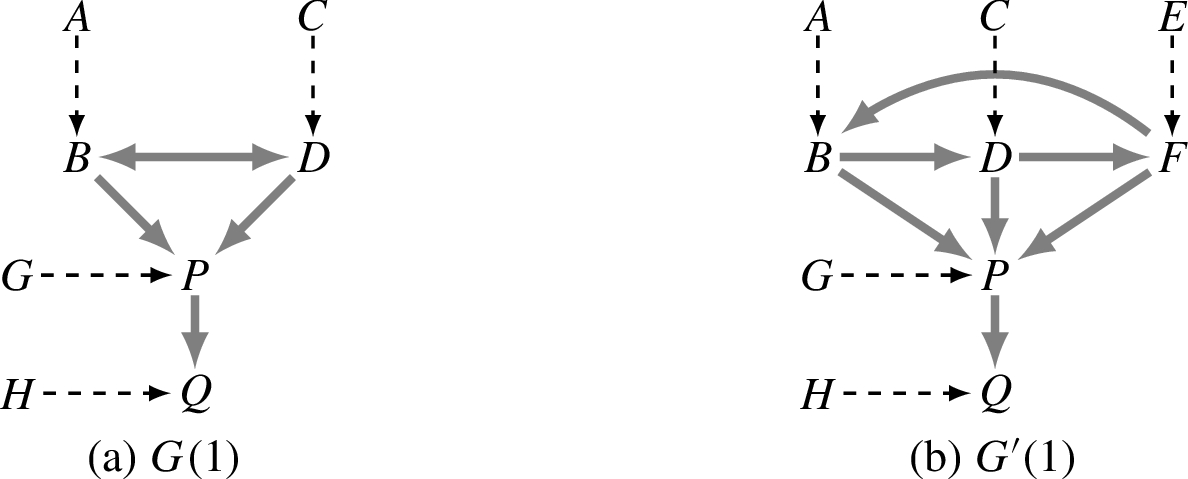
Inference graphs.
In
Pollock believed that the difference of statuses of Q in these two graphs is a clear counterexample to all existing semantics. In order to avoid this problem, he proposed a new so-called critical-link semantics.
The core idea of critical-link semantics [12,13] for solving the above problem is to build new inference-graphs as subgraphs of the original inference graph and assign various statuses to initial nodes in different cases. This idea is formally defined as follows:
An inference/defeat-path from a node φ to a node θ is a sequence of support-links and defeat-links such that
φ is a root of the first link in the path; θ is the target of the last link in the path; the root of each link after the first member of the path is the target of the preceding link; the path does not contain an internal loop, i.e., no two links in the path have the same target.
For simplicity, we define the inference/defeat-path from a node φ to a node θ as a sequence of support-links and defeat-links
A node θ of an inference graph is φ-dependent iff there is an inference/defeat-path from φ to θ.
In
A circular inference/defeat-path from a node φ to itself is an inference/defeat-path from φ to φ via a defeater of φ.
In
A circular inference/defeat-path is an undefeated circular path iff it is a circular path and there is no defeat link outside the path having a node in the circular path as its target.
In
A defeat-link is φ-critical iff it is a member of some minimal set of defeat-links such that removing all the defeat-links in the set suffices to cut all the circular inference/defeat-paths from φ to φ.
In
If φ is a node of an inference graph G, then deleting all φ-critical defeat-links from G and making all members of the node-basis of φ initial nodes in making all φ-independent nodes initial-nodes in
Note that Pollock thus in fact modified the default justification status “undefeated” of initial nodes by stipulating that some initial nodes in a newly-constructed inference graph are defeated, instead of being automatically undefeated. For example, graph
Pollock then redefined his computation principles as follows:
The critical-link semantics consists of two rules:
Initial nodes are defeated when they are newly initial nodes and belong to the node-basis of a node in an undefeated circular path. Otherwise, initial nodes are undefeated. A non-initial node φ is undefeated in an inference-graph G iff all members of the node-basis of φ are undefeated and any defeater for φ is defeated in
Note that thus in his critical-link semantics Pollock does not any more consider (possibly multiple) status assignments to a graph but directly defines the justification status of nodes.
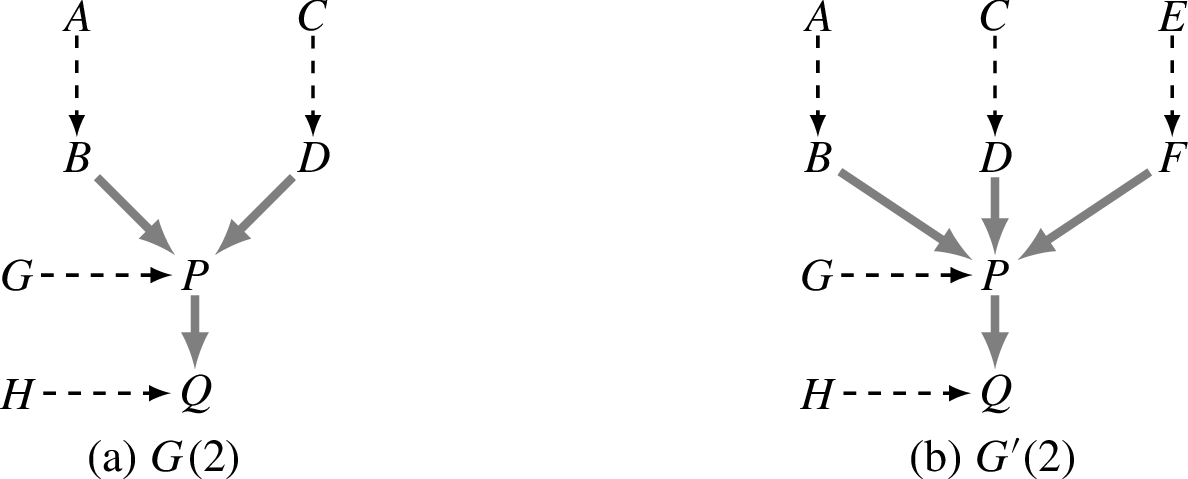
Renewed inference graphs.
In our example this definition yields that node Q has in both
We next discuss how Pollock uses his critical-link semantics [12] to define variable degrees of justification. A main motivation of the idea that propositions should have variable degrees of justification is Pollock’ notion of a diminisher. A diminisher is a defeater of a node that is weaker than its target. Note that the notion of defeater here is different from the notion defined in Definition 2, since the new version of the defeat relation does not depend on the strength of arguments anymore. Thus from now on we assume that the condition
To see how a diminisher works, see again
For the sake of the mathematics of diminishers, Pollock proposed that there exists a function ◇1
Pollock added the mathematical analysis in his extended version of [12], see
the degree of justification can be measured using real numbers, possibly augmented with ∞, i.e., ‘the extended real numbers’. More precisely, the degrees of justification fall in some interval
◇ is continuous on the interval If If If If If
(Representation of ◇).
Pollock then gave his definition of the computation of degrees of justification.
(Computation of degree of justification).
If P is inferred from the basis If P has P-dependent defeaters If P is inferred from the basis
Principle DJ1 is the computation for the nodes not in a circular path, while DJ2 is for the nodes in a circular path and DJ unites these two principles for “collaborative defeat”, where the nodes are defeated by both node-dependent defeaters and node-independent defeaters. Note that in both cases, if P is taken from the knowledge base, then the degree of justification of P equals
Consider by way of example node B in
Problem cases and modifications
In this section, we discuss some possible problems of Pollock’s critical-link semantics with variable degrees of justification, by analyzing some problem cases.
Problem case on diminishers
The first problem concerns some arguably counter-intuitive consequences of the mathematical properties and representation of the function ◇. We present an example and discuss why the outcomes may be counter-intuitive, and then modify some properties of ◇ and choose another definition for ∽ to represent ◇.
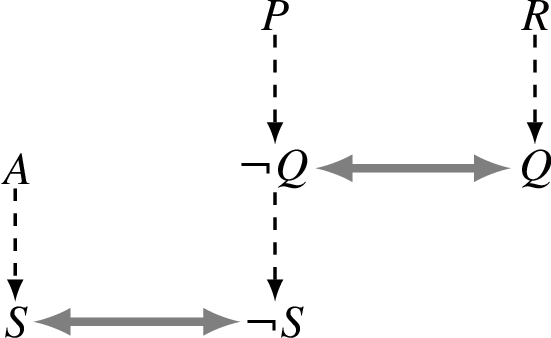
Inference graph of Presumptive defeat.
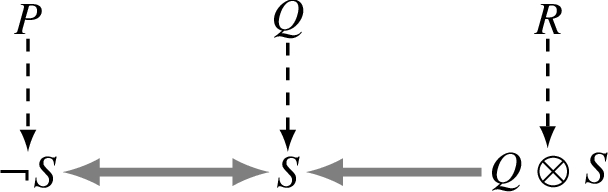
Consider rebutting defeaters in Fig. 3. Let P be “Jones says that it is not raining”, R be “Smith says that it is raining”, and Q be “It is raining”. Let us first assume that Smith and Jones as equally reliable. Then according to Pollock both Q and
The arguably counter-intuitive consequence is that node
The previous point can be further developed in a discussion of ambiguity blocking vs. ambiguity propagating (by Pollock called “presumptive defeat”). Consider again Fig. 3 but let now Q stand for “Rain was predicted by the morning weather forecast”, P for “Jones says that no rain was predicted by the morning weather forecast”, R for “Smith says that rain was predicted by the morning weather forecast”, S for “It will rain” and A for “rain was predicted by the afternoon weather forecast”. Suppose again that the reason strengths are at least as great as those of the initial nodes and suppose that P and R are equally strong. Then according to Pollock’s new approach the degree of justification of all of Q,
Problem case on undercutters
Next we discuss a problem of the computation principle DJ by arguing that it gives an unnatural treatment of the effect of undercutters on the degree of justification of their target. Consider Fig. 4 and let P be “Jones says that it is raining” and Q be “It is raining”, R be “Smith says that Jones always lies” and
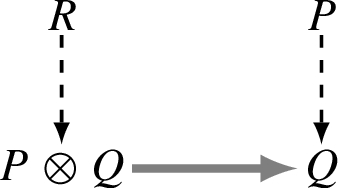
Inference of Undercutter.
In his final paper [14], Pollock reconsidered the problem of degrees of justification. He measured degrees of justification using numbers in the interval
Firstly, according to the above analysis on diminishers and “presumptive defeat”, assumption (A4) should be modified as follows:
If If
These two revised assumptions say that the degrees of justification of nodes in defeat cycles (where defeat is defined as in Definition 2) should be not less than 0 if we choose the scale as
Secondly, Pollock wanted that the function for degrees of justification is continuous for both merely diminishing nodes and completely defeating nodes. However, according to the above analysis of diminishers, the degree of justification of a diminished node reduces to real number 0 when the strength of the completing defeating node is approaching to the strength of the diminished node. Then the degree of justification of the diminished node would be definitely greater than 0 in accordance with (A4′) if the strengths of the rebutting defeaters are equal. Therefore, the representation is not continuous on the whole interval
Thirdly, the degree of justification for a diminished node should be the strength of this node decremented by an amount determined by the strength of the diminishing node. Moreover, the strength of a node as conclusion is determined by the strength of its reason and the strength of its node as premise. Rebutting defeaters or undercutting defeaters can both act as diminishers but their influences on diminished nodes are different. Undercutting defeaters weaken the strength of the reason they attack, while rebutting defeaters directly weaken the strength of the node as conclusion. Therefore, the order in which undercutting defeaters and rebutting defeaters as diminishers are applied to an argument makes a difference to the degrees of justification, and this in turn means that (A6) is invalid.
In sum, our analysis in Sections 3.1–3.3 makes that assumption (A4) must be modified while assumptions (A1) and (A6) cannot hold. We now define a new representation ∽ for operator ◇, which matches the above-revised assumptions. Let us define:
Next we prove that the new function satisfies the revisions of Pollock’s assumptions:
For any point If If If If
If
It’s easy to directly prove this property by definition of function (2).
If Actually, we can get a precise result: If If
The revised idea for the problem case of undercutters is that the degree of justification of node P equals the minimum of the strength of reason after being diminished and the degrees of justification of its premises. Then the computation can be modified as follows: (DJ1) If P has P-independent defeaters
We next discuss the case where a node P is defeated by both P-dependent defeaters and P-independent defeaters. We propose that these two kinds of defeaters can unite to defeat node P with a double counting, but computing it with P-independent defeaters firstly and then continue to compute it with P-dependent defeaters. The final computation can be modified as follows:
(Variable degrees of justification).
If P is inferred from the basis
For instance, in Fig. 5, node
Inference graph of Collective defeaters.
We now show that the new definition avoids the arguably counterintuitive outcomes we described above. We do this by analyzing the example of presumptive defeat, which includes the problem case of diminishers. Consider again the example in Fig. 3. In the multiple-assignment semantics of Definition 5,
We discuss the possible degrees of justification of
Apparently,
The new semantics applied to the ASPIC+ framework
The idea of critical-link semantics with variable degrees of justification is a general theory and can be applied in other argumentation formalisms as well. In this section, we discuss how the new semantics can be combined with the ASPIC+ argumentation framework. This framework [9,10,16–18] has been shown to capture a number of other approaches to structured argumentation, such as assumption-based argumentation [3], forms of classical argumentation [6] and Carneades [5]. Therefore, a discussion of how the above ideas can be incorporated in ASPIC+ arguably increases the generality of the present contributions. It should be noted, however, that in the present section we modify ASPIC+’s semantics, by replacing its Dung-based semantics with a semantics that allows for variable degrees of justification.
The ASPIC+ framework is like Pollock’s approach based on the general idea that arguments are constructed by chaining reasons into trees and it also assumes both deductive and defeasible reasons (unlike in Pollock’s work, ASPIC+ also allows for premise attack). However, ASPIC+ does not define the notion of an inference graph but defines a set of arguments plus binary relations of attack and defeat, where defeat is a subset of attack by applying a preference relation between arguments to resolve attacks. Attack and defeat are thus not defined between argument lines but between arguments in their entirety. In essence, an argument A attacks/defeats an argument B if it directly attacks/defeats the last step of some subargument
We now sketch how this can be done, where we assume that the degree of justification of one argument equals the degree of justification of its conclusion. Firstly, we introduce the ASPIC+ framework with variable degrees of justification.
ASPIC+ framework with variable degrees
The ASPIC+ framework assumes an unspecified logical language
Informally, that an inference rule is strict means that if its antecedents are accepted, then its consequent must be accepted no matter what, while that an inference rule is defeasible means that if its antecedents are accepted, then its consequent must be accepted if there are no good reasons not to accept it. In other words, if an inference rule is strict, then it is rationally impossible to accept its antecedents while refusing to accept its consequent, while if an inference rule is defeasible, it is rationally possible to accept its antecedents but not its consequent.
We now present a modified definition of ASPIC+’s notion of an argumentation system,2
In fact, we consider the special case where ASPIC+’s contrariness function over
An argumentation system φ is a contrary of ψ, if φ is a contradictory of ψ (denoted by ‘ each ν is a function that assigns the degree of support from antecedent to consequent in a strict or defeasible inference, modeled as:
Arguments are constructed from a knowledge base
(Knowledge base).
A knowledge base η is a function that assigns degrees of acceptability to elements of the knowledge base, modeled as
Arguments can be constructed step-by-step by chaining inference rules into directed acyclic graphs. Arguments thus contain subarguments, which are the structures that support intermediate conclusions (plus the argument itself and its premises as limiting cases). In what follows, for a given argument
(Argument).
An argument A on the basis of a knowledge base φ if
An argument is strict if all its inference rules are strict and defeasible otherwise, and it is firm if all its premises are in
(Argument strength).
if if A is the form
(Maximal proper subargument).
Argument A is a maximal proper subargument of B iff A is a subargument of B and there does not exist any proper subargument C of B such that A is a proper subargument of C.
(Argumentation theories).
An argumentation theory is a triple
Arguments can be attacked in three ways: attacking a conclusion of a defeasible inference, attacking the defeasible inference itself, or attacking a premise.
(ASPIC+ attacks).
A attacks B iff A undercuts, rebuts or undermines B, where:
A undercuts argument B (on A rebuts argument B (on Argument A undermines B (on
We next give some new definitions that are useful in our modification of ASPIC+.
(Direct attacks).
Argument A directly attacks argument B iff A rebuts or undercuts or undermines B on B; Otherwise A indirectly attacks B.
Argument A directly attacks argument B iff
We further say that (1) A directly rebuts B or A is the direct rebutter of B iff they satisfy the first condition, (2) A directly undermines B or A is the direct underminer of B iff they satisfy the second condition, and (3) A directly undercuts B or A is the direct undercutter of B iff they satisfy the third condition.
In all previous publications on the ASPIC+ framework the definition of attack was combined with a preference ordering on arguments to yield a notion of defeat. Then the semantics was defined by regarding the set of all arguments that can be constructed plus the defeat relation as an abstract argumentation framework in the sense of [2].
Thus any semantics can be applied to arguments in an ASPIC+ framework and it can also be used to define the degrees of justification of arguments and their conclusions after it’s extended with gradual degrees. We will not link the semantics of ASPIC+’s argumentation theories with gradual values to Dung’s theory, but instead of a gradual graph with two kinds of links.
Presumptive defeat.
Next we will discuss the computation of degrees of justification in ASPIC+, using the new notion of an argument graph. We regard the degree of justification of an argument as the variable degree for accepting or rejecting the argument from a cognitive perspective. We further assume that the degree of justification of one argument equals the degree of justification of its conclusion.
An argument graph G is a labeled, finite, directed graph, consisting of argument nodes and attacking links indicating attacking relationships between argument nodes and proper subargument links indicating connecting subargument relationships between an argument and its proper superarguments.
The attacking links relate their roots to their targets and the root of an attacking link is an attacker in the graph, while the proper subargument links relate their roots to their targets and the root is the proper subargument of its target or the target is the proper superargument of its root in graph. In the diagrams of argument graphs, arguments are displayed as dots, attacking links are indicated using ordinary arrowheads, while proper subargument links are indicated using closed-dot arrowheads. The initial arguments in G can be defined as follows:
An argument is initial in G iff it is not the target of any attacking link or proper subargument link.
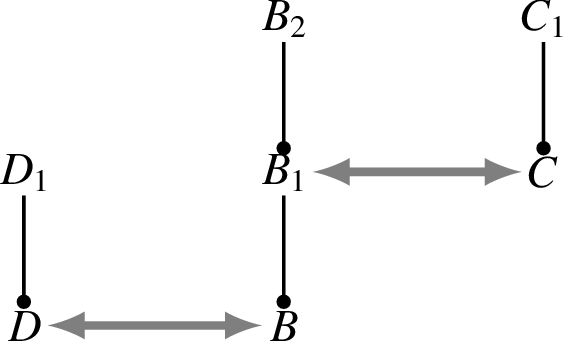
Consider and Pollock’s inference graph in Fig. 3. We assume arguments in ASPIC+ framework as
An argument path
For instance, in Fig. 6,
An argument-path is a circular path from an argument A to itself iff there exists an argument path
For instance, in Fig. 6,
Argument A is in a circular path from an argument B to B itself iff there exists at least one circular path from argument B to B itself containing argument A.
For instance, let
Next we will make our approach simpler than Pollock’s by defining the notions of a basic set and its extension instead of the notions of node-dependent and node-critical links.
The notions of basic set and critical extension can be defined as follows:
A set of attack links is a basic set of argument A in graph G iff removing all members of the set suffices to cut all cycles from A to A. A set of attack links is a critical extension of argument A in graph G iff it is a minimum basic set of argument of A in graph G.
For any argument A in a circular path
Suppose for contradiction that there is no basic set of argument A. If there is no basic set of argument A, then there does not exist any link set such that removing all members suffices to cut the circular paths from A to A. But clearly removing all members of the set containing all links in the path can cut the circular paths. Contradiction. □
For any attack link L in a circular path P
Suppose for contradiction that there exists at least one critical extension containing L. If there is no critical extension containing L, then there is no basic set, contradicting Proposition 1. □
If an attack link does not occur on any circular path
It is equivalent to prove that if an attack link belongs to a critical extension, then it occurs on a circular path. Assume attack link L belongs to a critical extension and it does not occur on any circular path, by definition 32, then there does not exist basic set, hence there is no critical extension contains L. Contradiction. □
Given a graph G, the new graph
Note that Pollock only has two kinds of defeaters, namely rebuttals (attacking a conclusion) and undercutters (attacking an inference rule), so there is no computation for the defeater on premises. However, in ASPIC+, a third way of argument attacking, namely premise attack or “undermining” has been added. So we add a calculation for the arguments which are attacked by underminers. The new computation for the degrees of justification of arguments in a new argument graph can be defined as follows:
The computation of Justification ( If argument A is initial in G, If argument A is initial in If argument A is not initial in G and
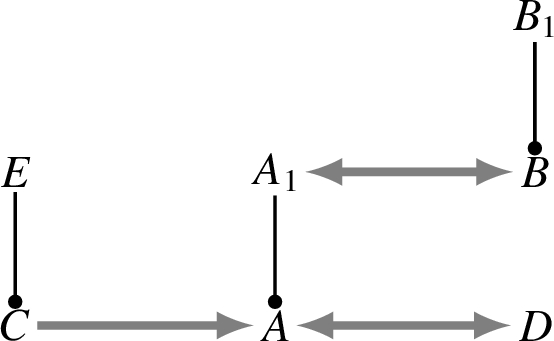
We define We assume the arguments in Fig. 7 as B directly undermines D directly rebuts A and C directly undercuts A, then from C is free from attacking, so
Conclusion
In this paper we studied the modelling of variable degrees of justification in argumentation. We pointed out some arguably counter-intuitive consequences of Pollock’s critical-link semantics with variable degrees of justification and then presented some modifications that avoid these outcomes. Moreover, to illustrate the generality of Pollock’ approach and our modifications, we also discussed how they can be combined with the ASPIC+ framework. In future work we aim to investigate the properties of our definitions and to study their application to realistic examples, including problems of legal reasoning with evidence.
Collaborative defeat.
While our contributions in this paper still need to be further developed in these and other ways, we hope we have contributed to the study of an important but often neglected aspect of natural argumentation. In most current approaches, the justification status of arguments and conclusions is an all-or-nothing affair, but in many realistic applications, such as legal reasoning about evidence or other applications of epistemic reasoning, it is natural to regard arguments or conclusions as justified to variable degrees.
Footnotes
Acknowledgements
We thank the anonymous reviewers for their useful comments on the earlier versions of this paper. Bin Wei was supported by the Humanity and Social Science Youth foundation of Ministry of Education of China (15YJCZH182), the Chinese MOE Project of Key Research Institute of Humanities and Social Sciences at Universities (15JJD720014) and by the Scientific and Technological Research Program of Chongqing Municipal Education Commission (KJ1500103).