



Abstract
The growth phenomena may be considered as a gradual transformation of growth energy to the work done in forming the mass which composes the body. The present writer wishes to determine “what law, if there is any, governs in any individual the rate of transforming the growth energy into the work done.”
In order to solve the above problem, the assumption was made that under normal conditions the growth energy is transformed into the work with least loss of energy. It was shown that in order that this assumption should be true we must have δA = O in the following integral

Applying this principle it was proved that the formula for the growth of brain in weight (and any other data which satisfy the same conditions) must be a function which renders the following integral minimum

The integral is minimized when the function y has the following relations:
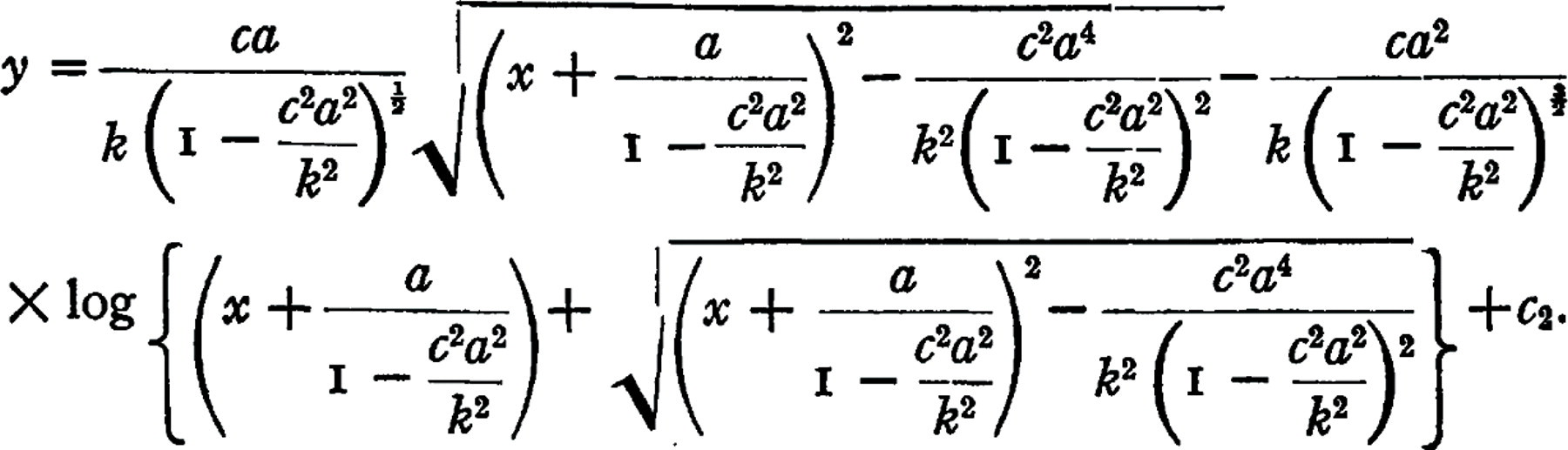
If our assumptions are correct, the above formula ought to represent adequately our growth curves. It was shown that the above formula can be transformed into the following forms as particular cases:

These are formulas which are already extensively used for graduating observed growth curves. Thus there is no further need to test the adequacy of the formula to represent the growth curves, since numerous applications have been made with satisfaction and already published by various investigators. I therefore put forward the following provisional definition of growth considered as a process: “An organism tends during growth to form greatest amount of mass with least loss of growth capacity.”
Further the present investigation furnishes a biological meaning to the logarithmic formulas which have been extensively used without appreciating the full significance of their properties.
Get full access to this article
View all access options for this article.