




Abstract
The secreted membranes surrounding the diapause egg of the grasshopper, Melanoplus differentialis, consist of 4 distinct layers: the exochorion, a thin microscopically homogeneous layer; the endochorion, an underlying granular layer; a thin (about 1.5μ) yellow cuticle; and a thick white fibrous cuticular layer. 1 These can be further subdivided. 2 The chorion is secreted by the mother, and the cuticle is secreted by the serosa cells when the embryo is about 6-11 days old at 25°C. The only published observation on the chemical composition of the membranes is that of Campbell, 3 who obtained a positive chitosan test with the cuticle (both layers combined) but not with the chorion. Since at least 2 of these membranes are semipermeable 4 their chemical compositions are of considerable importance in interpreting data on permeability of the egg.
The chorion could be separated from the cuticle mechanically, but no method was found for separating the layers of the chorion. When eggs were soaked overnight in concentrated HCl and washed in water for several hours the white fibrous cuticle could be separated from the others in a small percentage of cases. The thin yellow cuticle was freed from the others by boiling in concentrated HCl. The solubilities and some of the chemical reactions of the layers have been investigated, and the results, together with the chemical reactions of chitin (from various sources, loc. cit.) are shown in Table I. Determination of the isoelectric point was made 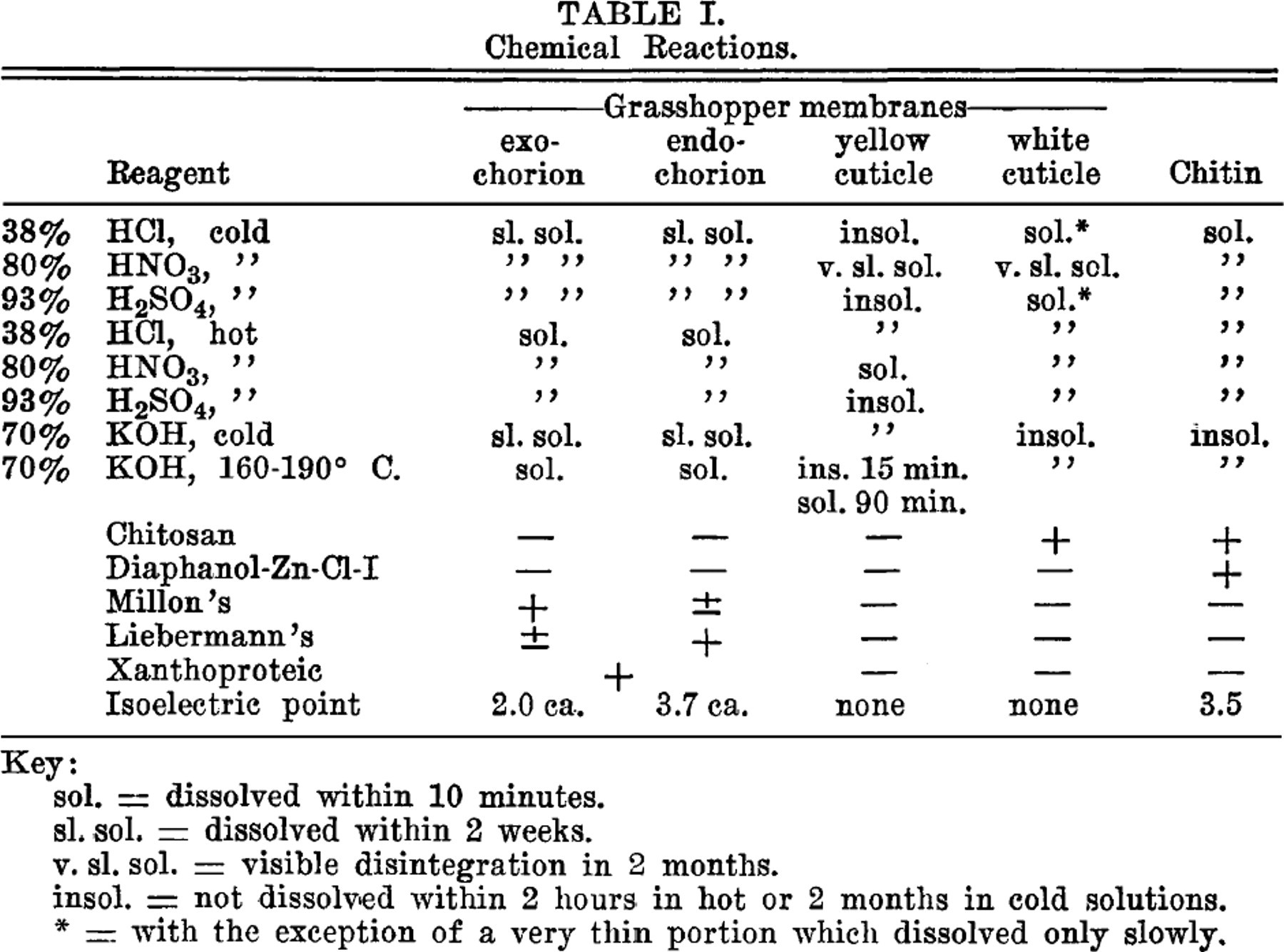 by the prussian blue method of Loeb.
5
Pieces of chorion and cuticle were left for 24 hours in citrate buffers over the pH range 1-5 to which a few drops of weak K4Fe(CN)6 had been added. They were then washed 24 hours in buffer solution without cyanide and treated with FeCl3 Exposures of only 1-2 hours in buffer-cyanide solutions as used by Yonge
5
were ineffective, probably because of the low permeability of the exochorion.
by the prussian blue method of Loeb.
5
Pieces of chorion and cuticle were left for 24 hours in citrate buffers over the pH range 1-5 to which a few drops of weak K4Fe(CN)6 had been added. They were then washed 24 hours in buffer solution without cyanide and treated with FeCl3 Exposures of only 1-2 hours in buffer-cyanide solutions as used by Yonge
5
were ineffective, probably because of the low permeability of the exochorion.
Get full access to this article
View all access options for this article.