




Abstract
The increase in the respiratory frequency as described by earlier workers for various animals, particularly for the dog, 1 has been observed in cows by Regan during his investigation on the influence of environmental temperature on milk production.
The data obtained with 2 cows indicate that the frequency of respiration is about doubled as the environmental temperature increases 10°C. By the method of least squares the results have been fitted to the Arrhenius equation:
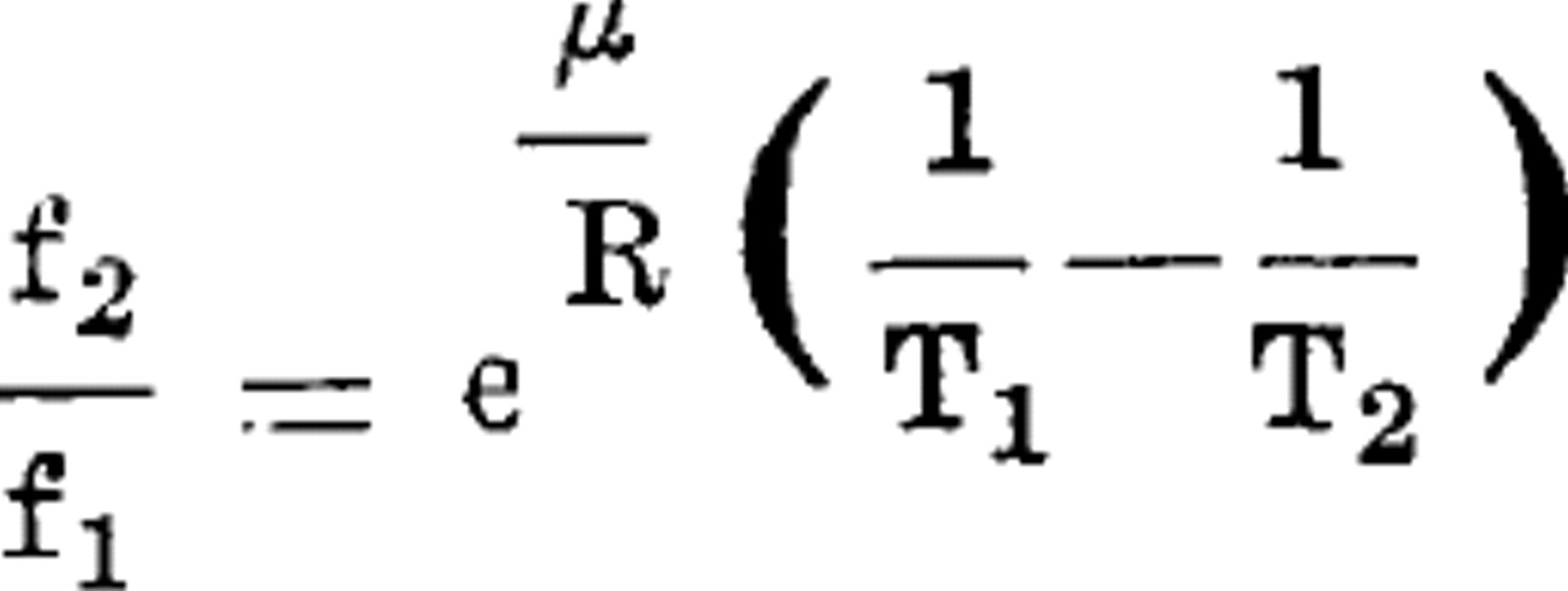
where
f = frequency of respiration, breaths per minute
R = Gas constant, 1.985 cals per degree centigrade
T = environmental temperature in degrees Kelvin
μ = temperature characteristic 2
The temperature characteristic thus calculated for the respiratory frequency was 11,980 cals for one cow and 13,070 cals for the other. The data with the respective regression lines are shown in Fig. 1. At environmental temperatures below 10°C. the influence of changes in temperature seems to be smaller than above 10°, which is probably not far from the critical temperature of milk cows during lactation.
The increase in the respiratory frequency with increasing temperature (above the critical temperature) is part of the animal's physical heat regulation. Particularly animals that do not have well developed sweat glands, as dogs and cattle, make use of polypnoea as a means of increasing evaporation of water for cooling. The question arose to which extent this mechanism for temperature regulation is operated ultimately by the environmental temperature at the body surface or by the temperature of the inspired air or both.
In order to answer this question a cow was kept in a large chamber where the environmental temperature and humidity were controlled, the latter at about 507% saturation. The cow was breathing through a muzzle similar to that used by Brody 3 for respiration trials. The respiratory movements were recorded on a kymograph by an air buffer similar in principle to the “concertina” apparatus used by Haldane. 4 The amount of air expired was measured in a dry gas meter.
Get full access to this article
View all access options for this article.