




Abstract
Using a modification of the technique of Friedman and Lapham,
1
involving intravenous injection of urine and the inspection of the ovaries after a period of 48 hours, an effort was made to determine the minimum amount of urine required to produce a positive reaction in cases of normal pregnancy. Observations were made between the fifth and the fourteenth weeks. All animals used were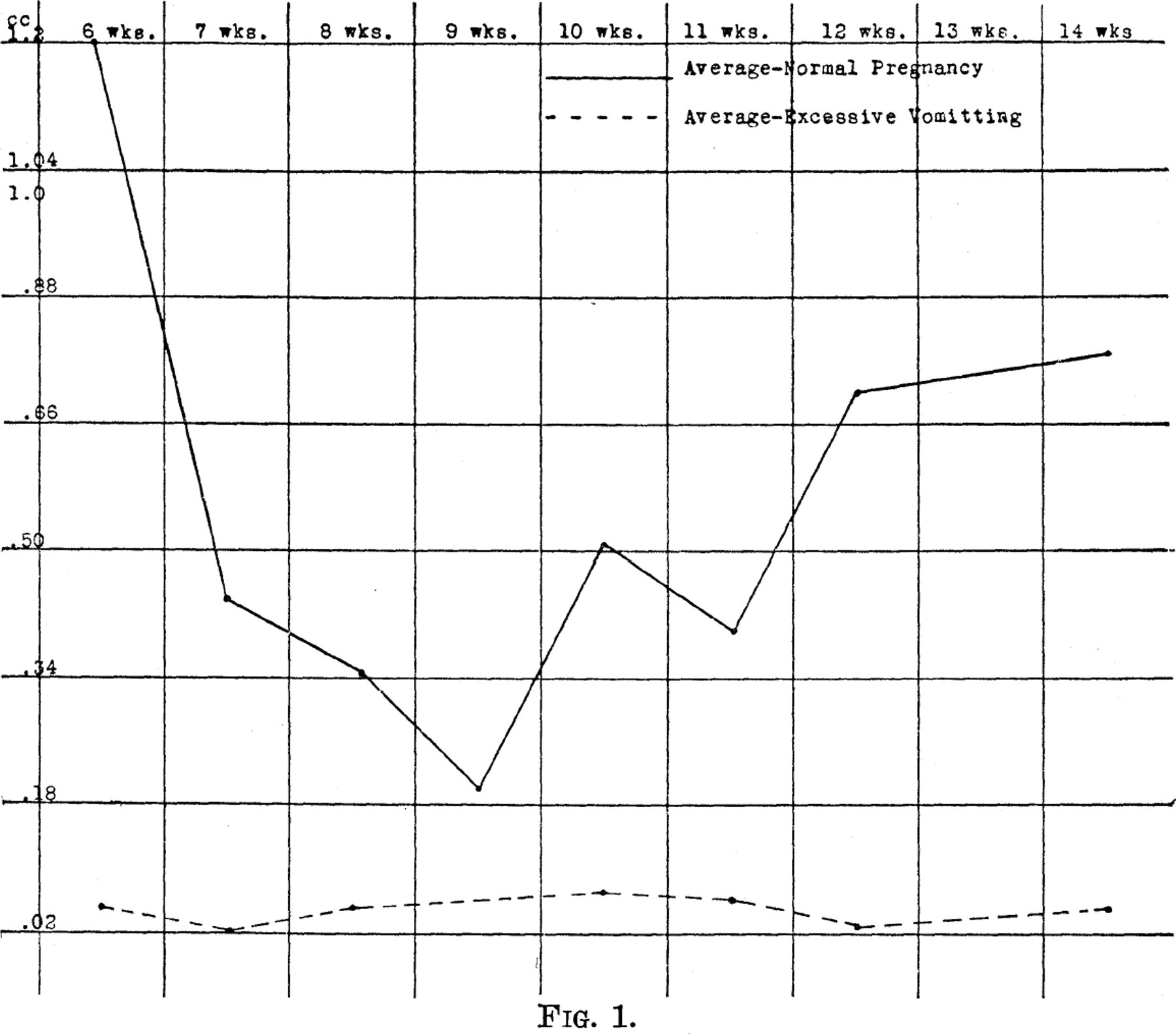 virgin does between 3 and 4 months old and were obtained from the same source. One hundred and nineteen determinations were made on 31 pregnancies. Of 39 fractional tests, 2 were positive with .05 cc. of urine; 10 with .1 cc., and the remaining 27 required .5 cc. or more.
Sixty-two similar determinations were made on 10 cases of excessive vomiting, 4 of which were of the pernicious type. Of 16 tests on these patients, one, associated with a hydatidiform mole, was positive with .01 cc. and .0075 cc.; 4 were positive with .0125 cc.; 6 with .05 cc. and 4 with .1 cc.
Due consideration was given to the concentration of urine as evidenced by the specific gravity, since I 2 have previously shown that this is a factor in the amount of urine required to produce a positive reaction.
In 5 of the vomiting cases, followed to date, it was found that the amount of urine required to produce a positive reaction increased as the symptoms improved.
Although the amount of urine required to produce a positive reaction varies considerably in the normal cases, it would seem that the discrepancy between that group and the vomiting cases is too great to be explained by simple concentration of urine or normal variation.
Get full access to this article
View all access options for this article.