




Abstract
It has been demonstrated (Nicholls 1 ) that excised strips of the stomach of Raja diaphanes and erinacea suspended in a nutrient solution (NaCl, 16.38 gm.; urea. 21.6 gm.; KCl, 0.894 gm.; CaCl2, 1.110 gm.; NaHCO 3 , 0.378 gm.; NaH2PO4, 0.06 gm.; and dextrose, 1.0 gm. per litre of distilled water; with a pH of 7.8) will react to adrenalin, pilocarpin and acetyl-cholin.
Adrenalin (1:100,000 to 1:250,000) stimulates all parts of the stomach, raising the base-line rate and amplitude of the contractions. The only exception is in the antral region near the pyloric canal, where it stimulates in concentrations of 1:2,000,000, but inhibits in concentrations greater than 1:1,000,000. Adrenalin following pilocarpin or acetyl-cholin has an additive effect. Pilocarpin (1: 250,000) and acetyl-cholin (1:100,000) stimulate all parts of the stomach. The former increases the rate and amplitude of the contractions, whereas the latter raises the base-line as well as increasing the rate and amplitude. Atropin (1:250,000) has no effect on the spontaneous contractions, but counteracts the effect of acetyl-cholin and pilocarpin, restoring the contractions to normal.
Thus it was shown that adrenalin not only stimulates isolated strips of the stomach (Dreyer 2 and Lutz 3 ), but it has a definite inhibitory action, due probably to the hypersensitivity of a special region of the stomach to adrenalin.
The well marked effect of adrenalin, pilocarpin and acetyl-cholin lends further proof to the fact, first discovered by Bottazzi, 4 that there is a well developed motor sympathetic and parasympathetic nerve supply to the stomach of elasmobranch fishes.
The effect of these drugs on the spiral intestine and valve, colon and rectum was also studied and the results tabulated:
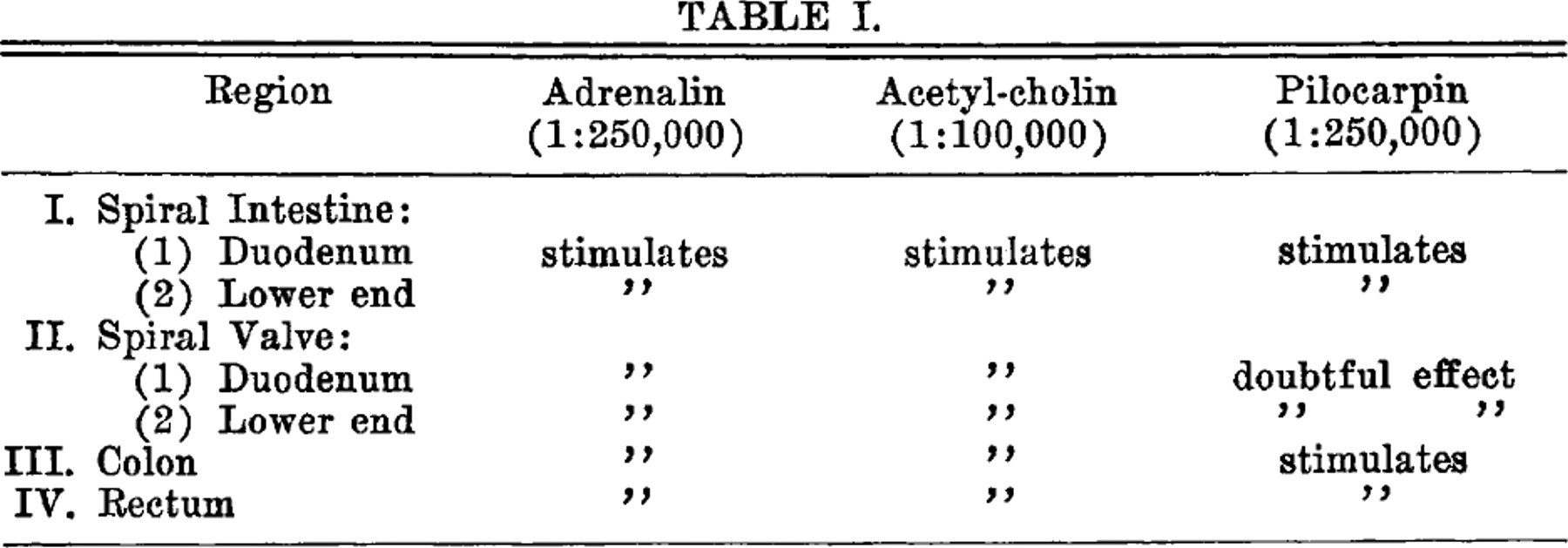
Adrenalin stimulates all these parts, raising the base-line, rate and amplitude of the contractions.
Get full access to this article
View all access options for this article.