




Abstract
The inhibitory effect of sucrose solutions upon saponin and taurocholate hemolysis has been studied in a previous paper. 1 The present report deals with the changes produced by solutions of sucrose and other sugars in the resistance of the hypotonic hemolytic system:
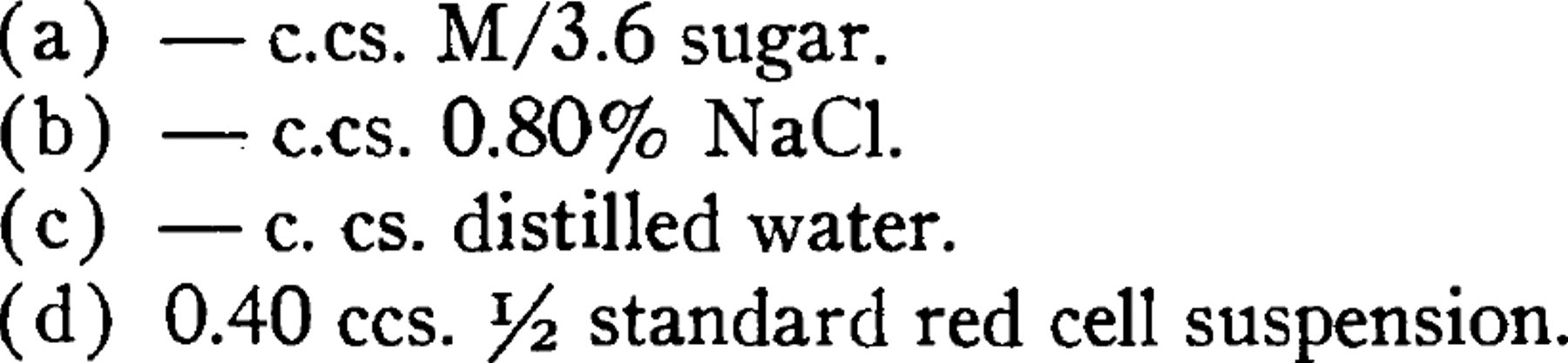
The quantities of (a), (b) and (c) are made such that the resulting system is of the hypotonicity desired. “Resistance” is expressed as that tonicity of the system which will just produce complete hemolysis in one hour. 2
A typical experiment is presented. In Fig. 1, Curve A shows the change in resistance of the system when increasing quantities of 0.80% NaCl are replaced by equal quantities of M/3.6 sucrose, the cell suspension being a citrate-NaCl-NaCl suspension; similarly, Curve B shows the effect of increasing quantities of M/3.6 sucrose, when the suspension is a citrate-sucrose-sucrose suspension. These curves indicate that the replacement, in this way, of NaCl solution by sugar solution in the system produces at least two effects: (1) an immediate effect, resulting in an increased resistance of the system and (2) a more prolonged effect, resulting in a comparative decrease of resistance. Curve A represents the first effect only. In Curve B, the first effect is superimposed upon the second; here the immediately produced increase in resistance occurs in the case of red cells in which a comparative decrease of resistance has already been brought about by a more prolonged contact with the solution of sugar. Essentially the same results are obtained with M/3.6 maltose and M/3.6 lactose, which increase resistance, and M/3.6 dextrose, which decreases the resistance of the system. These experiments, together with observations of the following type, indicate that the destruction of red cells by a hypotonic hemolytic system involves to a considerable extent factors other than those of pure osmosis: (a) red cells suspended for 3 hours in M/3.6 lactose show a resistance of less than 0.20%; (b) red cells suspended in 0.80% NaCl and kept for 36 hours at 10° C. show a resistance of less than 0.20%; (c) in both cases, microscopic observation of a hypotonic NaCl system that just fails to completely hemolyse shows that the few remaining cells are not swollen into spheres, as might be expected from an hypothesis involving the occurrence of only osmotic changes, but are mostly crenated, cup-shaped and disc-shaped; (d) the resistance (as defined above) is altered by altering the rate at which the suspension is added to the system.
Get full access to this article
View all access options for this article.