




Abstract
Wilson, Wishart, and Herrmann 1 have pointed out that the distribution of the potential differences produced by the heart beat within the body and at its surface is determined by the laws which govern the flow of currents in a solid conductor within which a potential difference is maintained.
In the case of a conductor of infinite extent the potential of any point (V) is determined by the following expression:
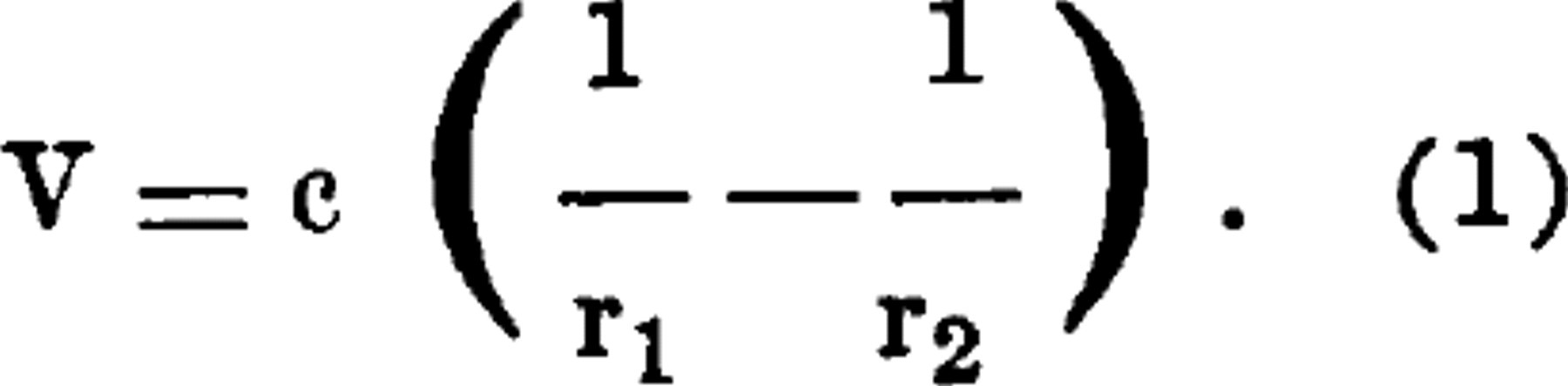
In this expression (c) is a constant, (r1) is the distance of the point from the positive pole or source, and (r2) is the distance from the negative pole or sink.
Let us assume that the positive pole is located at a point of which the coordinates are (a), (0), (0), and the negative pole at a second point (—a), (0), (0), and let us investigate the line, y = b, z = 0. The expression

will then give the potential of any point on this line.
Let us imagine that we can examine the potential of this line with the string galvanometer. To do so let us connect the left-hand electrode to a point so far distant from the origin that it may be considered as indifferent, and let us move the right-hand electrode with a uniform velocity along the line mentioned from a point where (x) has a very large positive value to a point where (x) has a very large negative value.
The form of the curve which would be written by our galvanometer under these conditions can be determined by equation (2), of which the essential constants are assumed to be known.
Let us now imagine that the exploring electrode is stationary and that the system of coordinates approaches it with the same uniform velocity as before.
Get full access to this article
View all access options for this article.