




Abstract
The weight of the human thymus in the fetal period is characterized by great variability. Therefore a large number of observations are necessary to demonstrate even the approximate course of prenatal growth of this organ.
The ponderal growth of the thymus, with respect to body-weight, has been studied in a series of 1043 weighings of the organ from human fetuses under 4000 grams in total (dead) body weight. In no instances were observations made on fetuses living over 48 hours. 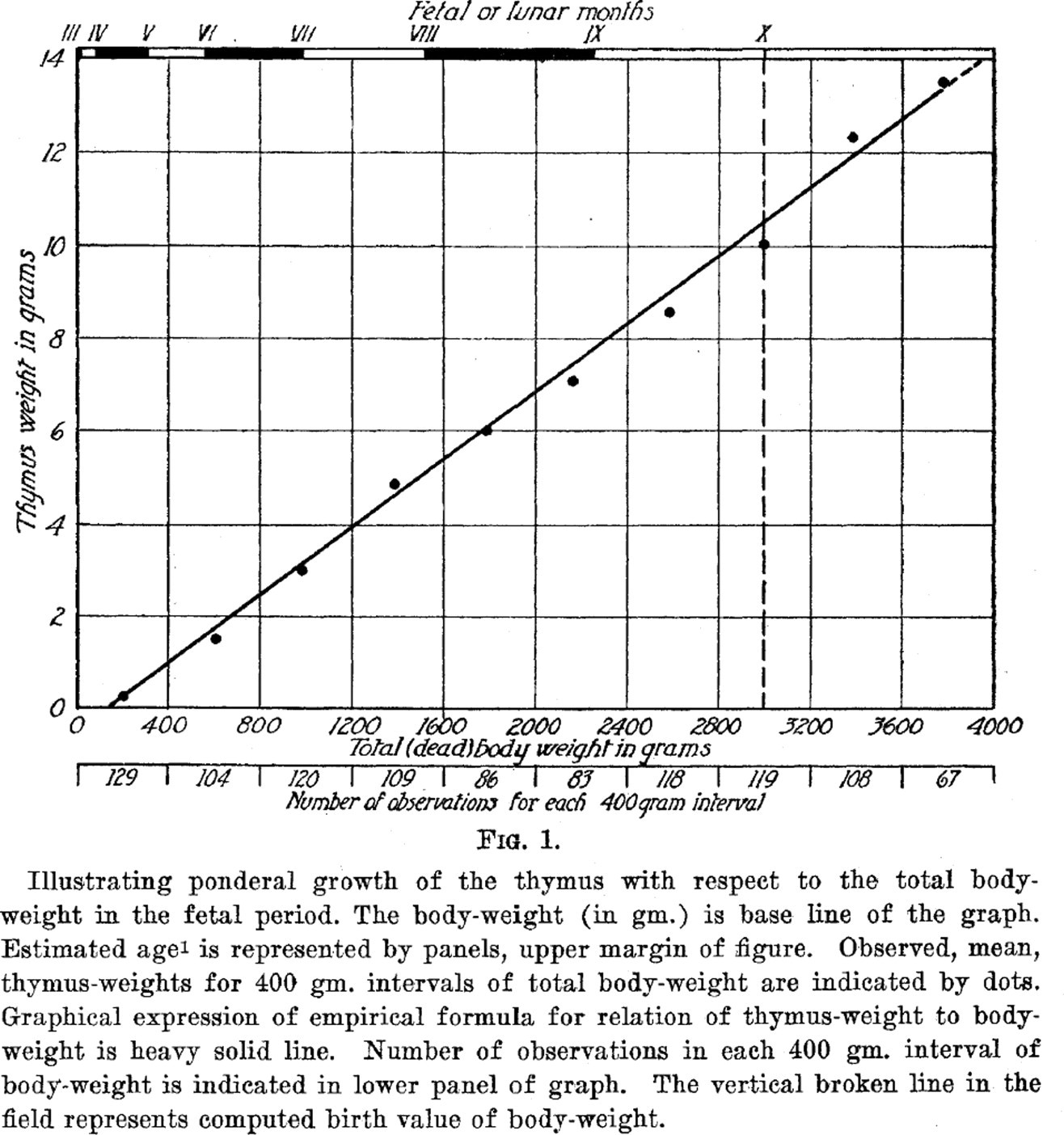 As shown in Figure 1, the relation appears to be rectilinear. It may be approximated by the empirical formula:

where “TW” is the weight of the thymus in grams and “BW” is the (dead) weight of the total body in grams. This formula was computed from the means of thymus-weight and of body-weight for the ten 400 gram intervals of body-weight from 0 to 4000 grams (weighting by the square root of the number of observations in each interval). The calculated values show a mean, weighted, absolute deviation of 0.248 grams from the observed averages. The mean, weighted, relative deviation is 6.03 per cent. This relative deviation lies mainly in the two lower weight-intervals, the mean, weighted, relative deviation for the upper eight intervals being 3.31 per cent.
The relation of thymus-weight to body-length is shown in Fig. 2. As in the preceding series, in no instances were observations made on fetuses living over 48 hours. Two approximate, empirical expressions have been developed for this relationship, the first by using the mean thynius-weights and body-lengths for the 5 centimeter intervals of body-llength from 5 to 60 centimeters (based upon 1216 observations), and the second by using the means of thymus-weight and body-length for the 5 centimeter intervals from 5 to 55 centimeters (based upon 1152 observations).
Get full access to this article
View all access options for this article.