




Abstract
In a recent paper by Clark and Groff 1 it was inferred that ephedrine or closely related substances are present in two California species of Ephedra. By blood pressure experiments with rabbits a 10 per cent infusion of Ephedra nevadensis Wats, was shown to have a marked effect in causing large rises of blood pressure. Other experiments with Ephedra californica Wats, indicated that it also contained a pressor material.
Samples of these two varieties of Ephedra were obtained from Dr. Walter Swingle, Department of Agriculture, Washington, and an attempt was made to isolate ephedrine from them. Using similar amounts and identical procedures of extraction there were prepared solutions of the active principles from these two species, and from Peking Ephedra, purchased in local drug stores. The chloroformic extracts were submitted to standard methods of assay, tested with 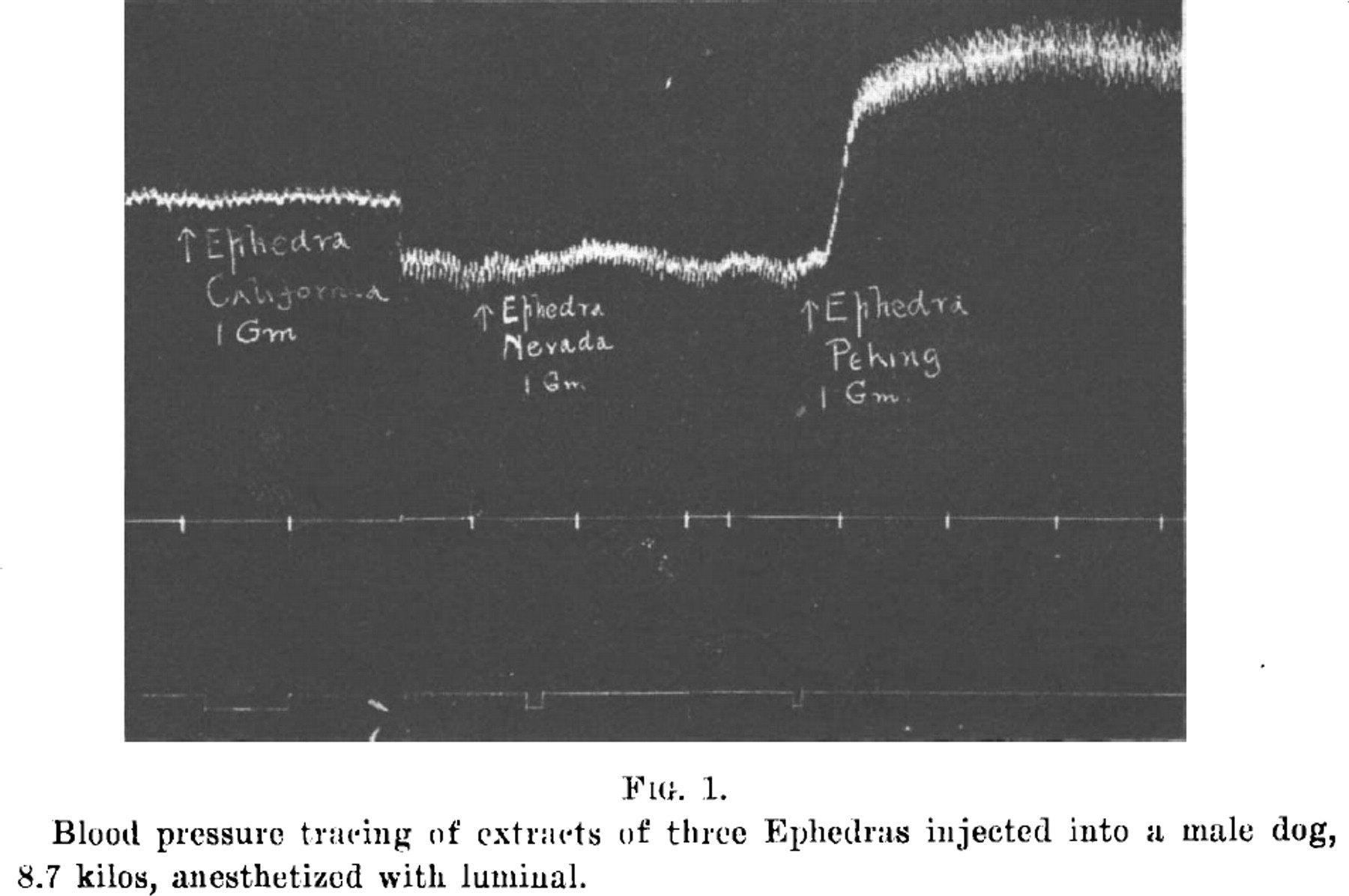 alkaloidal reagents and finally compared by Nagai's alkaline copper sulphate test. Then these extracts were used for physiological testing. Three intravenous injections of each of the two Californian Ephedras before and after an identical injection of Peking Ephedra were made with a large dog, suitably anesthetized and canulated for blood pressure tracing.
The chemical assay and testing, as compared with known extracts of specimens of Peking Ephedra containing ephedrine, showed absolutely no ephedrine in our sample of E. californica, Wats, nor was there anything more than possibly am exceedingly small trace in E. nevadensis, Wats. Both species gave no rise in blood pressure as did the preparations from Pekiag Ephedra. These results lead to the inference that the results formerly obtained with the infusions of Ephedra were probably due to the presence of simple colloids, and certainly not to basic substances related to, ephedrine, unless there be exceedingly great seasonal variation in the alkaloidal content of this plant.
Get full access to this article
View all access options for this article.