




Abstract
In 27 normal adults, 19 men, 8 women, age 19 to 36 years, total capacity, vital capacity, residual, complementary and reserve air were determined. Vital capacity was determined by expiration into a Krogh spirometer. The highest value of five determinations was chosen. Reserve and complementary air and middle capacity were determined by rebreathing air plus oxygen from a Krogh spirometer. Total capacity was determined by the dilution method (rebreathing oxygen). That complete mixture took place was proved by construction of mixture curves. Residual air was determined directly by the dilution method and indirectly as the difference between the total capacity and the vital capacity. The highest and lowest values are recorded in Table I. The values in this and the following 3 papers are given at observed tension and room temperature.
If the total lung volume is given a value of 100, we obtain an average value for the other volumes as shown in Table II, where we have included the corresponding values calculated from previous investigator's publications. We have determined the mean error of each determination by means of the usual formula 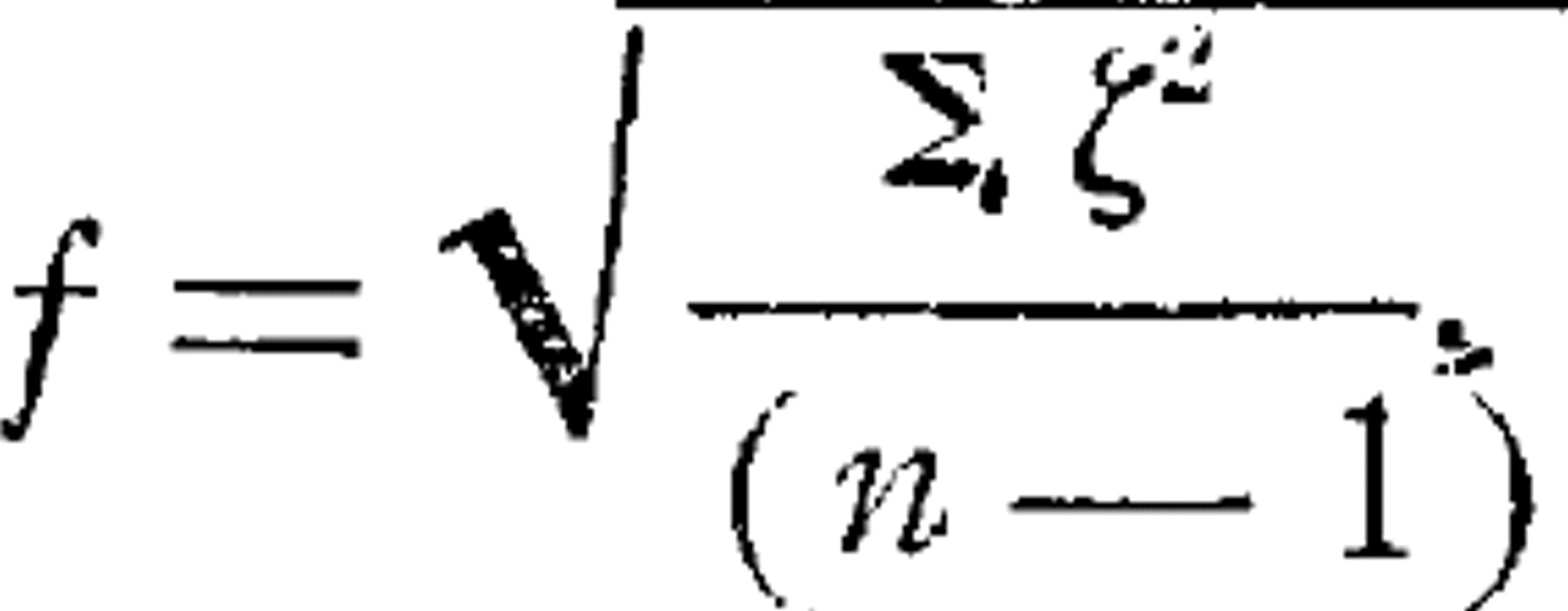 . The values for the mean, for the mean error and for the mean error in percentage of the mean are given in Table III.
In order to find out whether or not any systematic error was responsible for the deviations from the mean, we compared the observed and calculated number of errors in the different groups. The agreement was satisfactory. In Table IV are given the relative size of the lung volumes. If we know the normal value of one of the lung volumes, the normal values for the other may be calculated by means of the figures in Table IV.
Get full access to this article
View all access options for this article.