




Abstract
Insensibility and apathy are common clinical observations in traumatic or surgical shock. Meltzer and others have reported similar observations when the shock is produced experimentally by withdrawing the intestines from the abdominal cavity and cooling or manipulating them. I have repeated this procedure with spinal cats and have subjected to quantitative measurement the effects produced on the cord. The cats are made spinal by pithing the brain through the foramen magnum. The flexion reflex is elicited by stimulation of the posterior tibial nerve and recorded by contractions of the tibialis anticus muscle. The Martin system of measuring the break shocks to the nerve is used. In such a preparation, left to itself at normal temperature, the threshold of the flexion reflex remains very constant for long periods of time, changing, if at all, very gradually. Ordinarily the changes between successive readings are fractions of a single unit of measurement. If, now, the intestines be withdrawn from the abdominal cavity and manipulated, in about 50 per cent. of the animals operated on, this threshold rises very promptly—within two or three minutes ordinarily—and within ten minutes it may have reached a value 50 per cent. greater than before manipulation. It commonly remains at this high level during manipulation. Upon cessation of the manipulation the threshold drops, and within ten minutes or less, it may be at its original level and continue at this level, showing as slight variations as before the manipulation. In such cases it may be possible to repeat the procedure on the same animal.
To take a specific case:
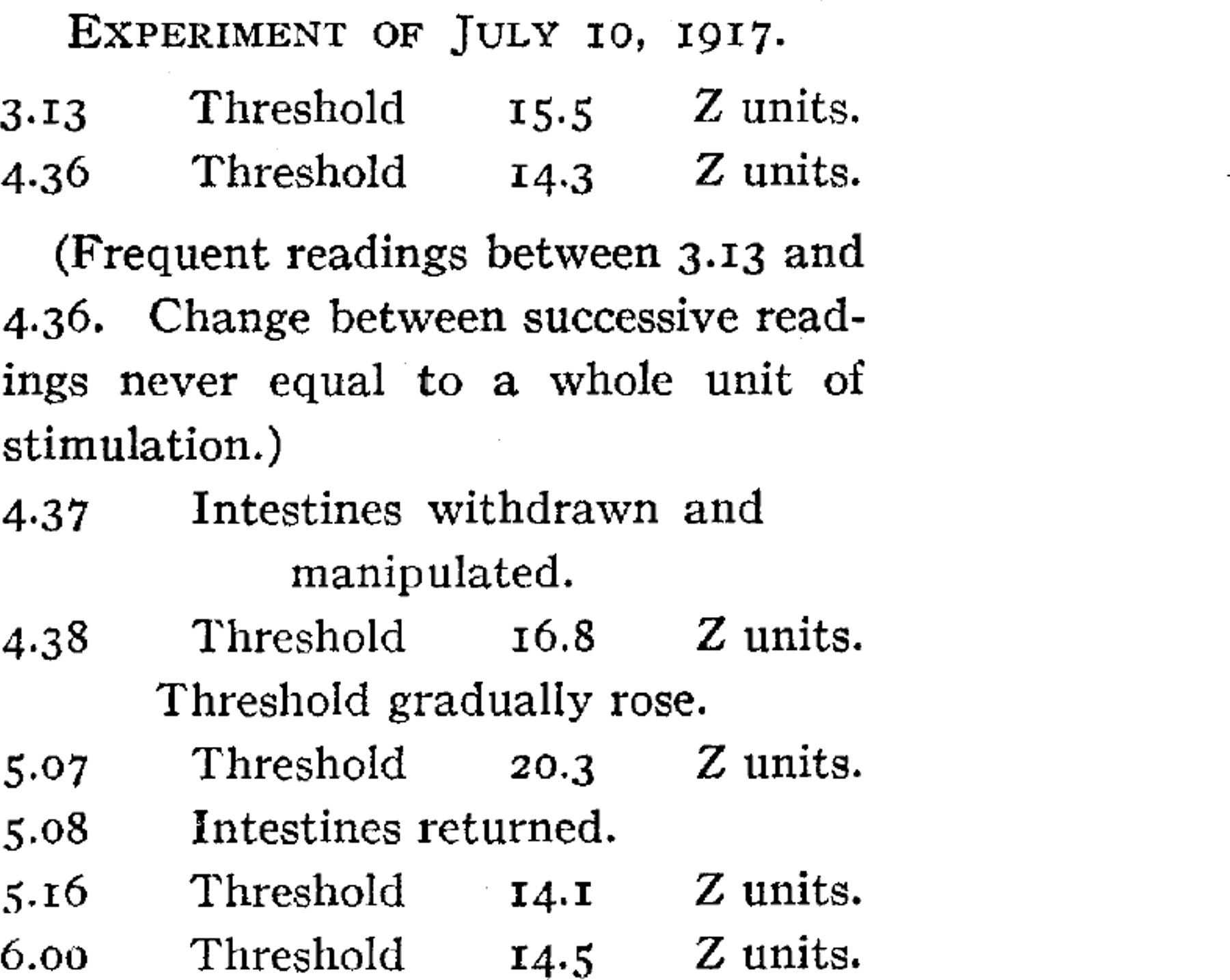
The changes in threshold I have found to bear no relation to changes in blood pressure. The threshold may return to its original level with a lower blood pressure than at the time it went up.
Get full access to this article
View all access options for this article.