




Abstract
In 1912 Löb and Gutmann 1 published some data from which they concluded that a ferment capable of splitting NH3 from urea existed in the pig's ovaries. Taniguchi 2 in a similar investigation which appeared last year confirmed this with somewhat more detailed data on determinations done with extracts from cow's ovaries. Both investigators used the Kruger and Reich method of ammonia estimation and their technique of extraction involved several hours of incubation.
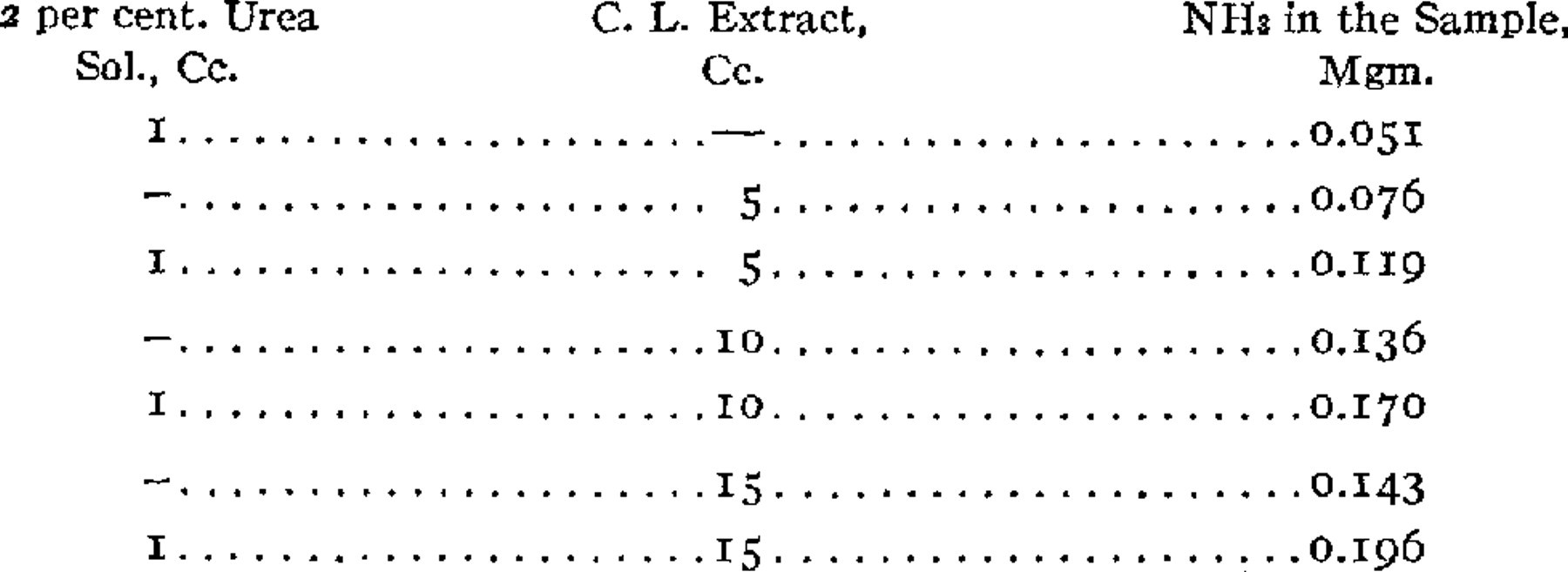
In the present study corpora lutea were separated from fresh cow's ovaries, ground with twice its volume of 0.9 per cent. NaCl solution and filtered after standing one hour at room temperature. A similar extract was made from the rest of the ovaries. To 1 c.c. samples of a 2 per cent. urea solution were added 5, 10 and 15 c.c. of the filtrate and the mixture incubated for one hour at 37° C. Samples of urea solution and of the filtrate alone were similarly treated.
Ammonia estimations on all the samples were done by the aëration-titration method, using Barnett's recently described technique. 3 No more ammonia was found after incubation in the samples of extract and urea mixture than the combined ammonia content of the urea and of the extract samples.
In the following table figures for the corpora lutea extract are given, extracts from the rest of the ovaries gave similar results.
Ammonium carbonate in passing through the liver is converted into urea. Urea on the other hand is converted into ammonium carbonate by an enzyme found in certain bacteria, fungi and a number of higher plants. In 1913 Fosse 1 published some data showing the occurrence of urea in fungi and higher plants, thus pointing to the possibility that the tissues of certain plants may be the site of both the formation of urea and its conversion into ammonium carbonate.
Get full access to this article
View all access options for this article.