




Abstract
Parathyroid tetany in dogs seems to be associated with diminished resistance to bacterial invasion of the mucous membranes, as shown by the frequent infection of the eyes, the nose, and the respiratory passages. This diminished resistance may be due to (1) depression of the processes of active immunity; (2) local depression of the cells of the mucous membranes; (3) disturbance of the body heat regulating mechanism. It is also possible that all three factors are involved.
In order to determine whether the first possibility is a factor, dogs were immunized at varying periods before and after parathyroidectomy, and the influence of the tetany condition on the immunity reaction noted. The particular antibody studied was the lysin developed by the injection of goat erythrocytes into dogs. The immunizing dose consisted of a single intravenous injection of 1 c.c. of a 10 per cent. suspension of goat corpuscles per kilo body weight of dog.
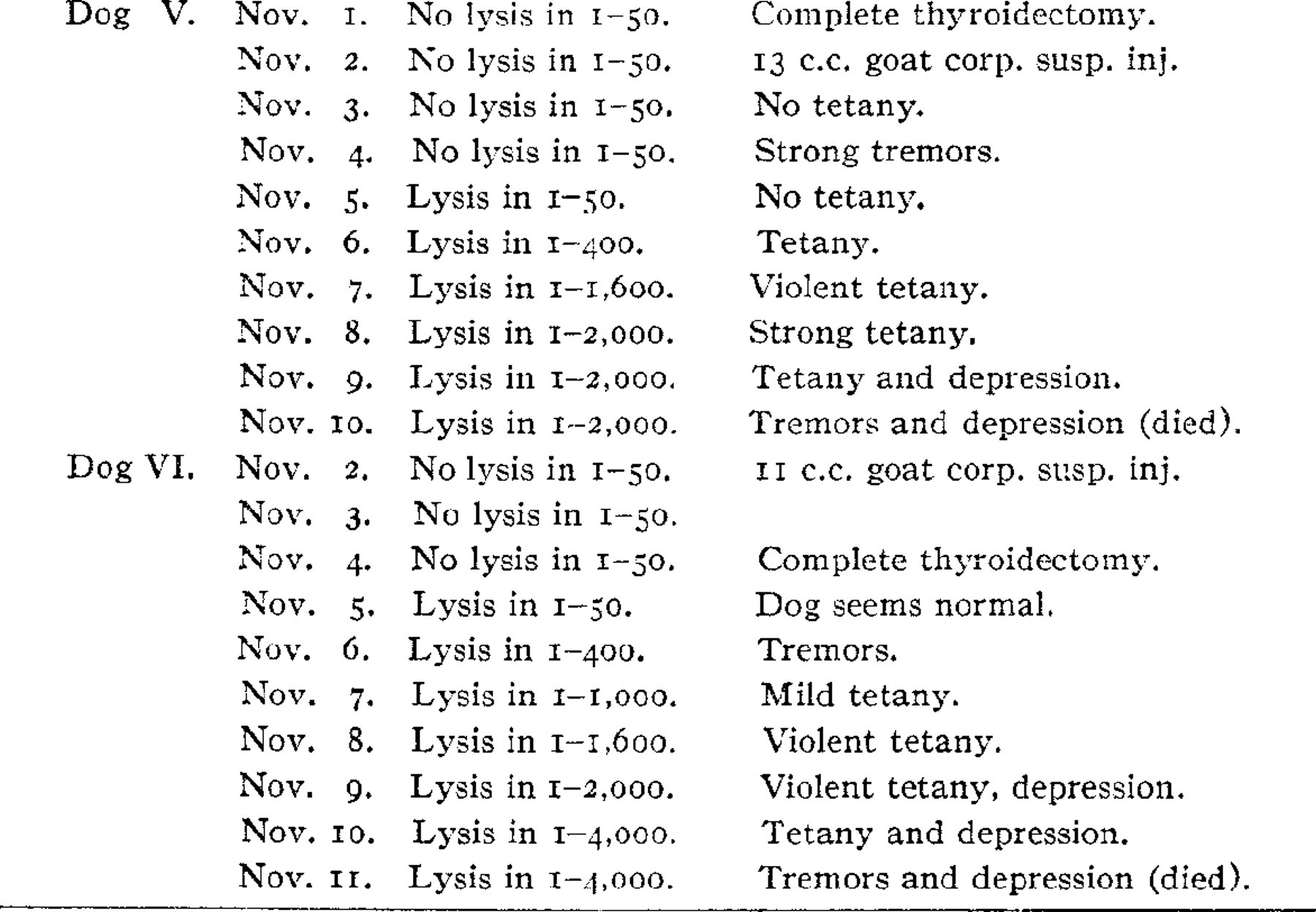
The results so far obtained show that the active immunity is decreased by the condition of parathyroid tetany. None of our dogs developed lysin to goat corpuscles to the degree observed in the series of normal dogs reported by Hektoen and Carlson, and by Luckhardt and Becht. 1 The greatest concentration of the specific lysin in our tetany dogs was represented by a serum dilution of 1-8,000; the lowest concentration by a serum dilution of 1-400. Two typical experiments may be cited:
Get full access to this article
View all access options for this article.