




Abstract
Posttraumatic stress disorder (PTSD) is a severe psychological reaction, including great fear, helplessness, and averseness, caused by exposure to one or more extraordinary threats or traumatic events. The most common characteristic of PTSD is anxiety that lasts for a long time after the threat or trauma. The most frequent PTSD symptoms include lasting re-experiencing cluster, avoidance cluster, and hyper-arousal cluster [1].
PTSD can alter patient's emotions and behaviour and indirectly impact family members. Without proper therapy, PTSD can affect the function of the family and sometimes cause severe family problems [2,3]. Previous research has focused on the relationship between family factors and PTSD. For example, research shows that the posttraumatic relationship between a husband and wife coincides with less marital satisfaction and less intimacy [2]. Even if exposure and other demographical data are controlled for, there is a close association between the severity of PTSD symptoms between a husband and wife [3]. It is also more likely for the children of parents with PTSD to display symptoms of PTSD [4,5]. The phenomenon that PTSD in the older generation impact the development of PTSD in the younger generation is defined by researchers as ‘intergenerational transmission of trauma’ [5,6].
The earliest research on intergenerational transmission of trauma began with studies of the Jewish holocaust survivors’ families in the 1960s. Later research also focused on holocaust survivors’ and combat veterans’ families [7–9]. At present, research has been expanded to include natural disasters, such as earthquakes [10] and hurricanes [11]. Although intergenerational transmission of trauma is presently well established in both the empirical and clinical literature [8,9], the mechanisms through which trauma and/or its symptoms are transmitted are still poorly understood. The transmission mechanisms could be primarily described as direct and indirect [12]. Direct impact includes the inheritance of genes and character [13]. With indirect impact, parental PTSD symptoms may affect or shape their children's mental health, based upon evidence that parental PTSD symptoms greatly influence family function, the relationships among family members, and the patterns of communication. Furthermore, children who grow up in a violent and/or stressful family atmosphere are more likely to have negative experiences as a result [14–16].
Floods are the most common natural disaster affecting more people across the globe (140 million people per year on average) than all other natural or technological disasters [17]. Floods can lead to direct economic and property losses and result not only in physical injuries and deaths but also in psychological injuries [18]. All previous studies on the relationship between family factors and PTSD in family members have mainly focused on holocaust survivors’ and combat veterans’ families [8,14–16]. Little is known about the relationship between PTSD in flood victim parents and children. Given the obvious differences in the nature of the trauma inflicted upon holocaust survivors’, combat veterans’, and flood victims’ families, it is reasonable to suggest the mechanism by which the flood victim parents transmit PTSD to their children is different from the mechanism within holocaust survivors’ and combat veterans’ families. In order to explore the relationship and the possible mechanism between PTSD in flood victim parents and children, we therefore conducted a retrospective study on the residents in the Dongting Lake area in Hunan province, China, to explore the relationship between parent PTSD and child PTSD and to provide data for the future prevention of intergenerational transmission of PTSD after floods.
Materials and methods
Subjects
In 1998, a severe flood struck China's Hunan province, which is an inland province located at the south end of the middle reaches of the Yangtze River in southern China. The area is flood-prone, and suffers mainly river floods, flash floods, and drainage-problem floods. River floods are caused by flooding of the river outside its regular boundaries, often as a result of high precipitation levels. Flash floods usually occur as a result of local rainfalls with high intensity whilst drainage-problem floods occur as a result of regular drainage systems not being able to handle high precipitation levels [19].
Subjects were recruited from the Dongting Lake area in this province by the method of multistage cluster random sampling. At first, focusing on types of floods, we randomly selected Luxi County among five counties hit by flash floods and seven counties and regions including Anxiang County, Yueyang County, Huarong County, Lingxiang County, Qianliang Lake Farm, Mingzhuyuan in Ziyang District of Yiyang city, and Datong Lake Farm among 33 counties and regions hit by river floods and drainage-problem floods during the summer of 1998. In the second stage of sampling, we randomly selected 40 of 80 townships (50%) from the eight chosen counties and regions. In the third stage of sampling, we randomly selected 310 of the 620 villages (50%) from the 40 chosen townships. Finally, from the 310 chosen villages we randomly selected 3,698 families (50%) that had 7–15-year-old children and a mother and father. All children aged 7–15 years old and their parents in the selected families were included in our study.
Data collection
A retrospective investigation was carried out 18 months after the floods in January 2000 and completed within a month. Face-to-face interviews were carried out and a questionnaire designed by the research team was used in these interviews. The content of the interviews included the following: demographic data about the children and their parents, which was answered by the parents, flood exposure level of the children and parental attitudes toward their children, which was answered by the children.
The clinical examination and diagnosis of PTSD were made both in parents and their children. The diagnosis of PTSD was made according to the criteria of the Diagnostic and Statistical Manual of Mental Disorders, fourth edition (DSM-IV)[1], which includes 17 symptoms scored as 0=none, 1=slight, 2=moderate, 3=severe, and 4=extreme. Subjects with scores ≥2 were defined as positive for a specific symptom. The 17 symptoms of PTSD were further divided into three groups, representing three diagnostic criteria B, C, and D. Criterion B symptoms represented the re-experiencing cluster: namely, intrusive recollections (B1); repeated nightmares about floods (B2); acting as if the flood was occurring (B3); feeling worse when reminded of the flood (B4); and reactivity to flood reminders (B5). Subjects were defined as positive if they showed one or more positive items in the B group. Criterion C symptoms represented the avoidance cluster, and included the following: efforts to avoid thoughts or feelings associated with the flood (C1); efforts to avoid activities that arouse recollections of the flood (C2); amnesia in regard to the flood (C3); diminished interest (C4); detachment or estrangement (C5); restricted range of affect (C6); and sense of foreshortened future (C7). Subjects were defined as positive if they showed three or more positive items in the C group. Criterion D symptoms represented the hyper-arousal cluster: namely, difficulty in falling or staying asleep (D1); irritability or anger (D2); difficulty concentrating (D3); hyper-vigilance (D4); and exaggerated startle response (D5). Subjects were defined as positive if they showed two or more positive items in the D group. Additionally, there were Criteria A and E for the diagnosis of PTSD. Criterion A represented exposure to a trauma outside the range of usual experience, and criterion E represented the disturbance lasting more than one month. Subjects were diagnosed as PTSD if Criterion A, B, C, D, and E symptoms were all positive. We assessed all symptoms, including the time and duration of occurrence.
Data analysis
In this study, flood types were divided into drainage-problem flood, river flood, and flash flood. Flood severity was also divided into three levels according to the affected area in each village: mild (less than 25% of the total area), moderate (from 25% to less than 50%), and severe (50% or greater).
We created a data bank using Visual FoxPro 6.0 and conducted a statistical analysis of the data using SAS 9.0. ‘Child’ is the basic analysis unit in our research. Each child in our database has all of his/her parents’ information. Therefore, when the family has more than one child the parents datum shows up more than one time during the analysis. The comparison of the rate of PTSD positive in the groups of children with different characteristics was done by using an overall chi-square test (α =0.05). When the compared groups are more than two and the overall chi-square test is significant, the partition of chi-square method will be adopted (α′=α/((k∗(k–1)/2)+1); k is the number of groups). In order to know if family violence is the moderator between parental PTSD and PTSD in their children, stratified analysis and the Breslow–Day test was adopted. In cases where there was homogeneity between the different layers, the Mantel–Haenszel method was adopted to calculate the adjusted Odds Ratio. In the evaluation of the impact of parental PTSD on PTSD in their children, we used a multivariable logistic regression model to re-estimate the adjusted Odds Ratio (OR) and its confidence interval (CI) after the possible confounding variables were controlled for.
In multivariable logistic regression analysis, we chose the children's PTSD as the dependent variable and the father's PTSD and mother's PTSD as the independent variable. Meanwhile, the following were chosen as concomitant variables to adjust the Odds Ratio between the children's PTSD and their parents’ PTSD: flood type (drainage-problem=0, river flood=1, flash flood=2, drainage-problem as the reference), flood severity (mild=1, moderate=2, severe=3, mild as the reference), gender (male=0, female=1), age (7–9 years old=0, 10–12 years old=1, 13–15years old=2, 7–9 years group as the reference), drop into the water (no=0, yes=1), trap in water (no=0, yes=1), serious injury in flood (no=0, yes=1), your relatives seriously injured in flood (no=0, yes=1), witnessing somebody drown (no=0, yes=1), death of a your family member in flood (no=0, yes=1), first flood experience (no=0, yes=1), separation from your family members during flood (no=0, yes=1), death of friends in flood (no=0, yes=1), class suspended because of flood (no=0, yes=1), the following school semester postponed because of flood (no=0, yes=1), physical and verbal abuse by the father (no=0, yes=1), and physical and verbal abuse by the mother (no=0, yes=1).
Results
Overview
A total of 3,698 families with 4,833 children and their parents were entered into this study. Of them, 406 families with 506 questionnaires had incomplete data and were therefore excluded. In fact, 4,327 children and their parents (89.5%) of 3,292 families were included for analysis. Among 4,327 children, 203 (4.7%) were diagnosed with PTSD. Among 6,584 parents, 740 (11.2%) were diagnosed with PTSD.
We analysed the difference between the PTSD positive rates in the children with different characteristics. Shown in Table 1, the PTSD positive rate is significantly higher in children who had the following disaster-related experiences and characteristics: flash flood or drainage-problem flood, moderate or severe flood, female, drop into the water, trap in water, serious injury in flood, seriously injured relatives in flood, witnessing somebody drown, death of a family member or friend in flood, trapped in the water near a dead body, not the first flood experience separation from family members during flood, teachers or classmates drowned in flood, class suspended because of flood, and the following school semester postponed because of flood. However, the children's age and frequency of beatings by their parents did not correlate with a PTSD positive clinical diagnosis in the children.
The PTSD positive rate of different characteristics of 4,327 children who suffered flood in 1998 in Hunan, China
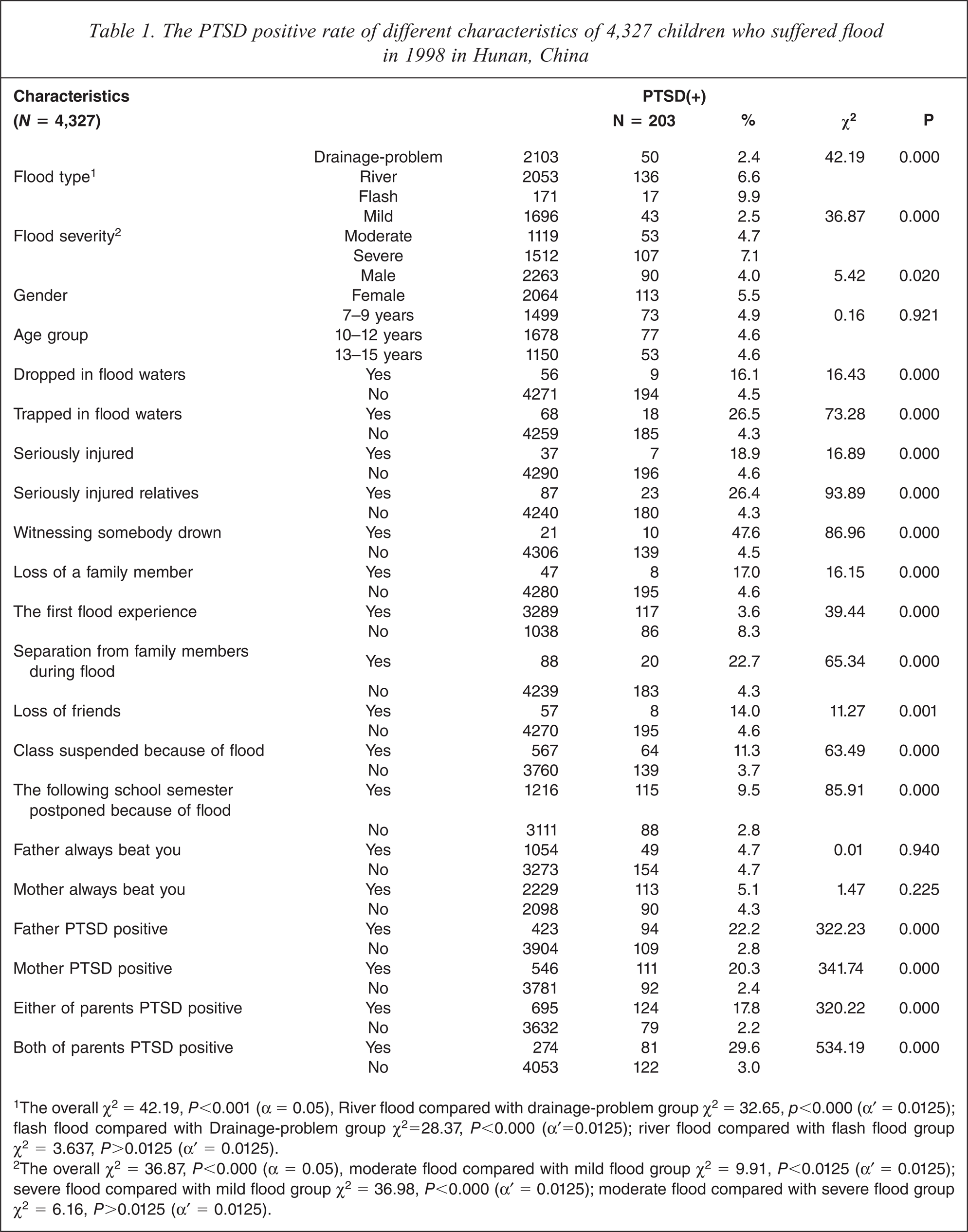
1The overall χ2 = 42.19, P<0.001 (α = 0.05), River flood compared with drainage-problem group χ2 = 32.65, p<0.000 (α′ = 0.0125); flash flood compared with Drainage-problem group χ2=28.37, P<0.000 (α′=0.0125); river flood compared with flash flood group χ2 = 3.637, P>0.0125 (α′ = 0.0125).
2The overall χ2 = 36.87, P<0.000 (α = 0.05), moderate flood compared with mild flood group χ2 = 9.91, P<0.0125 (α′ = 0.0125); severe flood compared with mild flood group χ2 = 36.98, P<0.000 (α′ = 0.0125); moderate flood compared with severe flood group χ2 = 6.16, P>0.0125 (α′ = 0.0125).
The analysis of the relationship between PTSD positive in parents and the frequency of beatings of children shows that the rate of beatings for PTSD positive fathers (54.9%) was higher than that of PTSD negative fathers (51.2%), while no correlation was found between mothers with or without PTSD and the frequency of beatings of their children, shown in Table 2.
The association between parental PTSD and family violence
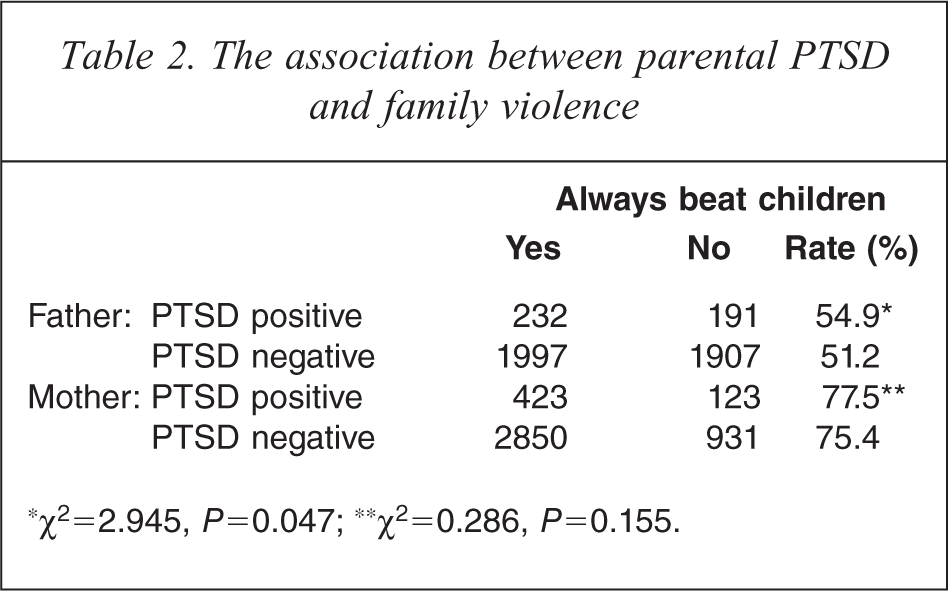
∗χ2=2.945, P=0.047; ∗∗χ2=0.286, P=0.155.
Relationship between PTSD in parents and their children
The stratify analysis shows that family violence did not affect the relationship between parental PTSD and PTSD in their children. After adjusting the distribution of family violence, the risk for children of developing PTSD is 8.9 times higher in the families with PTSD positive fathers than in families without (95% CI: 7.3, 13.3), 9.2 times higher in families with PTSD positive mothers than in families without PTSD (95% CI: 7.6, 13.7) (Table 3). When we used a multivariable logistic regression model to control the other possible confounding variables, the relation was still present. The adjusted Odds Ratio is 3.0 (95% CI 2.0, 4.4), 4.4 (95% CI 3.0, 6.4), respectively (Table 4).
The relationship between a parents’ PTSD and their childrens’ PTSD in different subgroups
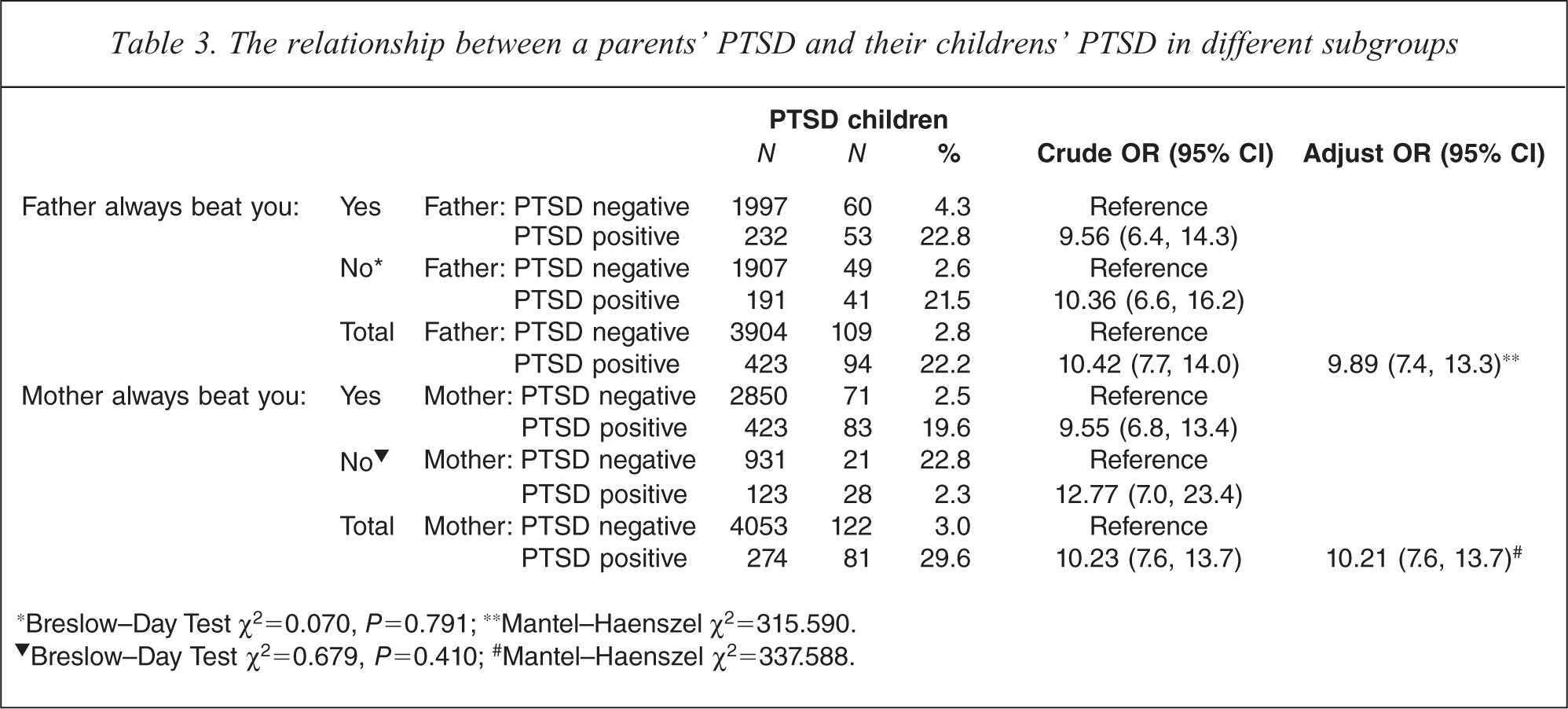
∗Breslow–Day Test χ2=0.070, P=0.791; ∗∗Mantel–Haenszel χ2=315.590.
▾ Breslow–Day Test χ2=0.679, P=0.410; #Mantel–Haenszel χ2=337588.
Multivariate logistic regression analysis on the relationship between putative risk factors and children's PTSD
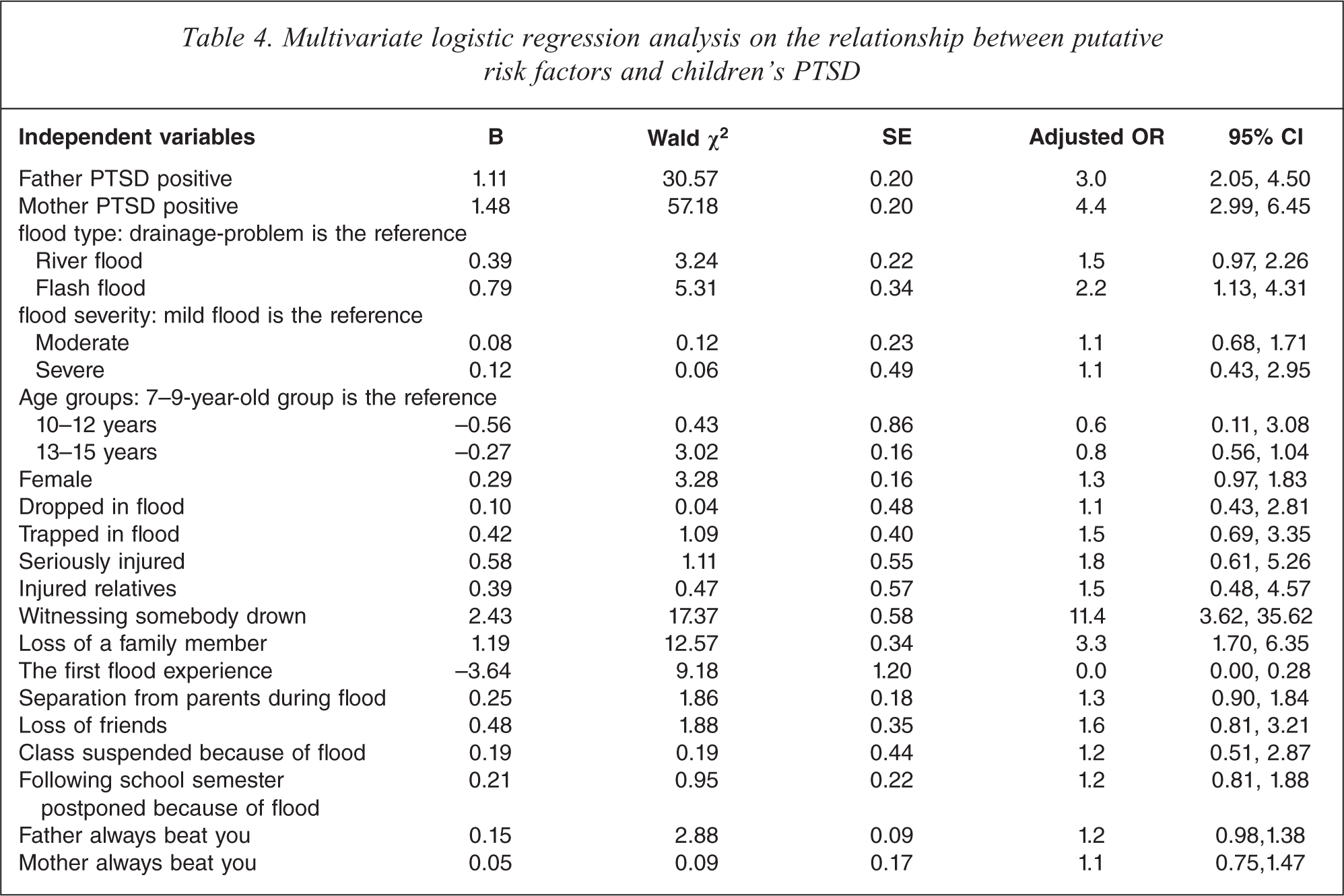
Table 4 also shows that after adjusting the putative confounding variables, the relationship between child PTSD and flash flood, witnessing someone drown loss of family members, the first flood experience still exist. However, the relationship between a PTSD positive clinical diagnosis in children and other flood-related experiences or flood severity is insignificant.
Discussion
Severe natural disasters such as floods and earthquakes put both adults and children at risk of developing psychological disorders [20]. This study shows that PTSD positive rate in children caused by flood is 4.7%, which reveals that PTSD is more common among children after floods and should be given more attention to improve public health. The rate of children with PTSD in this study is lower than that (17.7%) in the research done in1997 by Bokszczanin [21] in school students in flood areas in Poland. The reason for the inconsistent rates may be that Bokszczanin chose 11– 21-year-old students, which is not the same with the characteristics of the sample in this study, the exposure levels to the floods may not be equivalent, and also there are many difference in society environment between the two population.
Tables 1 and 4 show that a higher PTSD positive rate exists in flash flood areas. The reason may be that flash floods usually occur suddenly and violently so that people are usually not mentally prepared for them. Therefore, they more easily affect the victims’ mental health. Though the flood severity itself is an indicator for exposure level, the multivariate analysis shows no significance between flood severity and the PTSD positive rate in children. This may indicate that the flood type may be more important in predicting the PTSD positive rate in children. The rate of PTSD is higher in females than in males, which is consistent with the findings by Chen [22] and Bokszczanin [21]. Male adolescents tend to report better control of their feelings than female adolescents do [21]. On the other hand, research shows that those aimed at active problem-solving strategies are usually the most successful in coping with disasters [23]. Quite reasonably, males are more easily involved in the post disaster recovery activities and more likely to have different and better coping strategies than females [21]. Therefore, this group of children may have increased self-esteem and ability of emotional control [21–24].
Experience of trauma may directly leads to development of psychological problem in children [25] and with the increase of exposure level PTSD becomes more severe and lasts longer [26]. The finding of our research are consistent with previous studies and show that the rate of PTSD was a little high in these children who had more frequent and more severer flood experiences, including drop into the water, being trapped in the water, seriously injured in the flood, seriously injured relatives in flood, witnessing somebody drown, death of a family member or friend in flood, not the first flood experience, separation from family members during flood, teachers and classmates drowned in flood, class suspended because of flood, the following school semester postponed because of flood. The multivariate analysis showed that, after controlling other factors, the relationship between children PTSD and the experience of witnessing someone drown, losing a family member, or not being their first flood is still significant, which suggests that more care and help should be directed to the children with those experience.
This study shows that the risk of PTSD for the children living in the families of parents with PTSD obviously increased, the relationship still exists even if the confounding variables were controlled, and the risk of PTSD in children more obviously increased when both parents had PTSD. The mechanism of intergenerational transmission of trauma in flood areas is complicated. It is believed at present that the impact of the parents’ PTSD on their childrens’ PTSD can be divided into direct and indirect [12]. Direct impact mainly result from the inheritance of gene [13]; and the indirect impact may result from the worse family function and relationship between the family members in parents PTSD positive family, which makes children vulnerable for a violent and/or a stressful event, or result from the change of the family member communication patterns and intimacy level. All these factors may increase the risk of developing psychological problems in children [14–16]. In addition, it is possible that children and their parents had similar problems because they exposed to the trauma of the same severity. Only 2.0% (88/4327) children were separated from their parents, and 98% children live with his/her parents and experienced the same flood in flood period, as shown in Table 1.
Research on combat veterans supported the hypothesis that symptoms of PTSD in parents impact the family function and the relationship between the family members, which leads to the onset of PTSD in children. In families with fathers who are diagnosed with PTSD, the rate of family violence affecting children increased, thus increasing the chance that those children become afflicted with PTSD [8, 9]. Zinnur Kilic [27] measured the family function in 49 earthquake survivor families with 7–14-year-old children, by using the Family Assessment Device. He found that family function was affected by the presence of a PTSD positive father and/or PTSD mother. Our research shows that when father had PTSD the rate of family violence for children was rather high while no statistical significance was found in the relationship between mothers with or without PTSD and family violence for children and between parents family violence for children and children's PTSD. The above finding in this study is not consistent with Kilic's finding. Kilic used the Family Assessment Device to measure family function, in which a questionnaire was completed by parents. Therefore, it only measured the family function from the point of view of parents. We let the children answer whether they usually suffered from family violence, which may reflect different aspects of family violence compared with the parents’ perspective answer. The stratify analysis showed that the family violence involving children does not affect the relationship between parental PTSD and PTSD in children. It is hereby suggested that the correlation between PTSD in parents and PTSD in children after flood may not be made by the direct family violence because the relationship between PTSD in fathers and PTSD in children remains significant even after adjusting for family violence.
In conclusion, the rate of PTSD in 7–14-year-old children is 4.7% in areas in Hunan, China, who suffered from flooding in 1998. The possibility for children to develop PTSD is increased in families with PTSD parents, which indicated that this kind of families need be found timely and psychological consultation and intervention is needed for the family members, including children, to prevent further development of PTSD. The mechanism of intergenerational transmission of trauma in flood areas may include similar inheritance susceptibility to flood (even if we did not test the gene) and similar flood exposure; but further study may be needed to explore the detail mechanism for this intergenerational transmission of trauma in flood survival families.
Footnotes
Acknowledgements
This research was supported by the China Medical Board in the USA (Grant#98-689). The author Xin Huang was supported by the China Scholarship Council. We thank Linbao Zhang (CDC Director, Yiyang city), Xiumin Zhang (CDC Director, Anxiang county), Huaxian He (CDC Director, Yueyang city), Linlin Li (CDC Director, Xiangxi autonomy city) and Senlin Tang (CDC Director, Datong Lake district) for their cooperation. Special thanks to Dr Richard M. Reznick for revising the manuscript.