




Abstract
Darwin's theory of sexual selection offers a challenge to psychology and psychiatry. We select each other, and have been doing so since social life first evolved. But who is selected and what happens to those who are not selected? What social structures have evolved to contain the unselected? What behaviours have evolved to manage the selection process? How do the selected relate to the unselected and what behaviours have evolved to manage this asymmetry in social relations? What mental states have evolved to characterize the selected and the unselected? These questions should be kept in mind when we observe and study the social structures, behaviours and mental states that we see displayed before us in all the variety of nature. It is suggested that a significant amount of current psychiatric disorder, especially depressive states and both social and generalized anxiety disorder, have evolved because they managed the processes of being unselected and de-selected, and maintained the unselected in that social role without loss of life or physical incapacity, and enabled the unselected to contribute to general social well-being.
In this anniversary year of the publication of the Origin of Species it is appropriate to think of the challenge that Darwin gave to psychology. The influence of Darwin's ideas on the psychological sciences and on evolutionary psychiatry in particular has been masterfully reviewed by Stein [1]. Discussions of depressive disorders from an evolutionary viewpoint have also been numerous [2–16]. In this paper I shall take a more radical approach, and suggest that we need something approaching a paradigm shift to conceptualize psychiatric disorder in terms of the basic sciences of evolutionary theory, comparative ethology and behavioural ecology [17], and that it should be this new appreciation of the basic sciences that should inform the psychological treatment of depressed patients, and so to free us from the constricting medical model of treatment that has resulted in the prognosis of psychiatric disorders being worse in the developed than in the undeveloped world [18].
With his theory of sexual selection, Darwin proposed that we are not only selected by disease and hunger and other natural forces, but that we also select ourselves. This selection of ourselves is a social process, and has been going on in every generation since social life began. This means that the population is divided into those who are selected and those who are not selected, or maybe into a continuous variable of more or less selected, and there is a possibility that once selected, a person may then be de-selected. How do we recognize a human population divided into the selected, the unselected and the de-selected?
Before reviewing what Darwin actually said, let me point out some important questions about human social life that arise from Darwin's observations, for instance: (i) how much of human differential reproduction can be accounted for by sexual selection; (ii) what are the criteria for selection, in other words, what is the human equivalent of the stag's antlers and the peacock's tail; (iii) how can we classify the criteria of selection into physical and psychological; (iv) what is the nature of the social process by which selection is made, and is there an ‘arena’ in which this process takes place; (v) what is the social role of those who are not selected; (vi) because it is clearly desirable to be selected, what are the constraints that maintain the unselected in their role; in particular, are these constraints applied by the selected or by the unselected themselves; and (vii) because we and our ancestors are descended from those who have been selected, how is the genetic capacity to be unselected or de-selected maintained in the population?
Darwin and sexual selection
Darwin made it clear that natural selection is based on differential ability to deal with the physical environment, including predator and prey relations with other species, but at the same time he recognized that selection occurs as a result of interactions with members of the same species. In the Origin of Species he wrote the following.
This form of selection depends not on a struggle for existence in relation to other organic beings or the external conditions, but on the struggle between individuals of one sex, generally the males, for the possession of the other sex. [19]
In 1871 Darwin published The Descent of Man and Selection in Relation to Sex, which was devoted to a meticulous analysis of sexual selection [20]. In this book he introduced the term for the first time, and he pointed out that sexual selection has two components. He wrote as follows.
Sexual selection depends on the success of certain individuals over others of the same sex, in relation to the propagation of the species; whilst natural selection depends on the success of both sexes, at all ages, in relation to the general conditions of life. The sexual struggle is of two kinds; in the one it is between individuals of one sex, generally the male, in order to drive away or kill their rivals, the female remaining passive; whilst in the other, the struggle is likewise between the individuals of the same sex, in order to excite or charm those of the opposite sex, generally the females, which no longer remain passive but select more agreeable partners. This latter kind of selection is closely analogous to that which man unintentionally, yet effectually, brings to bear on his domesticated productions, when he preserves during a long period the most pleasing or useful individuals, without any wish to modify the breed. [20]
So, according to Darwin's brilliant formulation, in each generation some individuals are rejected my members of the opposite sex, and others are ‘driven away or killed’ by members of the same sex. In spite of his interest in human and animal emotions [21], Darwin did not pursue any further the physical and psychological fate of these unselected individuals. But he left us with several unanswered questions.
Social structures
What social structures have evolved to accommodate the asymmetry between the selected and the unselected? Here, we should not look at the human situation, which is too complex for easy analysis, but rather at the wide range of animal species studied in detail by comparative ethologists [22]. Two types of social structure have been described and this applies to the whole vertebrate subphylum stretching back hundreds of millions of years. One type of structure is territory: the division into territory owners and those lacking territory clearly matches the division into selected and unselected. The other structure is social hierarchy, which occurs in practically all group-living vertebrates. Here the division into selected and unselected is less clear than in the case of territory, but it does not take much imagination to conclude that the selected occupy high ranks in the social hierarchy and the low ranks are occupied by the unselected. High-ranking animals are fitter than low-ranking animals, in that they tend to have more offspring.
Competitive behaviour
How is the division into territory owners and non-territory owners, and into high-ranking and low-ranking individuals achieved? In most vertebrate species it is achieved by fighting or agonistic behaviour, which has been described in great detail by comparative ethologists [23,24].
An even more important discovery by ethologists is that fighting behaviour is ritualized in almost all vertebrate species. Whereas invertebrates often kill their rivals, it is rare for vertebrates to do so. The ritual acts are symbols in that they stand for lethal acts, and they clearly have an effect on the opponent that is not physical in nature. Some ritual signals are clearly aggressive, such as baring the canine teeth, whereas others are almost indistinguishable from courtship. It might well be asked why any animals would agree to lose a ritual fight in which they are not injured in any way. These ritual agonistic encounters have been studied by behavioural ecologists under the term ‘pairwise contests’ [25–27], using game theory, and their conclusion has been that a population consisting entirely of winners (or ‘hawks’) is not stable, in that it can be infiltrated and replaced by a population that also includes losers (or ‘doves’). The outcome of any pairwise contest is decided by three main variables: resource-holding potential (RHP), which is a measure of fighting capacity [28]; resource value, which is a measure of the value to each contestant of what is being fought about; and ownership (e.g. which of the two is the current owner of the territory or other prize being fought over). Clearly hawks tend to have higher values of these variables than doves.
Ritualization of losing
In an unritualized fight the loser has two main characteristics: he lies on the ground and he is dead (or severely incapacitated). In a ritualized fight, these two characteristics need to be ritualized. The fact that the loser falls to the ground and lies there has given rise to the evolution of complex symbolic and metaphorical behaviours that have been well studied by ethologists, and are described as submissive behaviour. All losers tend to adopt a spatial position in which they are lower down than the winner, and also seem smaller and more vulnerable, a widely evolved form of submission that has been called SLV (smaller, lower and more vulnerable) behaviour by Feierman [29]. In highly social species such as wolves and monkeys, more metaphorical symbols have evolved to express submission [12]. For instance if two adult male wolves are fighting, the loser will roll over and bare his perineum to the other, as a puppy does to its parent in a request for licking, giving the message, ‘I am like a weak puppy to your strong adult’. The winning wolf is bound by the ritual and does not take advantage of the exposure to attack, but may instead give a token lick to the loser. And if two adult male rhesus monkeys are fighting, the loser may present its hindquarters to the winner in a sexual manner, as if to say, ‘I am like a weak female to your strong male’, and the winner again does not take advantage of the vulnerability of the loser, but may make a token sexual mount. This observation of the symbolic submissive behaviour in many species has been a major achievement of comparative ethology.
Ethologists, however, have not described the ritualization of the second component of losing an unritualized fight, which is being dead or severely incapacitated. If this is not ritualized, the loser could re-contest the issue, either immediately, or the next day, or sometime soon, and the whole point of settling the contest in a ritual manner would be vitiated. We must look for a form of ritual death or ritual incapacity that prevents the loser from re-contest the issue. We need something that acts as an internal referee, telling the loser to behave like a loser and to accept the new social situation, which will be clearly less favourable than that existing prior to the contest. Clinical psychologist Paul Gilbert has described just such an internal referee in his depressed patients [30]. If it is the case that depressed mood represents the ritualization of incapacity, why has it not been identified by ethologists? The main reason is that ethologists study animals, and animals cannot speak. The evidence of depressed mood comes mainly from the self-reports of psychiatric patients. They are not otherwise remarkable. Even hospitalized depressives can be seen going about their daily lives without any conspicuous abnormality (except, or course, extreme cases of stupor and agitation). And depressive subjects do not make submissive signals: their active submissive behaviour (such as flattery) is, if anything reduced, but their passive submissive behaviour is increased. Depressed patients are more conspicuous for what they do not do than for what they do, which often results in their being described as lazy or rude rather than depressed. So it is not surprising that ethologists’ reports of defeated animals have not usually identified depressive states, although this lack is now being made good [31] and defeated rodents are increasingly being used as animal models of depression [32]. The defeat behaviour is affected by antidepressant drugs, although not always in the anticipated direction [33].
Application to psychiatry
It is one thing to say that depression evolved as ritual incapacity, and quite another to apply it to the problems of psychiatry, such as the classification of depression and to treatment, and also to explain how it fits with the various analyses of depression from a functional point of view mentioned at the beginning of this paper. Having mulled over this problem for over 40 years, a few colleagues and I have concluded that, in order to appreciate how the evolutionary scenario apples to clinical practice, we need to appreciate some changes that have occurred in human evolution since the original defeat response evolved [13].
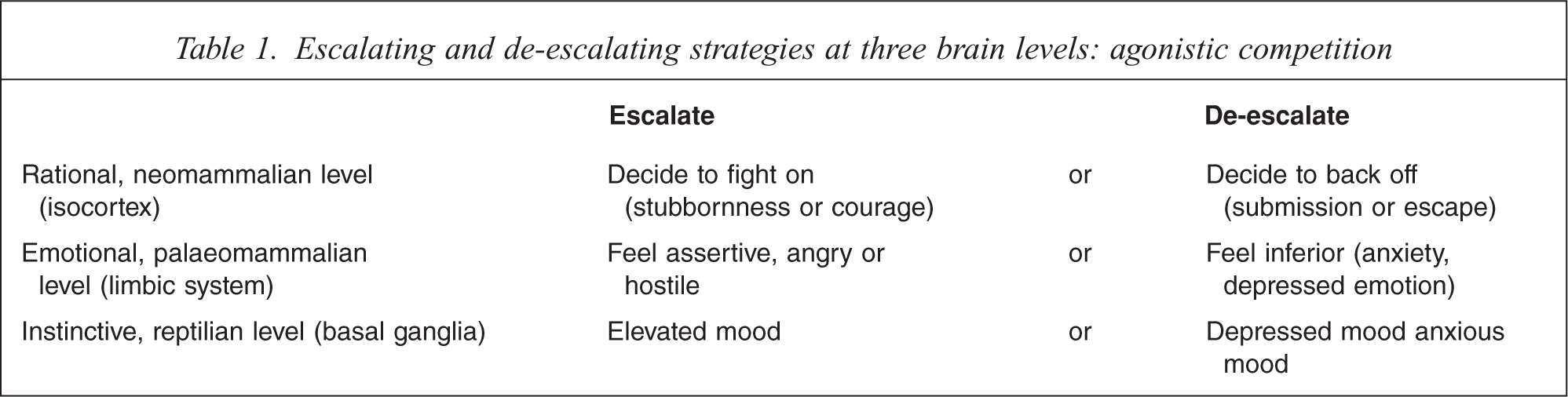
(1) In competitive situations, the alternative strategies of escalation and de-escalation are available to contenders [24,25]. Escalation (based on the fight response) increases the chance of winning but also increases the cost of losing. De-escalation (based on flight and submission) reduces the chances of winning but also reduces the costs of losing.
(2) The strategies of escalation and de-escalation are deployed at each of three relatively independent levels of the forebrain, as described by MacLean [34].
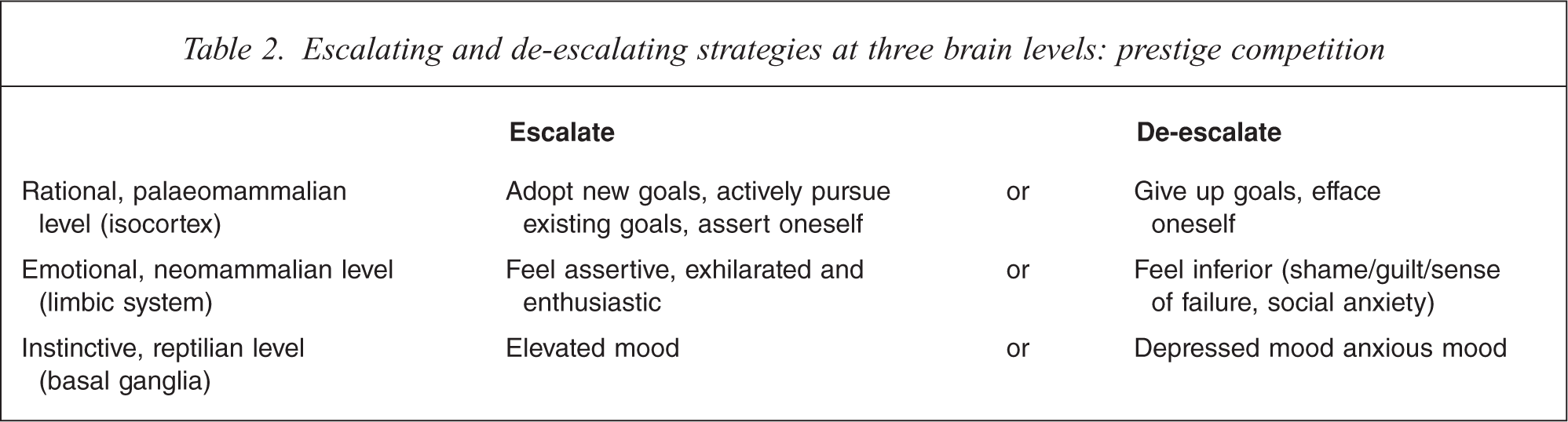
(3) In human social competition, prestige has come to have even more importance than dominance. In prestige competition, one makes oneself attractive to others, who then confer prestige on one, whereas in agonistic competition one makes oneself intimidating to rivals and extracts submission from them. Surprisingly perhaps, the relation of depression to loss of rank has survived the transition to prestige competition, so that loss of prestige remains a cause of the ritual incapacity of depression.
These matters have been described in a number of papers [12,13,35], and there is not sufficient space allocated to this review to spell them out in detail, but they result in Table 1,2, which summarize the outcome of these deliberations, and which we feel are helpful in translating these theoretical matters into clinical practice. Note that escalation and de-escalation differ at the two upper levels of MacLean's triune brain, but at the lower level they are the same.
Escalating and de-escalating strategies at three brain levels: agonistic competition.
Escalating and de-escalating strategies at three brain levels: prestige competition
Agonistic competition at three brain levels
As we have said, decisions to escalate or de-escalate take place either simultaneously or consecutively at all three levels of the triune brain (Table 1).
Mammalian versus reptilian de-escalation
Possibly MacLean's divisions may help us to understand the difference between some forms of depression. The terminology is confusing, and the words mood and emotion have been used in different senses, but here I will use the term ‘depressed emotion’ for de-escalation at the limbic, mammalian level and the term ‘depressed mood’ for de-escalation at the striatal, reptilian level. It is generally agreed that depressed mood is pervasive in that it affects all aspects of social functioning; it is not responsive to environmental change, so that if the situation improves, the depression does not; it is also internally directed, in that those with depressed mood look to themselves and their symptoms as the cause of their distress. Depressed emotion, on the other hand, is not pervasive, in that the person can be distracted from it if attention is drawn to other things; it is responsive to favourable change in the environment, so that a person will cheer up if they realize that, after all, their loved one was not on the flight that crashed; and on the whole those with depressed emotion know what it is in their situation that has made them depressed.
These differences are likely to reflect the different function of depressed emotion and depressed mood. With depressed emotion, some aspect of the environment is seen as unsatisfactory, and an attempt is made to change the situation. This is the message of ‘niche change’ theory, the ‘social navigation hypothesis’ of Watson and Andrews [7] and also the ‘analytic rumination hypothesis’ of Andrews and Thomson [16]. Unrealizable goals are recognized as unrealizable and therefore changed to realizable ones. Pathological relationships are given up and replaced by healthy ones.
With depressed mood, on the other hand, it is not the depressed individual who remedies the situation, but rather the rival with whom the depressed person has been in conflict; with the depressed person out of action the rest of the group can pursue activities and goals that they find attractive, and may have been opposed by the depressed person.
It seems possible that the three agonistic variables of RHP, resource value and ownership are not affected in depressed emotion, but are reduced in depressed mood. Freud noted that the main difference between grief and melancholia was that in grief there is no lowering of self-esteem (a human development of RHP) [36]. In depressed emotion it is only the resource value of the goal to be given up that needs to be reduced, whereas other achievable goals should continue to be attractive. And the loss of ownership and entitlement should apply only to those things that are given up, but not to the other aspects of life that are retained. So we might expect that in depressed emotion, any loss of RHP, resource value and ownership should be item specific and should not show a general reduction.
This difference between depressed emotion and depressed mood may reflect the increased complexity of mammalian over reptilian social life. The group-living mammal needs to negotiate a complex social hierarchy, and its access to rewards depends on its ability to do this successfully. Loss of a single rank may be dictated by circumstances, but there are still those below in the hierarchy who must be controlled, and the response to defeat must therefore be person-specific and not generalized to the whole social group. Although reptiles are known to form social hierarchies, they are not as sophisticated as mammalian hierarchies, and it is likely that the defeated reptile falls to the bottom of the rank order. In some species a defeated animal loses its adult colouring and reverts to a dull pre-adult colouration [37], which must perforce be seen not only by the winner of the conflict but by all members of the group. In mammals such as the vervet monkey, some defeats are limited to one particular rival, suggesting depressed emotion, whereas others are more serious and involve a fall to the very bottom of the social hierarchy, and may be associated with change in the colour of dominance signals [38], and in these cases we might assume that the mammal has developed depressed mood at the reptilian level of its brain. Likewise the human being may develop depressed emotion and feel bad and do something about it, or they may develop depressed mood and feel even worse and do nothing about it.
This approach is consistent with those who emphasize the difference between sadness and clinical depression [39,40]. If emotions become overwhelming they may well cause the patient to go to the doctor, but they are still in a different category from depressed mood. Depressed mood, in contrast, may be very mild, and the patient may not feel the need to go to the doctor at all. Bipolar patients can learn to live with, and even make use of, moderate degrees of elation and depression. One of my patients was an insurance salesman, and when he was elated he saw new prospective clients, when he was normal he saw his old clients, and when he was depressed he stayed at home and caught up on his paper work; but his depression did not feel to him like sadness; rather, when he was depressed, he was unable to feel emotion at all.
Types of depression
Having discussed the difference between depressed emotion and depressed mood, I should point out that there is another evolutionary reason for dichotomizing depression. In a social hierarchy there tends to be constant threat directed down the hierarchy, and this may make the lower ranks depressed, as Schjelderup-Ebbe noted in his hens [41]. This chronic, sometimes lifelong depression may well be similar to human dysthymic disorder, or dysthymic personality [42]. The animal is ‘pecked’ by a superior, and if her submissive signals do not stop the pecking, she is in a situation of ‘learned helplessness’ [43]. Thus depression may function in the maintenance of rank, but it also functions to subserve reversal of rank, in which a more severe form of depression occurs, and this is more likely to come into the psychotic or endogenous category [44]. Schjelderup-Ebbe described rank reversal in an alpha hen, as follows.
If a certain a-bird loses in the fight and has to take refuge in flight, its behavior becomes entirely changed. Deeply depressed in spirit, humble, with drooping wings and head in the dust, it is – at any rate, directly upon being vanquished – overcome with paralysis, although one cannot detect any physical injury. The bird's resistance now seems broken, and in some cases the effects of the psychological condition are so strong that the bird sooner or later comes to grief. This is especially true if the bird has been absolute ruler for a long time, and the reaction has been, therefore, most complete. In most cases, however, time heals the disappointment and the bird becomes used to its new position. [41,45]
Thus, neurotic and reactive depression are likely to be a mixture of severe depressed emotion and mild depressed mood, whereas the psychotic and endogenous depressions are likely to be cases of depressed mood following rank reversal or the modern equivalent. And, of course, some patients may be de-escalating at both the limbic and the striatal levels. Others may be escalating at the limbic level and de-escalating at the striatal level, and these may be seen as ‘mixed states’. All these depressions are probably unrelated to the seasonal depressions, which may have similarities to animal hibernation [46]. They have more in common with post-traumatic stress disorder, which also uses an appeasement strategy as a form of defence [47,48].
Avoidance of revenge killing
Groups of early humans needed to cooperate, because individual survival depended on being a member of a cooperative group [49]. Many mechanisms have evolved to promote friendly working together. One factor that disrupted cooperation was killing of a fellow group member, often followed by revenge killing. The myths of many cultures are concerned with revenge killing, suggesting that it may have been an important factor in human history [50]. Also, in simple hunter–gatherer bands, which may have been the main form of human social organization during the Pleistocene (2 million–10 000 years ago), revenge killing has been observed by anthropologists to be a major cause of homicide, second only to disputes about women [51]. The revenge killing may not be restricted to the murderer himself, but may extend to his relatives, so that a single killing can develop into a feud that may last for generations. Therefore, the resolution of disputes by the ritual incapacity of depression, rather than by wounding and killing, may have been a major contribution to the maintenance of cooperation in these simple hunter–gatherer bands.
Severe depression is without apparent cause, and in fact used to be called ‘endogenous depression’. The patient's ideas are focused on themselves, and if asked why they are depressed they are likely to blame a symptom of the depression like insomnia or pain. They have no hope for the future, often see no future at all, so they are not likely to make plans to remedy the situation. They often have depressive delusions about their past, such that they had no social standing and no resources, so they are not in a mind to try to regain what they have lost. Like a person asleep or a hibernating animal, they have gone into another mode for a fixed period of time, after which they will recover (usually about 6 months) and then the social situation may have changed, or they will find it easier to accept. A further advantage is that they and their relatives do not blame anyone for the depression, because the cause is obscure. This prevents recriminations. This may well be an important factor in keeping the peace in groups of our hominid ancestors. Imagine a group with two factions led by powerful personalities, each with different ideas about what the group should do. If they resolve their differences by fighting, and one kills the other, then the group may be disrupted for years, or even for generations, by revenge killings. But if one of the two develops severe ‘endogenous’ depression, this is likely to be recognized as a physical disease by the group and is not likely to be attributed to the successful rival. So the group is spared recrimination, and in this sense the ritualized incapacity is even more important to human beings than to animals, which do not have the social or cognitive resources to attribute blame and seek revenge. Thus we should not be surprised if the frequency and severity of this ritual incapacity is greater in man than in our nearest relatives.
Giving up unrealizable goals
Edward Bibring was probably the first to point out that depressed patients seem to be clinging on to unreachable objectives [52], and although it is sometimes said to be happier to travel than to arrive, it is reasonable to agree that it is depressing to be always striving and never arriving. It is only a short step from here to postulate, as Klinger did, that the function of depression is to help patients give up unrealizable goals [53]. If the depression is not successful in this, it becomes severe and chronic and so causes the patient to present to the psychiatric clinic. I have seen many patients in the situation described by Bibring, and they are there for a variety of reasons, sometimes courage, sometimes stubbornness, sometimes moral scruples in that they refused to go along with group wrongdoing. It may be that Darwin himself was in this situation in his reluctance to offend his wife and others with his theory of natural selection, and yet reluctant to give up the reward of being the first to publish such a breathtaking theory [54]. This idea is heuristic in that it has given rise to research, which has supported the idea that (among adolescent girls at any rate) depression aids the giving up of old goals, but not the commitment to new goals [55]. Bibring's ideas are consistent with ‘niche change’ theories of depression and the social navigation hypothesis [7], and they apply to de-escalation at the limbic level of the brain.
Other evolutionary theories
Nesse has suggested that the function of mood is to monitor the propitiousness of the environment [5]. When the environment appears propitious, mood is high, there is confidence and a policy of expansion, so that the individual invests more in enterprises. When mood is low there is retraction and inactivity. Thus the individual is able to profit from good times and avoid wasting effort during bad times. This is a very general theory of which the one outlined here can be seen as a subset. When there is an estimation of favourable RHP the mood rises and there is escalation in social relations; when relative RHP is unfavourable, mood is low and there is de-escalation.
The same can be said about Nettle's risk-taking theory [15]. A propitious environment and high mood lead to risk-taking, whereas an unpropitious environment and low mood inhibit risk taking. When things are very bad, however, there is an increase in risk-taking on the ‘nothing more to lose’ principle. This is consistent with the theory of interpersonal competition: high mood is associated with escalation, which is risky; low mood is associated with de-escalation, which is not risky; and in very bad interpersonal situations in which submission has failed to stop aggression, there appears a different form of risky aggression that Moyer called ‘defensive aggression’ and which is seen in the cornered animal who has nothing to lose [56].
Ours is a social theory [13]. It sees the depressive state as a form of unconscious consent to being put in a social role in which resources are enjoyed by other people. To go back to Darwin, when some are selected and some are not, whose responsibility is it to ensure that the unselected remain unselected? Darwin said that the selected ‘drive away’ the unselected, but if they do not kill them, what is to prevent the unselected from coming back? It clearly has not been evolutionarily stable for the selected to spend a lot of effort standing guard all the time, so the responsibility has been placed on the unselected to ensure that they remain unselected, and, in ways that the game theory used by behavioural ecologists can explain, the unselected have developed an internal referee that ensures that they remain unselected, and this referee can be seen as a ritualized form of the death that the selected might have, but have not, inflicted on them. This system leaves the unselected in a state of relative psychological incapacity for a considerable part of their lives, but it has proved, over the course of evolution, more advantageous than having them dead.
Conclusion
Evolutionary statements tend to be unfalsifiable, and therefore are regarded by many as unscientific. The statement that depressive states evolved as a ritual form of death or incapacity has a different logical status from the statement that depressed patients have low serotonergic activity in their brains. The ‘just so’ stories, however, of evolutionary psychiatry are useful in both clinical work and research. We should treat them as what Karl Popper called ‘useful myths’ [57]. One would like to know how the leopard got its spots, and in speculating on the theme we might make useful discoveries about vision, camouflage and predator–prey relations.
There is also a relevance to research on mood change. By situating the control mechanism for depression in the reptilian part of the forebrain we can suggest that reptiles would make good subjects for depression research. Their brains are simpler than those of mammals and their visual communications are easier to study than the largely olfactory communications of rodents. We know that they show behavioural change similar to human depression when they are defeated in ritual combat [37]. And yet PubMed cites over 600 papers describing depression research in rodents, while the number of papers describing depression research on reptiles is zero. One paper on patients suffering from obsessive–compulsive disorder (OCD) found changes in the striatum similar to the changes seen during submissive behaviour in reptiles [58], and this may well have been because OCD patients are often depressed. Stevens and Price described the enormous waste of time and effort that has occurred in research on the expression of hostility in depression, due to the failure to take account of the object of the hostility by investigators who were apparently unaware that to direct aggression up the hierarchy is a very different matter from directing it down the hierarchy [4].
We have noted that ethologists, while describing the ritualization of agonistic behaviour so vividly in so many species, and the signals of submission that terminate an encounter, have not considered the ritualization of the incapacity that results from non-ritualized combat. This may be due partly to our natural inclination to attend to winners rather than losers and partly because depression is difficult to see in animals, being characterized by the absence rather than the presence of certain behaviours. Apart from very severe cases, even hospitalized depressed patients look fairly normal while going about their day-to-day business.
We have been accused of emphasizing the importance of competition at the expense of sexuality and affiliation. De Block [59] described Freud's views, who based his evolutionary speculations on the effect of the ice-age on sexuality, and Bowlby was rightly concerned with the importance of attachment for good human development [60], but if these theorists had had at their disposal the knowledge that we now have of animal behaviour and evolutionary theory, they might well have concerned themselves more with the problems of interpersonal competition, which has been important in evolution for hundreds of millions of years, antedating the evolution of the family and complex sexual relationships [49]. Sexuality and affiliation are of vital importance to mankind, but we would suggest that they were grafted onto already existing mechanisms for managing social symmetry and asymmetry.
Summarizing the theme of this paper, the adaptive function of the capacity for mood change has been the creation and maintenance of asymmetry in relationships. This can be conceptualized at a number of different levels. Social asymmetry is predicted by Darwin's theory of sexual selection: who is selected and who is not; who, having been selected, is then de-selected? Social asymmetry is observed at the structural level of social hierarchy and territory: who is up and who is down, who is going up the hierarchy and who is going down; who has gained a territory and who has lost one? Social asymmetry is created at the level of ritual agonistic behaviour: who has won and who has been ritually defeated? Social asymmetry is maintained in the population because it is an evolutionarily stable strategy according to the game theory models of behavioural ecologists. No one wants to be unselected, or low ranking or defeated; these undesirable social roles can be made acceptable at the highest brain level with humility or at the lowest brain level with depressed mood.
The classical scientific approach is to look at what is in front of us, to describe it, classify it and try to explain it. The evolutionary approach is to ask what we should expect to find, using evolutionary theory and basic sciences such as comparative ethology and behavioural ecology. In this paper I have tried to formulate what we might expect to find in the case of depressed emotion and mood, in the hope that it might help to analyse the very complex array of data that we find in front of us. Ideally, the two approaches should be used together and, if they were, there would be no need for such a thing as evolutionary psychiatry.