




Abstract
There was concern during the 1990s in Australia and around the world about increasing suicide rates. There has been a steady decline, however, since 1997 [1]. The unadjusted Australian national rate fell from 14.7 per 100 000 in 1997 to 9.1 in 2006 [2]. There had been particular concern regarding an increase in the suicide rate of young people, but a decline for this group has also been reported [3,4]. In contrast, the suicide rate in the Northern Territory (NT) was continuing to rise as recently as 2002 [5].
The Australian Bureau of Statistics (ABS) reported that in 2006, the NT had a suicide rate of 13 per 100 000 (male, 22.1; female, 3.6), the second highest rate (Tasmania having the highest) in the country [6]. A consistent finding in Australia has been a higher rate of suicide in rural compared to urban areas (particularly among young male subjects). Unlike the other states of Australia, 44%% of the NT population lives in rural areas [7]. Also, the NT population is younger than the rest of the country; the 2006 Census gave a median age for NT of 31 years, and for Australia, 37 years.
NT has a high Indigenous population. The 2001 Census found the NT Indigenous population comprised 25.1%% of the total population, while for Australia the Indigenous population comprised <4.0%% of the total population. Indigenous Australians are believed to have a relatively high suicide rate, although the quality of data has not allowed an unequivocal statement. The life expectancy of Indigenous Australians is approximately 17 years less than that of the general Australian population [8], which has been attributed to social, educational and material (among other) disadvantages.
Many Indigenous populations, although not all [9], are experiencing higher suicide rates compared to respective dominant cultures. Examples include the Maori of New Zealand 1995 [10,11], the First Nations and Inuit of Canada [12] and the Inuit of Greenland [13]. In all these Indigenous groups, very high rates have been reported among the young.
With respect to Indigenous Australians, the available (limited) evidence suggests that prior to contact with the West, suicide was either unknown or very rare. Rapid social transformations, however, occurred in the late 1960s, and appear to have resulted (commencing some 15 years later) in a rapid increase in suicide [14].
Due to technical and administrative difficulties, combined with low numbers and wide geographical distribution, the quality of suicide statistics for Indigenous Australians is somewhat lacking. In 2006, national figures indicated that suicide accounted for 4.9%% of all Aboriginal deaths, compared with 1.8%% of Australian deaths (suggesting death by suicide was more than twice as common among Indigenous people). In 1988–1998, in the States of Western Australia and South Australia and the Northern Territory, suicide rates was calculated to be 17 per 100 000 for the Indigenous and 13.3 for non-Indigenous people [15].
The aim of the present study was to characterize suicide in the NT for the 6 year period 1 January 2001–31 December 2006.
Method
Suicide data were obtained from the National Coroners Information System (NCIS) through the Victorian Institute of Forensic Medicine for the years 1 January 2001–31 December 2006, regarding suicide deaths of the people of Australia and the people of NT, with respect to Indigenous status, sex, age, and method of death. This was provided as raw figures.
The NCIS database contains case detail information from the coro-nial files of all Australian States and Territories. Because these data are drawn from Coroner findings, only those deaths meeting the legal definition of suicide are included. This is a thorough, standardized process. At particular times some cases are necessarily omitted because the process of reaching findings is a staggered affair. For the current exercise, all suicides occurred at least 2 years from the time of writing. Nevertheless, there is a small degree of underreporting. In some jurisdictions the Indigenous status demographic is not a standard item, thus NCIS reports ‘unknown’ for this item in up to 15%% of cases. This is not the case in the NT, however, and the Indigenous status is only ‘unknown’ for other parts of the country. Other systems may yield different results, but differences can be expected to be small.
For each year, we obtained the entire populations of NT and Australia from the ABS [6], the Aboriginal and Torres Strait Islander Australians population [16], and the regional statistics of NT for subcategory populations [7]. Death by suicide, and sex and Indigenous status differences were calculated for the period 2001–2006. Adjustments were made to cater for population differences. Poisson regression analysis was used to estimate average annual changes in suicide rates. The data were analysed using SPSS version 15.0 (SPSS, Chicago, IL, USA).
Because the numbers for the NT are small and variable, an overall suicide rate for the entire period (2001–2006) was calculated. For comparison purposes, similar overall rates were also calculated for Australia.
Results
Overall suicide rate in Australia and NT for 2001–2006
Table 1 illustrates the number of suicides in Indigenous and non-Indigenous populations in NT and Australia. For the period 2001–2006 the overall suicide rates of NT was 21.6 per 100 000 population, which was nearly twice the national rate of 11.0 (p, 0.001). In NT the rate of suicide in the Indigenous population (36.7) was significantly higher than non-Indigenous people (14.7) over this 6 year period (p, 0.001), with a death ratio for Indigenous to non-Indigenous of 2.88:1.
Suicides vs Indigenous status and location (2001–2006)
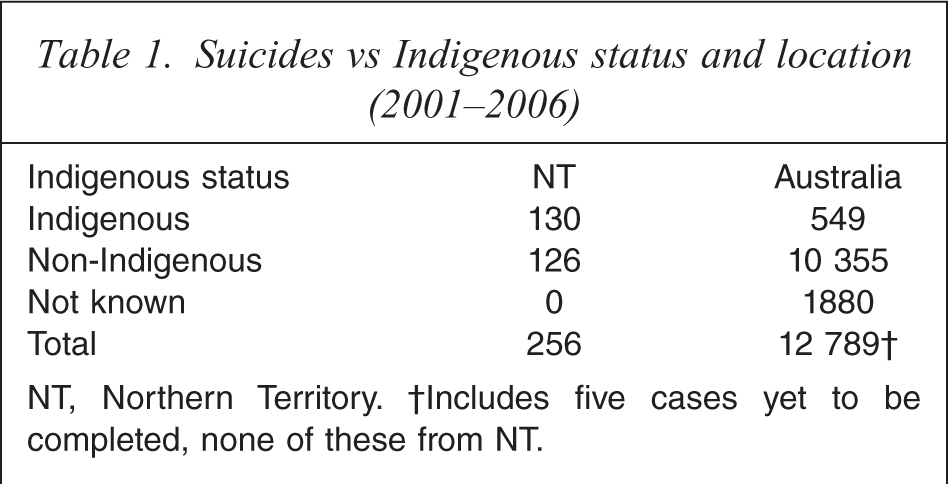
NT, Northern Territory. †Includes five cases yet to be completed, none of these from NT.
Annual rates of suicide in Australia and NT
Suicide rates of Indigenous and non-Indigenous populations in NT for each year during 2001–2006 are presented in Table 2 along with national suicide rates in the same period. During this period the overall rate of suicide decreased significantly both for Australia and NT, with annual average reductions of 28.6%% (95%% confidence interval (CI) 5 213.1 to 24.0%%, p, 0.001) for Australia and 26.3%% for NT (95%%CI 5 29.5 to 23.1%%, p, 0.001).
Suicide rates vs Indigenous status and location (2001–2006): no. deaths per 100 000 population
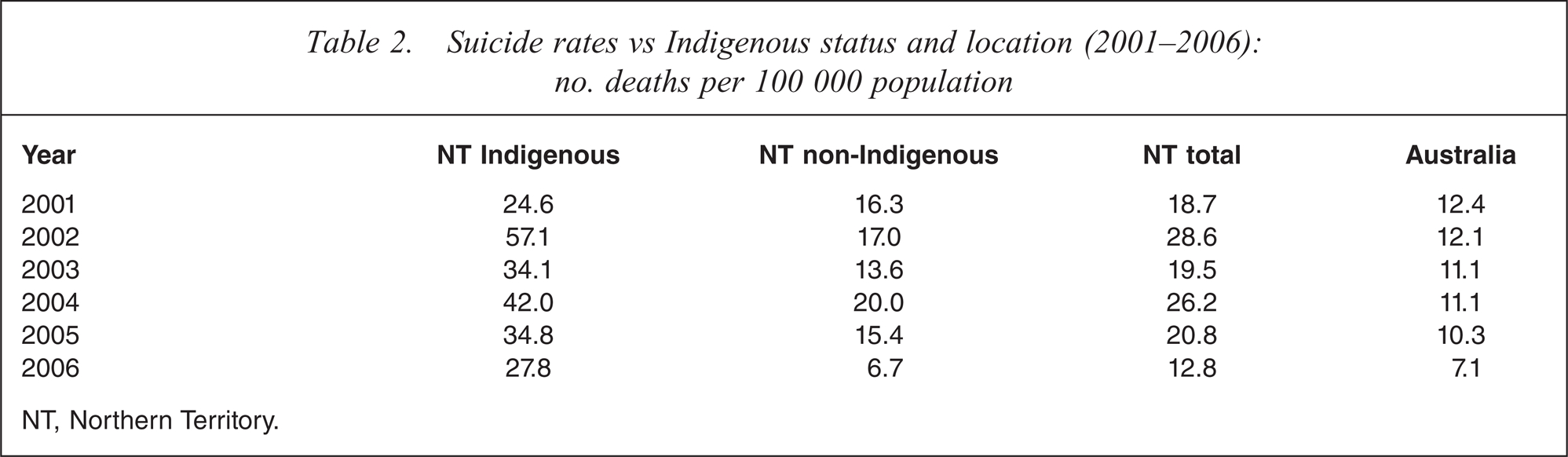
NT, Northern Territory.
Annual rates of suicide by Indigenous status in NT
In NT, suicide rates of Indigenous and non-Indigenous populations sig-nificantly decreased over time, with annual average reductions of 23.3%% (95%%CI 5 25.8 to 20.9%%, p 5 0.007) for Indigenous and 29.0%% (95%%CI 5 212.9 to 25.1%%, p, 0.001) for non-Indigenous populations (Figure 1).
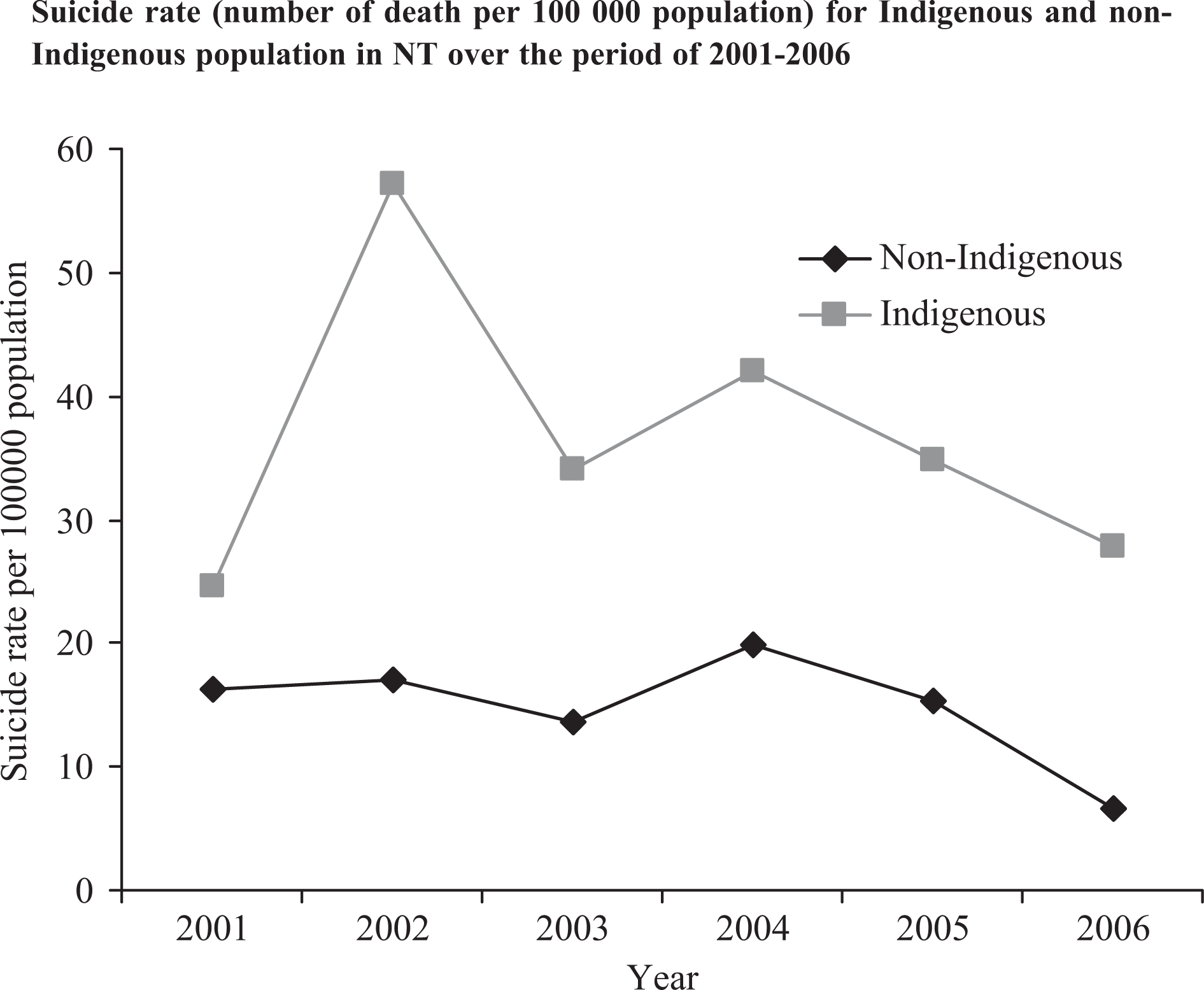
Suicide rate (no. deaths per 100 000 population) for (□) Indigenous and (♦) non-Indigenous people in the Northern Territory for 2001–2006.
Suicide rate by sex in Australia and NT
During 2001–2006 the population-adjusted ratios show that the overall suicide rates for male subjects were significantly higher than that for female subjects both in Australia and NT. In Australia the rate for male subjects was 17.4 per 100 000, which was nearly fourfold more than the rate for female subjects (4.81; p < 0.001). In NT the difference was more pronounced; the male suicide rate was 36.6 per 100 000 and the female suicide was 5.3 per 100 000 (p < 0.001), with a death ratio for male to female of 6.97:1.
Age-specific suicide rates in Australia and NT
Table 3 shows that for the national population, the highest ratio of suicide was in the 25-34 year group. A high rate for this age category was also observed in NT, but here the 15-24 age group had a similar suicide rate to the 25-34 year group. For Australia, the category 25-54 years had a higher suicide rate than other age categories (p < 0.001). For NT, the category 15–44 years had a higher suicide rate than other age categories, except the 65-74 age group (p < 0.001).
Suicide rates vs age: no. deaths per 100 000 population
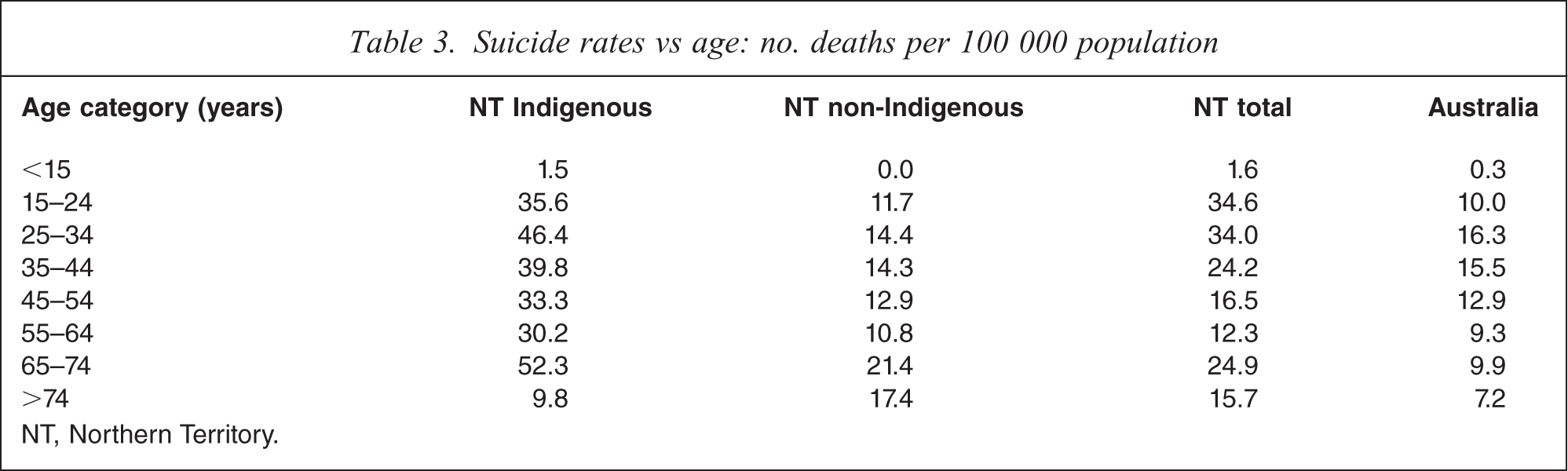
NT, Northern Territory.
Age-specific suicide rates by Indigenous status in NT
For NT non-Indigenous people, with respect to age, there was a bimodal distribution (p < 0.001). The categories 15-54 and >65 years being higher than the categories >15 and 55-64 years (Table 3). For the Indigenous population there was no statistical evidence of a bimodal distribution.
Manner of death
For the period under consideration, hanging was the most common method, accounting for 44%% of Australian suicides and 74%% of NT suicides. Thus, the preference for hanging was stronger in the NT. The second most common method for Australia was carbon monoxide poisoning (16%%), and for the NT, firearm (9%%).
Table 4 provides details of method of death according to jurisdiction and Indigenous status. Hanging occurred in 87%% of NT Indigenous suicide. This was slightly higher than occurred in Australia Indigenous suicide (80%%), markedly higher than non-Indigenous suicide in the NT (60%%) and double non-Indigenous suicide in Australia (42%%). Hanging was the most common form of suicide for all groups, and was remarkable in Indigenous suicide in both NT and Australia.
Suicides vs manner of death, jurisdiction and Indigenous status
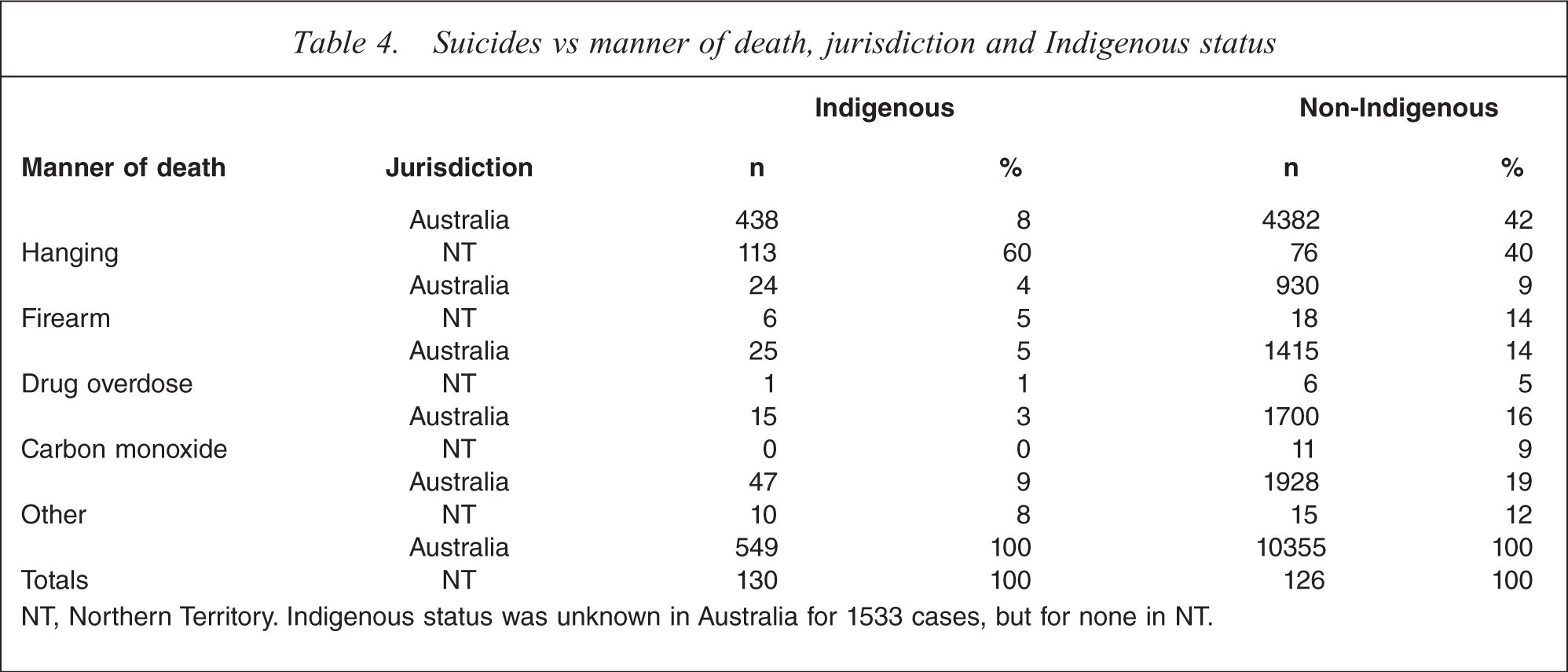
NT, Northern Territory. Indigenous status was unknown in Australia for 1533 cases but for none in NT.
Carbon monoxide poisoning was not found in the NT Indigenous suicide, and in only 3%% of non-Indigenous NT suicide. This was lower than occurred in Australia Indigenous suicide (9%%) and non-Indigenous Australia suicide (16%%).
Firearm death was more common in non-Indigenous NT (14%%) than Indigenous NT suicide (5%%). For Australia, the numbers were slightly lower: non-Indigenous = 9%% and Indigenous = 4%%. Thus, firearm suicide is more common in NT than Australia.
Drug overdose was less common in NT (Indigenous, 1%%; non-Indigenous, 5%%), than Australia (Indigenous, 5%%; non-Indigenous, 14%%).
Discussion
As with all suicide studies, a limitation of the present study is the quality of the data. We believe that NCIS provides the best NT suicide data available at the present time. Another limitation is that the time period studied is short (6 years). NCIS, however, is recently established and this was the full period for which data are currently held.
De Leo suggested that the recent nationally reported decrease in suicide rate may be an artefact of the current ABS reporting process, and drew attention to recent increases in figures for death by accident and ill-defined death (ICD10 R00-R99), which have coincided with the reported decreases in suicide rate [17]. The current study uses NCIS suicide data.
For the period 2001–2006 the overall suicide rate for Australia was 11 per 100 000 and for NT 21.6 per 100 000, indicating an NT rate of double the national average. In NT the rate for non-Indigenous people was 14.7 per 100 000 (which is above the national rate), and for Indigenous people, 36.7 per 100 000, suggesting a rate 2.5-fold the national average.
There has been global evidence of decreasing suicide rates since 1997, and this has also been reported in Australian. This was not observed by Measey et al., who studied a period of two decades [5]. The present shorter study (6 years), however, suggests a decline over the period 2001–2006. This may be due to the anomalously high figure in 2002 and the anomalously low figure in 2006 for non-Indigenous population. Methodological differences (including that Measey et al. [5] used ABS and local coroner's office reports, and we used NCIS data) render strict comparisons of these studies problematic. Should future studies support the present findings, however, this may indicate that the relative isolation of NT led to the delay in the arrival of a social trend.
Measey et al. found significantly more suicides among male subjects compared to female subjects for both the non-Indigenous and Indigenous populations [5]. We did not examine NT suicide by sex and Indigenous status. The opinions of clinicians working in the field for the period 2000–2006, however, strongly suggest this relationship has remained.
The present finding that the peak in the suicide rates may occur earlier in Indigenous compared to non-Indigenous people could not be fully explored because of small numbers. This observation needs further study.
With respect to age, the results should be interpreted with caution because the suicide number for subjects under 15 years is extremely low and the number of subjects older than age 65 years is also very small. The suicide rates for NT non-Indigenous people followed a bimodal distribution, with a second increase with older age. This is in accordance with the bimodal distribution commonly reported in UK, USA and Australia [18]. With respect to NT Indigenous suicide, we found no statistical evidence of a bimodal distribution, which is consistent with reports of suicide of the Maori of New Zealand [11] and First Nations of Canada [19].
Hanging was the mode of death in 74%% of all NT suicides, and 87%% of NT Indigenous suicides. Firearm and carbon monoxide poisoning, the other major methods used in Australia were infrequent among NT Indigenous suicide (5%% and 0%%, respectively). Presumably, this reflects availability. This is important information and may be useful in discussions aimed at prevention.
The present report, which examines suicide in NT for the 6 year period 2001–2006, draws on high-quality information provided by NCIS. It focuses attention on the high rate of suicide in NT, especially among the Indigenous population. This group comprises 26%% of the total NT population, but provides 51%% of the completed suicides. Hanging (particularly among the Indigenous population) is more commonly used in NT than the rest of the country. It is encouraging to learn of evidence suggesting a decrease in the rate of NT suicide (both non-Indigenous and Indigenous populations), but there is much to be done to bring the NT suicide rate down to the national average (and hopefully below).