




Abstract
Video games are used internationally by millions of people from diverse backgrounds. Advances in technology have meant that gamers may immerse themselves in increasingly realistic virtual worlds. For many, these worlds provide an alternative to the limitations of everyday life. For a significant number, escape into virtual reality becomes a compelling experience worth sacrificing considerable periods of time as well as real world activities and responsibilities. Media reports have highlighted individual cases of mental illness, physical exhaustion, and even death associated with prolonged use of video games [1]. Incidents such as these are emphasized by self-help websites run by video gamers themselves attesting to the addictive nature of certain games (www.wowdetox.com, www.gamerwidow.com). Some investigators and mental health professionals have responded by suggesting that video game and Internet addiction should be formally recognized as mental disorders [2–4]. There is currently, however, a lack of clear criteria for identifying excessive (or problem) video game use. In addition, it seems that only some types of video games, especially online games, have a greater potential to be played for extended hours or to be associated with problem use [4–8].
The present study, conducted as an anonymous online survey, arose from a need to address some of these issues. Its main aim was to identify individuals with problem video game use on the basis of relevant information provided by these individuals and criteria that we have developed. The second aim was to compare individuals with and without problem video game use in terms of the demographic data, patterns of playing, use of alcohol, caffeine, and other substances, and other characteristics (e.g. social interaction style). Finally, we aimed to ascertain in a preliminary way whether our provisional criteria for problem video game use have some validity.
Previous research and interactions with individuals with problem video game use have led us to hypothesize that problem video game use could be distinguished on the basis of (i) preoccupation with and craving for playing video games, negative emotional reactions to the abstinence from playing, and loss of control over playing; and (ii) various detrimental consequences of playing video games [4,6,9]. We also hypothesized that problem video game players were more likely to use certain types of games, such as massively multiplayer online role-playing games (MMORPGs) and that they played longer than individuals without problem video game use. This hypothesis was based on the findings that users of role-playing games were significantly more addicted than users of other games [7], that MMORPG users had a tendency to spend much more time playing than non-MMORPG players [4], and that there was a positive correlation between the amount of time spent playing an MMORPG game and the likelihood of problematic usage of the game [6].
Methods
Concepts, criteria, and instruments
We conceptualize problem video game use as excessive use of one or more video games resulting in a preoccupation with and a loss of control over playing video games, and various negative psychosocial and/or physical consequences. We did not conceptualize problem video game use as an addiction because it is controversial as to whether addictive video game use exists [10–13]. We acknowledge, however, that there is an overlap between our concept of problem video game use and that of video game addiction.
With the goal of identifying problem video game users, we have developed provisional criteria for problem video game use (Table 1). These criteria are based on the concept of ‘behavioural addiction’ [14,15], DSM-IV-TR criteria for substance dependence and pathological gambling [16], previous research in this area [4,6,9], the relatively specific aspects and consequences of excessive video game use, video gamer testimonies from online sources (www.wowdetox.com, www.gamerwidow.com), and interviews with video game players encountered in the authors’ clinical practice. We chose these criteria because they reflect what we and others believe to be the crucial features of problem video game use: preoccupation with and craving for playing, reaction to the abstinence from playing in the form of restlessness or irritability, and loss of control over playing (‘preoccupation criteria’), as well as multiple adverse consequences of excessive video game playing (‘adverse consequences criteria’) [4,6,9,11–13,17]. The latter include interference with school or work performance, significant relationships and social or recreational activities, financial difficulties, reduced sleep, weight change, and sore eyes, back pain or other physical problems.
Provisional criteria for problem video game use
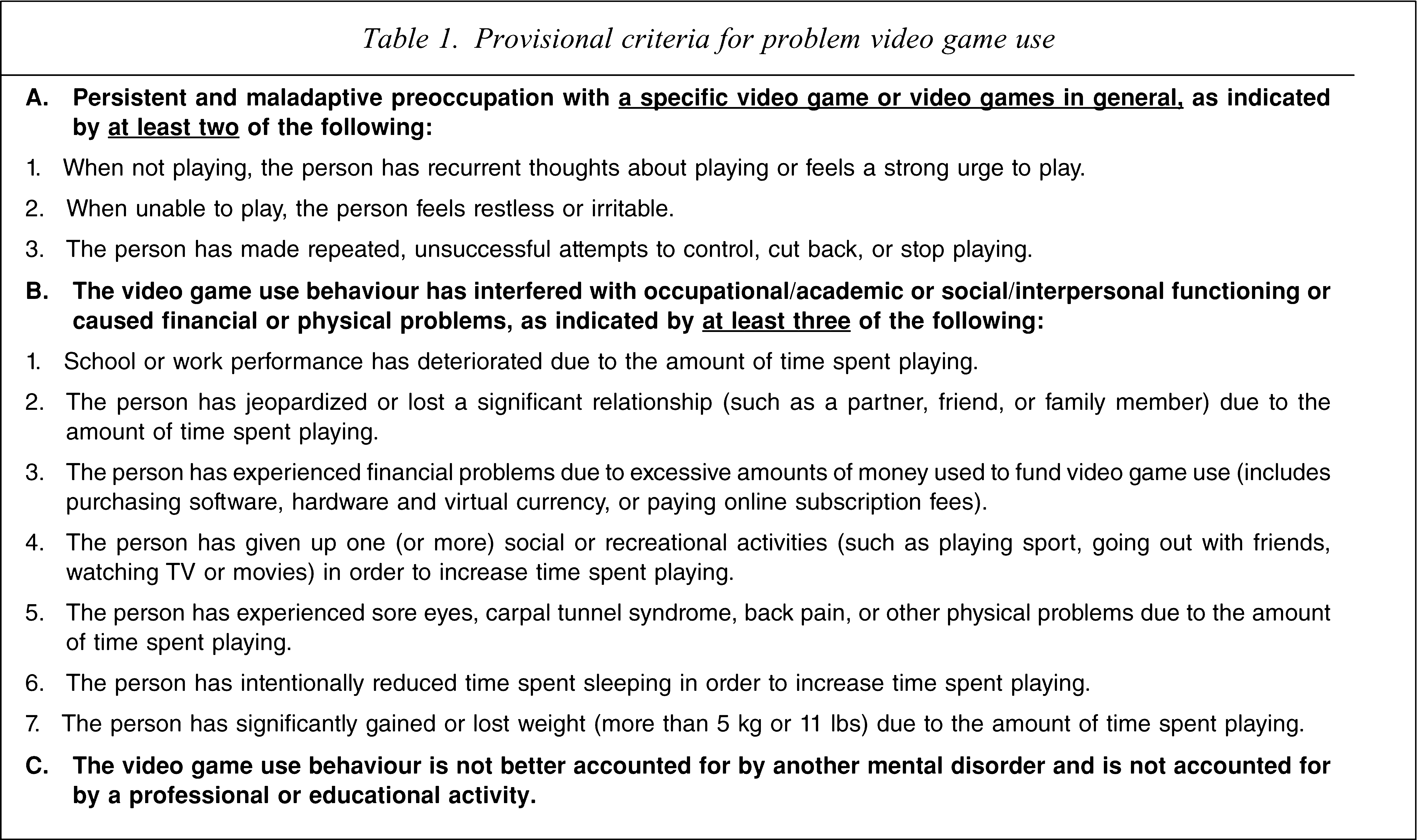
Developing criteria for identifying problem video game users required that we impose the cut-offs; we decided that the criteria are met if participants endorse at least two out of three preoccupation criteria and at least three out of seven adverse consequences criteria (Table 1). The rationale for choosing these particular cut-offs was in our endeavour to balance between setting the thresholds too high (and therefore risking to have too many false negatives) and setting the thresholds too low (and then risking to have too many false positives). Although the primary purpose of our criteria was to identify problem video game users, which implied that the main task was to minimize the number of false negatives, we also took care not to set the cut-offs too low. Because there is no way of independently verifying the true number of false negatives and false positives among the survey participants, our choice of the cut-offs remains to be validated.
Our criteria for problem video game use did not include other features usually associated with dependence or addiction, such as tolerance and physical symptoms of withdrawal, because there is no clear evidence that problem video game use is associated with these phenomena [9,12].
A 33-item video game use questionnaire (VGUQ) was constructed for online administration. Its primary purpose was to identify problem video game use on the basis of the provisional criteria that we have adopted. Therefore, it included questions with dichotomous yes/no responses that covered all 10 criteria listed in Table 1. Second, the VGUQ included six questions that were not a part of the criteria for problem video game use but covered the frequency and usual duration of playing video games (‘How often do you play video games?‘; ‘On average, how many hours per day do you spend playing video games?‘), salience of this activity (‘Do you feel that playing video game(s) has become so important that you can hardly imagine your life without it?‘), and various aspects of the loss of control over video game playing (‘Do you usually end up playing longer than planned?‘; ‘Do you often play even though you don't want to?‘; ‘Do you often play despite knowing that you shouldn't do it (for example, when you have other important things to do)?‘). The questions about frequency and duration of gaming activity could not serve as criteria for problem video game use because of the unknown cut-off that might separate people with problem video game use from those without such use; but people with problem video game use are expected to play more often and longer, so that greater frequency and duration of playing could validate in a preliminary way the criteria by means of which problem video game users have been identified. Likewise, the questions about salience of playing video games and other aspects of the loss of control over this activity, although used to preliminarily validate the criteria for problem video game use, did not serve as criteria for such use because of the need to make the criteria relatively simple and have no more than one item to refer to the criterion of the loss of control. As a criterion for the loss of control, we decided to use the item derived from the DSM-IV-TR criteria for substance dependence and pathological gambling (‘The person has made repeated, unsuccessful attempts to control, cut back, or stop playing’).
The VGUQ was also administered to obtain information on the following: basic demographics, other aspects of video game use (number and type of games played), structuring of free time when not playing video games, online and offline socializing, and alcohol and other substance use. After completing the VGUQ, the participants were asked to complete an online version of the Symptom Checklist 90 [18], a measure of overall distress and several dimensions of psychopathology. Results obtained from the administration of the Symptom Checklist 90 will be reported elsewhere.
Administration of the survey
The survey was administered using a professional online survey software program (www.questionpro.com). The website of the University of Sydney Nepean Clinical School, Penrith, Australia (www.nepean.med.usyd.edu.au) hosted the link to the survey. Participants were recruited from a wide range of English-speaking Internet video game forums over a 4 month period. In order to ensure that a diverse range of video gamers took part, the advertisement for the survey was posted in 53 different forums, covering multiple game genres (MMORPGs, first-person shooters, strategy games, sport games, and simulation games). Most forums were based in Europe, Australia, and the USA. On completion of the live survey period, the link to the survey was terminated and results were collated.
The survey was open to individuals aged ≥ 14, with a good understanding of English. Participants between 14 and 18 years of age needed to have parental consent. Participants were not offered any reward for completing the survey. Names of participants and contact details such as email addresses were not recorded to ensure complete anonymity. The survey software program, however, registered a digital signature for each participant to prevent multiple responses from the same computer. Ethics committee approval for the study was granted by the University of Sydney prior to the commencement of the survey.
Analyses
Two-tailed χ2 analyses were conducted using the SPSS version 15.0 (SPSS, Chicago, IL, USA) to compare the proportions of participants with and without problem video game use. Given many null-hypothesis significance tests conducted, a more stringent type-one error rate of 0.001 was used to determine statistical significance.
Results
Of 2396 participants who commenced the survey, 451 (18.8%) discontinued before the end, leaving 1945 participants (81.2%) who completed the survey. There were no statistically significant differences between completers and non-completers on any of the variables available for comparisons. Consequently, all subsequent analyses are based on the 1945 participants who completed the survey.
Findings of the study are presented in Tables 2–6. Most of the participants were male (92.6%), under 30 years of age (87.5%), and from the USA, Canada, Europe, Australia, or New Zealand (96.8%). Almost one-half (48.4%) of all participants spent 1–3 h per day playing video games, and approximately one-third (32.9%) spent 4–8 h per day doing so. The majority reported playing video games every day (62.1%), playing longer than planned (59.8%), and playing despite believing that they should not do it (52.0%).
Demographic characteristics of survey participants with and without problem video game use
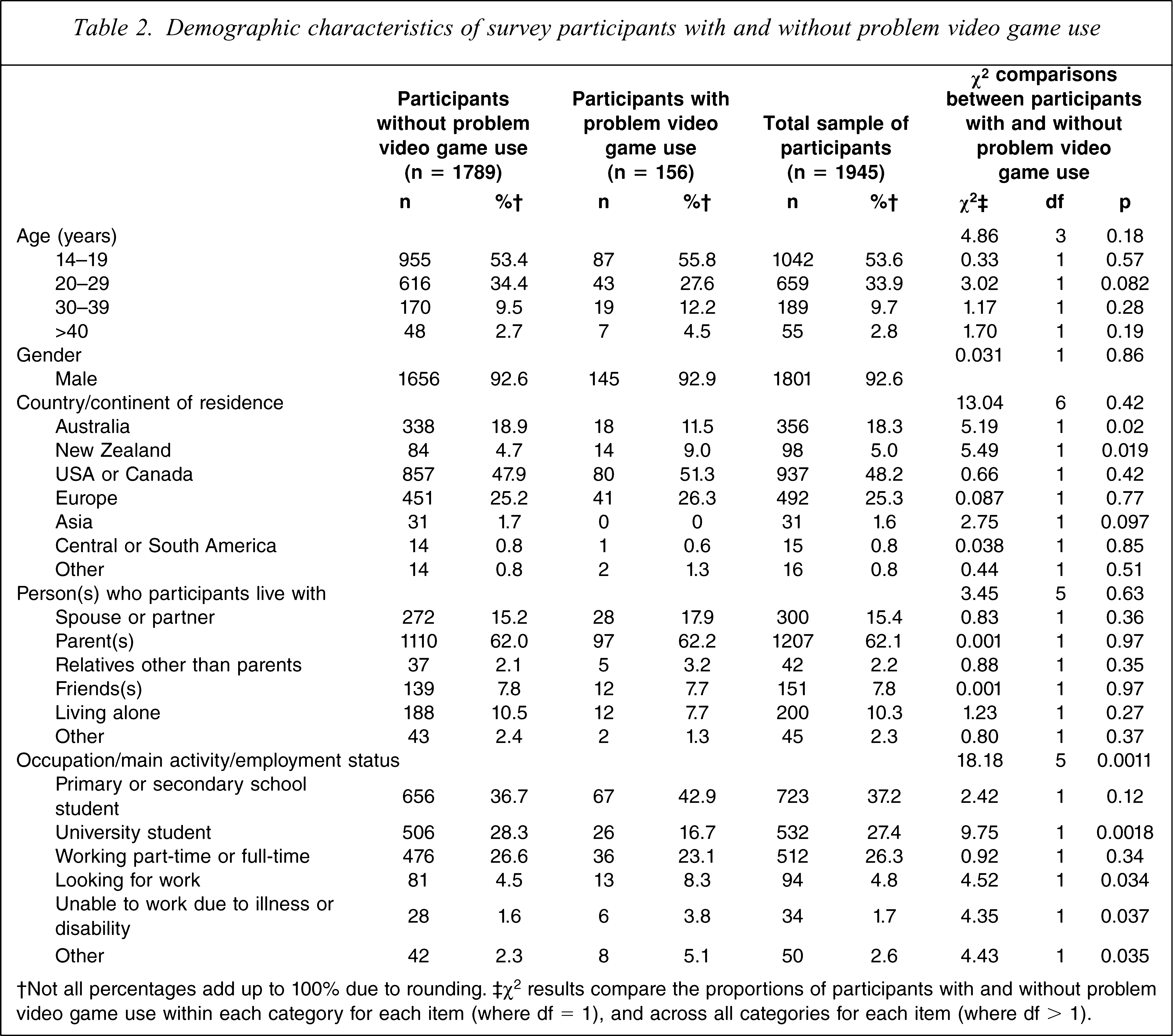
†Not all percentages add up to 100% due to rounding. ‡χ2 results compare the proportions of participants with and without problem video game use within each category for each item (where df = 1), and across all categories for each item (where df > 1).
Patterns of video game use in survey participants with and without problem video game use
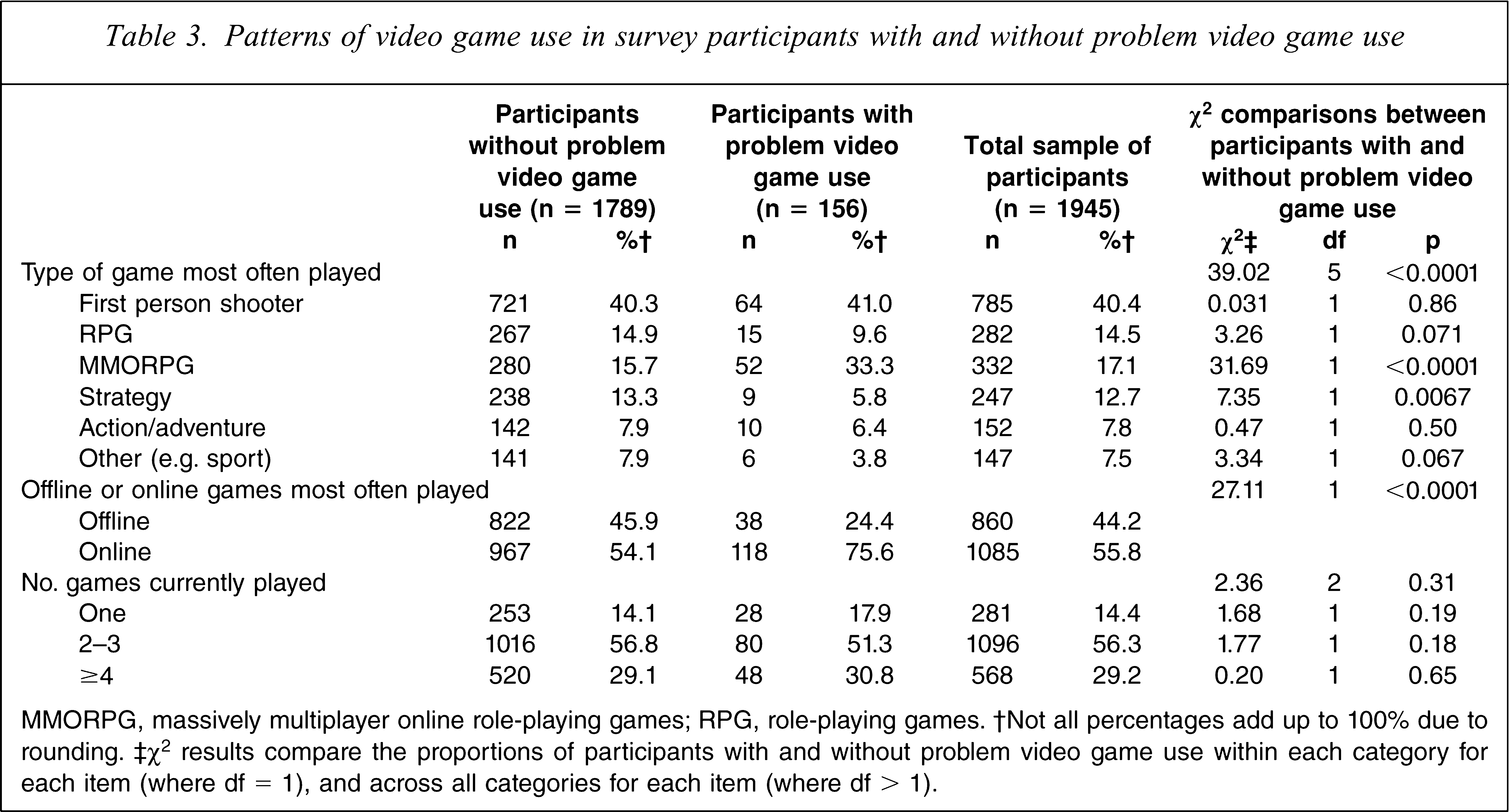
MMORPG, massively multiplayer online role-playing games; RPG, role-playing games. †Not all percentages add up to 100% due to rounding. ‡χ2 results compare the proportions of participants with and without problem video game use within each category for each item (where df = 1), and across all categories for each item (where df > 1).
Other characteristics of survey participants with and without problem video game use and their patterns of substance use
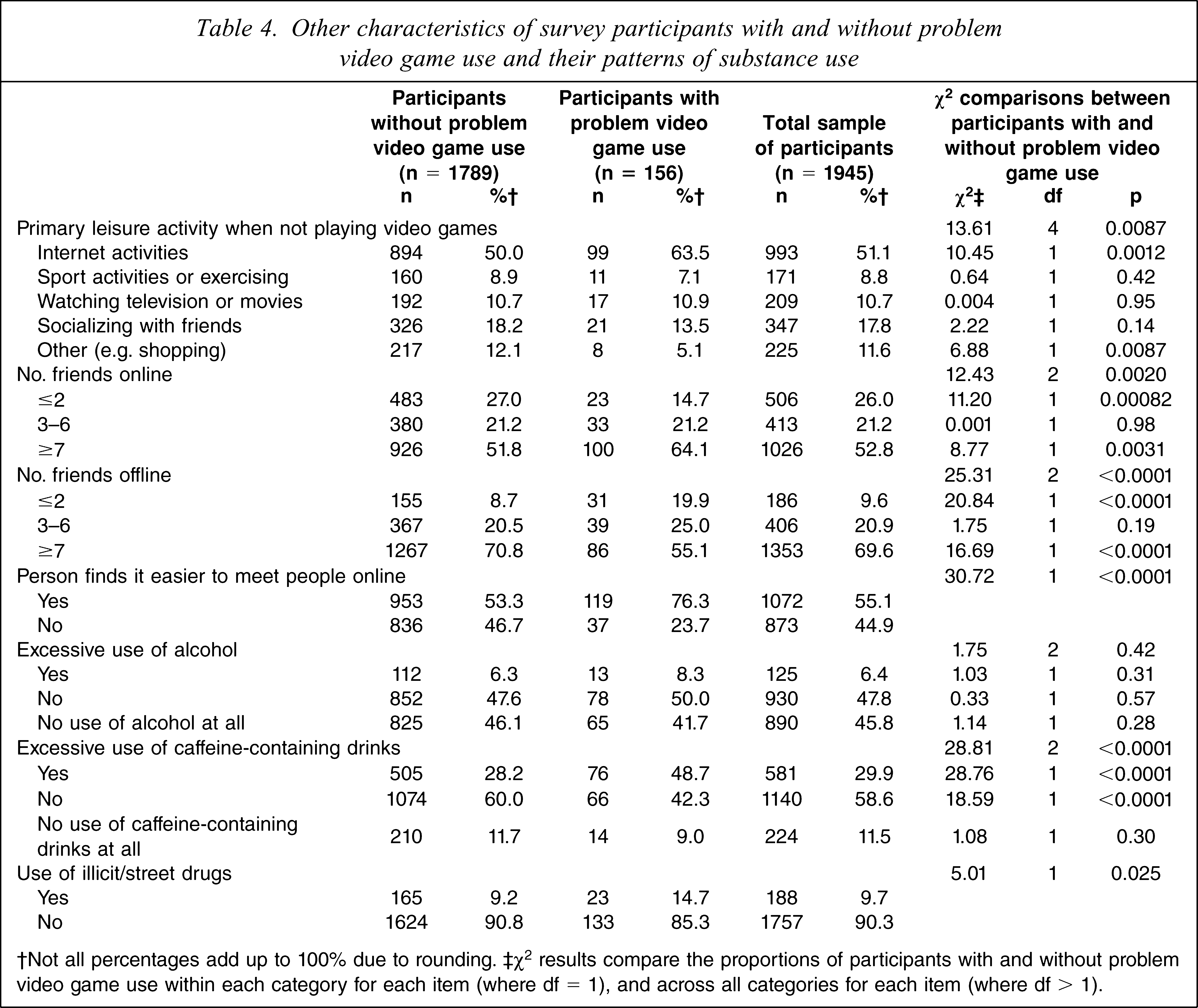
†Not all percentages add up to 100% due to rounding. ‡χ2 results compare the proportions of participants with and without problem video game use within each category for each item (where df = 1), and across all categories for each item (where df > 1).
Endorsement of items for preliminary validation of the criteria for problem video game use
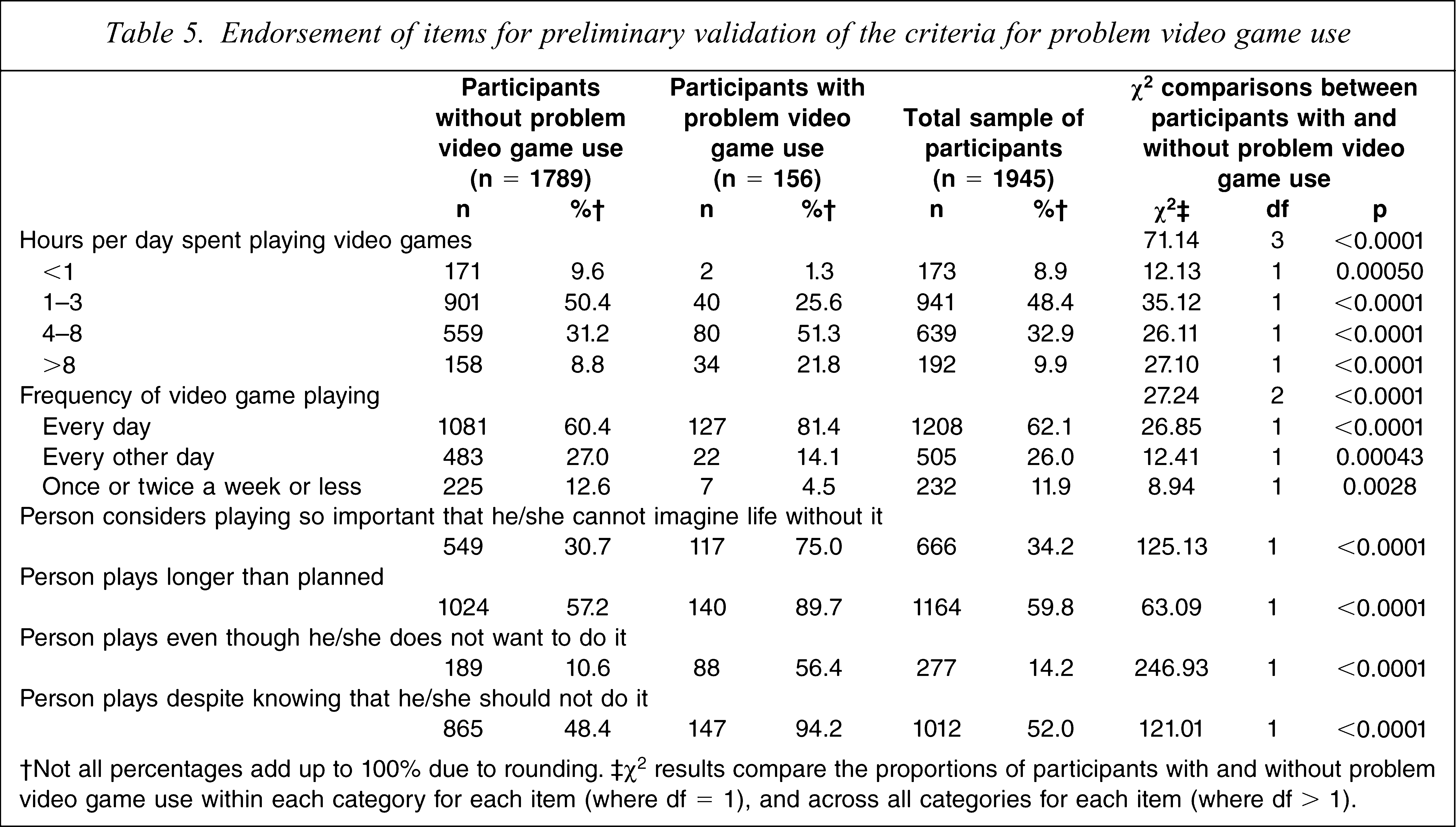
†Not all percentages add up to 100% due to rounding. ‡χ2 results compare the proportions of participants with and without problem video game use within each category for each item (where df = 1), and across all categories for each item (where df > 1).
Endorsement of items for provisional problem video game criteria
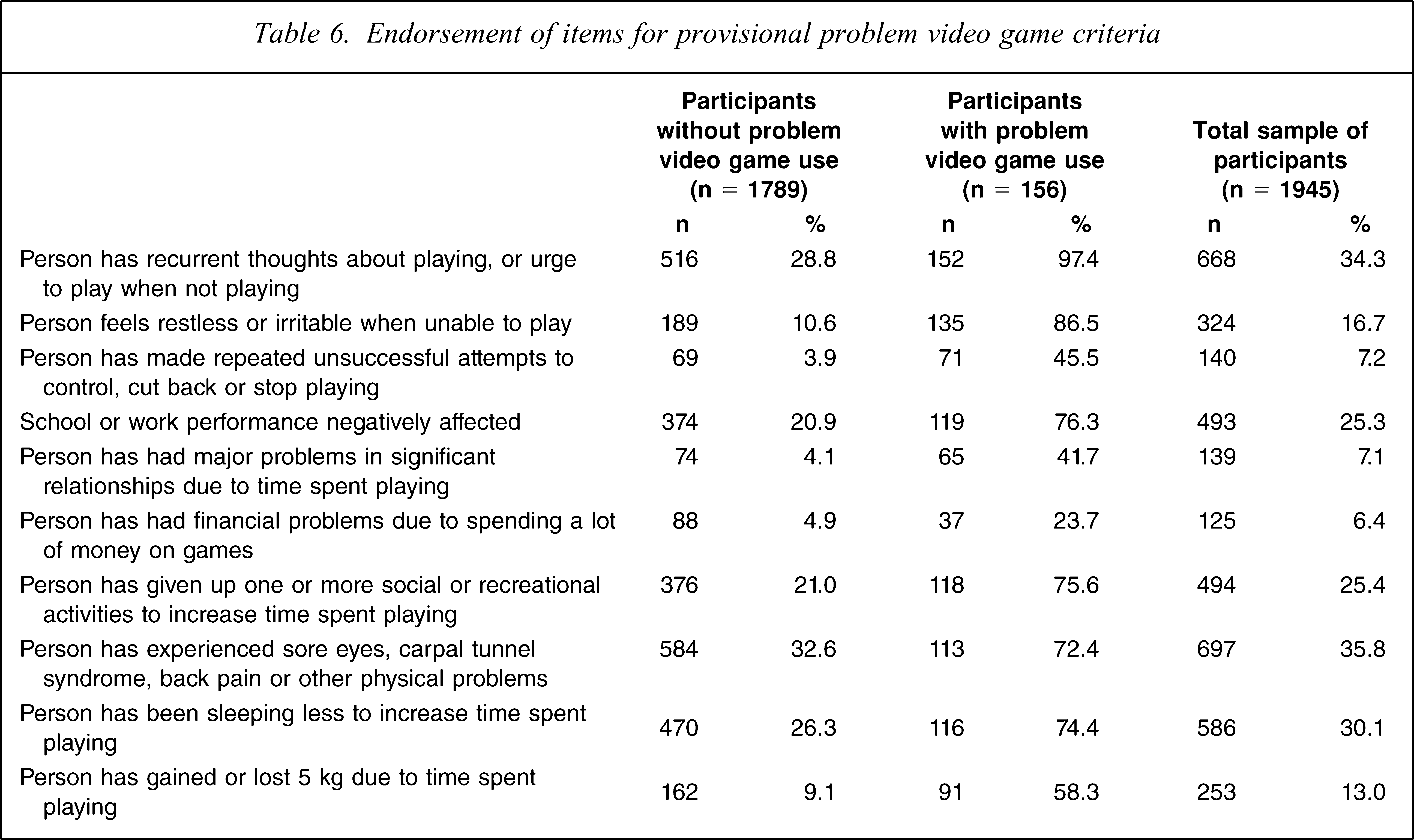
On the basis of our provisional criteria (Table 1), we classified 156 participants (8.0%) as problem video game users (Table 6). Participants with and without problem video game use did not differ significantly on any of the demographic variables (Table 2). Problem video game users played online games and MMORPGs significantly more often than participants without problem video game use (Table 3), reported having significantly fewer friends in real life (offline), and found it easier to meet people online (Table 4). A significantly higher proportion of problem video game players reported excessive consumption of caffeine-containing drinks (Table 4).
Participants with problem video game use played significantly longer and significantly more often than those without problem video game use (Table 5). A significantly greater proportion of participants with problem video game use endorsed a statement that playing video games was so important that they could not imagine life without it and reported that they played longer than planned, even though they did not want to, and despite knowing that they should not do it. Thus, problem video game players differed significantly from participants without this pattern on variables that provided an independent, preliminary validation of our provisional criteria for problem video game use.
Discussion
The first aim of the present study was to identify individuals with problem video game use. In our sample of participants who played video games, 8% were identified as problem video game players. This compares to 8.5% [17], 11% [9] and 11.9% [13] of participants in other studies. The most likely reasons for different findings are the different criteria for problem video game use and different compositions of the study samples. Thus, in one study, criteria for ‘problem video game playing’ included tolerance, derived from the diagnostic criteria for substance dependence [9]. As already noted, we did not include tolerance in the present criteria because having to spend more time playing to increase the pleasurable effect of the gaming experience does not seem to occur in problem video game players [12]. This issue, however, requires further study to clarify whether tolerance may play some role in problem video game use.
The other aim was to ascertain how well our provisional criteria for problem video game use perform. They have been preliminarily validated through a demonstration that problem video game users endorsed, significantly more often, all items relevant for problem video game use that have not been a part of the criteria (Table 5). These findings allow two conclusions to be made. First, problem video game use seems to be characterized by multiple manifestations of a loss of control over this activity. In fact, the validating items ‘playing longer than planned’ and ‘playing despite knowing that one should not do it’ were endorsed by a much greater proportion of participants with problem video game use than the criterion ‘repeated, unsuccessful attempts were made to control, cut back, or stop playing’, which was used to identify problem video game users (Tables 5,6). Second, use of duration or frequency of playing video games as the main criteria for identifying problem video game users might not be reliable, although problem video game users played for longer periods of time and more often. This is in agreement with previous research results [4,6].
More than 70% of participants with problem video game use endorsed six out of 10 criteria for problem video game use (Table 6). Of the preoccupation criteria, those referring to preoccupation with and craving for playing, and restlessness or irritability as a reaction to the abstinence from playing performed particularly well. Of the adverse consequences criteria, those reflecting interference with school or work performance and social or recreational activities, intentional sleep reduction, and sore eyes, back pain or other physical problems performed better than criteria referring to other consequences. Interestingly, financial problems as a result of playing video games were endorsed by less than one-quarter of participants with problem video game use, suggesting that this consequence of problem video game use might not be as important as it is, for example, in pathological gambling.
Comparisons of the survey participants with and without problem video game use showed several important differences. First, problem video game users played online games and MMORPGs with significantly greater frequency. This finding is in accordance with the results of a few studies that suggested that MMORPGs are most likely to be associated with problem use [6,7]. The play style of MMORPGs may lead to their excessive use, because these games often require extended periods of online game time for group activities, the harvesting of resources, manufacture of goods, and trade in a continuous virtual world [19]. MMORPGs also involve complex nestled reward systems within the game and opportunities to assume an anonymous virtual online identity and socialize with other gamers [20]. Although these characteristics of MMORPGs may lead to problem use, it is also possible that individuals predisposed to problem use are more attracted to MMORPGs and choose to play these games.
Problem video game users found it easier to meet people online and had fewer friends in real life. Consistent with these results, higher levels of social anxiety have been found in problem gamers [21], but it is uncertain whether difficulty socializing may predispose gamers to develop problem video game use or whether it is a consequence of such use. Problems with socializing may also account to a certain extent for greater likelihood of problem video game users to play online games such as MMORPGs, because these games provide an opportunity to socialize behind a virtual character chosen by the player [22].
Problem video game players reported an excessive use of caffeine-containing drinks more often than other gamers. This finding, not reported previously, can be understood in light of the stimulant effects of caffeine and a need for video game players to stay alert for prolonged periods of time to be able to play. Participants with and without problem video game use did not differ with regard to the frequency of alcohol and illicit drug use, which suggests that problem video game users do not tend to abuse substances that could interfere with their gaming activity.
This study has several limitations. Recruiting video gamers from online video game forums generates a sample of more avid gamers with longer playing hours, and it is uncertain to what extent participants in the present survey are representative of video game players. Therefore, the overall finding that 8% of gamers exhibit problem video game use may be an overestimate. The English-language requirement for participation in the study meant that many gamers, especially those from Asia, could not participate. For this reason the present findings may not necessarily apply to non-English-speaking video game players. Any anonymous survey methodology leaves survey questions open to individual interpretation, with reliability of the responses not being amenable to verification. The present criteria for problem video game use are provisional and require further study. The items we used for preliminary validation of the criteria for problem video game use have themselves not been validated. True validation would require interviewing survey participants, which was not possible in the current study. Even if we had been able to conduct these interviews, it would have been difficult to perform a thorough validation because of the lack of broadly agreed-upon criteria for problem video game use and the lack of the corresponding psychopathological or diagnostic entity. The actual strength of the present study is that questionnaire items regarding excessive or problematic use were endorsed by respondents themselves, and are less likely to have been biased by value judgements of clinicians, parents, or others.
We conclude by emphasizing implications of our findings for mental health professionals. Without entering a debate as to whether or not problem video game use should be conceptualized as a mental disorder, the present survey confirms that a minority of people who play video games become excessively preoccupied with this activity and lose control over it, which has various adverse consequences. These consequences affect multiple domains of physical and mental health and functioning. The present criteria for problem video game use may assist in recognizing problem video game users among individuals, especially adolescents and young adults, presenting to general medical and mental health services. This endeavour can be enhanced by taking into consideration features associated with problem video game use, such as playing certain types of online role-playing games, socializing difficulties, and excessive use of caffeine-containing drinks. Considering the consequences of problem video game use, it is time to acknowledge its public health significance and suggest that mental health professionals routinely enquire about use of electronic media when assessing at-risk patients. In fact, taking an Internet history has recently been recommended to become a part of routine psychiatric history taking from young patients [23]. This would ensure that problem video game use is not missed, because patients typically seek help and medical attention for depression, anxiety, or other disorders, not problem video game use. Ultimately, a timely recognition of individuals with problem video game use would allow implementation of adequate management strategies.
Footnotes
Acknowledgements
The authors gratefully acknowledge the support provided by the Nepean Clinical School of the University of Sydney for hosting the link to the survey. We also thank Mr Peter Sammut for his assistance with data collection.