




Abstract
Campus climate assessment has been an important strategy for improving students’ racialized experiences and racial equity in higher education. But when these assessments lack critical interventions in structural racism, they are easily co-opted to keep white students and faculty centered while exacerbating racial harm. This article responds to the timely question about the role/efficacy of campus climate assessments given the 2023 Supreme Court decision banning race-conscious admissions and subsequent backlash against diversity, equity, and inclusion programs and efforts. Drawing on University of North Carolina (UNC) data that informed this litigation, the author (an expert witness) demonstrates how a holistic view of campus climate health reflective of structural competency can be achieved with existing climate data sources, when accounting for missing areas of inquiry identified by student intervenors representing UNC and higher education race scholars.
Keywords
Co-optations of justice-focused language are also shaping the campus racial climate. Over the last decade, a growing number of white students have claimed marginality, invoked “free speech” to justify feelings of victimhood, and demanded “safe spaces” for already privileged identity groups. Groups like The Union of White Cornell Students—self-described as “a community of white students who wish to preserve and advance their race”—have made demands of administrators (Keller & Hu, 2016). And groups like Berkeley Patriot—a small alliance of students, heavily supported by outside funders, who invited conservative activists like Milo Yiannopoulos to campus—have tested university policies about free speech and safety (Shrivestava, 2017). According to the Anti-Defamation League (ADL, 2019), recruitment efforts and propaganda drops by white supremacist groups increased exponentially during the Trump years, becoming a regular occurrence on college campuses.
As conservative mobilizations, including burgeoning national and local anti-critical race theory (CRT)/anti-DEI legislative efforts, aim to dismantle race-conscious practices and inclusive curricula, fostering racial divisiveness and hostility, it is vital that we address legacies of racism that hinder student well-being. Too often, as Ledesma (2016) has argued, institutions utilize campus climate work, like other DEI research and programs, to make some improvements, but stop short of intervening on the root problem. Ledesma critiques traditional approaches to campus climate research for contributing to superficial interventions when they focus in a binary way on “positive” versus “negative” climate. In the new “post-colorblind” racism era (as named by Leonardo, 2018b), characterized by collective white victimization claims, this critique is all the more important. When white students report marginalization at institutions where they are dominant and privileged, what do we do? If enough white students report a positive racial climate, for example, it does not necessarily mean the campus is welcoming for minoritized students; conversely, if white students report a negative climate, they may actually be experiencing the productive discomfort necessary for personal development. At institutions where Black, Indigenous, and people of color (BIPOC) students and faculty are underrepresented, data can be marshaled to show a “positive climate” without centering the experiences of those who have the most important information. Decontextualizing climate data from deeper structural issues and privileging white students’ perspectives can mask exclusionary racial structures and ongoing enactments of structural racism, even while signaling a commitment to racial justice. Ledesma argues for shifting campus climate work from a superficial measuring of “positive” or “negative” climate toward a more holistic focus on the “health” of our BIPOC students and faculty and, therefore, the health of our campuses. In this article, I both join in this call and demonstrate how such an approach can be implemented.
The University of North Carolina case illustrates why such a shift is crucial. When SFFA sued UNC, arguing that its race-conscious admissions policies and practices discriminated against white applicants, UNC used its campus climate data to make the case that improvements were being made in students’ sense of belonging, cross-racial engagement, study body diversity, and graduation rates—and that affirmative action was a crucial part of this progress. But a group of Black and Latina/x/o students organized to offer a counternarrative to the institutional story, making a version of Ledesma’s argument: UNC was displaying efforts to become inclusive, but in their experience, it was still a place with a hostile climate. Instead of focusing on the benefits of diversity, as UNC lawyers were doing, these students of color wanted to emphasize the effects of the University’s segregationist history on their racialized experiences on campus and the lack of a critical mass of students of color, both of which encouraged ongoing harms to their wellbeing, including tokenism and microaggressions. They wanted this more complex picture, which complicated the institution’s straightforward narrative of progress, included in the legal record, to bolster the argument that UNC was justified in considering race as a factor in its holistic admissions process. They were granted intervenor status to do so. In 2017 the Lawyer’s Committee for Civil Rights Under Law, which the students were represented by, asked me to assess whether UNC had what Liliana Garces and I call “dynamic diversity”—a healthy racial climate combined with critical mass (Garces & Jayakumar, 2014; Jayakumar, 2018, 2023).
To support the intervenor’s distinct case, I studied the University of North Carolina’s campus climate assessments to understand its racial climate and the ongoing need for critical mass there. My findings were part of the research on diversity and critical mass that the conservative justices had to disregard in order to argue that UNC’s race-conscious admissions practices discriminated against white applicants. I return to that research now both to honor the imperatives set by the student intervenors, whose voices the conservative justices silenced, and to reflect on how my study of UNC might offer lessons for how we assess and intervene in the tense racial climates of our campuses in light of the Court’s decision and widespread backlash to racism-conscious DEI work.
In the legacy of prior scholarship that comes out of expert witness work (see, e.g., Allen & Solórzano, 2000; Gurin et al., 2002), this study offers praxis-based theoretical contributions while sharing data gathered in the context of a consequential Supreme Court case. I share some of the empirical research and analyses I conducted as an expert witness in SFFA v. UNC, to reflect on how we can do campus climate research that emphasizes the ongoing harm of segregationist legacies, names and values critical mass, and understands current, ongoing racialized trauma by looking upstream and at the root cause, to focus, as Ledesma (2016) recommends, in a holistic way on the “health” of campus climate. During my research at UNC, I also turned to the medical field, where practitioners have argued for holistic evaluations that address the structural causes of symptoms. I will explain how health and healing-oriented frameworks enabled me to align with Ledesma’s critique. As we move away from researching, arguing, and intervening within the limitations of a prior legal context shaped by the “diversity rationale,” this more holistic, health-centered approach to campus climate offers strategic ways to name and intervene in the structural violence of racism masked by a legal fantasy of facially “race-neutral” discourse.
Dynamic Diversity, Structural Violence, and Campus Climate Health
In order to see the significance of shifting to a health-centered approach that reclaims a focus on structural racism, it is important to understand how diversity and climate scholarship is shaped by legal advocacy challenges. I will begin with the legal context, then explain my research assignment at UNC in light of relevant literature on campus climate, and then turn to the medical field to draw from the literature on structural violence and competency.
Before the recent SCOTUS decision in SFFA v. Harvard/UNC, arguments about race-conscious admissions were governed by the “diversity rationale,” which Regents of the University of California v. Bakke (1978) had established as the only legal justification for affirmative action: Racial diversity has educational benefits for students. Over the next 4 decades, affirmative action could not legally be defended as a way to remediate for or counteract racism. Instead, arguments and scholarship—including climate studies—had to focus on presenting evidence of those educational benefits to sustain its legality. As countless scholars and advocates have pointed out, those benefits tend to most accrue for white students, while students of color also endure harm from cross-racial engagement (Jayakumar et al., 2018). While affirmative action was crucial to counteracting white bias in admission, the diversity rationale Bakke enshrined was superficial and white-centered. Because it did not name racism, it was easily coopted to mean something like the diversity of the photographs on collegiate websites, where students of color provide spectacular variety and offer experiences of cultural difference that enrich white students.
During the 4 decades when the dominant legal framework for justifying affirmative action rejected racism as a rationale, campus climate research gained prominence as an effective strategy to study and highlight the effects of structural violence on campus (Jayakumar et al., 2018). Hurtado and colleagues introduced a framework for understanding racial climate in higher education, consisting of four key elements: (a) the historical context of inclusion or exclusion of racial/ethnic groups, (b) the structural diversity within institutions, (c) the psychological dynamics among different groups, and (d) the behavioral climate, encompassing intergroup relations (Hurtado, 1992; Hurtado et al., 1998, 1999). Building upon this foundation, Milem and colleagues (2005) expanded the framework to include a fifth dimension, focusing on organizational and structural processes. These groundbreaking scholars who developed the study of campus racial climate focused on institutional legacies of racism as part of their examination (Hurtado, 1992; Hurtado et al., 1998, 1999, 2012; Milem et al., 2005) and incorporated CRT to center the experiences of BIPOC students (Allen & Solórzano, 2000; Harper & Hurtado, 2007) and faculty (Jayakumar et al., 2009). This work was utilized within legal arguments to explain why racial diversity under negative racial climate conditions led to “racial balkanization” (the conservative term) or self-segregation, while under other, positive climate conditions, it led to educational benefits for students of color and white students alike (Jayakumar et al., 2018).
Garces and I developed the dynamic diversity framework to clarify the importance of “critical mass”—which was being contested by the conservative Justices in the University of Texas v Fisher Supreme Court Cases. This framework utilized the required rhetoric and legal parameters of the “diversity rationale” while pushing against them, defining an authentic diversity where students of color are centered. The framework understands individual-level features (participation in the learning environment, engagement with diverse peers) as connected to the conditions that shape and are shaped by campus climate. We joined other scholars who argued that there needs to be more than a few token students of color for the “diversity” they bring to do more than benefit white students’ growth (by exposing them to “others”)—in other words, to have positive benefits also for the students of color themselves (Garces & Jayakumar, 2014; Jayakumar et al., 2018). At historically/predominantly white institutions, when critical mass is missing, and legacies of racism impact BIPOC students’ level of meaningful participation in the learning environment, BIPOC students become isolated and tokenized, and campus climates can be toxic, stressful, and unhealthy (Garces & Jayakumar, 2014). The presence of critical mass is crucial to a racial climate that supports learning for all students (Garces & Jayakumar, 2014; Hagedorn et al., 2007; Harpalani, 2017; Jayakumar, 2015; Jayakumar, 2023; Jayakumar, Kidder, & Reynolds, 2023; Kalbfeld, 2019). It was this understanding of critical mass, and the presence (or absence) of dynamic diversity, that the student intervenors asked me to study at UNC, so I drew on the dynamic diversity framework as a lens.
But what the student intervenors were asking me to help visualize was also the ongoing presence and influence of structural violence at UNC—precisely what the “diversity rationale,” and UNC’s own case, made it difficult to name. If violence is defined expansively, as Galtung (1969) does, as the “avoidable impairment of fundamental human needs or . . . the impairment of human life, which lowers the actual degree to which someone is able to meet their needs” (p. 1686), then structural violence is how this happens at the level of institutional practices, built environment, policies, systems, cultures, and norms. When understood as structural violence, racism is not just the lingering legacy of genocide, slavery, and segregation; it continues to be central to the colonial project of U.S. postsecondary institutions (Boggs et al., 2019; Dancy et al., 2018; Mustaffa, 2017; Squire et al., 2018; Tichavakunda, 2022). Structural violence is not necessarily tangible or physical; by design, it is seemingly imperceptible to those who benefit from it (Leonardo, 2018a). Unlike individual violence or trauma, the structural violence of institutional racism is indirect and embedded in the structure of society; it is thus identifiable through “unequal power and consequently as unequal life chances” (Galtung, 1969, p. 171).
Violent racist hierarchies and dynamics are baked into institutional structures and norms in ways illuminated by scholars focused on antiblackness (Dancy et al., 2018; Mustaffa, 2017; Squire et al., 2018; Tichavakunda, 2022). And structural violence’s influence in higher education is well documented. Mustaffa’s (2017) work, for example, shows how structural violence constructs antiblack higher education conditions that limit and end Black and other racially marginalized people’s lives. Applying Fairchild (1994) work on violence in educational spaces, Leonardo and Porter (2010) highlight how educational experiences, including racial dialogues, are shaped by racial colonialism, inflicting psychic violence to control the consciousness and “lifeworld” of oppressed people. Drawing from the work of psychiatrist Pierce (1970), Solórzano and colleagues brought in the concept of racial microaggressions to theorize the violence experienced by BIPOC students in the context of predominantly white institutions (Pierce, 1970, 1974; Solórzano, 1998; Solórzano et al., 2002). Bensimon’s (2004, 2012) groundbreaking work advancing the “equity scorecard” explicitly names inequality within higher education institutions as “a symptom” of structural racism and violence. Others have demonstrated how structural violence occurs on multiple levels, through institutional policies, practices, and cultural norms that teach people to accept societal stratification and construct inequitable access, political power, healthcare, educational, and employment outcomes that dehumanize Black and other people of color, to protect and advantage white normativity, power, and privilege (Dancy et al., 2018; Farmer et al., 2006; Harris, 1993; Jayakumar, 2024; Mustaffa, 2017; Whitman & Jayakumar, 2023).
As I completed my study, I found that the dynamic diversity framework, while centering BIPOC racialized experiences, relied on campus climate research that was not yet holistic in its approach to addressing these experiences of harm, as symptoms, or excavating the roots. Although hate crimes or individual microaggressions can easily be traced to the perpetrator, larger oppressive structures that nurture and condone them are more difficult for climate researchers and interventions to target. How can climate research remain rigorously focused on identifying the interactions among the multiple dimensions that create structural racism?
At UNC, for example, I noticed the prevalence of white victimization narratives and claims of oppressed identity status in the climate survey data, which are reflective of a Trump-informed racial ideology (Jayakumar et al., 2021; Leonardo, 2018b). When legacies of structural violence, such as enslavement and segregation, were named, they were described (as they often are) as “haunting” the campus. But that framing misses the problem: the institution had co-created the structural violence in North Carolina and was continuing to create exclusion and harm. It has been too easy for the institutions that commission racial climate work to leave untouched the very structures and practices that create toxic climates; my research showed this was the case at UNC. How was I going to instead support UNC’s effort to defend its race-conscious admissions practices while also highlighting these ideologies and legacies that harmed students of color? How was I going to support UNC, while also pointing to subtle forms of structural violence, including a superficially inclusive campus culture that denied racial trauma, extracted physical and emotional labor from BIPOC individuals, and engaged in silencing, denial, and gaslighting behaviors that coddled white defensiveness and comfort at the expense of racial justice—while working within the legal parameters of a “diversity rationale” that rejected racism as the thing affirmative action existed to try to mend?
As Ledesma (2016) asserts, campus climate research has not yet demonstrated a sustained engagement with the analysis of racism that connects the organizational, compositional, behavioral, and psychological dimensions of climate. Pointing to this lack of thorough analyses of how racism influences student well-being in climate assessments, Ledesma (2016) called for a conceptual shift toward campus climate health “to recover and recouple how the study of campus climate not only analyzes the power and impact of systemic white supremacy and racism on institutional and individual norms and values, but how these, in turn, affect the physical and mental health of participants and institutions alike” (pp. 7–8). Ledesma argued that this offers a more humanizing account of underrepresented students’ experiences and prompts an excision of the disease of racism as embedded in the institution. Beyond campus climate research, sociologist Victor Ray (2019) points to a lack of organizational research that holistically connects racism as it occurs at the macro, meso, and micro levels of postsecondary institutions, which ultimately supports institutional whiteness and racism.
Such a holistic approach would mean including attention to wellness and healing because structural violence affects the whole person. Groundbreaking work by CRT scholars and psychology researchers has documented racism at the micro-level of the organization, establishing, for example, the cumulative harms of mundane extreme environmental stress (Carroll, 1998), racial microaggressions (Pierce, 1977; Solórzano, 1998; Sue et al., 2008), and the toll of racial battle fatigue on BIPOC mental health and well-being (Smith et al., 2007). Everyday experiences with racism and oppression have also been described as insidious trauma (Bennett & Pasque, 2018; Burstow, 2003), exacerbated when racism is confounded with gender violence (Szymanski & Balsam, 2011; Watson et al., 2016). Moreover, researchers have directly linked students of color reports of negative campus climate with increased trauma-related symptoms (Pieterse et al., 2010; Vue, 2019). Police and racial violence in the United States, for example, leads to Black college students experiencing symptoms consistent with posttraumatic stress disorder (Campbell & Valera, 2020), which we can assume influences interactions with campus police and may even increase stress and vulnerability in predominantly white classrooms.
Notably, many factors that perpetuated ongoing structural violence at UNC are common in U.S. colleges and universities, even those without particularized segregationist legacies. For example, land grant institutions were born out of settler-colonial and racial capitalist projects of accumulation and exclusion (Stein, 2018; Stewart-Ambo, 2021). Even post-slavery universities founded on abolitionist principles have profited immensely from such positions while retaining explicit missions tied to settler-colonialism (Morris, 2014). Also, current relational system conditions, such as high levels of segregation in U.S. neighborhoods and schools, coupled with the concentration of educational resources in predominantly white high schools, contribute to the institutional capacity issues of race-evasive ideologies, racial biases, stereotypes, and white hostility toward racial justice. Even with increased student body diversity on college campuses, most institutions still have predominantly white trustees, faculty, and administrators, especially in higher-ranking positions; these individuals often lack capacity and racial literacies and are aligned with compartmentalized DEI efforts centering white interests.
Without a holistic, health-oriented approach that acknowledges and intervenes on historical and current racialized inequality and can describe how structural harm affects white and BIPOC students differently, institutions respond to claims of “lack of belonging” and “feelings of marginalization” from white students (as well as faculty and administrators) in ways that placate, without addressing more profound issues of the anti-BIPOC racism that makes campus climate toxic. So, a health-oriented approach would attend to the differences that structural violence enshrines on campus, following the model in health studies of intervention-focused diagnosis that excavates root causes. A holistic approach to diagnosis and treatment of toxic campus climates requires decompartmentalizing our understanding of climate dimensions, connecting racialized experiences to institutional structures and cultures of ongoing racism as they play out within organizational, compositional, behavioral, and psychological dimensions of climate, and becoming integrative in our assessments. It means consistently excavating how structural violence and vulnerability shape the institutional dimensions of climate. It means focusing not only on history of segregation and exclusion, but how that history influences ongoing unequal access to resources, admissions, and hiring, and how those selection processes contribute to and are reinforced by white-centered organizational norms and governance structures, reifying ongoing behavioral and psychological relationships with systemic racism, and invisibilized by institutional narratives of progress. It means designing our instruments, analytical frames, and justice-focused interventions to include multiple ways of connecting the effects of racism to its structures across macro, meso, and micro levels. My research at UNC helped me see these challenges more clearly, and I was able to begin to address some of them in my expert report. Others, like instrument design, were beyond the scope of what I could address.
Drawing From Health Approaches to Structural Violence and Competency
In the health sciences, the ability to address such issues has been called “structural competency.” According to Metzl and Hansen (2014), structural competency is “the trained ability to discern how a host of issues defined clinically as symptoms, attitudes, or diseases . . . also represent the downstream implications of a number of upstream decisions” (p. 128). This is a departure from an individualistic—often essentialist—focus on cultural competence (Metzl & Roberts, 2014) toward understanding institutional racism in U.S. medical education as an organizing principle requiring structural intervention (Farmer et al., 2006; Metzl & Hansen, 2014). As Metzl and Roberts (2014) asserted, “inattention to these [structural] forces has caused a crisis of competence” in the medical fields, for which institutions are “ill-prepared” to effectively respond (p. 675). There is a similar crisis of structural competency in higher education (Jayakumar, 2020; Whitman & Jayakumar, 2023).
In the context of higher education and campus climate work, structural competency might mean that micro, student-level data (e.g., BIPOC students indicating marginality, microaggression; white students indicating victimization, unawareness of microaggressions) and meso, institution-level data (e.g., admissions and graduation rate data by race) is understood not only as symptoms of upstream decisions such as admissions policies or a Eurocentric and antiblack organizational culture, but of macro level, exclusionary (supremacist, segregationist, antiblack, colonial) frameworks and systems that linger and persist no matter the diversity and inclusiveness the university is signaling. Structural competency means addressing campus climate health in ways that include and understand structure, to develop interventions that better prevent systemic health issues born of settler-colonial, white supremacist foundations and ongoing relations with racial capitalism that (re)create unhealthy institutional conditions and outcomes (Boggs et al., 2019; Jayakumar, 2020). And it means not only being structurally competent in our own approach but assessing the competency of the institutions we study. Part of this work in the context of higher education means assessing the racial literacies of the actors (students, faculty, administrators) involved. Racial literacy, as defined by Lani Guinier, is “the capacity to decipher the durable racial grammar that structures racialized hierarchies and frames the narrative of our republic” (Guinier, 2004, p. 100; Kohli et al., 2021). Students (as well as other institutional agents) with racial literacy can illuminate institutional racism and inform interventions that move campuses toward racial equity and healthy racial climates. Kohli and colleagues (2021) assert the importance of assessing, building, and valuing student, faculty, and administrator racial literacies as an essential component of creating a healthy racial climate.
In what follows, I show how, in my assessment of UNC, I worked within legal parameters to center the experiences of the student-of-color intervenors, who were racially literate, and connect the experiences they narrated to larger patterns of structural vulnerability and institutional violence. Vulnerability is experienced in relation to the structural context of racism: feelings of vulnerability for systematically disenfranchised racial groups are based on lower social status, while feelings of vulnerability by dominant (white) group members derive from perceiving unfair treatment based on entitlement to (or threat of losing) dominant social status (Jayakumar, 2015). Thus, “structural vulnerability means that a student’s potential exposure to harm does not exist in a vacuum but is reflective of broader dynamics shaped by structural violence” (Whitman & Jayakumar, 2023, p. 6).
In my expert report (Jayakumar, 2018; Jayakumar, 2023), it wasn’t appropriate to share my analysis of the scholarly literature on racial climate, explicate the need for bringing in structural competency from the medical field, or explain the importance of holistically answering Ledesma’s call for campus climate research to reflect an understanding of how structural and institutional level health shapes individual health and well-being. But drawing on this literature helped me to answer the student of color intervenors’ call for centering critical mass (or dynamic diversity) and the ongoing harms of a segregationist legacy on racial climate health. In this article, I reflect more explicitly on lessons from my work at UNC: how a health-oriented approach can center BIPOC student experiences and guide interventions that address both symptoms and root causes. My hope is to support administrators and researchers in working toward racial justice in our new facially “race-neutral” legal environments where the Court has joined conservative activists in defending white victimhood and both co-opting and attacking DEI language.
Methodology
Critical Race Praxis for Education Approach and Positionality
The scholarship that I have been describing so far—where theory informs advocacy, which then informs theory once again—is a critical race praxis. A critical race praxis applies CRT to support interventions at the level of legal and institutional policy and practice (Jayakumar & Adamian, 2015; Stovall, et al., 2009; Yamamoto, 1997). Mari Matsuda (1989) describes this “dualistic approach” to a repressive legal system, operating with a multiple consciousness that adheres to the law’s abstractions but with intentions and awareness toward oppressed community knowledge and advocacy. Legal scholar Yamamoto argues that in order to actually do this—to actually apply CRT to problems of practice—it is crucial to bridge the gaps among scholars, lawyers, and practitioners; we can work better toward effective interventions on all fronts if we work together (Jayakumar & Adamian, 2015). Bringing this into education, Critical Race Praxis for Education (CRP-Ed) seeks to draw on multiple knowledges and languages to challenge and transform dominant narratives and systems that perpetuate racial inequalities in education by working within (and contesting) policy framings rooted in dominant ideology and rhetoric, while striving to be a part of oppressive legal and schooling contexts. A CRP-Ed approach bridges the disconnection between theory and on-the-ground problem solving, produces counternarratives, and requires a back-and-forth movement between action and reflection (Jayakumar & Adamian, 2015; Stovall et al., 2009; Yamamoto, 1997). Problems of practice should then inform/shape the construction of research studies (e.g., research questions, theory, methods) that are positioned to inform interventions in structural/institutional racism (Jayakumar & Adamian, 2015). It is this cyclical, proactive application of scholarship to problems of practice that led me to apply and refine a health-centered approach to climate research—but even as I draw on concepts (such as structural competence) from the medical fields, it is important to bring a CRT theory of history and change to understanding the causes of the symptoms I observed at UNC.
A critical race praxis approach to advocacy is grounded in a socio-historical understanding of the moment. Ours is characterized by the reclaiming of white interests and power (Ledesma, 2023). As Critical Race Legal scholar Derrick Bell asserts, social progress within a white supremacist legal system only occurs when there is an “interest convergence” between the needs of those maintaining the power structure and those subjugated by and agitating to change it (1980). And perhaps most relevant here, is that temporary progress gets revoked when it no longer serves white elite interests; the white supremacist system re-asserts itself anew (Bell, 1980; Ledesma, 2023; Thompson Dorsey & Venzant Chambers, 2014). Scholars theorizing on the cyclical nature of interest convergence call this latter phase “white supremacist reclamation” (Thompson Dorsey & Venzant Chambers, 2014), explained by “the power preservation principle,” which names consistent collective white elite agency and effort toward fortifying white interests and dominance (Ledesma, 2023).
CRP-Ed draws from CRT and Freire’s (1970/1993) theorizing on liberatory praxis to posit that our educational advocacy approach must consider whether we are situated in relation to interest convergence, given that such “convergences” are created by the agitation and uprisings of the oppressed. Sometimes, we are in a period of “interest convergence expansion” where there is a policy/social change window for securing incremental progress, which, although temporary, has real consequences for improving the immediate material conditions for those positively impacted. Other times, we are in an “interest convergence constriction” phase where that policy/social change window is closing, imperialist reclamation has begun, and radical naming and agitation are needed to advance justice efforts (Jayakumar & Adamian, 2015). For example, a window for social change occurred when global protests and Black Lives Matter (BLM) uprisings followed the brutal murder of George Floyd, and white corporate and institutional interests in rebranding as antiracist converged with activists’ demands for change; we entered a period of constriction with Trump’s backlash against diversity workshops in September of 2020 and the introduction of anti-“CRT” ban rhetoric and attempts to censor any curricular content on race or gender. The Supreme Court’s decision represents a period of reclamation. There are different possibilities for advancing racial justice in moments of interest convergence expansion versus constriction, and whether we are in a moment of interest convergence or imperialist reclamation, different questions have to be asked, and different strategies taken with different implications.
However, an interesting convergence can provide, along with opportunities for incremental progress, double-binds for researchers. As an expert witness—sought out for my demonstrated scholarly contributions to the literature on critical mass and campus racial climate—I needed to leverage the interest convergence that arose from UNC’s desire to be seen as moving away from its racist past while listening to the lived experiences of students of color reflecting racial harm.
In this study, a critical race praxis approach entailed consistently reflecting on the real-time needs and voices of the student intervenors and the imperialist reclamation occurring within the legal context. Thus, the analysis shared in this article is shaped by considering the legal context informed by the SFFA v. UNC decision to enforce a legal fantasy of “race neutrality” and the type of counternarratives that might support effective future advocacy efforts. It was also shaped by my personal experiences as an East Asian Indian American woman—with a commitment to challenging whiteness and antiblackness—understanding that I navigate the double-binds of how white supremacy partially and temporarily incorporates Asian Americans to secure white interests at the expense of all BIPOC communities. I am indebted to critical race legal and educational scholars as well as Black radical scholars and elders for shaping my understanding of how to name and critique racism and how it operates within U.S. institutions, while still being able to imagine and work toward a world free from racism’s double-binds and infectious disease.
As I conducted my research at UNC in 2017, incorporating concepts of structural violence and competency, symptom/root diagnosis, and holistic intervention allowed me to answer my research questions and expand on the superficial approaches to campus climate work being enacted by UNC, while supporting the student of color intervenors to advocate for the importance of adding an analysis of critical mass. In the years since, my CRP-Ed approach led me to understand how a holistic, health-centered approach to campus climate research could address the problems introduced by a post-SFFA “race-neutral” legal context.
Case Study Methods
Employing an instrumental case study (Stake, 1995), I drew from data (now part of the public record) provided by UNC and the Lawyers’ Committee for Civil Rights Under the Law, the lawyers representing the student of color intervenors. This data was analyzed and entered as evidence in the historic 2023 SFFA Supreme Court case; it mostly consists of secondary data sets and campus climate reports, as outlined in detail below, which were part of the UNC case. It’s important to note that in the context of this SFFA case underrepresented minority students were defined as Black, Latinx, and Indigenous, and thus, this analysis conducted for my expert report does so as well. These data are primarily from 2016 or prior because Court cases take a long time to reach the Supreme Court and most of the work done is necessarily done for the decade prior to address a series of lower court decisions, as new testimony cannot be presented later. Yet reflecting on the data and how we approach campus climate assessments in the context of litigations and their outcomes, are essential to supporting future research and legal advocacy.
According to Stake (1995), instrumental cases are valuable for understanding social phenomenon: herein, to understand UNC’s campus climate health in relation to legal arguments that critical mass had not yet been achieved at the university while centering the perspectives of those most structurally vulnerable. I used the dynamic diversity framework Garces and I developed (Garces & Jayakumar, 2014), which looks at critical mass in relation to campus climate and educational benefits to answer my central research question: To what extent, if at all, is dynamic diversity (critical mass in the context of a healthy racial climate) happening at the University of North Carolina, Chapel Hill?
I employed an iterative analytical process of open and axial coding of various sources detailed ahead. Open coding was informed by analytical memos written after reading and reflecting separately on each data source. Axial coding was conducted strategically in looking for relationships and connections across sources to the components of the dynamic diversity framework, which centers on critical mass and racism in diversity assessments.
Analytical Frameworks
During the axial coding process, particularly as I worked with analytic memos of student intervenors’ depositions, I went back to the literature to incorporate elements I found missing in the dynamic diversity framework (Garces & Jayakumar, 2014), specifically, the need to address and make connections between student experiences and structural violence, to understand student claims of marginality as shaped by structural vulnerability, and to incorporate all of this in a report that does not just evaluate climate as a set of isolated symptoms but more holistically understands climate as an element of campus climate health. This is consistent with an iterative coding process (Saldaña, 2009). I accordingly revised the dynamic diversity assessment framework (Garces & Jayakumar, 2014) to include four components:
1. Racial representation—a broad understanding of campus compositional diversity and same-race representation, including diversity within diversity (i.e., discrepant examples within racial groups), as well as recruitment and retention efforts to ensure participation of structurally vulnerable groups. Racial representation of structurally vulnerable students, faculty, and staff are all relevant. Whether these numbers are sufficient to ensure dynamic diversity and related educational benefits depends on campus climate health and meaningful participation and engagement.
2. Meaningful participation—equal-status, individual-level classroom, and campus engagement that minimizes barriers to full participation, such as racial isolation, tokenism, and stereotype threat; this requires racial representation and literacies.
3. Meaningful engagement—structured and sustained intergroup dialogue and diversity within diversity in the classroom and on campus; this requires racial representation and literacy.
4. Campus climate health is the quality of institutional conditions that shape individual well-being. It is the extent to which systemic racial violence shapes organizational structures and policies based on the institution’s particularized legacy of exclusion and local, state, and national racial climates; this requires racial representation and literacies, as well as structural competency and capacity.
Data Sources
The extensive institutional data provided to me spanned a decade of quantitative and qualitative data summaries, allowing for various sources to triangulate my analysis (Stake, 1995). Note that these data were necessarily drawn from the years before the legal case; for this reason, they end in 2016 and do not include more recent UNC campus climate reports. Cases take a long time to reach the Supreme Court, and most of my work was done to address lower court decisions; new testimony cannot be presented later after cases are appealed upward.
Quantitative data sources included 2010 and 2016 Undergraduate Campus Climate Survey data, and 2010 and 2016 freshman survey data on pre-college and college experiences collected by the Higher Education Research Institute (HERI). These entailed descriptive statistics of every question on the respective surveys and cross-tabulations reporting on group differences (racial, socio-economic, gender, geographic) on items related to a broad range of campus experiences, including DEI experiences. The 2010 and 2016 Undergraduate Campus Climate Survey data (n = 4,316) included short answers to questions about experiences of marginalization, sense of belonging, experiences/observations of microaggressions, and perceptions of the institution’s commitment to diversity. The freshman survey data collected and analyzed by HERI (n = 36,882) were in the form of an institutional report, which included a range of background characteristics, educational environments/experiences, and dispositions (e.g., race/ethnic identity, neighborhood racial composition, parental income, secondary school activities and achievements, educational and career aspirations, values, attitudes, and self-concept). My data sources also included internal evaluations of campus climate across departments and schools conducted by UNC, and externally sourced evaluation reports on the state of DEI at UNC (which included faculty, staff, and student focus-group data, as well as reviews of curriculum and programming). The internal and external DEI reports included qualitative assessments of student experiences with campus climate and DEI progress over time in various departments and schools, as well as historical records of the institution’s relationship with the confederacy, segregation, and white supremacism. The internal reports sought to assess the state of DEI; for example, one report was organized around UNC’s five institutional DEI goals:
(1) Clearly define and publicize the University’s commitment to diversity.
(2) Achieve the critical mass of underrepresented populations necessary to ensure the benefits of diversity in faculty, staff, students, and executive, administrative, and managerial positions.
(3) Make high-quality diversity education, orientation, and training available to all members of the university community.
(4) Create and sustain a climate in which respectful discussions of diversity are encouraged and take leadership in creating opportunities for interaction and cross-group learning.
(5) Support further research to advance the University’s commitment to diversity and to assess the ways in which diversity advances the University’s mission.
The report included institutional data on racial/ethnic and gender composition trends over several years, graduation rates by race broken down by gender and generational status, composition of faculty, leadership, hiring over various years (of faculty and leadership of color), as part of the status across the five goals. The external evaluation by the Educational Council was based on 20 meetings and interviews with faculty, campus leaders, administrators, and staff. All participants were asked to share candid reflections on their experiences related to diversity and inclusion at UNC and recommendations for improvement. The Educational Council’s analysis of these interviews was informed by various publicly available documents, which I also separately reviewed, including UNC’s mission and policy statements, diversity plans and reports, faculty resolutions, admissions policies, public communications, and more.
Another essential data source was official student declarations collected by the lawyers’ committee and filed in the court case. Student declarations from prospective, current, and former students of color at UNC provided qualitative narrative accounts of students’ campus diversity experiences, challenges they faced as underrepresented students of color, and factors contributing to academic adjustment and success. These students had critical consciousness directed toward racial justice advocacy work—that is, racial literacies—as exemplified by their participation in the lawsuit.
The student intervenors’ detailed depositions spoke to what they deemed important in their college choice processes and specifically why they chose UNC, the types of activities and interactions they valued inside and outside of the classroom, their personal experiences with racial diversity at UNC, the impact of UNC’s consideration of race (or decision to stop considering race) on the quality of their educational experience, how the absence of critical mass had impacted their classroom experiences, campus life, and educational outcomes, and lastly, their perspectives on UNC administration’s commitments, diversity efforts, and responsiveness to race issues. Throughout the analysis, I revisited the literature on whiteness and structural oppression to account for issues that arose from the data. I reexamined the full dataset to assess structural vulnerability, understand campus climate health, and inform a structurally competent approach to assessment.
In the data analysis phase, this methodology enabled me to answer the research question assigned to me by the student of color intervenors: (a) To what extent, if at all, is dynamic diversity (informed by critical mass and campus climate health) happening at the University of North Carolina, Chapel Hill?
As I reflected on what I was seeing, I began to notice ways that the traditional climate data UNC provided and the constraints of arguing within the diversity rationale constrained my ability to make a holistic assessment of UNC’s climate. My expert report (see Jayakumar, 2018, 2023) shares in detail the themes and findings that led me to the conclusion that UNC was making important efforts to advance dynamic diversity but still fell short of achieving it. I began to draw on a holistic, health-oriented framework as I wrote my expert report. In this article, I share exemplary findings and high-level summaries from that much longer report, with an emphasis on key themes that supported moving toward a holistic approach to assessing campus climate. I began to picture an institution’s “health” as depicted above.
After sharing my findings, I’ll turn to a second reflective question that informs my discussion of those findings and their implications for policy and practice: (b) How can a holistic campus climate approach support researchers and practitioners in naming and intervening on racism and structural violence in the new facially “race-neutral” regime amid ongoing attacks on DEI work?
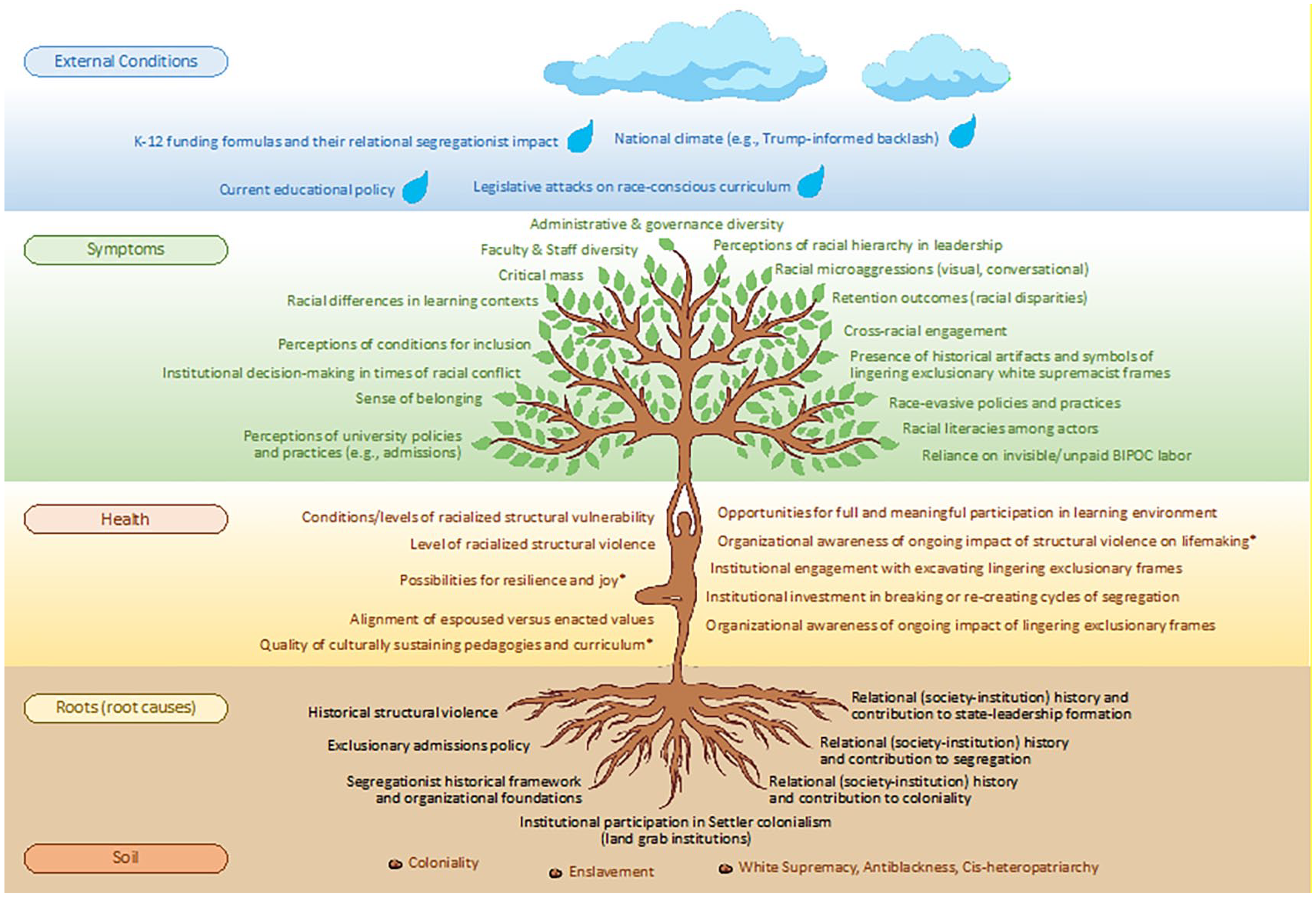
A holistic approach to assessing campus climate health.
Findings
Micro Level: Symptoms of Campus Climate Health
Symptoms of campus climate health are all the observable and perceived features of the institution. Symptoms are helpful in showing us when and where there is a larger problem. They are generally easier to observe than the root problem creating them and easier to measure with metrics such as demographic data and survey instruments that track enrollment and graduation rates and racial disparities, as well as racialized experiences including barriers to full participation and engagement in the learning environment.
UNC’s demographic data showed that racial representation on campus did not reflect the diversity in the state. In North Carolina as a whole, at the time of the study, Black residents comprised 22% of the population (U.S. Census Bureau, 2016), but at UNC, 8% of students identified as Black/African American. Only 10% of UNC faculty came from racially underrepresented groups (5% Black, 4% Latinx, and 0.4% Indigenous), as did 12% of administrators (9% Black and 3% Latinx) and 22% of staff (19% Black, 3% Latinx, and 0.4% Indigenous). The overwhelming majority of staff were white (70%); only eight Black and two Latinx individuals were serving as high-level administrators (10% and 3%, respectively).
These numbers indicated unequal access to college prep in North Carolina schools, but to understand them only as symptoms of the pipeline would ignore what they mean for student experience and learning. To understand this, we have to treat them as symptoms that can only be interpreted in the context of others. Lack of representation, at this level, can mean a lack of critical mass. A holistic approach to these numbers requires paying close attention to the way that, on a campus lacking critical mass, the quality of learning and engagement are racialized. At UNC, survey data indicated this was the case.
BIPOC Racialized Experiences
Institutional data showed underrepresented students of color at UNC experienced a racialized learning context. The majority had personally experienced bias at UNC and overwhelmingly reported being subject to racial bias, in particular, they (100% of Indigenous, 95% of Black, and 70% of Latinx students) disproportionately experienced discriminatory comments, including microaggressions and disparaging remarks. In UNC’s 2016 climate survey, 42% of Black students and 28% of Latinx students reported hearing faculty express stereotypes based on race or color sometimes, often, or very often.
Students’ dissatisfaction with the racial and ethnic diversity of the faculty was notably highest for Black students (52.4%), Latinx students (22%), and biracial/multiracial students (21.7%). Black students had the lowest agreement rates with statements about positive diversity-related behaviors and attitudes of institutional faculty, staff, and administrators. Specifically, they expressed lower agreement that “Faculty empower me to learn here,” “My contributions were valued in class,” and “Faculty were able to determine my level of understanding of the course material.” While only 16% of students overall agreed that “I have felt isolated at UNC because of the absence or low representation of people like me,” nearly half of Black students (48%) and one-third of Latinx students (31%) felt this way. Underrepresented minoritized students disproportionately felt the need to suppress their cultural identities, with 40% of Black students and 29% of Latinx students (versus 15% overall) agreeing or strongly agreeing that they felt the need “to minimize aspects of my racial or ethnic culture to fit in here.” Such feelings suppress minoritized student engagement and foster fragmented participation.
In institutional recruitment materials, UNC hyper-visibilized students of color to display and signal diversity. But the reality on the ground was that students of color felt consistently required to do the labor of upholding a status as tokens of diversity. For example, students of color expressed markedly higher agreement that they felt “pressured in class discussions to represent the views of all people” from their racial or ethnic background: Just over 50% and 30% of Black and Latinx students, respectively, agreed, compared to 14% of students overall. One student described a professor who “always assumed that I spoke for the entire Black race . . . because I was the only Black student in the class.” Another often felt “like I have to be the fact checker for a conversation or the spokesperson for my entire race or gender.” The physical absence of BIPOC students across various campus contexts contributed to perceptions of invisibility and of being devalued by the institution. One student described feeling “like I am a number that is used by the university to say, ‘Well, at least we have one Black student here.’” Another explained how important meaningful demographic representation is to a sense of safety and belonging:
I think that an increase in the number of minority students would make it so people couldn’t physically ignore our presence. I often feel invisible as a minority student. I felt this most my first year when I walked around campus and barely saw anyone who looked like me.
These students’ experiences underscored a heightened risk of stereotype threat, performance anxiety, and challenges to self-worth. The data showed higher rates of agreement among students of color that they “have been in situations where I was the only person of my race or ethnic group,” “don’t feel comfortable contributing to class discussions,” and “feel I have to work harder than other students to be perceived as a good student.” These experiences point to the accumulated emotional toll that tokenism, invisibilization, and stereotype threat can take.
Microaggressions on campus compounded the problem, as evidenced by comments shared in the 2010 Diversity Assessment and student declarations for the lawsuit. For example, a student who identified as Hispanic said one of his professors “kept bringing up my nationality as an explanation [for] why I might not understand some things or if I misused a word . . . . I made this clear in my evaluation of him, and to my knowledge nothing was done.” Another student, a Black woman, described being denied entrance to an event: “I do feel unappreciated as a person on campus—even little things, such as trying to get into a fraternity function and being turned away for being Black.” Another student described how a continued lack of underrepresented students in visible numbers contributed to stereotyping:
I’m usually a minority in everything I’m involved with on campus. It often feels like people aren’t expecting for me to perform well or to be insightful and effective. My intelligence, value, and worth are not assumed at UNC and I often feel like I have to prove myself.
These psychosocial experiences are often dismissed, but they are crucial data. We know they are associated with silencing or diminished participation (Garces & Jayakumar, 2014). They are symptoms of ongoing trauma for individuals experiencing this differential racialized climate (Jayakumar, 2023). They are crucial data, indicative of individual trauma responses and even Post Traumatic Stress Disorder (PTSD), and give us insight into the larger institutional trauma that continues to shape student experiences and outcomes.
These student experiences indicate structural vulnerability, in contrast to other students whose feelings of marginality did not. For example, one student reported feeling marginalized based on conservative political views and another expressed feeling like an outsider based on growing up on a different coast. The difference is that when the above students’ experiences reflecting structural vulnerability are read in the context of institutional-level equity benchmarks, such as student-of-color retention rates, they indicate a climate where marginalizing experiences are pushing out students. According to UNC’s 2010 Diversity Assessment, 19% of Black students had considered leaving UNC for reasons related to race. Racial disparities were also apparent in UNC’s 4-year graduation rates across three cohorts of graduates (entering in 2008, 2009, and 2010). The overall retention rate (82%) was higher than the rate for underrepresented students of color, with the lowest rates among Indigenous students (65%) and Black students (72%), followed by Latinx students (77%).
BIPOC faculty at UNC also reported symptoms related to their low representation and how that impacted them in promotion processes reliant on peer review. In UNC’s 2010 Diversity Assessment, 36% of faculty said they had experienced feeling marginalized, with significantly higher percentages for Black (51.5%) and Indigenous faculty (87.5%). When asked whether they agreed that tenure and promotion processes were “free from bias based on personal characteristics,” 21% of faculty disagreed overall, compared to 42% of Black respondents and 66.7% of Hawaiian and Pacific Islander respondents. Moreover, BIPOC faculty reported feeling overly responsible for supporting UNC’s diversity efforts. As such, UNC’s racial climate presented capacity barriers for faculty recruitment, engagement, and success, and the shortage of BIPOC faculty exacerbated BIPOC students’ sense of isolation.
Moreover, since faculty are involved in decision-making at the institutional and departmental levels, the shortage of BIPOC faculty contributed to institutional decision-making that maintained status quo policies and practices. In UNC’s 2010 Diversity Assessment, 36% of faculty said they had experienced feeling marginalized, with significantly higher percentages for Black (51.5%) and Indigenous faculty (87.5%). When asked whether they agreed that tenure and promotion processes were “free from bias based on personal characteristics,” 21% of faculty disagreed overall, compared to 42% of Black respondents and 66.7% of Hawaiian and Pacific Islander respondents. BIPOC faculty reported feeling overly responsible for supporting UNC’s diversity efforts.
When such symptoms of lack of representation, isolation, tokenism, microaggressions, and lack of belonging are found in institutional climate data, it’s tempting for institutions to group it together as data about “students of color” and “faculty of color.” This raises two problems. First, it avoids disaggregating racial groups to understand antiblackness, for example, which is shaped by a particular structural vulnerability. Second, it treats antiblack racism, or the marginalization of indigenous students and faculty, as problems that are about the students and the faculty who report them, instead of being problems that arise from the antiblackness and anti-indigenous prejudice among students and at the institutional level. These numbers and reported experiences, however, can not be understood outside of the conditions of racial bias, stereotypes, race-evasive ideologies, and denial that undermine interventions and perpetuate the problem. This means looking not only at reports of isolation and threat but also examining reports that indicate the pervasiveness of racial biases, denial, and antiblack perspectives among white students and faculty.
White Racialized Experiences and Denial
The racialized violence experienced by students of color does not happen in a vacuum but rather is shaped by the racialized experiences of white students, faculty, and administrators. In my expert report, I summarize literature and related findings demonstrating that heterogenous encounters are more likely to lead to a physiological stress response but that discomfort dissipates with increased exposure and when diversity experiences are facilitated in productive ways. The alternative of avoiding such discomfort does students a disservice in undermining educational benefits and skills needs in an increasingly diverse and global society. This is most relevant for white students since they are most likely to have had minimal encounters with diversity upon college entry. At UNC, for example, white students overwhelmingly came from segregated neighborhoods (77.6%) and high schools (62.5%), which foster ingrained stereotypes, racial bias (Sidanius et al., 2008), ways of thinking that promote racial discrimination and bias (Bonilla-Silva, 2014), and even pathological aversion to Black men (Smith et al., 2007; Yosso et al., 2009). This created tangible challenges at UNC when it came to building capacity for moving toward more inclusionary frameworks and cultivating a healthy climate. So, highlighting the racialized experiences of white students and measuring the extent to which they diverge from students of color in their understanding of racial realities was crucial to describing the conditions that inhibited campus health.
For example, at UNC, when asked whether “minority students are perceived as speaking for their race or culture when participating in class discussions,” 80% of Indigenous students and 75% of Black students agreed. Only 50% of white students were aware that people of color were being treated like representatives for their race. This difference in perception is an indicator of white denial, indicating race-evasive frames and biases that undermine full participation by students and faculty of color. Such white denial was pervasive throughout the racial climate data at UNC.
White students were much more likely to approve of the institution’s pro-diversity messaging; although most UNC students (68%) agreed that the institution “is committed to diversity,” Black and Indigenous students had lower rates of agreement—44% and 53%, respectively. White students expressed the highest level of agreement among all demographic categories. In addition, while 24% of Black students (and 29% of Indigenous, 23% Latina/o/x) reported hearing other students make insensitive or disparaging remarks related to racial and ethnic minorities often or very often, only 14% of white students did. When we see this differential racialized reality in climate, it can demonstrate ignorance of BIPOC experiences, racial apathy (Brown et al., 2019; Forman, 2004), or lack of racial literacy (Kohli et al., 2021); whatever the case, white student, faculty, and administrators’ denial of BIPOC racialized experiences reinforce structural violence at an institution, rather than dismantle it. To understand how and why takes structural competence: the ability to understand how individual and institutional practices are related. Therefore, in a health approach, institutional treatments of the problem must be examined as a data source.
Understanding Institutional Health Behaviors: Evaluating the Treatment Plan
Even when institutions recognize that lack of representation and retention of faculty and students of color is a problem, they may create treatment plans as if this is the entire problem to be solved, disconnected from the root causes and ongoing conditions that fortify and recreate the problem anew. When treatment plans to stop at isolated, band-aid solutions and avoid a holistic approach simultaneously focused on excavating root causes, CRP-Ed calls for reflecting on this disconnect as crucial diagnostic information about the climate itself. UNC demonstrated a commitment to race-conscious admissions programs and supported the student intervenors in making their case about the role of institutional racism. But they treated race-conscious admissions as a band-aid disconnected from larger structural problems that needed to be addressed at a deeper level. Here, I share three representative examples of the band-aid approach theme that emerged in the UNC data and what they reveal about how institutions perpetuate structural violence.
1. Superficial efforts at increasing representation: UNC tended to address disparities by adding DEI initiatives in superficial ways that stopped short of challenging white normativity and perpetual advantage. For example, UNC recruited “diversity hires” and publicly celebrated increases in faculty representation but paid little attention to the comparative hiring of white faculty, or how the lack of critical mass in faculty contributed to an overall culture of bias that contributed to the BIPOC faculty experiences overall and especially in the promotion process. In one recent year, the university emphasized in its materials, 28 faculty from underrepresented groups were hired. Yet, that same year, the university hired 224 white faculty. Thus, these efforts did not drastically affect staff and faculty demographics, particularly given UNC’s struggles to retain such hires. In 2011, for example, UNC hired 22 BIPOC faculty members but lost 11. The continued overrepresentation of white faculty had implications for BIPOC experiences on campus. The 2010 Diversity Assessment and other data suggested that faculty of color felt marginalized and believed they were treated unfairly and undervalued in promotion and tenure processes. The celebration of “diversity hires” while disproportionate hiring and promotion of white faculty continued unchecked contributed to a sense that racism was denied on campus, and that the racialized realities experienced and reported not only by faculty but by students of color were ignored by the institution. This reinforced unhealthy organizational conditions that upheld barriers to participation and allowed white hostility to go unchecked.
2. Additive racial diversity infrastructures: Similarly, while UNC had taken important steps, over 2 decades before the litigation, to implement racial diversity infrastructures, they supplemented everyday programming in an additive manner without holistically considering where and why institutional racism kept resurfacing to be intervened on and healed. This included campus and curriculum programming (e.g., approximately 22 departments and schools incorporated academic adjustment and success programs to support and retain BIPOC students), recruitment efforts (e.g., Project Uplift in support of BIPOC and rural students, Carolina Covenants in support of low-income students), career and post-graduate supports, and counterspaces (e.g., race-based student organizations and speaker series). However, these initiatives fell under the “band-aid” theme. They espoused DEI values and treated some symptoms; climate survey data over the period demonstrated some improved interactions, increases in cross-racial understanding, and some reduced prejudice and bias. Nevertheless, at UNC, climate surveys, institutional and external evaluation reports, and student declarations all demonstrated structural vulnerability as well as persistent and pervasive impediments to a healthy racial climate.
Despite UNC’s efforts to advance an inclusionary framework, additive DEI work had created diversity infrastructures that often remained focused on symptoms without reflection on the connection between these symptoms and root causes. While UNC had been addressing this with DEI displays and affirmative action, the lack of attention to the root problems indicated that the racial climate was not a healthy one. Several units on UNC’s campus reported struggling to identify “a successful approach to ensure that all participants [are] comfortable discussing diversity-related issues,” with particular challenges related to local and national incidents of racial hate and hostility. This is indicative of an “all students matter” approach that prioritizes white comfort and performances of white fragility at the expense of accountability and racial justice. Relatedly, a departmental climate assessment highlighted a problematic focus on advancing what it described as “cultural commonality,” “universal values,” and consensus among all faculty. Such an approach fails to prioritize counternarratives that can inform actions to disrupt racism embedded in institutional norms and enacted values. UNC’s institutional efforts to engage in racial dialogue seem to prioritize “universal” (white) comforts over excising the structural conditions responsible for unhealthy symptoms. When the goal is to minimize discomfort and conflict, white student and faculty interests are inevitably centered, and this approach is aligned with maintaining conditions of violence for BIPOC individuals (Applebaum, 2017; Cabrera et al., 2016; Leonardo & Porter, 2010). In fact, seen through the lens of CRP-Ed, in a holistic approach, we can recognize that this type of framing contributes to an institution’s structural violence toward communities of color—and that scholarship about climate at such an institution must push against the institution’s narrative by creating a counternarrative.
3. Overreliance on BIPOC labor: UNC, like many institutions, embodied a subtle form of violence: reliance on minoritized students, faculty, and staff to facilitate under-compensated or uncompensated DEI work. In addressing structural violence, most institutions (including UNC) tend to take a reactive approach, which entirely depends on learning from racist incidents and problematic processes while relying on Black student-led activism and the labor of a few dissenting faculty and administrators, primarily people of color (Chatelain, 2020). Chatelain aptly describes this as “another type of unpaid labor force on campus” that “shoulder[s] an undue responsibility to identify and rectify the racism of the academy.” UNC’s own assessment revealed that students, faculty, and staff of color were “tasked with advancing diversity without support.” Improving capacity for a healthy racial climate would have included substantive proactive support—people and resources—for those doing this important work. When an institution fails to take any action regarding its own lack of capacity, the structural violence that perpetuates racialized harm is left untouched.
This inertia seems to go hand in hand with institutional diversity work (Ahmed, 2012). It is fostered by the disconnect between such work and pervasive structurally informed violence—the ways that racial hierarchies and racialized experiences are repeated, codified, and reinforced through everyday interactions, decision-making, and organizational norms of silencing and denial that uphold whiteness. Institutional inertia is not coincidental, nor is it separate from the problems that DEI work tends to focus on in compartmentalized ways. This business-as-usual approach in all areas of the institutions —as if DEI is a separate thing—contributes to the capacity problem, to the denial of racialized experiences and trauma, to the prioritization of white comfort, to silencing and to re-traumatizating BIPOC students, faculty, and staff.
It is important to note that all the data I have shared about UNC’s treatment plans were pulled from UNC’s own climate assessment reports. UNC was active in studying its climate and eager to interpret such study as progress. But producing quantitative and qualitative climate data alone is not necessarily part of an effective treatment plan. It can indicate avoidance, contributing to institutional inertia when decontextualized from pervasive structural violence and root causes. When institutions avoid examining root causes, they surface in explosive ways. A CRP-ED, health-oriented approach to climate data must study not only the data institutions produce, but the data they do not share—most importantly, their responses to explicit racism and violence and BIPOC students’ reports of harm. Thus, I conclude the findings by exploring institutional responses to explosive racially violent incidents and the insights this can provide for a holistic campus climate assessment.
Excavating the Roots: UNC’s Competing Frameworks
For most of its history, UNC has been a strong and active promoter of white supremacy and racist exclusion (Cecelski, 2023). Founded as an institution of learning for members of the slaveholding class, the university excluded all BIPOC individuals from its faculty and student body into the 20th century. Trustees and graduates played leading roles in Ku Klux Klan (KKK) activities in North Carolina, and more than half a dozen buildings on campus have borne the names of leaders in the campaign for white supremacy. Although UNC admitted its first Black undergraduates in 1955 (under court order), the university and surrounding neighborhood remained segregated and hostile to integration. In 1976, the Department of Health, Education, and Welfare cited UNC for maintaining a segregated postsecondary education system. This led to a 2-decade battle with the federal government that ended with a settlement brokered by the Reagan administration over the strong objections of the NAACP Legal Defense Fund (Cecelski, 2023).
It is common to speak of “legacies” of racism as if they are in the past and as if they were separate from the institution, acting on it from the outside. In this way of thinking, institutions are a product of their society. But institutions shape society as well. In a holistic approach to campus racial climate, we must consider how a higher education institution has been responsible for the projects of racism and colonialism. This relational history does not end with the desegregation of higher education. It has an ongoing impact. And this was certainly the case in North Carolina, where segregation and UNC’s exclusionary norms reinforced one another. The high level of segregation in the local neighborhoods and schools shows up on campus as high levels of race-evasive frames, ingrained biases, and stereotypes among white students, making BIPOC students more structurally vulnerable.
UNC publicly rejected its legacy of racial discrimination and recognized it as a barrier to achieving its mission of preparing graduates to be leaders and innovators in diverse local and global contexts. Nevertheless, there were entrenched manifestations of these lingering exclusionary frameworks. For example, for more than a century, UNC had significantly encouraged white leadership throughout North Carolina by perpetuating segregated education. As UNC itself admitted, denying Black students access to campus effectively limited access to prominent professions and positions well into the second half of the 20th century.
Thus, while UNC gestured at rejecting its legacy of exclusion and racial discrimination, exclusionary frameworks and structural violence persisted. These challenges, for which there was a lack of both accountability and holistic institutional interventions, were magnified by the broader increase in white supremacist violence and backlash to racial justice initiatives. When root causes surface, and the institution has not built the capacity to respond in a holistic way, it often takes a reactionary approach, exacerbating unhealthy climate conditions. This was the case at UNC during Trump’s first presidential campaign and election year, when white supremacist incidents increased nationwide and on campus (ADL, 2019; Costello, 2016). As students of color gave their depositions, they anticipated the “Unite the Right” march, an effort to unify the white supremacist movement and oppose the removal of a statue of Robert E. Lee in nearby Charlottesville, Virginia. According to campus data, underrepresented students reported fear of physical harm—even being scared for their lives—and administrators agreed about the danger. In their depositions, the intervenors described an increase in overt racist remarks by white peers:
Shortly after the election of Donald Trump, a white fraternity member told me “my president says it is okay to kick out the [n-word stated].” After the election, some students on campus have been much more open about their racist views. I went out with my friends one night in the fall of 2015, for instance, and was told by a white fraternity brother that “no slaves” were allowed in the house. (Mwamba, 2017, p. 4)
Throughout the depositions, there was evidence of a Trump-inspired normalization of overt racism that emboldened and encouraged explicit discrimination and microaggressive comments in postsecondary institutions, creating trauma that was not only lingering from the past but ongoing.
In 2015, UNC decided to rename one of the buildings named for an individual with ties to white supremacy (Carolina Alumni Review, 2015). However, it simultaneously enacted a moratorium on removing other historical artifacts on campus (Lamm, 2015). Students demanded to remove the “Silent Sam” Confederate soldier statue, one of many lingering historical artifacts. This ignited white hostility from campus peers and an increased presence of white supremacists from the broader North Carolina community. Students and faculty were actively involved, asking the need for additional institutional actions and support for students targeted by threats. The ongoing refusal to take down structurally violent artifacts continued to enact violence and harm, particularly for UNC’s Black community (Galvin, 2017).
Thus, despite an espoused commitment to creating a welcoming campus racial climate, UNC continued to signal frameworks of exclusion that caused trauma to underrepresented students who walked by these artifacts every day and endured overtly racist comments from white peers emboldened by them. There was a mismatch between UNC’s espoused and enacted values. Yet removing building names and campus statues brought its own challenges, inviting grievances from white alumni and campus violence incited by local KKK groups. UNC lacked the structural capacity to address these challenges well. These groups and aligned institutional interests and actions (or lack thereof) signaled the need for institutional capacity building, rooted in self-examination about how a white-centered, exclusionary mindset continued to impact the campus community.
In 2019, a year after I had submitted my expert report, UNC resolved demands for removing the “Silent Sam” Confederate soldier statue by agreeing to give it to a well-known local white supremacist organization, along with a $2.5 million endowment for its care. The problem with this solution was not merely the white supremacist group, but the institutional actors—largely white liberal administrators, as well as some BIPOC—who allowed for this outcome. Although the agreement was later dissolved by court order (see Murphy, 2020), only pervasive race-evasive frames, racial biases, and lack of racial literacies could have enabled such a decision. UNC had not embraced the complex long-term work of self-examination, which includes noticing and reckoning with (rather than hiding) institutional actions that contradict espoused DEI values, and instead reflect lingering exclusionary frames indicative of structural violence. Declarations of “overcoming that history” by signaling desired inclusionary frameworks and values only deny reality, inflicting further harm and moving away from health and healing. When “diversity” values are signaled but do not include awareness of structural racism, and white stakeholders violently co-opt the victim position themselves, many historically/ predominantly white institutions like UNC cater to them, contributing even further to an unhealthy campus climate.
Discussion
Going into SFFA v. UNC, UNC clearly signaled that it desired to increase diversity. It made efforts toward more representation of BIPOC students, faculty, and staff and created important programmatic additions. Yet the data UNC provided painted a different picture: The institution sought the comfort of leaving the past behind, more than the discomfort of change. Exclusionary institutional frameworks initially created by and for white men persisted. So, there were formidable challenges to embedding diversity and racial justice commitments and accountability into institutional behaviors and decision-making. While the bandage interventions were necessary, a stratified and structurally violent institution persisted, reflecting a lack of will to connect symptoms to roots, to reflect on institutional collaboration in the creation of racism, to reckon with competing frameworks, and to make authentic change. In my expert report, I answered my first research question by demonstrating that the data seen through a holistic health-centered lens, as opposed to the superficial racial climate lens that UNC was employing, UNC’s unhealthy racial climate necessitated the continuation of race-conscious admissions to ensure critical mass.
Campus climate assessments and interventions must acknowledge and understand racism as the root of the problem of racialized realities.
New assessment tools, for example, might better holistically capture and intervene on institutional racism as an endemic problem, explicitly measuring performances of white fragility, hostility, and race-evasive frames. Assessment can focus on connecting symptoms to roots; identify institutional values and behaviors aligned with settler-colonial, white-supremacist foundations, and ongoing structural violence; and measure accountability and divestment from such structural conditions. For example, an article I wrote with Kohli and colleagues (2021) on racial health in teacher education suggests that campus climate assessments answer questions like “What is the connection between the institution and slavery?” and address issues such as the taking of land from Indigenous communities to excavate how racism has operated historically (p. 6). Even within the limitation of utilizing existing campus climate data that did not engage these root-focused inquiries, one can still pose questions that interrogate the impact of structural dynamics on student learning. For example, in my analysis of traditional climate data, I asked:
What is the gap between racialized experiences of BIPOC and the understanding of white students (and faculty, staff, and leadership)?
Are white students mostly coming from segregated white/high-income schools and neighborhoods?
Who is tasked with uncompensated DEI work, particularly invisible institutional labor, such as recruitment and retention efforts?
When there is a lack of critical mass, who shoulders the burden of racial backlash and hostility (without additional support or compensation)?
Assessing institutional awareness of the problem and its movement in relation to that awareness is crucial to holistic climate research. This means a vigilant focus on studying institutional interventions and treatment plans as data—even and especially when those institutions fund our studies. If we know that racial inequities exist, we must also know the extent to which the institution is working to excise this disease. This is not only a matter of data collection and analysis; the shift from a superficial, dualistic view of climate to a health approach is one institution, not only researchers, must make as well.
As I reflected on my research at UNC, I began to notice key differences between superficial, denialist approaches to campus climate and those focused more holistically on using campus climate data to diagnose and address racial climate health. Table 1 sums up these differences.
Superficial Versus Health-Oriented Approaches to Racial Campus Climate Data and Intervention

As my findings at UNC demonstrated, a lack of critical mass and race-evasive ideologies can promote a superficial, denialist campus climate assessment approach. For example, UNC’s own climate reports focused on dominant “consensus building” amongst departments and schools that were overwhelmingly white. Such an approach ensured that those not yet included (or marginally represented) would never have the conditions to “fit in” and fully thrive. When faculty, administrators, and/or students who are predominantly white and lack racial literacies are (consciously or not) hostile and resistant to DEI work that would intervene in structural violence, it increases structural vulnerability among racially literate BIPOC individuals, who often must then undertake additional physical and emotional labor to advance diversity and institutional change. Unfortunately, a small number of racially literate students and faculty (mostly BIPOC) often end up doing the heavy (uncompensated) lifting of enacting and upholding the frameworks that institutions cite when they evaluate their efforts and progress toward DEI (Ahmed, 2012; Warikoo, 2016).
While institutions should not rely on BIPOC students for racial literacies, when BIPOC students or faculty describe the institution in ways that indicate a lack of structural competency, a health approach instead treats this as essential data on racialized experiences to gain insights into structural violence and necessary changes. Minoritized student descriptions of harm are the best data for understanding broad institutional racial dynamics and lingering frameworks reflective of root problems left unaddressed. Working toward campus climate health also requires understanding when and how white students and faculty lack racial literacies, resist productive discomfort, and are hostile or defensive about shifting the organizational conditions that shape BIPOC student well-being. The extent to which BIPOC and white students differentially perceive symptoms of structural violence (e.g., BIPOC racial isolation, stereotyping comments by faculty) provides essential insights for diagnosing health.
The shift toward a health approach requires assessing and nurturing racial literacies (the language and consciousness to name racialized systems) and structural competencies (the ability to diagnose and address the way upstream decision-making impacts health) within program structures, curricula, and individuals. In terms of assessment, this means not only examining racial literacies among actors but also the extent to which the organization values and rewards them, as reflected in selection processes (admissions; faculty and staff hiring), experiences on campus (curriculum, norms, policies, and practices), and outcomes (retention efforts and promotion processes). When institutional climate assessments ignore white denial (e.g., data showing white students/faculty/administrators are unaware of or deny BIPOC lived experiences), when assessments do not consider how white students/faculty/administrators exacerbate and reinforce lingering institutional segregationist frameworks (or roots), they indicate a lack of structural competency at the institutional level. An approach to campus climate assessment that is itself structurally competent will diagnose these ongoing dynamics as reflective of arrangements of power and privilege that fortify—rather than excavate—–racism, antiblackness, and white supremacist roots.
However, a healthy approach to campus climate must continue beyond identifying disease and its metastasis. As highlighted in this study, a campus climate health approach examines the conditions for full participation that nurture BIPOC student well-being and meaningful interactions among all students. While beyond the scope of this study and the UNC data, I was given access to as an expert witness, a health approach and future studies of campus climate should also pay attention to BIPOC student “life-making” (see Mustaffa, 2017) and the function of “thirdspaces” (see la paperson, 2017) outside of University diversity infrastructures that span the boundaries of the campus and form health possibilities unrestricted by disease. As Mustaffa (2017) and other education scholars studying antiblackness and possibility (Comeaux et al., 2021; Vue et al., 2023; Warren, 2021; Warren & Wood, 2023) have pointed out, whenever there is structural violence, there is also life-making: engagement in alternative self-definition and self-care.
Conclusion
Now that the Supreme Court has effectively struck down the most time-tested admissions intervention for increasing racial representation on college campuses (Jayakumar & Kendi, 2023), in the current sociopolitical climate where overt racism and white supremacist organizing continue to rise (ADL, 2019; U.S. Department of Education, 2016), and the second Trump administration is exerting stunning pressure to label all antiracist efforts and programs as “DEI” and defund them, it is imperative that campus climate health be treated as an institutional crisis (Edwards & Haslerig, 2017; Ledesma, 2016). The SFFA decision promotes facially race-neutral “inclusionary” language that lends itself toward additive equity programming divorced from understanding and addressing root causes. Such denial of racism and institutional patterns enable the problem, center whiteness, and dominant institutional structures (norms, policies, practices), and exacerbate racial trauma connected to structural vulnerability. Conducting campus climate health assessments under a “race-neutral” regime, as enshrined by the SFFA Supreme Court decision, means attending even more carefully to the evidence BIPOC students and faculty provide, and reading that data holistically, connecting symptoms to roots and turning the institution itself into data about climate, in order to make policy and legal arguments that can support rather than undermine racial climate health. While the Court explicitly ignored the crucial connection, established by my research and that of other scholars, between critical mass and healthy climate, arguments about healthy campus climate, supported by the data such assessments can provide, will be crucial in combating rising attacks on race-conscious efforts and the lived realities of racialized experiences themselves. They defend against ongoing, and upcoming, legal battles emboldened by the Court’s decision, rooted in false assumptions about white victimhood and innocence.
But moving toward a healthier campus climate means realizing the challenge is not simply the Supreme Court’s affirmative action decision or Trumpism, emboldened racists or overt violence (past or present), or even white backlash and co-optation in general. The fact that UNC funded a white supremacist group to care for a Confederate statue while defending affirmative action, points to the deeper problems that persist on our college campuses: structurally embedded violence, including norms, culture, policies, and organizational decision-making; experiential violence, including microaggressions, insidious trauma, the centering of white comfort; institutional retraumatization from the denial of lingering exclusionary frameworks and racist realities; a lack of racial literacies and institutional capacity for fully embracing an inclusive structure, as evidenced by the prevalence of race-evasive ideology and racial biases that support denial and lack of accountability. In our legal advocacy, our assessments, and our DEI interventions, moving toward a healthy climate means working to excise these problems at their roots. In doing so, we create and imagine learning conditions free of disease, full of life-making and joy.
Footnotes
Acknowledgements
I extend my heartfelt gratitude to the UNC student-of-color intervenors and the Lawyers’ Committee on Civil Rights Under the Law for their invaluable partnership in this work. In particular, I am deeply thankful to Genevieve Bonadies Torres for her unwavering dedication and tireless legal advocacy in the SFFA v. UNC case. It was a profound honor to represent the intervenors’ voices and perspectives through a case study of UNC and to contribute through the expert report I produced. I am also grateful to Kristen Dombek and Maria Ledesma for their thoughtful and insightful feedback on earlier drafts, which greatly strengthened this article.
Declaration of Conflicting Interests
The author(s) declared no potential conflicts of interest with respect to the research, authorship, and/or publication of this article.
Funding
The author(s) received no financial support for the research, authorship, and/or publication of this article.

Author
UMA MAZYCK JAYAKUMAR, PhD, is an associate professor of higher education and policy at the University of California at Riverside. Her research, at the intersections of race, higher education, and the law, documents manifestations of racism in policies, practices, racial climates, ideologies, and norms, toward reimaginings foregrounded in the voices and liberatory pedagogies of students and communities of color.