




Abstract
This paper examines how relationships among government and “outside” organizations influenced policy implementation of new dropout prediction data systems. Using comparative historical and network analyses of three cities, I suggest the concept of interorganizational coupling—highlighting how the dependence and (in)formal collaborations among local school improvement organizations affected implementation speed, variation, and constraint. In Chicago, the loosely coupled system influenced slow and varied implementation, sustained by interpersonal relations and challenged by unclear division of labor. In Philadelphia, the tightly coupled system shaped swift and uniform changes, constrained by questions of sustainability. In New York, the tightening system led to fast yet variable transformations, limited by competition among organizations. Broadly, the article contributes to studies of education policies, interorganizational networks, and school improvement.
Keywords
This research asks: How does the structure of local organizations influence the implementation of a school improvement policy? To answer this question, I employ comparative case studies of three large urban U.S. school districts that have instituted similar high school data systems—driven by, and done in partnership with, outside organizations. These systems called early warning indicators (EWIs) use real-time data on attendance and course performance to identify students at-risk of dropping out in order for school staff to help intervene (Wentworth & Nagaoka, 2020). In addition to being the pioneers of using EWIs, Chicago, Philadelphia, and New York City were chosen for analytic leverage as they shared similar programs and organizational sectors—research, philanthropy, and school support—but had varying relationships and implementation outcomes. To preview the argument, I found that the level of coordination, centralization, and collaboration among the organizations had consequences for implementation speed, variation, and constraint—key aspects that drive program success and student outcomes. Instead of looking at specific dyadic relationships among organizations, this research investigates the larger whole network structure to illustrate the interorganizational bonds and information channels as well as the role of formal contract relations and informal interpersonal ties. Such holistic view of a district’s interorganizational network is also practically useful to understand how to leverage formal or informal ties to support policy adoption and implementation.
In this article, I develop the concept of interorganizational coupling, which takes the classic coupling metaphor beyond the organization and into interorganizational networks (Weick, 1976). Using the view of coupling as “variables which two systems share” (Weick, 1976, p. 3), I suggest that a tightly coupled system has organizations strategizing collectively, coordinating activities, and collaborating formally, while a loosely coupled system has organizations informally connected, often independently acting, and less coordinated. Applying this concept to the empirical case, I show that Chicago had loose interorganizational coupling sustained by brokers and informal networks that influenced slow, gradual, and variable implementation of EWIs. In contrast, Philadelphia exhibited tight interorganizational coupling of groups formally coordinated, which led to swift and similar changes across schools. In between the two, New York showed a tightening interorganizational system as organizations became more connected through data sharing agreements, leading to swift technical changes but more varied relational transformations. This research explores the consequences and constraints of these forms of interorganizational coupling, and suggests conditions conducive to specific forms of tightly or loosely coupled organizations.
This research contributes to the study of schools and school improvement organizations. First, it shows how educational inequalities and student outcomes are distally influenced not just by policies but also by the organizations that initiate, implement, and institutionalize them. Second, the study suggests how to characterize the local structure or coupling among various organizations—rather than simply note the dyadic partnerships of state and non-state agents. Third, the study attempts to illustrate how the concept of interorganizational coupling can be used in other public policy, sociology, and educational studies.
Literature Review
This literature review proceeds in three parts. First, I discuss studies regarding the school improvement industry, with a focus on research-practice partnerships (RPPs), philanthropic organizations, and school support nonprofits. Second, I focus on the connections across these organizations as I introduce the concept of interorganizational coupling. Third, I show how this concept can be studied using the case of EWIs, whose literature has focused on effects rather than implementation.
School Improvement Organizations
Studies of education often investigate the role of schools and their governing agencies in reproducing, exacerbating, attenuating, or addressing social inequalities (Bourdieu & Passeron, 1977; Bowles & Gintis, 1976; Downey & Condron, 2016; Freire, 1970). Often, the focus is on the decisions, relationships, and interactions along different levels of the school system: a national mandate for standardized testing, the district rule on suspension reduction, the school policy on tracking, or the classroom interaction of help-seeking (Calarco, 2011; Domina et al., 2019; Jennings & Bearak, 2014; Perry & Morris, 2014; Raabe et al., 2019). However, some education scholars have also investigated factors outside schools like professional associations, technological advancements, and external organizations (Arum, 2000; Diehl & McFarland, 2015; Mehta & Davies, 2018; Trinidad, 2023). In one review, Rowan (2002) suggested the role of the school improvement industry, inclusive of research, professional development, advocacy, associational, and for-profit organizations (see Table A1). For this research, I concentrate on research, philanthropic, and school support organizations.
Research organizations and universities are places not only for the academic study of education but also for the creation of RPPs, which are long-term intentional collaborations for school improvement and transformation through engagement with research (Farrell et al., 2021). In this sense, research has had a role to play with policies and practices, as these organizations worked directly with schools, districts and policy makers, and are fueled by national and local funders (Coburn & Penuel, 2016). Some qualitative case studies have documented their positive impact on evidence-based decision-making, practical problem-solving, and changing specific behaviors (Donovan, 2013; Fishman et al., 2013; Honig & Coburn, 2008). In a review, researchers showed how RPPs have led to sustained improvement efforts, high-quality instructional materials, and inclusion of marginalized voices (Coburn et al., 2021). However, these efforts are not immune to challenges in terms of RPPs navigating political tensions (Johnson et al., 2016), experiencing the potential non-generalizability of their findings (Kelly, 2004), and threading the line between objectivity and bias (Anderson & Shattuck, 2012). Although the studies highlight the individual impact of RPPs, they often do not show how these organizations are connected and at times dependent on other organizations in a local area.
Philanthropic organizations provide significant funds for research and other nonprofit organizations. Since the turn of the 21st century, studies have demonstrated the enlarged role of “venture philanthropies” that model corporate forms of governance, and privilege market logics and interventions (Saltman, 2010; Scott, 2009). More than this expansion, network studies have shown how philanthropies have also funded organizations that challenge and compete with traditional public sector institutions (Reckhow & Snyder, 2014). However, not all philanthropies function this way as a research comparing four national foundations has distinguished between outcome-oriented philanthropies concentrated on technical/centralized reforms and field-oriented philanthropies focused on adaptive and grassroots change (Tompkins-Stange, 2016). Taking inspiration from other studies that show the connection between philanthropies and school support organizations (Scott & Jabbar, 2014), I take an ecological view of philanthropies’ ties with the district and the various nonprofits in a local area.
School support organizations are groups that work directly in schools to provide training, coaching, and other supplementary educational services (Trinidad, 2023). They come in many forms such as for-profit management companies, nonprofit school management organizations, intermediary organizations, and partner support organizations that provide professional development and training (Scott & DiMartino, 2009). An example of this is Success for All, an organization that has collaborated with elementary schools to enact comprehensive school reforms (Peurach, 2011). Another set are the partner support organizations in New York City that collaborate with the district to provide curriculum support, teacher coaching, and professional development (Fruchter, 2020). Unterman (2021) details how these organizations “provide additional monetary, organizational, instructional, personnel and professional development resources.” However, peer-reviewed research on these school support organizations has been minimal, and even fewer have interrogated how they work alongside research and philanthropic organizations (with the exception of DeBray et al. [2020] and Unterman [2021]).
While studies in the past 10 years have become more attentive to the work of these outside organizations, many concentrate on the dyadic relationships between organizations and the school system. To be fair, a number have looked into the networks of these organizations (Ball, 2008; Reckhow & Snyder, 2014; Scott & Jabbar, 2014), but many of these focus on funding networks rather than collaborative networks for particular policies. However, knowing the collaborative (or competitive) structure of interorganizational networks can highlight why some policies succeed while others fail, and why some reforms are implemented well while others are not sustained at all.
Interorganizational Coupling
To frame discussions on how different school improvement organizations interact with each other, I use the classic concept of coupling, a concept “widely used and diversely understood” (Orton & Weick, 1990, p. 203). As a typology in new institutional theory, coupling may be understood as the dependence among elements like organizational units (Fusarelli, 2002), as the link between public displays for legitimacy and everyday practical routines (Hallett, 2010; Sauder & Espeland, 2009), or as the level of control or anarchy in a system (Gamoran & Dreeben, 1986). In this paper, I use the first description regarding interdependent elements that are “linked and preserve some degree of determinacy” (Orton & Weick, 1990, p. 204). Using this definition, a tightly coupled system is one with closely linked and responsive elements while a loosely coupled system is one with linked but relatively independent elements (Spillane et al., 2011).
Although studies have often focused on the antecedents and consequences of tight or loose coupling in organizations, studies have also attended to the level of interorganizational connection and collaboration (Knight, 2002; Ku et al., 2022; Provan, 1983; Provan & Kenis, 2008). Studies of interorganizational networks describe how forms of coordination, collaboration, or coalition bring about “enhanced learning, more efficient use of resources, increased capacity to plan for and address complex problems, greater competitiveness, and better services for clients and customers” (Provan & Kenis, 2008, p. 229). However, they often do not describe these connections in terms of the tight or loose coupling of the organizations.
What is the added value of thinking about interorganizational networks as tightly or loosely coupled? First, it emphasizes a whole network approach that views the larger structure of connections rather than dyadic relationships of collaboration (Provan et al., 2007). Second, it uncovers the larger interorganizational workflows, information connections, and frameworks that are shared across a specific system like an urban school district (Van der Aalst, 2000). Third, it helps stakeholders understand how networks are sustained by tight formal ties or by loose interpersonal connections—which can often dynamically influence each other. This last point is practically useful since interorganizational networks may depend more on informal bonds such that knowing and being connected to key actors is more important than formalized partnerships.
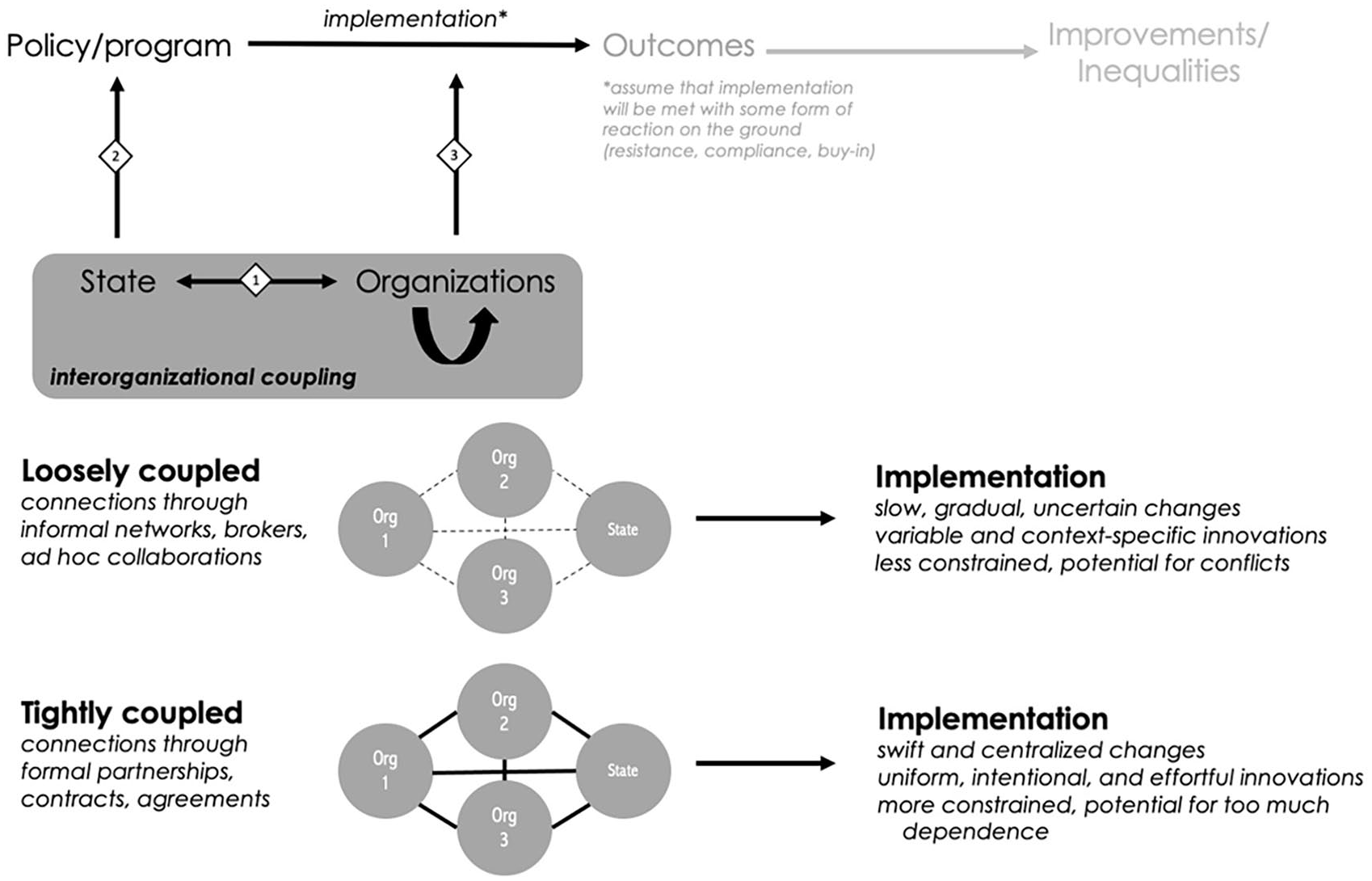
Integrating the coupling concept with the interorganizational literature, I conceptualize a loosely coupled system as one where organizations retain independence but are connected with other organizations through interpersonal relations, brokers, and ad hoc collaboration. On the other hand, a tightly coupled system is one where organizations depend closely on other organizations, and this dependence is formalized through partnerships, contracts, and shared data. I conceive of these two as forming a spectrum rather than discrete categories. Figure 1 provides a representation of organizations being loosely or tightly coupled.
Visual overview of interorganizational coupling.
For this research, I explore how the interorganizational coupling among school improvement organizations impacts the implementation of policies. Figure 1 illustrates a hypothesized overview of how this happens. First, collaborations happen among outside organizations, and between these organizations and the state. This may be in the form of research organizations recommending policies for a district, or philanthropic foundations infusing money to state or nonprofit agencies (Coburn et al., 2021; Reckhow, 2013; Tompkins-Stange, 2016). Second, the state agency—for example, school district—institutes a policy, program, intervention, or initiative that had been a consequence of outside organizations influencing the state’s decision-making. Third, organizations become involved in the implementation of these initiatives by translating research into practice, providing professional development or coaching, investing more resources on the program, or studying the effects of policies (Farrell et al., 2021; Honig, 2004; Scott & DiMartino, 2009). Ultimately, schools and school staff will implement the policies that impact proximal student outcomes, which then contribute to more distal social improvements and inequalities. For this research, I investigate numbers “1” and “3” in the figure as I suggest how interorganizational coupling influences implementation speed, variation, and constraint.
I hypothesize that a loosely coupled system contributes to slower, more gradual, and more variable changes because organizations are not formally connected and uncertainty is likely high. In this system, organizations are relatively less constrained and can create context-specific innovations (Pancs, 2017). However, the lack of constraints may also lead to potential conflicts among organizations due to unclear or overlapping division of roles. In contrast, a tightly coupled system contributes to swift, uniform, and largely centralized transformations because organizations had intentional connections and relatively clear vision. In this system, where organizations are more constrained and dependent on each other, deviations are less valued and sustainability may be threatened by the dysfunction or absence of one of the parts (Babb & Chorev, 2016).
Dropout Prediction Systems in Philadelphia, Chicago, and New York City
To study these concepts, I use the case of dropout prediction systems called ninth-grade early warning indicators (hereafter referred to as EWIs), which are used as yearly data points, just-in-time data tools, and preventative data systems to address high school dropout problems. Also known as Freshman OnTrack or Ninth Grade On-Track, EWIs have used real-time data on attendance, behavior, and course performance (Mac Iver & Messel, 2013, p. 50), and have been credited for increasing high school graduation rates, improving school processes, and addressing dropout inequities (Allensworth, 2013; Davis et al., 2019; Wentworth & Nagaoka, 2020). As data systems, EWIs did not just include yearly indicators and just-in-time data tools, they also include sets of interventions and structures that aim to facilitate student success (Balfanz & Byrnes, 2019).
Although most studies note the positive impact of EWIs, there are a number of limitations and open questions in this literature. Randomized controlled trials in various school districts have shown the impact of EWIs on reducing chronic absenteeism but not on affecting grades (Faria et al., 2017; Mac Iver et al., 2019). In one study in New York City, a program that provided early warning flags and mentorship to students at risk led to students in treatment schools being 9% less likely to be chronically absent, but had no effect on other outcomes (Balfanz & Byrnes, 2018). Teachers have feared that the “at risk” label might have negative effects on the labeled students but two quasi-experimental studies—one in Wisconsin and another in Massachusetts—show no negative effects of such risk label (Hansen, 2018; Perdomo et al., 2023). However, these two studies also note that EWIs had minimal or no impact on graduation outcomes—putting into question if EWIs were indeed helping reduce dropouts. Qualitative studies in California show that the lack of resources and proper training can be a barrier to implementing EWIs (Baharav & Sipes, 2020). Taken together, these studies show the promise of EWIs to improve short-term outcomes like attendance but are more limited in affecting graduation. One factor that may explain differences in outcomes is policy implementation (Pressman & Wildavsky, 1984), which is why this study interrogates the role of school improvement organizations in EWI implementation.
Even as EWIs were supported and practiced in places like Houston, Los Angeles, Louisiana, and Baltimore (Frazelle & Nagel, 2015; Mac Iver & Messel, 2013; M.Phillips et al., 2015), I chose the three urban areas—Chicago, Philadelphia, and New York City—for the following reasons: First, these were among the first urban centers in the early 2000s to systematically use data at the ninth grade to predict graduation. Second, organizations that have worked in these districts have been recognized as national leaders that help other districts establish their own EWIs. Third, these urban areas with large racial minority populations have been plagued with high dropout rates of around 50% in the early 2000s, but have since been improved through a number of changes that included EWIs (Balfanz & Legters, 2004; Nagaoka et al., 2019). Fourth, these districts offer comparative cases regarding varied trajectories that will be detailed further in this research.
Data and Methods
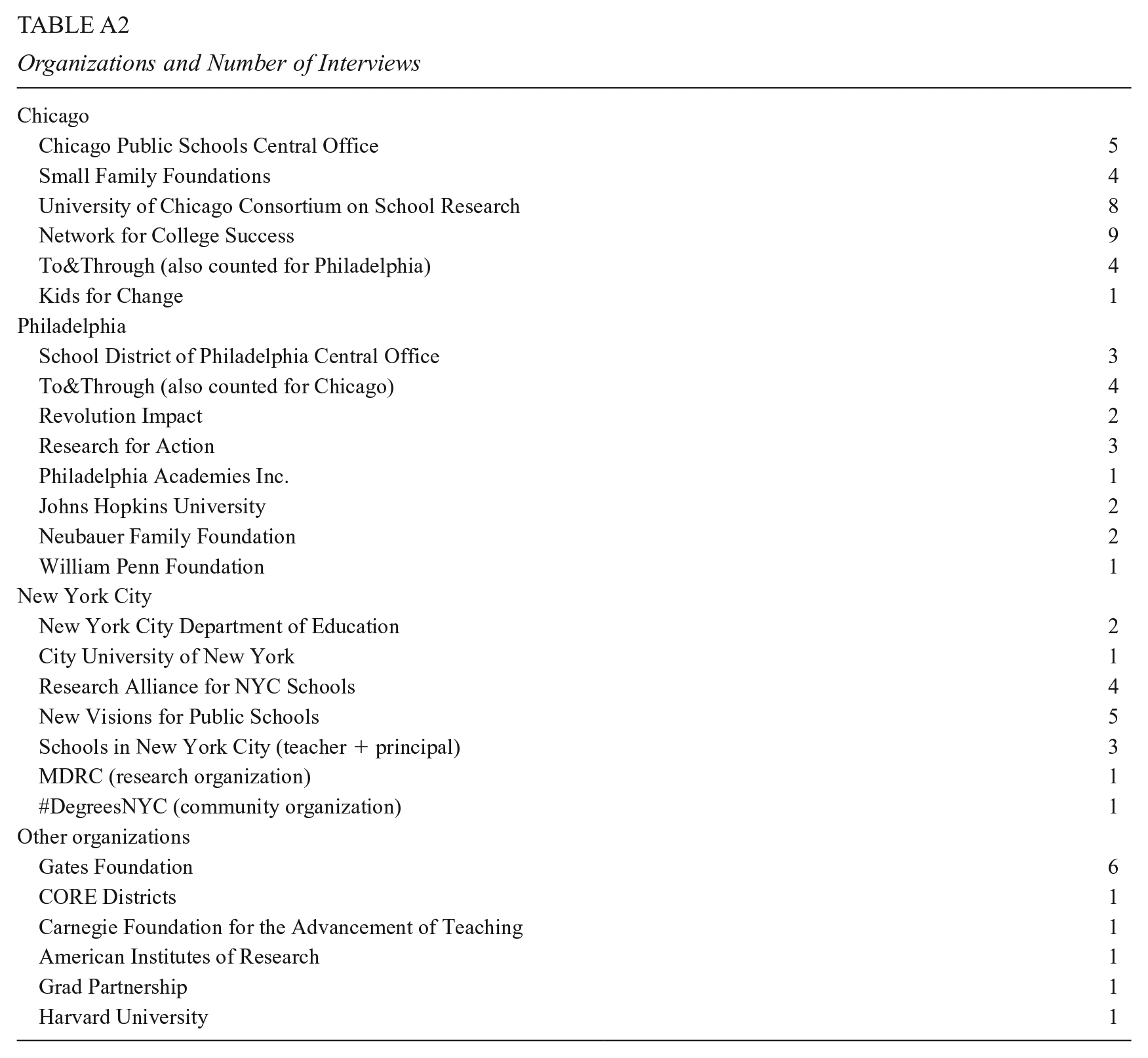
This article uses comparative case studies of the relationships among organizations that have been involved in initiating and implementing EWI systems in Chicago, Philadelphia, and New York City. It draws on variation not only across the three urban areas but also how these variations shifted through time. By comparing different districts, this study provides an in-depth understanding of “comprehensive structures and large-scale processes,” which are often not seen in big data studies or single case studies (Mahoney & Rueschemeyer, 2003, p. 7). In education, studies comparing school systems help show contextual and institutional factors that explain variation in processes and outcomes (Munoz-Chereau et al., 2020; Scott et al., 2017). Given the intention to understand the consequences of interorganizational connections, this study uses a comparative approach, attentive to the network structure of the different organizational stakeholders in a city (Provan et al., 2007). The key source of data were the interviews with 73 individuals in the 3 cities, which were supplemented and confirmed by documentary evidence totaling more than 2,800 pages (see Table A2 for details).
Sampling
This research used a combination of purposive and snowball sampling as I first determined organizations and individuals that worked on EWIs. To determine the organizations included in the analysis, I investigated published papers detailing efforts on EWIs, on-track indicators, and data use in the three urban centers. This search showed focal research organizations like Johns Hopkins’ Center for the Social Organization of Schools, University of Chicago’s Consortium on School Research, and New York University’s Research Alliance for NYC Schools. I also contacted a school support organization in New York, and a data organization working in Chicago and Philadelphia, both organizations recognized as pioneers in using EWIs. I reached out to directors of these organizations to gain permission, and they also referred me to others doing similar work.
Primary Data
I conducted semi-structured interviews lasting 30 to 90 min, with questions on their involvement in EWIs, the changes they’ve seen, their relations with other organizations, and instances of success or failure. Before interviews, I researched the individuals I would be speaking to, their published work, and their professional profiles. Given the public status of many informants and the difficulty of anonymizing organizations and positions, participants were asked if they would be willing to be identified (as approved in this study’s IRB application). Most participants agreed to being identified, except for one who requested anonymity and three who were working in schools. Given the high stakes of misrepresentation for my informants and myself as a researcher, I endeavored to fact-check all details in this research.
Supplementary Data
One way I made sure all details were accurate was by triangulating interviews with each other and with written documents. I compiled more than 2,800 pages of documentary evidence that included published documents and flyers, news articles in local dailies, district reports, company annual reports, published research, peer-reviewed studies, district handbooks, and organizational webpages. Spanning from 1999 to 2022, these documents were critical to map out and confirm historical trajectories and changes across the three cities. To promote open science, the documents are available at this DOI: 10.17605/OSF.IO/Z435F
Analysis and Validity
The comparative analysis included creating a historical timeline for each city, coding interviews, creating network maps, and verifying with documents. First, I created a timeline of the significant events related to EWIs between 1999 and 2022 in each city, using the interviews and documentary evidence. Second, I made a codebook of analytic themes inductively surfacing from the interviews and this timeline, and coded transcripts with the help of three research assistants. For example, our team coded “networks” as a main theme with subcodes like “organic networks,” “formalized networks,” and “philanthropic networks.” We also had codes for “shifts” happening in the three cities like “data use,” “positive,” “negative,” and “teacher team” shifts. To promote reliability of the coding, our team met weekly to discuss new codes or to address differences in coding. We also used social network theories of strong and weak ties as well as the network brokers to inform the creation of network maps (Burt, 2004; Granovetter, 1973).
Drawing on these interviews and supplemented by the documentary evidence, I created social networks among individuals and among organizations. At the individual level, a “formal tie” (solid line) denotes being co-workers, co-authors, or having some form of supervisory relationship while an “informal tie” (dotted line) denotes friendship, brokerage, or ad hoc collaboration. At the organizational level, a “formal tie” denotes contract-dependent partnership, data sharing, or formal funding while an “informal tie” denotes time-specific engagement or ad hoc supports. Ties were created whenever an informant talks about another individual or organization during their interview. In many cases, these ties were triangulated with documentary evidence from reports (e.g., funding reports), websites (list of partners), and published papers. Because efforts by organizations in Chicago were connected less by formal organizational ties and more by individual brokers and boundary-spanners, I emphasized the individual network ties in Chicago and the formal organizational ties in the two other cities. These ties were inputted in datasets of individual and organizational connections in each of the three cities, which were then used to create the network maps in the respective places.
Finally, once the interorganizational relationships were drawn, I went back to the data to look for cases that negated the interpretation of interorganizational coupling (e.g., individuals not mentioning ties with specific organizations). To check the validity of analysis, I shared the preliminary drafts with all the informants identified in this paper, providing a space for their feedback and opportunity to fact-check. Some informants made suggestions on their quotes (e.g., grammatical changes) or on facts (e.g., clarifying when a specific intervention started or stopped). In these cases, I made the necessary changes. Three of the 73 informants had interpretive suggestions, which I addressed with further conversations with them to clarify the point of the research.
Author Positionality
During the time of the study, I was a researcher based in Chicago, familiar with the EWIs in the city. I have been introduced to the director of the University of Chicago Consortium on School Research, which was instrumental in gaining access to organizations working on EWIs. Other facets about me that could have influenced this research were my being a male international doctoral student from a developing country in Asia. Given its novelty for me, I was initially interested in studying the use of these data systems and the role of nonprofits in their creation. This study happened during the COVID-19 pandemic, which is why all interviews happened over Zoom to comply with social distancing protocols.
Limitations
While I tried to be comprehensive in descriptions of historical changes, I also had to focus on particular periods or particular social or organizational connections. The analysis for Philadelphia was particularly challenging because there were two “periods” for its implementation—one in the early 2000s led by researchers from Johns Hopkins University and another in 2017 led by an organization from the University of Chicago. While I analyzed both periods and both periods could be characterized as tightly coupled, the present article focuses on the 2017 implementation because of the greater availability of sources. Nonetheless, I also noted instances of tight coupling in the earlier implementation.
Findings
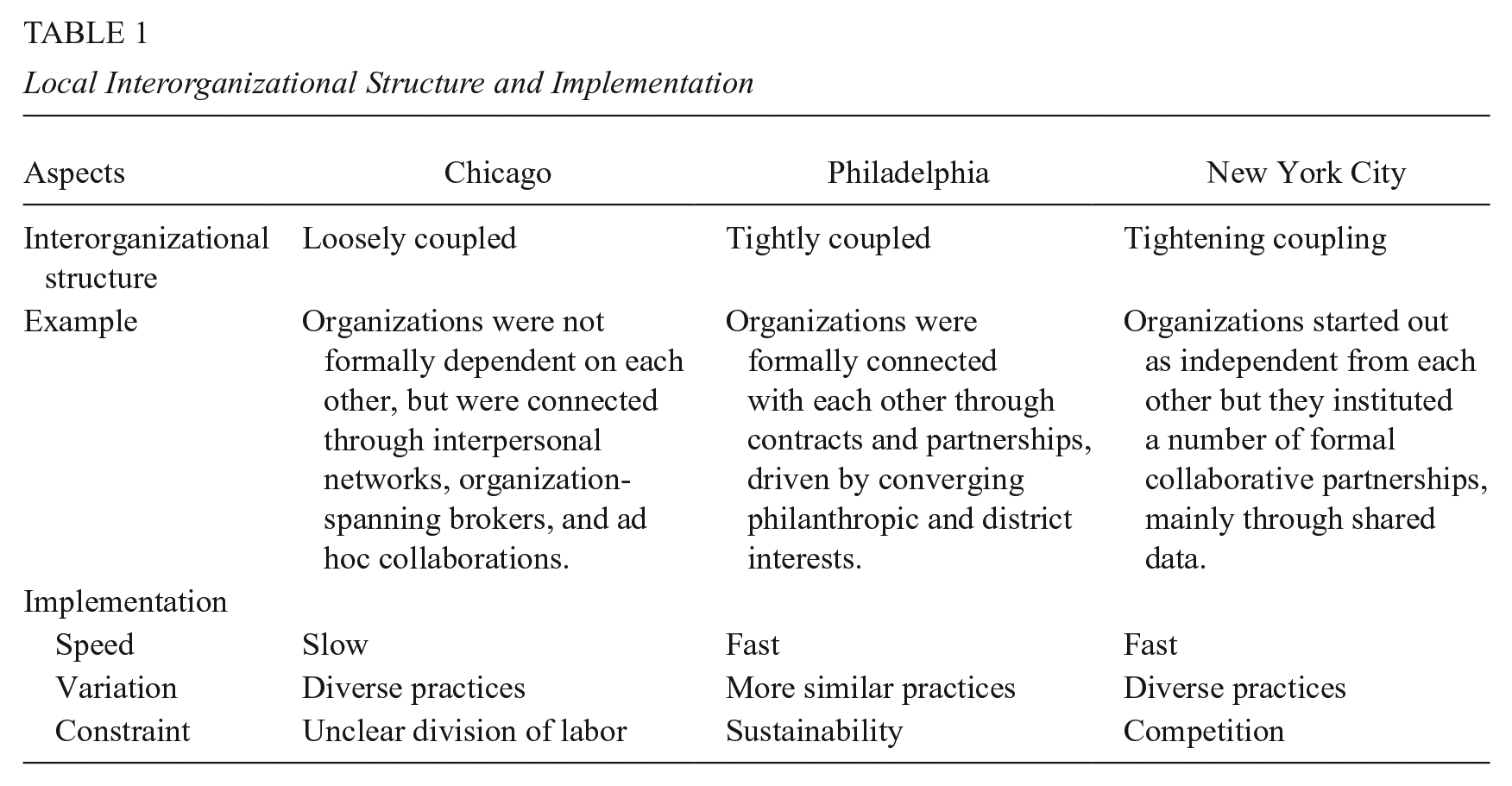
This research explores how the dependence of organizations with each other—interorganizational coupling—influenced implementation speed, variation, and constraint. Table 1 compares the network structure among organizations in each city, and what consequences such structures had for the implementation of EWIs.
Local Interorganizational Structure and Implementation
Loose Interorganizational Coupling in Chicago
In the late 1980s, the Chicago Public Schools was described by an education secretary as the worst school district in the United States (Associated Press, 1987). Since the late 1990s, however, the city’s school system has been characterized as having centralized control with a district Chief Executive Officer appointed by the mayor and increased local autonomy with local school councils (Bryk, 1999). The city’s public schools had largely catered to Black and Hispanic students, but the number of Black students had declined from 240,000 in 1981 to 156,000 in 2015 (Jankov & Caref, 2017). During the start of the millennium the 4-year graduation rate in the city was less than 50%, but this had risen to 82% by 2019 (Nagaoka et al., 2019).
In 1999, researchers from the University of Chicago created reports for elementary schools that showed where their graduates went, and how many were on-track or off-track to graduate at every year level. In 2003, this “on-track” metric at ninth grade was added to the district’s school accountability system. As researchers continued to study the metric’s predictiveness, the Chicago Public Schools created data systems that provided 5-week reports on which students were on-track or at risk of being off-track to graduate. In 2008, this was supplemented by coaching from the district and from a nonprofit called Network for College Success. In 2014, another group based at the University of Chicago created public data interfaces that showed schools’ on-track and graduation numbers through the years. As shown by the example, the loosely coupled structure did not have organizations formally depend on each other. Rather, the network was mainly kept and sustained by interpersonal relationships, boundary-spanning brokers, and ad hoc collaborations. I argue that such structure led to the slow and gradual use of EWIs, marked by variations in how they are implemented in schools, and constrained by unclear division of labor among organizations.
Structure of Interorganizational Relationships
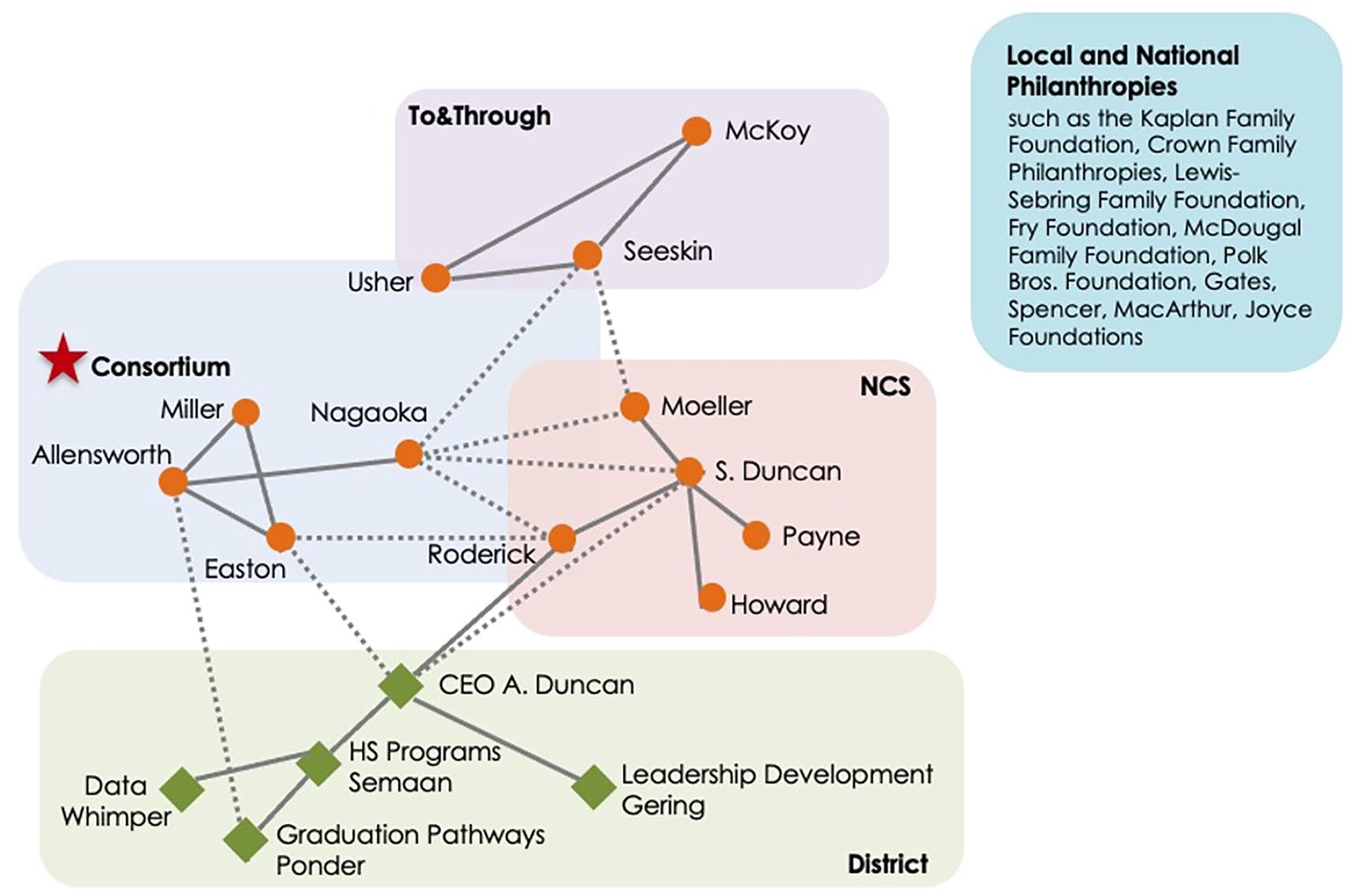
Instead of formal relationships, a loosely coupled network is often sustained by informal ties. Figure 2 shows four organizations that were key to the initiation and institutionalization of EWIs in Chicago but were less formally connected with each other. The effort started with researchers from the Consortium on Chicago School Research (Figure 2 top left) who found that ninth graders who had completed five course credits and failed no more than one semester of English, Math, Science, or Social Studies, were four times more likely to graduate high school than those considered “off-track” (Allensworth & Easton, 2005). Recalling OnTrack’s early days, John Easton—then the executive director of the Consortium—highlighted how the initiative moved from research to the district: We used [the on-track metric] in a big report . . . It talked about on-track rates, it might have talked about change in on-track rates over time, there was a little footnote about some validity evidence, and [CPS CEO] Arne Duncan read this whole paper and he remembered the on-track thing and that’s when he started putting it in the high school accountability system in 2002–2003.
Chicago network of individuals and organizations for freshman ontrack.
Chicago Public Schools CEO Arne Duncan attributed the start of OnTrack when Easton “presented to our leadership team—which was probably 100 or 125 of us,” highlighting a more organic rather than organized start to the EWI program. Inasmuch as the Consortium and the central district had formalized connections, it was the interpersonal connections—and trust—that spurred new activities in the district as it created offices designed to address high school programs, data systems, and graduation outcomes (Figure 2 bottom).
Another core organization was the Network for College Success (NCS; Figure 2 center), a school support organization devoted to leadership coaching, professional development, and learning circles for freshman success. Its two co-founders, Melissa Roderick and Sarah Duncan, were important brokers of relationships. Roderick may be considered an organization-spanning broker as she held different hats as professor at the University of Chicago, researcher at the Consortium, senior advisor to Arne Duncan, and co-founder of NCS. On the other hand, Sarah Duncan (who was sister to Arne Duncan) was a central node for collaboration shown in how she talked about the people they initially worked with: John [Easton] was a really strong connection to the Consortium while Melissa was there. We talked to Jenny [Nagaoka] all the time, and Elaine [Allensworth] more and more. Paige [Ponder], I didn’t know well, but we definitely met with her and talked to her. She’s since become a friend.
These informal connections—friendships, in a way—were important: Easton was the Consortium director, Allensworth headed the research efforts, Nagaoka led the public data project, and Ponder was the district’s lead for creating Freshman OnTrack systems. These webs of connections helped buoy a loosely coupled system that relied more on informal contacts and less on formal contracts.
A fourth organization was added in 2014 with the To&Through Project, tasked to provide education stakeholders with data on students’ educational outcomes and facilitate dialogue about them (Figure 2 top). This organization was also part of ad hoc collaborations among the three organizations that created a report on Practice-Driven Data (Moeller et al., 2018), a core document detailing their shared EWI work.
The different organizations were connected not by formal partnerships but by informal connections, brokers, central nodes, and ad hoc collaborations. While some may find fault in this loosely structured network, others see this as its strength. For example, Chicago philanthropist Charles Lewis, in an email after our interview wrote, “I am not suggesting that these collaborations should be more formalized . . . I would caution that formalizing them might jeopardize their effectiveness.”
Consequences of Loose Coupling
A loosely coupled interorganizational structure influenced the slow and variable implementation of the practice. Since organizations were not formally connected with each other, the spread of ideas depended on the slow work of building relationships. Thus, the work of EWIs spreads through diffused channels rather than central mandates. John Easton highlighted the importance of this slowness as, I likened [EWI implementation] to a slow idea. And what did it take for all this change in mindset to occur? I attribute it to the people in the schools and the people working with the people in the schools and the coaches . . . I think what’s really important is we had early champions, we had highly credible principals who found this OnTrack stuff.
It was individual connections and relationships—not the formal mandates or district policies—that changed things. Although the concept of EWIs started in 1999, it was not until 2003 that the district had this in the school accountability metric; in 2008, they introduced data tools and teacher team meetings; and in 2014, they started public data reporting. In this example, a loosely coupled group of organizations with no central organizer experienced slower implementation of changes.
In an environment where the loose structure was a boon, it was natural that implementation was similarly variable. Between 2003 and 2008, the district instituted a number of programs for ninth grade. It created an office for high school programs and graduation pathways, added Freshman OnTrack coaches in six schools, created data reports that provided a roster of students’ on-track status every 5 weeks, and had sets of ninth grade teachers. While it seemed that these programs were centrally mandated from the district, the reality was more variable. To&Through’s associate director Alexandra Usher said, “the district said being on-track is really important but what that looks like at your school might be different based on your context.” She continued detailing how some schools had summer bridge programs, some had ninth grade teams, some had separate uniforms for freshmen, and so on. In a way, a loose environment facilitated autonomous work with each other.
One challenge of such a system is when lines are blurred, no clear adjudicator is tasked to decide the specific bounds of an organization’s work. For example, To&Through originally started with the Consortium, but subsequently had to be its own entity. One of its original funders had approached the University of Chicago to start the project because “people were making what we would consider to be suboptimal decisions based on either Sunny Tuesday [i.e., overly optimistic] data or no data at all.” But this funder, who declined to be named, detailed why this project was not just subsumed in one of the organizations: There was this big fight between us and the Consortium, and that’s why To&Through kinda lives outside of the Consortium but is affiliated with the Consortium. Because essentially, some people in the Consortium felt like this wasn’t their job. Their job was not regular data reporting; their job was research.
This story highlights the frictions and challenges that come when organizations are not centrally coordinated. It was a challenge of distinguishing where one organization’s task ends and another begins—a challenge of how labor will be divided when no central actor facilitated such division.
Tight Interorganizational Coupling in Philadelphia
In 2002, after years of low achievement and budget crises in the School District of Philadelphia, the state of Pennsylvania took over the district, and turned over the management of some of the lowest-achieving schools to for-profit and nonprofit organizations (Gill et al., 2007). The School Reform Commission (SRC) had governed the district between 2001 and 2018. In 2018, the SRC had voted itself out of existence and was replaced by a new board of education, appointed by the city mayor (Cutler, 2022). Similar to Chicago, the district had catered to a large minority population with close to 50% of students identifying as Black. Between 2002 and 2021, the 4-year graduation rate increased from 50% to 80% (Neild & Balfanz, 2006; Pylvainen, 2022).
Although Philadelphia has had schools with EWI systems that had been developing since the early 2000s, it was only in 2017 that most district schools had a Ninth Grade On-Track program, supported by a partnership between a philanthropic foundation and the district. The foundation contracted the services of a Chicago nonprofit, which then brought in a school support/coaching organization and a project management group that would help create data systems and organize professional development for this new EWI system. These outside organizations working with each other were then connected with different offices in the school district, having weekly meetings with them. An independent research organization was funded by the same foundation with additional funding from another philanthropy, and its researchers worked with the district’s research office to come up with reports on the On-Track system. This example highlights a tightly coupled system where organizations are connected through formal contracts, partnerships, and converging interests. The network structure depends more heavily on administrative-legal and financial bonds rather than interpersonal connections. I argue that such a loose structure contributed to swift and uniform practices, but its sustainability is threatened by shifts in leadership and partnership.
Structure of Interorganizational Relationships
Philadelphia offers a curious story of formal organizations coming and going because of district support or lack thereof. Around the same time as Chicago’s EWI started, Philadelphia had researchers from Johns Hopkins University doing similar work, but they withdrew for a number of reasons I detail later in this section. The work was then taken up by the United Way of Greater Philadelphia and Southern New Jersey, and the Philadelphia Education Fund. However, in 2017, Joseph Neubauer, a Philadelphia businessman and philanthropist, proposed a program to the superintendent, William Hite Jr. The foundation’s executive director, Rebecca Cornejo, recounted, I think we convened a meeting and said, “Listen, Dr. Hite. Your goal is to improve the high school graduation rate. We have observed and applaud the success that’s happening in Chicago. Why don’t we try to bring that here to Philadelphia?” And so hence began the early To&Through work here at Philly.
The foundation was particularly familiar with this work in Chicago because Neubauer was chair of the University of Chicago’s board of trustees. Given the interesting history, other informants highlighted how this support was only a continuation and scaling of the work that had already been happening in select Philadelphia schools. For this research, I focus on the things that happened after 2017 to highlight the consequences of tight interorganizational coupling.
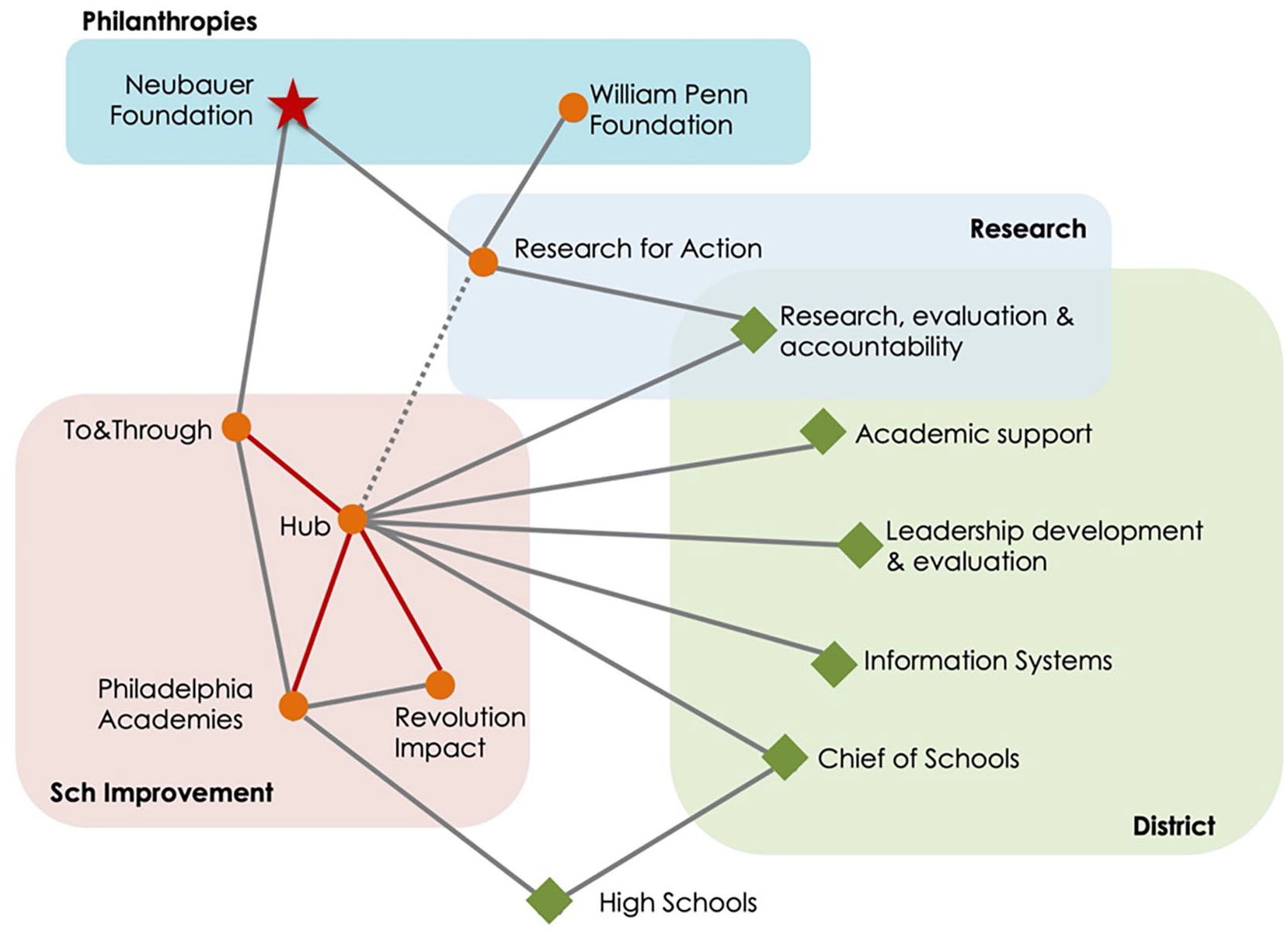
Figure 3 illustrates that the connection was initially established between the Neubauer Foundation and To&Through. The organization’s director, Alex Seeskin, said their role in Philadelphia was “trying to build data tools that enable schools to use early warning indicators [that are piloted in] high schools that participate and get weekly coaching for their ninth grade teams.”
Philadelphia network of school improvement organizations for ninth grade on-track.
To accomplish this, To&Through enlisted Revolution Impact as a project management consultant and Philadelphia Academies as a subcontractor working directly with schools. This triumvirate of school improvement organizations worked very closely with each other and with the school district. As shown in Figure 3, the three organizations were formally bound with each other and the district through a hub between the two groups. Revolution Impact’s CEO, Pranav Kothari, said they focused on “the implementation of data tools, professional learning, and in some cases, research to drive ninth grade on-track rates.” The work was not only driven by the three outside organizations since they regularly met with their district counterparts as well. Kothari recounted, We have a cross-organizational, cross-functional team that meets weekly online to help develop the data tools, develop the professional learning around the data tools, and then also overall inform how the district is implementing Ninth Grade On-Track. Actually, literally the meeting I had before this was an introduction on Ninth Grade On-Track to new assistant principals in the district and folks that are new to their roles for the current year. (Emphasis added)
He then mentioned the five offices they often worked with: research, academic support, leadership development, information systems, and the chief of schools (composed of the assistant superintendents). This weekly engagement suggested a tightly coupled system where organizations depended on each other’s work and alignment.
To complement these structural changes, Philadelphia Academies worked directly with schools to provide coaching, technical assistance, and professional development. They convened a network of 8 to 13 schools that shared best practices to help students stay on track. Its manager of data supports, Nadia Schafer, highlighted the importance of such coordination: There are definitely policies that come from central office that apply to all schools; any kind of district-wide professional development comes from central office and does apply to the whole district . . . But I think that’s just why it’s important to collaborate at that level of central office because it does have an impact on people across the district.
Such a tightly coupled system was also present as the district’s research office worked closely with an independent research organization, Research for Action, to create the Philadelphia Education Research Consortium. Its former director, Ruth Neild, mentioned how they worked with the district to write “a couple of different reports . . . like how early in the ninth-grade year can you predict falling off-track.” A dotted line between Research for Action and the school improvement organizations hints at the weaker tie between the two—much of the engagement happening during the start of the initiative.
Consequences of Tight Coupling
In a way, the organizations in Philadelphia were able to tightly couple since they had the benefit of the insights and experiences from Chicago. Such dependent and unified structure, however, was itself contributive to the swift and uniform implementation of the practice. While Chicago’s institutionalization was organic, Philadelphia’s was organized and strategic.
Although plans for the reforms only started in 2016, by autumn 2017, nineteen Philadelphia high schools had Ninth Grade Academies, which used EWIs and were described as “a school within a school, where freshmen have a dedicated group of specially selected teachers and extra supports” (Graham, 2018). In 2018, this program expanded to 28 schools, each with its own ninth grade assistant principal, and a core set of teachers who met weekly to discuss students’ individual progress, instructional plans, and interventions. While not all 54 high schools had it, all these schools had some professional development for data tools and practices to support ninth graders. Thus, the tightly coupled and strategically motivated interorganizational structure had led to swift implementation of this new data system and centralized efforts to institute changes.
Aside from the swift implementation, this tightly coordinated and centralized implementation promoted similar practices across schools: High schools had structures such as ninth grade academies and ninth grade principals. Centralized data systems were iterated and then used by teachers to predict students at risk of dropping out. Teachers received professional development and coaching to catalyze practices using these EWIs, and networks of schools shared practices with each other. However, uniform practices may have their downsides as To&Through’s associate director of engagement, Dom McKoy, shared, Investments in data infrastructure usually happen at a district-level and that takes resources. And so, I think that is really critical. . . [But] if the investment in doing this work solely lives at a top-down level, it doesn’t work. I think this has to be something that schools have the flexibility to implement, because it is so context dependent.
When organizations are tightly coupled and have a strong vision, these may come in the way of flexibility and discretion. Alex Seeskin highlighted that the EWI initiative required “a lot of different moving parts, a lot of different organizations, a lot of different people working in alignment together, and there are tensions and disagreements that naturally arise.”
What does one do with conflicts or when organizations are no longer aligned? This is a crucial question that hints at the constraint of having a tightly coupled system of organizations. Dan Berkowitz of the Neubauer Foundation questioned the capacity of the program to endure a superintendent transition, a legitimate question because of how a previous group in Philadelphia had failed to sustain the original EWI work in the district. In the early 2000s, a group of researchers from Johns Hopkins University studied the patterns of dropping out in Philadelphia and created early indicators to identify students at risk (Balfanz et al., 2007; Neild & Balfanz, 2006; Neild et al., 2007). However, in this tightly coupled environment, the withdrawal of support from any of the organizations can spell disaster for its continuation. In the case of this early group of researchers, as Ruth Neild recounted, “it became clear that the district wasn’t as supportive” as the previous administration. Thus, the program and systems created “fizzled out” although some of their aspects continued in certain district schools.
Tightening Interorganizational Coupling in New York City
In 2002, the control over New York’s school system was given to the mayor who had the power to appoint 7 of the 12-member body for education policy. High schools were organized into ten regions, each overseen by a regional superintendent (Zeng, 2009). Although there have been threats to mayoral control, the state had passed laws that kept mayoral control over the New York City Department of Education (DOE) (Amin, 2019). The city has a significant population of Hispanic and Black students, and the graduation rates have steadily increased from 54% in 2004 to more than 80% in 2021 (Amin & Zimmerman, 2022).
The use of data to track the progress of students in New York City did not start with research or philanthropy but with a partnership support organization called New Visions for Public Schools, with its network of district and charter schools. Around 2008, the organization created an on-track metric based on the work in Chicago, and their own just-in-time dashboard that used data on students’ course and Regents exam performance. Over the years, New Visions had developed their system—moving it from spreadsheets to a live website, harmonizing data with the NYC DOE through a data sharing agreement. Similar efforts were made between the NYC DOE and the City University of New York (CUNY) as the two instituted data sharing agreements to create longitudinal data that tracked high school students as they entered CUNY. In 2018, attempts were made to combine these data with data from community-based organizations (CBOs). Thus, within a decade, different organizations that were previously unconnected were formally bound through shared data. New York presents the case of organizations that were initially uncoupled or loosely connected but have become more tightly coupled through formal partnerships, shared data, and collaborative projects. I argue that this tightened network contributed to the swift diffusion of changes because of new technical systems, but that its implementation was varied because relational systems of support were not similarly set up. Moreover, a tightened system can be constrained by competition among organizations that vie to be in the coupled system.
Structure of Interorganizational Relationships
In 2008, when the Research Alliance for New York City Schools was founded, New Visions for Public Schools had an on-track metric that used a combination of completed courses and Regents exams to monitor student progress. The left panel of Figure 4 shows that during this year, education organizations were not very connected: Research Alliance was only starting to get data from the NYC DOE. New Visions was an organization with a portfolio of schools it supported. Most CBOs were working independently with each other. However, individuals in these different organizations saw an opportunity with connecting disparate data.
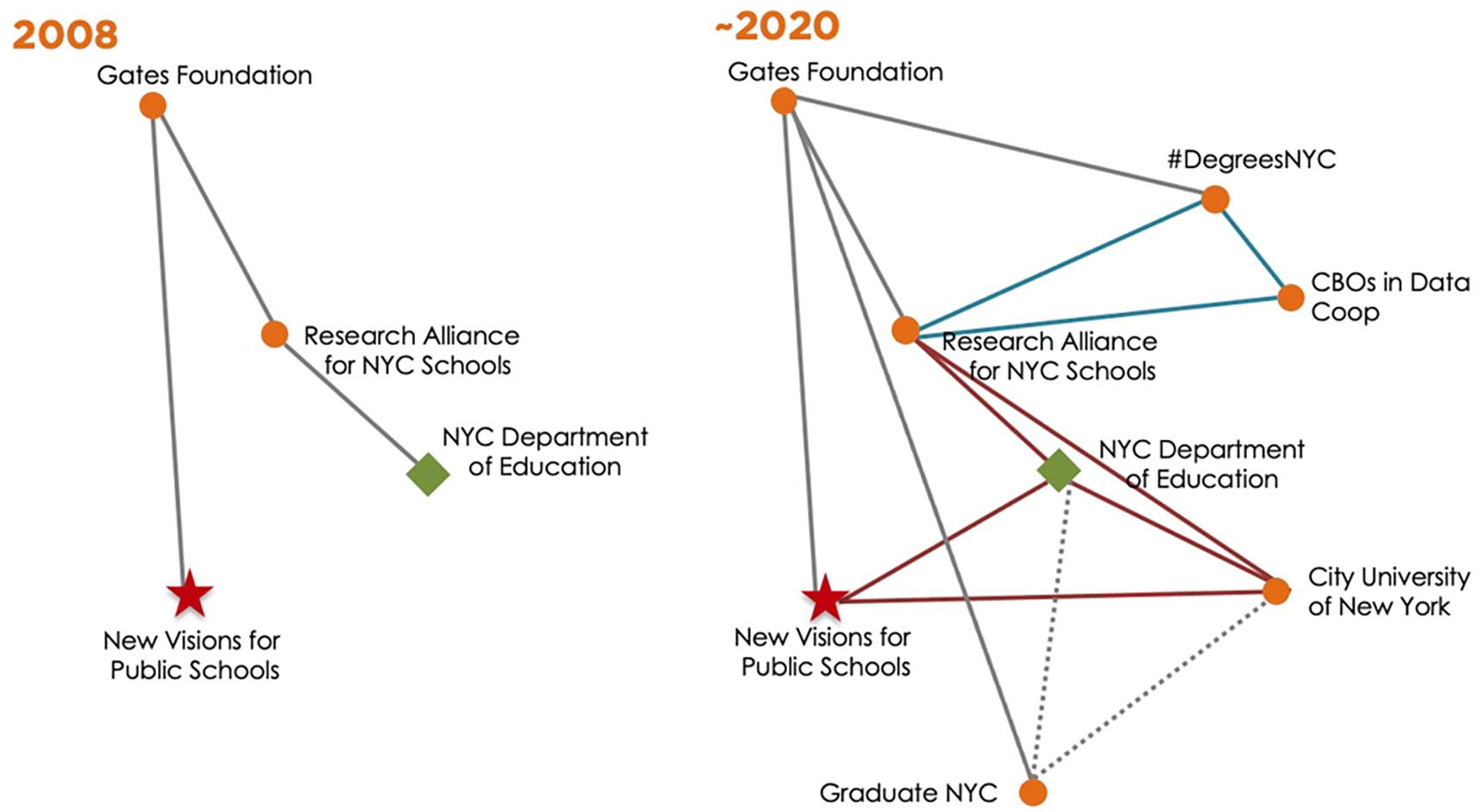
New York City network of organizations harmonizing data systems.
One of those organizations was New Visions for Public Schools. Its chief of staff, Nikki Giunta, highlighted how their data system moved from one spreadsheet tool with 276 columns that was updated monthly to a “full stack web application that . . . gets updated on a daily basis and allows [schools] to do student level planning alongside that data.” Called Portal by New Visions, the web application had data on attendance, course credits, Regents exams, and marking period grades—providing summary statistics for schools and a roster of each student’s current performance and missing credits for graduation.
While the data system was developed in New Visions, it needed data from different institutions like the NYC DOE and CUNY. Thus, the organization endeavored to establish data sharing agreements with these two institutions. Giunta said the Portal was “built in collaboration with New York City educators and the DOE to bring them current data.” New Visions’ deputy director of college success Jeremy Greenfield highlighted that, About a year and a half ago, we completed a data sharing agreement with CUNY that puts all of the college application data for all New York City public schools into the Data Portal, and so in that way, we’re connecting the DOE and CUNY . . . And then we have personal relationships, and we try to stay connected with them to understand what their efforts are and try to support them to achieve their goals. (Emphasis added)
Thus, these partnerships were being formalized to create connections across data systems (see right panel of Figure 4). Similar dynamics happened in late 2008 when the DOE and CUNY initiated their data sharing agreement. CUNY’s then dean for K-12 initiative, Cass Conrad, explained what brought this about: CUNY was initially very interested in doing analysis to try to understand what factors in a high school transcript were predictive of college success. We had some of the data from the application pool, but I think this data sharing agreement allowed much more fine-grained analysis, and similarly DOE was interested in trying to understand what’s happening to students once they graduated. So, there was a lot of interest in both directions—that’s what generated the agreement.
To formalize this, the two institutions created GraduateNYC that brought staff from both institutions to look at issues of student success.
Aside from the connections between DOE, CUNY, New Visions, and Research Alliance (red lines on the right panel of Figure 4), CBOs were also being connected because of leaders from Research Alliance and a nonprofit called #DegreesNYC. Lisa Merrill, a research associate from the Research Alliance, mentioned how their organization shared analysis and results to the CBOs which formed part of the “Data Co-Op.” #DegreesNYC’s director Judith Lorimer mentioned that the Co-Op was originally “a group of 14 community based organizations that were joining their data at the student level with the Research Alliance’s longitudinal educational database,” where CBOs get aggregate reports on their students’ data. By early 2022, the Co-Op included 19 CBOs.
Consequences of Tightening Coupling
When organizations collaborate and data are successfully integrated, they open opportunities for sophisticated technical systems. When asked about early warning systems, Research Alliance’s director James Kemple pointed out the Data Portal, saying, “the very best [data] tools have been developed by New Visions . . . [They] put the highest possible premium on data use, data development and collection and analysis, and accessibility to all of their practitioners, their principals.” In terms of implementation, it was swift as the Portal became widely accessible in 2018 to all New York City high schools. Because the technical systems were formally coordinated, it was easy for the Portal to be used by schools and teachers.
However, there was a lot more variability in terms of how the technology was taken up. On one end are coaches like Jamie Esperon who spoke about the significant gains from having such a Portal as she coached her schools. She talked about one of her schools that made tremendous progress in just a matter of years: This is a school that went from 55% grad rate to 90% grad rate over the course of six years . . . The work that the school is engaging in for PD [professional development] is looking at academic and attendance related data. The school has an advisory program, where a teacher is assigned a group of students where they serve as the academic and social emotional point person for each child. . . . The advisory teachers use the Portal to access their advisory students’ data, which presents information and data in a way that is digestible and easy to understand, but more importantly they can use the data to make decisions and take actions that best support their advisory students. (Emphasis added)
She highlighted the possibility with this tracker that showed what supports were necessary for students. Of course, this was for a school that had the luxury of coaching. Most other schools did not have it. This “high-touch” approach of having one coach shared among 10 to 15 schools was what New Visions had with its own district and charter schools.
On the other end are schools that do not have access to coaches and supports, and which consequently did not regularly use the Portal. As Nikki Giunta acknowledged, “Being in 1600 schools, we obviously can’t do that, so we provide citywide training where we train them in any new functionality.” Thus, some schools had incorporated certain strategies more than others. Giunta followed, “it’s one thing to provide them with the tool, [but] very few people are going to be able to just dive right in and get going.” This explains how the relational aspect could drive greater variability.
When organizations are becoming more connected with each other, there is also a challenge with competition among organizations. Judith Lorimer who tried bringing together different CBOs said, “People are terrified to share their outcomes with each other . . . because it feels like you’re giving up some advantage you have in being secret about what your program’s data is.” This highlights the potential downsides of tightened interorganizational links brought about by foundations that choose which organizations to fund. Moreover, Kristin Black from the Research Alliance, highlighted the potential disadvantage of this competitive marketization of public education as relegating to private organizations “things that should be citywide structural improvements.” Thus, an ever tightened interorganizational structure may have its own set of challenges for implementation of public policies.
Counterarguments and Alternative Explanations
A number of arguments may be made against the utility of the concept on interorganizational coupling, and I engage those arguments in this section.
Non-Generalizability
Some may argue that there are essentially three cases I draw from, and that this is not generalizable. To address this, I have to clarify the intent of this project. It is not to confirm theory but to build a concept about interorganizational coupling. My goal is not to say that a tightly coupled system, for example, always predicts faster implementation of policies. Rather, this paper’s contributions are more modest but nonetheless essential: First, I show how school improvement organizations are consequential for the implementation of policies. Second, I suggest that what matters are not discrete dyadic relationships between organizations and school systems, but the inter-organizational interactions in the system. Thus, the structure of the network is what researchers should attend to, more than the individual ties between organizations. The three cases provide analytic leverage to see potential consequences and constraints of the coupling of these organizations. To make an argument of generalizability will be a second-order project that needs to build on the conceptual possibility and validity of the coupling I suggest.
Temporal Explanation
Another set of arguments may be made that what mattered was not interorganizational coupling but the time that has elapsed. In a way, Philadelphia’s swift implementation and Chicago’s slower one could be due to the latter’s first-mover disadvantage as it needed time to legitimize, learn, and adapt its early warning systems (Dobrev & Gotsopoulos, 2010). To address this, I use the case of New York since the city went from a loosely coupled set of organizations to one that was tightly coupled by shared data and funding. Even as New Visions was able to improve their data tool, this could only go so far without data from the DOE and CUNY. As one New Visions coach mentioned, the ability to have such harmonized data was a “game-changer,” something that was unlikely to happen without the coupling of these organizations. While I am not discounting the contribution of time to help with improvement, time was not sufficient to implement centralized technical data systems in New York; what was needed was tight interorganizational coupling.
Cultural Explanation
Others may then argue that what could explain the differences in trajectories was the district’s culture itself. In a sense, Philadelphia’s EWI implementation was uniform and Chicago’s was diverse since they merely reflected the district’s respective centralized or decentralized structures. However, I again use New York as a case where the tightened interorganizational structure was the constitutive element for the adoption of data tools, independent of the centralized mayoral control of city schools that was already in place in 2002 (Elwick, 2017). One way to reconcile these ideas is to think about how outside organizations and philanthropies are sensitive to the political and cultural environment or changes in a district, such that their interorganizational structure is responsive to this larger environment. However, despite being responsive to such a system, the interorganizational structure is still the main aspect driving the change.
Counterfactual
A quantitative researcher may question what the counterfactual situation is to coupling. Is the counterfactual that organizations work independently of each other, or is it that the district works alone? In this research, I conceive of coupling as an expansive heuristic that may be applied even to organizational subunits coordinating with each other. Thus, the counterfactual is when organizations (or organizational subunits) work independently of each other. For example, Jennifer Bell-Ellwanger, who previously worked as research director at the NYC DOE, talked about her subsequent work in Baltimore as they created “red-yellow-green dashboard of chronic absence and alerts,” and how this got “a lot of pushback because you have not brought your school leaders along with it”—something an organization like the NCS would have helped with. Although hypothetically these initiatives may be developed and furthered within the district, outside organizations have the advantage of focus and flexibility. As one coach from NCS said, NCS can come into a school, with a much narrower focus than other people . . . We will never have that tool that is the heavy club of accountability—we can’t fire anybody—but because everybody knows that about us, I think we are offered the opportunity to engender a different kind of trust and to push people in different ways.
Thus, this conscious separation and distinction from the district affords outside organizations an opportunity to cultivate different forms of relationships in schools.
Social Desirability
Some may find suspicious the accounts of organizational actors that had incentives to promote the EWI program. I address this in a number of ways. First, I showed both the positive and negative consequences of these interorganizational interactions in all three urban areas. Second, many of these examples came from the informants themselves who were candid about the challenges, resistances, and failures they experienced. Third, the data were verified, confirmed, and triangulated with other interviews and documentary evidence. Finally, I endeavored to critically and reflexively assess my own interpretations of these data.
Discussion and Conclusions
Theoretically, this study asks how organizations, and their interactions with each other, influenced the implementation of school initiatives. Empirically, it asks how the structure and relationships of school improvement organizations influenced the implementation of EWI systems. Using comparisons of Chicago, Philadelphia, and New York City, I found that the structure of organizational relationships—what I detailed as interorganizational coupling—had implications for implementation speed, variation, and constraint. In Chicago, the loosely coupled system influenced slow and varied implementation, sustained by interpersonal relations and challenged by unclear division of labor. In Philadelphia, the tightly coupled system shaped swift and uniform changes, constrained by questions of sustainability. In New York, the tightening system led to swift yet varied transformations, limited by competition among organizations. In this study, I argue that the network structure of school improvement organizations had core consequences for the implementation of school policies, and there are a number of ways for researchers to study the field of school improvement organizations in local districts.
Theoretical Implications
While the research is specific to three urban contexts implementing unique data systems, its concepts and insights may be applied to and shed light on other examples of school improvement initiatives, interactions among complementary organizations, and relationships among state and non-state actors. I argue that this perspective emphasizing the work of outside organizations and their dependencies with each other has key contributions to the study of education and organizations.
In terms of education, this research contributes to an understanding of how more distal factors like the ecology of school improvement organizations contribute to, or help address, school inequities. In the case of this example, different organizations had worked to reduce high school dropouts through new data systems and through interactions with different levels of the school bureaucracy (Graham, 2018; E. K.Phillips, 2019). In a decentralized system like the United States where federal state intervention is met with suspicion (Morgan & Campbell, 2011), these outside organizations could strongly yet subtly influence important education and social changes. While the outcomes of “outside” intervention on EWIs were generally positive, organizations can wield a lot of power that may have unintended consequences (Russakoff, 2015). By understanding various stakeholders, their connections with each other, and the larger structure of the network, the public may keep in check the power of these private organizations. Such public–private collaborations happen globally as in the case of Teach for All and the Programme for International Student Assessments (Engel & Frizzell, 2015; La Londe et al., 2015); nationally in the United States as in RPPs and philanthropies (Coburn et al., 2021; Saltman, 2010); and locally in school districts as in intermediary and support organizations (Fruchter, 2020; Honig, 2004). In the current context of ideological conflicts on what to teach in schools, there is a greater need to investigate “outside school” organizations—individually, as a group, and in relation with one another.
More than investigating the consequences of single organizations or sectors on schools, I argue that interorganizational connections and their structure are focal sites of investigation. Drawing on and building from the work of other education scholars studying networks (Ball, 2008; Reckhow, 2013; Scott & Jabbar, 2014), I show that interorganizational links matter for the implementation of school initiatives. More than individual links, however, I also show that the structural coordination and dependence of these organizations can impact the local implementation of school improvement. The present study notes extreme examples of tight and loose coupling, but systems may lean toward being more tightly or loosely coupled with each other. It may be possible that in the same district, some organizations are more tightly coupled (e.g., research and district offices) while others are more loosely connected (e.g., nonprofits and specific schools). It is also possible for organizations to be tightly coupled at the beginning as projects start with close collaborations, but become loosely coupled through time as new tasks need flexibility and relative independences among organizations. Researchers may thus interrogate what are the consequences of such hybrid forms of interorganizational structure.
The concept of interorganizational coupling (e.g., whether certain organizations tend to be more tightly or loosely coupled with each other) can be a helpful concept to characterize different relationships across various levels in the education system. It can describe the relationship (a) between the central district office and school improvement organizations, (b) between schools and the organizations they work with, (c) among improvement organizations themselves, or (d) among schools that work with each other. Because the concept of coupling may be tied to the task of leadership and collaboration, it may also be used to connect to literatures on distributed leadership and networked improvement communities (Bryk, 2015; Spillane, 2012). Although I use the concept to describe the development and implementation of a policy (i.e., EWIs), the characterization of tight or loose coupling may be a more stable relationship as in many RPPs, or may be ad hoc as in school service providers (Burch, 2009; Coburn et al., 2021). Other researchers may use the concept to interrogate the creation of new policies, the engagement of different stakeholders, and the outcomes of such work. Finally, studies may also interrogate how the type of coupling can be beneficial in particular conditions such as a tight system helping a technical policy change while a loose system helping relational and cultural changes.
In studying organizations, one core debate is in terms of the appropriate level of analysis, as research may be done on the level of the individual, organization, and community (Neal & Christens, 2014). One auxiliary argument that may be made from this research is that a loosely coupled system like Chicago is initiated and sustained by individuals with informal and interpersonal relationships, while a tightly coupled system like Philadelphia or New York is pushed forth by organizational connections through formal contracts and shared agreements. Thus, the level of empirical analysis may substantially differ depending on the type of coupling in a given system.
Methodological Implications
In addition to the substantive and theoretical implications, the study applies creative methods for the study of education, organizations, and school improvement. Although I drew on the usual qualitative interviews and documentary evidence, the design of the project had a number of innovations for education research.
Rather than investigate schools, the research focused on “outside school” organizations. Although some may consider this a limitation, I contest that understanding these elite organizations and entrepreneurial individuals can help us more fully understand dynamics of school change. Moreover, this attempt at an organizational sociology of elites can help uncover how these networks matter for inequalities, similar to how studies of elite students help shape our understanding of merit and inequalities (Khan, 2012).
Rather than concentrate on one organization like what most ethnographers do, I focused on the networks of organizations—investigating how the generative changes happened in the interstices of those networks rather than simply within organizations. Although education research is not foreign to network studies, many of these are at the level of individuals rather than organizations, with a number of exceptions like Scott and Jabbar (2014) and Reckhow (2013). My research on networks, however, did not arise out of formal surveys on who was connected with whom but through interviews and documents that suggested interorganizational and interpersonal connections. Thus, it highlights the promise of combining interview and historical data to understand networks similar to Padgett and Ansell’s (1993) network study that relied on historical data on renaissance Florentine society.
Rather than understand one network at a particular time point, I employed a comparative approach similar to comparative historical sociologists. While comparative historical analysis often focuses on large-scale outcomes and national comparisons (Mahoney & Rueschemeyer, 2003), I show that elements of this method may be incorporated for comparisons across urban areas with shorter time periods. Moreover, I also integrate the comparative analysis with the network analysis to suggest the potential synergy of using both methods. Thus, these different methodological design elements present ways of appropriating qualitative data collection for comparative historical and interorganizational studies of education.
Limitations
Despite the theoretical contributions, this study has a number of limitations. First, the study has been unable to interrogate effects on educational outcomes like graduation or dropout rates because of the relatively recent programs in Philadelphia (2017) and New York City (2018). Given the long-term outcome and the disruption in schooling caused by the COVID-19 pandemic, such comparisons may fail to hold water and may need to wait some more years. Second, because of space limitations, I focused on a comparative study of the three cities even as there were some connections across the three (e.g., To&Through, Consortium-Research Alliance). It would have been possible to create another section linking these three cities, but this will distract from the main arguments of the paper. Third, I have endeavored to be as exhaustive as possible with the organizations and individuals interviewed but because of inaccessibility of some respondents, there is the possibility that networks are incomplete. Nevertheless, the fact that these results have been fact-checked and confirmed with the organizations provides strong support for the extensiveness of the study.
Conclusions
Outside organizations matter for the initiation, implementation, and institutionalization of state policies and programs. In this research on high school dropout prediction data systems, I show that the levels of dependence and coordination among research, philanthropic, school support, and government organizations were critical for implementation speed, variation, and constraint. By developing the concept of interorganizational coupling, I encourage other researchers to interrogate the structure of outside school improvement organizations more than just schools as well as to view interstitial interactions rather than mere organizational activities.
Footnotes
Appendix
Organizations and Number of Interviews
| Chicago | |
| Chicago Public Schools Central Office | 5 |
| Small Family Foundations | 4 |
| University of Chicago Consortium on School Research | 8 |
| Network for College Success | 9 |
| To&Through (also counted for Philadelphia) | 4 |
| Kids for Change | 1 |
| Philadelphia | |
| School District of Philadelphia Central Office | 3 |
| To&Through (also counted for Chicago) | 4 |
| Revolution Impact | 2 |
| Research for Action | 3 |
| Philadelphia Academies Inc. | 1 |
| Johns Hopkins University | 2 |
| Neubauer Family Foundation | 2 |
| William Penn Foundation | 1 |
| New York City | |
| New York City Department of Education | 2 |
| City University of New York | 1 |
| Research Alliance for NYC Schools | 4 |
| New Visions for Public Schools | 5 |
| Schools in New York City (teacher + principal) | 3 |
| MDRC (research organization) | 1 |
| #DegreesNYC (community organization) | 1 |
| Other organizations | |
| Gates Foundation | 6 |
| CORE Districts | 1 |
| Carnegie Foundation for the Advancement of Teaching | 1 |
| American Institutes of Research | 1 |
| Grad Partnership | 1 |
| Harvard University | 1 |
Acknowledgements
The author thanks the expert mentorship and advise from Stephen W. Raudenbush, Guanglei Hong, Elisabeth S. Clemens, and Micere Keels. He also acknowledges the research assistants who worked on the project to transcribe and code the interviews, including Emilio Borromeo, Isid Victor Alngog, April Jewel Domingo, Bianca Mikaila Aguilar, Sofia Isabella Rome Nagrampa, and Mariane Desiree Avendano. Finally, the author thanks the reviewers, editors, and participants in workshops at the University of Chicago, New York University, Washington University in St. Louis, Vanderbilt University, University of Southern California, University of California Berkeley, and the American Educational Researcher Association’s Annual Meeting. All shortcomings are entirely the author’s. This research has been approved by the University of Chicago’s Institutional Review Board. All human subjects gave their informed consent prior to their participation in the research, and most approved to being identified, as written in this study’s IRB application.
Declaration of Conflicting Interests
The author declared no potential conflicts of interest with respect to the research, authorship, and/or publication of this article.
Funding
The author(s) disclosed receipt of the following financial support for the research, authorship, and/or publication of this article: This work is supported by the American Sociological Association’s Doctoral Dissertation Research Improvement Grant, the Charles Henderson Fund, and the National Academy of Education/Spencer Foundation’s Dissertation Fellowship.

JOSE EOS TRINIDAD, PhD, is assistant professor of education policy at the University of California, Berkeley. His research focuses on the influence of outside organizations on schools and on theorizing schools as organizations.