




Abstract
We evaluate public opinion on the sufficiency of school funding and teacher salaries in the United States, using a representative survey (n = 12,151). Data were collected during the COVID-19 pandemic (2020/2021), with schools and teachers having a reduced role due to homeschooling. While opinions are diverse for sufficiency of school funding, most respondents indicated that teacher salaries should increase. For respondents who received additional information about average school funding and teacher salaries, the overall opinion about funding and salaries being insufficient was less strong. Furthermore, this information effect differs as per respondents’ demographic variables.
Keywords
Introduction
Hence, public opinion—and its measurement—are an inherent part of the continuous process of policy development, justification, and evaluation, involving various stakeholders such as policymakers, civil society organizations, journalists, and scientists (Key, 1961; McClellan et al., 2018; Shapiro, 2011). For example, policymakers can benefit from monitoring public opinion, to adjust (proposed) policies for meeting the needs and preferences of citizens (Bauch & Goldring, 1995; Patashnik, 2014). However, being an important part of the political process in a democratic system, policymakers are (also) concerned about electoral success, which can be achieved by focusing their policies on the preferences of particular social groups (Malin & Lubienski, 2022; Sinclair & Brooks, 2022). In turn, the policies implemented as well as the public information and elite-driven communications about these policies can influence public opinion (Kickert, 1995; Reed, 2001; Zaller, 1992). For example, Busemeyer et al. (2018) investigated how various forms of information impact public opinion concerning educational spending in the United States and Germany. They found that additional information significantly changes reported preferences on educational spending, especially in the case of those who had earlier underestimated actual teacher salary levels and overall educational spending. This result can be attributed to the effect of making particular types of information more explicit, when opinions from citizens are solicited. The provision of specific information through opinion polls prompts respondents to rely relatively more upon those particular pieces of information, from among the range of all available—and potentially even conflicting—information on the topic (Zaller, 1992). Against this backdrop, it is relevant to understand how public opinions on school funding vary for different demographic variables and how distinct groups answer differently following provision of additional information on school funding (Anderson, 2007). Such analysis provides an insight into the demographic differences in (the expression and potential formation of) public opinions. This in turn is relevant for assessing potential differences vis-a-vis how various social groups are involved in and affected by the policy development process (Levinson et al., 2009; Willems, 2017).
Moreover, while the observed changes in the mutual interaction between public opinion and policy development are rather continuous and incremental, stronger disruptions can happen in the event of crises (Schmidt, 2011). In recent years, the COVID-19 pandemic—and the societal and economic consequences of the lockdown—have generated substantial changes and disruptions in the education of students. For instance, in most K–12 schools, the mode of education shifted, often for an extended period of time, from a “traditional” mode with students attending schools in-person to “hybrid” or “fully-virtual/distance-learning” modes (Burbio 2023) with parents being called on to assume different and often relatively larger roles in the educational process (Andersson & Willems, 2023; Goldhaber & Theobald, 2022; Griffith et al., 2023; Mifsud, 2022). As a result, the (perceived) roles of schools and teachers also might have changed (Richmond et al., 2020); correspondingly, public opinion on the need and sufficiency of their funding might also have shifted. During crises, policymakers often decide on unforeseen measures that have far-reaching consequences (such as the COVID-19 lockdown measures). However, information that is scrutinized through public debates on the direct (expected) impact as well as the potential side effects of these measures is often limited or nonexisting (Devine et al., 2021; Schraff, 2021). Moreover, due to the more urgent and less scrutinized nature of crisis decision-making, the available information can play a different role, when compared with noncrisis situations. For example, on one hand, people might have to rely more on the scarce information that is available for their opinion formation, while on the other hand, they might not fully trust this information (Fuest et al., 2023; Newton, 2020). Therefore, while it is largely relevant to study how individuals express opinions differently because of data availability, additional insights can be obtained when large-scale data collected during a major crisis, such as the COVID-19 pandemic, can be analyzed and compared with insights from before such a crisis.
Building upon the existing literature on public opinion related to educational matters, in particular the literature on school funding and teacher salaries, this study has two aims. First, we analyzed data from more than 12,000 U.S. respondents during the 2020/2021 academic school year, evaluating their perceptions about the sufficiency of school funding and teacher salaries. In doing so, we examined how these opinions differ for a variety of demographic variables, including political identification, age, household income, parental status, race, and level of urbanization. As these data were collected during the apex of the COVID-19 pandemic, we compared our findings with earlier studies to assess how public opinions on school funding and teacher salaries substantially changed during the COVID-19 pandemic.
Second, we studied, using an experimental survey design, if and how opinions differ when more concrete information on actual school funding and teacher salaries is provided. In particular, we looked at whether a respondent’s background variables could help explain any difference in opinions as a result of additional information about school funding and teacher salaries, that is, whether some social groups were particularly susceptible to additional information while offering their opinions. In doing so, we built upon insights from Houston (2021), Lergetporer et al. (2018), and Valant and Weixler (2022). This study follows a growing trend in public opinion scholarship, which focuses upon how information affects support for education policy and education spending (Busemeyer et al., 2018; Houston, 2021; Schueler & West, 2016).
Data and Method
The data for this project were collected by the U.S. nonprofit organization EdChoice and made available to the authors for scientific analysis. Information about EdChoice’s regular data collection process among the general U.S. population can be found on their website: edchoice.org, while detailed information and details regarding the data collection for this research are given in our online supplementary materials. The data reported herein is part of a larger and ongoing data collection initiative wherein U.S. citizens are surveyed on a monthly basis about various aspects of school quality, choice, and personal preferences. Each month, between 1,100 and 2,200 respondents are polled (nonrepetitive participants). For this study, we relied on data collected between August 2020 and May 2021, resulting in a total sample of 13,637. Out of this total sample, 12,347 respondents provided answers for both the dependent variables that focused on school funding and teacher salaries, respectively. A total of 12,151 respondents provided responses for all the variables in our analysis, including the two dependent variables as well as the demographic variables regarding political identification, age, household income, parental status, race, and level of urbanization. Descriptive statistics for the sample are presented in the online supplementary materials.
The survey included two questions, each with two variations, regarding respondents’ opinions on the sufficiency of school funding and teacher salaries. For both questions, respondents were randomly split into two groups: Group 1 “without information” and Group 2 “with information.” The formulation of the questions and the treatments are outlined and illustrated in Figure 1. As budgets and salaries can differ across states (depending on different state policies), the information received was adjusted to the state in which a respondent lived (see Figure 1), which was determined based on the zip code where the respondent lived. Respondents who received information for the question on funding also received information for the question on teacher salaries; and respondents who did not receive information for the question on funding did also not receive information for the question on teacher salaries. In total, 6,111 respondents received the treatments without information and 6,040 respondents the treatments with information.
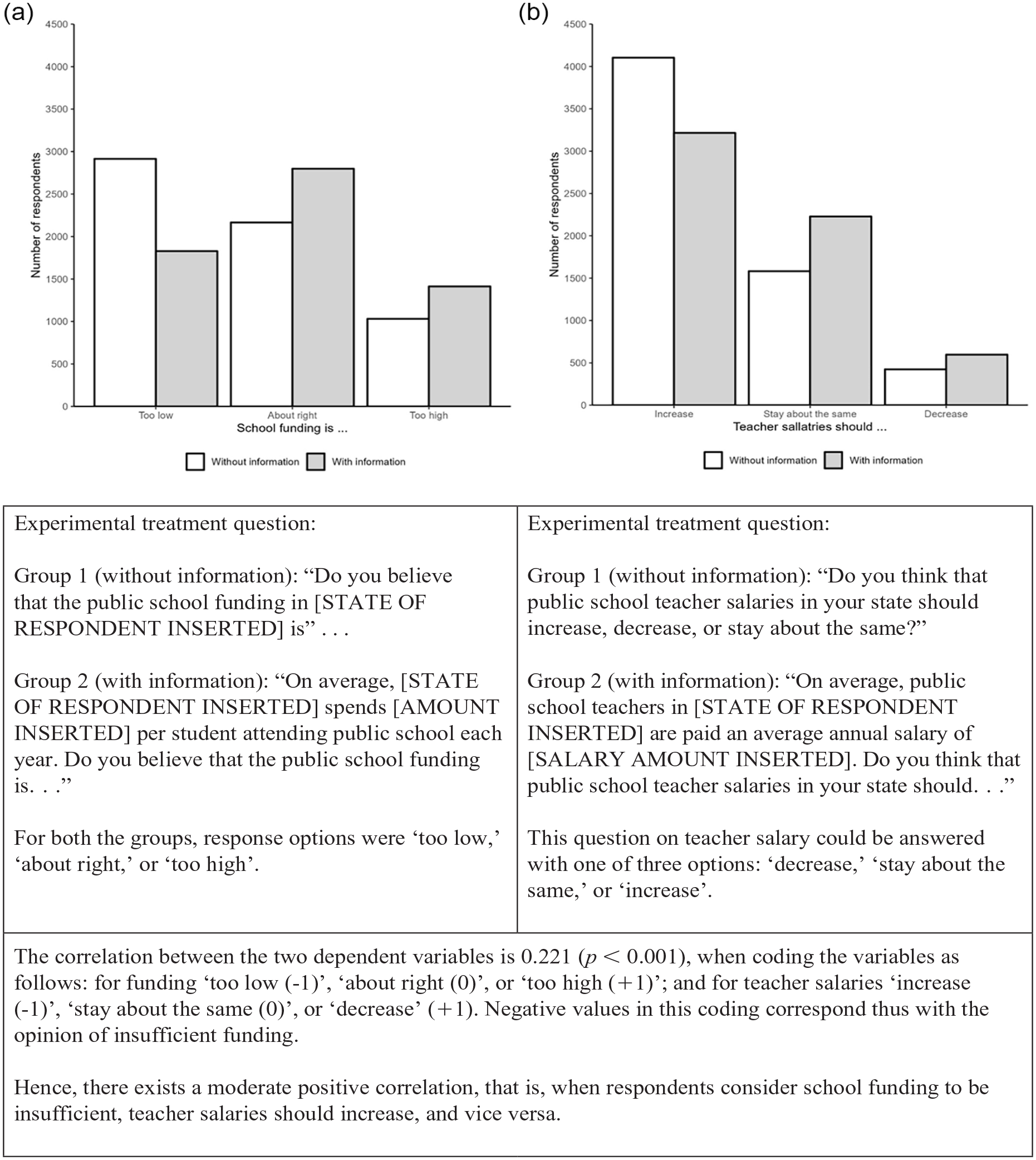
Public opinion on the sufficiency of (a) school funding and (b) teacher salaries for treatment groups “without information” and “with information.”
The survey also included multiple demographic variables: political identification, age, annual household income, parental status of the respondent (parent or nonparent), race, and (self-reported) level of urbanization in the respondent’s place of residence. We use these variables as independent variables to explain variations in opinions about school funding and teacher salaries. Prior research has argued that attitudes toward educational spending have varied systematically across these variables, and have persisted across time (Berkman & Plutzer, 2005; Lau & Redlawsk, 2001). For our research aim, these demographic variables define the boundaries that delineate various social groups impacted differently by educational policies. For example, differences in household income relate to different needs for public education and provide different reference frameworks on the cost of good education (Glomm & Ravikumar, 2003). Moreover, these variables have been commonly used for differentiated communication and campaigning by political actors to promote support for policy decisions (Baines et al., 2003; Blumler & Kavanagh, 1999).
Results and Discussion
Overall Public Opinion and Main Differences as a Result of Information Availability
Figure 1 shows the differences in respondents’ opinions, based on the experimental manipulation, for sufficiency of (A) school funding and (B) teachers’ salary. Overall, for opinions on the sufficiency of school funding, most respondents answer that funding is about right (40.85%), closely followed by the proportion of respondents indicating that school funding is too low (39.03%). The remaining respondents (22.11%) consider school funding to be too high. The results in Table 1 show that respondents are equally likely to choose between “too low” and “about right,” while respondents are much more likely to answer “about right” compared with “too high” (odds ratio = 3.17; p < .001).
Ordered Probit Regression for the Sufficiency of (A) School Funding and (B) Teacher Salaries
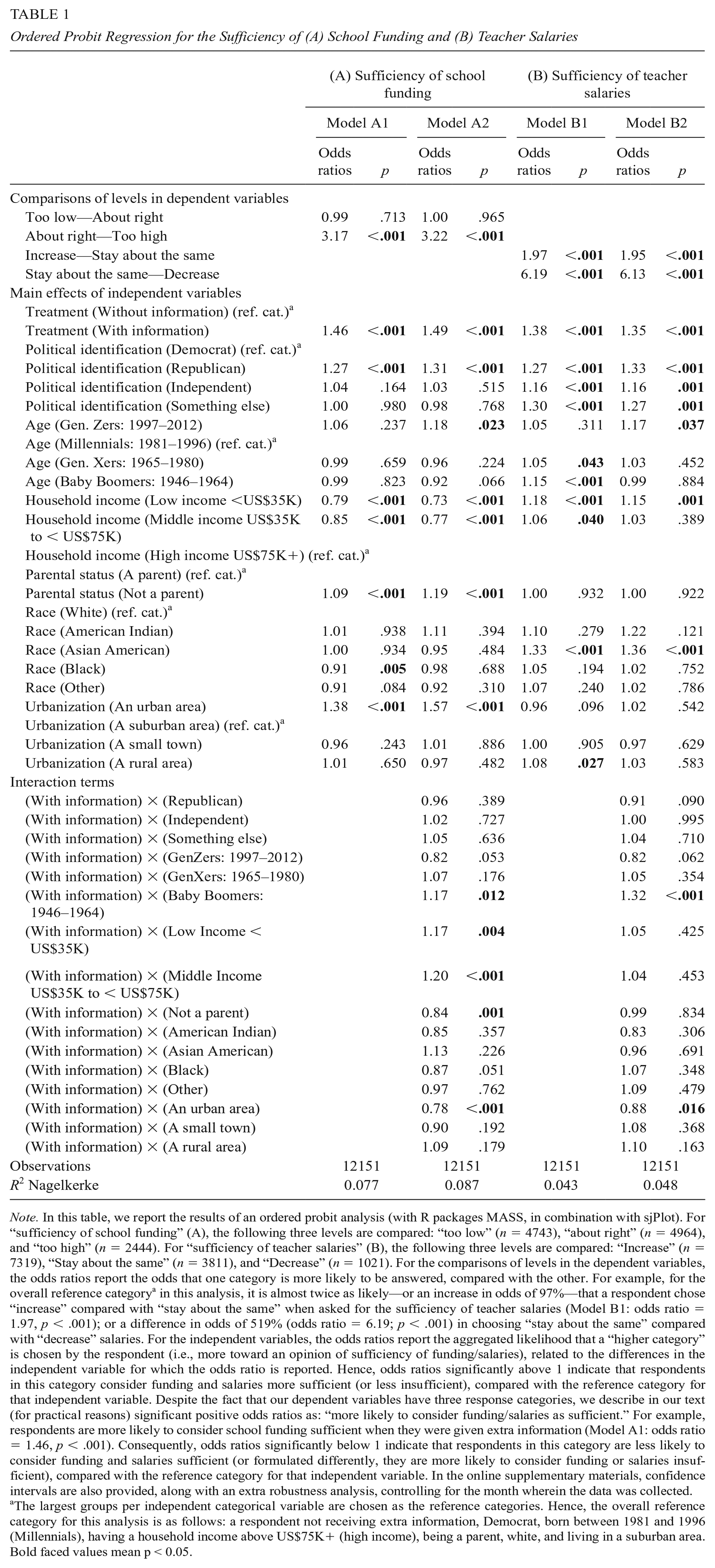
Note. In this table, we report the results of an ordered probit analysis (with R packages MASS, in combination with sjPlot). For “sufficiency of school funding” (A), the following three levels are compared: “too low” (n = 4743), “about right” (n = 4964), and “too high” (n = 2444). For “sufficiency of teacher salaries” (B), the following three levels are compared: “Increase” (n = 7319), “Stay about the same” (n = 3811), and “Decrease” (n = 1021). For the comparisons of levels in the dependent variables, the odds ratios report the odds that one category is more likely to be answered, compared with the other. For example, for the overall reference categorya in this analysis, it is almost twice as likely—or an increase in odds of 97%—that a respondent chose “increase” compared with “stay about the same” when asked for the sufficiency of teacher salaries (Model B1: odds ratio = 1.97, p < .001); or a difference in odds of 519% (odds ratio = 6.19; p < .001) in choosing “stay about the same” compared with “decrease” salaries. For the independent variables, the odds ratios report the aggregated likelihood that a “higher category” is chosen by the respondent (i.e., more toward an opinion of sufficiency of funding/salaries), related to the differences in the independent variable for which the odds ratio is reported. Hence, odds ratios significantly above 1 indicate that respondents in this category consider funding and salaries more sufficient (or less insufficient), compared with the reference category for that independent variable. Despite the fact that our dependent variables have three response categories, we describe in our text (for practical reasons) significant positive odds ratios as: “more likely to consider funding/salaries as sufficient.” For example, respondents are more likely to consider school funding sufficient when they were given extra information (Model A1: odds ratio = 1.46, p < .001). Consequently, odds ratios significantly below 1 indicate that respondents in this category are less likely to consider funding and salaries sufficient (or formulated differently, they are more likely to consider funding or salaries insufficient), compared with the reference category for that independent variable. In the online supplementary materials, confidence intervals are also provided, along with an extra robustness analysis, controlling for the month wherein the data was collected.
The largest groups per independent categorical variable are chosen as the reference categories. Hence, the overall reference category for this analysis is as follows: a respondent not receiving extra information, Democrat, born between 1981 and 1996 (Millennials), having a household income above US$75K+ (high income), being a parent, white, and living in a suburban area. Bold faced values mean p < 0.05.
Differences in opinions are stronger when it comes to the sufficiency of teacher salaries, as 60.32% of the respondents answer that teacher salaries should increase. Moreover, 31.36% report that salaries should remain the same, whereas only a small portion answers that teacher salaries should decrease (8.40%). This is also confirmed by the relatively large, significant odds ratios in Table 1 (1.97 and 6.19 respectively, both at p < .001).
These results are consistent with studies conducted before the COVID-19 pandemic (Berkman & Plutzer, 2005; Houston, 2021; McClellan et al., 2018; Schueler & West, 2016). As schools and teachers were relatively less involved in educational activities during the pandemic, one might expect public opinion on educational funding to have changed. However, the various negative side effects that citizens—mainly parents—experienced during the pandemic, such as the need for homeschooling in combination with job responsibilities (Letzel et al., 2020), could have made the benefits of a well-functioning educational system even more evident. Moreover, other studies have shown how opinions on core values—such as the need for good public education—were not affected by the short-term changes necessitated by COVID-19 (Reeskens et al., 2021). Therefore, we conclude that citizens mainly remained convinced of the need for educational funding and an increase in teachers’ salaries, even at a time when schools and teachers could not contribute to their full potential.
Integrated Analysis of the Direct and Interactional Effects of Demographic Variables
In this section, we report which demographic variables explain (a) the difference in opinions on educational funding and (b) the susceptibility to information when expressing this opinion. Table 1 reports the results of the ordered probit regression examining the perceived sufficiency of (A) school funding and (B) teachers’ salary. For each of these dependent variables, we consider two models—one with and one without the interaction terms for the information treatment and the explaining demographic variables. The combined explanatory power of the independent variables is higher for the opinion on school funding (R2-Nagelkerke = 0.077) than for teacher salaries (R2-Nagelkerke = 0.043). For the models that include the interaction terms with the experimental treatment—and thus offer insight into the extent that different social groups voiced different opinions related to the additional information—age, income, and level of urbanization explain additional differences for the opinion on school funding. Model 2 reports this for each of the dependent variables, and the explanatory powers are 0.087 and 0.048 respectively (R2- Nagelkerke).
We elaborate these findings in the following sections, for each of the explaining variables.
Political Identification: Republicans More Likely to Consider School Funding and Salaries Sufficient
Compared with respondents identifying themselves as Democrats, those identifying as Rep-ublicans are more likely to consider school funding and teacher salaries as sufficient (respective odds ratios are 1.27, p < .001 in Model A1 and 1.27, p < .001 in model B1). This finding is consistent with the political program of the Republican Party, which commonly aims for overall less government spending (Hill & Jones, 2017; Houston, 2021). Concerning the opinion on school funding, respondents who identify as “independent” or “something else” are more similar to Democrats (no significant differences with Democrats), while for the opinion on teacher salaries, they are more similar to Republicans (similar differences as Republicans with Demo-crats; respective odds ratios are 1.16 and 1.30, both p < .001 in Model B1).
In addition, political identification does not explain differences in the extent to which public opinion on school funding is voiced differently when respondents were presented with additional information (that is, there are no significant interaction terms for political identification in Model 2, for both dependent variables). In other words, political identification does not explain different levels of susceptibility to information, when voicing one’s opinion on school funding and teachers’ salaries.
Age: Conventional Wisdom Revisited—General Differences in Voiced Opinions as per Available Information
No overall differences in public opinion for school funding are explained by age (no significant estimates in Model A1, Table 1). For the opinion on teacher salaries, people born before 1980 are more likely to consider teacher salaries as sufficient (odds ratio for Generation Xers compared with Millennials = 1.05, p = .043; and odds ratio for Baby Boomers compared with Millennials = 1.15, p < .001, in model B1). These findings are different from earlier observations by Plutzer and Berkman’s (2005). In their longitudinal cohort analysis, they show how older generations are not only more supportive for increased education spending—which they refer to as ‘conventional wisdom’—but how all cohorts increasingly consider education funding insufficient. In this data, we thus do not observe such a “conventional wisdom” difference for the opinion on school funding, and for the opinion on teachers’ salaries we observe thus the opposite.
When taking the role of extra information into account, results deviate even more. When Baby Boomers received extra information, they voice an even stronger opinion toward sufficiency of school funding and teacher salaries (respective odds ratios for them are 1.17, p = .012 in Model A2 and 1.32, p < .001 in Model B2). Potentially, demographic changes in the past two decades also urge updating “conventional wisdom” on public opinion on school funding and teachers’ salaries.
Household Income: Divergent Findings for Sufficiency of School Funding and Teacher Salaries
Respondents with a household income below US$75K are less likely to consider school funding as sufficient, compared with respondents with a household income higher than US$75K. The odds ratios, compared with respondents with a high household income (>US$75K), were significantly below 1 for respondents from low- and middle-income households (respective odds ratios, in Model A1, are 0.79, p < .001 and 0.85, p < .001). However, when also considering available information (Model A2), it is visible that this overall difference in voiced opinion (as observed in Model A1) is driven by a difference in household incomes for the specific group that did not receive extra information. Concretely, we observe how the odds ratios for the interaction terms of income and extra available information are significantly above 1. The respective odds ratios are 1.17 (p = .012) for the interaction with “low income” and 1.20 (p < .001) for the interaction with “middle income.” Hence, we can conclude that the overall difference found based on household income is reduced when additional information on exact funding and salaries was provided.
Moreover, it is interesting to observe how household income explains opinions on teacher salaries in the opposite direction compared with opinions on school funding. Respondents from low- and medium-income households are more likely to answer that teacher salaries are sufficient (the respective odds ratios for low and middle incomes are 1.18, p < .001 and 1.06, P = .040, in Model B1). In other words, the higher the household income, the less strong the opinion is supported that school funding is insufficient. However, the opposite is true for their opinion on the sufficiency of teacher salaries, i.e., the higher the household income, the more likely are respondents to support the opinion that teacher salaries are insufficient. Given the complexity of these findings, further theorization and empirical analysis are needed. Overall, these results show how differences in household income remain a relevant factor for adjusting educational policies to the specific needs and preferences of particular social groups as well as for differentiated political campaigning (Baines et al., 2003; Blumler & Kavanagh, 1999).
Parental Status: Nonparents More Susceptible to Additional Information While Voicing Their Opinions on School Funding
Respondents who are nonparents, when compared with respondents who are parents, are more likely to consider school funding as sufficient (odds ratio = 1.09, p < .001, in Model A1). However, when making a distinction based on extra information received, the extra information available seems to have a divergent effect on opinion on school funding. To explain further, in the group of nonparents who did not receive additional information, the likelihood of considering school funding as sufficient is 10% higher (odds ratio = 1.19, p < .001, in Model A2, compared with odds ratio 1.09 in Model A1), while in the group of nonparents that did receive information, there is a lower likelihood of considering school funding as sufficient (odds ratio = .84, p = .001, in Model A2). In other words, with extra information, opinions voiced are further from each other related to the additional information given.
Moreover, parental status does not explain differences in the opinions on teacher salaries: neither in general, nor when taking extra available information into account.
Race: Blacks Less Likely to Consider School Funding Sufficient; Asian-Americans More Likely to Consider Teacher Salaries Sufficient
Blacks—compared with Whites—are less likely to consider school funding as sufficient (odds ratio = 0.91, p < .001). However, the two races did not differ in their opinions on the sufficiency of teacher salaries. Concerning the opinion on teacher salaries, Asian-Americans—compared with Whites—are more likely to consider teacher salaries as sufficient (odds ratio = 1.33, p < .001). Except for these findings, race does not explain any substantial differences in opinion on school funding and teacher salaries. Also, the analysis does not suggest that there exists a difference in information susceptibility that is related to race.
Level of Urbanization: School Funding Considered More Sufficient by Respondents Living in Urban Areas
Respondents living in an urban area—compared with a suburban area—are more likely to consider school funding sufficient (odds ratio = 1.38, p < .001, in Model A1), while respondents living in “a small town” or “rural area” do not differ in their opinions on school funding, compared with respondents living in a suburban area. However, when making a distinction based on available information, we also observe divergence in opinions (i.e., for the comparison between urban and suburban areas). When making the distinction based on additional information, respondents who did not receive extra information, are even more likely to consider school funding sufficient (odds ratio = 1.57, p < .001, in Model A2), while respondents from urban areas who received extra information were less likely to express the opinion that school funding is sufficient (odds ratio = .78, p < .001, in Model A2). This difference in voiced opinions, related to information availability for respondents living in an urban area is also visible for opinions on teacher salaries (odds ratio = .88, p < .001, in Model B2).
Conclusion and Implications
Drawing on the perceptions of more than 12,000 U.S. respondents during the 2020/2021 school year, this study examined how various demographic variables: (a) relate to public opinion on school funding and teacher salaries and (b) moderate the extent to which people are susceptible—with respect to adjusting how they voice their opinion—to concrete information on school funding and teacher salaries. As data were collected during the COVID-19 pandemic, our analysis (a) validates earlier insights from data collections before the pandemic and (b) potentially provides additional insights about how opinions are expressed differently as a result of the changed educational setting generated by lockdown measures. Our results show that, during the COVID-19 pandemic, overall public opinion indicated teacher salaries to be insufficient. However, additional information on teacher salaries partially reduced the support for this opinion. In case of opinions on sufficiency of school funding, they were found to be more diverse across the sample; but also here, additional information explained differences in the opinions voiced. Finally, we observed variations in opinions as a result of political identification, age, household income, parental status, race, and level of urbanization. We observed variations in how additional information can reduce or aggravate support for the opinion on funding (in)sufficiency. These information-related variations are associated with age, income, parental status, and level of urbanization (but not political identification and race).
Some Implications for Practice
As the overall public opinion across various social groups is that school funding is considered (by a vast majority) to be “about right” or “too low” (together about 80% of all respondents) and teacher salaries should increase (about 60% of all respondents), decision-makers can see this as a sign to update priorities for public budgeting. Moreover, variations in opinions on sufficiency of school funding explained by differences in demographic characteristics signal how (a) needs in terms of school funding and (b) the extent these needs are fulfilled are (perceived) differently for various groups in society. In other words, they might pinpoint (perceived) inequities in school funding. Hence, our results can be used, and further investigated, to adjust funding to the specific needs of different groups in society.
In case of stakeholders managing and providing information on school funding and teacher salaries (e.g., journalist, researchers, and policymakers), our results show that they potentially could influence how public opinion is voiced and on how public opinion is eventually shaped. From a utilitarian perspective, our insights could help some of these stakeholders in steering public opinion toward goals beneficial for themselves. Furthermore, other stakeholders could rely on our findings for developing strategies (with targeted information initiatives for different social groups) to involve and engage several diverse citizens in a well-informed public debate about the role and funding of education.
For stakeholders looking to make decisions based on information about school funding and teacher salaries (e.g., public servants, citizens, and some [other] politicians and policymakers), our results are relevant in acknowledging that opinions—and eventually resultant decisions—are dependent upon the availability or nonavailability of information. This can enable information users to actively strive for broad access to various sources of information, to be less dependent upon singled-out (sources of) information.
Some Implications for Research
This empirical research brief is only one small piece adding to the process of continued theorization and empirical observation when it comes to understanding public opinion on sufficiency of school funding. Our approach is exploratory and can hopefully contribute to further theoretical elaboration (e.g., through induction, combined with other bottom-up empirical studies), while it also provides an invitation for further empirical verification of our findings in other contexts, with other variables, and with other designs. Concretely, future research could elaborate the concrete societal and sociopsychological mechanisms related to particular demographic variables, different op-inions, other individual and contextual factors, and diverse levels of information susceptibility. Moreover, our study focuses only on voicing opinions related to two rather abstract elements: school funding and teacher salaries. As public opinion and policymaking on education are significantly more complex areas, future studies can focus on a broader variety of relevant variables; for example, behavioral measures such as school choice or voting as dependent variables. Moreover, our design only tested the presence or absence of a very specific type of information, in a binary manner. While this was a suitable method of testing for a basic effect in a large survey, further studies can apply varied research methods to get additional insight into how the amount of information, various types of information, and/or various sources of information can additionally explain potential differences in individuals’ opinions on educational funding.
Supplemental Material
sj-pdf-1-epa-10.3102_01623737241232939 – Supplemental material for Public Opinion on School Funding and Teacher Salaries: The Information Gap Explained?
Supplemental material, sj-pdf-1-epa-10.3102_01623737241232939 for Public Opinion on School Funding and Teacher Salaries: The Information Gap Explained? by Jurgen Willems and Fredrik O. Andersson in Educational Evaluation and Policy Analysis
Footnotes
Acknowledgements

Declaration of Conflicting Interests
The author(s) declared no potential conflicts of interest with respect to the research, authorship, and/or publication of this article.
Funding
The author(s) received no financial support for the research, authorship, and/or publication of this article.
Authors
JURGEN WILLEMS, PhD, is professor at Vienna University of Economics and Business, Department of Management, Institute for Public Management & Governance. His research focuses on citizen–state interactions.
FREDRIK O. ANDERSSON, PhD, is associate professor at Indiana University Indianapolis, Paul H. O’Neill School of Public and Environmental Affairs. His research focuses on entrepreneurship and governance in the nonprofit sector.
References
Supplementary Material
Please find the following supplemental material available below.
For Open Access articles published under a Creative Commons License, all supplemental material carries the same license as the article it is associated with.
For non-Open Access articles published, all supplemental material carries a non-exclusive license, and permission requests for re-use of supplemental material or any part of supplemental material shall be sent directly to the copyright owner as specified in the copyright notice associated with the article.
