




Abstract
Racial inequality in exclusionary discipline is a salient educational equity issue. The implications of educators’ discretion in administering discipline and the complexity of repeated office discipline referrals (ODRs) and suspensions are reflected in school discipline policy debates nationwide. This brief uses New York City to learn more about persistently disciplined students. Black students are more likely to be persistently referred than other students. The disparities in the students who are persistently suspended are not as stark as the disparities in the students who are persistently referred. School characteristics play an essential role in predicting persistently disciplined students and the findings reinforce the value of teachers’ diversity and experience and school climate for reducing racial inequality in school discipline.
S
This brief uses New York City (NYC) to learn more about persistently disciplined students. The following research questions guide the analyses:
What are the characteristics of persistently disciplined students? To what extent does the rate at which students are persistently disciplined differs by grade level and student race/ethnicity?
To what extent do school characteristics (e.g., school climate, the diversity and experience of teachers and school leaders) predict the likelihood of a student being persistently disciplined?
The resulting findings provide a granular understanding of the disciplinary process in schools by examining the relationship between ODRs and suspensions, the characteristics of students receiving multiple referrals and suspensions, and the school characteristics associated with repeated disciplinary consequences. The insights will help educational leaders target resources to students and schools most affected by racial inequities in school discipline.
A Better Understanding of the Disciplinary Process: From ODRs to Suspensions
Disparities in exclusionary discipline begin with ODRs, an important yet relatively understudied disciplinary outcome (Liu et al., 2022; Skiba et al., 1997; Welsh & Little, 2018b). Most ODRs are due to subjective offenses that are largely dependent on the discretion and authority of educators (Skiba et al., 1997), and subjective ODRs explain the majority of the variation in disproportionality in school discipline (Girvan et al., 2017). ODRs are disciplinary decisions made primarily by teachers, whereas suspensions are decisions made primarily by school administrators. As such, ODRs provide some indication of how teachers may be responding to perceived misbehavior in classrooms and teacher bias in their decision to report certain infractions for specific students (Gilliam et al., 2016; Girvan et al., 2017; Okonofua et al., 2016), whereas suspensions capture how school leaders make decisions on ODRs, which may also reflect similar biases of school administrators (Jarvis & Okonofua, 2020). Thus, simultaneously examining ODRs and suspensions as well as the relationship between these two interrelated disciplinary outcomes provides insights on whether teacher discretion or school administrator discretion or both are fueling racial inequities in exclusionary discipline.
Previous research has used infraction-level data to examine different facets of ODRs, including (a) the infractions leading to ODRs and the likelihood of receiving ODRs (Ritter & Anderson, 2018; Rocque, 2010; Skiba et al., 1997, 2011), (b) differential processing or whether students receive harsher punishment for similar infractions (Anderson & Ritter, 2017, 2020; Barrett et al., 2019; Gregory et al., 2018; Skiba et al., 2011, 2014), (c) linking the referral process to racial inequality (Anyon et al., 2018; Girvan et al., 2017; Rocque, 2010), and (d) the validity of ODRs as a disciplinary measure (Pas et al., 2011). Prior studies have found significant differences in the referral rate of Black and White students (Liu et al., 2022; Rocque, 2010; Skiba et al., 2011). For instance, Skiba et al. (2011) found that Black students were more likely to be referred to the office than White students and Ritter and Anderson (2018) found that Black students had a higher risk of receiving an ODR for subjective infractions.
Liu et al.’s (2022) study is one of the few studies to examine the relationship between ODRs and suspensions and found that the conversion rate was higher for Black students than other students, and the patterns in referrals mirror suspension patterns. Similarly, how school factors are associated with the referral process and persistently referred students has received relatively little attention (Anderson & Ritter, 2017; Liu et al., 2022; Skiba et al., 2014). Prior studies have examined students’ experiences being persistently disciplined and labeled as a “frequent flyer” and the label’s deficit underpinnings (Kennedy-Lewis, 2012, 2013; Kennedy-Lewis & Murphy, 2016; Kennedy-Lewis et al., 2016). Another set of studies have used quantitative analyses to shed light on students receiving multiple disciplinary consequences, with a focus on the frequency of suspensions over a period of time rather than in a single school year (Fisher et al., 2021; Smith et al., 2020; Wilkerson & Afacan, 2021). The study contributes to the robust school discipline literature through its focus on persistently disciplined students. At present, there is no prior research on persistently referred students and there remains a dearth of comparisons between students with a single ODR and students who received multiple ODRs. Furthermore, our study provides an illustrative empirical case using the NYC context, which represents an “urban intensive” district that (similar to numerous districts nationwide) is in the midst of system-wide shift away from exclusionary discipline as characterized by recent changes in school discipline policy and investments in restorative justice (Rodriguez & Welsh, 2022).
Data and Method
This policy brief leverages a rich, longitudinal administrative data for middle and high schools in NYC from the 2011–2012 to the 2018–2019 school years to deepen the understanding of persistently referred and suspended students in urban districts. The essential data elements are drawn from infraction-level discipline records, which provide information on reported infractions resulting in ODRs and suspensions, the annual NYC School Survey, and education administrative records of students, teachers, and schools. Infractions are classified into five levels based on the severity, ranging from Level 1 (Uncooperative/Noncompliant Behavior) to Level 5 (Seriously Dangerous/Nonviolent Behavior). Furthermore, the NYC Department of Education (DOE) distinguishes between two types of suspension, superintendent’s suspension and principal’s suspension, which varies based on the severity of the infraction and duration of suspension (a superintendent suspension is typically imposed for more severe behavior and may result in a period of suspension for more than five school days). We report results from the combined total suspensions, given that the overwhelming majority comprises principal suspensions (77.9%). Details on methods are provided in the Supplemental Appendix in the online version of the journal.
Results
Table 1 presents summary statistics of student characteristics and discipline patterns, overall and across different student groups by disciplinary status, ranging from students not receiving an ODR to being persistently suspended. Black students account for only about 27% of student enrollment in NYC (Column 1) but Black students account for about 38% of students who received one ODR within a school year (Column 3), 48% of students who are persistently referred within a year (Column 4), 45% of students who received only one suspension (Column 6), and 53% of students who are persistently suspended (Column 7). The rate at which Black students are persistently referred and persistently suspended is 1.7 and 1.9 times higher, respectively, than their share of the student population. Similarly, male students receiving special education services and students living in temporary housing are persistently referred and suspended in stark disproportionality to their enrollment.
Descriptive Mean/Percent of Student Characteristics, by Disciplinary Status (2011–2012 to 2018–2019)
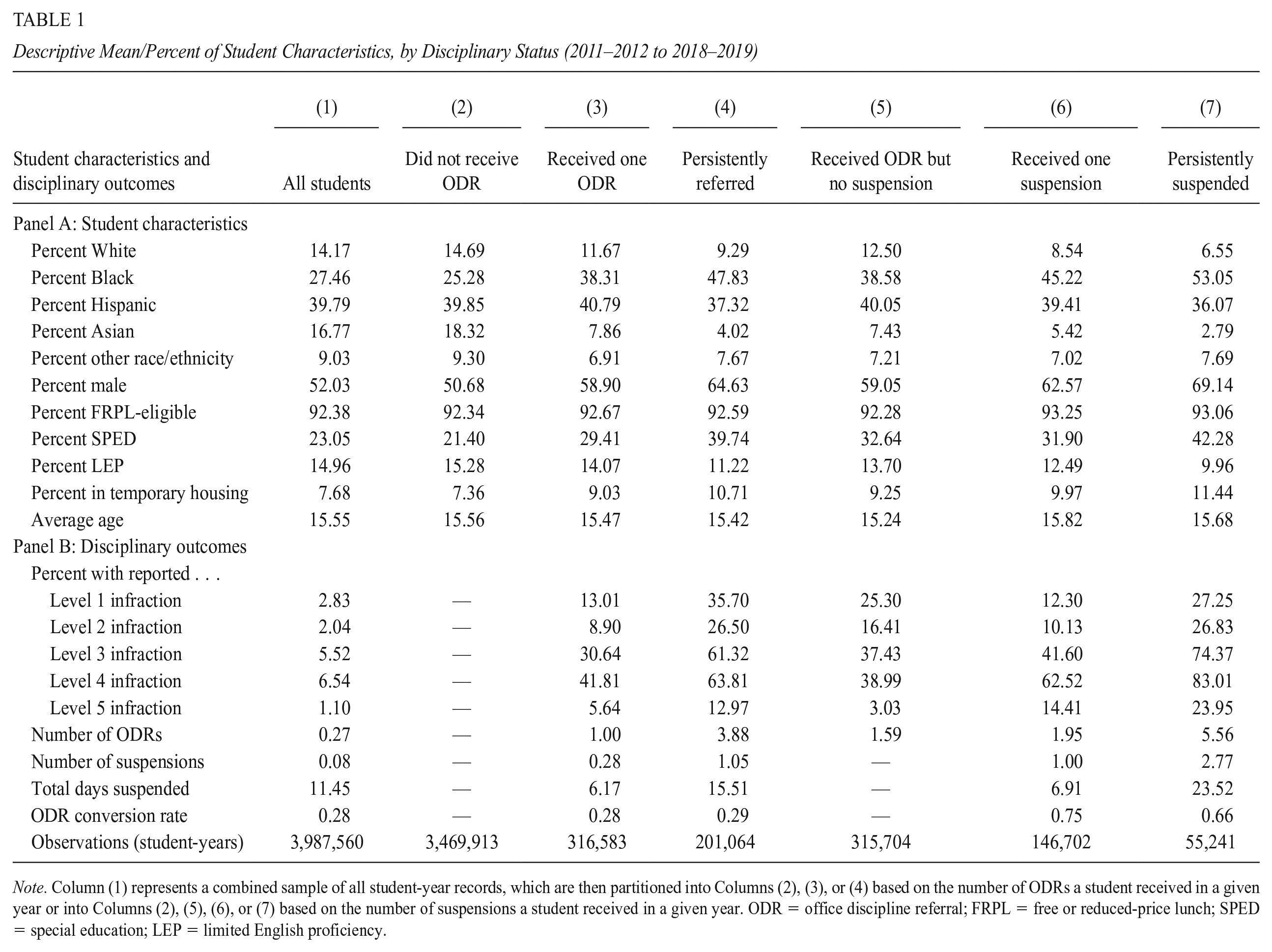
Note. Column (1) represents a combined sample of all student-year records, which are then partitioned into Columns (2), (3), or (4) based on the number of ODRs a student received in a given year or into Columns (2), (5), (6), or (7) based on the number of suspensions a student received in a given year. ODR = office discipline referral; FRPL = free or reduced-price lunch; SPED = special education; LEP = limited English proficiency.
On average, persistently suspended students receive roughly six ODRs and three suspensions within a given school year. However, referrals are converted to suspensions at a lower rate for persistently disciplined students (0.66) compared with students receiving a single suspension (0.75), suggesting that persistently disciplined students are more likely to be referred for infractions that do not lead to suspensions. When examining descriptives disaggregated by middle and high school level (presented in Supplemental Tables A.1 and A.2 in the online version of the journal), we note a higher share of middle school students are reported for Levels 3 and 4 infractions overall (about 7% and 8%, respectively) compared with high school students (5% and 6%, respectively). In addition, on average, middle school students receive more referrals than high school students but about the same number of suspensions.
Persistently Disciplined Disparities
Examining the share of students who are persistently disciplined by student race/ethnicity further highlights the racial disparities in repeated ODRs and suspensions. Black students are persistently referred at nearly twice the rate of other student groups. As shown in Figure 1, about 8.8% of Black students across Grades 6 through 12 are persistently referred compared with only 3.3% of White students and 1.2% of Asian students. Similarly, 2.7% of Black students were persistently suspended compared with only 0.6% and 0.2% of White and Asian students, respectively. Intersectional disparities are worthy of note as well; for example, about 14% of students in NYC are Black males yet 29% of persistently referred students and 35% of persistently suspended students are Black males. Likewise, Black males with Individualized Education Program (IEP) account for 4% of all students but 12% of persistently referred students and 15% of persistently suspended students.
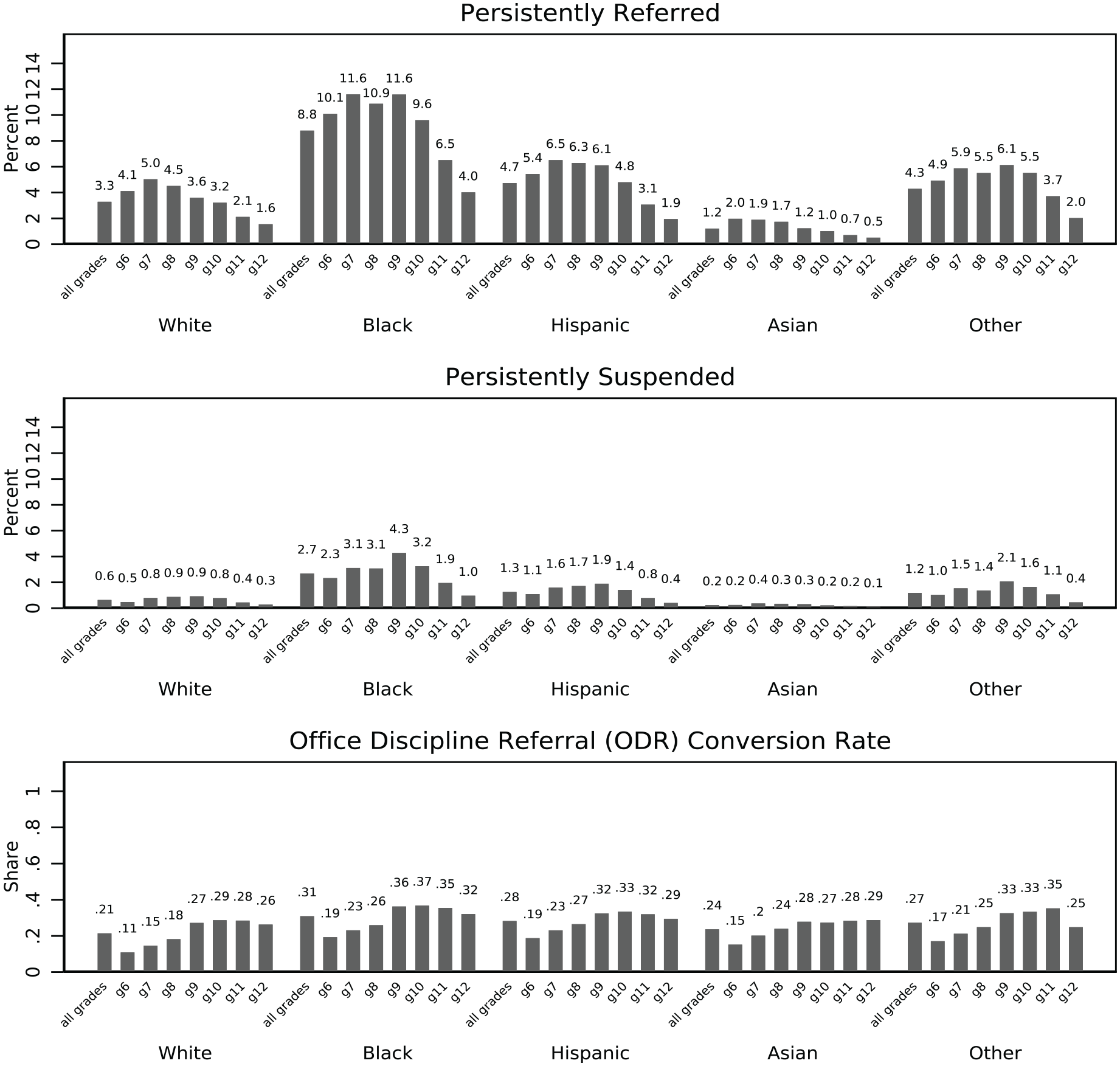
Percentage of students who are persistently disciplined and average office discipline referral (ODR) conversion rate, by student race/ethnicity and grade level.
Figure 1 also illustrates that the average ODR conversion rate for Black students is slightly higher for students of other racial/ethnic backgrounds, indicating that Black students tend to receive suspensions for a higher percentage of reported ODRs than their peers. For example, on average and across Grades 6 through 12, Black students receive suspensions for about 31% of reported ODRs they receive while White students receive suspensions for about 21% of ODRs, Asian students for 24% of ODRs, Hispanic students for 28% of ODRs, and students of other racial or ethnic backgrounds for 27% of ODRs. Stated differently, Black students tend to receive a suspension for approximately every 3.2 ODRs, while students of other racial or ethnic backgrounds tend to receive a suspension after receiving anywhere between 3.7 and 4.8 ODRs.
School Characteristics
Table 2 presents the results from logistic regression models predicting the likelihood of being a student receiving an ODR (Column 1), being persistently referred (Column 2), receiving a suspension (Column 3), and being persistently suspended (Column 4) based on student and school characteristics. We find that even after adjusting for student characteristics and fixed differences across schools, time-varying school characteristics significantly predict the likelihood of students being persistently disciplined in a variety of ways. For instance, students in schools with a larger percentage of students of color (Black, Hispanic, Asian) are more likely to be persistently referred, which is congruent with prior studies highlighting evidence of racial threat in school discipline (Welch & Payne, 2010). However, the share of Hispanic students within a school significantly predicts a lower likelihood that a student is persistently suspended. Conversely, students in schools with a larger proportion of free or reduced-price lunch students have a lower risk of persistent referral but higher likelihood of persistent suspension. Students in schools with a larger percentage of students receiving special education services are more likely to be persistently referred while those in schools with a larger percentage of students who have limited English proficiency are more likely to be persistently suspended. Students in larger schools and in schools with higher student–teacher ratios are less likely to be persistently referred and less likely to be both persistently referred and suspended when enrolled in a school with a higher attendance rate, suggesting persistent exclusionary discipline tends to be more prevalent in larger schools with larger class sizes and higher rate of student attendance. In addition, being enrolled in a school with a higher proficiency in English Language Arts (ELA) and Math predicts a lower likelihood of being persistently referred and suspended.
Estimates Predicting Probability of Student Being Disciplined and Office-Discipline-Referral-to-Suspension Conversion Rate
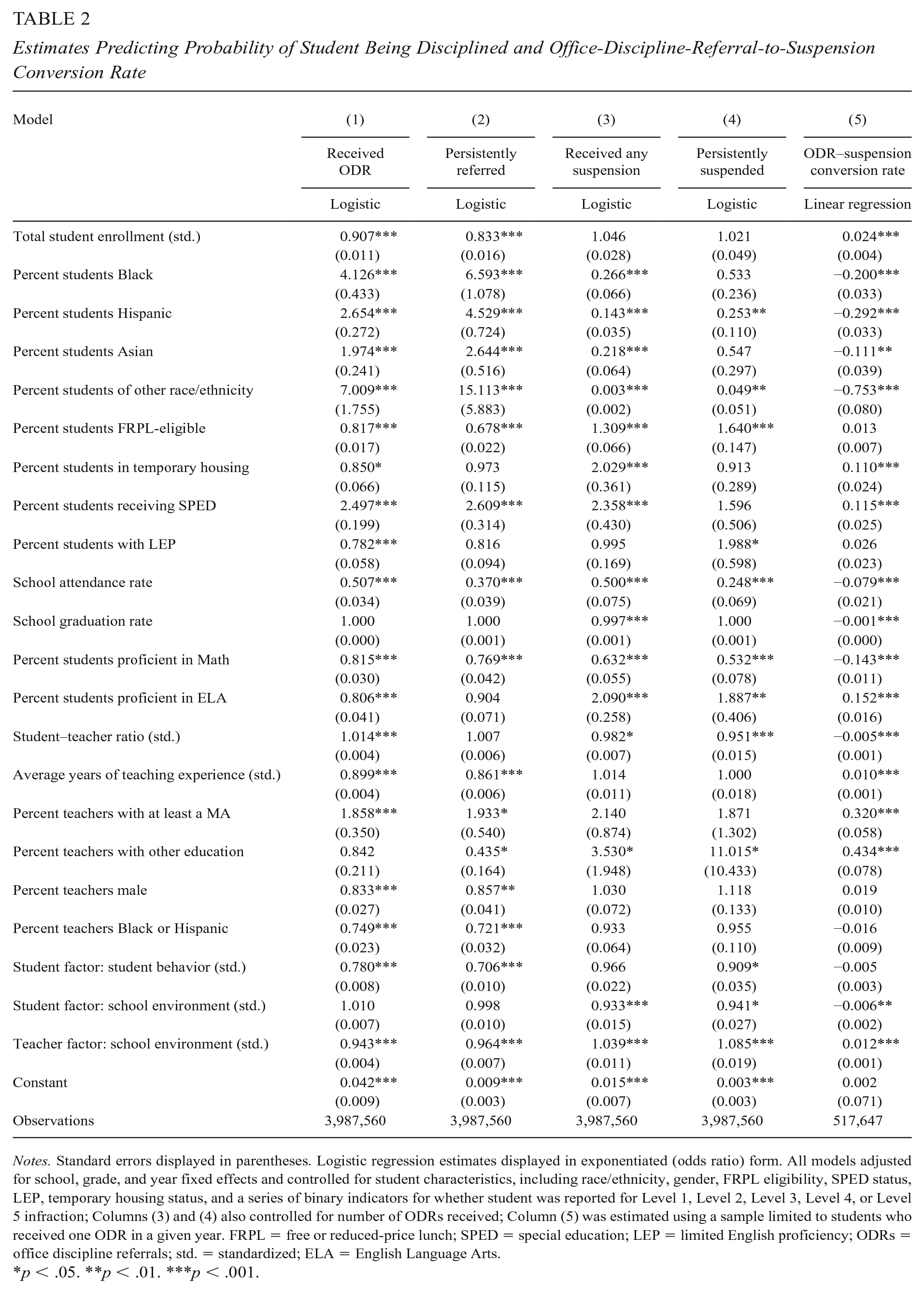
Notes. Standard errors displayed in parentheses. Logistic regression estimates displayed in exponentiated (odds ratio) form. All models adjusted for school, grade, and year fixed effects and controlled for student characteristics, including race/ethnicity, gender, FRPL eligibility, SPED status, LEP, temporary housing status, and a series of binary indicators for whether student was reported for Level 1, Level 2, Level 3, Level 4, or Level 5 infraction; Columns (3) and (4) also controlled for number of ODRs received; Column (5) was estimated using a sample limited to students who received one ODR in a given year. FRPL = free or reduced-price lunch; SPED = special education; LEP = limited English proficiency; ODRs = office discipline referrals; std. = standardized; ELA = English Language Arts.
p < .05. **p < .01. ***p < .001.
Consistent with our conceptual framework, several teacher characteristics are only significant for referrals. Table 2 illustrates that students in schools with a greater proportion of Black or Hispanic teachers (i.e., more diverse teacher composition), male teachers, and higher average years of teaching experience have a lower likelihood of being persistently referred. Overall, the results illustrate that students in schools with a more positive school climate (as measured by student and teacher surveys) are generally less likely to be persistently referred and persistently suspended, with the exception of teacher survey–based measures of school climate indicating a more positive school climate is associated with a higher likelihood of persistent suspension.
The final column of Table 2 (Column 5) presents linear regression estimates predicting the ODR-to-suspension conversion rate based on the sample of students receiving at least one ODR. Students receiving an ODR tend to have a higher conversion rate from referrals to suspensions when enrolled in larger schools and in schools with a higher share of students in temporary housing and receiving special education services and with more experienced teaching staff. However, students receiving an ODR are predicted to have a lower rate of conversion from referrals to suspensions when in schools with a higher percentage of students of color, larger class sizes (i.e., higher student–teacher ratios), and higher attendance and graduation rates.
Discussion
Findings presented in this study illustrate that persistently referred students are suspended at high rates (average of one suspension among persistently referred) as multiple ODRs typically result in suspensions. In essence, each ODR represents a “ticket in the suspension lottery”; thus, in the event that some ODRs do not result in students being suspended, it is likely that the persistently referred students who receive multiple ODRs will lose the “suspension lottery” as one of the ODRs leads to a suspension. This policy brief highlights noteworthy disparities in persistently referred students and indicates that disparities in ODRs may differ from disparities in suspensions and whether or not a student receives a suspension for an ODR varies across grades and schooling levels. Black students are more likely to be persistently referred than other students and the disparities in the students who are persistently suspended are not as stark as the disparities in the students who are persistently referred. The plight of persistently disciplined students starkly illustrates the snowball of exclusionary discipline experienced by Black students. The results highlight that Black students are not only more likely to be referred and suspended in schools but these students are also likely to be disciplined multiple times within a given school year. The results provide justification for concerns that anti-Black racism prevalent in the American society is replicated in schools through exclusionary discipline practices (Carter et al., 2017; Little & Welsh, 2022).
This policy brief also demonstrates the importance of school characteristics in predicting whether students are persistently referred and suspended. While limited in its ability to support causal inferences, the findings are aligned with those of prior causal studies (Lindsay & Hart, 2017) as it highlights the significance of teachers’ diversity and experience and school climate for reducing racial inequality in school discipline (Gage et al., 2016; Hughes et al., 2020). As such, the findings offer empirical support for Education Secretary Miguel Cardona’s advice to charter school leaders to bolster teacher diversity as a means to boost students’ recovery from the pandemic (Lehrer-Small, 2021) and investing in school climate as a way to reduce racial disparities in suspensions (U.S. DOE, n.d.).
It is important to note that these demographic and disciplinary patterns are most directly reflective of the NYC school context, as they are likely to vary in other urban settings. For example, Liu et al. (2022) similarly report demographic and disciplinary patterns in a large urban school district in California, yet their sample comprises a far lower share of Black and Hispanic students (7% and 30%, respectively) and higher share of Asian students and students of other racial/ethnic backgrounds (33% and 18%, respectively) than the sample of NYC public middle and high school students explored in this current study. Moreover, students within the NYC context appear to have higher rates of exclusionary discipline compared with the sample of students examined in Liu et al.’s (2022) study. For example, Liu et al. (2022) report that only 8% of students received at least one referral and only 2% of students received at least one suspension, while 12% of students received at least one referral and 5% of students received at least one suspension in NYC. The rate at which referrals are converted to suspension appears to be higher in the NYC context as well—0.28 compared with 0.05, as reported by Liu et al. (2022).
The policy brief provides support for a shift in mindset away from exclusionary discipline to bolstering student support for persistently disciplined students and adds to a growing body of studies emphasizing the importance of prevention strategies in school discipline (Gregory et al., 2017). Reducing the use of ODRs for Black students, especially in middle schools, is a key plank of disrupting racial disproportionality in exclusionary discipline. Rather than expansion of discretion afforded to teachers in determining exclusionary disciplinary outcomes such as in Tennessee, a more equitable approach is providing guardrails and supporting educators in the disciplinary process to lessen the manifestation of biases in disciplinary outcomes. The findings also highlight the importance of identifying and aiding students who are repeatedly referred and suspended. In addition, the results compel policymakers to bolster the focus on the categories of disciplinary infractions that are drivers of persistently disciplined students. In NYC, Level 3 and 4 infractions account for the significant proportion of infractions for persistently referred and persistently suspended students.
Finally, similar to prior studies (Kennedy-Lewis, 2013; Welsh & Little, 2018b), the findings also underscore the need for professional development to enhance teachers’ classroom management strategies and cultural responsiveness. There are more ODRs in middle schools relative to high schools, suggesting that teacher discretion and decision-making in the disciplinary process are especially concerning in Grades 6 to 8 and that professional development ought to focus on distinguishing between office-managed and classroom-managed infractions given the importance of reducing ODRs to disrupting racial inequality in students’ disciplinary outcomes.
Supplemental Material
sj-pdf-1-epa-10.3102_01623737231155155 – Supplemental material for The Plight of Persistently Disciplined Students: Examining Frequent Flyers and the Conversion of Office Discipline Referrals Into Suspensions
Supplemental material, sj-pdf-1-epa-10.3102_01623737231155155 for The Plight of Persistently Disciplined Students: Examining Frequent Flyers and the Conversion of Office Discipline Referrals Into Suspensions by Richard O. Welsh and Luis A. Rodriguez in Educational Evaluation and Policy Analysis
Footnotes

Supplemental Material
Supplemental material for this article is available online.
Authors
RICHARD O. WELSH, PhD, is associate professor of education and public policy at the Peabody College of Education and Human Development, Vanderbilt University. His research focuses on understanding and transforming inequality in K–12 education, and his scholarship interests include urban education, the economics of education, school discipline, student mobility, the politics of education, and research–practice partnerships.
LUIS A. RODRIGUEZ, PhD, is assistant professor of education leadership and policy studies at New York University. His research focuses on understanding how school organizational conditions, education reform, and broader sociopolitical factors affect the P–12 educator workforce and its ability to generate positive outcomes for students.
References
Supplementary Material
Please find the following supplemental material available below.
For Open Access articles published under a Creative Commons License, all supplemental material carries the same license as the article it is associated with.
For non-Open Access articles published, all supplemental material carries a non-exclusive license, and permission requests for re-use of supplemental material or any part of supplemental material shall be sent directly to the copyright owner as specified in the copyright notice associated with the article.
