




Abstract
Background/Context:
In thousands of classrooms throughout the United States and internationally, behavior management apps have become an integral part of schools’ discipline machineries. Such apps are designed to help teachers enforce rules, especially when it comes to rewards and punishments within school token economies. To understand how these apps are beginning to shape and reshape schooling, research is needed that sheds light on the values and beliefs underpinning their use.
Purpose:
The purpose of this study is to describe and analyze three schools’ discipline practices involving behavior management apps. Our two research questions focused on the paradigms underpinning schools' discipline models and on the influence of these paradigms on schools’ app uses. Our investigation is informed by the scholarship on classroom management, as well as key concepts from Foucault’s (1977) Discipline and Punish.
Research Design:
This qualitative, comparative case study drew on data gathered at three urban schools. In total, 34 interviews were conducted with campus administrators and teachers. Within-case portraits described paradigms and practices at each school, and cross-case analyses addressed patterns across the schools.
Findings:
Schools’ behavior app uses were underpinned by differing school discipline paradigms. Although all three schools saw behavior apps as fostering orderly classroom environments, schools’ practices were underpinned by differing sets of values and beliefs (e.g., accountability/social control; neoliberalism; positivity and fun). In this way, the look and feel of app practices, and, ultimately, schools’ overarching discipline systems, also varied.
Conclusions:
This study examines a widespread, yet understudied, educational technology. By problematizing the values and beliefs underpinning teachers’ behavior app practices, the present study invites scholars and practitioners to question how rewards, punishments, and relationships manifest in schools. In doing so, it highlights opportunities to join with students, parents, and other stakeholders in broader conversations about schooling and discipline.
Recent times have seen increased attention toward dismantling the school-to-prison pipeline, one dimension of which includes the disproportionate punishment of students according to race, class, gender, sexual orientation, and other social identities (Annamma et al., 2019; Meiners, 2011). Within this context, many leaders still find themselves with few clear answers regarding how to optimally revamp school discipline. Even as conventional punishments (e.g., suspension) have been taken off the table, leaders still face continued pressures to maintain the trappings of order and compliance (Irby, 2014; Lustick, 2017). Attempting to walk this line, some schools are beginning to turn toward discipline models that go beyond punishment, toward also rewarding students for positive behavior—for example, positive behavioral intervention and supports, or PBIS (e.g., Bornstein, 2017).
As digital apps for education have gained prominence in school settings, so too have student behavior management apps. The behavior management app known as ClassDojo can be found in 95% of U.S. public schools (Konrad, 2022) and is a top education app download in the United States and United Kingdom, barely preceded by apps like Google Classroom and Duolingo (AppMagic, 2022; Apptopia, 2023). A defining feature of behavior management apps is the automation and tracking of punishments and rewards (e.g., merits and demerits). Teachers can use apps to reward or punish students from moment to moment for specific behaviors or dispositions. Points or demerits that are accumulated may then be exchanged for rewards, or used to justify withholding of rewards, as part of classroom or school token economies (Cho et al., 2021; Robacker et al., 2016).
Such apps may be appealing to educators because they are portrayed as dovetailing with PBIS, and social and emotional learning (SEL) (Kaltreider, 2021; Williamson, 2017) that are so popular in schools. The assumption is that digital automation is an efficient, accurate, and aligned means to gather and analyze information and to problem-solve around how to improve student behavior (Manolev et al., 2019; Riden et al., 2019). Despite the increasing prevalence of behavior management apps in schools, classroom management researchers have rarely studied the use of these apps empirically (Cho et al., 2020).
Some have posited that behavior management apps foster student motivation and classroom orderliness (e.g., Chiarelli et al., 2015; Robacker et al., 2016). Others raise concerns that behavior management apps dehumanize students (Manolev et al., 2019; Williamson, 2017) and that simply implementing new technology does not necessarily equate to better teaching and learning (Brooks, 2011; Hamilton et al., 2016). Moreover, some have argued that the surface-level benefits of an uncritical reliance on apps, such as for orderliness, may come at the expense of students’ well-being and success (Hatt, 2012; Kowalski & Froiland, 2020). Therefore, the purpose of this study is to describe and analyze three schools’ discipline practices involving behavior management apps. We theorized that various beliefs about discipline could play roles in schools’ practices. As such, two research questions guided our inquiry: (1) What paradigms underpinned schools’ discipline models? (2) How did those paradigms enable or constrain schools’ uses of behavior management apps?
To answer these questions, we employed a comparative case study of three purposively selected schools that allowed us to explore educators’ uses of behavior management apps. Drawing on scholarship relating to classroom management and discipline, we examined how educators’ beliefs about what constitutes effective classroom management shaped their deployment of behavior management apps. We found that although behavioristic thinking dominated educators’ practices, schools differed when it came to whether those practices were geared toward compliance, or positivity and fun. This research study contributes to scholarship concerned with the changing landscape of school discipline, including the potential benefits and drawbacks of student behavior management apps. In what follows, we present the scholarship that informed our study design, data collection, and analysis.
Theoretical Tools
Scholars have long observed that work practices are informed by shared values, beliefs, and experiences. This basic observation has been discussed in various ways, ranging from sensemaking, to structuration, to institutional logics (e.g., Bridwell-Mitchell & Sherer, 2017; Coburn, 2001; Leonardi & Barley, 2010). To understand educators’ beliefs about discipline, it is helpful to consider prominent paradigms in the literature. First, we begin by focusing on schools of thought in classroom management. Second, we summarize key concepts from Foucault’s (1977) Discipline and Punish. This helps to underscore broader dynamics underlying discipline practices. Altogether, these bodies of literature provided us with tools for theorizing about discipline paradigms and their roles in behavior app practices.
Schools of Thought in Classroom Management
Classroom management scholars can conceptualize about the field in terms of three schools of thought: behaviorism, relational approaches, and ecological approaches (Bear, 2015; Osher et al., 2010). 1 In terms of behavior management apps, scholars have focused largely on their behavioristic applications, such for facilitating rewards or punishments in token economies (e.g., Riden et al., 2019; Robacker et al., 2016). It is on this front that some have voiced concerns about artificially incentivizing personal qualities (e.g., grit, empathy, zest) that might have intrinsic value and traditionally be learned through relationships-based practices (Manolev et al., 2019; Williamson, 2017). Educators who rely on behaviorist discipline approaches aim to promote rule following by providing students with rewards, punishments, and other feedback about targeted behaviors (e.g., Cooper et al., 2007). One prominent example of behaviorism is PBIS, which, among other things, encourages schools to adopt token economies as a way to systematize rewards and interventions (e.g., Sugai et al., 2000). Technologically, this is the main practice that behavior management apps aim to facilitate, if not also intensify (Manolev et al., 2019; Robacker et al., 2016).
Other practices can also be important to behaviorism. These include nontechnological practices, such as teaching students desired behaviors, fading rewards over time, and identifying the underlying function of “misbehaviors”—for example, peers laughing at “misbehaviors” or getting sent out of the classroom could actually feel rewarding (Gable et al., 2009; Riden et al., 2019). Although studies of behavior management apps are situated primarily within behaviorist paradigms, we know that educators rely on multiple paradigms to think about and enact behavior management practices.
Many educators’ thinking about classroom management focuses on relationships. Examples of relationships-based initiatives include today’s movements toward restorative justice and SEL, both of which aim to help students develop stronger interpersonal skills and self-awareness (Bear, 2015; Osher et al., 2010). The language of SEL has been especially popular among behavior management app vendors; they market themselves as ways to gamify youngsters’ personal and psychological growth—for example, persevering, being mindful, or caring for others (Manolev et al., 2019; Williamson, 2017). However, relationships-focused strategies can include trauma-informed schooling, which draws on techniques from counseling and social work—for example, teaching coping strategies; sensitivity to triggers; focusing on personal strengths (e.g., Walkley & Cox, 2013). Relationships-focused strategies can also include cultural responsiveness (Milner & Tenore, 2010; Weinstein et al., 2004) and acting as “warm demanders” (Ladson-Billings, 2009). To our knowledge, these additional strategies are seldom found in behavior management app discourse.
A third school of thought focuses on classroom environment or “ecology” (Bear, 2015; Osher et al., 2010). Ecological perspectives focus on leveraging elements of classroom habitats (e.g., physical space, transitional routines, lesson pacing), such that the very momentum of activities minimizes the likelihood of misbehavior. In this sense, ecological approaches recognize the intrinsic value of classroom activities and relationships, or what Wilson (1971) termed “educative order.” In this view, ensuring that instruction is interesting and engaging helps to bolster positive behavior (Irby, 2014; MacAllister, 2013). Indeed, ecological perspectives encourage teachers to look at whether students are engaged cognitively, recognizing that “not every infraction of a rule is necessarily misbehavior” (Doyle, 2006, p. 112). To an outsider, challenging or complex activities could look disorderly but actually represent deep forms of learning. Even talking out of turn sometimes adds to the vector of a lesson, and on the flip side, taking time to intervene with some infractions threatens to derail the rhythm and energy of the classroom.
While we have described three discrete categories, in practice, educators’ discipline management practices typically draw on behaviorist, relationships-based, or ecological approaches. By extension, educators may ascribe to more than one perspective simultaneously, using different features of apps for different purposes. For example, we know that some teachers use such apps to reshape their classroom ecologies, such as via auditory cues (e.g., ding-ding, buzzer) or by publicly projecting behavioral earnings via interactive whiteboard (e.g., Chiarelli et al., 2015). Prior research has not examined whether apps may be used to support relationships-based classroom management. However, qualitative data from these apps could be used to inform educators’ decisions about how to support students (e.g., identifying students’ needs, noticing a bad day). This study contributes to a gap in the literature by exploring how educators’ discipline beliefs and practices shape their uses of student behavior management apps.
Broader Dynamics of Discipline and Punishment
To elucidate the role that student behavior management apps play in educators’ school discipline practices across a range of discipline approaches, we summarize key concepts from Foucault’s (1977) Discipline and Punish. Whereas everyday notions about power might focus on interactions between two individuals (e.g., teacher to student), Foucault addresses power at the social and institutional level. In what follows, we focus on Foucault’s notions of spectacle, surveillance, and misbehavior. Subsequently, we close by theorizing about how these dynamics may be observed in school discipline today.
Foucault (1977) begins with a historical account of how institutions (e.g., absolutist monarchies) relied on spectacle to exercise power and authority. Spectacles, like public torture and killings, did not merely inflict physical, bodily pain upon criminals as a form of punishment. Rather, such spectacles impressed upon the broader social body knowledge about crimes, norms, and punishments. Alongside other public displays (e.g., legal hearings, public postings), such spectacles made “open for all to see” (p. 35) the wrongs committed, while also underlining the “unrestrained presence” (p. 49) of authorities in social life.
As societies began to frown upon punishing criminals through spectacle, a modern “machinery” (p. 21) emerged that exercised power in less obvious ways. Foucault theorized this new machinery as comprising professions, industries, and other “technologies of the soul” (p. 30) geared toward addressing subjects’ inner and psychological workings (e.g., passions, infirmities, heredity). Crimes came to be defined not by simply by physical actions, but by what might have been present in one’s heart and mind. Thus, surveillance can be understood as an especially useful tool because it can feel invisible yet everywhere, as well as lead to constant self-monitoring. The benefits of surveillance may be such that institutions (e.g., education, medicine, criminal justice) may even work together or “swarm” to monitor individuals and ensure their compliance with social norms.
Such dynamics may also play out in schools today. For example, Irby (2014) described how educators may employ “the spectacle of highly visible, swift, harsh punishment” (p. 525) to mark students and deter misbehavior. On this front, educators may use behavior apps to publicly display students’ earnings (Chiarelli et al., 2015; Riden et al., 2019), thus potentially increasing the spectacle rewards and punishments. Moreover, behavior apps may underline for students that their actions are constantly tracked and monitored, thus making them akin to other surveillance tools such as school security cameras, browser monitoring, and law enforcement (Hope, 2010; Turner & Beneke, 2020). In addition, others have also raised concerns regarding how behavior apps are used to target students’ inner and psychological workings, such as when they are used to support PBIS or to incentivize personal qualities such as perseverance or integrity (Manolev et al., 2019; Williamson, 2017). This line of concerns may also be extended to instances in which biases relating to race, class, or other social identities lead educators to pathologize students as lazy, disorderly, or not valuing education (Bornstein, 2017; Morris, 2005). For example, “no excuses” charter schools have been found to embrace neoliberal views on competition and accountability in order to address what they see as deficiencies within students (Lopez Kershen et al., 2018). In this way, Foucault (1977) provides additional tools for understanding educators’ potential beliefs and practices that are not accounted for in traditional classroom management research.
Methods
We employed a comparative case study design to explore schools’ discipline paradigms and practices involving behavior management apps. Comparative case studies help researchers to develop theoretical insights into how phenomena may span contexts, as well as about circumstances and conditions that can break those patterns (Yin, 2017).
Site Selection
We purposively selected three sites 2 in the northeastern United States where behavior management apps were being used. With the assistance of leaders at app companies (i.e., LiveSchool, Kickboard), study invitations were sent to schools. After receiving responses from those who expressed interest, schools were selected to vary in terms of sector (i.e., public or charter), grade levels, and student demographics (see Table 1). Seeking out variation increases the potential for diverse perspectives and for observing patterns that might transcend context (Merriam & Tisdell, 2015; Yin, 2017).
Characteristics of Study Sites.
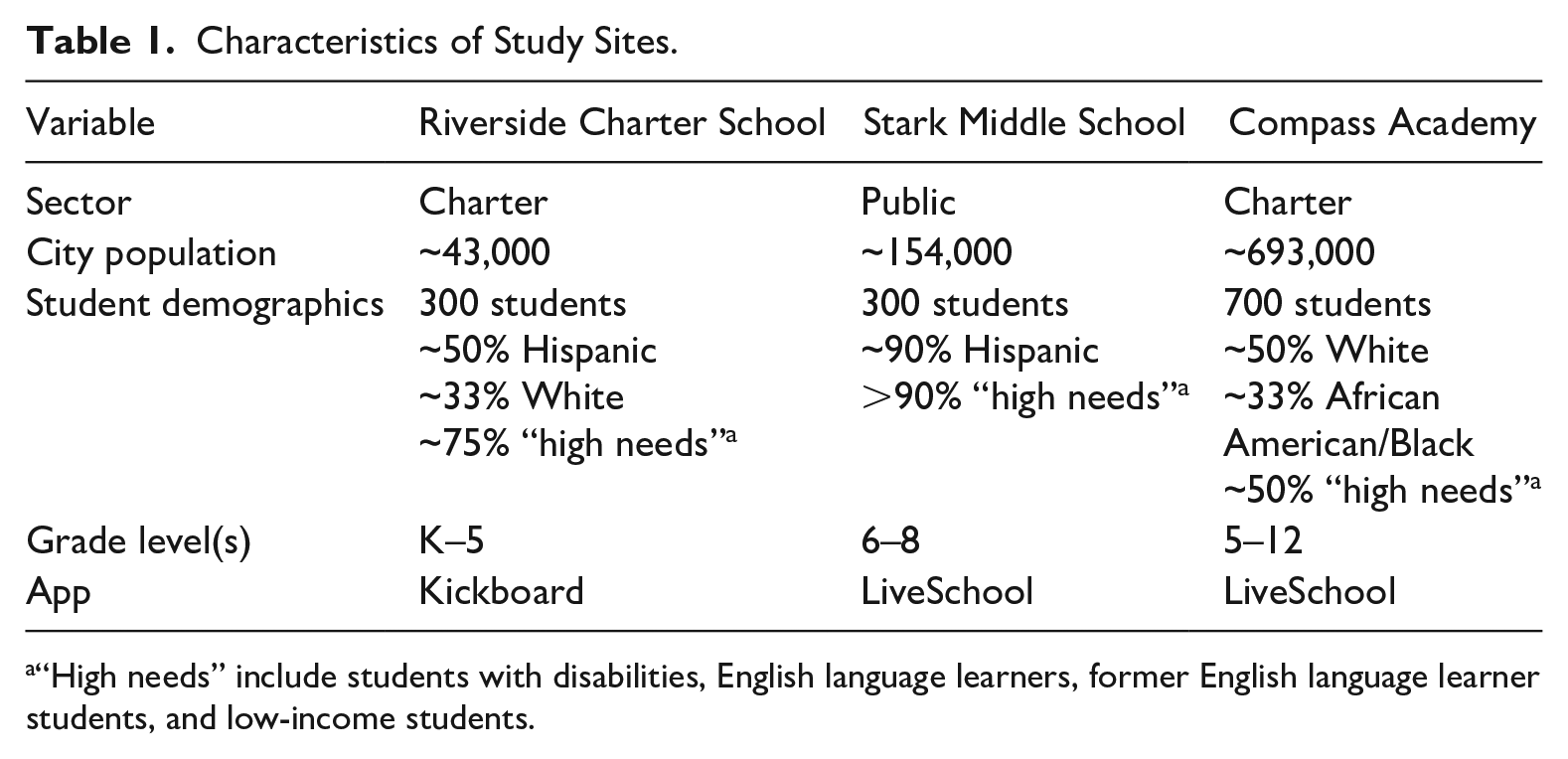
“High needs” include students with disabilities, English language learners, former English language learner students, and low-income students.
In terms of context, Riverside Charter was located in a small city. Demographically, nearly half of all students were classified as Hispanic or Latinx, and about one third were classified as white. Approximately three fourths were also classified by the state as “high needs.” 3 Next, Stark Middle School was located in a medium-sized city. Demographically, nine out of 10 students were classified as Hispanic or Latinx, with even higher numbers classified by the state as high needs. Whereas the other schools in this study had used their app for several years, Stark had only adopted its system in the spring before data collection. Finally, Compass Academy was a charter school in a large city. Demographically, approximately half of all students were classified as white, and about one third were classified as African American or Black. Nearly half of Compass students were classified as high needs.
Data Collection
Because of issues of capacity, data collection at Stark took place in fall 2016 and in fall 2017 at Riverside and Compass. In total, 34 school leaders and teachers participated in individual interviews across the three schools. The school leaders were selected based on their role and responsibilities relating to school discipline (e.g., principals, assistant principals, deans, counselors). Stratified random sampling was used to ensure that the pool of teachers at each school represented various grade levels and subject areas. At Stark, nine teachers and four leaders were interviewed (13 total). At Compass, 11 teachers and one leader were interviewed (12 total). At Riverside, seven teachers and two leaders were interviewed (9 total).
Interviews took place in either administrators’ offices or teachers’ classrooms at each of the three school sites and lasted approximately 40 minutes each. These interviews followed the same semi-structured protocol (Merriam & Tisdell, 2015). In accord with Research Question 1, which related to the school’s discipline paradigms, the protocol asked about beliefs and values related to school discipline. Example questions included: What are some values that are important at this school? How does [app name] fit in with those values? Tell me about your school’s approach to discipline. When you were first learning to use [app name], what were you hoping for? Tell me about a recent conversation you had with a colleague about student behavior. What expectations do leaders have for your app use? Similarly, Research Question 2 related to uses of the apps. Examples included: Tell me about a recent time you used [app name]. What features of [app name] do you find most useful? How do you see [app name] benefiting students? What drawbacks do you see about using [the app]? Tell me about some data stored in [app name] that you find useful. How so?
Data Analysis
Analysis in multiple case studies often begins with the development of case portraits (i.e., descriptions) about each individual case, then the comparison of phenomena across cases. As Yin (2017) asserted, this analytic process affords insight into how or why certain phenomena or theoretic propositions may take place, as well as the ways in which unique contextual factors or other circumstances may affect those processes. The present study aimed to describe schools’ discipline practices involving behavior management apps and focused especially on schools’ discipline paradigms (Research Question 1) and the roles those paradigms may have played in their uses of those apps (Research Question 2).
As such, the development of case portraits progressed in phases. During the preliminary analysis phase, each school’s interview transcripts were reviewed, and memos summarizing our impressions were drafted. To strengthen the validity of later analyses (Brantlinger et al., 2005; Merriam & Tisdell, 2015), each school’s respective memo was shared in meetings with leaders and teachers. Those meeting participants included some who had participated in interviews, as well as newcomers. Participants confirmed interpretations made in the memos, thus helping us launch into formal coding.
The formal coding phase was modeled on Hill and colleagues’ (1997, 2005) procedures for collaborative data analysis. These recommendations include having both analysts (Cho and Borowiec) and an auditor (Irby) serve on the research team. As Brantlinger et al. (2005) also explained, these practices can promote validity by providing checks on the logic and grounding of analyses. In practice, the analysts began by first reading the same transcript independently, jotting down summaries of statements and phenomena in the form of open codes (Merriam & Tisdell, 2015).
Subsequently, the analysts convened to develop a consensus-level coding of the transcript, taking turns leading conversations to develop and refine parent codes (e.g., discipline paradigm, policies and practices, and app uses). During this step, Hill et al. (1997) recommended leaning into disagreement as a source of productive friction, something that can be hindered by focusing on interrater reliability. In practice, this meant developing consensus about the underlying rationales for code assignments. Even in instances in which the analysts agreed, exchanging ideas about their underlying rationales invited richer exploration of the data. During these conversations, the analysts also developed child codes within the main categories. For example, within the discipline paradigm parent code, there were child codes for behavioristic approach, relational approach, and environmental approach. If a comment also espoused deficit or capitalist ideologies, it was double-coded as such (e.g., both behavioristic and deficit-oriented). When coding had stabilized to approximately 90% agreement, the analysts progressed to first coding independently, then reviewing and discussing each other’s work weekly.
In the final phase, those in auditing roles began reviewing code assignments and providing feedback and perspectives about the interpretation of data. This continued as within-case portraits describing schools’ discipline paradigms and uses of behavior management apps were developed. Cross-case analyses summarized commonalities and differences among the schools (Yin, 2017). In line with Hill and colleagues’ (2005) recommendations for describing frequency of occurrence in qualitative data, we reported findings as generally occurring if they applied to all or all but one. “Rare” or “a few” described a maximum of three respondents. Within-case and cross-case comparisons are reported separately later.
Positionality
Similar to the theoretical tools described earlier, team members’ racial, gender, class, and professional identities helped to inform their interests in school discipline and technology. Cho and Cho are both cisgender men (one Black and one Asian American), both parents of school-age children who attend public school, and both university faculty members. Cho is the child of first-generation immigrants, and a first-generation college student. His research interests are also informed by his prior experiences as a teacher and assistant principal. Irby is a qualitative researcher who has studied and written about school discipline policies and practices from a critical perspective, with an emphasis on the ways that punitive discipline approaches disproportionately harm children and youth of color. Borowiec is a cisgender White woman and doctoral student. She uses quantitative, qualitative, and mixed methods to study and write about diverse topics, including whole-person education, sense of community, and well-being. Her higher education work experiences include having regularly collected and analyzed campus climate for students, faculty, and staff. Collectively, their prior professional experiences ranged from teacher, to administrator, to institutional researcher. Their fields of expertise in academia included equity-focused leadership, school technology leadership, and research methods.
In this way, each member brought varying experiences of being disciplined, of acting as disciplinarian, and of engaging with or being subjected to surveillance machineries and other recent technological advancements. This mosaic of positionalities strengthened data collection, analysis, and reporting by increasing the team’s overall sensitivity to the dimensions of school discipline. Differences among team members helped them to unearth and articulate insights about the data.
Limitations
The present study has several limitations to consider. First, unlike statistical or other similar methods, multiple case studies are not geared toward making broad generalizations about truths in a population or the universe (Brantlinger et al., 2005; Yin, 2017). Rather, they afford analytic generalizability, which focuses on how theoretic propositions play out within and across particular contexts. Further, data consisted of semi-structured interviews. Findings represent participants’ perceptions about their use and are subject to issues such as memory or social desirability.
Within-Case Findings
Each within-case portrait that follows begins by providing context about each school and its token economy. In accord with our research questions, each portrait then describes the schools’ discipline paradigm (Research Question 1) and teachers’ practices involving behavior management apps (Research Question 2). Cross-case comparisons of these portraits are reported in a separate section that follows.
Riverside Charter: A System Creating Winners and Losers
Riverside’s Competitive Token Economy Context
Riverside Charter employed a complicated discipline model, one that openly encouraged competition among students for access to rewards and resources. Specifically, students automatically earned a base pay of 20 “Riverside bucks” each day (totaling 100 points for the week), aside from whatever students might earn or lose during regular classroom interactions. Thus, in practice, the actual cut score for avoiding “reflection time” on Fridays was 93; those who earned top choices needed to earn well above their automatically allotted 100 points in order to be competitive. Some teachers felt that students, especially those in younger grades or those who had weaker numeracy skills, had trouble making sense of this system. As one teacher stated, “Some of our students are so low that they can't even do that math. The number 100 and making sure you're at 93 bucks? Not seeing that in front of them means nothing to them.” Additionally, there was the issue of understanding the time scale of a week. As one teacher asserted, “With the younger kids, they don’t think in terms of a week. . . . Even with the fourth graders, their concept of time is not like ours as adults.” For these reasons, teachers at Riverside expressed concerns that their economy system was “abstract” and “not concrete enough” for students.
Foucault (1977) posits that modern systems for punishment often focus on one’s heart and mind rather than behavior. Echoing this, Riverside’s token economy was organized around five “core values”: discipline, grit, integrity, collaboration, and zest. Of these, only collaboration seemed to be behavioral, while the others related to inner psychological states. Although points could be spent at the school store, it was actually Friday Choice Time that drove the school’s token economy. On Friday afternoons, students received “paychecks” summarizing their Riverside buck earnings for the week. From there, top earners had first choice for afternoon activities (e.g., physical education, music, art, or Spanish class). Lower earners could choose from what had not been filled. But the clear “losers” in this system were students who had net losses of 7 or more points that week. Instead of Friday Choice Time, those students were required to engage in additional inner work by completing a “reflection form” with the dean of students about their behavior that week. As explained next, this summary of Riverside’s token economy only captures a fraction of its complexity.
Riverside’s Neoliberal Paradigm
Some have argued that behavior management apps promulgate neoliberal values relating to incentives and competition, especially around qualities that might typically be considered of intrinsic value (Manolev et al., 2019; Williamson, 2017). Riverside educators did not discuss alternatives to rewards-based classroom management—for example, ecological or relationships-based approaches (e.g., Bear, 2015)—in any of our interviews. Rather, educators at Riverside saw rewards and competition as integral to “holding scholars accountable.” In the words of one administrator, “I think consistency, follow through, and reinforcement are three very important foundations of a school.”
These views were underlined by Riverside’s focus on competition for rewards. As described in the next section, students who lost at Friday Choice Time sometimes reacted negatively. However, when interviewers probed whether these reactions might be avoided with a less competitive token economy model, Riverside educators responded that competition and rewards were essential to promoting student success. For example, one leader emphasized, “We come to school for a paycheck. [Students] come to school for a paycheck, and they get reinforced by their paycheck.” Similarly, a teacher stated, “I know if I got paid more, I’d do a better job . . . . With kids, if there’s an incentive to get more bucks, to get better prizes, they’re going to put in more effort.” Indeed, the consensus was that “paychecks” kept students motivated or even “obsessed” with earning points, with some students spending their “whole life” and “whole day” thinking about their earnings.
Moreover, Riverside educators sometimes espoused deficit mindsets when attempting to argue the importance of their token economy. In line with Foucault (1977), discipline was seen as a way to treat perceived deficiencies that some educators attributed to students’ inner selves—deficiencies that they saw as stemming from students’ home lives, upbringing, and social class. Exemplifying this view, one teacher explained the importance of providing incentives relating to the school’s “core values” (e.g., grit, integrity, zest): Seventy percent-ish [of student families], I think, are lower income families. We take a very serious approach to discipline. Because we want kids to understand that if they’re really applying themselves, and if they’re showing integrity and discipline and collaboration, that that’s what’s going to get them further in life . . . I think the overall push at [Riverside] is to really be clear with kids: what’s okay and what’s not. Because a lot of times they’re not getting such clear messages at home.
In short, these educators felt that a stringent approach to discipline was necessary because they associated family income with a lack of work ethic or other personal qualities. In fact, in none of our interviews did Riverside educators question the incentivization of “core values,” nor did they offer counternarratives about students’ families, such as how they might already be imparting important strengths and values or how systemic factors might influence local poverty levels.
Riverside’s Uses of Kickboard
Riverside educators saw Kickboard, especially its weekly Friday Choice Time paychecks, as vital to their discipline practices. In fact, many spoke interchangeably about Kickboard and the token economy that it managed. In the words of one leader, “Kickboard is just a really great tool to use with scholars. It gives them something to look forward to at the end of the week. . . . [Kickboard] holds them accountable for their daily behavior.”
In line with Foucault (1977), such statements helped to underline how the app’s value was tied to surveillance and social control rather to other potential uses. For example, even when asked, no participants reported analyzing or viewing Kickboard data to inform their decision making. To the contrary, many admitted that Kickboard data were often inaccurate. All except one teacher stated that they did not use Kickboard on a moment-to-moment or real-time basis because doing so would “break the flow of teaching.” Most teachers logged points after school (or even at the end of the week), relying on handwritten notes or sheer memory, or referring to color-coded charts that only summarized impressions from the end of the day. As such, paycheck totals were “never as accurate as they could be.” Teachers still found it helpful and consistent with the overarching idea of Kickboard having a “clear and immediate effect” on student behavior.
Additionally, despite the importance of providing students with timely instruction around targeted behaviors (Cooper et al., 2007; Riden et al., 2019), teachers rarely reported doing so. Rather, students were described as unaware of their accumulation of merits/demerits until the end of the week, and teachers did not speak to students about their behaviors until students reacted to their points at Friday paycheck time. Indeed, only one teacher, one with prior special education training, instructed students around targeted behaviors in the moment. This teacher logged points in real time using her personal mobile device, asking students, “Why did you earn this buck?” before logging points.
Altogether, these reports situated Kickboard’s role in the school’s discipline machinery. However, it is also worth noting some of the unintended consequences of this machinery’s competitive elements. For example, one teacher reported that their students were very competitive about who earned the “most bonus bucks.” Students would sometimes instigate misbehavior by “bragging” about their earnings in order to derail their peers who had more bucks. Similarly, other teachers reported that the token economy held such weight in students’ minds that losing just one point could lead students to “shut down,” go into a “downward spiral,” or hide “under a desk.”
Stark Middle School: A Collage of Paradigms
Unlike the charter schools in this study, Stark was a public school in danger of being taken over by the state because of low student test scores. Accordingly, Stark had recently reorganized many processes and hired new staff. Educators spoke with both urgency and hope when it came to its collage of improvement efforts.
Stark’s Token Economy Context
Stark was the only school in this study to have reported following formal guidance when implementing its token economy. Specifically, Stark’s token economy was a part of its PBIS initiative. Its token economy asked that students be productive, accountable, and kind (PAK). Because Stark’s mascot was the wolf, these values had been dubbed the “Wolf PAK.” Merit points could be spent on items in the school store or special events and activities (e.g., dress-down day; field trips; time with a favorite staff member). However, because paper tickets had been subject to errors and abuses (e.g., lost tickets, teachers forgetting to distribute tickets, or students reselling tickets to peers), the school had recently shifted to using the app known as LiveSchool to manage the token economy.
Stark’s Many Paradigms
Throughout our interviews, Stark educators focused on how it was important to provide students with positive school experiences, tying together their understandings about behavioristic, relationships-focused, and ecological classroom management strategies (e.g., Bear, 2015). Anecdotally, our sense was their sense of urgency around school improvement, and overall, this spirit of positivity opened up their willingness to think about supporting students from multiple angles.
For example, in terms of behaviorism, Stark educators intentionally put a positive spin on the school’s token economy and uses of rewards. Unlike at Riverside, where rewards were geared toward instilling competitiveness, Stark educators spoke about promoting promote a “positive school culture” and injecting “inspiration” and “fun” into the day. They discussed wanting to “narrate the positive,” “frame things positively,” and provide consistency for students. As but one example, a teacher boasted about giving out “hundreds and hundreds and thousands of points.”
Also unlike at Riverside, Stark educators reported avoiding demerits, because demerits might shame students or result in downward spirals of behavior. As one teacher explained, “I feel like I’m not doing my job as well as I could be by giving demerits.” In line with established behavior modification practices (e.g., Riden, 2019), some also allowed students to repair or “work off” their demerits through positive behavior.
In terms of relationships-focused practices, Stark educators also spoke about the importance of having positive relationships with students. As one teacher summed, it was important to regularly communicate, “We love you, we want you here, and we want you to go to college.” Other practices included giving students second chances and speaking gently to them several times before applying behavioral consequences. Such practices were seen as ways to make the school feel more caring. Although caring is something from which all students might benefit, a few Stark educators approached such work through the lens of deficit. For example, one leader asserted that Stark students lived in “the poorest neighborhood in [the state]” and that their “generational poverty” had added “baggage” to students’ ability to learn. As a remedy, this leader advised teachers to be more “cognitively empathetic,” because Stark students needed “more relationships and encouragement than they do anything else."
In terms of ecological practices, Stark teachers reported making efforts to explicitly teach routines for entering or exiting classrooms, use engaging lessons to minimize misbehavior, and redirect student attention in nonconfrontational ways. As one teacher put it, this provided classrooms with “system upon system upon system” to ensure positive behavior. Additionally, these practices were described as part of the school’s overall approach to being “trauma-informed.” For example, some educators mentioned that students lived in the state’s “poorest neighborhood” and that some of their students came to school having experienced homelessness, difficulties in foster care, sexual or physical abuse, drug use, and gang violence. One student was reported as having witnessed their sibling being shot nearby the school. As such, Stark educators felt that it was important for them to take responsibility for ensuring an environment that was “safe and conducive to learning.” As one school leader explained, These kids walk through [criminal activity] just to get to what should be a safe spot at home. Even at home, it’s not necessarily a safe place. They don’t have a place to sit and decompress, to feel okay and feel taken care of . . . 24 hours a day, you’re not feeling okay. You’re always on guard and ready to go.
Although these justifications for ecological practices were evocative, we did not sense that educators were aiming to disparage or sensationalize students or their life experiences. Rather, our sense was that Stark educators embraced their responsibility to support students, but they also wanted to communicate that the work was complex. One leader put this responsibility in terms of needing to be “aware about whatever [traumatic] factors might be hindering a student” and be “more available to work with that.” Indeed, we only heard one Stark educator speak about students in what might be considered a deficit-oriented way. Akin to teachers at Riverside, this Stark teacher asserted that “urban populations” benefited from token economies, because they rarely witnessed economic reward. In other words, because students felt that “we’re not gonna get big jobs; we’re gonna get small jobs,” they needed extra incentives in the classroom to get class work done.
Stark’s Uses of LiveSchool
Stark’s approach to LiveSchool was based both in its positive approach to behaviorism and in its emphasis on positive teacher–student relationships. Overall, Stark educators felt that using LiveSchool provided students with an extra bit of motivation, pride, and self-reflectiveness.
Several of LiveSchool’s technological features seemed to facilitate this work. First, LiveSchool helped educators to track and monitor their own practices, including the extent to which they were being positive with students. As mentioned earlier, teachers tried to avoid punishments; LiveSchool facilitated this by providing data to monitor school and teacher “ratios” of rewards to demerits. This allowed teachers to more accurately aim at least 10 rewards to any demerit. Second, several educators mentioned how access to LiveSchool via mobile devices made it even easier to be positive with students. They listed various examples of on-the-fly rewards throughout the day (e.g., in the cafeteria, during passing periods, in classrooms). These rewards were often for explicitly targeted behaviors, such as greeting the teacher at the door, persevering at difficult activities, writing in full sentences, and helping peers. As one teacher summarized, ease of use made it easier to create a positive atmosphere: It costs me nothing. If a kid is going to do his or her work and behave and raise their hand and take the pass to the bathroom, what does it cost me? A half a second on LiveSchool pressing the buttons? That’s what it’s there for.
Third, many Stark teachers liked how LiveSchool provided audible merit notification sounds (“ding-ding-ding”). 4 These sounds were described as providing students with “instant gratification” and as a way to “catch kids being good.” For example, one teacher described constantly scanning the environment for targeted behaviors (e.g., starting the day’s opening activity on their own, putting forth extra effort, persevering despite difficulty): “It’s great because when you add the points in, it makes a noise. The ding-ding-ding. It makes a noise so the kids know. It’s like everyone peeks their head up when they hear the noise.” In addition, notification sounds helped to redirect off-task behavior. As another teacher explained, this approach was less confrontational than directly speaking to an off-task student: “If there are four people sitting around Maria, and you hit every single one of them with ‘Great job! Ding-ding-ding-ding,’ then Maria is like, ‘Whoa, maybe I should be paying attention.’”
Finally, LiveSchool also supported relationships-oriented work. As a part of avoiding punishments, Stark educators also assigned “zero-point” and “placeholder” demerits. They described these merits as “warnings” or as ways to ask students to “stop and look.” Moreover, LiveSchool allowed teachers to add qualitative notes to zero-point demerits. These qualitative notes became data to be discussed with students during daily advisory and weekly support group times. In this way, teachers could converse with students about their needs, goals, and plans for success. For example, one teacher described how such data helped her to praise success on an assessment or with class participation, as well as to unpack a student’s “off” day or “rough week.” In her words, “That’s our opportunity to get on the computer and check in. See if you got 50 demerits in the past week—what’s going on? Is something changing. . . . Is something going on at home?” Aside from these formal meeting times, several teachers also mentioned logging in immediately before the next class period. This practice helped them to better support students who might be struggling socially or emotionally. Examples included finding time to connect personally with them and providing them with special praise.
Compass Academy: Shifting Paradigms
Compass’s Token Economy Context
Compass Academy’s discipline model was based on its core values of mindfulness, achievement, perseverance, and professionalism (MAPP). The school was also functionally divided into three levels (lower, middle, high). All divisions had a policy of three demerits resulting in one detention. In the lower and middle schools (Grades 5–8), MAPP served as the basis for merits and demerits in the token economy. These divisions used points to auction off prizes to students (e.g., homemade brownies, college memorabilia, permission to wear jeans). At the high school (Grades 9–12), there was no rewards policy; students could only receive demerits.
Compass’s Changing Paradigms
At the time of data collection, Compass Academy was beginning to transition from a behavioristic paradigm toward a relationships-oriented one. Behavioristic thinking was most common among teachers. For example, teachers at all levels agreed that the token economy promoted “clarity” and “accountability” around target behaviors. Unlike the other schools, where rewards were framed in terms of fostering competitiveness or a positive school culture, Compass teachers saw rewards as providing additional motivation to “struggling” individuals. Examples included rewarding students for “meeting expectations in the face of adversity” and “extra encouragement” in cases in which a student might be struggling.
However, school leaders had begun to shift away from this paradigm, describing the token economy as “kind of simplistic” and too punishment oriented. This shift had been sparked by LiveSchool, which had helped to surface inequities associated with certain school rules, such as lacking school supplies and violating dress code (see also Cho et al., 2021). As one leader summed, the token economy “system wasn’t working for all kids.” As such, leaders had begun to encourage Compass teachers to be more relationships oriented, such as by focusing less on compliance, by personally helping students and by working from “broad understanding of student development and child development.” Indeed, teachers confirmed that leaders had begun encouraging them to “picture the whole student,” to “deeply know” students, to think differently about the “roots of problems,” and to build meaningful relationships instead of relying on punishments.
Compass’s Uses of LiveSchool
Despite the rhetorical shifts at Compass, the school’s uses of LiveSchool were still largely behavioristic. Leaders at Compass were not yet comfortable with abandoning LiveSchool because they had found that novice teachers were commonly reliant on it to foster order in the classroom. Or, as one teacher put it, “teachers who are further developed” can rely on “relationships to manage the class” rather than LiveSchool. Another teacher described LiveSchool as “cementing” some behavioristic practices into place: There's no way to conceive of restorative justice or other models for classroom management within [LiveSchool]. If you adopt [LiveSchool], you're basically saying that our school is committed to this behaviorist—what's the word for it? Punitive structure to our discipline policy.
As such, Compass educators held positive views about the app itself but saw shortcomings with becoming dependent on it. For example, lower and middle school teachers described LiveSchool as a source of “positive reinforcement” for target behaviors, such as getting settled, completing independent work, or staying on task during group work. They felt that LiveSchool made students more “eager” and “positive.” In a slight contrast, high school teachers only used LiveSchool punitively, to assign demerits and track detentions. Their consensus was that older students should be “more independent” and that rewarding students did not fit into the flow of lecture-based or college preparatory classes.
Similar to teachers at Riverside, teachers at Compass logged behavioral data idiosyncratically, which in turn led to inaccurate data. Nearly all teachers reported that they recorded merits and demerits by hand on sticky notes or the whiteboard, only logging in to LiveSchool later on. Although such notes were sometimes lost or forgotten, they felt that this cost outweighed the “pain” of breaking the class rhythm to use their computers. Unlike at the other schools, no Compass teachers accessed the behavior management apps using mobile devices. Notwithstanding, two teachers did report using LiveSchool continuously throughout the day. They did so because they publicly displayed students’ behavioral data throughout class, which one teacher described as a “nonverbal cue” to stay on task. In this way, we saw Compass educators generally avoiding LiveSchool in order to preserve classroom rhythm and flow (ecological classroom management), but also turning toward LiveSchool’s potential to subject students to a sense of surveillance in order to maintain that flow.
As an unintended consequence of such idiosyncratic app use, teachers spent less time instructing students about target behaviors. As one teacher explained, because demerits could be assigned “with a click . . . some teachers will forget to have that conversation or forget to even tell the student that they’re getting a demerit.” As a point of contrast, other teachers recalled prior years when demerits were tracked using hard copy paperwork. The hard copy approach was described as having promoted “transparency” because teachers felt accountable for “confronting” or “having a conversation” with students, given that students were also responsible for maintaining their own logs. Similar to Riverside, this lack of dialogue meant that students at Compass were often caught off guard when told they had demerits or a detention earlier in the day or week. In fact, one teacher lamented, “It surprises them most of the time.” Other teachers described these surprise punishments as “digging up old wounds,” making students feel “very self-conscious,” and causing “outbursts” or “derailing” class.
Cross-Case Synthesis and Implications
In the “Within-Case Findings” section earlier, we focused on each individual school’s respective discipline paradigms (Research Question 1) and uses of behavior management apps (Research Question 2). In line with sensemaking (Cho & Wayman, 2014; Coburn, 2001; Weick & Roberts, 1993), different social groups (i.e., schools) drew on different experiences and paradigms to inform their uses of behavior management apps. In examining these paradigms and practices across cases, two themes became apparent. First, we noted two competing approaches to behaviorism. Second, we noted instances in which app practices broke away from behaviorism.
Competing Approaches to Behaviorism
In line with Robacker et al. (2016), the three study schools in the present study embraced behavior management apps as key to managing their token economies. They saw behavioristic rewards as important to promoting orderly school environments. However, the schools also demonstrated two very different approaches to incorporating apps into behavioristic practices.
The first approach relied on spectacle, surveillance, and the threat of surveillance in order to produce compliance and social control (Foucault, 1977; Irby, 2014). This was seen at the two schools (Riverside and Compass). Teachers at both of these schools were candid about how data in their apps were often incorrect, because they were recording merits and demerits using handwritten notes, sheer memory, or other alternatives to app use. At Compass, some teachers even publicly displayed students’ accumulated points, thus using their app to enhance the sense of spectacle.
At both Riverside and Compass, teachers treated students’ motivation to earn points and to avoid punishments as the basic driver of school discipline. Indeed, teachers at both schools reported a variety of negative reactions from students (e.g., outbursts, meltdowns) but did not report regretting or trying to minimize them. This was even the case when they recognized that the system may have been unfair, because app data were often inaccurate (e.g., recorded from memory or by hand), and students might not have even known that their behaviors were resulting in demerits. Such practices run contrary to recommendations from the Center on PBIS and other experts, who emphasize helping students understand how specific behaviors lead to rewards and discourage publicly shaming students or otherwise displaying their behavior status (e.g., McIntosh et al., 2020; Riden et al., 2019). One potential explanation for similarities among Riverside and Compass may have been their charter school contexts. Charter schools, especially those with neoliberal inclinations, have been found to treat students as deserving of punishment and to prioritize rules over relationships with students (Lopez Kershen et al., 2018). Additional comparative research is necessary, however, to understand the similarities and differences among charter and traditional public schools.
As a point of contrast, the second approach was found at Stark, the only school to have cast its token economy as a part of a broader initiative (PBIS). Its approach to behaviorism focused on positivity and fun. Stark was also more transparent to students concerning how and when rewards were being dispersed. Three technological features seemed to facilitate this work: (1) app access from anywhere, at any time; (2) the ability to monitor adults’ own ratios of merits versus demerits; and (3) the audible “ding-ding” notification to mark targeted behaviors. These features made it possible to foster an orderly environment based on praise rather than coercion. Given that Stark was the only school to see its economy as part of a broader initiative, additional research is needed regarding whether educators are properly prepared to leverage behavior management apps in ways that do not inadvertently cause harm (Cho et al., 2019).
Although the present study has described two very different approaches to behaviorism, other schools might approach their apps from yet other perspectives. For school leaders, this elevates the importance of questioning their own assumptions about school discipline, as well as engaging with their faculties about discipline. Such conversations might begin by tackling questions such as whether discipline is simply about compliance, or if school is also about social or personal flourishing. Indeed, additional conversations might be had about whose ideas about personal growth are heard and valued, and whether those are in alignment with the perspectives of families and caretakers. After all, some study participants seemed to assume that having a relatively low income signified a lack of motivation to work hard and that the use of behavior management apps would fix such “flaws” in character (i.e., fix a lack of motivation through integrity, grit, or self-discipline). This kind of thinking ignores the systemic factors that lead to socioeconomic inequity (Gorski, 2016), pathologizing and disciplining students for those differences (Bornstein, 2017; Foucault, 1977; Williamson, 2017). In this way, teachers subtly communicate to students who is good, who has value, and who belongs in school—often reproducing biases relating to race, gender, and class (Freidus, 2020; Hatt, 2012).
Ecological and Relational Possibilities With Schoolwide Apps
To date, scholars have typically presented behavior management apps in terms of their behavioristic properties (e.g., Riden et al., 2019; Williamson, 2017). Although the present study did find behavioristic practices in the schools, it also demonstrated that such practices were not necessarily guaranteed or preordained. In line with the concept of interpretive flexibility (Cho & Wayman, 2014; Oliver, 2011; Pinch & Bijker, 1984), educators drew on local norms and paradigms as a part of imagining what was possible and appropriate with their technologies.
For example, Stark educators found ways to use their app in ecological and relational ways (e.g., Bear, 2015). This included smoothing classroom routines, promoting a positive atmosphere, and adjusting classroom and advisory practices in accord with qualitative data (i.e., notes from zero-point demerits). Though to be fair, we did not necessarily see Stark as a radical example of alternative ways to use such apps. For example, we did not see educators using apps to think about students’ personal strengths or help students develop coping strategies, nor did we see them using data to monitor broader issues such as school culture. To the contrary, we did see educators at two schools accept students’ fear, anger, and disillusionment with token economies as normal, without questioning whether such reactions might be signs of injustice (Hope, 2010; Rios, 2012) or that students might need other social or emotional support.
From a sensemaking perspective, educators already balance a variety of signals about what can or ought to be happening in schools (e.g., Coburn, 2001). Although researchers often attribute such signals as coming from policy makers, leaders, or communities, we argue that technology companies and designers can also play a role in how teachers think about school discipline. For example, Stark’s ecological and relational practices were possible both because the app made those practices easier, and because local paradigms encouraged educators to seek out those practices. Stark’s practices were in reach of Riverside and Compass but not necessarily a part of their mindsets. Riverside educators clearly bought into Kickboard’s language around paychecks. At Compass, the language around discipline had begun to change, but at the time of data collection, practices had yet to follow suit. Thus, it may be worthwhile for future research to examine the interplay between what features technologies offer, how those features are marketed or presented to educators, and how educators’ interpretations of those messages or other signals might affect practice.
Conclusion
Despite the increasing prevalence of behavior management apps in schools, classroom management researchers have rarely studied the use of these apps empirically (Cho et al., 2020). In debates about these apps, some have argued about their potential benefits to student motivation and classroom orderliness (e.g., Chiarelli et al., 2015; Robacker et al., 2016), while others have raised fears that students will be increasingly dehumanized (Manolev et al., 2019; Williamson, 2017). On this front, the present study helps to identify emerging practices associated with a new technology, including the ways in which some practices may have been problematic. In line with Foucault (1977), the present study did find examples for how some app practices might provoke feelings of fear, shame, and surveillance, as well as how some of those practices can be directed at supposed deficits in students’ inner selves, rather than their specific behaviors. In this sense, educators seemed positive about their token economies (e.g., Maggin et al., 2011) but also seemed to have reflected little about how to refine their practices, or the ultimate implications of those practices.
As such, the present study helps to problematize the values, beliefs, and implications of schools’ discipline machineries (Irby, 2014). If technology practices are socially constructed (e.g., Leonardi & Barley, 2010; Oliver, 2011; Orlikowski & Iacono, 2001), then educators have power in deciding how one should or could be using a tool. Without careful reflection, educators risk enacting discipline models that are actually counterproductive toward their hopes and goals (Bornstein, 2017; Lustick, 2017). If educators want schools to be places of joy, friendship, and a love of learning, then they must actively build and revise their disciplinary practices toward those ends (Milner & Tenore, 2010; Wilson, 1971). Valuing such spaces is important because it helps technology designers make decisions about what products and features to develop next.
Finally, we note that accounts about the benefits of behavior management apps have often focused on teachers or other distal outcomes—for example, out-of-school suspension (e.g., Barrett & Harris, 2018; Chiarelli et al., 2015). Although such pictures have been positive, the present study suggests that some students’ experiences of these apps may be negative or even painful. Thus, future research should begin to tackle questions relating to students’ experiences, including their perceptions about transparency, fairness, surveillance, and the impact of using app data to enhance teacher–student relationships. Additional questions might relate to the impacts of being extrinsically rewarded for supposedly intrinsically rewarding states, such as being “gritty” and “zestful.” Such research might especially benefit from the use of observations, app use logs, or other quantitative data. Such efforts could thus build on others recognizing the importance of data-informed approaches to addressing disproportionalities in school discipline (Cho et al., 2021; Heidelburg et al., 2022; Irby, 2018). As Bornstein (2017) posited, such analyses “shift from the passive voice in which students are the objects of disproportionate discipline to the active voice in which a school and its adults are the subjects” (p. 159).
Footnotes
Declaration of Conflicting Interests
The author(s) declared no potential conflicts of interest with respect to the research, authorship, and/or publication of this article.
Funding
The author(s) received no financial support for the research, authorship, and/or publication of this article.