




Abstract
Although uncertainty has gained increasing attention in education, to date, existing research on the topic has not been collated. Therefore, this systematic review sought to understand which range of phenomena, terms, and theoretical conceptualizations of uncertainty are found in the education research literature in the context of school and teacher education. A systematic search of publications (2005–2020) in the two most widely used publication languages in the social sciences (English and German) yielded an initial sample of n initial = 3,847 publications. The rigorous application of four inclusion criteria reduced that number to n final = 201. Synthesis revealed four types of uncertainty: disciplinary uncertainty addressed by subject-specific curricular research, individual uncertainty addressed by teacher knowledge research, interactional uncertainty addressed by classroom research, and contextual uncertainty addressed by school research. The review found a fundamental contradiction: While many theoretical publications constitute uncertainty as something to be taken into account and addressed, empirical papers found widespread camouflaging or eradication of uncertainty in educational practices. The presented conceptual scheme and findings will hopefully inspire future work into uncertainty in education.
Keywords
In the field of education, uncertainty is present in several fundamental ways. It has been acknowledged as a sine qua non of human existence at the intraindividual level, considering the ideas of psychoanalysis or phenomenological philosophy, which resulted in Kristeva’s (1991) conclusion that we are strangers to ourselves. It is also a sine qua non of human existence at the interindividual level. Radical constructivism (Von Glasersfeld, 1995) and systems theory (Luhmann, 2004) point to the impossibility of anticipating an interlocutor’s response and suggest a fundamental rift between the “interactional system” (at the collective level) and the “psychological system” (at the individual level). Thus, anyone who wants to teach something can never put subject matter into someone else’s brain; we can only initiate a certain kind of interaction with another person, hoping to cause the intended effects. From Vygotsky’s (1978) psychological perspective, the interaction between teachers and learners should be designed so that learners can reach the zone of proximal development. To Vygotsky we thus owe the modeling of a pedagogical interaction in which the gap between the uncertainty of “not-knowing” and “knowing” is bridged—only to reopen as not-knowing at a higher level. Furthermore, in the classroom, the question of uncertainty arises not only in the process of teaching, but the subject matter itself may also have an uncertain dimension. Awareness that knowledge is always limited and intertwined with different kinds of non-knowledge, ignorance, the unknown, or “negative knowledge” (Boeschen et al., 2010, p. 788) is fundamental when determining topics and teaching approaches.
There is abundant research on what factors foster learning or increase the probability of the intended outcomes (Hattie, 2009). Nevertheless, fundamental theories of learning (cf. above) highlight the fact that learning is not a mimetic reproduction of what is taught. It is a process of individual, even idiosyncratic, sense-making. Therefore, a teacher can never fully predict what a student will learn, and a substantial amount of uncertainty in any pedagogical interaction always remains. This was Hattie’s (2009) point when he argued that learning needs to be made visible so that teachers and students can negotiate whether and how what has been learned differs from what has been taught. This is also true where such interaction becomes institutionalized (P. L. Berger & Luckmann, 1967), as the educational system has become over recent centuries. The question of uncertainty has therefore been identified as being at the core of teacher professionalization (Lortie, 2002/1975). It has also been found to significantly impact school development. Schools must be managed despite uncertainties about future student numbers, educational policies, the wishes of parents and other stakeholders, and wider societal developments, such as migration or digitalization.
In summary, our approach to uncertainty follows a recent trend in the social sciences to acknowledge a fundamental difference between the two basic types of uncertainty. “Epistemic uncertainty refers to uncertainty due to our lack of knowledge about a phenomenon [and] can in principle be reduced by increasing our knowledge [. . .], gathering more information, doing more research or building better models” (Dewulf & Biesbroek, 2018, p. 444). From a sociology-of-knowledge perspective, this corresponds to the temporary “not yet known” (Boeschen et al., 2010, p. 786), which can be overcome. In contrast, there is also “ontological uncertainty” (Dewulf & Biesbroek, 2018, p. 444), which is caused by “inherent variability in the phenomenon of interest such that its chaotic behavior precludes full predictability [. . . .] By definition, ontological uncertainty cannot be reduced by doing more research or building better models about the phenomenon of interest” (ibid.). This corresponds to the uncircumventable “known unknown” (Boeschen et al., 2010, p. 786) (i.e., knowledge we know that we do not have and can only partially or not acquire at all). Variants of the latter—that is, ontological uncertainty—represent our main concern.
Considering these deliberations, uncertainty in pedagogical 1 interactions at the intraindividual, interindividual, subject-related, and institutional levels is a pressing issue in education research. This assumption is supported by other reviews in educational science in which uncertainty emerges as a significant phenomenon, even though it is not the focus of their research questions. For example, Manz (2015) discussed various publications showing that confronting students with the uncertainty of scientific work provides productive support for their argumentation practice. Bae et al. (2021) reported similar findings in a systematic review on science discourse in K–12 urban classrooms regarding students’ appropriation of scientific talk. These reviews noted that in the education literature, subject-related uncertainty is recognized as an opportunity to support higher learning goals, such as argumentative or discursive competence. In another systematic review, Sinha and Kapur (2020) reported the importance of the interrelation of intraindividual, interindividual, and institutional levels of uncertainty with respect to first-generation college students as academic learners. Thus, the practical significance of research in these reviews and in the present text is to make the uncertainties inherent in teachers’ daily work visible, describable, and accessible to reflection, which will in turn improve pedagogical decision-making. Therefore, this review poses the following research question: Which range of phenomena, terms, and theoretical conceptualizations of uncertainty are found in the education research literature in the context of school and teacher education?
The review we present here is intended as an initial work on the phenomenon of uncertainty in the context of school and teacher education. We acknowledge that we ask this research question as scientists whose thinking is shaped—implicitly and explicitly—by the languages we use (German and English) and the internationally dominant (Mason et al., 2021) Western scientific discourse. As a result of this Eurocentric framing, we recognize that we have neglected ways of thinking and scientific scholarship beyond our perspective. Further work based on nondominant ways of thinking and originating from other linguistic and cultural contexts need to be explored. We invite our readers to consider this in terms of the results of this review.
Theoretical Framework
Our approach to this research question began with establishing a general and preliminary heuristic definition of uncertainty as the inability to predict the outcome(s) of a situation or of mid- or long-term processes, or an instance of destabilization of familiar routines of action that opens a wide range of yet unknown or even fundamentally unknowable possibilities. This definition follows the distinction between the concept of risk and that of uncertainty, as proposed in decision-making theory and cognitive psychology (e.g., Mousavi & Gigerenzer, 2014). Possible outcomes of risk and their probabilities of occurrence are known, allowing them to be calculated using statistical methods (Spiegelhalter, 2011). However, in the case of uncertainty, decisions based on probabilistic and statistical procedures are insufficient because at least the probabilities remain unknown (Helsper et al., 2005; Mousavi & Gigerenzer, 2014).
We then took three different perspectives on uncertainty in pedagogical contexts. First, we looked at uncertainty as a structural feature of all communication and interactions. Linguistically speaking, communication is fundamentally ambiguous. This is because most words are polysemous (Wasow, 2015). This ambiguity, which has been identified as integral to texts in a broader sense and to all communication, has been subdivided into rhetorical, literary, and linguistic dimensions (Bauer et al., 2010). Kennedy (2011) extended this scope by defining ambiguity as a subtype of uncertainty, which “manifests itself as variation in truth conditions: one and the same utterance token can be judged true of one situation and false of another, or the other way around, depending on how it is interpreted” (p. 508).
Second, the experience of uncertainty is viewed as an ineluctable structural feature of the processes of learning that goes beyond mere reproduction. This type of learning starts with a disruption where the available knowledge proves unserviceable before the required new knowledge is available. Radical constructivism calls this perturbation, which contradicts the subject’s existing theories and causes cognitive conflict (Strike & Posner, 1982). Pragmatic learning theory speaks of “perplexities” in this context arising from “genuine problems” (English, 2005, p. 32). The transformational theory of learning—or in German: Bildung (Koller, 2012)—expects such disruptions of established (learning) routines to trigger experiential learning processes from which individuals may emerge changed (Combe, 2010). The related concept of transformative learning (Mezirow, 1991) uses the idea of the disorienting dilemma, viewing even small disruptions as potential triggers of learning.
This is the basis for the third perspective—orchestrated uncertainty used as a pedagogical tool—which is deployed in a range of subjects. In intercultural education, reflective pedagogical support is provided to use disruptive moments of intercultural shock as opportunities to raise learners’ awareness (e.g., Barkhuizen, 2022). Discourse on the teaching of foreign languages ascribes a higher value to literary texts, whose “multiplicity of themes and forms invites readers to encounter unfamiliar, sometimes disconcerting worlds” (Decke-Cornill et al., 2007, p. 263), which, being written in a foreign language, trigger a double contingency (Bracker, 2015). Uncertainty is also integral to philosophizing with children, where the philosophical content is open and the process of philosophical discussion is unplannable (Michalik, 2019). Aesthetic subjects (e.g., physical education [PE], drama, and art) are often concerned with making productive use of the intrinsic uncertainty of the outcomes of sports games, theatrical productions, and the creation of works of art, respectively (Bähr et al., 2016). Examples of methodologies from other subjects can be found in edited volumes by Bähr et al. (2019), Benner (2005), Edwards et al. (2002), Gugutzer et al. (2018), and Paseka, Keller-Schneider and Combe (2018).
Methods
To address the research question, a systematic review (Petticrew & Roberts, 2006) was conducted to present a comprehensive overview of current, high-quality publications. We did not use a meta-analysis because we aimed to analyze studies from distinctive subdisciplines of educational science (e.g., foreign language teaching, science teaching, and PE). The examined studies explored highly different topics and issues and used different research methods and methodologies, particularly theoretical work, qualitative approaches, and mixed-method approaches. With a meta-analysis aiming to provide a quantitative and statistical review of the previous results, significant studies on uncertainty would not have been included. We attempted to present the discourse of education research around uncertainty over the last 15 years on many levels: the surface structure (study characteristics), terminology, and content of the systematically identified publications. The process for searching and screening studies, which followed the PRISMA (Preferred Reporting Items for Systematic reviews and Meta-Analyses) approach (Page et al., 2021), is presented in Figure 1.
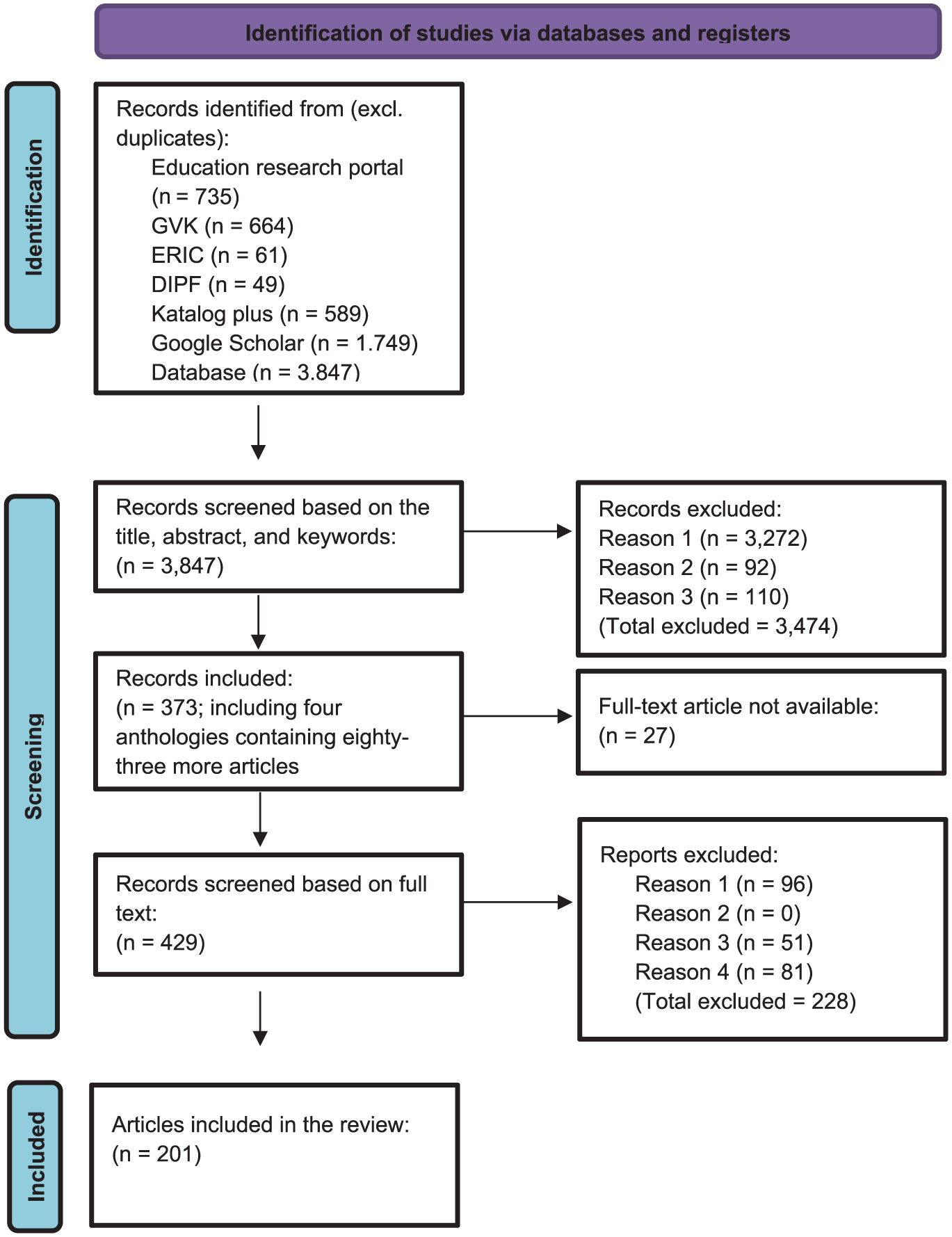
Flow chart of PRISMA (Page et al., 2021).
Search Strategy
Using the theoretical framework described previously, we had to balance the conflicting needs of the relevant elaboration of the research field and (considering our resources) the feasibility of the review. Since it was not possible to trace all terms potentially used in the research field (e.g., ambiguity, doubt, the German Kontingenz, and others), even on the basis of the expertise of the seventeen authors of this review, it was necessary to select one term that represents the research field as thoroughly as possible. This also meant narrowing the claim of the review to the discursive extension of the term. The term uncertainty seemed to represent the research field most comprehensively and was chosen because experiencing uncertainty is considered a core characteristic of being a professional in general and a professional teacher in particular (Evetts, 2003, p. 297). We limited the search to English- and German-language literature because these languages are the two most frequently used publication languages in the social sciences, together covering 96.14 percent of the referenced literature in the field (Liu, 2017). Once the sample was identified under this restriction, a closer look at the publications showed that the national contexts of the sample covered a wide range of origins. Thirty-three countries from Africa, Asia, Europe, North America, Oceania, and South America were represented (see for overview Additional Supplement S1: Overview of publications by country and continent and for detailed analysis Additional Supplement S4: Contexts of school systems of included publications). Nevertheless, there was a strong focus on publications from North America and Europe (with 15 countries represented throughout Europe)—a structurally similar pattern reported by Mason et al. (2021). The search was undertaken in December 2020 and included publications from 2005 to the search date. This period is particularly relevant because the discourse intensified at that time due to emerging educational concepts associated with uncertainty, such as ESD (Education for Sustainable Development).
Based on these decisions, the following search strings were used (with truncated forms of uncertainty and Ungewissheit/Unsicherheit as translations for German-language literature): (1) Uncertain* AND teach* OR learn* OR education* OR Bildung* OR literacy* OR school* OR student* OR class*; (2) Unsicher* OR Ungewiss* AND Lehr* OR Lern* OR Erzieh* OR Bildung* OR Unterricht.* We drew on publications that included the search terms in the title or as keywords (except Google Scholar, which only allows searches by title).
The goal was to choose different specialized databases for the field of education and interdisciplinary databases aimed at minimizing selection biases. Therefore, the researchers searched the following databases: Google Scholar, the University of Hamburg’s “Katalog Plus,” the German Common Library Network GVK, ERIC (Education Research Information Centre), and DIPF (the Leibniz Institute for Research and Information in Education). While the latter three specialize in education literature, the former three are interdisciplinary. Furthermore, to limit the bubble effect of internet searches and therefore minimize selection biases, three additional actions were performed before searching the databases: (1) the search history of the browser was cleared, (2) the researchers logged out from every account, and (3) the privacy mode was activated (Ćurković & Košec, 2018). A total of 3,847 studies were identified (see Additional Supplement S2: Sample total 3,847).
Screening Process
Imports of the search results from each database automatically removed duplicates. The literature identified ninitial = 3,847 publications, which were subjected to an initial screening phase on the basis of the title, abstract, and keywords, along with inclusion criteria R1–R3. These papers included the following:
R1: Content directly related to schools or university-based teacher education.
R2: Published in specialist journals (print and digital), edited volumes, as monographs, or as part of a doctoral thesis.
R3: Uncertainty appears as a main theme and a core term in the text.
The initial screening (on the basis of title, abstract, and keywords) was carried out by a team of three to reveal any ambiguities during this selection process in the course of communicative validation (Creswell & Creswell, 2023; Flick, 2020). Each publication was assessed by at least two members of the team regarding R1–R3, and all deviating assessments were discussed by a team of three. While (rare) deviating assessments could be easily clarified for the inclusion criterion R2, definitions in the sense of a coding rule were developed for the application of criteria R1 and R3 (see Appendix I, columns R1 and R3). The application of these rules in communicative validation systematically ensured intersubjectively validated decisions about inclusion (or exclusion if the criterion was not met) of publications. The number of publications was reduced from 3,847 to 373, and 27 of which did not have the full text available. Of the remaining sample, four were edited volumes (Bähr et al., 2019; Frei & Körner, 2010; Helsper et al., 2005; Paseka, Keller-Schneider & Combe, 2018). Eighty-three articles of these edited volumes that were not found by the initial search were also included, increasing the sample to 429. These publications were sifted in a second screening phase (on the basis of full text) using R1–R4.
R4: The publication includes an explicit definition of the core term uncertainty.
The second screening phase and all further evaluation stages were undertaken with the involvement of 17 educational scientists with expertise in eight specialist fields: professionalism research, school development research, pedagogical psychology, science-technology-engineering-and-mathematics (STEM), languages, social sciences, aesthetic subjects, and ethics/philosophy. The use of such a large research team was intended to ensure that the specifics of various relevant disciplines could be adequately considered when applying R1–R4 to the full text (and later when synthesizing the publications). For each of the abovementioned disciplines or domains, teams of two to three researchers were formed according to their disciplinary expertise. The 429 publications were assigned to these teams according to the principle of the best possible approximation of the respective discipline from which they originated (interdisciplinary publications were assigned to several teams). In this way, the decisions from the first screening phase regarding the fulfillment of criteria R1–R3 were checked for each of the 429 publications with a full-text reading, and criterion R4 was applied. For criterion R4, rules were formulated to evaluate the conceptual depth of the publications with respect to an explicit definition of the core term uncertainty in the text (see Appendix I, column R4) and the additional theoretical framework (the two last columns 2 ). Where there was doubt about a classification, this was discussed again in communicative validation with at least two other members of the research group. Thus, 228 papers were excluded for failure to meet the inclusion criteria (R1 = 96; R2 = 0; R3 = 51; R4 = 81). This resulted in a final sample size of nfinal = 201.
Procedures
For the purposes of the synthesis, the publications were analyzed on the following levels:
Descriptive Level (Result A: Surface Structure Synthesis): Research methodology, discipline, and the topic areas to which uncertainty was related were described. This was based on a qualitative content analysis, followed by a frequency analysis (Mayring, 2014). The deductively derived categories and those that were inductively generated (and communicatively validated) can be found in Appendix II and Additional Supplement S3 (Topic-specific characteristics of publications).
Analytical Level (Result B: Terminology Synthesis): Terminology and variations in meaning ascribed to the phenomenon of uncertainty were analyzed. Central terms were extracted from the publications to clarify their meaning and analyze their relevance.
Interpretive Level (Result C: Content Synthesis): The conceptualizations of uncertainty (i.e., the meaning and use of this term in the publications) were analyzed. This was based on a discursive and interpretive evaluation using a step-by-step paraphrasing process that condensed the content into more concise summaries. In this process, a continuum of four patterns inductively emerged, according to which all publications were finally classified.
The analysis of the sample moved from description to interpretation, with the latter based, above all, on discursive comparisons. The procedure thus sought “to find an appropriate balance between [the] advantages and disadvantages of formalized procedures, which have to be traded off against each other” (Hammersley, 2020, p. 35). Currently, there is a dearth of advice on how to synthesize reviews that work with qualitative studies (Bearman & Dawson, 2013) or bring together qualitative and quantitative studies (Hong et al., 2017). Therefore, developing the synthesis procedures for this review required significant methodological innovation. This allowed for a systematic analysis of an unusually large and methodologically disparate sample of nfinal = 201 publications, integrating publications from a variety of subdisciplines of educational science to cross-reference and synthesize.
Results
Surface Structure Synthesis: Publication Characteristics
The surface structure synthesis involved the initial identification of the characteristics of the publications in terms of research methodology, discipline, and topic area.
Methodological characteristics of publications
The 201 included publications comprised seventy-nine theoretical and 122 empirical papers. One-third of the papers were in the German language (63), while two-thirds were in the English language (138). The publications were further differentiated with regard to their research paradigms. Theoretical papers were divided into conceptual (52), practice-related (15), review (three), and unspecified (nine). The publications categorized as empirical were subcategorized as qualitative (70), quantitative (43), and mixed-methods (nine). Three further methodological aspects were analyzed in detail: study design, data collection, and data analysis (see Table 1).
Study design, data collection, and data analysis of the publications
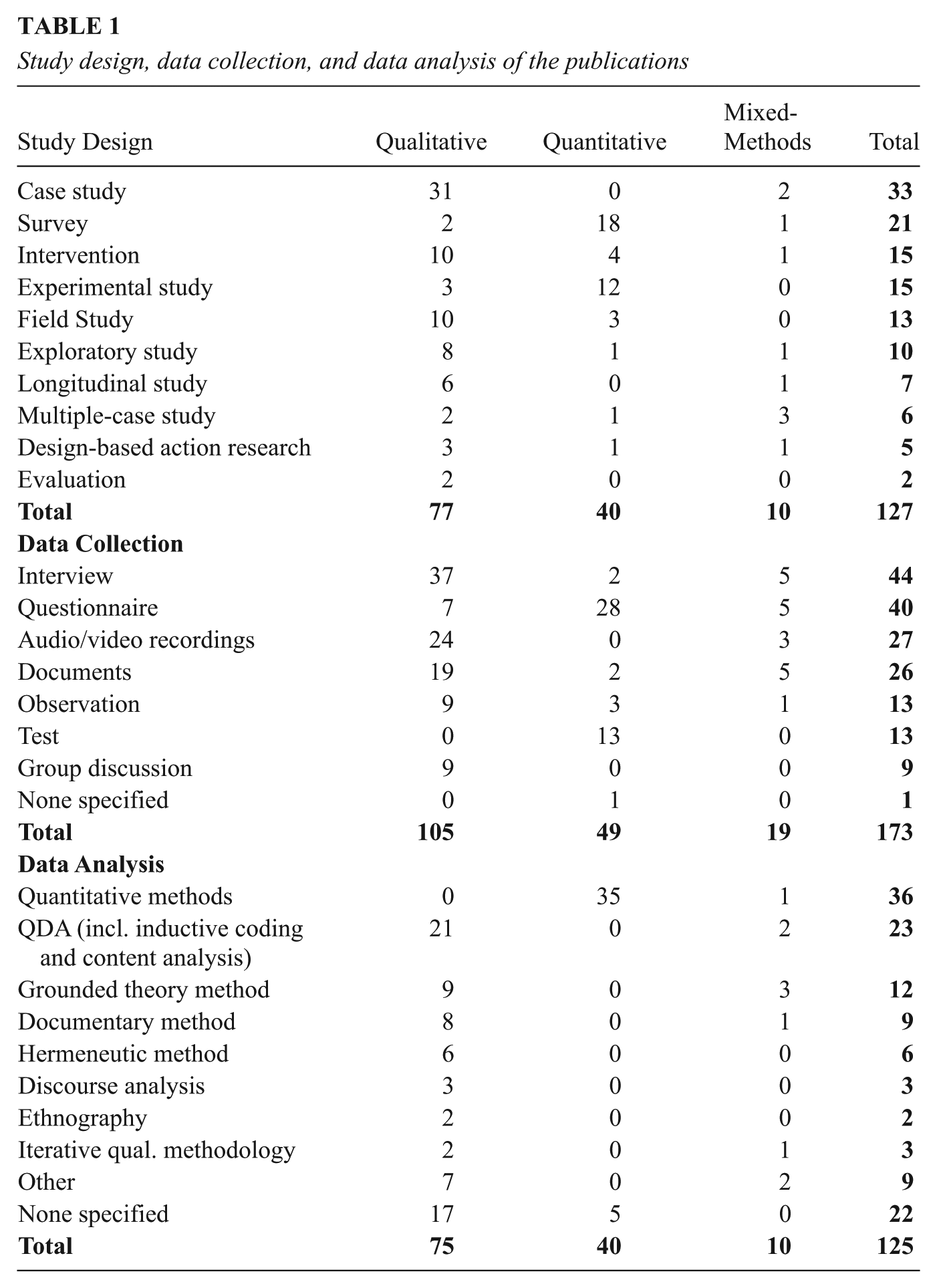
The study designs most commonly used in qualitative research were case studies (31), field studies (10), and intervention studies (10). Quantitative research was dominated by surveys (18) and experimental studies (12). Mixed-method studies were the least represented in the sample. The most common design in this category was the multiple-case study (three). Table 1 shows the data collection methods. For publications detailing a qualitative approach, the data collection methods used most frequently were interviews (37) and audio or video recordings (24). Publications dealing with quantitative research mainly used questionnaires (28) and tests (13). Those based on a mixed-methods approach favored interviews (five) and document analysis (five). The data analysis methods are shown in Table 1. The tools most commonly used to analyze data for publications using a qualitative approach were qualitative data analysis (QDA) (21) and the grounded theory method (GTM) (nine). Papers detailing quantitative approaches deployed a multiplicity of analytical methods, which were summarized as “quantitative methods” (35). As with research papers dealing with qualitative research, papers that were coded as mixed-methods predominantly used GTM (three) and QDA (two) for data analysis.
Discipline-specific characteristics of publications
As illustrated above, the nfinal = 201 publications were classified into eight specialist fields in terms of their underlying disciplines and in accordance to the members of the author group. Thus, 104 publications could be assigned to different fields of subject matter education: STEM dominated with 62 publications, followed by aesthetic subjects (18), social science (15), languages (seven), and ethics/philosophy (two). The other 97 publications were classified into generic disciplines, dominated by work in the context of teacher professionalism with 37 publications, followed by school development (21) and (educational) psychology (18). A ninth specialist field was inductively developed to include generic educational publications (labeled general education, 21). The scheme for categorizing the discipline-specific characteristics of publications can be found in Appendix II.
Topic-specific characteristics of publications: Seven areas were identified as the main focus of the topics referred to in the publications in the sample. Several publications covered multiple topics, which explained the difference between the number of codings (265) and the total number of publications (nfinal = 201). A detailed explanation of the inductive (topic) categories can be found in Additional Supplement S3: Topic-specific characteristics of publications. Eighty-one publications were assigned to the broader topic of teacher, teaching & professionalism, which included research questions related to teachers’ experience and interpretation of uncertainty, the actions they took in response to uncertainty, and the significance of uncertainty for teaching as a profession. Whereas this category referred to teachers’ learning in schools as well as at teacher education colleges, 68 publications were assigned to the category of students & learning, which addressed uncertainty exclusively from the perspective of K–12 students. Twenty-one publications were assigned to the school & school development category, which dealt with uncertainty as an aspect, problem, or characteristic of schools as organizations and the way such uncertainty was experienced, interpreted, and handled by those who run the organization (e.g., principals). Thirty publications addressed uncertainty from the perspective of a specific school subject, and 31 addressed the topic of teacher education, either dealing with curricular issues or with the experience and actions of preservice teachers, student teachers, teacher candidates, novice teachers, aspiring teachers, and individuals in equivalent positions. Twenty-three publications focused on the classroom (i.e., on interactions between teachers and their students). Because of the proximity of this category to the teacher category, double coding was common here. Eleven publications focused on society (i.e., uncertainty as a societal phenomenon related to pedagogical activity).
Terminology Synthesis: Uncertainty and Variation of Meaning
When synthesizing a heterogeneous set of studies, it is necessary to ensure that the terms used in such studies are based on consistent definitions (Bearman & Dawson, 2013). In the course of our analysis, it became evident that this was not the case in the research field addressed here. Therefore, core terms (i.e., the central term used by a publication in the context of uncertainty) had to be reconstructed from the publications. The initial descriptive analysis was followed by a more interpretive reconstruction of the meanings of the identified core terms. This was done for all nfinal = 201 publications in an open-response format. Four fields were identified by the meaning assigned to uncertainty, and multiple coding was possible.
Descriptive and qualitative data analyses of relevant terms
The analysis revealed that the three terms (uncertainty, Ungewissheit, and Unsicherheit) chosen for the search strategy were used alongside many other terms in the publications. The terms uncertainty and Ungewissheit/Unsicherheit occurred alongside four terms with almost the same frequency: ambiguity/Ambiguität (20 publications), risk/Risiko (21), contingency/Kontingenz (19) and doubt/Zweifel (17). The frequency (total number of publications in each language) of references to risk (10.9 percent of English publications) and its German equivalent Risiko (9.5 percent of German publications) were similar. The same was true of ambiguity (10.9 percent) and Ambiguität (7.9 percent). However, there were language-specific differences for the terms contingency (.7 percent)/Kontingenz (28.6 percent) and doubt (10.1 percent)/Zweifel (4.8 percent). This may have been due to semantic differences in the use of the term contingency/Kontingenz between English and German. While it occurs in colloquial English (referring to an eventuality or possibility), the German term is used only in sociological and philosophical theory (referring to the uncircumventable openness of the future and the existence of alternatives for any decision anyone takes). In the same vein, crisis/Krise (referred to in 2.2 percent of the English publications versus 11.1 percent of the German publications) and non-knowledge/Nichtwissen (English 2 percent; German 7.9 percent) occurred more often in the German publications, with English publications referring more frequently to complexity/Komplexität (English 7.2 percent; German 3.2 percent). The terms conflict (7.2 percent), perplexity (2.2 percent), struggle (3.6 percent), and dissonance (2.2 percent) were only used in English publications, while the term Irritation / disruption was only used in German (12.7 percent).
Variation of meaning: When we moved beyond these first analyses, some difficulties emerged. For example, the English term uncertainty can be translated into German in two ways: Ungewissheit and Unsicherheit. Some publications used these terms synonymously, but others did not (e.g., Asbrand, 2005). 3 Additionally, the meaning and use of the term uncertainty differed significantly across the sample as a whole. A closer look at the use and meaning of uncertainty allowed for the inductive identification of four fields, each focusing on a different aspect of uncertainty.
Field (1)—Disciplinary uncertainty: In the context of educational science, uncertainty is described as scientific uncertainty and understood as an inherent structural feature of science, scientific knowledge, and/or science-related issues (e.g., Gardner-Medwin, 2011). As Kirch and Siry (2012) stated, “Uncertainty is inherent in exploring and inquiring; inquiry, defined as intellectual curiosity (motivated to learn more and find answers), often begins from being uncertain or having an assumption of certainty challenged” (p. 262). In science, disciplinary uncertainty arises when there are no well-established datasets related to the questions one is trying to answer or when there is a vast amount of information (e.g., Rennie, 2020; Stadtler et al., 2013). One example is when geography teachers refer to uncertainty in the context of climate change in terms of predicting future developments concerning scenarios, internal variability, and long-term forecasting. Here, nescience (or the inability to know) becomes evident. Hannart (2013) summarized it well, calling it the “uncertain future of climate uncertainty” (p. 13).
Field (2)—Individual uncertainty: In this field, the term uncertainty focuses on the individual and where/how they experience uncertainty. In psychological approaches, uncertainty and the tolerance of uncertainty are assessed as personal characteristics. K–12 students experience uncertainty in learning processes in general (Bayless & Schlottmann, 2010) and before exams in particular (Putwain & Pescod, 2018). As moderating factors, the roles of parents (Anil et al., 2011; Shen et al., 2020) and schools (Howard-Jones & Demetriou, 2009; Wigfield & Gladstone, 2019) were analyzed. To measure the amount of individual uncertainty on the teachers’ side, “uncertainty scales” were used (e.g., König & Dalbert, 2007; Martinek, 2007). In publications reporting research on teachers, teacher socialization, or teacher knowledge, individual uncertainty was an integral part of the process of becoming a teacher through the experience of crises or irritations/disruptions (Košinár, 2018) when confronting habitus, one’s own social background, and the culture of the school at which one worked (Helsper, 2018). In the context of school development, teachers experienced individual uncertainty when external reforms and initiatives were perceived as demanding and as calling their professional identity into question (e.g., Bernasconi & Böing, 2017; Englund & Frostenson, 2017).
Field (3)—Interactional uncertainty: Here, the term uncertainty is understood as an uncircumventable part of classroom practice related to teaching and learning and derives from several sources: lack of an agreed-upon knowledge base; lack of consensus around goals and methods; multiple and often conflicting educational values; and the complexities inherent in relating to and working with other people (e.g., Chen et al., 2019; Melville et al., 2012). Interactional uncertainty was identified as “the unknown and unexpected” (Dotger, 2015, p. 215) experienced by teachers and teacher educators (Dinkelman, 2011). Mintz (2014) defined uncertainty as “the anxiety and confusion linked to classroom situations in which one experiences a state of ‘not knowing’ which knowledge to make use of when deciding what to do with a child who misbehaves, a group that does not seem to understand or progress, or a child who experiences difficulties with learning” (p. 1). These anglophone publications frequently referred to authors who had looked at uncertainty in the context of teachers’ classroom actions in previous decades. For example, Floden and Clark (1988) made general remarks about sources of uncertainty in the classroom. Schön (1983) described uncertainty as a crisis in teachers’ actions and considered how they reflected on it (“reflection-in-action”) to find a way to cope with such uncertainty. Several German publications emphasized aspects of this nature and identified two further facets. First, interactional uncertainty was seen as part of teacher professionalism and teachers’ self-concepts (e.g., Paseka & Schrittesser, 2018). Second, teachers have to cope with the Eigenwelt (i.e., the idiosyncrasies of K–12 students in making meaning and acquiring knowledge). Therefore, uncertainties appear as differences and fractures in the interactions between teachers and learners (Combe, 2018). Additionally, there is the impossibility of short-circuiting teaching and successful learning through direct instruction, which means that there is always a mismatch between lesson plans and how lessons actually unfold (Keller-Schneider, 2018). Many German publications referenced Luhmann’s (2004) concept of “double contingency.” Some authors also discussed ways in which uncertainty can be triggered to initiate learning processes, describing the resulting interactional uncertainty as crisis, doubt, confusion, or perplexity. With regard to PE, Bähr et al. (2016) situated this idea in the context of “Bildung”, which is the German term for one particular variant of transformative learning. “Philosophizing with children” provokes such uncertainties by choosing questions to which no unequivocal answer exist (e.g., Helzel, 2018). Paseka, Hinzke and Maleyka (2018) described an approach in the context of teacher education in which student teachers’ self-images were triggered to prompt critical reflection.
Field (4)—Contextual uncertainty refers to the environment and the conditions in which uncertainty in an educational field might occur. In the context of schools and the attempt to look beyond formal standards and rules, the authors identified an underlying “hidden curriculum” that acted as the basis for teaching and relationships with K–12 students. Such tacit knowledge gives rise to uncertainty (Kumashiro, 2009; Paseka & Schrittesser, 2018), and it is necessary to deconstruct hidden curricula to trigger development processes in schools. In the context of teacher education, uncertainty was discussed with regard to institutional principles and standards. Their complexity means that “being a teacher educator is to forge a professional identity in a field organized around what are uncertain principles and methods to guide decision-making” (Dinkelman, 2011, p. 316). Sinner (2012) described such uncertainty as a feeling of being in between (p. 603) and having a sense of disjuncture between university and school assignments (p. 606). In some publications, time structuring lessons and working hours were described as uncertain. For Barnett (2007, p. 9), uncertainty arose from changes in society and living in an age of uncertainty and perplexity that produced open questions and challenges of being. As a result, epistemological, practical, and ontological risks emerge, and such contextual uncertainty affects all people (D’Agnese, 2018, p. 144). Hallman (2017, p. 195) set schools in a wider context, emphasizing that teachers living in such “uncertain times” are confronted with a wide range of changes, with consequences for K–12 students, teaching, and schools. Here, links to publications from the context of school development become apparent. A recurring assumption was that schools are increasingly confronted with contextual uncertainty (e.g., due to social change, technological progress, social injustice, or the expectations of educational policy). Several authors (e.g., Hameiri & Nir, 2016; Schechter & Asher, 2012) referred to Milliken (1987), who argued from the perspective of organizational theory that environmental uncertainty prevents those who experience it from being able to predict situations and consequences. According to Milliken (1987), organizations face three distinct types of uncertainty: state uncertainty, effect uncertainty, and response uncertainty.
Content Synthesis: Dealing With Uncertainty as a Challenge or Opportunity
The overarching question under which papers were analyzed in this content synthesis was in what ways social actors in schools deal with uncertainty. Four patterns were differentiated and arranged on a continuum, ranging from uncertainty as a challenge to uncertainty as an opportunity. After this brief overview, each pattern will be explained in detail.
(C1) This pattern at the challenging end of the continuum can be described as blocking out or overcoming the challenge of uncertainty by suppressing, ignoring, or avoiding it.
(C2) A more moderate approach is accepting and reflecting on the challenge of uncertainty by acknowledging uncertainty and dealing with it reflectively.
(C3) The mirror image of C2 (i.e., the moderate approach on the other side of the continuum) is seizing uncertainty as an opportunity. In this pattern, K–12 students, teachers, or school leaders actively address uncertainty by accepting or even welcoming it.
(C4) The pattern at the opportunity end of the continuum is initiating uncertainty as an opportunity. This means that teachers or school leaders intentionally trigger or induce moments of uncertainty to stimulate learning and educational processes, mostly for K–12 students, but also in the context of (preservice) teachers’ professionalization.
C4 occurred exclusively from the perspective of the teachers. However, with the other three, publications mostly focused on either the students’ or the teachers’ perspectives, with the latter being dominant. This differentiation of perspectives is shown in the frequencies of the publications’ assignments in the sample in Table 2. A further distinction shown in Table 2, which was also significant, was that publications in which authors took unequivocal theoretically normative stances (clear bubbles in Table 2) explained or suggested that school/college stakeholders
Ways of dealing with uncertainty identified in the publications and numbers of assignments: multiple assignments were possible, total number of publications within a pattern in bold, distinction between theoretical positionings (clear bubbles), and empirical findings (shaded bubbles)
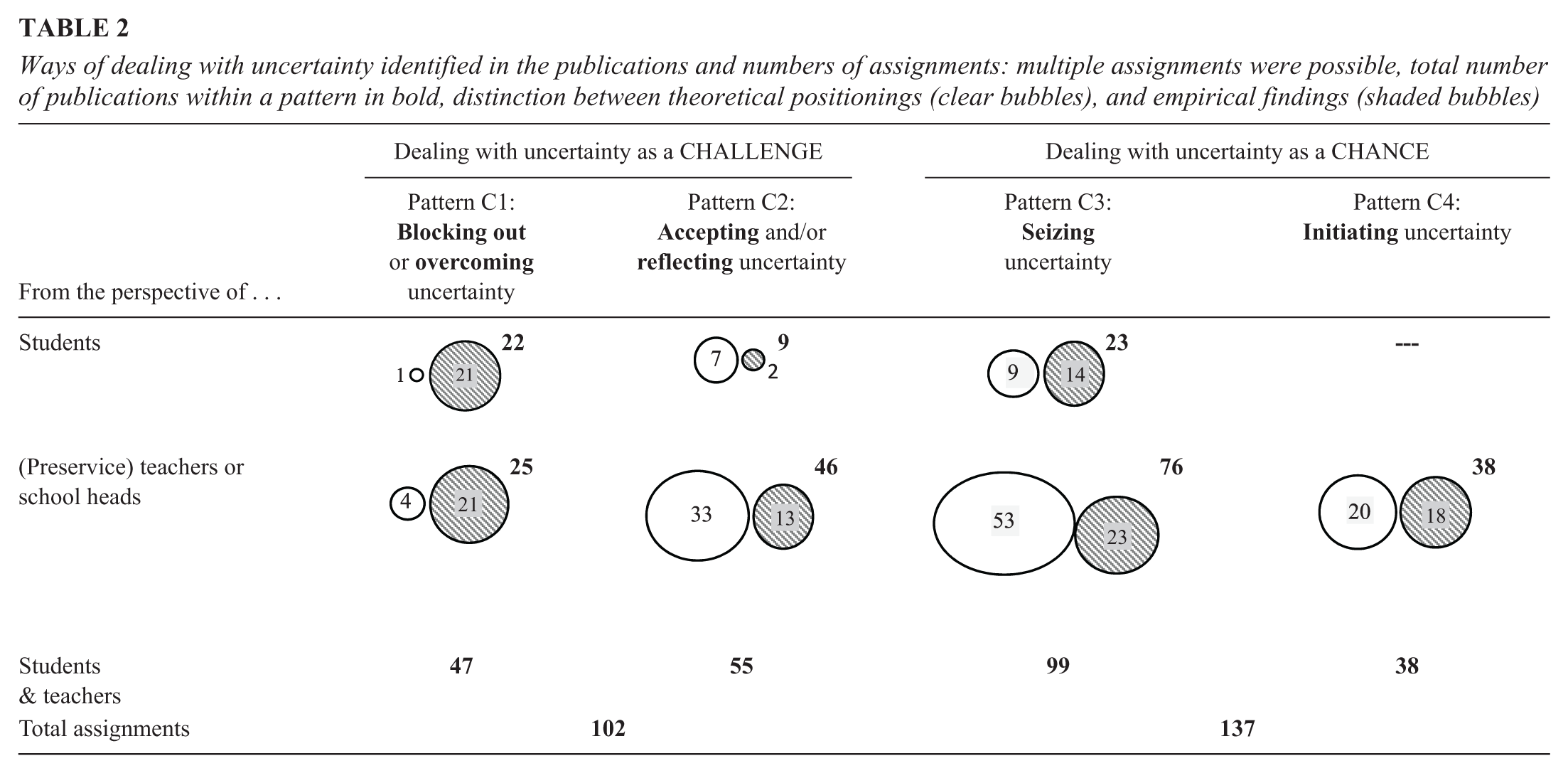
Becoming aware of this distinction between a normative or prescriptive approach and a descriptive approach (sometimes even contradictorily side by side within the same publication) proved to be crucial to the content synthesis presented here. At this point, the review revealed a fundamental contradiction about how social actors in schools deal with uncertainty and how they should deal with it according to normative statements. While the vast majority of publications theoretically praised uncertainty, empirical papers almost unequivocally showed that uncertainty is routinely ignored, camouflaged, or erased in educational practices. In this sense, Table 2 aims to help readers “[to] explore different configurations of the data and to produce new synthetic accounts of the phenomena under investigation” (Newman & Gough, 2020, p. 14). For this reason, it is not the exact number of assignments of publications to approaches that is relevant, but rather the rough pattern that can be discerned from the frequencies. With this in mind, multiple assignments were used (and commented on) as a way to depict transitions or juxtapositions between approaches within a publication (which was the case in 38 publications and is why the total in Table 2 [239] exceeds the sample size of nfinal = 201). In the detailed presentation of the results, disciplinary specifications are also considered. Notably, the overall sample has a disciplinary emphasis, with studies on STEM education and professionalism research particularly abundant in the sample.
Results for C1 and C2: Dealing With Uncertainty as a Challenge
In total, 102 publications from the sample postulated or empirically found uncertainty to be a challenge, focusing either on pattern C1 (blocking out or overcoming) or pattern C2 (accepting and reflecting). Both patterns were evenly distributed in the literature, and the previously mentioned contradiction between normative claims and empirical findings was clear: Blocking out or overcoming uncertainty was a pattern mainly on the empirical level, while accepting and reflecting uncertainty was the clearly predominant pattern on the theoretical level.
In pattern C1 (blocking out or overcoming the challenge of uncertainty), only five publications in the entire sample argued on a theoretical level that K–12 students or teachers should do so. Still, the majority of the 42 empirical publications showed that K–12 students and teachers often do (or aim to) overcome uncertainty as quickly as possible or (less frequently) block it out.
The students’ perspective within pattern C1 was examined by 11 empirical publications, all of which were on STEM classrooms. Two of these—surveys dealing with research-based learning (Heinström & Todd, 2006) and problem-based learning (Heng, 2013)—also explicitly took a theoretical position and opined that K–12 students should be able to overcome uncertainty as rapidly as possible. The empirical findings reported by the remaining nine publications were primarily concerned with blocking out uncertainty—namely, the absence of engagement by K–12 students with the disciplinary uncertainty inherent in natural sciences and mathematics. For example, in their study of mathematics teaching, Henriques and Oliveira (2016) stated that “few students used probabilistic language for describing their generalizations” (p. 62). Nonetheless, the nine studies on STEM subjects included a clear theoretical expectation that K–12 students should address and engage productively with disciplinary uncertainty (hence, the additional assignment of these nine studies to the “opportunity to be seized” pattern [C3]). Corner and Hahn (2009) explain this discrepancy between the norm (productive engagement with uncertainty) and practice (blocking out uncertainty) by referencing traditional presentations of knowledge in science lessons as “certain.”
In first and foreign language teaching, four empirical publications viewed disciplinary uncertainty, here understood as ambiguity, as a necessary and ineluctable structural feature of language that must ultimately be overcome. Thus, they viewed engagement with this ambiguity as a necessary part of the process of language acquisition. They asserted that learners, particularly at the start of language acquisition, demonstrate high levels of uncertainty regarding the production and reception of language because they lack knowledge and can only access incomplete and unstable mental representations of it: “We hypothesize that successful learning could be seen as a reduction in uncertainty” (Bultena et al., 2020, p. 76).
Five publications with a psychological focus addressed K–12 students’ experience of individual uncertainty as a challenge to be overcome or minimized and its impact on learning. The contexts of these empirical studies varied widely, ranging from test anxiety (Putwain & Pescod, 2018) to parenting styles (Shen et al., 2020) and “home instability” (Anil et al., 2011). One paper emphasized the importance of promoting positive expectations of success and valuing student achievement to overcome individual uncertainty (Wigfield & Gladstone, 2019).
The teachers’ perspective within pattern C1 was found in 25 publications. The findings of seven publications dealing with STEM teaching showed that—similar to K–12 students in STEM classrooms—STEM teachers have limited capabilities to meet normative expectations that they will engage productively with disciplinary uncertainty. Alongside one or two instances of seizing uncertainty as an opportunity (pattern C3), studies by Priemer and Hellwig (2018), Capobianco and Ní Ríordáin (2015), and Melville et al. (2012) all reported situations in which teachers either avoided disciplinary uncertainty in their teaching or overcame it (or wanted to) as quickly as possible. Ruhrig and Höttecke (2014, 2015) provided an even clearer account of physics teachers’ defensive handling of uncertain evidence (here, measurement uncertainty) by “removing,” “concealing,” and “avoiding” uncertainty (Ruhrig & Höttecke, 2014, p. 34).
A small group of five theoretical publications in the field of professionalism research argued that teaching staff should minimize or suppress interactional, individual, and disciplinary uncertainty in the context of pedagogical interaction. Bullough (2012) described a tendency for current education research to focus on best practice models and thus avoid discussions of uncertainty in pedagogical activity and decision-making. Other texts discussed how to create structures to “absorb” uncertainty in teacher education (Şenol & Akdağ, 2018) and schools (J. Berger & Combet, 2016, p. 95), such as programs for the qualification of teaching staff (ibid.). At the empirical level, the previously mentioned study by Senol and Akdağ (2018) and 10 other publications showed that interactional, individual, or disciplinary uncertainty was experienced as a burden by preservice teachers and teacher educators who aimed at reducing uncertainty (e.g., Britzman, 2007). With regard to school-based teachers, Paseka and Schrittesser (2018) found a tacit and uncritical working alliance with K–12 students that was built on a hidden curriculum of trouble-free lessons. In the context of school development, and against the background of psychological and organizational theory, two survey-based studies viewed structural uncertainty as a stressor and therefore focused on overcoming it: Soltau and Mienert (2010) investigated this in the context of teacher collaboration, while Oerke (2012) focused on the way teachers deal with school reforms that were imposed externally. Tan and Eyal (2015) took a (cognitive) psychological perspective, undertaking an intervention study that explored teachers’ strategies and diagnostic activities for overcoming situations of uncertainty and presenting empirical findings on the importance of self-efficacy in this context.
In pattern C2 (accepting and reflecting on uncertainty as a challenge), 40 of 55 publications were exclusively theoretical, according to which students (seven publications) and, above all, teachers (33 publications) should accept and reflect on disciplinary and/or interactional uncertainty in the context of schools or universities. However, only 15 studies provided empirical evidence of school/college teachers or students doing so.
From the students’ perspective within pattern C2, nine publications initially elucidated the characteristics of disciplinary uncertainty for specific subjects. Corner and Hahn (2009), for example, thus referred to the need within STEM contexts to reflect on the contradiction between viewing uncertainty as an “integral part of the scientific progress” and considering science a “discipline that provides certainty and consistency” (p. 203). Four publications highlighted the relevance of disciplinary or structural uncertainty to geography teaching. In the context of education for sustainable development or global learning, they argued that the challenges faced by society require decisions to be made under conditions of uncertainty (e.g., Chambers & Rowell, 2007). Therefore, K–12 students need to understand and reflect on uncertainty as a key concept of the discipline (e.g., Gray et al., 2011; Hall, 2006). There were only isolated empirical findings to balance these theoretical positions (i.e., Asbrand, 2005) in the context of global learning and in the context of STEM education (Lee et al., 2019).
The teachers’ perspective within pattern C2 was emphasized in 46 publications. Again, theoretical texts (33) clearly predominated. They were mostly related to professionalism research (28). Seventeen of these were purely theoretical contributions and conceived of uncertainty as “not to be avoided” in the context of pedagogical activities (Kurtz, 2006, p. 549). Sources of uncertainty included, among other things, “situativity, problems of understanding [author’s note: lack of subject knowledge on the part of the teacher], the complexity of the interaction, and the construct of what constitutes a good lesson” (ibid.). Most authors considered acceptance of and reflection on such interactional and disciplinary uncertainty as precursors to active and productive engagement with them, thus marking the transition to pattern C3 (uncertainty as an opportunity). As Mintz (2014) stated:
What I argue here is, first, that the first port of call for teachers should be their interaction with the child as a human other; second, that teachers should be open in recognizing that uncertainty can be productive; and third, that teachers should recognize that encountering uncertainty in their work with children can be very difficult, but there is more to be gained by staying with the struggle than by fleeing from it too early, into the promise of expert solutions. (p. 179)
This notion was sometimes related more to teachers (e.g., Brüninghaus & Tetens, 2012) and other times more to teacher education (e.g., Keller-Schneider, 2018). The 11 empirical publications related to professionalism research each described different options for dealing with uncertainty. These studies showed that (preservice) teachers can meet the normatively formulated requirement to accept and reflect on uncertainty to some extent, but not fully. Three quantitative studies drew on the construct of uncertainty tolerance to compare and contrast different teacher types (König & Dalbert, 2007; Martinek, 2007; Senol & Akdağ, 2018), finding that teachers who experience uncertainty as a burden tend to suppress, avoid, or ignore it, while teachers with greater tolerance for uncertainty accept it as a challenge and to some extent take a reflective approach to it. Conversely, six qualitative case studies depicted a variety of procedures for handling uncertain situations in the classroom, ranging from discontinuing them to accepting them as something that could be handled actively. Košinár (2018, p. 260) distinguished between three ways of approaching interactional uncertainty: (a) erasing it through a broad repertoire of knowledge, routines, and planning; (b) recognition of uncertainty; and (c) smoothing out crises and routines with situated creativity.
With regard to school development, at a theoretical level, 14 texts found that schools were increasingly faced with contextual uncertainty and should accept and reflect on it. They asserted that uncertainty in this context arose, among other things, from societal transformation, technological progress, social inequality, education policy expectations, a focus on output (including regular evaluation and measurement of school quality and student achievement), and the associated changes to the culture of learning in schools. Some publications have addressed teacher collaboration as a productive way of collectively dealing with challenging uncertainties in instructional practice (e.g., Ham, 2011) or, conversely, as something that triggers or amplifies uncertainty when teachers already feel uncertain 2 (e.g., Soltau & Mienert, 2013). Other publications have focused on the importance of school management for reform processes. Transformational leadership is considered essential to finding ways of accepting and reflecting on the challenge of uncertainty at schools (Hameiri & Nir, 2016; Schechter & Asher, 2012). Other publications have addressed the impact of introducing neoliberal performative technologies (e.g., focus on outputs or standards) to schools (Bormann, 2015; Englund & Frostenson, 2017). Englund and Frostenson’s (2017) study was the only one to undertake any empirical exploration of the approach to uncertainty, designating teachers as “struggling performers” (p. 903).
Only four publications on subject teaching opined that teachers should take an accepting and reflective attitude to disciplinary and interactional uncertainty: Sullivan et al. (2020) recommended that mathematics teachers engage with the uncertainty of negotiating with K–12 students about mathematical issues. Three PE publications formulated this idea similarly. Baumgartner (2017) presented empirical findings showing how teachers reflexively handle the complex situativity of the subject (especially given the dynamic spatial and social conditions in gyms).
Results for C3 and C4: Dealing With Uncertainty as an Opportunity
The category of uncertainty as an opportunity was distinguished between pattern C3 (seizing uncertainty) and pattern C4 (initiating uncertainty). It comprised 137 publications focusing on engaging with, using, or orchestrating uncertainty. Encountering uncertainty was perceived as a specific opportunity for teaching and learning. At the empirical level, the focus was on whether and how this opportunity could be seized to foster educational processes.
Pattern C3 contained the largest group in the sample (99 publications), with three-quarters (76) referring to the teachers’ perspective. These publications either focused on teachers considering uncertainty as an opportunity for student learning (40) or an opportunity for teacher learning (36). In this pattern, the normative appraisal of uncertainty was shared in a wide pool of publications, raising expectations of educational practices to follow this idea. These were often not met, as shown in patterns C1 and (partly) C2.
The teachers’ perspective on seizing uncertainty as an opportunity for student learning was strongly represented in STEM subject teaching (27); these publications focused predominantly on the practicalities of teaching, with 24 presenting exclusively theoretical arguments and suggesting that teachers should see disciplinary uncertainty as an opportunity to learn about the nature of science with respect to issues like measurement uncertainty in physics (cf. Nunn, 2015) or stochastics in mathematics (Kapadia & Borovcnik, 2017). Studies by Manz and Suárez (2018) and Backman (2008) have centered on teaching practices and teachers’ concepts. However, the empirical findings of these studies again highlighted that despite all the theoretical urgings to make use of uncertainty, teachers’ actions overwhelmingly erase uncertainty (see pattern C1). Empirical studies of STEM teachers reporting productive engagement with uncertainty are rare (Manz & Suárez, 2018; Priemer & Hellwig, 2018). Two PE publications focused on teachers and their processes of reflection and relearning when dealing with uncertain situations to facilitate a deep learning process for students (Krieger, 2010; Schierz, 2010). In the field of professionalism research, six papers showed that within the interactional uncertainty of teaching and learning, disruptions and differences arose that could not be controlled (Bähr et al., 2019; Combe, 2018; Mintz, 2014); however, such uncertainties could be assessed as “fruitful moments” for learning (Paseka & Schrittesser, 2018). The field of educational psychology gave rise to three empirical investigations. Bayless and Schlottmann (2010) examined how preschoolers and primary school students handled uncertainty productively when making predictions, while Howard-Jones and Demetriou (2009) emphasized uncertainty as a motivational factor in the use of games to promote learning. Wang et al. (2008) established a positive connection between individual uncertainty orientation and K–12 students’ educational skills, self-awareness, academic achievement, and mental well-being.
The teachers’ perspective on seizing uncertainty as an opportunity for themselves with regard to their professionalization was the focus of 36 publications. In the context of STEM subject teacher education, five publications used action research (Capobianco & Ní Ríordáin, 2015) and storytelling (Melville & Pilot, 2014) interventions to investigate the extent to which preservice teachers deliberately used and (successfully) dealt with unavoidable moments of interactional and disciplinary uncertainty that arose. Five publications on the aesthetic subjects of PE and drama/art took a theoretical stance. All authors who explored this perspective considered interactional uncertainty a (challenging) opportunity for teachers’ professional development, which is why they were classified in pattern C3 (cf. De Martin-Silva et al., 2015; Schürch & Willenbacher, 2019).
Twelve theoretical papers in the field of professionalism research argued that allowing uncertainty to unfold is a central aspect of teacher professionalism. Thus, preservice teachers need to be prepared for different aspects of uncertainty, and the authors suggested various ways to achieve this. Helsper (2018) suggested that case studies could be used as starting points for reflecting on uncertainty, whereas Gomez and Johnson (2019) suggested that “service learning” could trigger uncertainty and reflection on it. Schuck et al. (2018) and Britzman (2007) put uncertainty into a wider context by emphasizing it as a social phenomenon and a condition of being human. In a similar vein, uncertainty was combined with the promotion of democracy (Bullough, 2012) or diversity (Hallman, 2017). Empirical studies analyzed whether and how (preservice) teachers took advantage of uncertainty. Dietrich (2018), Košinár (2018), and Paseka, Hinzke and Maleyka (2018) considered various modes for handling uncertainty and how young teachers could use such crises to change their ideas of professional activity.
Seven publications from the field of school development research took the view that, at the theoretical level, contextual uncertainty represented an opportunity for teachers and school management. Two of these publications focused on the importance of school management for processes of reform, cultivating a leadership style that views proactivity and “daring” as a means of boosting schools’ effectiveness (Hameiri et al., 2014), or that proved flexible and resilient in the face of the pandemic (Miller, 2020). Two further publications addressed teachers’ handling of contextual uncertainty in connection with specific reforms. Drawing on structural theory in the context of professional approaches, Idel and Schütz (2018) discovered that changes to a learning culture (which resulted from the shift to all-day schools in Germany) led to increased uncertainty regarding teachers’ professional agency. Keesing-Styles et al. (2013) demonstrated that the introduction of a new curriculum in tertiary education could trigger individual uncertainty among teachers. Three other publications focused on teachers’ reflective approaches to uncertainty in a changing and unpredictable world (Koşar, 2020; Seddon, 2015; Todd, 2016). (Prospective) school managers in Singapore also expressed this view in the context of a qualification program for up-and-coming managers (Ng, 2013).
The students’ perspective within pattern C3 comprised 23 texts, 20 of which looked at STEM subject teaching. Two justifications emerged for the need for K–12 students to seize uncertainty as an opportunity. It was argued that disciplinary uncertainty is inherent in the production of scientific knowledge (e.g., Buck et al., 2014; Kirch & Siry, 2012; Schroeder et al., 2019); however, it was also noted that future citizens must be able to handle various aspects of uncertainty (e.g., Christensen & Fensham, 2012; Hauge & Barwell, 2017). Notably, of the 12 publications that also took an empirical approach to the way K–12 students handled disciplinary or interactional uncertainty, eight reported findings that frustrated these expectations. In contrast, some results showed that K–12 students’ learning benefited from them engaging actively with uncertainty, such as scientific reasoning (Buck et al., 2014). Studies of this subgroup also produced many examples of situations in which K–12 students warded off uncertainty or overcame it as rapidly as possible (cf. pattern C1). This behavior appeared to deviate significantly from the normative objective of using uncertainty productively (e.g., Buck et al., 2014; Hauge & Barwell, 2017; Henriques & Oliveira, 2016). Notably, the authors tended to focus the presentation of their findings more on an application of uncertainty that conformed to their theoretically based aspirations than on the K–12 students’ defensive response to uncertainty. However, four studies on STEM teachers reported solely positive results when K–12 students used uncertainty as an opportunity (e.g., Kirch & Siry, 2012; Munier et al., 2013; Schroeder et al., 2019). The social sciences subject group was represented by three publications, all of which reported positive results in the development of competences to deal with uncertainty (e.g., Lorenz, 2008; Pallant et al., 2020; Sender, 2017).
Pattern C4, initiating uncertainty as an opportunity, focused on the active introduction of uncertainty into the classroom by teachers as an opportunity for students’ learning processes, or the integration of disciplinary or contextual uncertainty into teaching in an even more comprehensive philosophical sense. These scenarios, which emerged in 38 publications, focused exclusively on the teachers.
The perspective of teachers initiating uncertainty as an opportunity for students’ learning was found in 20 publications. Four of them, which dealt with STEM subject teaching, called for teachers not only to engage with disciplinary uncertainty but also to introduce it deliberately in their lessons. Of these, three empirical video-based studies looked at the promotion of K–12 students’ reasoning skills in the natural sciences in the context of whole-class discussions (Chen, 2020; Chen & Qiao, 2020; Chen et al., 2019). A fourth theoretically focused paper on mathematics by Zaslavsky (2005) saw emphasizing disciplinary uncertainty as an opportunity for learning. The aesthetic subjects were represented by eight papers, most of which were concerned with transformative learning. They shared the assumption that “small crises” in subject teaching (i.e., disruptions) could initiate learning processes (Bähr et al., 2019; Sabisch, 2019). Five of the eight publications also took an empirical approach (e.g., Gebhard et al., 2019).
Of the 12 publications dealing with subject-matter teaching, eight viewed uncertainty as a feature of human existence and called for this epistemologically, ontologically, and anthropologically based feature to be integrated into lessons to prepare K–12 students for a life lived in uncertainty. They argued that since this feature of uncertainty also impacts teachers, teaching and learning can be seen as communal acts on the part of all involved and as acts that can be linked with uncertainty at an interactional level (D’Agnese, 2018; Fecho, 2013; Jordan & McDaniel Jr., 2014). Such educational processes manifest in the fields of ethical and philosophical education. According to Hayden (2012), in light of the uncertainty of human existence and moral truths, moral education must be understood as the participation of students in research and the development of morals in a learning environment where teachers and learners engage in a collective search for meaning and significance. This is also at the center of philosophizing with children, which is the subject of two empirical studies (Helzel, 2018; Michalik, 2018) that analyze ways in which K–12 students deal productively with the uncertainty of philosophical questions and research in subject-matter education.
The perspective of teachers initiating uncertainty as an opportunity for their own professionalization was the focus of 18 publications, four of which were concerned with subject-matter teaching. Two empirical studies dealing with STEM subjects investigated the use of uncertainty prompts in the training and professionalization of preservice teachers, seeing disciplinary uncertainty as an opportunity and the starting point for subject-based learning. Melville et al. (2012) demonstrated that teachers’ preexisting certainties about the status of scientific research could be questioned on an ongoing basis. In the field of ethical and philosophical education, Lucas and Miligan (2019) considered the structural uncertainty of concepts such as social justice and called for philosophical questions and research to be the focus of education. The collective search for meaning with dialogue between learners and teachers—a central feature of philosophizing with children—was researched by Michalik (2019) in an empirical study of social studies teachers.
The field of professionalism research comprised 12 publications that discussed the instigation of uncertainty at a theoretical level as a learning opportunity for preservice teachers. Paseka, Hinzke and Maleyka (2018) advocated the instigation of disruptions in the form of staged videos. Dotger (2015) proposed introducing “clinical skill centers” where uncertain situations could be planned and initiated. Finally, Gomez and Johnson Lachuk (2019) recommended service learning as a potential framework for questioning one’s own certainties. Regarding school development, two publications (from a theoretical perspective) saw contextual uncertainty as an opportunity that should be initiated. Bernasconi and Böing (2017) stressed opportunities to further develop processes in inclusive school settings, whereas Ng (2013) provided examples for the development of leadership skills.
Discussion
The present review focused on phenomena, terminology, and theoretical conceptualizations related to the term uncertainty in English-language education research on school and teacher education and the corresponding German-language research. The systematic search yielded an initial sample of ninitial = 3,847 publications, which was reduced via the rigorous application of four inclusion and exclusion criteria to nfinal = 201. This sample was evaluated by 17 educational scientists with expertise in the basic subdisciplines of educational science and subject matter education in selected subjects. The review, which is an innovative combination of descriptive and interpretive analysis stages, yielded insights on three levels. The surface structure synthesis (A) was based on descriptive analysis and revealed features of the publications related to the research methodology, discipline, and specific topic areas. The results showed that empirical publications dominated, but theoretical publications were also represented in the sample. The majority of the empirical studies reviewed were based on a qualitative paradigm and the corresponding research methods (predominantly interviews or audio/video footage and categorical analysis). The publications in the sample covered nine disciplines, which were reflected in the expertise of the educational scientists involved in the review. More than half of the publications could be assigned to subject matter education, with a strong focus on STEM subjects. The studies focused relatively frequently on teacher education and learning processes for teachers in schools, but they also looked at K–12 students’ learning processes. Because the sample of relevant publications was large and diverse, formalized processes and inferential statistics that are frequently deployed in systematic reviews or meta-analyses faced serious limitations. The nature of the sample demanded a new approach by transitioning from initial descriptive to gradually more discursive and interpretive analysis stages.
The terminology synthesis (B) focused on the core terms used in the publications and their meanings. At the descriptive level, this was divided into two issues. First, the search terms for the review (uncertainty for English-language publications and the translations Ungewissheit and Unsicherheit for German-language publications) were relatively inconsistently defined. Second, they were often used in conjunction with other terms, particularly ambiguity, risk, or doubt, and, more rarely, contingency, crisis, non-knowledge, complexity, conflict, perplexity, struggle, dissonance, and irritation/disruption.
Because consistent definitions for the search terms were not available, an initial descriptive analysis was followed by a second interpretive analysis, which inferred a term’s meaning from its context. Four different meanings of uncertainty were inductively developed: (1) Disciplinary uncertainty was evident across all publications dealing with subject matter learning and was especially prevalent in science education. In this context, uncertainty was described as an inherent structural feature of science or scientific knowledge (e.g., measurement uncertainty in physics or the uncertainty of predictions about climate change in geography). (2) Individual uncertainty focuses on the individual. In psychological approaches, the experiences of uncertainty, uncertainty tolerance, and coping with uncertainty were conceived as personality traits. Research on teaching and professionalism viewed uncertainty as integral to the process of becoming a teacher, and research on school development conceived individual uncertainty as a reaction to external reform initiatives that were perceived as challenging and called teachers’ sense of their own professional identity into question. (3) Interactional uncertainty was understood as an integral and ineluctable part of instruction and of the processes of teaching and learning. Interactional uncertainty finds expression in the impossibility of planning social processes in advance or in the disruptions that emerge in interactions between teachers and learners. Several German-language publications on teacher professionalism applied Luhmann’s systems theory and his concept of double contingency, referring to reciprocal expectations and actions in the context of interactions (Luhmann, 2004). (4) Contextual uncertainty due to the publications in the sample was expressed in different ways, such as “hidden curricula,” more or less official institutional principles and standards, linguistic systems, or general social conditions under which teaching and learning in the education system should happen.
Content synthesis (C), which was based solely on discursive and interpretive analysis, resulted in increasingly condensed summaries of the publications’ content. Here, two basic patterns for dealing with uncertainty emerged. Papers could be grouped according to whether they considered uncertainty a challenge or an opportunity. Through the analysis, these two patterns were refined into four patterns that could be arranged on a continuum: (C1) blocking out or overcoming uncertainty as a challenge, (C2) accepting and reflecting on uncertainty as a challenge, (C3) seizing uncertainty as an opportunity, and (C4) initiating uncertainty as an opportunity. Whereas the first two patterns describe warding off or enduring uncertainty, the latter two patterns represent engagement with uncertainty aimed at fostering K–12 students’ learning or the professionalization of (preservice) teachers.
The three central overarching findings are as follows. First, the dominant pattern was clearly C3. It was assigned to nearly half of the publications of the samples and was particularly common in theoretical or conceptional publications. Second, the majority (three-quarters) of the publications in the review sample investigated (preservice) teachers’ and school leaders’ perspectives. However, many empirical studies have explored the perspective of K–12 students, with half assigned to pattern C1. These studies’ empirical findings showed that when dealing with subject matter (especially in STEM subjects), K–12 students warded off any disciplinary uncertainties that arose or tried to overcome them as rapidly as possible rather than engaging with them productively. Third, we found a discrepancy between the adoption of (normative) theoretical positions and the reporting of (descriptive) empirical findings, and it was not unusual for both to occur within a single publication. Recommending patterns C2 and C3 was particularly prevalent when theoretical positions were adopted. Conversely, C1 was dominant when empirical findings were reported. Notably, many empirical studies conceptualizing uncertainty as an opportunity (i.e., in the context of STEM education) tended to emphasize outcomes that conformed to their expectations. Therefore, it can be concluded that the theoretical positionings were associated with recommendations or even expectations of a reflective and productive approach to uncertainty, which were often not met when pedagogical practice was investigated.
Limitations
The present review was subject to the typical limitations of other systematic reviews: high levels of precision were at odds with high levels of completeness because the chosen criteria and search terms needed to identify as many relevant studies as possible (sensitivity) and keep the number of nonrelevant hits low (specificity). Therefore, the results have limitations in terms of scope and coverage. Regarding the present analysis of uncertainty, this mainly relates to four aspects, which are explained in the following sections.
Lack of disciplinary accuracy
The interdisciplinary approach taken in this review has limitations regarding disciplinary accuracy and completeness. The locations chosen for the searches were limited to general databases and those containing educational science literature. To achieve subject-specific completeness, subject-specific databases would have to be searched (e.g., Psyndex or PubPsych for educational psychology). Additionally, the focus on the search term uncertainty (and its two translations in German) resulted in reduced completeness in individual disciplines. For example, in foreign language education, anxiety would be relevant in the context of uncertainty, as would otherness in PE, or terms such as risk, evidence, variation, or mutation in STEM subjects. Thus, the one-term search led to lower accuracy in terms of discipline-specific results.
Blind spots with respect to theories
The (necessary) focus on one search term also resulted in the underrepresentation of fundamental (but not directly related) terms, such as negativity, crisis, irritation or disruption. These are used in foundational works on (the philosophy of) educational theory (e.g., English, 2005; Lischewski, 2016). The same was true for contingency or non-knowledge, which predominated in works focusing on the theory of practice, systems theory, and sociology (e.g., Meseth et al., 2012; Schäfer, 2018). Thus, focusing on the search term uncertainty reduced the number of theoretical concepts to which connections could be established.
Fuzzy margins of the research area
A third limitation resulted from a strong focus on the application of strict quality criteria for literature selection. Since the quality and rigor of a review’s results are only as robust as the quality of the studies it analyzes, only contributions containing an explicit definition of uncertainty as a core term were included. A case in point is the field of creativity. Works on creativity that relate it to “the unexpected” (Gugutzer et al., 2018) that did not explicitly define uncertainty as part of creativity were identified by the search strategy but failed to be included in our review. The same was true for intercultural approaches, where foreignness and otherness were the terms that constituted the phenomenon of uncertainty (e.g., Seiberth, 2010).
Language-based bias
It is common in systematic reviews to limit the inclusion of studies based on their language of publication. This review refers to English- and German-language publications because they are the two most frequently used publication languages in social science and cover over 96% of referenced publications in this field (Liu, 2017). Even though the sample of this review covers studies from a range of 33 countries from different continents, there was a strong focus on publications from North America and Europe. Within the European subsample of 15 countries, publications in the German language (although not necessarily focusing on the German school system) were the most numerous. This imbalance in favor of German-language publications was due to the fact that German educational science has contributed crucial theories, such as “Bildungstheorie” (cf. above), to the discourse on uncertainty, which led to a large proportion of German-language publications in pattern C4. However, this pattern was potentially overrepresented because the respective concepts were more prevalent in the German-language discourse than in the educational science discourses of other countries. Additionally, there was an underrepresentation of scholarship published in languages other than the dominating “mainstream” (Boveda et al., 2023; Mason et al., 2021). Therefore, the aim of this paper was limited to providing an initial systematic review of the discourse of uncertainty in the context of school and teacher education based on the current scientific literature that determines the discourse. Metaphorically speaking, as with an onion, after this first layer has been removed, the underlying layers should be brought into focus. We see our review as a starting point for further research that investigates the relevance of diverse educational systems and different—including marginalized—cultural contexts for uncertainty.
Following this, a fundamental critique of the theory of science is also applicable to the present paper. Being rooted in technical processes, systematic reviews convey particular ideas about what constitutes scientific knowledge (among other things) by excluding certain publications or rendering them invisible from the outset (publication bias). Finally, limitations regarding the availability of sources must be mentioned: 27 sources could not be accessed (not even via interlibrary loan) in full text and were therefore not included in the second screening phase (see Search Strategy). This may have led to a bias in the sample that could not be further controlled.
Implications
Despite the limitations outlined, the present review is fruitful in several respects. From an epistemological perspective, an interdisciplinary team of 17 educational scientists has reviewed the English- and German-language discourse on uncertainty in the context of school and teacher education, condensing and systematizing it with respect to phenomena, terms, and theoretical conceptualizations. The existing body of theory and research on uncertainty is thus significantly expanded. The results of the terminology analysis (B) with its four variations of meaning of uncertainty in educational discourse (disciplinary, individual, interactional, and contextual uncertainty) as well as the results of the content analysis (C) with its four ways of dealing with such variations of uncertainty as a challenge (patterns C1 and C2) or as an opportunity (patterns C3 and C4) have the potential to clearly structure further research in this field regarding terminology and content.
The resulting framework provides orientation and can also be used to focus the discourse in the field of education. Among other things, this will enable comparative studies, which would also be beneficial for research that is more relevant to schools and practice. There could be a shift from a previously fragmented collection of area-specific representations of uncertainty toward a comparative understanding of uncertainty in different areas of education in research and practice (e.g., consideration or integration of aspects of uncertainty in school curricula and development of a coherent understanding of uncertainty in schools). Furthermore, the review has practical implications. A central finding is that theoretical positionings formulate high expectations for an accepting, reflective, and productive handling of uncertainty, which are only partially traceable in the pedagogical practice that was studied empirically. This draws attention to the need for development in teacher education.
In terms of research methodology, a new approach was established by combining descriptive and discursive–interpretive steps of analysis to account for a large sample of publications characterized by substantial diversity with respect to theoretical approaches and empirical methodologies. The epistemological and research methodological yields can serve as starting points for further research.
Supplemental Material
sj-docx-1-rer-10.3102_00346543251404456 – Supplemental material for Uncertainty in the Context of School and Teacher Education in Educational Science Literature—A Systematic Review
Supplemental material, sj-docx-1-rer-10.3102_00346543251404456 for Uncertainty in the Context of School and Teacher Education in Educational Science Literature—A Systematic Review by Ingrid Bähr, Britta Lübke, Kerstin Michalik, Teresa Berding, Ioana Chiotoroiu, Melissa Hanke, Telse Iwers, Dagmar Killus, Claus Krieger, Jessica Kruska, Julia Schwanewedel, Sandra Sprenger, Ole Stabick, Constanze Struck, Merve Yilmaz, Andreas Bonnet and Angelika Paseka in Review of Educational Research
Supplemental Material
sj-xlsx-2-rer-10.3102_00346543251404456 – Supplemental material for Uncertainty in the Context of School and Teacher Education in Educational Science Literature—A Systematic Review
Supplemental material, sj-xlsx-2-rer-10.3102_00346543251404456 for Uncertainty in the Context of School and Teacher Education in Educational Science Literature—A Systematic Review by Ingrid Bähr, Britta Lübke, Kerstin Michalik, Teresa Berding, Ioana Chiotoroiu, Melissa Hanke, Telse Iwers, Dagmar Killus, Claus Krieger, Jessica Kruska, Julia Schwanewedel, Sandra Sprenger, Ole Stabick, Constanze Struck, Merve Yilmaz, Andreas Bonnet and Angelika Paseka in Review of Educational Research
Supplemental Material
sj-xlsx-3-rer-10.3102_00346543251404456 – Supplemental material for Uncertainty in the Context of School and Teacher Education in Educational Science Literature—A Systematic Review
Supplemental material, sj-xlsx-3-rer-10.3102_00346543251404456 for Uncertainty in the Context of School and Teacher Education in Educational Science Literature—A Systematic Review by Ingrid Bähr, Britta Lübke, Kerstin Michalik, Teresa Berding, Ioana Chiotoroiu, Melissa Hanke, Telse Iwers, Dagmar Killus, Claus Krieger, Jessica Kruska, Julia Schwanewedel, Sandra Sprenger, Ole Stabick, Constanze Struck, Merve Yilmaz, Andreas Bonnet and Angelika Paseka in Review of Educational Research
Supplemental Material
sj-xlsx-4-rer-10.3102_00346543251404456 – Supplemental material for Uncertainty in the Context of School and Teacher Education in Educational Science Literature—A Systematic Review
Supplemental material, sj-xlsx-4-rer-10.3102_00346543251404456 for Uncertainty in the Context of School and Teacher Education in Educational Science Literature—A Systematic Review by Ingrid Bähr, Britta Lübke, Kerstin Michalik, Teresa Berding, Ioana Chiotoroiu, Melissa Hanke, Telse Iwers, Dagmar Killus, Claus Krieger, Jessica Kruska, Julia Schwanewedel, Sandra Sprenger, Ole Stabick, Constanze Struck, Merve Yilmaz, Andreas Bonnet and Angelika Paseka in Review of Educational Research
Footnotes
Appendix
Scheme for categorization of
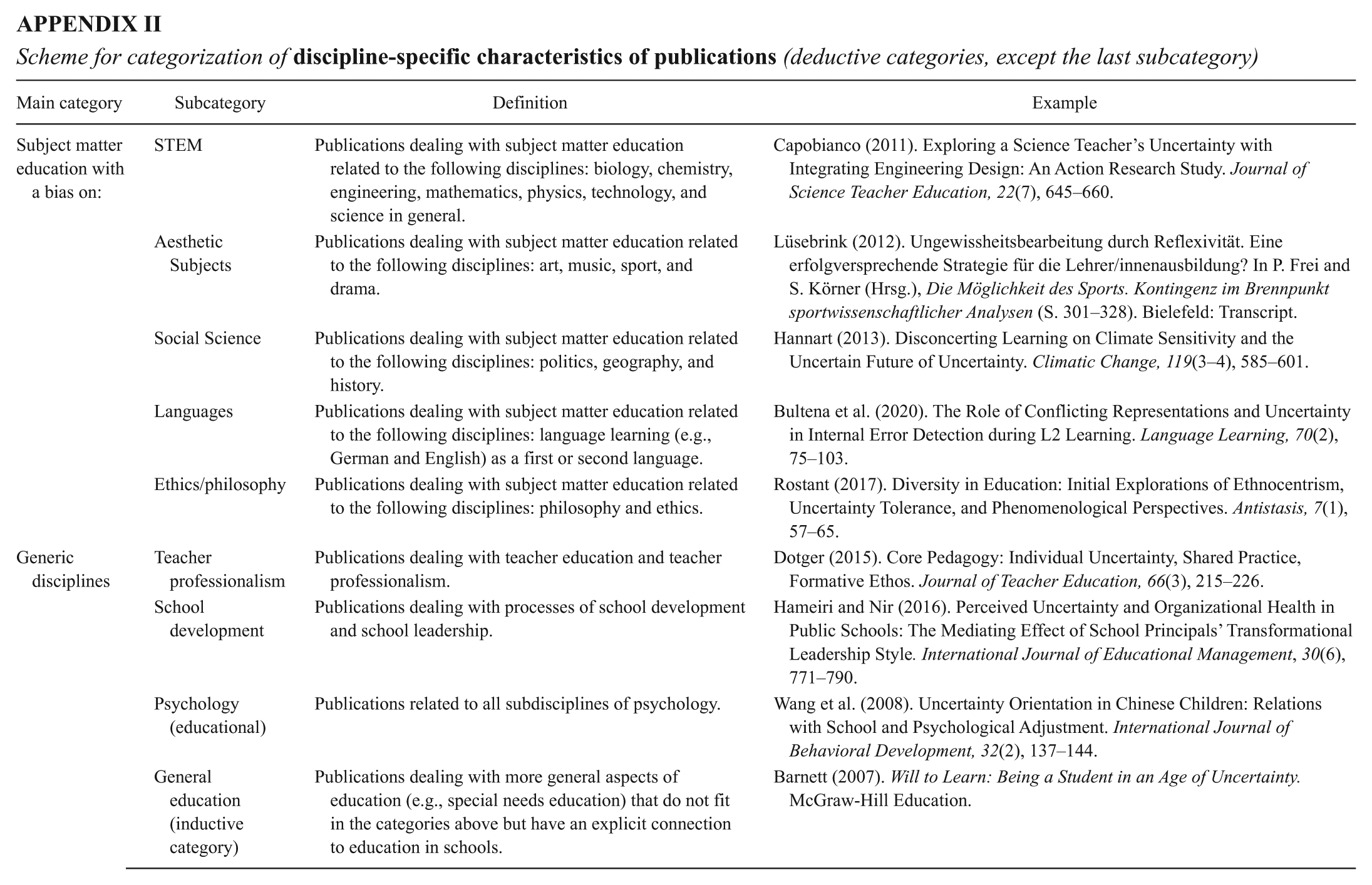
| Main category | Subcategory | Definition | Example |
|---|---|---|---|
| Subject matter education with a bias on: |
STEM | Publications dealing with subject matter education related to the following disciplines: biology, chemistry, engineering, mathematics, physics, technology, and science in general. | Capobianco (2011). Exploring a Science Teacher’s Uncertainty with Integrating Engineering Design: An Action Research Study. Journal of Science Teacher Education, 22(7), 645–660. |
| Aesthetic Subjects | Publications dealing with subject matter education related to the following disciplines: art, music, sport, and drama. | Lüsebrink (2012). Ungewissheitsbearbeitung durch Reflexivität. Eine erfolgversprechende Strategie für die Lehrer/innenausbildung? In P. Frei and S. Körner (Hrsg.), Die Möglichkeit des Sports. Kontingenz im Brennpunkt sportwissenschaftlicher Analysen (S. 301–328). Bielefeld: Transcript. | |
| Social Science | Publications dealing with subject matter education related to the following disciplines: politics, geography, and history. | Hannart (2013). Disconcerting Learning on Climate Sensitivity and the Uncertain Future of Uncertainty. Climatic Change, 119(3–4), 585–601. | |
| Languages | Publications dealing with subject matter education related to the following disciplines: language learning (e.g., German and English) as a first or second language. | Bultena et al. (2020). The Role of Conflicting Representations and Uncertainty in Internal Error Detection during L2 Learning. Language Learning, 70(2), 75–103. | |
| Ethics/philosophy | Publications dealing with subject matter education related to the following disciplines: philosophy and ethics. | Rostant (2017). Diversity in Education: Initial Explorations of Ethnocentrism, Uncertainty Tolerance, and Phenomenological Perspectives. Antistasis, 7(1), 57–65. | |
| Generic disciplines | Teacher professionalism | Publications dealing with teacher education and teacher professionalism. | Dotger (2015). Core Pedagogy: Individual Uncertainty, Shared Practice, Formative Ethos. Journal of Teacher Education, 66(3), 215–226. |
| School development | Publications dealing with processes of school development and school leadership. | Hameiri and Nir (2016). Perceived Uncertainty and Organizational Health in Public Schools: The Mediating Effect of School Principals’ Transformational Leadership Style. International Journal of Educational Management, 30(6), 771–790. | |
| Psychology (educational) | Publications related to all subdisciplines of psychology. | Wang et al. (2008). Uncertainty Orientation in Chinese Children: Relations with School and Psychological Adjustment. International Journal of Behavioral Development, 32(2), 137–144. | |
| General education (inductive category) | Publications dealing with more general aspects of education (e.g., special needs education) that do not fit in the categories above but have an explicit connection to education in schools. | Barnett (2007). Will to Learn: Being a Student in an Age of Uncertainty. McGraw-Hill Education. |
ORCID iDs

Notes
Authors
INGRID BÄHR is professor for educational science (focusing on physical education) at the Universität Hamburg – Faculty of Education, Physical Education, Von-Melle-Park 8, 20146 Hamburg; email:
BRITTA LÜBKE is an educational researcher at the Universität Hamburg – Faculty of Education, Biology Education, Von-Melle-Park 8, 20146 Hamburg; email:
KERSTIN MICHALIK is currently professor of social studies and science in primary education at Universität Hamburg – Faculty of Education, Didactics of teaching science and social studies in primary schools, Von-Melle-Park 8, 20146 Hamburg; email:
TERESA BERDING contributed to this project as research assistant. She is currently PhD student at Universität Hamburg – Faculty of Education, Von-Melle-Park 8, 20146 Hamburg; email:
IOANA CHIOTOROIU is junior researcher and doctoral candidate for EFL didactics at the Universität Hamburg – Faculty of Education, Von-Melle-Park 8, 20146 Hamburg; email:
MELISSA HANKE is currently a PhD student in geography education at Universität Hamburg – Faculty of Education, Geography Education, Von-Melle-Park 8, 20146 Hamburg; email:
TELSE IWERS, PhD, Master of Higher Education, is professor of educational science (focusing on educational psychology) at the Universität Hamburg – Faculty of Education, Von-Melle-Park 8, 20146 Hamburg; email:
DAGMAR KILLUS is professor of school pedagogy at Universität Hamburg – Faculty of Education, Department School Education, Von-Melle-Park 8, 20146 Hamburg; email:
CLAUS KRIEGER is professor of physical education and currently dean at Universität Hamburg – Faculty of Education, Physical Education, Von-Melle-Park 8, 20146 Hamburg; email:
JESSICA KRUSKA is currently a PhD candidate and research associate at Hamburg University, Faculty for Education, Department School Education, Von-Melle-Park 8, 20146 Hamburg; email:
JULIA SCHWANEWEDEL is currently professor of biology education at Universität Hamburg – Faculty of Education, Biology Education, Von-Melle-Park 8, 20146 Hamburg; email:
SANDRA SPRENGER is professor of geography education and head of Geography Education Group at Universität Hamburg – Faculty of Education, Geography Education, Von-Melle-Park 8, 20146 Hamburg; email:
OLE STABICK is a PhD student at the Universität Hamburg – Faculty of Education, Physical Education, Von-Melle-Park 8, 20146 Hamburg; email:
CONSTANZE STRUCK is currently a PhD student and research assistant in the Department of Social Studies and Science in Primary Education at the Universität Hamburg – Faculty of Education, Didactics of teaching science and social studies in primary schools, Von-Melle-Park 8, 20146 Hamburg; email:
MERVE YILMAZ was a former research associate in the Faculty of Education at Universität Hamburg and currently works as a teacher. Her research interests include subjective theories of teachers and education in diversity settings. Email:
ANDREAS BONNET is currently professor of English language education at Universität Hamburg, Faculty of Education. Von-Melle-Park 8, 20146 Hamburg; email:
ANGELIKA PASEKA has currently retired as a full professor for school education at the Universität Hamburg, Faculty of Education, Department School Education, Von-Melle-Park 8, 20146 Hamburg, Germany, email:
References
Supplementary Material
Please find the following supplemental material available below.
For Open Access articles published under a Creative Commons License, all supplemental material carries the same license as the article it is associated with.
For non-Open Access articles published, all supplemental material carries a non-exclusive license, and permission requests for re-use of supplemental material or any part of supplemental material shall be sent directly to the copyright owner as specified in the copyright notice associated with the article.
