




Abstract
This systematic literature review synthesized findings of 217 empirical studies, spanning from 1986 to 2023, focusing on: (a) the relationships of science teachers’ pedagogical content knowledge (PCK) to their competence and qualifications, teaching practices, and student outcomes; (b) factors influencing PCK changes; (c) mechanisms of PCK development; and (d) methodological trends and challenges in the selected studies. Analyses employed coding schemes derived from existing frameworks for teacher quality and competence, as well as adapted coding schemes from previous PCK reviews. Results confirmed PCK’s strong connections with content knowledge and teaching practices but revealed inconclusive relationships with teacher affective-motivational variables or student outcomes, while identifying contributing factors and patterns in the mechanisms of PCK development, along with future research areas. However, divergences emerged in the conceptualization, operationalization, and measurement of PCK, potentially hindering the establishment of robust theoretical foundations of PCK research and impeding the accumulation of enduring insights regarding PCK.
Keywords
Pedagogical content knowledge (PCK) is a unique blending of content and pedagogy that enables teachers to transform their content knowledge into “forms that are pedagogically powerful and yet adaptive to the variations in ability and background presented by the students” (Shulman, 1987, p. 15). Since Shulman (1986) first introduced the concept of PCK, its complex and “amorphic” nature (Park & Oliver, 2008b, p. 262) has led science education scholars to make significant efforts to articulate and clarify it, resulting in various definitions and conceptual models of PCK. For example, Magnusson et al. (1999) defined PCK as “a teacher’s understanding of how to help students understand specific subject matter” (p. 16). They proposed a model in which PCK consists of five components: orientation to teaching science, knowledge of student understanding of science, knowledge of instructional strategies, knowledge of curriculum, and knowledge of assessment. Later, Park and Oliver (2008b) organized these components into a pentagonal form, placing PCK and reflection at the center to highlight the interrelatedness of the components and the critical role of reflection in their interactions. More recently, two PCK summits (Berry et al., 2015; Hume et al., 2019) were convened, bringing together leading PCK researchers from around the world to explore the possibility of a unified model for organizing PCK studies. This collaborative effort led to the development of a consensus model (CM; Gess-Newsome, 2015), which later evolved into the refined consensus model (RCM; Carlson et al., 2019). In both of these models, PCK is defined as comprising two key aspects: “the knowledge of, reasoning behind, and planning for teaching a particular topic in a particular way for a particular purpose to particular students for enhanced student outcomes (Reflection on Action, Explicit)” and “the act of teaching a particular topic in a particular way for a particular purpose to particular students for enhanced student outcomes (Reflection in Action, Tacit or Explicit)” (Gess-Newsome 2015, p. 36). Unlike the oft-cited Magnusson et al. (1999) model and the pentagon model (Park & Oliver, 2008b), the CM did not identify the components that constitute PCK.
Despite the multiplicity of conceptualizations and the differences in details of various PCK models (see also Mavhunga & Rollnick, 2013; Tepner, 2012), they all share the same theoretical foundation as Shulman (1986, 1987) and emphasize PCK as essential for transforming content knowledge into forms accessible to students in viable instruction (Abell, 2007; K. K. H. Chan & Hume, 2019; Park & Oliver, 2008b, J. H. van Driel et al., 1998). Thus, teachers with sophisticated PCK should understand how particular subject matter topics, problems, or issues need to be organized, represented, and tailored to accommodate the diverse interests, abilities, needs, and backgrounds of students, and further use that understanding to engage them during instruction (Shulman, 1986, 1987). In this regard, PCK has been widely regarded as a critical component of teacher quality (Park et al., 2020; She et al., 2024) and teacher competence (Baumert & Kunter, 2013; Fauth et al., 2019), essential for effective teaching that leads to positive student learning outcomes. Based on this theoretical presumption, for more than three decades, a great number of researchers have sought empirical evidence that explains the relationship of PCK to teacher competence and qualifications, teacher practices, and student learning outcomes.
As it is extremely challenging or unfeasible to examine all possible relationships between PCK and various variables associated with teachers, teaching practices, and student learning at the same time, it is not uncommon for researchers to focus only on some parts of the relationships. For example, in the field of science education, Park et al.’s (2011) correlational study focused on the relationship between high school biology teachers’ PCK levels, as measured by a researcher-developed PCK rubric, and their implementation levels of reform-oriented science instruction. While Uzuntiryaki-Kondakci et al. (2017) explored how secondary preservice science teachers’ PCK is related to their self-efficacy beliefs, Sadler et al.’s (2013) study centered on the link between teachers’ PCK and middle school students’ learning of physical science concepts. Although each of these independent studies contributes to our understanding of the relationship between PCK and various other variables, the significant number of studies examining PCK through different lenses—such as teacher quality (Goe, 2007) and teacher competence (Blömeke & Delaney, 2012)—has led to a complex and fragmented body of literature. Inconsistencies in how teacher quality and competence are defined and operationalized further complicate the analysis and synthesis of PCK literature to obtain a comprehensive overview of empirically identified relationships involving PCK. Hence, synthesizing the existing literature using a more unifying framework that explains how PCK is situated in relation to teacher quality and competence is imperative to enhance our understanding of how PCK is associated with diverse teacher- and student-level variables in complex teaching and learning contexts. This is the primary aim of this current review. To this end, we adopt Shulman’s (1987) original conceptualization of PCK, as most subsequent PCK models are grounded in or derived from his concept, and it provides the most coherent theoretical foundation for examining the literature spanning the full period from 1986 to 2023. Additionally, we constructed an analytic framework to specify variables related to PCK within the broader context of teacher quality and competence by adapting Goe’s (2007) framework for teacher quality and Blömeke and Delaney’s (2012) framework for teacher competence. This framework (Figure 1) is detailed in the Methods section.
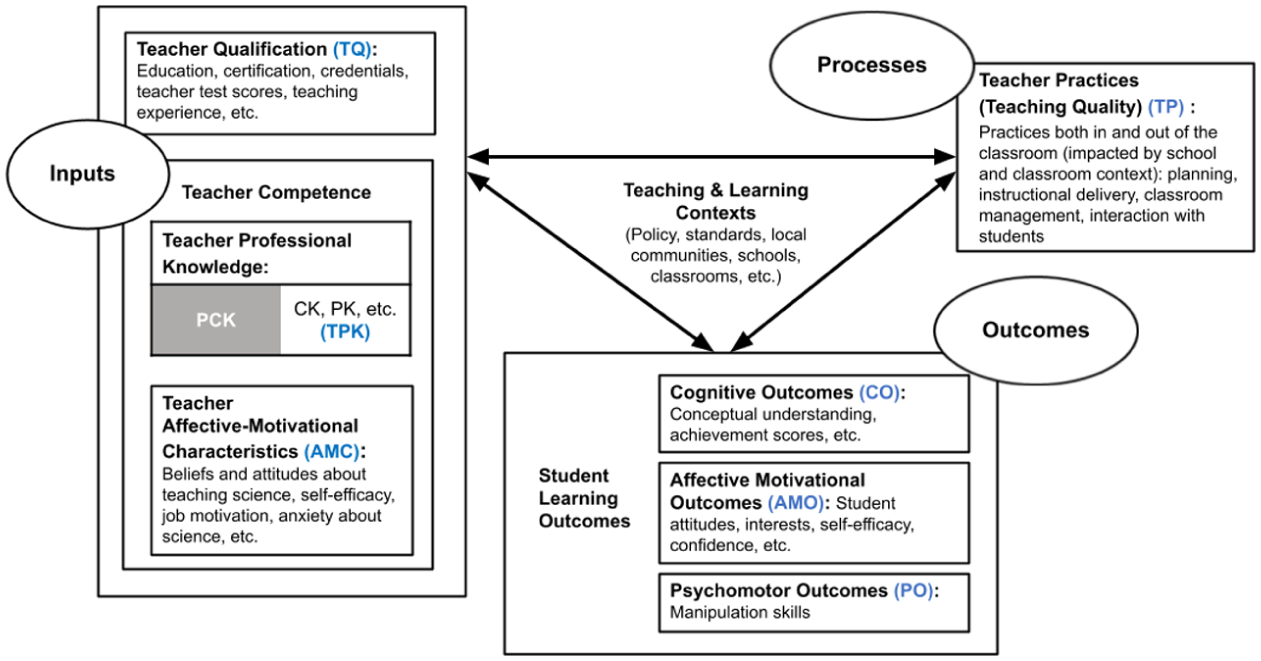
Analytic framework of teaching & learning in a classroom.
Recognizing the pivotal role of PCK in effective teaching and student learning, researchers have identified factors that contribute to PCK development. These factors have been investigated through interventions or natural instructional settings, involving various groups of science teachers ranging from preservice to elementary and secondary science teachers, and college science instructors (Findlay & Bryce, 2012; Reiser et al., 2017; Sarkar et al., 2024). Several reviews have compiled these factors across multiple subjects, including science (Berry et al., 2016; Evens et al., 2015). Specifically, Berry et al. (2016) reviewed 66 articles from seven disciplines (e.g., mathematics, sciences, physical education, language) investigating preservice teachers’ PCK development. They concluded that PCK development would benefit from teacher education programs that integrate PCK-based methods courses, as well as field experience. Similarly, Evens et al. (2015) reviewed 85 existing PCK interventions for mathematics and science teachers and found that effective interventions typically include PCK courses, classroom experience, and interaction with mentors. However, considering the domain-specific nature of PCK (Carlson et al., 2019; Shulman, 1987), a more focused review is warranted to systematically synthesize the factors influencing PCK development, specifically for science teachers. There have also been several reviews on science teachers’ professional knowledge, sometimes offering insights into important factors for PCK development (Abell, 2007; H. E. Fischer et al., 2012; Kind, 2009; Schneider & Plasman, 2011; J. H. van Driel et al., 2014, 2023). For example, in their review aimed at identifying science teachers’ learning progression in terms of PCK development, Schneider and Plasman (2011) reported that systematic and ongoing formal learning opportunities and thoughtful reflection on classroom experiences are critical for PCK development. Yet, none of these reviews provides a thorough analysis of the factors contributing to PCK development across a wide range of science teachers, spanning from preservice teachers to college-level instructors. Given the variations in academic preparation, pedagogical training, and teaching contexts between K–12 science teachers and college science instructors (Brownell & Tanner, 2012), as a comprehensive review of existing PCK studies, it is crucial to examine these factors across the full spectrum of science teachers. Such an analysis will facilitate the identification of both commonalities and diversities in the factors shaping PCK development. Moreover, previous reviews rarely delve into the mechanisms underlying PCK development, specifically how and why certain factors exert their influence (NRC, 2002), through systematic methods, going beyond the mere identification of potential contributing factors. This current review aims to bridge these gaps, striving to provide a more nuanced understanding of the complex processes of PCK development, using systematic approaches.
In essence, this study represents the most comprehensive review of PCK studies in science education (N = 217), seeking to thoroughly address the relationships, contributing factors, and development mechanisms of PCK as a cohesive whole, particularly by employing a systematic review approach with the aim of simultaneously minimizing researcher bias and enhancing transparency (Gough et al., 2017). In this pursuit, this review further critically evaluates the methodological approaches used in existing PCK studies, identifying emerging trends and issues. These findings concerning methodological approaches can contribute to the establishment of principled methodological guidelines for systematically accumulating substantial empirical evidence in PCK research. Given the discipline specificity of PCK in addition to topic and concept specificity (Carlson et al., 2019), we delimit the scope of this review to literature in science education. To achieve the previously mentioned goals, the following questions guided this review.
RQ1. What relationships exist between science teachers’ PCK and their competencies, qualifications, teaching practices, and student learning outcomes as evidenced in empirical studies?
RQ2. What factors, identified by empirical studies, contribute to changes in science teachers’ PCK?
RQ3. What are the characteristics of the mechanisms of PCK changes stimulated by the identified factors?
RQ4. What are the major trends and issues in methodological approaches used to examine PCK relationships and their development in the selected studies?
The findings of this review will serve as guidance for researchers to identify areas in need of more research and to further generate theoretical and practical questions about unforeseen or predictable relationships, causal effects, or mechanisms around PCK. More importantly, by highlighting factors that have been empirically shown to promote or hinder PCK development and explaining how these factors work, this review will provide valuable insights for teacher educators and those involved in designing professional development programs for promoting science teachers’ PCK growth and effective teaching practices and ultimately supporting student learning.
Methods
Following a systematic literature review process (Alexander, 2020; Gough et al., 2017), we conducted two rounds of searches in Scopus and Web of Science using the following keyword combinations “Science” AND “teacher knowledge” and “Pedagogical content knowledge” AND “Science.” The two search rounds were a methodological decision primarily driven by the extensive time required to analyze the large volume of initially selected studies, coupled with the need to include the most recent literature up to the time of manuscript preparation. The first search ranged from 1986, when PCK was first introduced, to March 19, 2021, while the second ranged from 2021 to March 5, 2023. This resulted in 2,212 articles after removing duplicates: 1,764 from the first round and 448 from the second.
Screening and Selection of the Studies for Review
The 2,212 articles underwent a three-phase screening process (see Figure 2). In the first phase, titles and abstracts were examined using initial screening criteria formulated to identify articles investigating science teachers’ PCK for teaching science content. Specifically, we used Shulman’s original concept of PCK as the unique province of knowledge that enables teachers to transform their science content knowledge into “forms that are pedagogically powerful and yet adaptive to the variations in ability and background presented by the students” (Shulman, 1987, p. 15) to select articles for inclusion. We independently reviewed 50 articles and resolved any discrepancies, refining inclusion and exclusion criteria as shown in Table 1. We subsequently screened the remaining papers, resulting in 511 articles for full-text analysis.
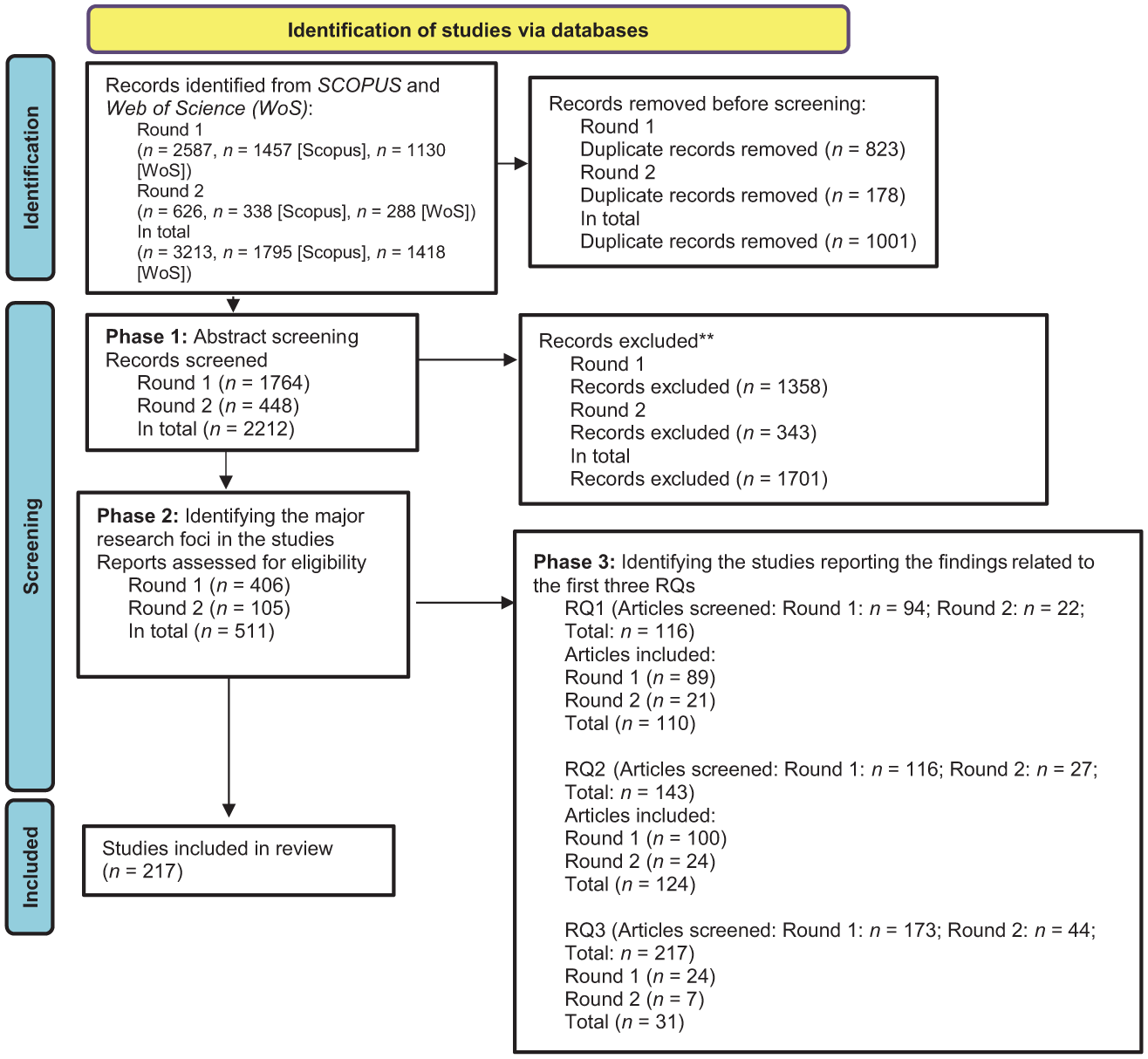
PRISMA flow diagram of the study selection process.
Inclusion and Exclusion Criteria
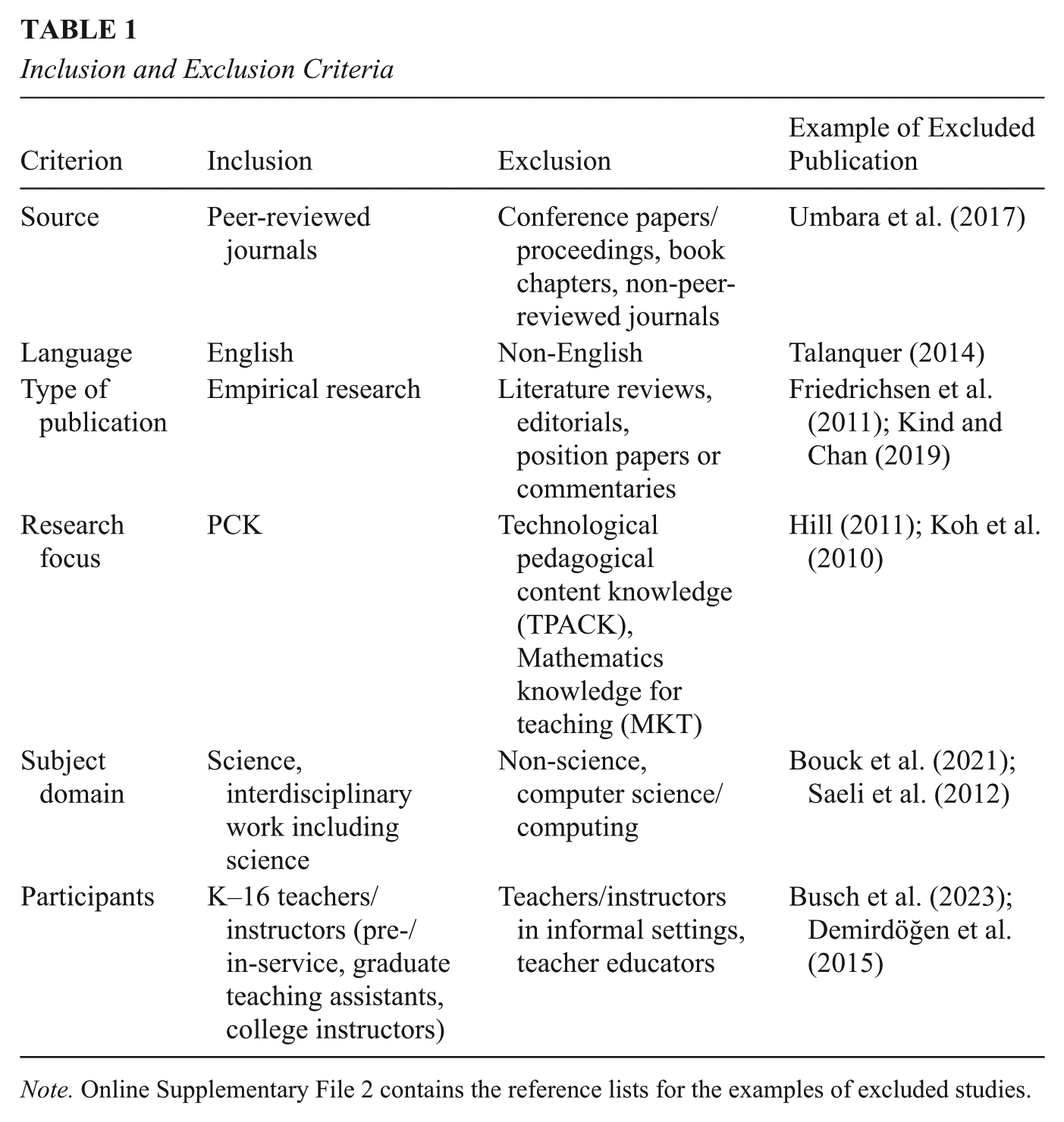
Note. Online Supplementary File 2 contains the reference lists for the examples of excluded studies.
In the second phase, we identified major research foci through a close examination of the articles, focusing on their research questions and key findings. We initially used a preestablished set of codes derived from categories of PCK research based on their research goals and foci, as employed in previous reviews (K. K. H. Chan & Hume, 2019; Depaepe et al., 2013). As we analyzed the studies selected in the first phase, we refined the initial codes and added an “others” code for studies which goals did not fit into any of the existing categories. The final codes were: (a) developing a PCK instrument to capture/measure PCK; (b) examining the nature of PCK; (c) examining teachers’ development of PCK; (d) examining relationships between PCK and other variables; (e) sources/factors contributing to PCK development; (f) examining students’ perceptions or teachers’ conceptions of PCK; and (g) others. In this round of coding, each article could have been assigned to multiple categories based on the research focus of the study. This coding process allowed us to distinguish articles relevant to the first three research questions of this review.
The last phase aimed to identify the articles pertinent to each research question through full-text reading. For RQ1, 110 articles were chosen from the 116 articles coded as (d) from the final code list presented earlier, excluding 6 articles lacking findings on relationships. For RQ 2, 124 articles were selected after reviewing 143 articles coded as (c) and/or (e), focusing on studies that either: (a) reported changes in teachers’ PCK between two or more time points in an intervention or natural instructional setting or (b) compared teachers’ PCK between a control group and a treatment group at one time point (e.g., Heppt et al., 2022). For RQ3, a subset of 31 studies was identified from those selected for RQ1 and RQ2, which presented findings related to mechanisms of PCK development. These studies described how the variables of interest influence (or are influenced by) PCK or how PCK changes occur, beyond merely determining the association between variables and PCK, identifying PCK changes through an intervention, or over a period of time in natural instructional settings. Considering 17 articles selected for both RQ1 and RQ2, the total of articles included in this review is 217. Available online only, Supplementary File 2 provides the complete list of the 217 articles along with their unique numeric identifiers, and Supplementary File 1 presents an overview of their basic information.
Analysis of Selected Studies
For RQ1, we employed the analytic framework (Figure 1) to guide the analysis of the selected studies. The framework describes four distinct but interrelated elements of teaching and learning in a formal classroom setting: inputs (teacher quality), processes (teaching practices), outcomes (student learning), and contexts. In this framework, teacher quality encompasses both teacher qualification and teacher competence, which are essential for effective teaching that promotes student learning (Goe, 2007). Teacher qualifications, a crucial aspect of teacher quality, refer to the necessary credentials, certifications, degrees, training, and other indicators of preparation required for teaching specific subjects or grade levels (Goe, 2007). Meanwhile, teacher competence, the other key aspect of teacher quality, is a multidimensional construct including “the skills, knowledge, attitudes, and motivational variables that form the basis for mastery of specific situations” (Baumert & Kunter, 2013, p. 807). Integral to this competence, teacher professional knowledge can be regarded “as the total knowledge that a teacher has at his or her disposal at a particular moment that underlies his or her actions” (J. H. van Driel et al. 2014, p. 848). This professional knowledge of teachers comprises multiple knowledge domains, with PCK, content knowledge, and pedagogical knowledge commonly recognized as the major constituents (Abell, 2007; J. H. van Driel et al., 2014, 2023). While content knowledge refers to teachers’ understanding of the key ideas, concepts, and principles in a particular discipline as well as their relationships (Cochran & Jones, 1998; Grossman, 1990), pedagogical knowledge refers to “the general, not subject-specific, aspects of teacher knowledge about teaching, such as learning theory, instructional principles, and classroom disciplines” (Abell, 2007, p. 1108).
We first identified the variable(s) examined in each of the 110 selected studies based on the seven components in blue in Figure 1. The findings on the relationship between PCK and the investigated variable(s) were then assigned one of the following codes: (a) positive relationship, (b) no relationship, (c) negative relationship, or (d) mixed relationship. Positive relationships were determined when empirical data demonstrated one of the following: (statistically) positive (cor-)relation or alignments/association between PCK and the variable; the ability of PCK to explain the change of the variable or vice versa; or productiveness or congruence/consistency between PCK and the variable. No relationship was coded when findings revealed no (statistical) (cor-)relation, influence, or association between PCK and the variable. Negative relationship was assigned to findings illustrating (statistically) negative (cor-)relation or misalignment/dissociation/inconsistency between PCK and the variable. Mixed relationship was used when PCK was related to the variable in some ways but unrelated in other ways.
For RQ2, we analyzed the 124 selected articles, examining: (a) factor(s) contributing to changes in PCK; (b) whether the study investigated a part(s) or the entirety of the PCK construct based on the author(s)’ conceptualization of PCK; and (c) the impact of the identified factor(s) on PCK changes (positive, no change, negative). For identifying contributing factors, we developed an initial code list including teacher education courses and field experience informed by existing reviews on PCK development (Berry et al., 2016; Evens et al., 2015) and refined it iteratively throughout inductive analysis procedures. The final codes include teacher education courses, field experience, professional development programs, classroom practice, professional learning communities, and others. Considering the varying contexts in which science teachers’ learning occurs across preservice, in-service, and college science instructors, the analysis of contributing factors was conducted for each teacher group. In addition, given that PCK development requires a significant time even with intentional support (Schneider & Plasman, 2011; J. H. van Driel & Berry, 2012), we determined if each study employed a longitudinal study design, applying criteria from White and Arzi’s (2005) definition of a longitudinal study: “one in which two or more measures or observations of a comparable form are made of the same individuals or entities over a period of at least one year” (p. 138).
For RQ3, we compiled and inductively analyzed findings on PCK development mechanisms from the 31 articles. As a result, two categories emerged that characterize the approach to understanding PCK development mechanisms: (a) how PCK components interact during development and (b) how other variables in the analytical framework (Figure 1) interact to stimulate PCK development. Then, major findings from each group were thematically synthesized.
For RQ4, while analyzing selected articles for the first three research questions, both authors kept analytic memos on emerging methodological issues. These memos were then compiled and categorized into three main aspects: (a) defining and operationalizing PCK, (b) approaches to measuring/capturing PCK, and (c) methods for measuring/capturing PCK changes. In each aspect, emerging issues were identified through discussions with illustrative examples.
Throughout the analysis process, investigator triangulation (Denzin, 2017) was consistently employed for the trustworthiness of the findings. Specifically, both authors independently coded assigned portions of the selected articles and met regularly to compare and resolve any discrepancies in their coding through discussion and negotiation until consensus was achieved. They also wrote analytic memos documenting reflections and thoughts that emerged during the analysis (Miles et al., 2014), which were shared and compiled during their regular meetings.
Despite our efforts to make methodological decisions that adequately correspond to our research questions, we acknowledge several limitations in our methods. First, we chose to use Shulman’s original definition for selecting articles. While this aligns with our aim to provide a comprehensive review of existing scholarship on PCK in science education, we recognize that this approach could lead to the inclusion of articles that some researchers with differing interpretations of PCK might find incompatible with their views. To address this limitation, we have discussed major trends and issues in the methodological approaches of the selected studies. Second, we did not assess the quality of each selected article. By including articles of varying quality in our review, there is a potential risk of incorporating articles that, even though they were peer-reviewed, may have issues related to conceptualizing and operationalizing PCK. We discuss some of these concerns in our findings.
Findings
RQ 1: Relationships Between PCK and Other Variables
Studies on PCK’s relationships with variables associated with teachers, teaching practices, and student learning outcomes have been mainly conducted with in-service teachers (n = 70) in secondary science classrooms (n = 75), using either qualitative (n = 52) or quantitative (n = 37) research designs (Table 2). The sample size for the studies ranges from 1 (e.g., [17, 45]) to 987 (216). About 68% of the 110 studies were conducted in the United States (n = 35), Germany (n = 24), and Türkiye (n = 16), while a majority of them were published in 2011 through 2023 (n = 97; 88%).
Breakdown of Selected Papers for RQ 1 (N = 110)
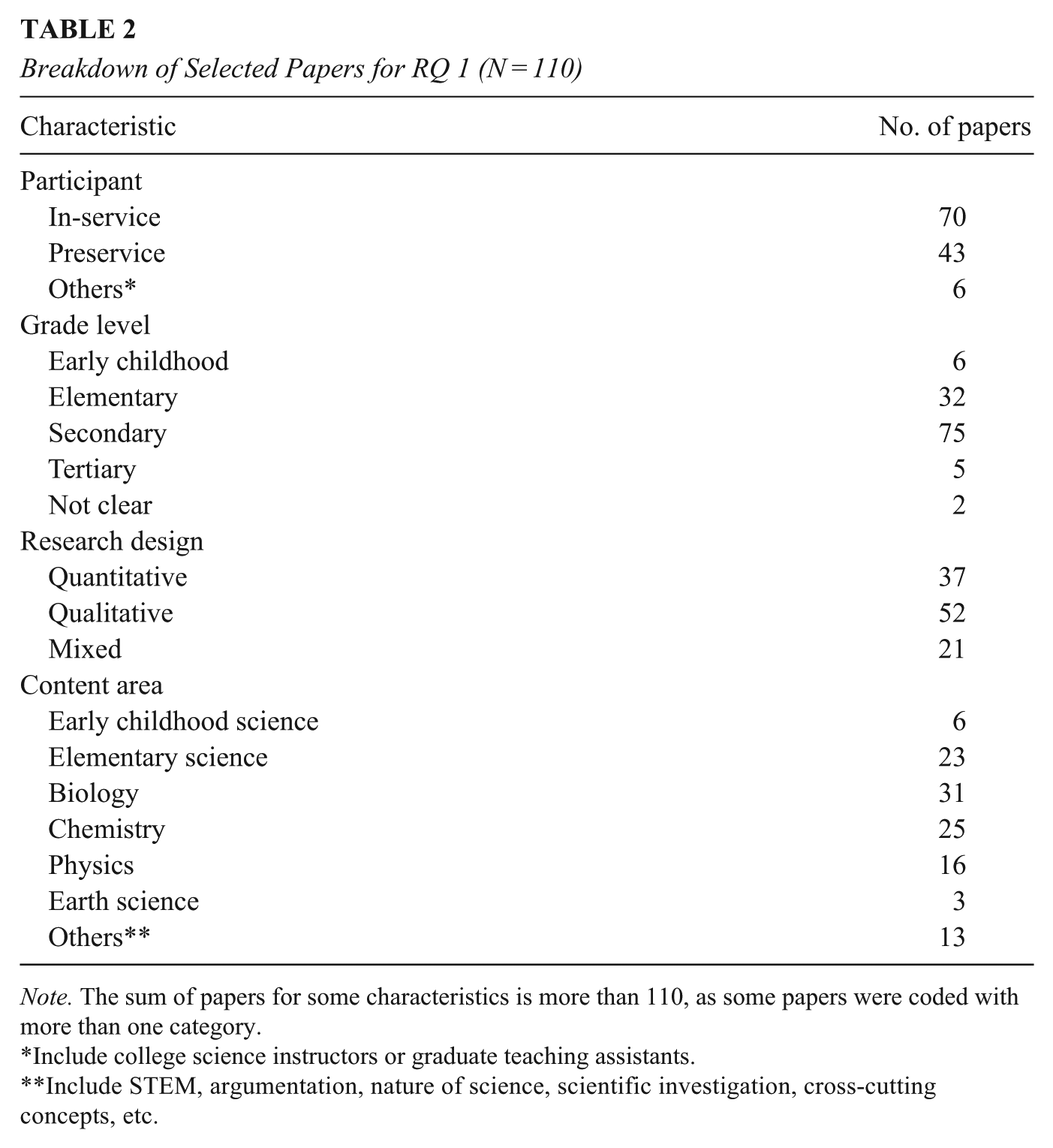
Note. The sum of papers for some characteristics is more than 110, as some papers were coded with more than one category.
Include college science instructors or graduate teaching assistants.
Include STEM, argumentation, nature of science, scientific investigation, cross-cutting concepts, etc.
Table 3 summarizes the number of studies examining PCK relationships with each of the seven variables in the analytic framework. Research on PCK relationships centers more on teacher inputs (i.e., teacher qualifications and competence: n = 71) than on the teaching process (n = 43) or student outcomes (n = 22).
Number of Studies Examining PCK Relationships With Different Variables (N = 110)
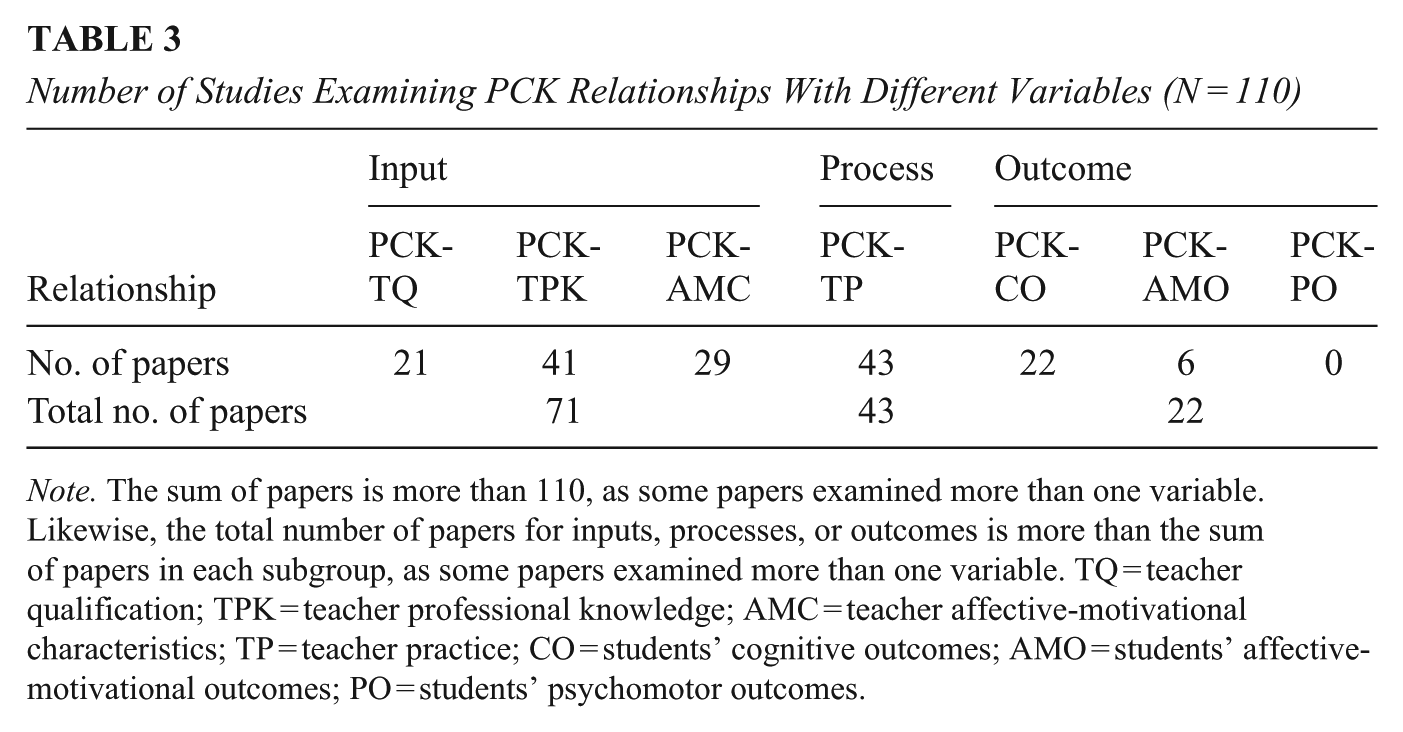
Note. The sum of papers is more than 110, as some papers examined more than one variable. Likewise, the total number of papers for inputs, processes, or outcomes is more than the sum of papers in each subgroup, as some papers examined more than one variable. TQ = teacher qualification; TPK = teacher professional knowledge; AMC = teacher affective-motivational characteristics; TP = teacher practice; CO = students’ cognitive outcomes; AMO = students’ affective-motivational outcomes; PO = students’ psychomotor outcomes.
Research on PCK Relationships Centering on Inputs
This group of studies spans unevenly across the three areas of inputs, often investigating more than one area in the same study.
PCK-Teacher Qualification (TQ)
Most studies on this relationship focused on years of teaching experiences (n = 17), demonstrating inconsistent results. Specifically, whereas 10 studies reported positive relations, the rest exhibited no relation (n = 5), negative relation (n = 1), or mixed relation (n = 1). Despite varying results, this cluster of studies implies that a certain amount of teaching experience is generally requisite, although not necessarily proportional to PCK. In particular, the necessity of teaching experience for PCK development is empirically supported by studies that revealed significant differences in PCK between preservice teachers who had opportunities to teach in actual classrooms and those who did not (e.g., [177, 197]). In a comprehensive study that examined the effects of school-level and teacher-level characteristics on science teacher knowledge and practice, Yang et al. (2020; [217]) identified teaching experience as well as holding a degree in science as teacher characteristics substantially related to PCK. The positive link between PCK and teaching experience was also found with graduate teaching assistants [72, 118]. In contrast, Leuchter et al.’s (2020; [109]) study with Swiss preschool teachers discovered a negative relationship between teacher PCK, as measured by their understanding about children’s conceptions of floating and sinking, and teaching experiences. They attributed this to less-experienced teachers holding bachelors’ degrees rather than vocational training, suggesting the potential influence of teacher education programs on PCK through content knowledge acquisition and exposure to constructivist pedagogies. This inference is corroborated by other studies indicating that prerequisite content knowledge is necessary for teaching experience to impact PCK [93, 101, 155]. Considering the topic-specific nature of PCK (Gess-Newsome-2015), the use of general years of teaching experience rather than years of teaching a particular topic may contribute to this conflicting result. This conjecture is supported by Han-Tosunoglu and Lederman’s (2021; [76]) study that indicated remarkable differences in PCK for biological socioscientific issues (SSIs) between teachers who had SSI teaching experience and those who were inexperienced in SSI instruction. Similarly, in a cross-national study of secondary science teacher PCK for teaching photosynthesis in Korea and the United States, Park et al. (2020; [154]) found a positive correlation between years of teaching biology and PCK, but no correlation between overall years of teaching and PCK. Besides years of teaching experience, teaching certification areas [154], grade-point average (GPA; [36, 68, 69]), teacher performance assessments [163], cognitive ability [52, 24], and science content preparation [217] appeared as positive proxy indicators of PCK. However, the relationship of gender [122, 217] and highest degrees [122, 161] to PCK is inconclusive, with inconsistent results.
PCK-Teacher Professional Knowledge (TPK)
Research on the relationship of PCK to other professional knowledge domains greatly centers on content knowledge (CK, n = 37), followed by pedagogical knowledge (PK, n = 9) and professional vision, an indicator for integrated teacher knowledge for teacher noticing (n = 2; [132, 214]). A main finding from this line of research is that either PCK or some components of PCK are positively related to CK (n = 28), PK (n = 8), or professional vision (n = 2). Some studies (n = 7) revealed mixed results regarding the association between PCK and CK in that PCK and CK are generally correlated, but high CK is not always translated into high PCK [72, 118, 152]. This finding supports that a certain level of CK is necessary for PCK, but it becomes less influential thereafter (Darling-Hammond, 2000). Interestingly, Smit et al.’s (2017; [191]) study with 121 preservice science teachers in Germany and Switzerland detected no relationship between PCK and CK. They interpreted that no relationship might be caused by the inconsistency between the PCK test focusing on scientific inquiry teaching and the CK test centering on visual perception. However, no empirical evidence for a negative relation between PCK and CK has been found.
Similarly, eight out of the nine studies exploring the relationship between PCK and PK revealed a positive link between the two, while one study [110] showed no relationship. No study demonstrated a negative relationship. In this set of studies, PK was mostly examined in terms of general PK, except for Lakin and Wallace (2015; [106]) who examined science discipline-specific PK—that is, knowledge of inquiry practices. Taken together, studies on the relationships between PCK and various professional knowledge domains empirically support the theoretical assumption that PCK is developed by the transformation and/or integration of other teacher knowledge, such as CK and PK, and thus they have a reciprocal and nurturing relationship with PCK (Gess-Newsome, 1999).
PCK-Teacher Affective-Motivational Characteristics (AMC)
A growing number of studies have examined teachers’ affective-motivational characteristics in relation to PCK (n = 29). Largely conducted with preservice teachers (n = 18; 62%), followed by in-service science teachers (n = 11; 38%), this body of research concentrates on teacher beliefs (n = 14), particularly focusing on conceptions of teaching and learning (or called beliefs about teaching and learning, n = 10) followed by epistemological beliefs (n = 5; one study examined both). This subset of studies focusing on teacher beliefs employs either qualitative (n = 7) or quantitative (n = 5) research designs. Moreover, their findings are somewhat inconsistent with eight studies indicating positive relationships and the rest presenting mixed (n = 4) or no relationships (n = 2). As an illustration, Wu et al. (2021; [216]) found that scientific epistemic beliefs were strongly associated with and predictive of science-specific PCK among 987 preservice kindergarten teachers in China. In contrast, Leuchter et al. (2020; [109]) reported no significant differences in PCK across three groups of 104 Swiss preschool teachers categorized by their beliefs about science teaching and learning—that is, highly constructivist, low constructivist, and hands-on.
This inconclusive relationship may be related not only to the messiness of teacher beliefs (Fives & Buehl, 2012) but also to the complexity of PCK (Friedrichsen et al., 2011). Particularly, orientations to teaching science (OTS) is a component of PCK in Magnusson et al.’s (1999) most widely used PCK model in science education. However, in a noticeable number of studies, OTS was often considered as a subset of teacher beliefs. Through a comprehensive review of studies employing Magnusson et al.’s (1999) PCK model, Friedrichsen et al. (2011) identified conceptions of teaching and learning (COTL), beliefs about the nature of science, and beliefs about the purposes of science teaching as three dimensions of the OTS component of PCK. In this current review, however, most studies viewed these dimensions as a belief construct separated from PCK and explored their relationship to PCK or specific components of PCK (e.g., [97, 129, 177, 207]). Ladachart’s (2020; [104]) study is an exception, examining one dimension of OTS, COTL, in relation to the overall construct of OTS to understand its internal structure.
Besides beliefs, teacher affective-motivational characteristics examined in relation to PCK include self-efficacy, confidence in teaching, interest, self-concept, attitudes, emotions, internal motivation, motivational orientations, and so on (n = 16). These studies reported either positive connections to PCK (n = 12) or no relationships (n = 4). In contrast to teachers’ self-efficacy being a central focus in science teacher education for over 30 years (Deehan, 2017), only two studies examined the relationship between self-efficacy and PCK, both with preservice teachers, and found positive links between the two [198, 202].
Research on PCK Relationships Centering on Processes
The next group of studies (n = 43) uncovered the relationship between PCK or its components and teaching practices throughout various stages of the pedagogical cycle, including planning, enactment/implementation, and reflection/evaluation (Carlson et al., 2019; Shulman, 1987). For example, Smit et al. (2018; [190]) examined the effects of collaborative lesson planning on preservice teachers’ PCK and their lesson planning competency. They noted that preceding PCK had a significant effect on their lesson planning competency, but planning competency did not influence succeeding PCK. However, many of the studies in this cluster investigated actual teaching practices in combination with lesson planning and/or post-lesson reflection (e.g., [181, 184]).
Another emerging pattern in this line of research is the examination of teaching practices in relation to PCK across various levels of granularity (i.e., the degree of specificity with which these practices are connected to science). These range from general pedagogy, such as formative assessment practices [55] or cognitive activation [56, 95], to science discipline-specific instructional practices, including reform-oriented science teaching [155] and inquiry-based teaching [90, 106, 217], as well as argument-based teaching [99], and even to particular science content–specific instructional practices [28, 172]. However, given the inevitable embeddedness of content in PCK (Shulman, 1986) and its topic-specific nature (Gess-Newsome, 2015), even studies concentrating on general or discipline-specific teaching practices were often situated within the context of teaching a specific science topic, such as electric circuits [55], heredity [7], solubility [174], and evolution [113]. Two exceptions to this trend were Lakin and Wallace (2015; [106]) who investigated middle school teachers’ self-reported use of inquiry strategies in relation to PCK without a specific focus on particular science content, and Yang et al. (2020; [217]) who focused on six crosscutting concepts in the Next Generation Science Standards (NGSS Lead States, 2013), including patterns, cause and effect, and scale.
Regardless of the various approaches to examining teaching practices, this group of studies mostly indicated positive relations between PCK and teaching practices (n = 27), suggesting the critical role of PCK in effective science teaching. For instance, Leuchter et al. (2020; [109]) investigated the relation between teachers’ PCK and the reform-oriented nature of their classroom practices using the reformed teaching observation protocol (RTOP), revealing a significant relationship. However, some studies reported mixed results (n = 6) or no relationship, indicating relative independence between PCK and teaching practices (n = 9). For example, Mazibe et al.’s (2020; [127]) case study of four South African secondary physical sciences teachers found that the teachers’ reported PCK, captured by interviews and the Content Representations (CoRes; Loughran et al., 2004) form, did not necessarily align with their actual teaching practices. Similarly, Barendsen and Henze’s (2019; [17]) study revealed both correspondences and differences between a case teacher’s PCK and his classroom practice. Interestingly, Liepertz and Borowski (2019; [110]) highlighted that only pedagogical knowledge, but not PCK or CK, substantially influenced teaching practices. In line with these findings, Gess-Newsome et al. (2019, [64]) reported that PCK did not exhibit a statistically significant relationship to inquiry-oriented teaching practice, whereas general pedagogical knowledge was statistically significant in predicting teaching practices. They further asserted that teacher knowledge and skill variables accounted for only 53% of the variance in teachers’ classroom practices, suggesting the influence of other variables, including contextual factors, on the act of teaching.
Research on PCK Relationships Centering on Learning Outcomes
Less research has examined the relationship between PCK and student learning outcomes (n = 22), with a focus on cognitive learning outcomes in all studies, and six studies extended the investigation to students’ affective outcomes. No study investigated psychomotor outcomes. Some studies investigated the impact of PCK on student outcomes independently of teaching practices [119, 171], while others examined the relationships among teacher knowledge, teaching practice, and student learning altogether (e.g., [58, 170, 201]). Notably, all these studies have been published since 2010, a few years after Abell (2007) called for more studies on the connections between teacher professional knowledge and student learning.
PCK-Student Cognitive Outcomes (CO)
Fourteen out of 22 studies reported that PCK positively influenced student cognitive outcomes, such as achievement, conceptual understanding, and thinking skills, either directly (n = 12) or indirectly, functioning as a mediator influencing teaching practices (n = 2). Sadler et al.’s large-scale study (2013; [171]) revealed that middle school teachers with strong PCK, as measured by their accuracy in predicting the most common misconceptions in student answers, had larger student learning gains than those who knew only the correct answers in a multiple-choice science content assessment but did not identify their students’ most prevalent wrong answers. Mahler et al.’s (2017; [119]) study also showed a positive relationship between biology teachers’ PCK (not CK or knowledge of curriculum) and students’ system thinking. A few studies demonstrated that PCK indirectly impacted student learning through mediation by teaching practices. Förtsch et al.’s (2016; [58]) study on German secondary school teachers found that while neither PCK nor CK had considerable positive effects on students’ achievement measured by a paper-pencil test on the topic of neurobiology, PCK (not CK) indirectly affected students’ achievement through mediation by teachers’ cognitive activation in science teaching.
In contrast, some studies identified no relationships or even negative relationships between PCK and student cognitive outcomes. In comparing two types of professional development programs for elementary teachers, Roth et al. (2019; [170]) discovered that only teacher practice had the strongest correlation to student achievement, while PCK or CK had no significant relationship. Yang et al. (2020; [217]) reported a similar result, finding no relationship between teachers’ PCK test scores and students’ understanding of crosscutting concepts. Gess-Newsome et al. (2019; [64]) and Usak et al. (2022; [201]) also exhibited no influence of PCK on student achievement. Usak et al. (2022; [201]) employed an unusual approach by estimating teachers’ PCK through student questionnaires about their perceptions of their teachers’ knowledge, potentially impacting the credibility of the finding. Furthermore, Liepertz and Borowski (2019; [110]) declared that physics teachers’ PCK negatively predicted student learning, as measured by a post-content knowledge test on mechanics. They attributed this unexpected result to limitations of their PCK test, such as its restricted ability to assess pedagogical reasoning and weak prognostic validity.
PCK-Student Affective-Motivational Outcomes (AMO)
Six studies explored the influence of PCK on student affective-motivational outcomes, including interest in science, sense of efficacy, values, and attitudes toward science, yet yielded inconclusive findings. Through multilevel regression analyses, Fauth et al. (2019; [56]) found that elementary teachers’ PCK predicted students’ interest in science education but not their conceptual understanding of the topic of floating and sinking. However, Keller et al. (2017; [95]) reported no direct influence of teacher PCK on students’ interest. In a project-based curriculum context, Kanter and Konstantopoulos (2010; [90]) observed that PCK was statistically significantly correlated with declines in minority students’ perceptions of the value and relevance of science, interest in science, and sense of efficacy in doing science tasks related to the curriculum, but still predicting minority student achievement in specific areas like calorimetry and body systems, along with CK.
RQ 2: Factors Contributing to Changes in Science Teachers’ PCK
As shown in Table 4, 124 studies selected for RQ 2 have been predominantly conducted with in-service (n = 67) or preservice (n = 61) teachers in the context of secondary science teaching (n = 87), primarily using qualitative research design (n = 78), mainly published since 2011 (n = 103). These studies were carried out in more than 25 countries, with 41 studies in the United States. Although 38 studies self-identified as longitudinal studies, only 18 met the criteria of a longitudinal study adopted in this review.
Breakdown of Selected Papers for RQ 2 (N = 124)
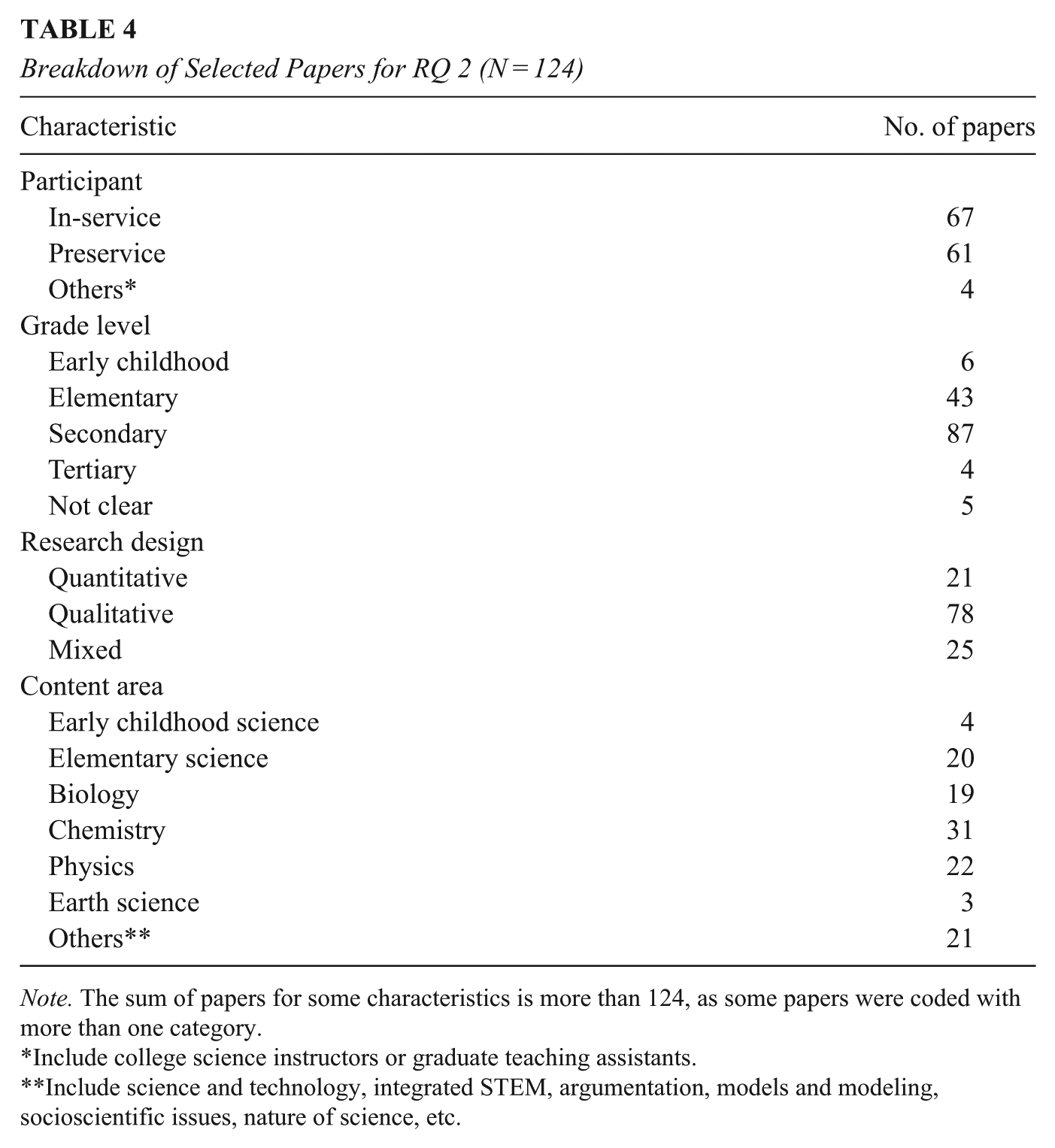
Note. The sum of papers for some characteristics is more than 124, as some papers were coded with more than one category.
Include college science instructors or graduate teaching assistants.
Include science and technology, integrated STEM, argumentation, models and modeling, socioscientific issues, nature of science, etc.
Factors Contributing to Preservice Science Teachers’ PCK Development
Two major factors were found to contribute to preservice science teachers’ PCK development: (a) teacher education courses and (b) field experience such as practicum and student teaching. While a few studies have examined both factors using a longitudinal research design [78, 133], the predominant focus has been on either factor. Most of the research with preservice teachers (i.e., 45 out of 61) was conducted in a purposefully designed course to improve PCK that focused on science content, general education, or science teaching methods. Strategies utilized in those courses include: research-based learning activities [14], case study method [71], self-regulated learning [134] or active learning strategies[25], explicit teaching of PCK components [13, 125], peer coaching [136, 191, 212], analysis of lesson plans [26], content representations (Loughran et al., 2004) construction [31, 54, 153], lesson study [44], adopting specific curricular materials [142], flipped classroom approach [180], microteaching [36, 195], and, most frequently, integrating short-term teaching experience in actual science classrooms, often along with reflection [23, 92, 135, 146, 158]. All these studies reported a positive impact of the courses on preservice teachers’ PCK overall [1, 22, 35] or some components of PCK [31, 92, 164, 175, 212], while several studies reported varied impact or varied patterns of PCK development by participants [14, 142] and/or by PCK components [13, 35, 54].
Fourteen studies examined PCK changes in preservice teachers while engaging in field experience like practicum (n = 5) or student teaching (n = 9). On the one hand, the majority (n = 11) highlighted the positive influence of teaching in natural classroom settings on PCK, demonstrating PCK improvement after field experience. Kulgemeyer et al. (2021; [102]) found that while preservice science teachers developed PCK over the course of a semester-long field experience, the number of lessons they taught had no impact, and the number of lessons they observed had a negative impact on their PCK. This study suggests that the quality of the field experience, rather than the quantity of lessons taught or observed, is crucial for facilitating PCK development. Norville and Park (2021; [148]) demonstrated insufficient influence of mentor teachers on PCK development during field experience, calling for the need for mentor training and support. Similarly, Kulgemeyer et al. (2021; [102]) reported no impact of collaborative reflection with mentor teachers on PCK development, while van Driel et al. (2002; [204]) found mentors influenced the growth of PCK in some, though not all, preservice science teachers.
On the other hand, three studies focused on the impact of reflection using particular interventions such as reflective frameworks, content representations, and/or lesson study during field experience, reporting its positive impact on preservice teachers’ PCK development [86, 176].
Factors Contributing to In-service Science Teachers’ PCK Development
Our analysis revealed several factors contributing to in-service science teachers’ PCK development: (a) professional development (PD) program, (b) classroom practice, (c) professional learning community (PLC), and (d) others (e.g., mentoring, National Board Certification process, previous teacher preparation programs, etc.).
Professional Development
About 60% of the research conducted with in-service science teachers (i.e., 40 out of 67) utilized a purposefully designed PD program as a research context, all of which reported a positive influence of the PD on PCK. These PD programs typically incorporate the following features expected to promote PCK development either directly or indirectly based on existing literature or relevant theories: (a) deepening understanding of science content; (b) engaging in innovative science teaching practices as learners, often followed by implementation of those practices into classrooms as teachers; (c) analyzing classroom videos; and (d) using a learning study or lesson study model. Given the critical role of CK in PCK development, several PDs provided activities targeting increased science content understanding, such as scientific fieldwork [50] or online modules on science content [150], yielding a positive impact on PCK as well as CK. In concert with this, through a large-scale national study, Doyle et al. (2020; [51]) identified focusing on foundational science concepts as the only PD feature positively associated with teacher gains in knowledge of student misconceptions, a key aspect of PCK.
A prevalent PD feature infused in this cluster of research is engaging teachers in innovative, reform-oriented science teaching as learners and then guiding them to apply these approaches to their own teaching through lesson planning or curriculum revisions. These approaches focused on inquiry-based science teaching [67, 105, 138, 205], scientific argumentation [128, 184], construction of scientific explanation [124], conceptual change strategies [192], problem-based learning [213], constructivist science teaching [96], etc. These PDs predominantly occurred during the summer and often extended support into the following academic year when teachers implemented the learned practices in their classrooms [169, 170, 205]. To facilitate effective implementation, studies utilized strategies such as follow-up meetings [205, 213], coaching and mentoring [67, 160, 199], educative curriculum materials [64, 70, 169, 178, 199], and action research [215].
Another PD feature aimed at directly promoting PCK development involves teachers analyzing example classroom videos for insight on instructional practices and student thinking, both integral to PCK [4, 162, 169]. With face-to-face, online, or hybrid support [162] or through elaborated focus questions [4], teachers were engaged in analyzing classroom videos in groups to collaboratively make sense of pedagogical approaches and student learning and to figure out ways to apply their insights to their own classroom.
The last PD feature linked to PCK development was employing the lesson study [112] or learning study model [29, 144, 147]. Both models follow a cyclical process where a group of teachers collaboratively set goals, co-plan a lesson, observe and record one teacher from the group teaching it, reflect on the lesson concentrating on student learning, and revise the lesson. This cycle is repeated with another teacher from the group teaching the revised lesson. Although the learning study is distinct for involving a researcher in the process and being grounded in the theory of variation (Adamson & Walker, 2011), both models aim to improve student and teacher learning [144]. In accordance, Nilsson (2014; [144]) documented how three science teachers’ participation in a learning study improved their PCK, particularly their knowledge of student understanding and knowledge of instructional strategies, possibly contributing to enhanced student learning.
Classroom Practices
A modest number of studies (n = 12) have delved into how classroom practices affect PCK, especially with beginning science teachers, without interventions, and revealed the positive impact of teaching practices on PCK. Findlay and Bryce’s (2012; [57]) study tracked PCK changes in six beginning physics teachers from their student teaching to two different points in their teaching careers, at the end of the first year and two-and-a-half years later, using repeated semistructured interviews. They observed a shift in focus from their own subject matter knowledge for teaching electricity to transforming that knowledge to make it more accessible and influential for student learning as they gained more teaching experience. However, some researchers pointed out that teaching a specific subject or course has a greater impact on PCK in that area than overall teaching experience. For example, Luft et al. (2022; [116]) followed 95 secondary science teachers who participated in four different induction programs over 5 years and found that teaching similar content courses over time had a positive impact on PCK, with induction programs showing no significant impact. Singh et al. (2021; [189]) explored the development of enacted PCK between in-field and out-of-field physical science teachers during their first 3 years, noting a negative impact of out-of-field teaching experience on enacted PCK. In a similar vein, Hanuscin et al. (2020; [78]) reported that, as elementary teachers were assigned to new grade levels, their science teaching experience had a negative influence on their PCK, with teaching at new grade levels appearing comparable to out-of-field teaching for elementary teachers.
Professional Learning Community
Participating in PLC is another factor contributing to in-service science teachers’ PCK development (n = 5). PLC is “the collaborative teams of educators whose members work interdependently to achieve” (DuFour et al., 2016, p. 12). Barr and Askell-Williams (2020; [19]) investigated the impact of a 12-week researcher-facilitated PLC focusing on self-regulated learning (SLR) in the context of teaching grade 8 science topics and presented a positive influence of the PLC on teachers’ PCK about SLR. Similar positive effects were reported by Rodrigues et al. (2003; [165]) and Vossen et al. (2020; [209]), despite variations in PLC duration (several weeks through several months) and focus areas.
Others
Luft and colleagues conducted a series of research [113, 114, 115, 116, 117] on the impact of mentoring programs and classroom practices on beginning teachers’ PCK over their first 3 years of teaching. They reported that mentoring had no impact on PCK, regardless of different types of mentoring programs, while teaching experience was positively related to PCK development. Additionally, Park and Oliver (2008a; [156]) illustrated that the portfolio creation process for the National Board Certification in the United States promoted PCK development by fostering reflection on classroom practices, innovative instructional and assessment strategies, and improved understanding of students. Supporting the critical role of reflection, Melo et al. (2020; [131]) documented changes in a physics teacher’s PCK through an individualized intervention focusing on metacognitive reflection. Moreover, studies by Bartholomew et al. (2011, 2012; [20, 21]) in New Zealand discovered positive impacts of initial teacher education programs on beginning teachers’ PCK development in their first 2 years of teaching.
Factors Contributing to College Science Teachers’ PCK Development
Limited research (n = 4) exists on PCK development of college science instructors, with the majority focusing on TAs (n = 3). Utilizing PD workshops as a strategy to improve PCK, all these studies demonstrated a positive impact on PCK. For instance, Seung et al. (2012; [186]) tracked PCK changes in five TAs from a 4-week workshop on both a new physics curriculum emphasizing real-world applications and constructivist pedagogical approaches to the end of the following semester when they taught recitation and laboratory sessions of the curriculum. Qualitative data analysis revealed improved PCK for teaching the new curriculum over time, particularly in knowledge of curriculum, students, and instructional strategies. Similarly, Lampley et al. (2018; [107]) found that a PD program incorporating a lesson study model and emphasizing reflection positively influenced TAs’ PCK growth in terms of their conceptions of science teaching goals and knowledge of instructional strategies.
RQ 3: Mechanisms of PCK Changes
A small subset of studies selected for RQ 1 and RQ 2 (n = 31) addressed mechanisms or processes of PCK changes or interactions with other variables as part of their findings while maintaining a primary focus on PCK development or the relationships between PCK and other variables. As indicated in Table 5, most studies employed qualitative research designs (n = 27), primarily using case study research design (n = 14), in secondary science classrooms (n = 22).
Breakdown of Selected Papers for RQ 3 (N = 31)
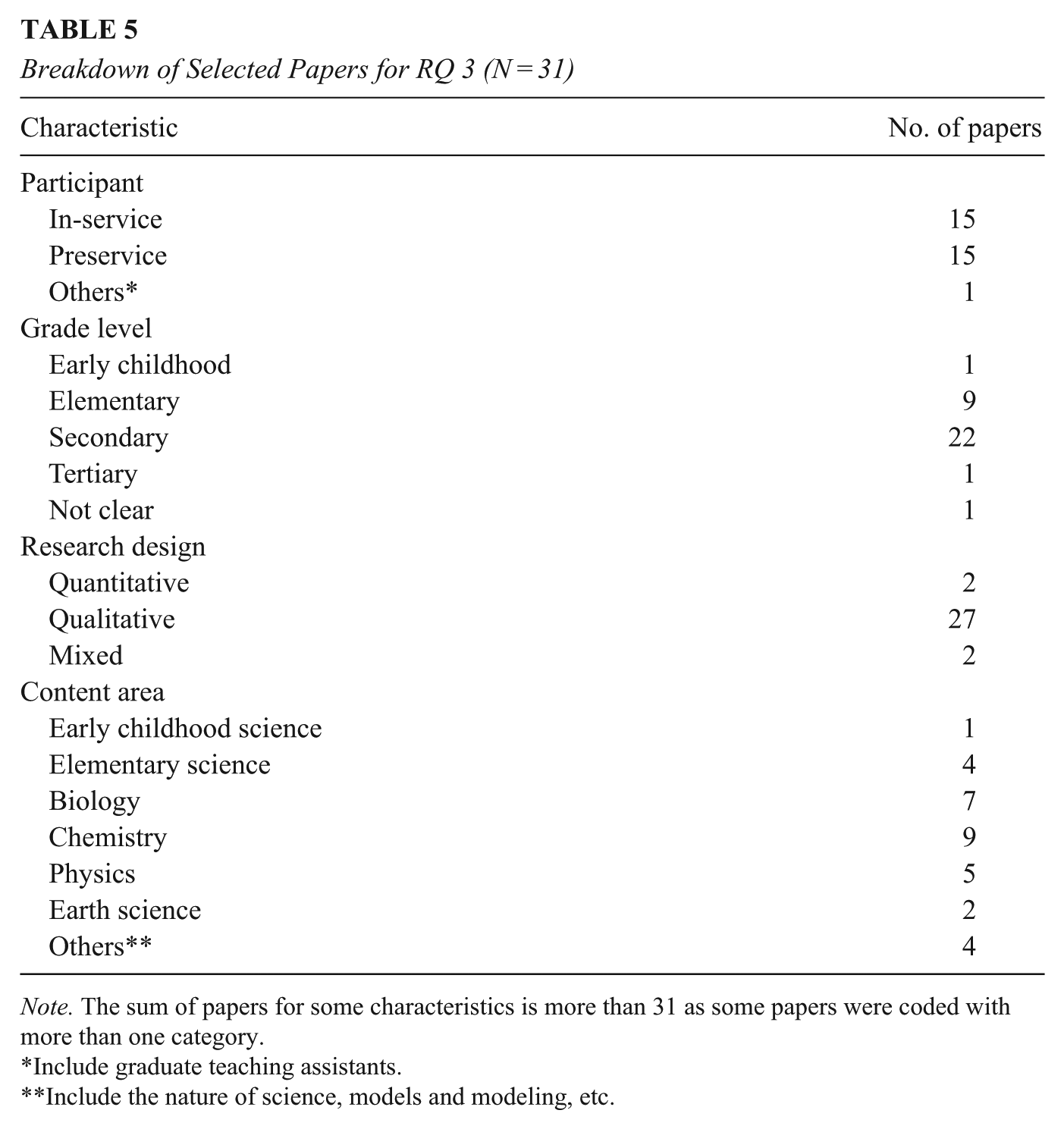
Note. The sum of papers for some characteristics is more than 31 as some papers were coded with more than one category.
Include graduate teaching assistants.
Include the nature of science, models and modeling, etc.
Our analysis revealed two focal areas in this collection of studies: (a) how PCK components interact during the PCK development process (n = 15) and (b) how other variables in the analytic framework of this current review (Figure 1) interact to shape PCK development (n = 22). Nonetheless, certain studies addressed both areas. The first group of studies detected processes in PCK development concerning interactions among PCK components, revealing two major emerging patterns. Firstly, the development of one component often stimulated the growth of other components. Specifically, several studies underlined the reciprocal influence between knowledge of student understanding (KSU) and knowledge of instructional strategies and representations (KISR). For example, Alonzo et al. (2012; [5]) asserted that teachers’ knowledge of student learning difficulties informed their sequencing of instructional representations. Similarly, Park and Oliver (2008a; [156]) found that improved understanding of individual students’ differences in prior knowledge and learning difficulties, stemming from the National Board Certification process, contributed to the expansion of KISR through tailoring instructional approaches. In contrast, Bayram-Jacobs et al. (2019; [22]) and Brown et al. (2013; [30]) suggested that the development of KSU and KISR occurred simultaneously, often making connections between them. Brown et al. (2013; [30]) observed that orientations toward teaching science (OTS) directed the development and connections between preservice science teachers’ KSU and KISR. Conversely, Scharfenberg and Bogner (2021; [175]) reported that some teachers developed KSU without changes to more student-centered orientations, suggesting potential independence of OTS and KSU as well as the idiosyncratic nature of PCK development. Secondly, when the development of one component affected other components, their interactions increased the coherence and strength of connections between components, enhancing the complexity in the PCK structure [29, 80, 125, 156]. As an illustration, Chan and Yung (2018; [39]) unveiled how a biology teacher’s increased KISR influenced their KSU and knowledge of assessment, promoting greater integration among these components.
The second group of the mechanism studies elucidated how different variables within the analytic framework affect PCK development. A substantial portion of this group explained roles of teacher professional knowledge (input; [195]), teacher belief (input; [208]), classroom teaching (process; [206]), and student work or responses (output; [80]) in the PCK development process. Chan and Yung (2015; [38]) illustrated that CK and pedagogical knowledge stimulated a teacher’s in-the-moment PCK development. Strong CK enabled the noticing of student misconceptions, while strong PK facilitated the spontaneous generation of new instructional strategies. However, Sperandeo-Mineo et al. (2006; [194]) reported bidirectional knowledge transformation between CK and PCK rather than a one-way process from CK to PCK, aligning with Davis’s (2004; [45]) study. In addition, some studies suggested that lesson planning or classroom teaching coupled with reflection triggered the growth of some or all of the PCK components [9, 75, 175] and connections among PCK components [153], contributing to an expanded PCK [156]. Hamed and Rivero (2021; [75]) monitored 311 primary school preservice teachers’ progression in their PCK as reflected in their lesson plans over a science methods course, emphasizing in-depth reflections. Their findings indicated various trajectories of PCK progression, implying that PCK development occurred gradually rather than radically and unevenly by different preservice teachers. This conclusion is echoed by Schafer and Yezierski (2021; [174]), exemplifying stepwise development in preservice science teachers’ PCK components as well as individual variations in PCK development. Additionally, studies by Bayram-Jacobs et al. (2019; [22]), Chan and Yung (2015; [38]), and Henze et al. (2008; [80]) found that student responses or performance initiated the expansion of KSU, influencing other PCK components and fostering connections among them.
RQ 4: Emerging Trends and Issues in Methodological Approaches to Examine PCK Employed in the Selected Studies
Our analysis revealed several methodological issues in PCK research, particularly in three areas: (a) defining and operationalizing PCK, (b) approaches to measuring or capturing PCK, and (c) methods for measuring or capturing changes in PCK.
Defining/Operationalizing PCK
Not surprisingly, an overwhelming majority of the studies defined PCK by adopting Shulman’s (1986, 1987) and/or other scholars’ definitions built on Shulman’s original conceptualizations (e.g., Loughran et al., 2004; Magnusson et al., 1999; J. H. van Driel et al., 1998). Despite slight deviations, all the definitions center on the notion that PCK is “a special amalgam of content and pedagogy” (Shulman, 1987, p. 8) required for the transformation of content knowledge for the purpose of teaching (Shulman, 1987). However, a large portion of these studies also operationalized PCK as an integration of various constituent components, adopting conceptual models of PCK, such as Magnusson et al. (1999), Park and Oliver (2008a, 2008b), or Mavhunga and Rollnick (2013). While this operationalization facilitates analytical focus and convenience by breaking the complex construct into individual parts, it presents certain challenges. A noteworthy challenge is that the debate over what constitutes PCK is not fully resolved yet. These varying views may contribute to fundamental differences in conceptualizing, operationalizing, and assessing the construct. A case in point is the inconsistency in the conceptualization of OTS. As mentioned earlier, some studies consider it a component of PCK [11, 30, 49], adopting widely accepted PCK conceptual models, especially Magnusson et al. (1999), whereas others regard it as a distinct belief construct separated from PCK [97, 129, 177]. This disparity may stem from different epistemological stances regarding what counts as teacher knowledge, posing a critical challenge for PCK researchers striving to establish a consensus in the conceptualization of PCK (e.g., Carlson et al., 2019; Gess-Newsome, 2015). Such consensus is crucial for theorizing PCK with robust empirical support drawn from accumulated research using clearly defined theoretical frameworks.
Another conceptual concern has arisen, particularly with the introduction of the refined consensus model (RCM) of PCK (Carlson et al., 2019), regarding the potential conflation between enacted PCK (ePCK) and various teaching practices encompassing planning, teaching, and reflection. The RCM defines ePCK as “specific knowledge and skills utilized by a teacher in a particular setting to achieve particular student outcomes” (p. 84), emphasizing the pedagogical reasoning employed by a teacher, drawing upon their knowledge, as they plan, teach, and reflect (Carlson et al., 2019; Park, 2019). However, certain studies equate teachers’ actions, such as lesson planning or teaching practices, with ePCK, often without adequately considering the pedagogical reasoning behind these actions. Mazibe et al.’s (2020; [127]) study comparing reported PCK and ePCK is an example. Adopting the topic-specific PCK model (TSPCK; Mavhunga & Rollnick, 2013), they developed two rubrics to assess reported PCK and ePCK, respectively, in terms of the manifestation of the five components of TSPCK on a four-point scale. In essence, ePCK was assessed based on the degree to which a teacher’s actions reflected each component of TSPCK without considering the underlying pedagogical reasoning. The oversight of pedagogical reasoning is problematic because the absence of certain pedagogical moves/actions may not be due to a deficiency of knowledge, but rather a reasoned decision based on the teacher’s knowledge. Furthermore, a teacher may possess knowledge about what to do and why, yet lack the ability to implement that knowledge in the classroom due to insufficient pedagogical skills (e.g., classroom management), contextual considerations (e.g., prescribed curriculum), or motivational factors. Incorporating teachers’ pedagogical reasoning acknowledges teachers’ sensitivity and responsiveness to context, essential aspects of the PCK concept (K. K. H. Chan et al., 2019).
Approaches to Measuring/Capturing PCK
To examine PCK relationships or changes between multiple time points, the selected studies employed diverse methodological approaches. Some studies investigated PCK as a whole construct, whereas others focused on changes in parts of PCK. When exploring the entire PCK construct, researchers usually first operationalized it as consisting of various aspects, dimensions, or components according to their research purpose. Then, they measured or captured individual constituents [35, 54] and in some cases [103, 153], connections between them as well, to measure or capture PCK in its entirety. However, researchers identified constituents of PCK in diverse ways and at diverse levels. For instance, Findlay and Bryce (2012; [52]) categorized subject matter knowledge, general PCK, and contextual knowledge as “a threefold division of PCK” (p. 2729) to examine the development of beginning physics teachers’ PCK. Similarly, Gess-Newsome et al. (2019; [64]) defined three internal constructs of PCK: PCK-CK, PCK-PK, and PCK-CxK (contextual knowledge) to investigate the impact of a 2-year PD program on teacher knowledge and practice. Counter to this approach, most studies adopted components from the three most popular PCK models mentioned earlier [107, 125, 148, 213], occasionally with modifications by eliminating or adding component(s) to align with their research aims and scope [22, 131, 150]. As unique cases, Weitzel and Blank (2020; [212]) employed 33 components of PCK identified from their literature review, and Milner-Bolotin et al. (2016; [136]) operationalized seven dimensions of PCK to be compatible with their focus on PCK reflected in the quality of teacher-generated conceptual multiple-choice questions.
In examining PCK in parts, researchers usually concentrated only on specific components of the PCK models, most frequently following Magnusson et al.’s (1999) model. These studies targeted varying numbers of PCK components, such as four components (excluding OTS [14]; excluding knowledge of curriculum [22]), three components [26], two components [47, 128, 184], or even one component—for example, knowledge of instructional strategies [21], knowledge of curriculum [74], knowledge of student misconceptions [51], or orientations toward teaching science [63, 105]. Notably, studies focusing on the two components most frequently selected, knowledge of student understanding and knowledge of instructional strategies and representations [47, 128, 144, 147, 190, 191], mirror Shulman’s (1986) two PCK components.
Moreover, the selected studies have addressed a wide range of subject matter in examining PCK, encompassing specific science concepts [171], interdisciplinary science concepts [217], and concepts across multiple science topics [64]. This trend raises concerns about inconsistent conceptualizations of what constitutes the “C” in PCK, as well as the varying grain sizes of PCK, across different studies. Researchers focusing on science domain-specific PCK often consider science-specific methods—such as science process skills [31], scientific inquiry [140], argumentation [128, 185], and scientific models and modeling [71]—to be the “C” in PCK. In some studies, however, the “C” becomes less apparent, particularly in PCK concerning self-regulated learning [19], integrated STEM [4], and socioscientific issues [22]. In addition to the divergence in PCK conceptualizations, the aforementioned diversity in approaches to capturing or measuring PCK poses challenges in aggregating findings across different research settings, hindering direct comparison between studies on PCK in relation to other variables and PCK development.
Methods for Measuring/Capturing PCK Changes
In this review, a majority of studies employed qualitative research designs, prevalently utilizing multiple data sources over single ones to capture or assess PCK. However, akin to K. K. H. Chan and Hume’s (2019) findings, researchers using multiple data sources seldom described how individual data sources contributed to their findings, particularly whether and how they served as primary data to determine PCK changes, or as secondary sources for contextual information or triangulation. Interestingly, a considerable proportion of the quantitative studies (43 out of 51; 84%), particularly those with larger sample sizes, tended to rely on a single data source—mostly in forms of written PCK tests, questionnaires, surveys, or interviews—for investigating PCK [151, 171].
The primary data sources in the selected studies to examine PCK include: (a) written questionnaires/surveys/tests, (b) artifacts from teaching tasks, (c) interviews, (d) teaching observations, and (e) others (e.g., concept maps, researcher’s field notes, teacher artifacts generated from PDs or teacher education courses). Written PCK tests, questionnaires, and surveys varied in format with a variety of item numbers: Likert scale, selected and ranked responses, multiple choice, true/false, open-ended questions, or various mixtures of these formats. Although a great majority of the instruments were developed by researchers themselves in a study, evidence of their validity was rarely reported. Different research groups rarely shared PCK instruments or built their work on one another. Studies using paper-and-pencil tests often either overlooked capturing teacher pedagogical reasoning [70, 171] or investigated pedagogical reasoning detached from their actions in the teacher’s own contexts when examining PCK as reflected in their pedagogical decision-making [84, 193].
Interviews were the most widely used data source to elicit and capture PCK. Semistructured individual interviews were more prevalent than focus groups and were often accompanied by teaching observations [92, 131], frequently using stimulated recall interviews [30, 147, 208]. Classroom teaching observations, oftentimes video-recorded, were conducted more commonly with in-service teachers. Artifacts from teaching tasks, collected in and out of the classroom at different stages of the pedagogical cycle (Carlson et al., 2019; Shulman, 1987), were another common data source. For preservice teachers, artifacts frequently focused on planning and reflection stages, including lesson plans [33, 212], content representations [11, 12], and post-lesson reflection [86]. In contrast, studies with in-service science teachers collected artifacts across the three stages: content representations [131, 160], lesson plans [22], reflection on planning a lesson [96], teacher-generated tests [199] in the planning stage; student work samples [128, 156] in the enactment stage; and post-lesson reflections [64, 124, 178] in the reflection stage.
A methodological issue arises from potential discrepancies between the measurement of PCK and the measurement of other variables in studies examining PCK relationships. For instance, Smit et al.’s (2017; [191]) study signified a mismatch in the focus area between PCK tests and CK tests. Similarly, Gess-Newsome et al. (2019; [64]) investigated the relationship between PCK, general PK, and inquiry teaching practices. They measured PCK, utilizing multiple data sources including video recordings of instructional sessions on cell transport mechanisms and photosynthesis, written reflections on these and two other topics, and interviews on one of the four topics. However, when assessing general PK and teaching practices, they chose to randomly select video-recorded classroom sessions collected from each year of teaching throughout the study period. Another instance of misalignment is evident in Yang et al. (2020; [217]), in which PCK measurement focused on knowledge of learners in chemistry, biology, earth science, and physics, whereas student learning outcomes were measured based on crosscutting concepts.
Our analysis raises concerns about relying solely on self-report data for assessing PCK, particularly as it is enacted in teaching practice. For example, to examine the relationships between enacted PCK and teacher-level variables, Mapulanga et al. (2022; [122]) surveyed 54 biology teachers using a Likert-scale questionnaire to measure the extent to which each component of PCK was enacted. Similarly, van Uum et al. (2019; [205]) determined PCK changes based on teachers’ self-perceived ability to guide inquiry-based learning in their classrooms, also using a Likert-scale questionnaire. However, the credibility of research findings is questioned due to potential disparities between what teachers report and their actual actions (D. Chan, 2009). To address this, it is recommended to complement self-report data with other data sources, including observations, not only for a fuller understanding of PCK but also to enhance the trustworthiness of findings through triangulations across various data sources (K. K. H. Chan, 2022; Meijer et al., 2002; Park & Suh, 2015).
Discussion & Implications
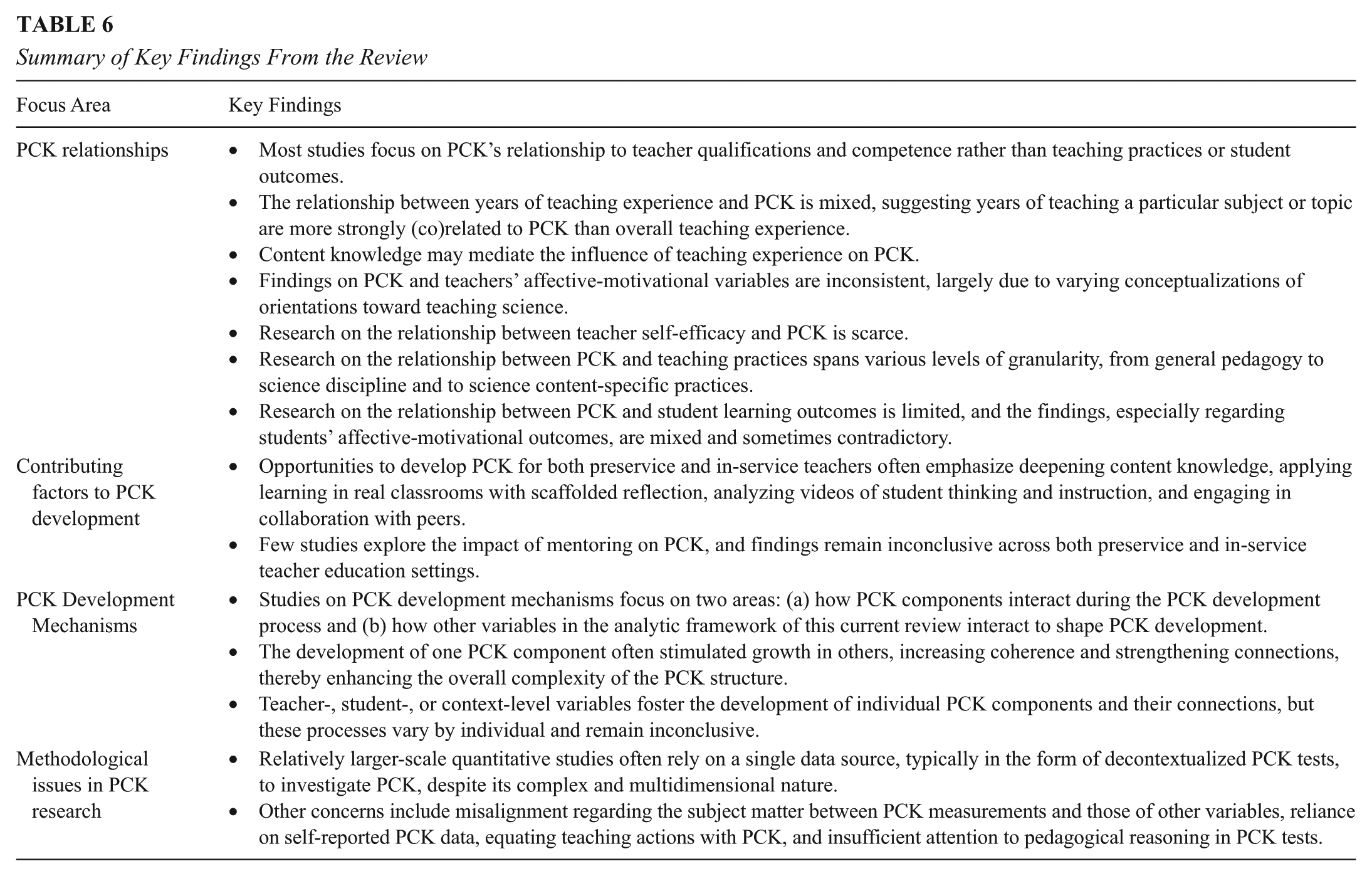
This comprehensive systematic literature review uniquely utilized an analytic framework that integrates various constructs related to PCK for reviewing existing empirical studies. The findings not only confirmed and added nuances to previous reviews of PCK studies (e.g., K. K. H. Chan & Hume, 2019; J. H. van Driel et al., 2023) but also revealed several new findings. To support a more coherent synthesis, we summarize these key findings, highlighting what this review adds to the existing knowledge (Table 6). In this section, we discuss the main findings for each research question, addressing the second (contributing factors) and third (mechanisms) questions together, as their findings are closely intertwined.
Summary of Key Findings From the Review
Relationships Between PCK and Teacher Quality, Teacher Practices, and Student Learning Outcomes
This review reveals that research on PCK relationships centers on input variables such as teacher qualifications and competence more than the teaching process or student outcomes. Particularly, a notable amount of research suggests that CK and PCK are distinct yet interrelated, mostly based on correlational analysis results. This seems natural considering that PCK is theoretically described as a synergistic integration of CK and PK (Shulman, 1987). Given the accumulated empirical evidence for strong links between CK and PCK, we recommend that researchers move beyond repetitive examinations of their relationship using different populations, topics, or settings through correlation designs and strive to unpack the interrelation and how their codependence influences each other’s development (Sorge et al., 2019 [193]). Rather than simply establishing a link between PCK and CK, researchers are encouraged to explicate how the quality of PCK—measured or captured by the presence and strengths of specific PCK components and/or the connections between them—relates to the depth and breadth of CK and/or the structure and organization of CK, as well as mediating factors impacting the integration of CK into PCK. Such research holds the potential to offer valuable implications for designing content courses as a leverage to improve both CK and PCK in science teachers. Empirical findings on the relationship between years of teaching experience and PCK are inconsistent, varying from positive to no relation or mixed relations. Given no indication of negative relations, it is clear that PCK is developed through teaching experience (J. van Driel, 2014), yet the extent and types of teaching experience needed for PCK expansion and refinement remain inconclusive. Considering the specificity of PCK, both in terms of the topic and context (Magnusson et al., 1999; Park & Oliver, 2008b), we suggest that the number of years spent teaching a particular topic or subject at a specific grade level may be more closely related to PCK than overall years of teaching. Additionally, some research [93, 101] demonstrates the potential mediating role of CK in the influence of years of teaching experience on PCK. Future PCK research, involving years of teaching experience, should take into consideration the topic and context specificity of PCK, as well as the role of CK in the relationship between PCK and teaching experience.
Furthermore, our findings underscore a robust positive relationship between science teachers’ PCK and both their teaching practices and student learning outcomes, emphasizing the importance of prioritizing PCK development in teacher professional development initiatives. Nonetheless, since several studies report no significant relation between PCK and teaching practices, we interpret these discrepancies as indicative of the complex process of translating PCK into teaching practices, influenced by a myriad of contextual factors, spanning from the broader education sector to individual student attributes (Carlson et al., 2019). In this regard, we urge researchers to shift focus from simply determining consistency or inconsistency between PCK and teaching practices toward investigating mediating factors and mechanisms in this translation process, thereby providing implications for practice. Moreover, studies on PCK reflected in teaching practices tend to overly emphasize science teachers’ actions with little consideration of their pedagogical reasoning directly tied to their actions. As Shulman (1987) pointed out, pedagogical reasoning plays a crucial role as a mediator between teachers’ knowledge and actions. Examining teaching practices with a sole focus on actions may risk overlooking the complex decision-making processes that involve science teachers’ sophisticated knowledge and sensitivity to the context (K. K. H. Chan et al., 2019). Such thinking processes are fundamental to teacher professionalism (Loughran, 2019; Park & Oliver, 2008b). The influence of PCK on student learning has primarily been explored in terms of cognitive outcomes, given the widespread recognition of student achievement as a major learning outcome (National Research Council, 2011; NGSS Lead States, 2013).
However, there is a growing attention to the significance of affect and motivation in student science learning (Davidson et al., 2020; Jaber & Hammer, 2016). Fortus (2014) emphasizes that affective-motivational processes, including motivation, interest, and self-efficacy, are critical to student engagement in science learning, asserting that science learning without engagement is partial at best. While research on the relationship between PCK and teacher affective-motivational characteristics is increasing, there is relatively scant investigation into PCK relationships with student affective-motivational characteristics. Furthermore, the limited studies have reported mixed findings. Notably, Kanter and Konstantopoulos (2010) found that PCK negatively relates to minority students’ perception and interest in science, suggesting that the relationship between teacher knowledge and student affective-motivational outcomes can be complex and influenced by various factors such as students’ demographic profiles and years of schooling. Further research is needed to unpack these complex relationships between student-level factors, students’ affective-motivational outcomes, and teacher PCK. It should be noted that while psychomotor outcomes are included in our analytic framework as a potential dimension of students’ learning, our review did not identify any studies that specifically addressed science teachers’ PCK in relation to these outcomes. This absence raises an important question as to whether psychomotor outcomes are underexplored in the literature or perhaps less emphasized in science education contexts. Future studies may consider investigating this dimension further, particularly in areas where experiments, practical work, or performance-based tasks are central to learning (Ullah et al., 2024). Exploring psychomotor outcomes could provide a more comprehensive understanding of how teachers support the full range of student learning in science classrooms.
Finally, readers are advised to exercise caution when interpreting findings concerning PCK relationships with input, process, and outcome variables in the selected studies for this review. It is critical to stress that PCK relationships derived from qualitative research or correlational studies should not be interpreted as causal-effect relationships. Instead, they signify a connection or relatedness between PCK and these variables. Robust quantitative research, especially using experimental or quasi-experimental research designs, is recommended to elucidate the nature of the relationships identified in qualitative and correlational studies.
Contributing Factors and Mechanisms of PCK Development
A key insight from this review is that while PCK naturally evolves through teaching experience in authentic classroom environments, preservice teachers’ PCK readiness (Smithey, 2008) and practicing science teachers’ PCK development can be accelerated through targeted interventions such as teacher education courses and PD programs. This finding aligns with Berry et al. (2016). Effective interventions identified in this review for positively influencing PCK progression include opportunities: (a) to deepen CK, (b) to apply what was learned from the intervention into real classroom settings while reflecting on teaching or a lesson, (c) to analyze classroom videos focusing on student thinking and instructional strategies as well as their connections, and (d) to collaboratively learn from teaching using a learning or lesson study model, or PLC. The importance of reflection, content knowledge, and collaboration with peers in PCK development was also identified in previous reviews (Kind, 2009; Mientus et al., 2022; Schneider & Plasman, 2011). We suggest using these identified features as foundational principles for designing high-leverage practices in interventions aimed at enhancing PCK.
It is essential to underline that studies focusing on PCK development through interventions consistently report positive impacts, although the patterns and degrees of PCK development vary among participants and across individual PCK components. This implies that well-designed interventions, informed by PCK research grounded in rigorous methodology aligned to answer research questions and free of bias (Harrison et al., 2020), can effectively facilitate PCK development. However, one could argue that the abundance of studies reporting positive impacts may stem from publication bias (Moller & Jennions, 2001; Sterling, 1959), suggesting the existence of studies showing no or negative impacts that remain unpublished due to this bias. Nonetheless, the presence of evidence supporting the impact of teacher education courses and PD programs strongly indicates their potential role in fostering PCK development when implemented effectively.
However, many quantitative studies in this review often lack explanations of how and why a particular intervention influences PCK, mainly focusing on pre- and postintervention changes. Given the multitude of personal and contextual factors influencing PCK (Carlson et al., 2019; Gess-Newsome, 2015), these positive outcomes should be interpreted cautiously. Specifically, this review unveils that the most common interventions to enhance PCK take the form of teacher education courses or PD programs. It has been common that teacher education programs aim to foster PCK development so that they structure their curricula to attain this goal. In this regard, it is possible that the reported positive impact on PCK for preservice teachers may result from collective learning effects in teacher education courses rather than the impact of a specific course. Similarly, voluntary participation in most PD programs may lead to motivated participants seeking improvement (Kennedy, 2016), potentially constraining the generalizability of research findings due to their unique affective-motivational characteristics. In this regard, greater emphasis should be placed on understanding what makes these interventions effective for whom and under what circumstances, with sufficient consideration of context, rather than solely examining to what extent or whether they are effective for PCK development. Similarly, we believe that a gap in the literature pertains to the critical analysis of less successful teacher education and PD programs in enhancing teachers’ PCK. Identifying the “failed design features” (Karsenty & Brodie, 2023, p. 579) and the explanations that have led to unsuccessful outcomes can provide valuable insights for the field, enabling us to learn from failures and better support future success.
The scant attention given by researchers to understand why and how a specific intervention contributes to PCK development is evident in the scarcity of studies exploring mechanisms of PCK development or processes underlying PCK relationships. These limited number of studies on mechanisms center on either how individual PCK components influence one another during development or on how teacher-, student-, or context-level variables play a role in PCK development. Nonetheless, the findings from these studies are rather inconclusive and insufficient to establish cumulative empirical foundations. To address this gap, we advocate for further research to explore PCK development mechanisms within the framework of features and approaches proven to positively impact PCK, as highlighted in this review. For example, a multiple case study could examine purposefully selected teachers with varying initial levels of CK in the context of a PD aimed at deepening CK, a research-supported strategy for improving PCK. This study would track changes in CK and PCK, in terms of individual PCK components’ growth and interactions between CK and PCK, as well as among PCK components, during PD and subsequent classroom teaching. By selecting case teachers from different teaching contexts, the study could explore the interplay among contextual factors, CK, and PCK. Additionally, a mixed-methods study could investigate how PLC influences PCK development, combining qualitative observations and interviews with quantitative comparisons of teachers’ PCK participating in PLC with those who do not, but working in similar teaching contexts. The study would provide insights into the mechanisms behind PCK development. Conducting more studies similar to these would enhance comparability across diverse studies, foster the accumulation of enduring insights into PCK development mechanisms, and offer substantial guidance for teacher support initiatives.
It is important to note that although mentoring is regarded as an effective means to support teachers’ learning of new skills and practices (Koballa & Bradbury, 2012; Schwille, 2008), research on its impact on PCK remains limited, and findings are inconclusive in both preservice and in-service science teacher education contexts. In this regard, more research is needed to explore how mentoring influences PCK and to understand key features that make mentoring practices and mentors effective in promoting PCK development and the mechanisms through which they operate.
Methodological Suggestions for Research on PCK
Our analysis of methodological trends and issues in the selected studies provides several implications. Firstly, large-scale studies often lean on a single data source, particularly PCK tests, due to practical constraints related to time, labor, and cost. However, our review underscores concern about the insufficient evidence of validity in researcher-made PCK tests, presenting challenges to the credibility of research findings. In addition, PCK tests have inherent weaknesses, such as the potential misalignment between a science teacher’s PCK captured through written tests and the PCK used in teaching tasks (K. K. H. Chan & Hume, 2019). These tests may also fall short in capturing teachers’ pedagogical reasoning and creativity (Smith & Banilower, 2015). Given the complex nature of PCK, there are clear advantages in utilizing diverse data sources for a comprehensive understanding, drawing from complementary uses and explicitly triangulating across multiple data sources (K. K. H. Chan & Hume, 2019; Park & Suh, 2015). Gardner and Gess-Newsome’s (2011) study showed variations in PCK qualities in the same science teachers when different data collection tools were employed, highlighting the multifaceted nature of PCK that is challenging to explore adequately with a single data collection method. Hence, researchers are encouraged to exhibit creativity in devising methodological approaches suitable for large-scale studies, ensuring rich and diverse data collection while addressing practical constraints. Potential approaches include incorporating video-based instruments using authentic classroom clips, as utilized in She and Chan (2023), or simulated classrooms closely resembling real classroom situations employed in J. Fischer et al. (2022), with a focus on the pedagogical reasoning guiding the application of PCK. When utilizing multiple data sources, transparent communication of analysis procedures and the contribution of individual data sources to findings will enhance research replicability and the trustworthiness of findings.
Secondly, this review unveils a literature gap regarding the scarcity of research on the mechanisms of PCK relationships and development. To address this, we propose several methodological approaches. Qualitative research is undoubtedly invaluable for gaining detailed and nuanced insights into mechanisms, and accordingly, a substantial number of the selected studies on mechanisms (i.e., 27 out of 31) employed qualitative research designs, particularly case studies. However, certain methodological choices in some studies raise concerns about trustworthiness and rigor. For instance, when examining how different features of an intervention influence participants’ PCK, several studies relied on participants’ self-reported, perceived contributions of those features rather than collecting relevant data for systematic analysis guided by an analytic framework [12, 14] or based their conclusions on researchers’ speculation without supporting evidence from data analysis (e.g., [1]). Therefore, it is essential for researchers to be accountable for rigorous and reliable methodologies to maximize the advantages of qualitative research in this much-needed research area. Furthermore, we advocate for the use of mixed-methods research to complement the weaknesses of either qualitative or quantitative research methods. Through a mixed-methods research design, researchers can not only determine PCK relations to other variables and assess the impact of factors on PCK using quantitative approaches but also construct explanations about identified relationships and impact using qualitative approaches. Additionally, experimental or quasi-experimental studies will enable researchers to test hypothetical processes underlying PCK development and interactions with other variables, although the feasibility of these research designs in educational settings has often been questioned (Campbell & Stanley, 2015; Gopalan et al., 2020).
Thirdly, a significant portion of the 217 selected studies primarily focused on secondary science classrooms or secondary teacher education courses. These studies predominantly utilized qualitative research methods with smaller sample sizes and lacked longitudinal investigation. While these studies have contributed valuable insights, they may not fully capture the nuances of PCK relationships and development across different educational contexts. Hence, to achieve a comprehensive understanding of PCK, there is a clear need for more research conducted in other grade levels beyond secondary school levels, particularly in college science classrooms. Moreover, employing diverse research designs, including quantitative and mixed-methods approaches, as well as prolonged examination through longitudinal studies, can contribute to unraveling the complexities of PCK relationships and development.
Finally, substantial discrepancies in the conceptualization, operationalization, and measurement of PCK were evident. These discrepancies may have contributed to the absence of well-established theoretical underpinnings supported by strong empirical evidence, a criticism echoed by Abell (2007), who characterized PCK research as being in a pre-scientific stage. We strongly advocate concerted endeavors among researchers to establish methodological consensus in PCK research, which can foster comparability across studies and enable meaningful and coherent explanations of PCK relationships and development. Two previous international PCK summits, which convene leading PCK researchers in science education to discuss issues in PCK research and future directions (Berry et al., 2015; Hume et al., 2019), serve as excellent examples of such collaborative initiatives. By continuing these collective actions to generate shared research frameworks and agendas, PCK research can enhance its utility, with cumulative findings, grounded in accountable and reliable methodologies, informing research, practice, and educational policies (Antonakis, 2017).
Supplemental Material
sj-docx-1-rer-10.3102_00346543251394404 – Supplemental material for Unpacking PCK Relationships and Development in Science Teachers: A Systematic Synthesis of Empirical Research
Supplemental material, sj-docx-1-rer-10.3102_00346543251394404 for Unpacking PCK Relationships and Development in Science Teachers: A Systematic Synthesis of Empirical Research by Soonhye Park and Kennedy Kam Ho Chan in Review of Educational Research
Footnotes

Authors
SOONHYE PARK is professor of science education at NC State University, Raleigh, North Carolina; email:
KENNEDY KAM HO CHAN is an associate professor at the Faculty of Education, The University of Hong Kong; email:
References
Supplementary Material
Please find the following supplemental material available below.
For Open Access articles published under a Creative Commons License, all supplemental material carries the same license as the article it is associated with.
For non-Open Access articles published, all supplemental material carries a non-exclusive license, and permission requests for re-use of supplemental material or any part of supplemental material shall be sent directly to the copyright owner as specified in the copyright notice associated with the article.
