




Abstract
Language development in early childhood plays a vital role in children’s academic achievement and long-term development. It is essential to understand how teachers’ language practices impact children’s language development to improve educational outcomes. In the current meta-analysis, we examined the associations between early childhood teachers’ language practices and children’s language development from preschool to third grade. Of 14,852 articles screened, 118 articles from 104 unique studies were included, comprising 411 effect sizes, calculated through partial correlation, from 13,572 teachers and 112,533 child participants. Results revealed a statistically significant association between teachers’ language quality (e.g., linguistic, interactive, conceptual) and children’s language development (rp = .11; p < .001). Meta-regression analyses showed that this association was stronger among older children, in classrooms with a higher percentage of female students, when teachers’ language practices were evaluated using systematic coding or when observed during language instructions. However, no significant association was identified between teachers’ language quantity and children’s language development based on the included studies. These findings emphasize the need to focus on improving the quality of teachers’ language practices in early childhood education through enhanced teacher preparation and ongoing professional development.
The acquisition and development of language in young children fundamentally influence their academic achievement, social integration, and lifelong success (Duncan et al., 2007; Golinkoff et al., 2019; Kopp, 1989, 2009; Lloyd, 1978; Snow et al., 1998). A wealth of research underscores the pivotal influence of caregivers’ language input, including that of parents and teachers, on children’s language development (Dickinson & Smith, 1994; Golinkoff et al., 2019; Hoff, 2003; Huttenlocher et al., 2002; Justice et al., 2008; Rowe, 2012; Tamis-LeMonda et al., 2001). Although there is a consensus on the critical role of a rich language environment for children, the nuances of how adult language affects children’s language development remain an area of active exploration. A notable recent debate in this realm is the one stirred by Golinkoff et al. (2019) and Sperry et al. (2019a, 2019b) concerning the “30-million-word gap,” a concept referring to the disparity in the number of words heard by children from higher-income families compared to those from lower-income families by the age of three (Hart & Risley, 1995). This debate focuses on issues such as the relative importance of quantity versus quality of language exposure, the definition of a quality language environment, and the role of the community in assessing home language environments. However, this debate and similar scholarly discussions have predominantly emphasized home settings, with less attention to how early education environments and teacher-child interactions contribute to children’s language development (Hadley, Barnes, Wiernik, et al., 2022).
In early educational settings, teachers’ language practices are crucial for nurturing young children’s language development. Previous research has identified a positive relationship between teacher language practices, such as engaging in extended conversations, employing decontextualized language, and using a rich vocabulary, and the enhancement of children’s language skills (Barnes & Dickinson, 2017a; Dickinson & Tabors, 1991; Hindman et al., 2012). Nonetheless, evidence also suggests that merely increasing the quantity or complexity of teacher talk may not automatically lead to children’s enhanced language outcomes (Barnes & Dickinson, 2017b; Hadley, Barnes, & Hwang, 2022; McDoniel et al., 2022; McLeod et al., 2019). Furthermore, the need for teachers to adapt their language practices to meet the diverse needs of children in varying activity settings further complicates this dynamic (Hadley, Barnes, & Hwang, 2022; Hadley, Barnes, Wiernik, et al., 2022). Against this backdrop of mixed findings, a comprehensive review of the literature on the relationship between teacher language practices and child language development is imperative to provide a deeper understanding of how these practices impact children’s language outcomes.
To the best of our knowledge, there has not been a meta-analysis examining the impact of early childhood teachers’ language practices on young children’s language development. To bridge this gap, we seek to systematically examine the associations between the language practices of early childhood teachers and the language development of children from preschool to third grade. In the current study, we defined teachers’ language practices broadly as the types and frequencies of language teachers use in the classroom (Hadley, Barnes, Wiernik, et al., 2022). This broad definition encompasses various aspects of teacher language input, teacher-child language exchanges, and the linguistic environment in early childhood classrooms (Hadley, Barnes, & Hwang, 2022). Additionally, we considered potential moderating factors, such as language dimensions in both teachers (quantity, conceptual, interactive, linguistic) and children (expressive, receptive, literacy), demographic characteristics of both teachers and children, and features of study design, with the aim of providing a more comprehensive picture of how teachers’ language practices impact children’s language development.
Teacher Language Practices: Concept Definition and Empirical Support
In this study, we focused on teachers’ natural language practices, as opposed to pedagogical strategies or instructional activities. Teacher language practices were classified into two main dimensions: language quantity and language quality. The former refers to the number of words or utterances spoken by teachers (Anderson et al., 2021). Although the concept of “language quality” is not universally agreed upon within the research field (see Hadley, Barnes, Wiernik, et al., 2022), in line with Rowe and Snow’s (2020) categorization, we defined teachers’ language quality through three aspects: interactive, linguistic, and conceptual features. Interactive features encompass verbal scaffolding strategies teachers employ to facilitate child engagement in dialogues, like being responsive, repeating, or expanding children’s speech; linguistic features refer to language characteristics, including lexical diversity, advanced vocabulary, grammatical complexity, and syntactical patterns; conceptual features relate to the introduction of cognitively challenging content, including using decontextualized language, the explanation of concepts, and talking about abstract topics (Rowe & Snow, 2020). Although distinctions exist among these categories, overlaps are inevitable. For instance, conceptual dialogue can be interactive, taking place through conversations with children, and linguistic features are also embedded in teachers’ interactive and conceptual talks.
A significant body of research has demonstrated the positive impact of different dimensions of early childhood teachers’ language practices on the development of children’s language skills. For example, previous research indicates a significant link between the amount of language exposure from early childhood teachers and the growth of children’s vocabulary (Barnes & Dickinson, 2017a; Bowers & Vasilyeva, 2011; Grøver et al., 2018). This connection has been supported by several studies in which researchers analyzed teacher language quantity using computational tools, such as the Computerized Language Analysis (CLAN; MacWhinney, 2000) software. For instance, an analysis of 90 minutes of classroom language recordings by Bowers and Vasilyeva (2011) demonstrated that the total number of words spoken by teachers was a significant predictor of vocabulary growth among preschoolers. Similarly, Franco et al. (2019) found that the frequency of teacher utterances within a 15-minute period was a positive indicator of young children’s literacy and expressive language development. This pattern has been observed in diverse linguistic and cultural contexts, including Norwegian- and Spanish-speaking environments (Bowne et al., 2017; Gámez, 2017; Rydland et al., 2014).
Teachers’ language quality has also been found to be positively associated with children’s language development. The interactive features of teachers’ language practices, including strategies to engage children in conversation, such as asking questions and echoing or building upon children’s answers, have been identified as beneficial for children’s language development (Rowe & Snow, 2020). For instance, a study by Barnes et al. (2017) underscored the value of teacher comments during book reading sessions that respond to, elaborate on, or supplement children’s remarks in fostering vocabulary growth in preschoolers. Similarly, Bratsch-Hines et al. (2019) observed that the dialogic interaction between pre-kindergarten teachers and students, characterized by a dynamic exchange of repetition, confirmation, and inquiries, significantly advanced children’s language and literacy development.
Linguistic features of teacher language, such as lexical diversity, the use of advanced vocabulary, and the complexity of syntax, have also been positively linked to child language development. For instance, the variety of vocabulary employed by teachers has been found to be associated with greater language development in children (Bowers & Vasilyeva, 2011). The employment of sophisticated vocabulary and complex syntactic structures, as measured by metrics like the mean length of utterance (MLU), has been found to support children’s language acquisition (Dickinson & Porche, 2011; Gámez & Levine, 2013; Neuman et al., 2018). Huttenlocher et al. (2002) conducted a longitudinal study and found that teachers’ use of syntactically complex language had a long-term positive effect on the syntactic development of preschoolers when measured 1 year later, highlighting the lasting impact of high-quality linguistic interactions in early education settings.
In addition, the conceptual features of teachers’ language practices, including discussing abstract topics, talking about word meanings, and talking about the past and future, have been found to nurture children’s language development (Rowe & Snow, 2020). Research by Hindman et al. (2012) demonstrated that teachers’ use of decontextualized language during book reading sessions, whether analyzing the text or linking it to the children’s own experiences, significantly supported the development of children’s receptive vocabulary. Further, teachers engaging children with conceptually demanding materials, along with posing reflective and predictive questions, have been positively linked to advancements in children’s language skills (Cabell et al., 2013; Wasik et al., 2006; Zucker et al., 2010). Additionally, the effectiveness of teachers’ language in fostering cognitive and linguistic growth, as evaluated by the Instructional Support (IS) subscale of the Classroom Assessment Scoring System (CLASS; Pianta et al., 2008), has associated with positive outcomes in children’s language development (Burchinal et al., 2010; Downer et al., 2012; Hamre et al., 2014).
However, despite the abundant evidence supporting the positive associations between teachers’ language practices and children’s language development, not all empirical evidence supports this positive relationship. For instance, Barnes and Dickinson (2017b) have found a negative correlation between teachers’ longer utterances and the vocabulary growth of children in Head Start programs. They proposed that excessive linguistic complexity, beyond the comprehension level of the children, may impede the acquisition of new vocabulary, especially in children with limited language skills. Bowers and Vasilyeva (2011) also found no associations between teachers’ language quantity or complexity and monolingual children’s vocabulary growth. They identified a negative association between the number of words per utterance used by teachers and English language learners’ vocabulary growth, suggesting that younger children might filter out input that is too complex. They proposed that exposure to input that is filled with repetitive basic words and simple sentences may benefit children in the initial stages of language development. In addition, several recent large-scale investigations have revealed no significant relationships between teachers’ instructional support and the language development in children (Finders et al., 2021; Hong et al., 2019; McDoniel et al., 2022). Thus, although previous findings underscore the relevance of early childhood educators’ language practices, the overall picture remains inconsistent, indicating a need for further exploration.
Potential Moderators of the Associations Between Teachers’ Language Practices and Children’s Language Development
In addition to examining the relationship between early childhood teachers’ language practices and young children’s language development, we also explored factors that may potentially moderate this relationship. These potential moderating factors were grouped into three categories: language dimensions pertaining to teachers and children, demographic characteristics of both teachers and children, and study design features (Table 1).
Potential Moderators and Descriptions
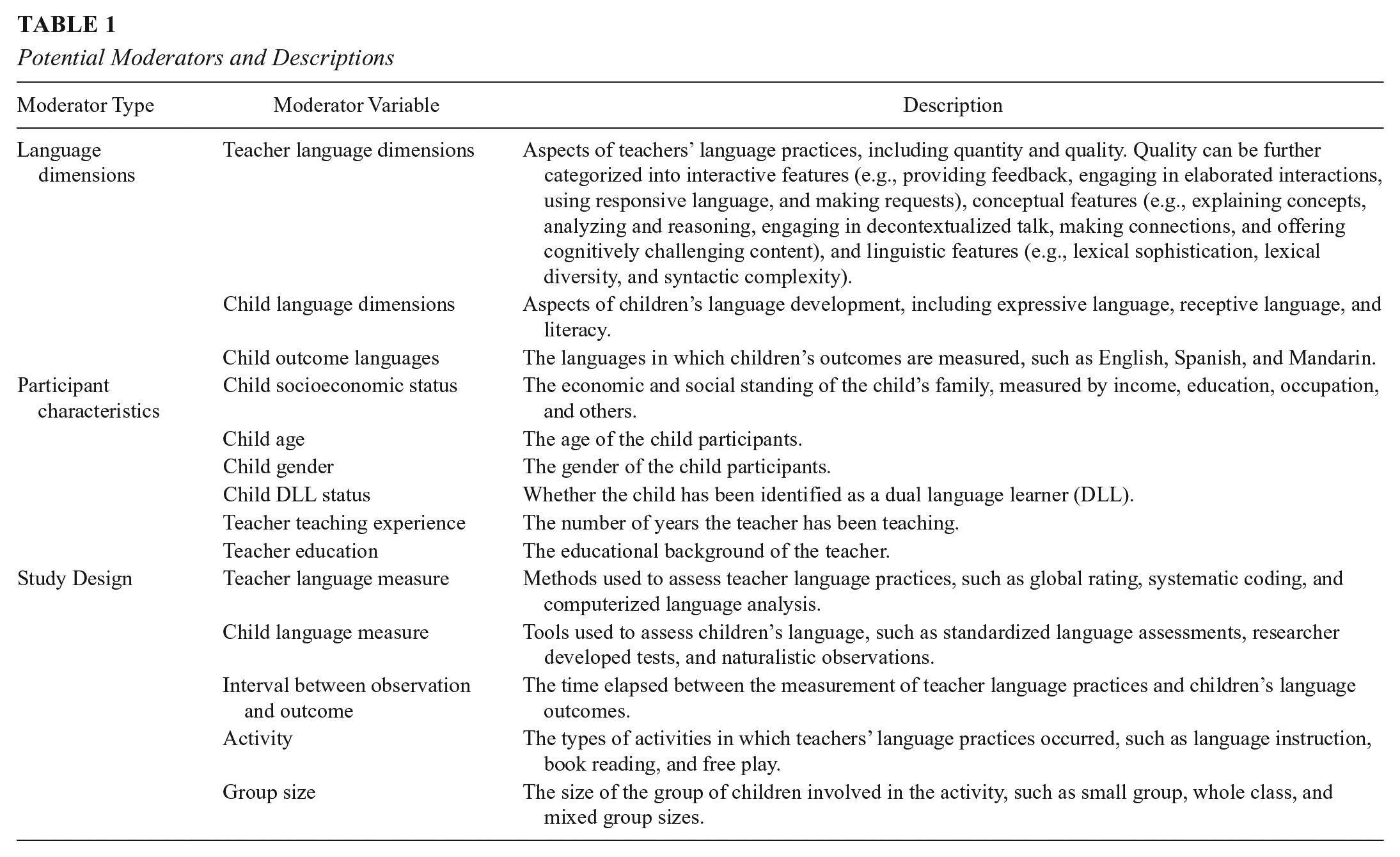
Language Dimensions
Previous research suggests that the various aspects of adults’ language practices exert differing impacts on children’s language development. In addition to the ongoing discussion on language quantity versus quality, different dimensions of language quality can also differentially influence children’s language development. For example, Dickinson and Porche (2011) found a positive correlation between teachers’ interactive comments on children’s utterances and the vocabulary growth of children in fourth grade. In contrast, they found no similar correlation between teachers’ utterances intended to draw children’s attention and children’s vocabulary growth. In a separate study by Wasik and Hindman (2015), teachers’ conceptual talk about vocabulary was found to be more associated with language growth in children than their interactive feedback with children.
Moreover, the impact of teachers’ language practices on children’s language development can also vary depending on the specific dimensions of children’s language development. For example, in a study conducted by Bratsch-Hines et al. (2019), teachers’ interactive language use was a significant predictor of children’s expressive language skills but not literacy skills. In a different investigation, researchers found that teachers’ conceptual language was linked with children’s receptive language skills but not with their expressive language abilities (Wasik et al., 2006). It is also generally recognized that young children typically develop receptive language skills before developing expressive language skills (Goldin-Meadow et al., 1976). Both receptive and expressive language skills are crucial foundations for acquiring literacy skills later in life (Hoff, 2009; Snow & Matthews, 2016).
Beyond varying language dimensions, cross-language studies have highlighted distinct attributes unique to different languages, such as English, Spanish, and Mandarin (Evans & Levinson, 2009). Additionally, the processes of language socialization and acquisition in children exhibit variations across languages (Caspe & Melzi, 2008). Consequently, it is also worth exploring how teachers’ language practices impact children’s language development differently within the context of different languages.
Participant Characteristics
Previous research also indicates that characteristics of children, including socioeconomic status (SES), age, gender, and dual language learner (DLL) status, as well as teacher characteristics, such as teaching experience and education levels, may play significant roles in influencing how teachers’ language practices impact the language development of children. It has been argued that children from lower SES families may benefit more from high-quality early childhood education programs than their counterparts from higher SES families (Heckman, 2006). Teachers’ language quality has been recognized as a critical indicator and is consistently included in evaluations of classroom quality (Pianta et al., 2008). However, there remains uncertainty about whether children from lower SES families also benefit more from the high-quality language use of their classroom teachers.
In addition to SES, children’s age, gender, and DLL status may also impact the relationship under investigation. Previous research has highlighted that, in the initial stages of language development, the quantity of language exposure plays an important role in young children’s language development (Melvin et al., 2016; Weisleder & Fernald, 2013). As children progress in language development, the quality of adult language becomes a more critical factor (Jiang et al., 2024; Wasik & Hindman, 2015). Moreover, existing studies suggest that adults adjust their language use based on the child’s gender, potentially moderating the impact of adult language practices on children’s language development. For example, a meta-analysis has revealed that mothers typically engage in more frequent and supportive conversations with their daughters than their sons (Leaper et al., 1998). Additionally, multilingual children may respond differently to educators’ language use compared to monolingual children. For instance, Bowers and Vasilyeva (2011) found that, within the same classrooms, DLLs’ vocabulary acquisition correlated positively with teacher language quantity and negatively with more complex teacher language, whereas monolingual children did not demonstrate such a pattern.
Additionally, teachers’ education and teaching experiences have also been linked to variations in their language practices in classrooms. Studies have indicated that teachers with more years of formal education or substantial professional training tend to use more complex language and engage in higher-quality interactions with students (Burchinal et al., 2021; de Kruif et al., 2000; Gerde, 2008; Gerde & Powell, 2009; Manning et al., 2019). However, several studies have been unable to corroborate a connection between teachers’ education or teaching experiences and the quality of their instruction (Early et al., 2007; Zill et al., 2003). As such, it is necessary to examine whether teachers’ education or teaching experiences influence the relationship under investigation.
Study Design
In addition to the factors discussed previously, the study design features are also expected to impact the relationship under investigation. These features include the methods used to measure teachers’ language practices and children’s language development, whether the study is longitudinal in design, and the contexts in which teachers’ language practices are observed.
Various methods have been employed to assess teachers’ language practices, including the use of global rating scales, systematic coding, computerized language analysis, and, more recently, language snapshot observation tools. Among global rating scales, the Instructional Support (IS) subscale from the Classroom Assessment Scoring System (CLASS; Pianta et al., 2008) has been frequently utilized to measure the quality of teachers’ language facilitation in promoting children’s cognitive and language development in classrooms (Burchinal et al., 2010; Downer et al., 2012; Gosse et al., 2014). Systematic coding, using existing or researcher-developed coding schemes, has been employed to examine teachers’ language practices in greater detail by manually coding transcripts at the utterance level (Barnes & Dickinson, 2017a; Zucker et al., 2010). Computerized language analysis uses computer software to automatically analyze the linguistic features of language samples, such as lexical diversity and complexity of utterances (Dickinson & Porche, 2011). Recent advancements in technology have led to the adoption of language snapshot observation tools, such as the Language Interaction Snapshot (LISn; Atkins-Burnett et al., 2011), which provides instant and detailed information on teachers’ language practices, reducing the need for transcription and subsequent coding (Bratsch-Hines et al., 2019; Franco et al., 2019).
In addition, various methods have been used to evaluate children’s language development. Although standardized language assessment tools have been widely adopted and are useful for cross-study comparisons (Crawford et al., 2013; Goble & Pianta, 2017; Han et al., 2017), some researchers have questioned the validity of these standardized measurements and argued that naturalistic observation might provide a more authentic reflection of children’s language abilities (McLeod et al., 2019). Additionally, some researchers have developed their own assessment tools to measure vocabularies that are more relevant to their specific studies and found that these measures yield stronger correlations between teachers’ language use and children’s vocabulary growth (Kraft, 2020).
Lastly, previous literature suggests that teachers adjust their language use based on the type of activity and size of the group in the classroom environment (Dickinson, 2011; Gerde, 2008; Hadley, Barnes, & Hwang, 2022; Meacham et al., 2014). For instance, Gest et al. (2006) found that teachers used more pretend language during free play, more decontextualized language during mealtime, and a more diverse vocabulary during book reading. Hence, it is worth examining whether the nature of the activity and group size influence how teachers’ language use impacts children’s language development.
Previous Literature Reviews and the Current Study
Several previous systematic reviews and meta-analyses are relevant to the current investigation. For instance, Anderson et al. (2021) conducted a meta-analysis on the relationship between parents’ language use and children’s language development, finding a stronger correlation between parental language quality (r = .33) and children’s language development than parental language quantity (r = .20). Hadley et al. (Hadley, Barnes, Wiernik, et al., 2022) conducted meta-analytic factor analyses of teachers’ language practices in early childhood classrooms and found that teachers’ language practices primarily loaded on two factors: the emergent academic language dimension and interactive language dimension. Moreover, Hadley et al. (Hadley, Barnes, & Hwang, 2022) conducted a systematic but nonquantitative review of teachers’ language practices and children’s language development from the perspectives of language registers and found that the efficacy of teachers’ different language practices varied based on the purposes, places, and participants involved.
Although previous systematic reviews and meta-analyses have provided valuable insights into the relationship between early childhood teachers’ language practices and young children’s language development, they did not include a quantitative synthesis of this relationship. To extend previous studies, we employed a meta-analysis to investigate the relationship between early childhood teachers’ language practices and children’s language development from preschool to third grade. By synthesizing studies that quantitatively examine this relationship, the current meta-analysis can provide further insights into how teachers’ language practices impact children’s language development. Specifically, we ask the following research questions:
What is the overarching relationship between early childhood teachers’ language practices and young children’s language development from preschool to third grade?
Do factors pertaining to dimensions of teacher and child language, demographic characteristics of participants, and study design features moderate the relationship between early childhood teachers’ language practices and young children’s language development?
Methods
Inclusion/Exclusion Criteria
Inclusion criteria were anchored around the following categories: child participant characteristics, measures of teacher language practices, measures of child language outcomes, study analysis approach, and publication status. Each criterion is described in detail in the following sections.
Child Participant Characteristics
Inclusion criteria for child participants included child age (birth to roughly eight years old), typically developing status, and participation in out of home childcare or early education settings (preschool, family childcare, daycare, kindergarten, transitional kindergarten, first grade, second grade, or third grade), when teachers’ language practices were observed. Previous research in this area has focused more on children under five years old. Given that children’s language development extends beyond age five, with ongoing mastery of complex vocabularies and sentence structures (Hoff, 2009), we expanded our focus to include children from preschool through third grade, recognizing the ongoing nature of language development and the sustained benefits of teacher language practices across a broader age range.
For longitudinal designs, studies were included if teachers’ language practices were measured at least once when students were enrolled in an early education program from preschool through third grade. Students’ language outcomes could be measured beyond third grade. To maintain the study’s focus, only typically developing children were included. The mechanisms by which teacher language impacts children with special needs may differ due to unique cognitive, sensory, and linguistic processing challenges (Orosco & O’Connor, 2014). These challenges often necessitate specialized instructional approaches, which could introduce variability beyond the scope of this study. As a result, studies focusing on children with atypical development, such as those with autism spectrum disorders, deafness or hearing loss, and language impairments, were excluded.
Measures of Teacher Language Practices
Included studies must involve at least one observation of teachers’ language practices within classroom settings. These language practices encompass both the quantity and the quality of language use. The quality aspect of language use is further categorized into interactive, linguistic, and conceptual features. Various measurement methods for teachers’ language practices were considered, including global ratings, systematic coding, computerized language analysis, and snapshot observations. Studies incorporating measures that blended teachers’ language practices with environmental factors, such as the number of books in the classroom or the sensitivity of the teacher, were excluded from the analysis. Intervention studies that have measured teachers’ language use were also included. In situations where studies utilized a tiered approach to analyze teachers’ language use, such as examining both the general use of questions and the use of open-ended or closed-ended questions, only the more general category of analysis was included.
Measures of Child Language Outcomes
The studies included must involve at least one assessment of the child’s language outcomes, comprising expressive language, receptive language, and literacy skills. A wide range of assessment methods, including naturalistic observations, standardized assessments, and researcher-developed assessments, were included. The language of assessment was not restricted to English. However, composite measures that integrated children’s language development with cognitive or socio-emotional outcomes, such as executive function, were excluded from the current study.
Study Analysis
The included studies must have quantitatively analyzed the relationship between early childhood teachers’ language practices and children’s language development. For this meta-analysis, partial correlation was employed as the effect size measure; therefore, the included studies must have reported results from multivariate regression analyses to examine the relationship in question. Studies limited to reporting only bivariate correlation analysis were excluded due to the general recommendation against mixing bivariate and partial correlation analyses within a single meta-analysis (Aloe, 2015). In studies employing a longitudinal design, where children’s language outcomes were evaluated at several intervals, we included only the analysis from the longest evaluation period. For instance, if researchers collected teachers’ language data in the fall semester and then assessed children’s language development both in the fall and the following spring, we only incorporated the data from the spring assessment into our analysis.
Timeframe, Publication Status, Study Design, Language, and Country
The time frame for the studies included in this review was not restricted. Similarly, the studies were not limited to a specific geographical region. Both published and unpublished studies were included, as including unpublished studies in systematic reviews and meta-analyses helps mitigate publication bias (Pigott & Polanin, 2020). Both intervention and observational study designs were included, as intervention studies often provide robust measures of teacher language practices. This broader scope allows us to build a more comprehensive picture of how teacher language practices, in all their variations, influence children’s language development. However, all studies included in the review must be written in English. In cases where the same analysis was published in multiple formats (such as a book, dissertation, journal, or report), peer-reviewed journal articles were given priority.
Literature Search
In this study, the search procedures were conducted in accordance with the guidelines outlined by Moher et al. (2009) and Pigott and Polanin (2020). The initial search terms were refined through member checking with three senior scholars in the field. The search terms were centered around the key constructs of early childhood education, teacher language practices, and child language development. To ensure the comprehensive inclusion of eligible studies, broad search terms, such as “teacher” and “language,” were used (Clark et al., 2016). The databases employed for the search, including ERIC, PsycInfo, Linguistics and Language Behavior Abstracts (LLBA), and Web of Science, were chosen in collaboration with a university librarian. The database search was conducted in July 2022.
The search strategy was implemented with the assistance of a university librarian, using methods such as Boolean logic, truncation and wildcard operators, and the thesaurus tool. A pilot set of 10 articles, which met the inclusion criteria, was used to evaluate the efficiency of different search strategies. The strategy that successfully identified all 10 articles was selected for the final search operation. Modifications to the strategies were applied to different databases based on their specific characteristics. The database search yielded a total of 14,641 articles. Furthermore, supplementary search strategies were adopted, consisting of reference harvesting from relevant systematic reviews and meta-analyses, along with manual screening of relevant journals (Pigott & Polanin, 2020), including Early Childhood Research Quarterly, Early Education and Development, Early Child Development and Care, Child Development, and Journal of Child Language. This extended search added another 211 articles. The combined search strategies resulted in a total of 14,852 articles, all of which were included in the screening process.
Screening and Coding Procedures
Deduplication
The retrieved articles were imported into Zotero to identify duplicates, and all duplicates were manually deleted. Following the deduplication process, 11,224 articles were moved forward to abstract screening. A PRISMA flowchart depicted the screening process (see Figure 1).
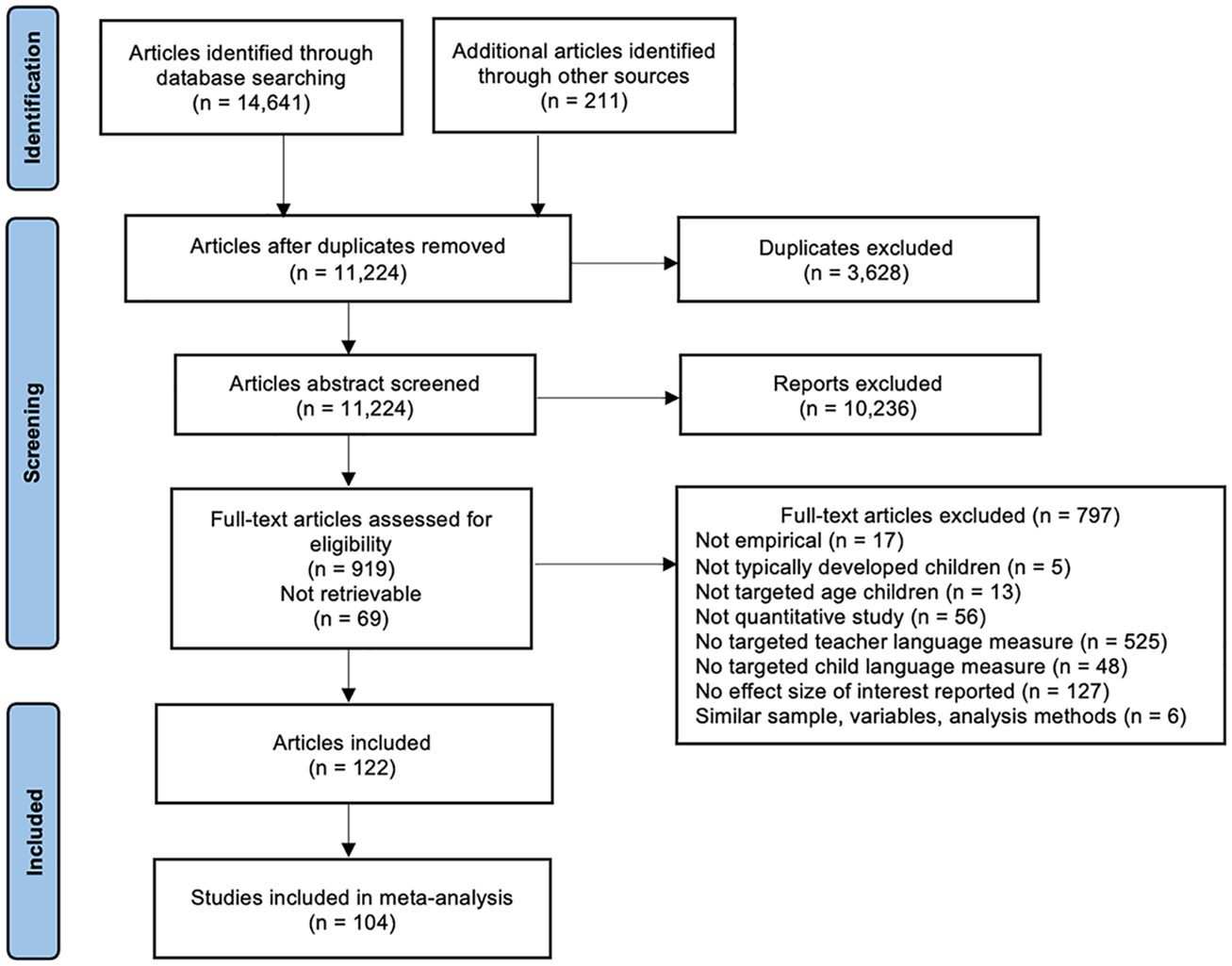
PRISMA flowchart.
Abstract Screening
The process of abstract screening was conducted with Abstrackr, an online tool powered by machine learning for systematic reviews and meta-analyses (Wallace et al., 2012). After the initial screening, Abstrackr predicted the likelihood of inclusion for the remaining articles and reorganized them based on predicted relevance, thereby streamlining the process by prioritizing articles most likely to meet the inclusion criteria.
In parallel, an abstract screening tool was developed to guide the evaluation of individual articles. This tool, based on the study’s inclusion and exclusion criteria, consisted of six sequential screening questions related to study design, population, and measures used; see the supplementary material available on the journal website. Abstrackr helped organize and rank articles, and the abstract screening tool was used to assess individual articles. Articles that failed to meet any of the criteria in the abstract screening tool, as indicated by a “No” response, were excluded from further consideration.
Following the screening of around 400 initial articles, Abstrackr identified an additional 1,200 articles with more than a 40% likelihood of meeting the inclusion criteria. Consequently, the top 2,000 articles were prioritized for a more thorough review and double-screened by the review team. Discrepancies were resolved through discussions in weekly meetings. After abstract screening, a total of 988 articles were included for further analysis.
Full-Text Screening
A Google spreadsheet was created to facilitate the full-text screening process, which included titles and links to the 988 articles that were retained following the abstract screening. With the assistance of the university librarian, 919 articles were retrieved in full text, and 69 articles could not be retrieved. The same screening criteria used during abstract screening were applied in the full-text screening. To ensure the reliability of the screening, the review team double-screened 20% of the articles. The overall agreement among reviewers was 92%. Discrepancies were resolved through discussion in weekly meetings. Following the full-text screening, a total of 122 articles met the inclusion and exclusion criteria and were retained for coding.
Full-Text Coding
A coding spreadsheet and a corresponding codebook were developed for the coding process. The development of the coding scheme was an iterative process, with the specific codes and their definitions refined during the preliminary coding process. The codebook was considered finalized when no further modifications were needed. With the finalized codebook, all the articles that had been previously coded were recoded according to the updated guidelines. The research team double-coded a random sample of 10% of the articles to ensure reliability. We calculated intraclass correlations (ICCs) for continuous variables and Cohen’s kappa (κ) for categorical variables, both of which demonstrated very good average interrater reliability (>.90; Landis & Koch, 1977), ranging from .82 (teacher language type) to 1.00 (regression coefficient). Disagreement was resolved through discussions during regular meetings. Following these procedures, the first author coded the remaining articles, with each article undergoing two rounds of coding for accuracy.
The coding scheme comprised five broad categories, including publication information, study characteristics, participants’ characteristics, language measurement, and the effect size; see the supplementary material available on the journal website. The publication information included the names of the first and last authors, the year and type of publication, and the publication status. The study characteristics included information on the study design (intervention or observation). The participants’ characteristics category was coded separately for teachers and children. For teachers, the sample size, teaching experience (years), percentage of female teachers, and percentage of teachers who held a bachelor’s degree were coded. For children, the sample size, grade, mean age (months), percentage of female children, percentage of DLLs, and SES were coded. SES was coded based on a combination of factors such as eligibility for free lunch, parental income, and parental education.
Language measurements were coded separately for teachers and children. For teachers, the dimensions of language, teacher language measurement methods, activity settings, and group sizes were recorded. Teacher language practices were coded into two main categories: quantity and quality. Quality was further categorized into three subcategories (interactive, linguistic, and conceptual). As a result, each study was coded into one of the four categories—quantity, quality-interactive, quality-conceptual, or quality-linguistic—based on the dimensions of teacher language practices.
For children, the dimensions of language, outcome language (e.g., English), children’s language assessment methods, and intervals between teacher language observations were recorded. The effect size category included information on whether the effect size was reported after the intervention, as well as the covariates, regression coefficient, standard error, t-value, degrees of freedom, and p-value.
Of the 122 articles coded, four articles did not provide adequate statistics for obtaining partial correlation. The authors of these studies were contacted for further information, but no replies were received. In addition, to ensure the accuracy of our analysis, we cross-verified the authors and study projects referenced in each article. When multiple articles used data from the same larger research project or used overlapping samples, they were treated as different analyses under a single unique study (Polanin et al., 2021). For example, all articles using data from the National Center for Early Development and Learning (NCEDL) project were considered part of a single study due to overlapping samples (e.g., Burchinal et al., 2012; Downer et al., 2012; Mashburn et al., 2008). In our dataset, it was more common for different articles to report findings from a larger study than for a single article to contain multiple studies. Consequently, the total number of included articles exceeded the number of unique studies identified. Ultimately, this process led to the identification of 118 articles, which represented 104 unique studies, comprising 411 effect sizes.
The Partial Correlation: Concept and Formula
In the current meta-analysis, we employed partial correlation as the effect size for measuring the associations between teachers’ language practices and children’s language development. Partial correlation is a statistical parameter that quantifies the relationship between two variables while controlling for the influence of covariates (Aloe & Thompson, 2013). It can be obtained from regression models and offers a nuanced understanding by accounting for potential confounding factors, which helps to mitigate the risk of relationship inflation due to collinearity (Aloe, 2014; Polanin et al., 2021). Additionally, researchers in recent empirical studies tend to use regression analyses rather than solely relying on bivariate correlations to analyze the association of interest. However, in studies where researchers utilized regression models, bivariate correlations were not always reported. Therefore, adopting partial correlation as the effect size could potentially increase the number of eligible studies for a meta-analysis. It should be noted that although bivariate correlation and partial correlation belong to the correlation family, they constitute distinct metrics, and combining them in the same analysis is not recommended (Aloe, 2015). Therefore, we only used partial correlation in our present analyses.
The formula used in this meta-analysis to calculate partial correlation is derived from Aloe’s (2014) study. According to Aloe, a general regression model is written as:

where
Based on Aloe’s (2014) study, the partial correlation was estimated from the regression model using the following formula:

where
Accordingly, the variance of partial correlation could be estimated using:

where
Statistical Analysis
All analyses were conducted using the RStudio software (version 2022.12.0; R Core Team, 2022). The analyses were informed by the practical guide on meta-analysis using R by Harrer et al. (2021). Formulas in Equations 2 and 3 were used to calculate the partial correlation and variances. We used the t-value when provided by the authors; otherwise, we calculated it by dividing the regression coefficient by its standard error (Gravetter & Wallnau, 2007). Degrees of freedom were extracted from the study when reported or were estimated using the formula n – p – 1, where n is the sample size and p is the number of predictors (Aloe & Thompson, 2013). If the standard error or t-value were not reported, but an exact p-value was reported, the t-value was estimated based on the p-value (Polanin et al., 2021). If an exact p-value was not reported, the authors were contacted for further information.
The metafor package in RStudio (Viechtbauer, 2010) was employed to estimate pooled effect sizes and conduct moderator analyses. Fisher’s z transformation was applied to normalize the distribution of the partial correlations (Hedges & Olkin, 2014). The pooled effect sizes estimation was based on the inverse of variance method (Harrer et al., 2021), using multilevel random-effects models to account for between-study heterogeneity and effect sizes clustered within studies (Raudenbush & Bryk, 2002). The estimation of the within-study variance was performed using restricted maximum-likelihood (REML; Viechtbauer, 2005), and the Hartung-Knapp (Knapp & Hartung, 2003) adjustment was applied to calculate the confidence intervals for the pooled effect sizes. The heterogeneity of overall analyses was reported using tau-squared and I-squared (Harrer et al., 2021).
We first examined the effect sizes derived from partial correlations between the quantity and quality of teachers’ language practices and children’s language development, where quality is an aggregated code of interactive, conceptual, and linguistic subcategories. Next, we examined the specific associations between each subcategory of teacher language quality (interactive, conceptual, linguistic) and children’s language development. We then conducted moderator and subgroup analyses to investigate variations within these relations. We employed meta-regression analyses based on random effects models to examine variations impacted by potential moderators such as teacher and child language dimensions, child SES, teacher and child language measures, activity settings, group sizes, and child outcome languages (Harrer et al., 2021). After identifying significant moderators, we proceeded with subgroup analyses to examine the effect sizes for moderators that showed a significant impact on the relationship under study. Additionally, we coded covariates into four categories: child characteristics (e.g., baseline language skills, age, gender), family characteristics (e.g., SES, home language, home literacy environment), teacher characteristics (e.g., teacher education, teaching experience, other teacher talk measures), and program characteristics (e.g., location, class size, public or private program). The initial coding was completed by the first author. To ensure interrater reliability, 10% of the coded items were randomly selected for double coding, resulting in a very good inter-rater reliability (κ = .90; Landis & Koch, 1977). These covariate categories were dummy coded into presence or absence and were analyzed through meta-regressions to evaluate their impact on the effect sizes.
To evaluate the presence of publication bias, we employed a funnel plot for visualization and applied Egger’s regression test (Sterne & Egger, 2005). Furthermore, we implemented the trim-and-fill method to explore how publication bias, if any, could influence the effect sizes reported in our study (Duval & Tweedie, 2000). To handle missing data, we made educated inferences based on the article’s available information, as suggested by Pigott and Polanin (2020). For instance, if a study was missing certain information but was part of a larger project, we conducted a literature search on the larger project to retrieve the missing information. In situations where the average age of children was not specified but it was indicated that they were attending preschool, we approximated their age using the average age of preschoolers in the United States. Through these procedures, we were able to supplement most of the missing information critical to our analyses.
Results
Descriptive Information
A total of 118 articles from 104 unique study samples were included in the analysis, comprising 411 effect sizes across 13,572 teachers and 112,533 child participants; see the supplementary material available on the journal website for included articles. Included studies were published from 2001 to 2022, including journal articles, dissertations, theses, and reports. Of the included studies, 81.36% were published. Slightly over half of the studies (56.73%) were observational, and the remaining studies employed an intervention design. See Table 2 for a summary of the descriptive statistics of the included articles.
Summary Statistics of Included Studies
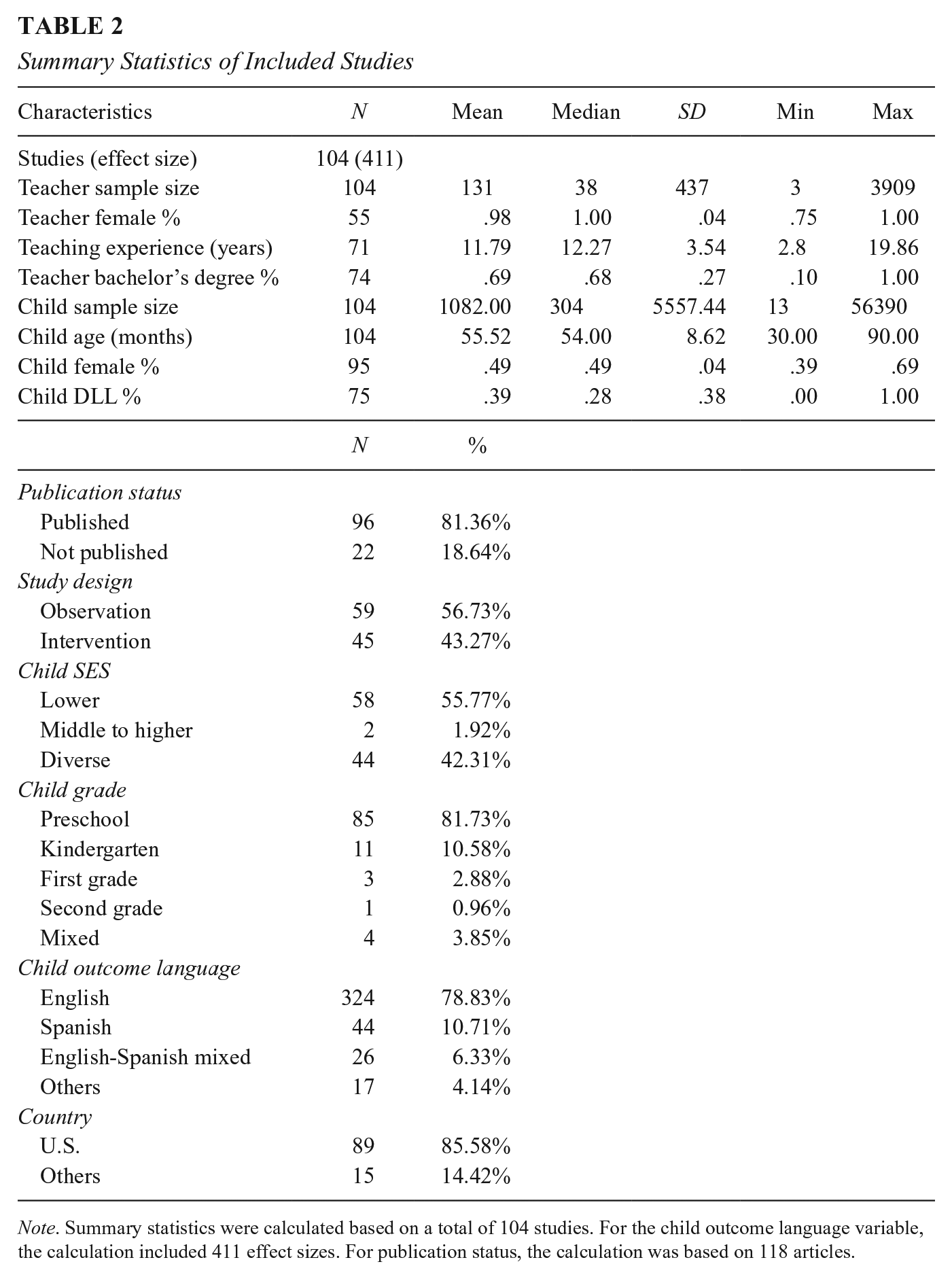
Note. Summary statistics were calculated based on a total of 104 studies. For the child outcome language variable, the calculation included 411 effect sizes. For publication status, the calculation was based on 118 articles.
The average sample size of teachers in the included studies was 131, with a median of 38. Most of the teachers were female (mean = 98%, median = 1), and they had an average of 11.79 years of teaching experience (median = 12.27). On average, 69% of the teachers had a bachelor’s degree (median = 68%). The average sample size of child participants was 1082 (median = 304), and their average age was 55.52 months (median = 54). On average, 49% of the child participants were female (median = 49%), and 39% (median = 28%) were identified as DLLs. More child participants (55.77%) came from lower SES backgrounds, 42.31% came from diverse SES backgrounds, and 1.92% came from middle to higher SES backgrounds. Most child participants (81.73%) were enrolled in preschools when observed.
The majority of child language outcomes were measured in English (78.83%), followed by Spanish (10.71%) and English-Spanish mixed measures (6.33%). Additional languages assessed included Chinese, German, Norwegian, and Portuguese. The vast majority of these studies (85.58%) were conducted in the United States. Regarding covariates, 90.7% of the studies controlled for child characteristics, 51.7% controlled for family characteristics, 47.5% controlled for teacher characteristics, and 39.8% controlled for program characteristics. The single most frequently adjusted covariates were children’s baseline language skills (68.6%), age (49.2%), gender (47.5%), socioeconomic status (46.6%), race and ethnicity (30.5%), and DLL status (26.3%).
Effect Sizes
We first examined the associations between the quality and quantity of teachers’ language practices and children’s language development outcomes. As shown in Table 3, a significant relationship was identified between teachers’ overall language quality and children’s language development outcomes (rp = .11, p < .001, 95% CI [.08, .13]). Heterogeneity analysis indicated variabilities (τ2 = .02, I2 = 64.4) among individual studies included. We then further examined the subcategories of teachers’ language quality, encompassing conceptual features, linguistic features, and interactive features, with children’s language development. The results indicated that teachers’ language conceptual features (rp = .10, p < .001, 95% CI [.07, .12], τ2 = .01, I2 = 61.5), linguistic features (rp = .13, p < .001, 95% CI [.07, .20], τ2 = .05, I2 = 72.5), and interactive features (rp = .10, p < .001, 95% CI [.05, .15], τ2 = .02, I2 = 61.4) were all found to be significantly associated with children’s language development. However, no significant relationship was identified between teachers’ language quantity and children’s overall language development (rp = .15, p > .05, 95% CI [−.06, .35]) based on studies included in this meta-analysis.
Effect Sizes of Teacher Language Practices and Child Language Development
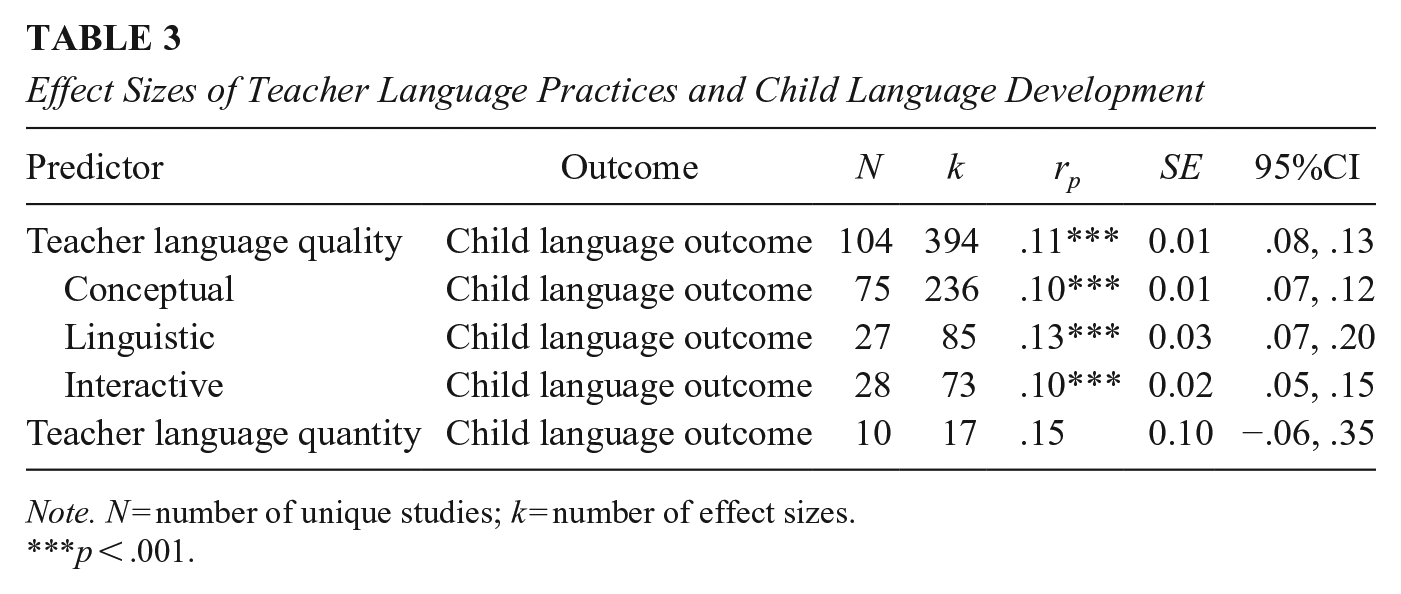
Note. N = number of unique studies; k = number of effect sizes.
***p < .001.
Although our analysis did not identify a significant relationship between teacher language quantity and children’s language development, it is important to note that this conclusion was based on a relatively small sample of 10 studies and 17 effect sizes. Caution should be exercised when interpreting this null relationship, as results from analyses conducted on a small number of effect sizes can be considered less accurate (Harrer et al., 2021). Due to the small number of studies on teacher language quantity, we decided to focus the subsequent moderator and subgroup analyses on teacher language quality only.
Moderator Analyses
We then conducted a set of meta-regression analyses to explore potential moderating factors on the association between teacher language quality and children’s language development. These moderators included dimensions of teachers’ language quality and children’s language outcomes, demographic characteristics of the participants, and study design features (see Table 4).
Moderator Analyses of the Relationship Between Teacher Language Quality and Child Language Development
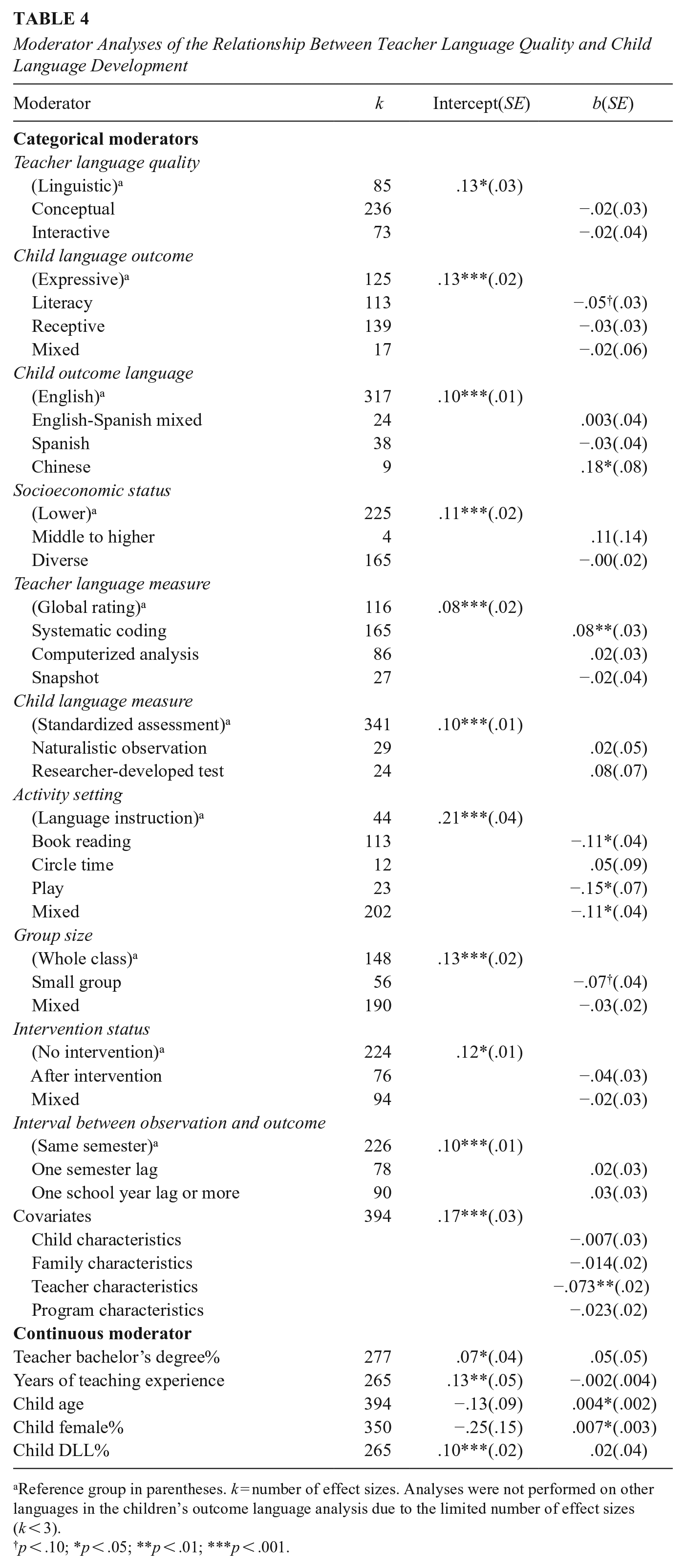
Reference group in parentheses. k = number of effect sizes. Analyses were not performed on other languages in the children’s outcome language analysis due to the limited number of effect sizes (k < 3).
p < .10; *p < .05; **p < .01; ***p < .001.
With respect to categorical moderators, the strength of the relationship between teacher language quality and children’s language development was significantly greater when the language of teachers was assessed via systematic coding compared to global rating (b = .08, p < .01); in language instruction contexts compared to book reading (b = −.11, p < .05), play (b = −.15, p < .05), or mixed settings (b = −.11, p < .05) or when the outcome language of the children was Chinese, as opposed to English (b = .18, p < .05). The strength of the relationship decreased after controlling for teacher characteristics (b = −.07, p < .01). Dimensions of child language outcomes and group sizes had a marginally significant impact on the relationship between teacher language quality and children’s language development. No significant variations were found among teacher language quality dimensions, child SES, child language measures, intervention status, or intervals between teacher language observation and child language assessment.
Child age and gender were found to be significant moderators of the relationship between teacher language quality and children’s language development. Specifically, the relationship between teachers’ language quality and children’s language development was found to be stronger as children’s age increased by month (b = .004, p < .05) or as the percentage of female students increased (b = .007, p < .05). Other factors such as the percentage of teachers with bachelor’s degrees, years of teaching experience, or the percentage of children who were DLLs did not significantly moderate the relationship under study.
Subgroup Analyses
To further explore within-group variations, subgroup analyses were conducted on categorical moderators that were found to significantly influence the relationship between teacher language quality and children’s language development. As shown in Table 5, the relationship under study was stronger when children’s outcome language was measured in Chinese (rp = .28, p < .001, 95% CI [.16, .39]), when teachers’ language use was measured by systematic coding (rp = .16, p < .001, 95% CI [.12, .20]), and when the observation was conducted during language instruction (rp = .21, p < .001, 95% CI [.12, .30]) and circle time (rp = .36, p < .01, 95% CI [.12, .57]). Furthermore, the analysis without controlling for teacher characteristic covariates exhibited a slightly larger effect size (rp = .14, p < .001, 95% CI [.11, .17]). However, caution is needed when interpreting results from analyses with a smaller number of effect sizes (Harrer et al., 2021). For instance, the stronger relationships observed for Chinese language measurements (k = 9) and circle time observations (k = 12) were based on a limited number of effect sizes, underscoring the need for careful interpretation.
Subgroup Analyses of the Relationship Between Teacher Language Quality and Child Language Development
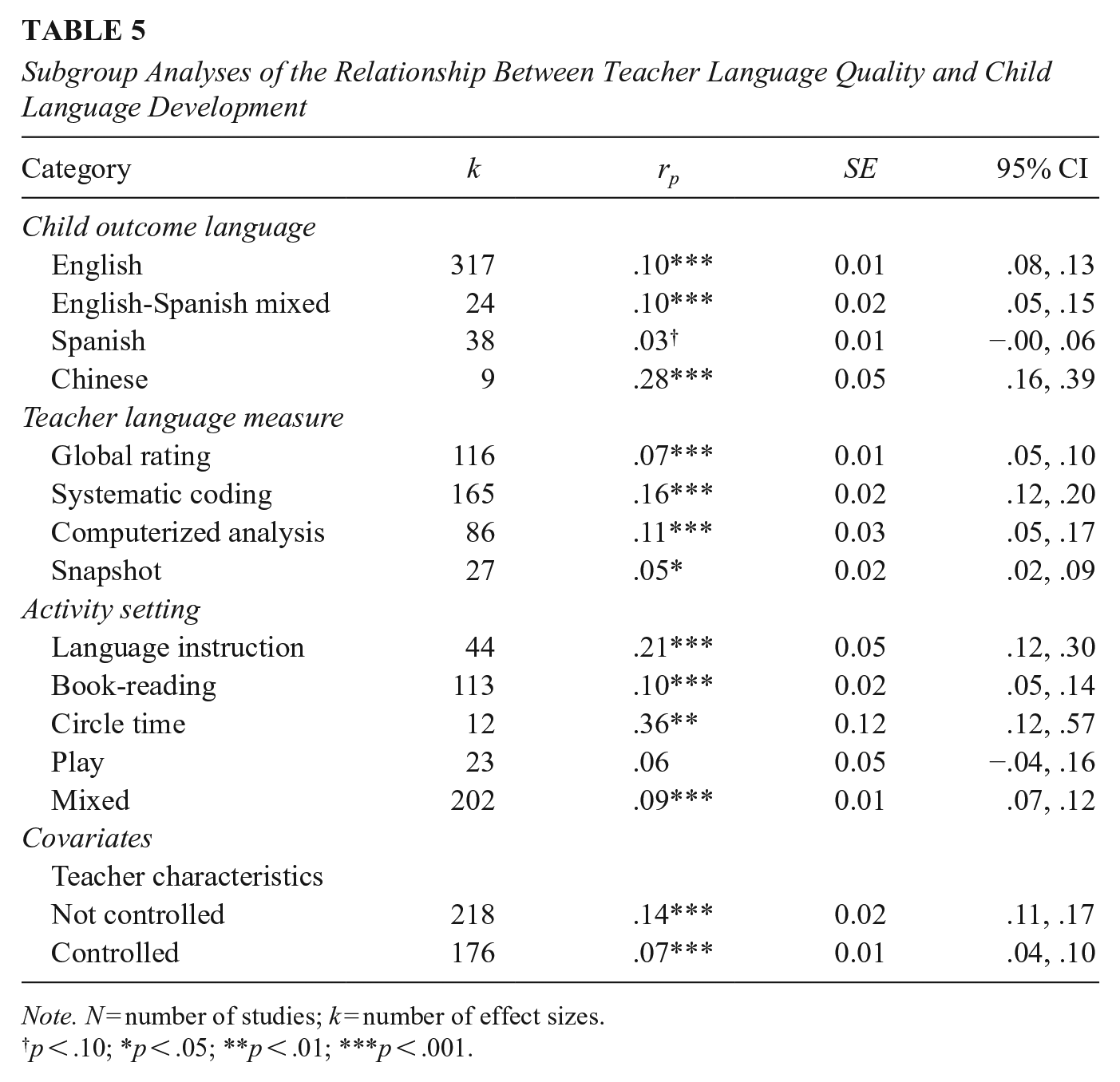
Note. N = number of studies; k = number of effect sizes.
p < .10; *p < .05; **p < .01; ***p < .001.
Publication Bias Analyses
Lastly, publication bias was investigated through a funnel plot and Egger’s regression test (Sterne & Egger, 2005; see Figure 2). The funnel plot appeared to be slightly asymmetrical, with a few missing data points in the lower left corner, indicating that a few studies with smaller sample sizes, larger standard errors, and nonsignificant results might be missing. Egger’s regression test further suggested that the funnel plot was asymmetrical, indicating the presence of publication bias (intercept = .72, p < .001). Additionally, we analyzed the effect size in relation to publication status, including 96 published and 22 unpublished articles, and no significant differences were found. According to the trim-and-fill analysis, an addition of 69 missing effect sizes was required to achieve symmetry in the plot. Incorporating these 69 hypothetical missing effect sizes into the analysis of teacher language quality studies adjusted the effect size to .053 (p < .001). Nonetheless, the considerable heterogeneity observed (I2 = 64.4), which likely derived from the diverse methods employed to observe teacher language practices, calls for a cautious interpretation of the trim-and-fill method’s adjusted outcome. This is because the heterogeneity challenges the underlying assumptions of the trim-and-fill approach, potentially resulting in an overestimation of the effect size adjustment (Harrer et al., 2021; Murano et al., 2020).
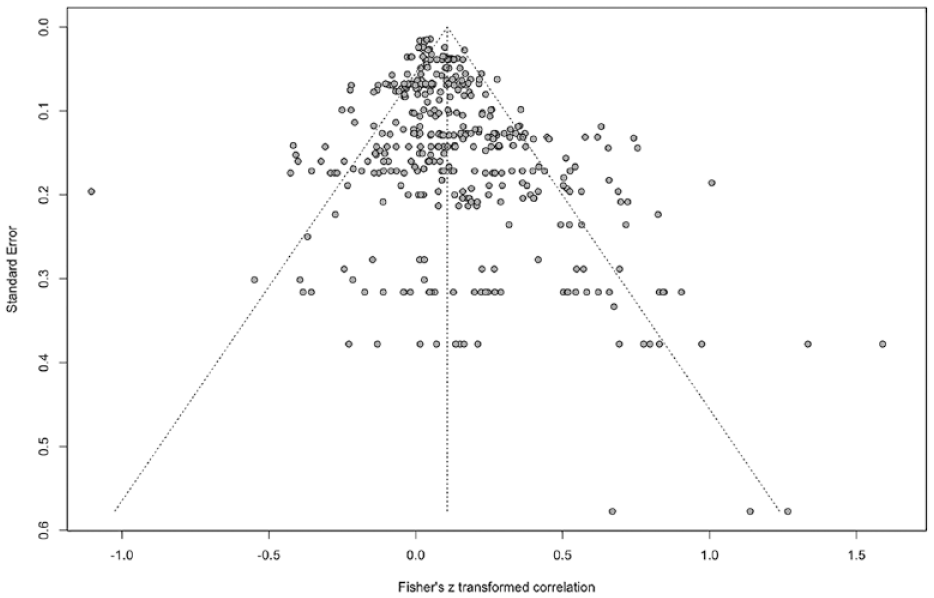
Funnel plot: Teacher language quality and child language development.
Discussion
Summary of Main Findings
In this meta-analysis, we investigated the relationship between early childhood teachers’ language practices and children’s language development from preschool to third grade. The findings highlight a significant and positive relationship between the quality of teachers’ language practices and children’s language development. However, no significant association was observed between the quantity of teachers’ language and children’s language outcomes across the studies reviewed. Moreover, the relationship between teacher language quality and children’s language development was found to be stronger among older children, in classrooms with a higher percentage of female students, when teacher language was evaluated using systematic coding or when observed during language instruction. To the best of our knowledge, this meta-analysis is the first attempt to synthesize studies that quantitatively examined the relationship between early childhood teachers’ language practices and children’s language development. The results emphasize the significance of teachers’ language practices as an important environmental factor that positively influences children’s language development and should guide future policy and practice.
First, our findings align with previous research suggesting that children’s language development is profoundly impacted by the language practices of early childhood teachers (Dickinson, 2011; Gámez, 2017; Justice et al., 2008; Rowe & Weisleder, 2020; Wasik & Hindman, 2011; Zucker et al., 2010). Our findings further add to the literature by emphasizing that teachers’ language practices, much like those of parents, are crucial in shaping children’s language development. Consistent with Anderson et al.’s (2021) findings on parental language practices, our findings also indicate that the quality, rather than the quantity, of teacher language was associated with children’s language development in the studies reviewed. However, because few studies have examined teacher language quantity, the nonsignificant relationship between teacher language quantity and children’s language development should be interpreted with caution.
Moreover, although the effect sizes might appear modest by Cohen’s standards, Kraft (2020) argues that in the context of field-based education research, even “small” effects can have meaningful impacts. Unlike Cohen’s criteria, which are based on studies conducted in controlled lab settings, Kraft’s (2020) framework for interpreting effect sizes in education research is context-specific. It accounts for the variability and complexity of real-world studies and emphasizes the practical significance of effect sizes over strict numerical thresholds. In our study of the relationship between teachers’ language practices and children’s language development, all included studies were conducted in authentic educational contexts, making Kraft’s standards particularly relevant for interpretation. Furthermore, even modest improvements in children’s language development can accumulate over time, resulting in significant long-term learning gains. In early childhood education, these incremental gains in language development can provide essential preventive benefits and lay the foundation for acquiring more complex skills. Additionally, it is important to note that children’s language abilities in our included studies were primarily evaluated using standardized assessments, which tend to produce smaller effect sizes compared to researcher-designed or specialized tests (Kraft, 2020). Our calculation of effect sizes accounted for confounding factors, leading to more conservative estimates. Consequently, our findings hold substantial educational significance, underscoring the critical role of quality teacher language practices in fostering language development during early childhood.
Another important finding is that various dimensions of teacher language quality, such as linguistic, interactive, and conceptual features, did not show significantly different effects on children’s language development. This may not be entirely unexpected, considering the inherently overlapping and interrelated nature of these dimensions (Rowe & Snow, 2020). However, previous research often categorizes teacher language into discrete practices, such as the frequency of open-ended questions, the use of sophisticated vocabulary, and the use of complex syntax. The lack of discernible differences in the effects of these dimensions on children’s language development may suggest that it may be beneficial to adopt a more integrated approach to evaluating language quality in future research. This aligns with Rowe and Snow’s (2020) advocacy for a holistic perspective on caregiver language quality, contending that linguistic, interactive, and conceptual dimensions could be examined collectively to fully understand their impact on children’s language development.
Our findings also indicate that the impact of teacher language practices on children’s language development extends beyond mere language interactions. It also encompasses the participants and contexts involved in these interactions. Interestingly, the quality of teacher language had a stronger effect when there was a higher percentage of female students, aligning with previous studies suggesting that girls may be more receptive to caregivers’ linguistic inputs (Leaper et al., 1998). Additionally, the link between the quality of teacher language and language development in children was stronger for older children, possibly indicating that older children may better absorb more complex language from their teachers. However, much of the previous research has been concentrated on preschoolers; future studies could examine a broader age range to better understand the effects of teacher language on older children.
Moreover, the relationship between teachers’ language quality and children’s language development was notably stronger in language instruction contexts, which is not surprising given the direct aim of enhancing language skills in such settings. Circle time also showed a stronger relationship, though the limited number of studies focused on this setting calls for further investigation. On the other hand, the relationship appeared weaker in book-reading settings. This could be due, in part, to the typical focus on extratextual conversations and the common exclusion of the book’s language itself when evaluating teachers’ language practices during book reading settings, potentially underestimating the impact of this activity. Interestingly, although book reading occupies a smaller portion of classroom time, it has been disproportionately emphasized in research (Hadley, Barnes, & Hwang, 2022). Conversely, other activities that facilitate interactive dialogue, such as play and circle time, have received less scholarly attention. Considering that the effectiveness of teachers’ language practices depends on contexts, activities, and participants (Hadley, Barnes, & Hwang, 2022), it is essential for future research to expand its scope to encompass a wider range of contexts and activities.
In addition, although the overall findings suggest a positive correlation between teacher language quality and child language outcomes, it is worth noting that around one-fourth of the effect sizes indicated negative correlations between teachers’ more sophisticated language use and children’s language development. This discrepancy may suggest that a measure of adult language that does not take into account the child’s language level may be insufficient (Hindman et al., 2016; Justice et al., 2013). This is in line with Barnes and Dickinson’s (2017b) findings, suggesting a negative correlation between teachers’ longer utterances and DLL children’s language outcomes. These learners may benefit more from simpler syntactic structures during the initial stages of English acquisition, challenging the notion that merely increasing the sophistication or quantity of teacher talk will automatically foster better language development in children. Given these insights, it is worthwhile to reevaluate the definition of high-quality teacher language practices from a developmentally responsive perspective, emphasizing not just the sophistication of language but also the teacher’s ability to adapt their language to better support children’s engagement in more complex language (Chan et al., 2022; Hadley, Barnes, Wiernik, et al., 2022; Hindman et al., 2016; Justice et al., 2013). Future research could examine how teachers adapt their language practices to accommodate the diverse language profiles within classrooms and the effects of these adaptations on children’s language development.
Implications for Policy and Practice
Our findings have significant implications for policy and practice. First, our findings indicate a significant and positive association between teachers’ language practices and children’s language development. Although the effect size might appear modest, its educational significance is potentially far-reaching. According to Kraft (2020), the effectiveness of education interventions should not be measured solely by their immediate impact but also by their cost-effectiveness and scalability. Enhancing teacher language practices is not only strategically vital but also cost-effective and scalable. Therefore, future policy should allocate resources to incorporate enhancing teacher language quality into teacher preparation curricula and provide ongoing teacher professional development to offer educators opportunities to continuously reflect on and adapt their communication styles to foster children’s language development. Because early language development lays the foundation for future academic performance, socioemotional skills, and career prospects, fostering language development in young children can lead to substantial long-term benefits.
Second, this meta-analysis contributes to the debate around the “30-million-word gap” narrative (Hart & Risley, 1995). Despite a broad consensus in the research field that quality of language exposure may outweigh mere quantity, the “30-million-word gap” narrative continues to profoundly shape perceptions of families and children from lower SES backgrounds among policymakers, practitioners, and the public, often reinforcing deficit views of this demographic. The term “30-million-word gap” oversimplifies the complexity of caregiver language practices across diverse SES groups (Sperry et al., 2019b). Our findings, in conjunction with those of Anderson et al. (2021), call for a reevaluation of the “30-million-word gap” narrative and highlight the need for a more nuanced understanding of adult language practices. Although acknowledging disparities in language development across SES backgrounds, we advocate for replacing the “30-million-word gap” narrative with strengths-based and inclusive perspectives that reflect the complexity of adult language practices supporting children’s optimal language development.
Lastly, our finding of no significant impact of intervention status warrants cautious interpretation. Although many interventions were related to teacher language use, such as enhancing teacher-child interactions, they did not directly target teacher language practices (McLeod et al., 2019). Moreover, it has been noted that several intervention studies targeting teachers’ language practices did not elicit the desired impact on children’s language development (Grøver et al., 2022). This outcome could be attributed to a variety of factors, including the stability of teachers’ language practices over time (Hindman & Wasik, 2012). Teachers develop their language use through their past experiences and surrounding environments. Expecting any fundamental changes in teachers’ language practices through brief training sessions or short-term interventions could be unrealistic. In light of this, it is recommended that future interventions targeting teachers’ language practices could consider longer or more frequent sessions to achieve sustained changes (Dickinson, 2011). Additionally, a holistic perspective on teacher language use could be adopted, including considering the contexts and characteristics of the children involved (Hadley, Barnes, & Hwang, 2022).
Future Research
The findings also reveal several gaps in the existing literature. First, the majority of evidence was derived from studies conducted in the United States or involving English-speaking participants. Although there has been a recent increase in studies that focus on Spanish-speaking children, there is a scarcity of studies in other geographic regions or languages. To promote diversity in this area of research and to determine the replicability of current patterns across geographic regions and languages, future studies should include participants from diverse geographic and language communities (Boveda et al., 2023). Second, children’s language development was largely evaluated through standardized assessments. However, the authenticity of these measurements remains a topic of ongoing debate (Moreno & Klute, 2011). To enhance the validity of children’s language development measurements, diverse sources of information, such as teachers or parents, and alternative assessments beyond standardized tests, such as naturalistic observation, could be considered in future research (Vagh et al., 2009).
Third, our findings suggest a potential over-representation of studies focusing on lower-income children and children of color. Although this shift addresses historical imbalances by moving away from an earlier focus on White, middle-class populations, it is important to ensure that this does not inadvertently imply that only these groups require study or intervention. Future studies should emphasize the strengths and potential of all children, regardless of their socioeconomic or racial backgrounds, to avoid the unintended consequences of reinforcing deficit thinking. Fourth, our findings reveal a predominant focus on preschool-age children, with few studies that extend beyond first grade. Notably, the early elementary school years mark a transition where children spend more time in the classroom than at home, positioning teachers as key providers of language input. Despite this critical role, research indicates that the quality of instruction during this stage may not consistently surpass that of preschool settings (Vitiello et al., 2020). Given the findings that the relationship between teachers’ language quality and children’s language development strengthened in older children, there is a need for future research to expand into early elementary school settings.
Finally, it is essential to recognize the deeply ingrained Western values and perspectives on research concerning adult-child language interactions and the design of related studies. Although the modern education system is inherently a product of Western civilization, different cultural groups may emphasize different aspects of language interactions derived from their cultural beliefs, even in school settings (Tobin et al., 1989). For example, although preschool teachers in the United States view language as a vital tool for self-expression and promoting individuality, their counterparts in Japan see it more as a medium for expressing group solidarity, with less emphasis on individual self-expression in Japanese preschool classrooms (Tobin et al., 1989). Additionally, in China and Japan, preschool teachers often use group activities like choral recitation and story memorization to enhance language skills, contrasting with the American focus on individualized learning experiences and personal expression (Tobin et al., 1989). These dynamics may impact how teachers’ language practices influence children’s language development. Despite these differences, such discussions are rarely addressed in this line of research. To expand knowledge about the impact of teachers’ language use on children’s language development in diverse cultural contexts, researchers could explore varied beliefs and practices regarding teacher language use in different cultural groups to gain a more comprehensive understanding of their influence on children’s language development.
Limitations
Several limitations should be considered when interpreting the findings of this meta-analysis. First, even though systematic search guidelines were adhered to, resulting in a substantial array of articles, it is probable that some relevant studies were overlooked. Second, the inclusion of literacy as a metric for children’s language development was not the initial intention of this meta-analysis. Although the search terms were designed to capture studies addressing the broad phrase “language development,” most studies involving children of this age group included assessments of both language and literacy development. Nevertheless, it is possible that certain studies that focused specifically on literacy development might have been omitted. Third, we did not include studies that used structural equation modeling (SEM) as their analysis method because of the complexity of the models and the lack of discussion on how to extract partial correlation coefficients from these models (Polanin et al., 2021). Although the number of studies omitted was small, as the use of SEM has become increasingly popular among researchers, it is important for future researchers to address this issue. In addition, caution should be exercised when interpreting results from subgroup analyses with fewer than 10 effect sizes, as the accuracy of results may diminish when k is less than 10 (Harrer et al., 2021). Although these analyses were included to provide a more comprehensive picture of the topic, caution should be exercised when interpreting results based on a small number of effect sizes. In addition, given the evidence of publication bias, the effect size may appear smaller in replication studies.
Lastly, during the screening process, it was observed that in most studies, except for a few older ones, researchers employed regression analysis to examine the relationship between teacher language practices and children’s language development. However, only a small proportion of these studies included correlation coefficients in addition to regression coefficients. If correlation coefficients were used as the effect sizes, the number of studies included in the meta-analysis would be fewer than 30 articles. However, despite the growing popularity of partial correlations as a measure of effect size in meta-analyses (Polanin et al., 2021; Stanley et al., 2024; Stuebing et al., 2015; Toste et al., 2020), their use remains relatively new and not without controversy. One key concern is the potential issues arising from combining partial correlations and bivariate correlations in the same analysis, which is generally not recommended due to the discrepancies in magnitude between these effect sizes and the increased heterogeneity this may introduce (Aloe, 2015; Polanin et al., 2021). Additionally, researchers in different studies often control for different covariates, making it challenging for partial correlation analyses to account for the varying impacts of these covariates, which can complicate the interpretation of results (Aloe, 2015).
Moreover, Stanley et al. (2024) suggested that meta-analyses using partial correlations might be biased, particularly in studies with small sample sizes. The authors proposed a UWLS+3 formula as an adjustment to the degrees of freedom used in calculating partial correlations to help minimize this bias. We applied this adjustment in our analyses and did not find substantial differences between the adjusted effect sizes and those calculated using traditional methods, with changes of less than .01; see the supplementary material available on the journal website for detailed results. These small changes did not affect the overall patterns, significance, or interpretation of the findings. This lack of substantial difference may be due to the mixed sample sizes in our included studies, as the proposed formula is primarily intended for small sample size bias correction (Stanley et al., 2024). Given the ongoing debates regarding the use of partial correlations, it is advisable for future research to report both bivariate correlations and regression statistics. Further investigation is also needed to enhance the understanding and interpretation of partial correlations as a measure of effect size.
Conclusion
This meta-analysis represents the first effort to synthesize studies that quantitatively examine the relationship between early childhood teachers’ language practices and children’s language development. The findings underscore the crucial role of teachers’ language practices, particularly the quality of language, in supporting children’s language development. They also highlight the need to redefine the concept of quality in teacher language practices, moving beyond just the quantity or complexity of language used and focusing on practices that meet children’s developmental needs. Additionally, it is important to consider broader contextual factors, such as classroom activities and the methods used to assess teacher and child language. Moving forward, future research should prioritize including participants from diverse geographic regions, linguistic communities, socioeconomic backgrounds, and age groups. Innovative study designs should also be considered to incorporate the cultural values and perspectives of specific communities, enabling more authentic assessments of both teachers’ language practices and children’s language development.
Supplemental Material
sj-docx-1-rer-10.3102_00346543251339131 – Supplemental material for Does Teacher Talk Matter Too? A Meta-Analysis of Partial Correlations Between Teachers’ Language Practices and Children’s Language Development from Preschool to Third Grade
Supplemental material, sj-docx-1-rer-10.3102_00346543251339131 for Does Teacher Talk Matter Too? A Meta-Analysis of Partial Correlations Between Teachers’ Language Practices and Children’s Language Development from Preschool to Third Grade by Yan Jiang, Brittany Kaplan and Lillie Ko-Wong in Review of Educational Research
Footnotes
Acknowledgements
We extend our heartfelt thanks to Alison Wishard Guerra, Joshua R. Polanin, Amanda Datnow, Austin Mulloy, Shana R. Cohen, María José Aragón, Sherice Clarke, and Carolyn Hofstetter. We also thank the anonymous reviewers and editors for their invaluable feedback.
Author Note
Brittany Kaplan and Lillie Ko-Wong contributed equally to this paper and are both entitled to list themselves as the second author on their respective curricula vitae.

Authors
YAN JIANG, M.A., is a PhD candidate in the Department of Education Studies at the University of California, San Diego, 9500 Gilman Drive, La Jolla, 92093-0070;
BRITTANY KAPLAN, M.A., is a PhD student in the Department of Education Studies at the University of California, San Diego, 9500 Gilman Drive, La Jolla, CA 92093-0070;
LILLIE KO-WONG, M.A., is a PhD candidate in the Department of Education Studies at the University of California, San Diego, 9500 Gilman Drive, La Jolla, 92093-0070;
References
Supplementary Material
Please find the following supplemental material available below.
For Open Access articles published under a Creative Commons License, all supplemental material carries the same license as the article it is associated with.
For non-Open Access articles published, all supplemental material carries a non-exclusive license, and permission requests for re-use of supplemental material or any part of supplemental material shall be sent directly to the copyright owner as specified in the copyright notice associated with the article.
