




Abstract
Need for cognition is conceptualized as an individual’s intrinsic motivation to engage in and enjoy effortful cognitive activities. Over the past three decades, there has been increasing interest in how need for cognition impacts and correlates with learning performance. This meta-analysis summarized 136 independent effect sizes (N = 53,258) for the association between need for cognition and academic achievement and investigated the moderating effects of variables related to research context, methodology, and instrumentation. The overall effect size weighted by inverse variance and using a random effects model was found to be small, r = .20, with a 95% confidence interval ranging from .18 to .22. The association between need for cognition and learning performance was moderated by grade level, geographic region, exposure to intervention, and outcome measurement tool. The implications of these findings for practice and future research are discussed.
An important goal of educational research is to understand individual difference factors that impact and correlate with learning performance (Richardson et al., 2012; Winne & Nesbit, 2010). One factor that has received considerable scholarly attention is need for cognition.
Previous studies have found that students with higher need for cognition tend to be more engaged with cognitively complex tasks and demonstrate better academic performance than those lower in need for cognition (Cacioppo & Petty, 1982; Cacioppo et al., 1996; Jebb et al., 2016). However, there is a scarcity of research that systematically examines the overall strength of the correlation between need for cognition and academic achievement and how their association varies across different educational contexts, an understanding of which is fundamental to refining theory and identifying factors conducive to the development of need for cognition (Cacioppo et al., 1996; Colling et al., 2022; Jebb et al., 2016; Luong et al., 2017). This research gap indicates the need for a meta-analytic review.
Need for Cognition
A. R. Cohen et al. (1955) originally conceptualized need for cognition as “a need to structure relevant situations in meaningful, integrated ways” and associated it with intolerance for ambiguity (p. 291). Later, Cacioppo and Petty (1982) redefined the term need for cognition as an index of individuals’ preference for engaging in cognitively demanding tasks that require, for example, abstract thinking, elaborative processing, critical evaluation, or complex problem solving. It is a stable dispositional variable that reflects intrinsic desire for higher level cognition and influences cognitive outcomes (Cacioppo et al., 1996).
Need for cognition is not an intellectual capacity, but a cognitive motivation. The former focuses more on what individuals are intellectually capable of doing, and the latter connotes how they intrinsically choose to invest cognitive capacities or resources (Cacioppo et al., 1996; Fleischhauer et al., 2010; Neigel et al., 2017). Whereas need for cognition is positively related to cognitive abilities like verbal intelligence (r = .25), Cacioppo et al. (1996) argued that the two constructs are theoretically and empirically separable. Need for cognition predicted performance on certain problem-solving tasks after controlling for cognitive ability. In a comprehensive examination of the association between need for cognition and cognitive ability, Fleischhauer et al. (2010) found positive correlations (fluid intelligence: r = .28; crystallized intelligence: r = .14; reasoning: r = .24). Given that the magnitudes of association were all modest, they contended there is only a minor overlap between need for cognition and cognitive ability. The implication is that need for cognition plays a distinct role in influencing problem solving and learning.
Measurement of Need for Cognition
Cacioppo and Petty (1982) developed a pool of 45 items gauging an individual’s need for cognition and eventually retained 34 items able to differentiate between an a priori chosen high need for cognition group composed of university faculty members and a low need for cognition group composed of assembly line workers. To increase efficiency and ease of administration, Cacioppo et al. (1984) revised it to an 18-item version that strongly correlated with the original 34-item scale (r = .95; Cacioppo et al., 1996).
There is disagreement on the factor structure of the original and abbreviated need for cognition scales (Jebb et al., 2016). Most studies reported a desire to engage in effortful cognitive activities as a single factor underlying each instrument (e.g., Bors et al., 2006; Cacioppo et al., 1984, 1996; Hevey et al., 2012), but some disputed this unidimensional hypothesis. Lord and Putrevu (2006) found both scales presented four dimensions, including enjoyment of cognitive stimulation, preference for complexity, commitment of cognitive effort, and desire for understanding. Tanaka et al. (1998) identified three dimensions of the 34-item scale: cognitive persistence, cognitive confidence, and cognitive complexity. The short-form scale was reported by Davis et al. (1993) to have two factors at play: preference for problem solving and enjoyment of cognitive effort. Disparate findings might be due to the presence of reverse coded items (X. Zhang et al., 2016) or different approaches employed to detect the dimensionality of the measurement tools (Hevey et al., 2012).
The need for cognition scales have been adapted to different age groups, including K–12 students (e.g., Coppens et al., 2019; Keller et al., 2019; Luong et al., 2017), and extensively validated with participants from different cultural backgrounds or countries, such as Germany (Bless et al., 1994), Australia (Forsterlee & Ho, 1999), Finland (Luong et al., 2017), and the Netherlands (Coppens et al., 2019). Since its publication in 1984, the 18-item scale has played a dominant role in gauging need for cognition.
How Need for Cognition May Impact Learning
There are abundant research findings on how need for cognition relates to other individual difference traits. For instance, it correlates positively with cognitive innovativeness (Venkatraman & Price, 1990), typical intellectual engagement (Ackerman et al., 1995; Woo et al., 2007), self-esteem (Osberg, 1987), openness to ideas (McCrae & Sutin, 2009), self-control (Grass et al., 2019), epistemic curiosity (Litman, 2008), goal orientation, and persistence (Fleischhauer et al., 2010). Need for cognition negatively correlates with individuals’ preference for order (Petty & Jarvis, 1996; Webster & Kruglanski, 1994), structure (Neuberg & Newsome, 1993; Petty & Jarvis, 1996), and the stress or anxiety provoked by effortful thinking (Buhr & Pryor, 1988; Olson et al., 1984). Individuals lower in need for cognition often feel more anxious or stressed while coping with complex tasks because they fear cognitive challenges and tend to have low self-confidence in problem solving (Heppner et al., 1983). Strobel et al. (2019) found need for cognition moderated the relation between cognitive ability and academic performance, highlighting a potential compensating role of need for cognition for students with lower cognitive ability. As a motivational construct, need for cognition associates with other educationally relevant motivations. Amabile et al. (1994) found it correlates positively with intrinsic motivation (r = .69) and negatively with extrinsic motivation (r = –.27) in the form of payment or recognition.
According to Jebb et al. (2016), need for cognition explains and relates to an individual’s engagement in cognitively effortful activities to make sense of the world. Cacioppo and Petty (1982) proposed a bipolar continuum to characterize people low in need for cognition as “chronic cognitive misers” and those high in need for cognition as “chronic cognizers.” Students with high need for cognition tend to make greater effort in information-processing activities (Cacioppo et al., 1996) and strive to learn more (Sorrentino et al., 1988). They are more likely to pay attention to an ongoing cognitive task (Osberg, 1987), search and use relevant information to solve problems (Berzonsky & Sullivan, 1992), attend to the quality of arguments (Cacioppo et al., 1983), process conflicting information (Kardash & Scholes, 1996), generate task-relevant thoughts after reading inconsistent information (Lassiter et al., 1991), base judgements on rational considerations (Leary et al., 1986), expect information about various aspects of the world, and desire to maximize learning gains (Sorrentino et al., 1988). In contrast, those low in need for cognition have a stronger tendency to ignore, avoid, or distort new information (Venkatraman et al., 1990).
Association With Academic Achievement
The above-mentioned relations between need for cognition and other learning-related individual difference traits illuminate how need for cognition might influence learning and cognitive outcomes. Although it is widely accepted that students who self-report high need for cognition do tend to relish and expend great effort on intellectually taxing learning tasks (Cacioppo et al., 1996; Jebb et al., 2016), the predictive capacity and causal effect of that tendency on academic performance have not been established. To understand the relation between need for cognition and academic achievement, we consider its effects on the specific and related outcomes of recall, comprehension, problem solving, argumentation, and general scholastic performance.
Positive Relations
Recall
Individuals with higher need for cognition are expected to remember more considering their intrinsic motive to think about, encode, and reflect on presented information. High need for cognition has been reported by several researchers to predict better recall. Cacioppo et al. (1983) found college students with high need for cognition remembered more arguments presented in an editorial-style text passage. Kardash and Noel (2000) reported a positive relation between need for cognition and recall of information from an expository text that followed a problem-solution structure.
Comprehension
Need for cognition has also been associated with better reading comprehension. Dai and Wang (2007) reported university students high in need for cognition outperformed those low in need for cognition on a comprehension test given after reading narrative or expository text. Adopting Kintsch’s model of text comprehension, they posited that high need for cognition indicates a tendency to deliberate more actively with the textbase-level network of related propositions (Hofman & Oostendorp, 1999) and with construction of a situation model that facilitates integration of newly learned information with prior knowledge (Kintsch, 1993). Bråten et al. (2014) asked secondary school students from Norway to read five texts presenting different perspectives on sun exposure and health. They found a positive correlation between need for cognition and multiple-text comprehension that pointed to indirect effects of need for cognition on comprehension mediated by strategy use, an interpretation mirrored by other research studies (Chen & Wu, 2012; Heijne-Penninga et al., 2010; Jebb et al., 2016).
Problem solving
Need for cognition plays a role in problem solving. Day et al. (2007) trained 411 university students to play a video game called Space Fortress and found a positive correlation between need for cognition and final task performance. Path analyses indicated the association was mediated by learning orientation and self-efficacy. Data collected from 199 university students revealed need for cognition was associated with performance on statistical reasoning tasks (Martin et al., 2017). Q. Liu and Nesbit (2018) reported a positive relation between need for cognition and learning transfer among postsecondary students.
Argumentation
Research has found that high need for cognition leads to generation of more and deeper arguments (Nussbaum, 2005) as well as a greater number of other-side reasons (Toplak et al., 2014). Cacioppo et al. (1983) and Mongeau (1989) contended that individuals with high need for cognition could do better on argumentative tasks because they show a stronger predilection to evaluate the quality of arguments in persuasive messages, differentiate between strong and weak arguments, and generate pertinent and task-relevant thoughts; whereas, according to the elaboration likelihood model of persuasion (Petty & Cacioppo, 1986), individuals with lower need for cognition have a tendency to avoid actively processing and weighing arguments on both sides but to make conclusions depending on such peripheral cues as the attractiveness or credibility of the message source (Petty et al., 1981; Petty & Cacioppo, 1986) and the sheer number of arguments presented in the text (Petty & Cacioppo, 1986). Those lower in need for cognition are more likely to ignore the conflicting nature of incoming information while drawing conclusions (Kardash & Scholes, 1996).
General scholastic performance
Research has found positive correlations between need for cognition and general metrics of school performance, such as high school graduation grades or grade point average (GPA) (e.g., Weissgerber et al., 2018), university GPA (e.g., Strobel et al., 2019), and the American College Test (ACT) or Scholastic Aptitude Test (SAT) (e.g., Neigel et al., 2017). Richardson et al. (2012) and von Stumm and Ackerman (2013) reviewed 5 and 26 studies, respectively, as subsets of two comprehensive meta-analyses investigating correlates between individual difference traits and learning achievement among adult learners. Both studies found small to moderate correlations between need for cognition and scholastic performance.
Discrepant Results
As we have described, previous research has reported positive associations between need for cognition and learning performance measured as recall (e.g., Cacioppo et al., 2003; Kardash & Noel, 2000; Peltier & Schibrowsky, 1994), comprehensionn (e.g., Bråten et al., 2014; Dai & Wang, 2007), problem solving (e.g., Day et al., 2007; Q. Liu & Nesbit, 2018), argumentation (e.g., Nussbaum, 2005; Toplak et al., 2014), and general scholastic performance (e.g., Richardson et al., 2012; von Stumm & Ackerman, 2013; Weissgerber et al., 2018). However, there exist discrepant findings that make it challenging to establish the predictive capacity of need for cognition on academic performance. For instance, Conzola and Klein (1998) found university students with lower need for cognition had better recall of warning instructions. They attributed this finding to the required reading that may have lacked conspicuous features (e.g., statistics) effective in grabbing the attention of students with high need for cognition or inducing deliberative processing. Kim et al. (2007) failed to detect a significant difference between fourth graders low and high in need for cognition in their performance on the comprehension test that was designed to assess students’ understanding and knowledge about the bicycle tire pump. Coppens et al. (2019) conducted research with 126 Dutch primary school students and found that need for cognition was not a statistically significant predictor for transfer problem solving with the same or slightly different solution procedure. Q. Liu (2020) did not detect a statistically significant correlation between need for cognition and participants’ argument essay scores. Garner (2003) asked participants to read a text on evolution and found a negative relation between need for cognition and argument evaluation ability. Warden and Myers (2017) reported that need for cognition is negatively correlated with university GPA for students older than 25 years old. Neigel et al. (2017) found that need for cognition was positively associated with standardized testing performance such as SAT and ACT, but not school performance as manifested by high school GPA, major GPA, or overall GPA. They speculated that the role of need for cognition might be more pronounced in completion of short-term challenges than in prolonged learning scenarios.
Moderators of Interest
A closer look at the studies producing discrepant results revealed that the observed disparities could be attributed to the moderating effects of factors relating to the context of study, research methodology, and measurement instruments. We selected moderators of interest for the present meta-analysis to (a) explore the possible reasons underlying the discrepant correlations between need for cognition and academic performance and (b) inform areas for future research to further investigate or validate the association between need for cognition and learning.
Context-Related Moderators
Students at different ages might interpret the scale or express their need for cognition in different ways (Soubelet & Salthouse, 2017), so it is important to include grade level denoting age difference as a potential moderator to investigate if the relation between need for cognition and academic achievement is invariant across age groups. Considering the diverse population of research participants, geographic region is another moderator of interest as it is a proxy for cultural differences that likely affect how students learn (Bisra et al., 2018; Frambach et al., 2012; Marambe et al., 2012). It is also of interest to code the subject domains of the learning materials (e.g., natural science or social sciences) to examine if the relation of need for cognition with learning achievement is subject dependent.
Methodology-Related Moderators
The studies reviewed for this meta-analysis were conducted in either laboratory or classroom contexts. The research setting might moderate the association between need for cognition and learning performance because students may be inclined to perform differently in laboratory environments if their awareness of being observed is more acute (McCambridge et al., 2014; Parsons, 1974). Data source of outcome achievements was also included for moderator analyses given the proposition that self-reported data are more susceptible to bias or validity concerns than data coded by researchers or obtained from reliable sources such as teachers or school registrar (Rosen et al., 2017). Data collection schedule, indicating if need for cognition and outcome achievement data were collected within one day or on different days, is considered another potential moderator. Researchers have been investigating if need for cognition is a stable individual trait or a dynamic variable changing over time (Bruinsma & Crutzen, 2018; Cacioppo et al., 1996). Analysis of the moderating effect of data collection schedule could to some degree contribute to this debate. Furthermore, we observed that many studies had students complete the outcome tests related to a research-specific instructional activity (e.g., creating a concept map), whereas others did not involve any research intervention (e.g., self-reported GPAs), so exposure to intervention prior to outcome measures likely moderates the relation between need for cognition and learning outcomes that might be sensitive to the features or efficacy of immediate interventions imposed on participants.
As a type of intrinsic motivation, need for cognition would theoretically be undermined by external rewards (J. Cameron et al., 2004; Thompson et al., 1993). It is therefore of interest to examine the role of incentive for participation as a moderator variable. Moreover, research has found that task difficulty affects learning motivation and performance (Lipson, 2014; Musolino, 2007). In this meta-analysis, the outcome measure was categorized based on Bloom’s taxonomy (Anderson et al., 2001) denoting an increasing level of cognitive complexity. It is speculated that the association between need for cognition and learning performance might be stronger in outcome tests that require more complex cognitive processes, such as evaluation and creation. Lastly, it was observed that there were two primary methods of handling the need for cognition variable: Most researchers analyzed it as a continuous variable, but some transformed it into a dichotomous variable (i.e., high or low need for cognition). Statisticians have raised a concern that artificially categorizing continuous variables using a median split can reduce the magnitude of the observed relationship (MacCallum et al., 2002; Peters & Van Voorhis, 1940). Hence, type of need for cognition data was included as a moderator to investigate if artificial categorization exerts an impact on the research findings.
Instrument-Related Moderators
It was found that need for cognition and learning outcomes were measured using a wide range of instruments across studies. There has been an ongoing debate over the use of standardized or researcher-developed tests to gauge learning outcomes (Casas & Meaghan, 2001; Wolf et al., 2020), so it is of value to explore if the mean effect sizes are associated with different types of outcome measurement tools. Moreover, research has found test formats (e.g., multiple-choice or constructed response questions) that induce varied levels or types of cognitive processes affect students’ test performance (Alharbi, 2017). Hence, test format was included as a potential moderator in this meta-analysis.
Different need for cognition instruments, such as the 18-item need for cognition scale by Cacioppo et al. (1984) and the 34-item need for cognition scale by Cacioppo and Petty (1982), have been selected for use in the included studies. Some studies reported score reliability of need for cognition scales (e.g., Cronbach’s alpha) for their research samples, and others did not. Therefore, this meta-analysis investigated if these measurement characteristics moderated the association between need for cognition and academic achievement.
Research Purpose and Questions
The review article by Cacioppo et al. (1996) stands out as a milestone in the theoretical and empirical study of need for cognition and has led to much research further investigating the association of this construct with learning achievement. There is, however, a lack of recent studies systematically examining the overall magnitude of the correlation between need for cognition and academic performance and the mean effect sizes for different learning contexts that inform further development of theory, intervention, and measurement of this educationally important individual difference construct (Colling et al., 2022; Jebb et al., 2016; Luong et al., 2017). Although, as we have described, research has been conducted to corroborate the positive relation of need for cognition with learning performance, there exist conflicting results. The disparities among research findings make it difficult to draw a conclusion with respect to the reliability of using need for cognition to predict scholastic achievement and its situational impact on learning. This meta-analysis was conducted to address the following questions:
Is need for cognition a reliable predictor of academic achievement? What is the strength of the association between need for cognition and academic achievement?
How does the effect size of this association vary as a function of context-related moderating variables?
How does the effect size of this association vary as a function of methodology-related moderating variables?
How does the effect size of this association vary as a function of instrument-related moderating variables?
Method
This meta-analysis followed the procedures and principles specified in Borenstein et al. (2009, 2021) and Lipsey and Wilson (2001) to (a) search for and identify relevant studies, (b) code study characteristics of interest, (c) calculate weighted mean effect sizes, and (d) perform subgroup analyses. The two researchers previously conducted three and five meta-analyses, respectively, in which they both performed literature search, screening, and coding.
Study Selection Criteria
To capture all relevant studies on the relation between need for cognition and academic achievement, specific criteria for inclusion were developed:
Measurable learning outcomes in the cognitive domain were clearly reported (e.g., course grades, GPAs, scores on tests of recall, comprehension, problem solving, argumentation, or acquired skills). Studies were excluded if they only measured affective or motivational outcomes, such as attitudes, biases, interests, goal orientations, performance expectancies, and epistemological beliefs. Studies focusing on the relations between need for cognition and cognitive ability, information search, approaches to learning and the like were also deemed ineligible.
The studies included participants from K–12 or postsecondary levels.
Only studies published in English and those publicly accessible, either online or in library archives, were analyzed.
Only peer reviewed publications were included for analysis. Theses and dissertations were considered eligible as these types of research are closely supervised and evaluated by a committee of scholars.
The empirical studies reported sufficient quantitative data on need for cognition and outcome measure(s) to compute a correlation coefficient effect size.
Literature Search, Selection, and Coding
A comprehensive and systematic search was conducted, using the query need for cognition AND (learn* OR instruction* OR science education), in the following electronic databases to locate relevant studies: Academic Search Premier, ERIC, PsycINFO, and Web of Science. We decided to add science education to the search query because a preliminary search indicated that a large proportion of eligible studies were from that field. Compared with other plausible search terms (e.g., STEM education), exploratory searches revealed that science education was more efficient in finding studies meeting the defined selection criteria. Combining science education with the other search terms by the Boolean operator OR only broadened the search and did not restrict coverage of other fields of educational research. All relevant fields (title, subject, abstract, and keywords) were searched in EBSCO and Web of Science. In addition, Google Scholar and previous review articles (Cacioppo et al., 1996; Jebb et al., 2016; Richardson et al., 2012; von Stumm & Ackerman, 2013) were consulted for appropriate studies. The most recent search was conducted on May 18, 2021, to make sure all relevant studies published prior to 2021 had been included. A total of 6,802 articles were returned in the primary search.
In the selection phase, the title and the abstract of each study were read to initially determine its eligibility for inclusion. For studies reporting insufficient information in abstracts, the full texts were scanned to determine whether they should be included. The two researchers double-screened 100 articles and reached .95 agreement (Cohen’s kappa = .81). The disparities mainly resulted from a loose standard for identifying potentially eligible studies. Through discussion, we developed a shared agreement that all studies that mentioned the term need for cognition in the Method and/or the Result section should be retained for further examination.
After this screening procedure, 502 articles were retained and their full-text copies were obtained prior to the next stage of review, during which each candidate study was scrutinized to (a) eliminate those not meeting the selection criteria and (b) code eligible studies according to a predefined coding form. Figure 1 shows the article search and screening process.
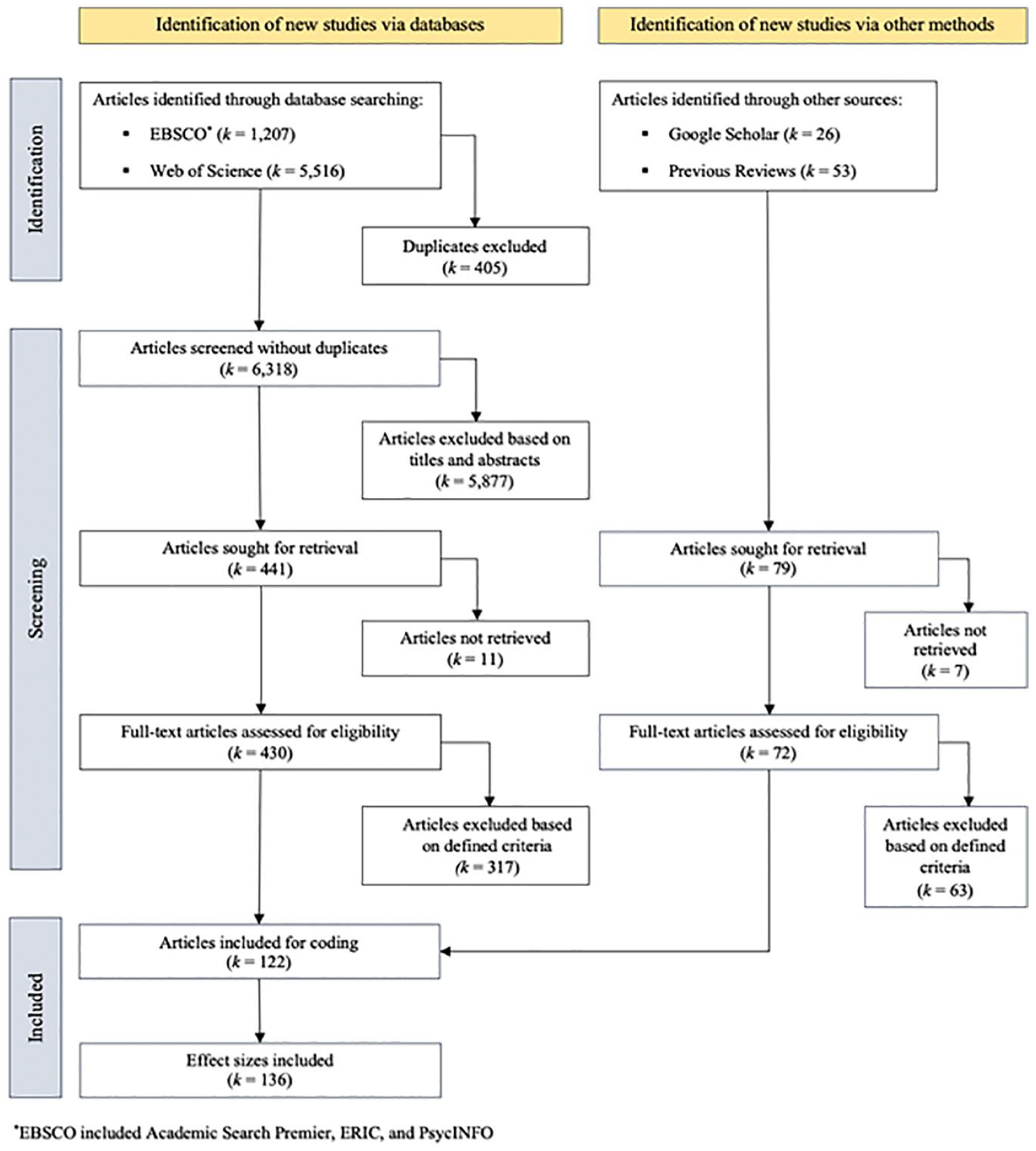
Article search and screening process.
Studies were mostly excluded for one of three reasons: (a) no statistics were reported from which an effect size could be calculated (e.g., Eitel & Kühl, 2016; Georgiou & Kyza, 2018), (b) participants were not enrolled in K–12 or postsecondary institutions (e.g., Hüttel et al., 2020; Jones et al., 2017), or (c) no evidence was reported bearing on the relation between need for cognition and a cognitive learning outcome (e.g., Arquero et al., 2017; Nishiguchi et al., 2018). Studies were often excluded that violated multiple criteria for inclusion (e.g., Cramer et al., 2020; Vannucci & Chiorri, 2018).
The coding form developed as an Excel spreadsheet consisted of items about study identification (e.g., authors and year of publication) and the moderating variables relevant to the context of study, research methodology, and measurement instruments as described above (please see supplementary materials in the online version of the journal). The codebook was initially developed based on literature informing the key factors (e.g., culture and age) that might moderate how need for cognition relates to learning. Subsequently, the codebook was iteratively refined to ensure that studies could be reliably assigned to categories. When data relevant to a code were not explicitly reported, we either made a reasonable inference or recorded “not reported.”
Coding in a meta-analytical review resembles that in other research where there is an iterative process of coding, discussing discrepancies, and refining the coding scheme. We followed the accepted practice (Miles & Huberman, 1994; O’Connor & Joffe, 2020) of dual coding a subset of the data until an acceptable level of intercoder agreement is obtained and then continuing to completion with a single coder. In the dual coding phase, the two researchers independently coded 12 studies and obtained .87 agreement, with the mean agreement per study ranging from .81 to .94 (SD = .05) and the mean agreement per variable ranging from .83 for the outcome measure variable to 1.00 for the grade level variable (SD = .06). We stopped co-coding when an agreement level of .80 was attained for each variable. Afterwards, we met weekly to discuss the borderline cases, sharpen category definitions, and address emerging issues to maintain the reliability of coding.
Effect Size Extraction
The correlation coefficient r was selected as the primary effect size statistic for this meta-analysis. For studies not reporting correlations, we calculated the effect sizes from related descriptive or inferential statistics provided by the authors. For instance, we followed established methods to derive r from standardized mean difference d (Borenstein et al., 2009), standardized coefficient β (Peterson & Brown, 2005), t, and F (Lipsey & Wilson, 2001). Following the suggestion by Castro et al. (2015), we also included studies reporting the direct effect of need for cognition on learning performance in a path analysis. Such procedures allowed a greater number of studies to be analyzed to reduce sampling error and increase the representativeness of the results (Becker & Wu, 2007; Borenstein et al., 2009; Lipsey & Wilson, 2001; Peterson & Brown, 2005).
When a study reported more than one correlation between need for cognition and learning performance, the strategies proposed by Lipsey and Wilson (2001) were used to guard against statistical dependency and reduce the potential bias in favor of studies reporting more effect sizes. One option to address this issue was to select the most relevant of the reported effect sizes. When multiple effect sizes based on different measures of academic achievement suggested equal importance and relevance, for instance, free recall and comprehension tests, the weighted average was used in calculating the mean effect size (e.g., Allison & Brimacombe, 2010; Q. Liu & Nesbit, 2018; Taasoobshirazi & Sinatra, 2011). Altogether, 136 effect sizes with an overall sample size of 53,258 participants reported in 122 articles were included in the meta-analysis.
Results
Data analyses were conducted using SPSS 27.0 and Comprehensive Meta-Analysis 3.0 (Borenstein et al., 2015). To correct the expected skewness of the correlation sampling distribution, Fisher’s z-transformation was applied. The forest plot 1 of the 136 effect sizes revealed two outlying values, r = –.26 (Warden & Myers, 2017) and r = –.20 (Conzola & Klein, 1998). Comprehensive Meta-Analysis 3.0 was used to determine the effects of eliminating the extreme observations. We removed the two outliers one at a time and found that the removal of the potential outliers did not result in a significantly different mean effect size or alter the heterogeneous effect size distribution, so we decided not to eliminate those two studies from the original distribution. Instead, following the procedure proposed by Tabachnick et al. (2019), we adjusted each effect size to the next smallest effect size in the distribution. The adjusted effect sizes were r = –.18 and r = –.17.
The overall effect size weighted by inverse variance and using a random effects model was r = .20 with a 95% confidence interval ranging from .18 to .22, a result that indicates a reliable, positive, but weak association between need for cognition and academic achievement (J. Cohen, 1988).
Substantial unaccounted-for variability was observed among the studies, Q = 677.16, df = 135, p < .001, indicating the need for moderator analyses (Gliner et al., 2003; Park & Shaw, 2013). Around 80% of the observed variance in effect sizes was due to variance in true effects rather than sampling error (I2 = 80.06), with an estimate of variance of true effect sizes, τ2 = .01, and an estimate of standard deviation of .10 in true effect sizes. Heterogeneity among the studies supports the selection of a random effects model for the overall and moderator analyses, assuming a common among-study variance component across subgroups.
Moderator Analyses
In our analyses of moderating variables, we used z-tests to examine whether the weighted mean effect size for each level of a variable was significantly different from zero, and we used between-level heterogeneity (QB) to test for a significant difference among the predefined categories. The significance level for tests of heterogeneity was α ≤ .05, although we do discuss results that slightly exceeded that threshold. As shown in Tables 1 to 3, the effect sizes for almost all levels of the moderating variables were significantly larger than zero, and there were only a few cases where the between-level heterogeneity attained or nearly attained statistical significance. For the sake of brevity, only the exceptional results are described.
Moderator analyses of context-related variables.
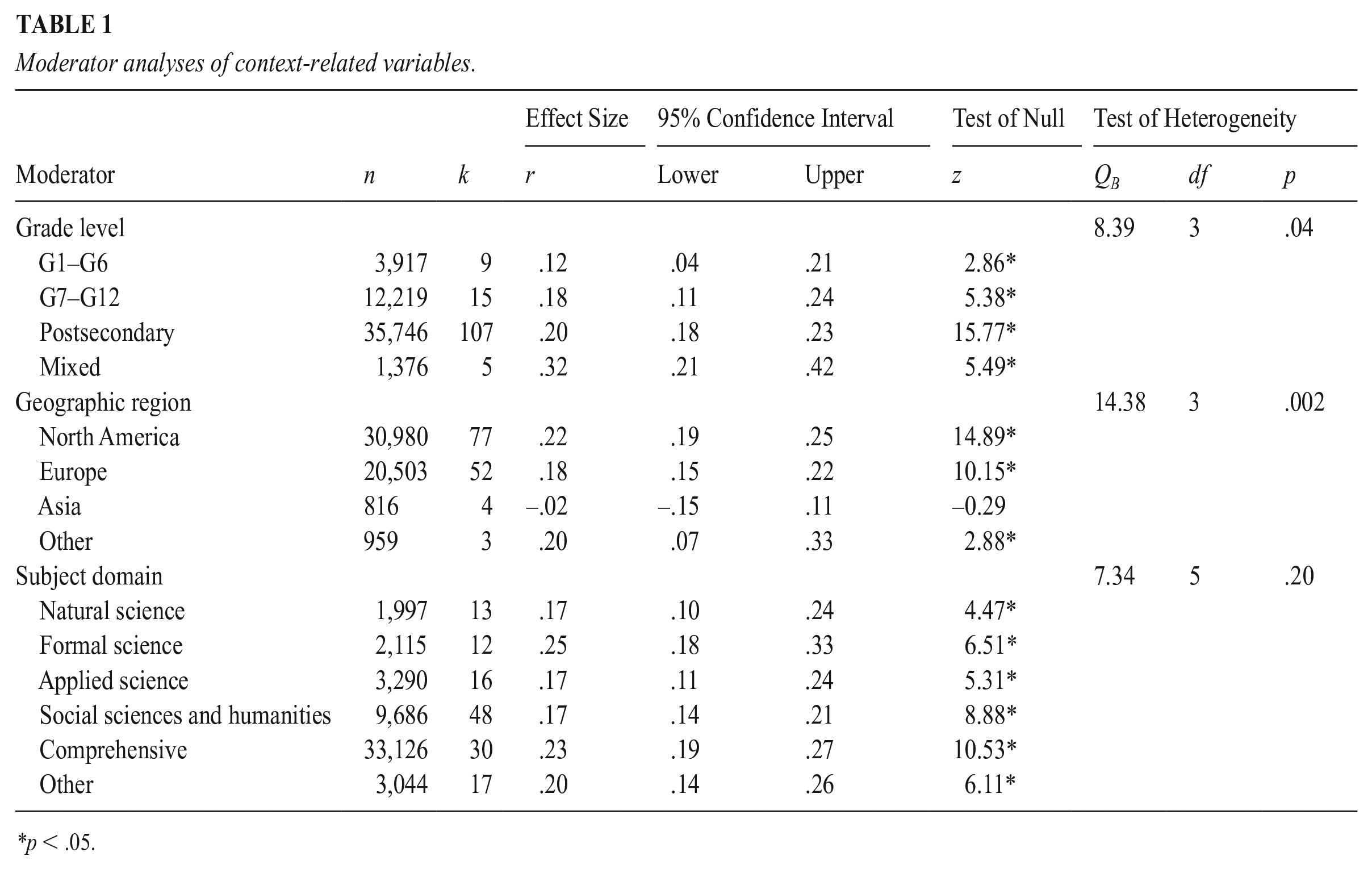
p < .05.
Moderator analyses of methodology-related variables.
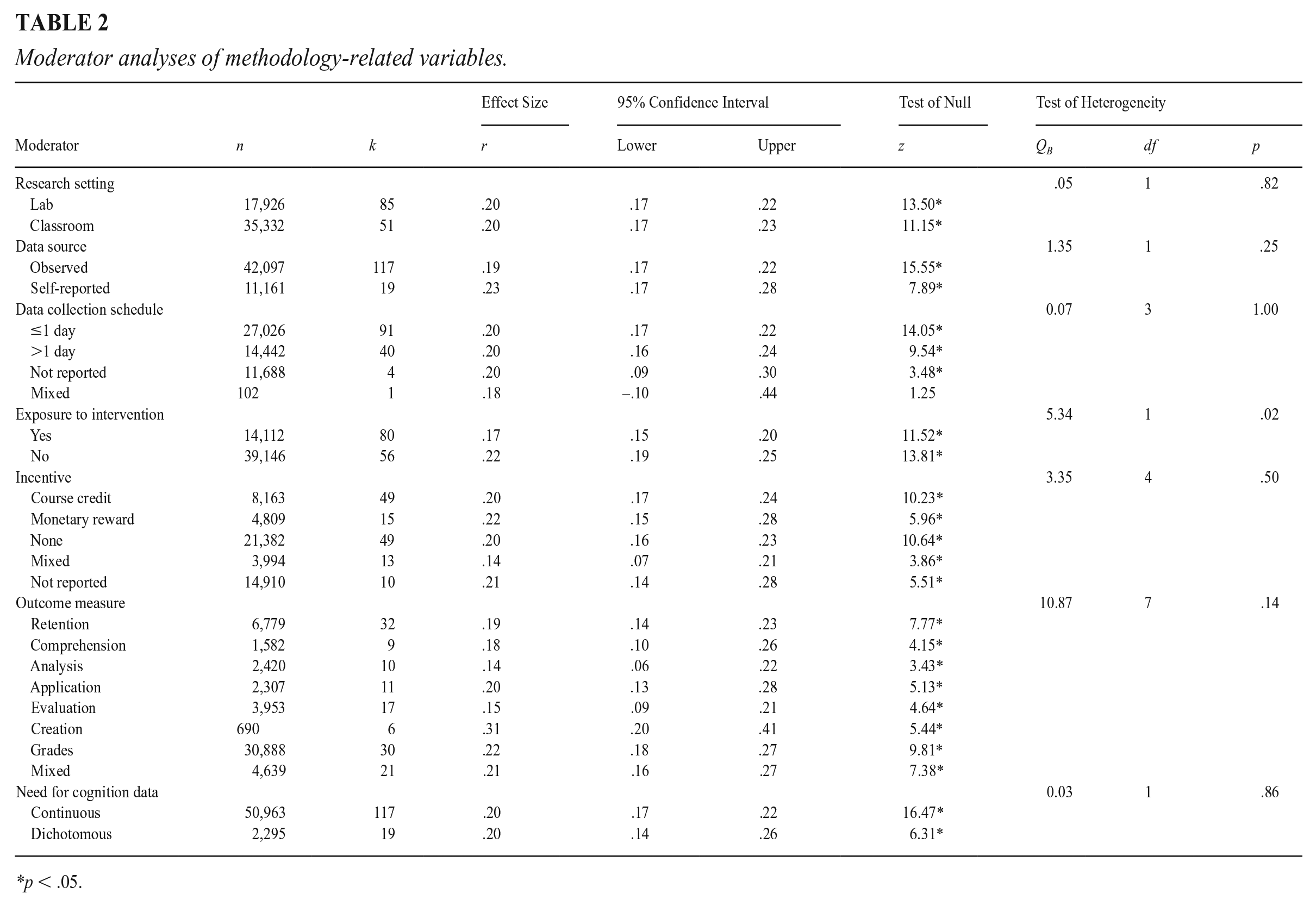
p < .05.
Moderator analyses of instrument-related moderators.
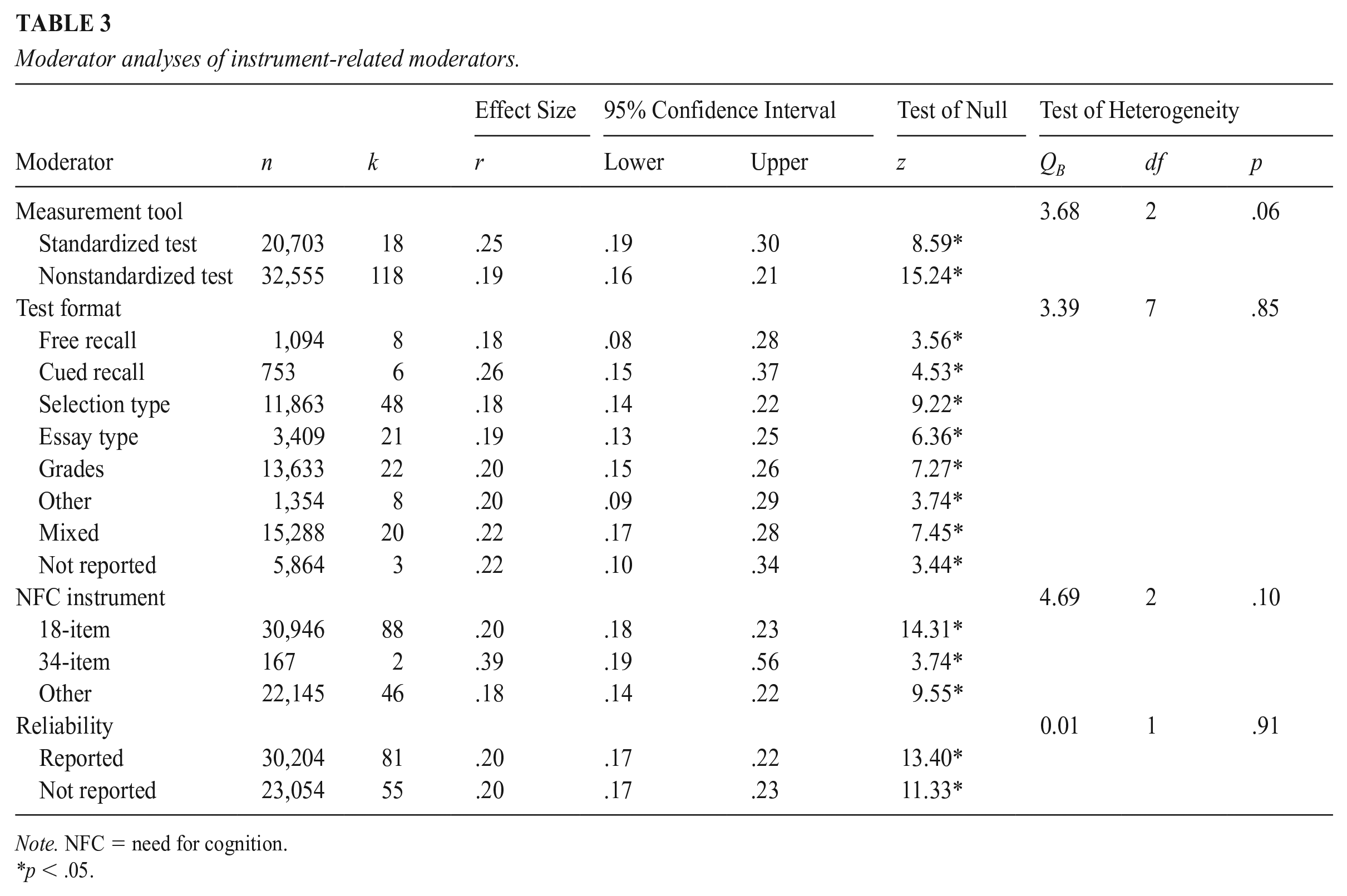
Note. NFC = need for cognition.
p < .05.
Analyses of Context-Related Moderators
Table 1 shows the results of moderator analyses based on three context-related variables. Admittedly, there is no ideal way to categorize grades K–12 due to the discrepancies across regions. This moderator was coded in a way that aligned with how most of the studies classified Grade 6 (e.g., Kim et al., 2007) and, given that there were a few studies involving students from multiple grade levels, avoided a greater number of studies to be assigned to the category of “mixed,” which might contribute little to the research findings, as follows: (a) Grade 1 to Grade 6 (G1–G6), (b) Grade 7 to Grade 12 (G7–G12), (c) postsecondary, and (d) mixed (e.g., including students from Grade 3 to Grade 8 or including students from high schools and universities). Geographic region was classified as (a) North America, (b) Europe, (c) Asia, and (d) other. Study materials were coded according to their associated subject domains, namely, (a) natural science (e.g., biology or physics), (b) formal science (e.g., math or statistics), (c) applied science (e.g., engineering or medicine), (d) social sciences and humanities (e.g., psychology or English), (e) comprehensive (e.g., GPA or ACT scores), and (f) other (e.g., general knowledge or critical thinking).
The moderating effect of subject domain was not statistically detectable. The correlation between need for cognition and academic performance varied significantly across regions, QB[3] = 14.38, p = .002. The studies conducted in North America reported the largest mean effect size (r = .22). Those conducted in Asian countries showed a negative, weak correlation between need for cognition and academic achievement (r = –.02). However, the small number of studies (k = 4) from Asia indicates this result cannot be regarded as robust.
Grade level was found to be a significant moderator, QB[3] = 8.39, p = .04. Differences across grade levels revealed a trend of increase in the magnitude of mean effect size with age. The studies involving students from G1 to G6 showed the weakest relation (r = .12), and those involving older students reported larger effects (r = .18 for G7–G12 and r = .20 for postsecondary students).
Analyses of Methodology-Related Moderators
Table 2 shows seven moderating variables related to research design and methodology. The studies collected data from different settings, coded as (a) lab, when research activities took place in laboratory settings; and (b) classroom, when research activities happened in authentic environments associated with school curriculum including academic performance data (e.g., course grades or GPAs) directly collected from participants or teachers. Data source included two types: (a) observed (e.g., learning outcome data provided by schools or coded by researchers) and (b) self-reported by participants (e.g., self-reported course grades or ACT scores). Data collection schedule was coded as: (a) ≤1 day, when need for cognition scores and all learning outcome data were collected on the same day; (b) >1 day, when need for cognition and the learning outcome data were collected on different days; (c) not reported; and (d) mixed, when some learning outcome data were collected on the same day with the need for cognition scores and some were not.
For the variable of exposure to intervention, Yes means the study involved learning activities designed as research treatments (e.g., participants were instructed to study a concept map or watch an animated video before working on related outcome tests) that might impact student performance on a related outcome measure, and No means it did not expose participants to any research-specific intervention activities prior to the outcome measure. Participants received different types of incentives for participation, coded as (a) course credit, (b) monetary reward (e.g., cash and movie ticket), (c) none, (d) mixed (e.g., some participants received course credits and some did not), and (e) not reported. The learning outcome measures were grouped into eight levels corresponding to Bloom’s taxonomy of the cognitive domain: (a) retention; (b) comprehension; (c) analysis; (d) application; (e) evaluation; (f) creation; (g) grades (e.g., university GPA); and (h) mixed, involving two or more types of constructs. Researchers analyzed the need for cognition scores either (a) as a continuous variable or (b) as a dichotomous variable (e.g., assigning participants into a high or low need for cognition group using a median split).
The variable of exposure to intervention was found to be a significant moderator, QB[1] = 5.34, p = .02. The studies that exposed participants to specifically designed instructional activities prior to outcome measure(s) were associated with lower effect size (r = .17) than those involving no research-specific intervention activities (r = .22), indicating their association was affected by factors related to research design. For other variables, differences across levels were not statistically detectable.
Analyses of Instrument-Related Moderators
Table 3 shows the moderating effects of four variables about research instruments used to gauge learning outcomes and need for cognition. Outcome measurement tool was coded as (a) standardized tests (e.g., ACT) and (b) nonstandardized tests such as those developed by researchers or by teachers (e.g., midterm exam). Outcome test formats included (a) free recall; (b) cued recall; (c) selection type questions (e.g., multiple-choice or true or false questions); (d) essay type questions (e.g., short-answer or argument essay tests); (e) grades (e.g., midterm exam grades or GPAs); (f) other (e.g., game playing or drawing); (g) mixed, if more than one type of test format was used; and (h) not reported, if no related information was available for inferencing.
The included studies employed different scales to gauge an individual’s need for cognition, coded as (a) the 18-item need for cognition scale by Cacioppo et al. (1984); (b) the 34-item need for cognition scale by Cacioppo and Petty (1982); and (c) other scales adapted from (a) or (b) or developed by other researchers such as the 33-item need for cognition scale by Bless et al. (1994), the 10-item INTEL’95 validated in the Netherlands by Schouwenburg (1996), and the 52-item scale by Schulze and Wilhelm (2001). It was also found that about 60% of the studies tested and reported the reliability of the need for cognition scale selected for use (i.e., reported) but the others did not (i.e., not reported).
Of the four instrument-related moderators, the moderating effect of outcome measurement tool was found to be salient. Studies using standardized tests returned larger effect sizes (r = .25) than nonstandardized tests (r = .19).
Other Observations
Cacioppo and Petty (1982) and Cacioppo et al. (1996) contended that need for cognition score is invariant across gender. In the studies we analyzed, female participants were overrepresented. Of the 136 studies, 88 had over 50% female students, among which 47 studies had over 66% female students. Only a rough estimate of gender distribution is possible as most studies did not report percentage changes after attrition, and 19 studies did not report gender distribution. For these reasons, we determined that analysis of the moderating effect of gender was not feasible.
It was also noticed there has been an increasing number of studies investigating the association between need for cognition and academic achievement. The correlation between the publication year and the effect size of each individual study was r = –.25 (p = .004). Figure 2 shows a trend of decline in the magnitude of the reported effect size that might be partially due to the scant number of relevant studies published in the 1980s and 1990s. Another potential cause is research studies conducted in recent years have introduced a variety of novel interventions or technology-enhanced learning environments (e.g., video games or animated presentations) that might have undermined the role of need for cognition as a motivational construct in promoting learning. Further research is needed to verify this possibility.
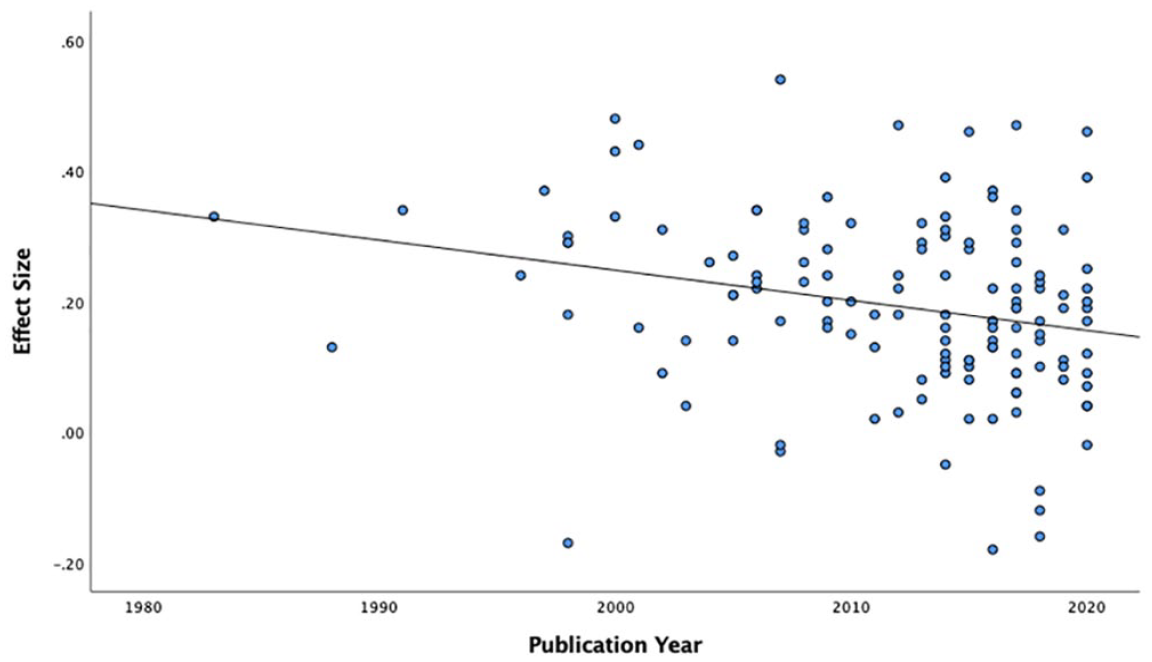
Scatterplot of effect size by year of publication.
Publication Bias
First, a funnel plot was examined to investigate publication bias. As shown in Figure 3, the plot shows a symmetric distribution of effect estimates, indicating an absence of publication bias in our data. Egger’s test (Egger et al., 1997), a linear regression method commonly used to assess asymmetry of distributions, returned t = .48, p = .63, which further substantiates the symmetry of the funnel plot. In addition, classic fail-safe N test suggested 5,998 additional null-effect studies would be required to nullify the overall effect found in this meta-analysis. According to Rosenthal (1995), the results of a meta-analysis are considered robust to publication bias unless the fail-safe N is smaller than 5k +10, where k is the number of studies included in the meta-analysis.
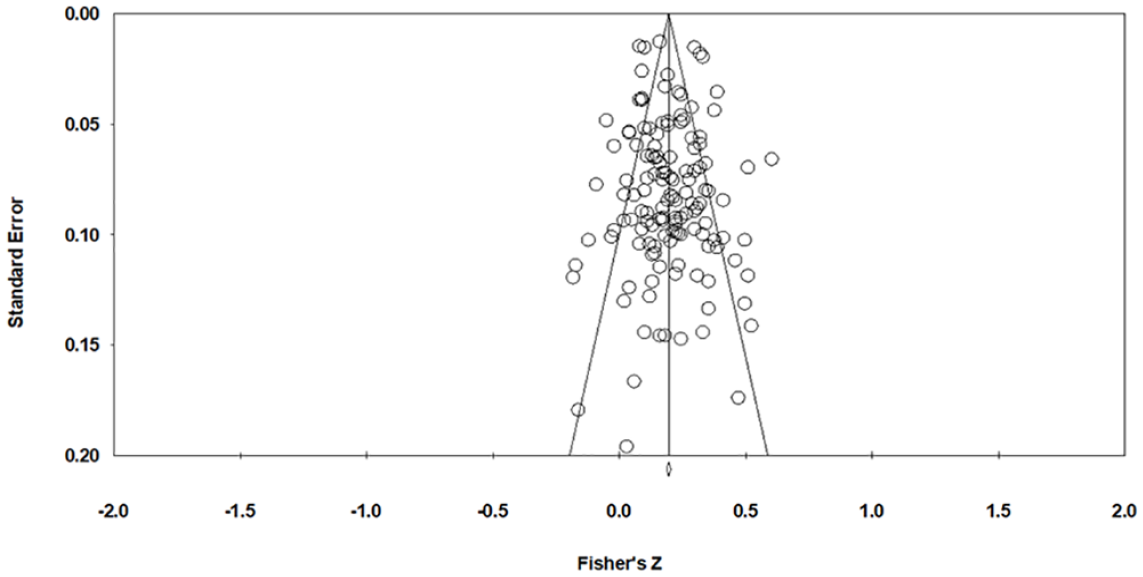
Funnel plot for publication bias.
Discussion
In summary, the meta-analysis found there is a small, positive, and reliable association between need for cognition and academic achievement. The present study tested the moderating effects of 14 variables, of which 4 were identified as significant moderators. The overall effect was moderated by grade level, geographic region, exposure to intervention, and outcome measurement tool.
Predictive Power of Need for Cognition
The overall effect size (r = .20) is comparable to the average correlations reported in two review studies (Richardson et al., 2012; von Stumm & Ackerman, 2013), indicating students with high need for cognition manifest better academic performance than those with low need for cognition. Theorists have proposed that students high in need for cognition have a propensity to enjoy cognitively demanding tasks and commit to effortful elaboration to seek out, acquire, process, evaluate, and reflect on relevant information for knowledge construction (Cacioppo et al., 1996; Jebb et al., 2016). Given that intrinsic motivation, enjoyment of cognitive challenges, and engagement with learning materials are widely expected to lead to better learning outcomes, we anticipated a stronger association between these two constructs.
Effects of Context-Related Moderators
This meta-analysis investigated the effects of three moderators related to the context of study. Subject domain did not demonstrate a significant moderating effect. Grade level and geographic region were identified as significant moderators.
About 79% of the studies were conducted with postsecondary students, and only about 18% involved students from K–12 contexts (7%: G1–G6; 11%: G7–G12), which suggests an inequality in sample distribution. It was found that the correlation of need for cognition with academic achievement varied significantly across grade levels, which are often used as a proxy for age differences. Higher age groups seemed to be more influenced by need for cognition than younger schoolchildren. Previous research reported a weak association between need for cognition and age (Cacioppo et al., 1996; Soubelet & Salthouse, 2017). However, their findings were mainly based on adult samples. Our data, which includes participants from K–12, provide a more complete picture of how the relation between need for cognition and academic achievement changes over time and how it impacts learning for students of different age groups or at different levels of schooling. Compared with adults, elementary school students are widely believed to lack advanced cognitive and metacognitive skills (Flavell, 1994; Forsberg et al., 2021), perhaps leaving less opportunity for need for cognition to play a role. According to Keller et al. (2019), “the link between investment traits such as NFC and cognitive performance is expected to become stronger with age as children with a high NFC encounter more complex problems and seek out more cognitively challenging situations” (p. 147).
A related methodological issue concerns the measurement tools used to gauge younger students’ need for cognition. It may be that the weaker association observed for younger students is due to inappropriate methods for assessing the construct. Most studies employed the 18-item scale (Cacioppo et al., 1984), as its validity and reliability have been abundantly tested. However, it was not originally designed for children. Having realized this issue, some researchers adapted the 18-item scale to younger participants by changing the wording, presenting alternative answer formats, and/or removing the negatively worded or double-barreled items (e.g., Kokis et al., 2002; Preckel & Strobel, 2011; Teodte, 2018). A large proportion of the variant versions were written in languages other than English, such as German (e.g., Preckel, 2014; Preckel & Strobel, 2011, 2016), French (e.g., Ginet & Py, 2000), and Finnish (e.g., Luong et al., 2017). Although the original need for cognition scales targeted at English-speaking adults have been extensively used and tested, educational research in this area would benefit from development of a standardized instrument suitable for school-age children and adolescents. Such an instrument could serve as the reference for developing alternate language forms to support cross-culture and within-culture comparisons.
The retained studies were mainly conducted in North America (57%) and Europe (38%). Studies in North America and in Europe reported larger correlations between need for cognition and academic achievement than those conducted in Asian countries. Sanders et al. (1992) and M. Zhang et al. (2021) found differences in need for cognition across ethnic groups, with the Asian samples scoring significantly lower on the need for cognition measures than their Western counterparts, which might be attributed to a social desirability bias (Sanders et al., 1992) or the “aversion to the spotlight” phenomenon indicating that Asians from collective cultures are more likely to avoid extreme responses on Likert-type scales (Hoy & Stone, 1993; R. Wang et al., 2008). If this is the case, it might result in a blurred contrast between students high and low in need for cognition and account for its weaker association with academic performance for participants studying in Asia. Considering, however, that only four of the included studies were conducted in Asian countries, not sufficient to represent such a large and culturally diverse region, attributing the result to cultural difference is not reasonable. All the studies conducted in Asia drew participants from Grades 4 to 10, so their significantly lower effect sizes are more likely due to the moderating effect of age or grade level.
Effects of Methodology-Related Moderators
There were seven moderators related to research design and methodology. Only one variable, exposure to intervention, demonstrated a significant moderating role. This finding is subject to various interpretations. Studies involving specifically designed interventions often take place in controlled trial contexts that may foster a novel learning environment where most students, regardless of their need for cognition, are motivated to demonstrate maximal performance (Ackerman & Heggestad, 1997; Fleischhauer et al., 2010). Following this line of reasoning, we argue the effect of need for cognition may be more salient in less instructor-directed or researcher-directed situations. Although studies that exposed students to intervention activities prior to outcome measure(s) were found to have significantly lower mean effect size than those with no interventions, it might not be fair to conclude that research interventions generally undermine the association between need for cognition and learning performance. Instead, a more valid speculation is the relation is susceptible to external factors, such as designed instructional activities or environments that strengthen or undermine the role of need for cognition. In other words, need for cognition may interact in varied and possibly unpredictable ways with instructional interventions. This hypothesis merits further investigation.
Cacioppo et al. (1996) suggested that the distinction between individuals high and low in need for cognition becomes more evident as learning tasks become more difficult, but one might ask what task difficulty means in this context. It may be that task characteristics such as complexity or novelty, rather than difficulty per se, are motivating learners who have high need for cognition. It may be difficult to memorize a list of esoteric terms and their definitions, but that task might not be more attractive to those with high need for cognition who expect cognitively challenging activities (Schneider et al., 2013). This meta-analysis categorized outcome measures aligning with the levels of learning tasks from less to more cognitively complex in Bloom’s taxonomy of the cognitive domain (Anderson et al., 2001). However, we were unable to find consistent differences in the effects of need for cognition across those presumed levels of task complexity. Taking this result at face value leads to the idea that whatever type of difficulty turns need for cognition off and on operates at all levels of Bloom’s taxonomy. According to this somewhat counterintuitive conception, even the lowest level of the taxonomy includes some learning tasks that engage learners with high need for cognition. We suggest future research investigate the type of tasks or interventions that uniquely engage learners with low or high need for cognition. This result may also be due to the broad sample examined in this meta-analysis, given that different levels of Bloom’s taxonomy might be more or less challenging for students with different characteristics. It is worth investigating what other individual difference traits might interact or co-act with need for cognition to affect learning at different levels of Bloom’s taxonomy.
Effects of Instrument-Related Moderators
The variable of measurement tool was found to moderate the relation between need for cognition and scholastic performance. Studies using standardized achievement tests reported larger mean effect sizes than those using nonstandardized tests. One possible explanation is that standardized tests tend to have higher reliability than measures developed by researchers or teachers and thus less subject to attenuation effects (Slavin & Madden, 2011). Although standardized tests are subject to criticisms when they are used as outcome measures to assess the intended effects of educational interventions (Pellegrino et al., 2001; Sussman, 2016), their enhanced psychometric properties may make them more suitable for meta-analysis. There is, however, an alternative explanation for the association of effect size with instrument. We observed that standardized test scores were in most cases collected from nonintervention contexts. The most justifiable interpretation is therefore that the associations of effect size with both standardized achievement testing and nonintervention research were due to a combination of psychometric and research design effects. The greatest effect sizes emerged from observational studies that used standardized achievement tests.
Limitations and Future Research
The unequal distribution of several study characteristics limits interpretation of our findings and points toward avenues for future research that would expand understanding of need for cognition, an educationally important individual difference factor. For example, the paucity of research at the elementary and secondary levels (18% of included studies) constrains what we can say about the role of need for cognition in elementary and secondary education and underlines the necessity of developmentally oriented research on need for cognition in children and adolescents. Likewise, that 95% of the studies were conducted in North America and Europe indicates a disproportionate reliance on WEIRD (Western, Educated, Industrialized, Rich, and Democratic) samples (Kahalon et al., 2021), which casts uncertainty on whether the observed relation between need for cognition and learning achievement generalizes across cultures and reveals that research in other cultural settings is necessary. The inequality of the sample distribution might result from biased sampling as this meta-analysis only included studies that were published in English and publicly accessible either online or in library archives that are largely restricted by the university’s subscription service. Although the sample appeared to comprise a larger proportion of female students, most studies did not report gender distribution after attrition, which prevented us from investigating whether the association between need for cognition and academic achievement varies with gender. To allow more thorough meta-analytic analysis, we recommend adequate reporting of generalizable variables such as age and gender.
It is important to note that the meta-analytic methods used in this study assume linear relations among the key variables. However, it is possible that the relationship between need for cognition and academic learning is nonlinear in some circumstances, in which cases the moderating effects of certain variables might have been distorted. We suggest future meta-analyses apply nonlinear methods as depicted in Roberts et al. (2022) to more rigorously investigate how need for cognition relates to learning in different contexts.
In addition, having a valid and reliable instrument for measuring need for cognition is key to research in this field. According to our observation, the 18-item need for cognition scale by Cacioppo et al. (1984) has been most frequently used in the past three decades. However, it might not suit younger participants or those from non-Western cultures. Substantial effort has been invested in constructing need for cognition scales that are more age appropriate and culturally acceptable (e.g., Ginet & Py, 2000; Koikis et al., 2002; Preckel, 2014; Preckel & Strobel, 2011; Teodte, 2018), but they have been only sporadically used. Research in this field might benefit from a systematic review that catalogues the best available need for cognition instruments developed for various contexts and strategically encourage greater use of appropriate ones as the basis for instrument validation and refinement. Furthermore, most of the currently used scales measure an individual’s need for cognition via self-report which is reflective in nature. To assess need for cognition more comprehensively and reliably, especially for children whose self-reflection or self-judgment skills are developing, it may be helpful to adopt behavioral measures related to need for cognition, such as task selection (Cacioppo et al., 1996), strategy use (Fleischhauerappropriate and culturally accepta et al., 2013), and exploration time (Rudolph et al., 2018).
This meta-analysis found need for cognition is positively correlated with academic achievement. Therefore, it may be beneficial to nurture need for cognition as an outcome in and of itself (Jebb et al., 2016). There is evidence that need for cognition is malleable (e.g., Castle, 2014; Padgett et al., 2010; Preckel, 2014). The finding that the relation between need for cognition and learning performance is sensitive to instructional setting to some degree corresponds to the contention that need for cognition can be cultivated, encouraged, and trained in intellectually stimulating environments (Colling et al., 2022; Jebb et al., 2016; Lapina, 2020; J. S. J. S. Wang et al., 2015). Researchers should investigate teaching strategies and ways of constructing learning materials that draw in and engage students who are low in need for cognition with the goal of reducing or eliminating their achievement deficit.
Despite its weak relation with learning performance among elementary school students, need for cognition has been found to incrementally predict academic achievement over school years. Therefore, it is of importance to foster students’ need for cognition in elementary education when changes in one’s competence beliefs and intrinsic motivation to learn start to unfold (Luong et al., 2017; Spinath & Steinmayr, 2008).
Accepting the plausibility of the claims by Cacioppo et al. (1996) and Heijne-Penninga et al. (2010) that need for cognition is mainly shaped by past experiences, we believe researchers should explore instructional strategies that might enhance students’ need for cognition. The key to this challenge may be to identify learning activities such as cooperative learning and argumentation that are already known to be related to need for cognition and yet have attractive points of ingress for students who are often uninterested in academic tasks. Such interventions might stimulate latent interest in complex, analytical thinking through activities that address topics about which students already have manifest interest. Accumulating positive experiences in such activities, especially in prolonged episodes of cognitively challenging problem solving, may develop an inclination toward persistent absorption in effortful cognitive activities owing to an increased sense of self-efficacy and self-satisfaction. To further strengthen their effectiveness in enhancing need for cognition, as suggested by Spinath and Steinmayr (2008), it might be helpful to have those activities take place in low-stakes learning environments where students are encouraged to focus on their individual progress towards a learning goal rather than the outcome of a specific learning task. Experiencing complex and interesting learning activities in low-stakes environments may enhance students’ awareness of the pleasure gained from investing cognitive effort and lead to increased intrinsic motivation to engage in cognitive challenges.
Supplemental Material
sj-docx-1-rer-10.3102_00346543231160474 – Supplemental material for The Relation Between Need for Cognition and Academic Achievement: A Meta-Analysis
Supplemental material, sj-docx-1-rer-10.3102_00346543231160474 for The Relation Between Need for Cognition and Academic Achievement: A Meta-Analysis by Qing Liu and John C. Nesbit in Review of Educational Research
Footnotes

Notes
Authors
QING LIU is the associate director of assessment and instructional design in the unit of Student Engagement and Retention and an adjunct professor in the Faculty of Education at Simon Fraser University, 8888 University Drive, Burnaby, BC, V5A 1S6; e-mail:
JOHN C. NESBIT is a professor in the Faculty of Education at Simon Fraser University, 8888 University Drive, Burnaby, BC, V5A 1S6; e-mail:
References
Supplementary Material
Please find the following supplemental material available below.
For Open Access articles published under a Creative Commons License, all supplemental material carries the same license as the article it is associated with.
For non-Open Access articles published, all supplemental material carries a non-exclusive license, and permission requests for re-use of supplemental material or any part of supplemental material shall be sent directly to the copyright owner as specified in the copyright notice associated with the article.
