




Abstract
Although research shows that critical outcomes occur for Native students when culture-based education (CBE) centers self-determination, sovereignty, and Indigeneity, Kanaka ʻŌiwi (Native Hawaiian) students rarely learn about these concepts. This review thus seeks to understand how scholars operationalize self-determination and Ea (sovereignty, life) in research on Native Hawaiian CBE and the extent to which this operationalization provides pathways for students to internalize the two concepts, self-identify as Indigenous, and enact praxis. By foregrounding Kānaka ways of knowing and being, a Kanaka ʻŌiwi literature review methodology (KanakaʻŌiwiLRM) is conceptualized and engaged to analyze 20 literature sources. Findings indicate that self-determination and Ea are positioned as the foundations and outcomes of CBE, yet disregarded as a basis for Indigenous self-identification. This results in a call for a purposeful decolonial Native Hawaiian CBE approach that nourishes Indigenous unity and supports self-determination, Ea, and pathways toward praxis.
Keywords
Since the United Nations adopted the Declaration on the Rights of Indigenous Peoples 1 (UNDRIP) in 2007, U.S.-based Indigenous scholars have increasingly used “self-determination,” the right to dictate one’s identity and future, and “sovereignty,” the ability to self-govern and perpetuate cultural traditions, in pre-K–12 education research that aims to improve Native students’ academic and life outcomes through culture-based learning (Brayboy & Castagno, 2009; Pulitano, 2012). It is disconcerting, then, that Kanaka ʻŌiwi 2 (Native Hawaiian) youth lack knowledge about these concepts and continue to face disproportionately high postsecondary obstacles, such as degree incompletion and poverty, when compared to their white and Asian peers (Brayboy & Lomawaima, 2018; Kanaʻiaupuni et al., 2021). Given the rising support for Native Hawaiian culture-based education (CBE), which grounds curricula, pedagogy, assessments, and community participation in Hawaiian ways of knowing and being in order to promote Indigenous student identities and active engagement with families and society (Demmert, 2011), this reality is especially troubling. Indeed, although Native Hawaiian CBE emerged as a result of Kanaka ʻŌiwi activism over cultural and political Ea 3 (sovereignty, life) for Native Hawaiians, American Indians, and Alaska Natives during the 1970s (Demmert & Towner, 2003), many Kanaka ʻŌiwi students attending CBE schools and programs do not possess the same ideological lens to challenge injustices impacting the global Indigenous community, a living entity comprised of those who self-identify as Indigenous and assert their Indigeneity 4 in multiple contexts, as their kūpuna (ancestors) did (McCallum, 2017). This raises questions about how scholars define and apply self-determination, sovereignty, and Ea in their work, and the extent to which CBE perpetuates western assimilation rather than Indigenous liberation.
To date, critical Native Hawaiian research has neither systematically reviewed the ways in which self-determination and Ea are operationalized in CBE scholarship nor analyzed the extent to which the academy explores students’ internalization of those concepts to pursue “decolonial pathways to praxis,” the combination of theory and reflection to produce a capacity for social action focused on disrupting the continued dispossession and exploitation of Indigenous Peoples and their sacred lands (Freire, 1970; Ineese-Nash, 2020). Moreover, Kanaka ʻŌiwi researchers have yet to express their own self-determination and Ea by engaging with a Kanaka ʻŌiwi literature review methodology (KanakaʻŌiwiLRM) grounded in Native Hawaiian worldviews. Instead, much of our current ʻike (knowledge) from CBE literature reviews prioritize academic measures over wellbeing outcomes (Kanaʻiaupuni et al., 2010; Takayama, 2008; Tibbetts et al., 2007) and rely on colonial methodologies that value the individual researcher’s knowledge over the community’s wisdom. Although some scholars have connected CBE to student autonomy (Borofsky, 2010; Kawakami & Dudoit, 2000) and improved relationships with ʻāina (land); (Kawaiʻaeʻa, 2018), self-determination and Ea are not explicitly mentioned. However, this current literature review affirms these concepts’ capacity for action and Indigenous solidarity through a Kanaka ʻŌiwi-grounded research approach.
I thus embark on a journey in search of ʻike on the following two research questions: (a) How do education researchers operationalize self-determination and Ea in scholarship on Native Hawaiian CBE? and (b) To what extent do these operationalizations in the literature shape pathways for Kānaka to internalize self-determination, Ea, and identities as members of a global Indigenous community inspired to engage in decolonial pathways to praxis? I offer this literature review to practitioners, scholars, and community members motivated to disrupt U.S. hegemony within Native Hawaiian CBE. With this radical vision as a guide, I explain my positionality to this work and present a critical analysis of this review’s pertinent concepts before introducing a KanakaʻŌiwiLRM and summarizing my findings. I conclude with recommendations to transform Native Hawaiian CBE efforts in policy, practice, and research.
Positionality
Although it began as a required capstone project for my master’s program, this review quickly developed into an embodiment of my paradigms, experiences, and hopes as a Kanaka ʻŌiwi female and a graduate of a pre-K–12 Native Hawaiian CBE school that did not equip me with a critical lens to combat oppression through knowledge about self-determination, Ea, Indigeneity, decoloniality, or praxis. Consequently, I must acknowledge my personal impact upon this paper’s epistemological, theoretical, and methodological framing. Primarily, I recognize that my Native Hawaiian worldviews have guided me toward distinct Kanaka ʻŌiwi ways of knowing and being that are steeped in ʻŌlelo Hawaiʻi (Hawaiian language), oral histories, storytelling, kaona (hidden meanings), and metaphors. Therefore, unlike colonial positivist scholars, I treat knowledge as dynamic and responsive to changes in place, space, and time. It is a gift that flows to and from elders, families, communities, and the natural world.
Similarly, my training as a critical race scholar in education shaped my theoretical and methodological decisions. For example, I intentionally attend to power dynamics, political agendas, and historical contexts when analyzing educational issues affecting Kanaka ʻŌiwi. I also look to the lived experiences of Native Hawaiians as accurate, legitimate insight because I am aware that “we know things with our lives, and live that knowledge, beyond anything any theory has yet theorized” (MacKinnon, 1991, p. 14). Together with my Indigenous heritage, this critical perspective challenged me to deconstruct aspects of a colonial literature review methodology and to purposefully form a culture-based approach centered on Native Hawaiian values. In essence, while my goal in proposing a KanakaʻŌiwiLRM is to push back against dominant, anti-Indigenous research techniques, my intent in applying this alternative methodology to Native Hawaiian CBE scholarship is to demonstrate the potentialities that arise when research is reflexive and Native Hawaiian voices are consistently utilized and affirmed.
Conceptual Framework
Native Hawaiian Culture-Based Education
Following early evidence of the academic and social benefits of culturally relevant and culturally responsive schooling efforts for Students of Color in the United States, Indigenous education activists called for more congruence between classroom and community settings, especially for American Indian, Alaska Native, and Native Hawaiian students, whose languages, histories, and connections to land were consistently erased and belittled by mainstream schools and dominant society (Demmert & Towner, 2003; Tharp et al., 2007). Thus, proponents of CBE advocated for schooling and programming rooted in a community’s beliefs, practices, and values. Native Hawaiian CBE, then, positions Kanaka ʻŌiwi ways of knowing and being as sources of meaningful and relevant learning opportunities for all students living in Hawai‘i. This educational approach encompasses five elements: the intentional use of ʻŌlelo Hawaiʻi, Kanaka ʻŌiwi pedagogical techniques, curriculum rooted in Native Hawaiian traditions and practices; Kānaka ʻŌiwi leadership and participation, and Hawaiian assessment methods (Kanaʻiaupuni & Kawaiʻaeʻa, 2008).
Accordingly, Native Hawaiian CBE schools are pre-K–12 institutions that implement the five core components in their policies and practices. This designation applies to over 50 community-founded institutions that serve more than 6,500 part-Native Hawaiian children across Hawai‘i (Espania et al., 2019). 5 To understand the historical, political, and cultural backgrounds of these institutions, I delve deeper into Native Hawaiian CBE in the following sections by critically examining the foundations, agendas, and goals of this approach as they relate to self-determination, sovereignty, Ea, Indigeneity, the global Indigenous community, and decolonial pathways to praxis, both in education research and the context of this review.
Sociohistorical Foundations: Self-Determination and Sovereignty for Kanaka ʻŌiwi
When the United Nations adopted UNDRIP in 2007, granting Indigenous Peoples around the world special rights to self-define and self-enact their cultural, economic, political, and social futures, Native educators were already well-acquainted with the concepts of self-determination and sovereignty. In the wake of the U.S. Civil Rights Movement and scathing national evaluations on the miseducation of Native youth, Indigenous Peoples recognized the role that culture would play in shaping their nationhood beyond the 20th century (Demmert & Towner, 2003; Wiessner, 2012). Although self-determination and sovereignty had mostly appeared in international discourse on the political and legal statuses of independent nations, these terms became associated with the principles of Native self-definition, self-education, and self-governance (Brayboy et al., 2015; Brayboy & Castagno, 2009). In order to perpetuate Indigenous identities, these educators argued that Natives must be able to teach their children according to their cultural ways. Therefore, in addition to affirming Indigenous Peoples’ right to safeguard and steward their ancestral homelands, UNDRIP took a major stance by declaring that they can preserve their traditions through control over educational systems on their cultures, histories, and worldviews (UNDRIP, 2007).
Consequently, Tribal and Native Hawaiian CBE supporters embraced this adapted understanding of self-determination and sovereignty. American Indian and Alaska Native communities came to position the concepts as goals that could be achieved on a national scale through the inclusion of Native languages and traditions in classrooms, subsequently equivocating self-determination and sovereignty with Tribal control over schools and educational programs (Brayboy & Castagno, 2009). Similarly, Kanaka ʻŌiwi self-determination and sovereignty in an education context came to represent a collective vision for the Lāhui (Hawaiian nation) based on family-oriented, culturally-driven, sustainable education efforts (Kahakalau, 2021). As a result, the rhetoric of educational self-determination and sovereignty bolstered calls to create CBE schools designed to serve Native communities (Kaomea, 2009; Lee, 2015). Moreover, it justified the teaching of cultural beliefs and practices as an intentional, genuine decision to perpetuate Native wisdoms in the face of ongoing colonialism (Ledward, 2013).
Since their application beyond political and legal spheres, self-determination—operationalized as self-education—and sovereignty—defined as the ability to perpetuate cultural traditions—have helped Kanaka ʻŌiwi establish and expand Native Hawaiian CBE. Additionally, through their explication in UNDRIP as inherent rights of all Indigenous Peoples, self-determination and sovereignty have become tools for Native Hawaiians to advocate for their culture’s perpetuity and to assert their Indigeneity (Coates, 2013). Although both concepts are still widely used in education discourse on American Indians and Alaska Natives, their suitability in the Kanaka ʻŌiwi context has been questioned in recent years. However, this opposition is largely in response to the political etymology of the terms, with some Kānaka asserting that self-determination and UNDRIP are not applicable because Hawai‘i is a sovereign kingdom, not a member of the United Nations or a Tribal nation within an imperial country (Schachter & Funk, 2012). Still, there is a critical perspective that self-determination and sovereignty, two western principles from international law, are inappropriate for discourse on Indigenous education and nation-building because they are derived from non-Indigenous worldviews (Cornell & Kalt, 2007; Hemi, 2019). While I take the position that UNDRIP, self-determination, and sovereignty apply to Kanaka ʻŌiwi because we are Indigenous according to cultural, legal, and political dimensions (Trask, 1999), I recognize that this is not the only stance within the Lāhui. I also acknowledge self-determination and sovereignty’s western origins, but I constrain the scope of this review to literature that applies the concepts specifically to Kanaka ʻŌiwi contexts in order to explore the extent to which it is positioned in relation to Native Hawaiian CBE.
This is a purposeful decision, intended to highlight the significance of self-determination and sovereignty in the history of Native Hawaiian CBE. Both should be considered liberatory concepts associated with Indigenous autonomy and control. In theory, self-determination and sovereignty work together to protect Indigenous identity and cultural integrity concerning whose histories and languages are privileged in U.S. classrooms; as a result, a loss of Native Hawaiian self-determination “may equate to a loss of [Native Hawaiian] sovereignty” (Hemi, 2019, p. 23). In practice, self-determination and sovereignty can empower Kanaka ʻŌiwi with the realization that they “have the capabilities to provide” for themselves through Indigenous wisdoms on ʻāina, ʻohana (family), and kūpuna (Sing et al., 1999, p. 9). As Ewalt and Mokuau (1995) note, when these group-based values are internalized by individual students engaging with Native Hawaiian CBE, a community’s capacity for self-determination and sovereignty is strengthened.
Sociopolitical Goals: Advancing the Lāhui’s Ea and Indigeneity
In the vein of critical race theoretical frameworks, this review positions education as political and schools as non-neutral institutions (Ladson-Billings & Tate, 1995; Solórzano, 1989; Wright & Balutski, 2016). There is always an agenda pushed through the histories and perspectives presented in curricula, the instructional strategies and techniques utilized, the information and skills tested, and the distribution of power in leadership structures. Since most Native Hawaiian CBE schools operate within the U.S. education system and Hawai‘i’s Department of Education, their policies and practices are as susceptible to politicized, bureaucratic reforms as mainstream, colonial institutions are. However, unlike this western approach, Native Hawaiian CBE is forthright about its commitment to teach ʻike and to advance the Lāhui to a political state of (re)empowerment (Kawai‘ae‘a et al., 2018). Thus, in addition to bolstering Kanaka ʻŌiwi self-determination and sovereignty, Native Hawaiian CBE develops the Lāhui’s Ea and Indigeneity.
Ea
Like self-determination and sovereignty, Ea has multiple contextual definitions, but most Kanaka ʻŌiwi scholars acknowledge two major denotations of the concept (Aluli Meyer, 2008; Goodyear-Kaʻōpua, 2013, 2016; Salis Reyes, 2013, 2018; Wright & Balutski, 2016). The first denotation of Ea is largely cultural: Ea is “life” and “breath”—in essence, an animating or life-giving principle. Ea is an active existence, survivance, 6 and the interdependence of Kānaka and ʻāina, which differs from the western notion of life as largely individualistic (Goodyear-Kaʻōpua, 2016; Salis Reyes, 2018). With this meaning, Ea closely resembles self-determination because it supports self-direction to ensure Native Hawaiians dictate their own futures. In fact, the Kūkulu Kumuhana 7 framework for Native Hawaiian wellbeing (2017) defines Ea as self-determination, articulating the relationship between the two concepts and their cultural significance for the Lāhui’s ability to survive and thrive for generations to come.
The second denotation of Ea is more political: Ea is also “sovereignty,” “rule,” “independence,” and “leadership” (Goodyear-Kaʻōpua, 2013, 2016). It is an assertion that self-governance in our homelands is vital to our lives (Kuwada, 2015). Moreover, Ea constitutes a degree of independence “to ensure the people’s continuance” through education about Hawai‘i’s past in order to think critically about Native futures (Goodyear-Kaʻōpua & Kuwada, 2018, p. 54). Indeed, although colonial interpretations of Hawaiian sovereignty narrowly describe Hawai‘i as an independent kingdom or a domestic nation-within-a-nation (Goodyear-Kaʻōpua, 2018), a Kanaka ʻŌiwi understanding of Ea reflects Native Hawaiians’ capacity to care for their sacred homelands and to maintain their language and cultural ways (Salis Reyes, 2018). Therefore, the inclusion of Ea in this review accounts for the epistemological limitations of invoking a western framework of political self-determination and sovereignty to analyze Native Hawaiian contexts.
Two historical examples of Native Hawaiian CBE efforts point to Ea as life and the sovereignty of the Lāhui. First, the establishment of Hawaiian language immersion preschools and K-12 institutions in the 1980s played an instrumental role in increasing the number of fluent ʻŌlelo Hawaiʻi speakers across Hawai‘i, representing Kanaka ʻŌiwi survivance in the face of linguistic extinction (Keehne et al., 2018). Furthermore, these early iterations of Native Hawaiian CBE schools are manifestations of sovereignty because their existence opposed a legal ban on the teaching of ʻŌlelo Hawaiʻi in public and private schools in the state of Hawai‘i from 1896 to 1986 (Lucas, 2000). More recently, the 2019 Kū Kiaʻi Mauna 8 movement centered on the protection of Maunakea, a sacred mountain on Hawai‘i Island, from the creation of a Thirty Meter Telescope has publicized Native Hawaiian CBE’s capacity to serve as a political vehicle for Ea. Throughout the months-long protest, instructors at Puʻuhonua o Puʻuhuluhulu, 9 a Native Hawaiian CBE school that operates beyond the state department’s jurisdiction, led courses for protestors and visitors on Kanaka ʻŌiwi beliefs about Maunakea, “further preserving Hawaiian culture in a continuing effort to protect Indigenous rights from private development” (Rosenberg, 2021, p. 288). This example demonstrates Ea through Native Hawaiians’ relationality with ʻāina, their mobilization to defend their sacred site from desecration, and their resistance against the settler state’s demands. Moreover, Puʻuhonua o Puʻuhuluhulu embodies the idea that an Indigenized liberatory educational approach has the potential to disrupt oppressive, colonial social orders through political enlightenment and collective action (Freire, 1970).
Indigeneity and the Global Indigenous Community
Native Hawaiian CBE also advances the Lāhui’s Indigeneity as members of the global Indigenous community. While critical scholars define Indigeneity as a citizenship status rooted in a sense of belonging to community, culture, and land, western thinkers often frame Indigeneity as a racial marker that carries specific legal implications complicated by colonial policies and practices concerning migration and international borders (Blackwell et al., 2017), as well as divisive discourse on blood quantum and racial purity (Kauanui, 2008). Unsurprisingly, this second interpretation of Indigeneity contrasts the way that Native Peoples assert their self-determination and sovereignty through self-definition and self-education. For some Natives, Indigeneity constitutes a choice to identify as Indigenous, which establishes a sense of self in relation to land, other Indigenous Peoples, and a colonial regime (Ineese-Nash, 2020; Schachter & Funk, 2012). Like the denotation of Ea as life, Indigeneity is an act of survivance against “systems that have worked to oppress, silence, and replace what it means to be Indigenous” through a simultaneous re-centering of Native “rights to self-determination” (San Pedro, 2021, p. 193).
Since Kanaka ʻŌiwi possess a unique relationship with the colonizing federal and state entities, their acceptance of Indigeneity as cultural and political categories and an identity marker is more tenuous in comparison to American Indian and Alaska Native communities. Some Kanaka ‘Ōiwi recognize Indigeneity as a political stance built upon “international alliances and interconnections” (Aikau, 2010, p. 480) with the global Indigenous community, an amalgamation of over 475 million individuals united through their collective identity as caretakers and protectors of ancestral homelands (Åhrén et al., 2021). Yet, there are also members of the Lāhui who do not believe Indigeneity reflects their understanding of what it means to be Kanaka ʻŌiwi. For these individuals, being Native Hawaiian is a particular experience and should be framed as such (Schachter & Funk, 2012). Consequently, Kanaka ʻŌiwi who hold this second perspective may feel responsible to advocate on behalf of other Native Hawaiians, but they may not possess a similar sense to act for the global Indigenous community, even if they recognize that some Kanaka ʻŌiwi define themselves as Indigenous.
Despite these diverging views over Indigeneity in the Native Hawaiian context, members of both sides tend to agree that education has the potential to intervene between the Lāhui and colonial state institutions (Schachter & Funk, 2012). When the decision to enroll Kanaka ʻŌiwi youth in a Native Hawaiian CBE school is a conscientious choice for students and families, Hawaiians assert their special group right to self-education. When a curriculum is purposefully grounded in Native Hawaiian ʻike, the Lāhui challenges and resists dominant colonial agendas governing the U.S. education system. When ʻāina is revered as an instructor, students come to recognize that their existence is tied to their homelands. In essence, individuals may not agree that Indigeneity and the global Indigenous community applies to their identity, but Native Hawaiian CBE advances the Lāhui’s Indigeneity through an enactment of self-determination, self-education, and survivance.
The use of Indigeneity and Indigenous Peoples in this review thus seeks to uplift commonalities and respect differences in the experiences of settler colonialism and resistance among first inhabitant peoples of diverse lands. Although my focus is on the Kanaka ʻŌiwi experience with CBE, I aim to link community-specific research to broader Indigenous conversations on the mistreatment and miseducation of Native children and youth to contend that Kanaka ʻŌiwi are not alone in their battle to navigate complex lives steeped in cultural, legal, political, and social identities. Furthermore, due to globalization and neoliberal competition for “scarce” resources and opportunities, more Kanaka ʻŌiwi find themselves beyond the borders of their ancestral homeland (Blackwell et al., 2017; Trask, 1999). In fact, Native Hawaiians are increasingly the visitors and occupiers of other Indigenous Peoples’ homelands when they relocate for college or career opportunities. Subsequently, recognizing the global Indigenous community in this review is a crucial way to practice reciprocity and to behave in an appropriate manner that affirms the self-determination and sovereignty of other Natives.
Sociocultural Outcomes: Decolonial Pathways to Praxis
Although this review does not claim that learning about self-determination, sovereignty, and Ea will definitively enact decolonization, defined as the repatriation and de-occupation of stolen Indigenous land (Tuck & Yang, 2012), it does attend to relevant scholarship on Native education that emphasizes particular sociocultural outcomes of CBE that resonate with decolonial pathways to praxis. For example, Brayboy and Castagno (2008) found that Indigenous youth who engaged in culturally responsive schooling reported “healthy identity formation,” a “positive influence in their Tribal communities,” and “more respect to Tribal elders” (p. 958). While these three outcomes do not indicate a clear path to the end of settler colonialism, they validate the educational approach’s capacity to foster students’ self-definition and self-direction. A decolonial pathway to praxis, then, is operationalized using a critical Indigenous education lens rather than an ideology guided by empire and nation-state relations. Its use in this review is meant to invoke a decentering and dismantling of hegemonic, colonial power through the (re)empowerment and Indigenization of the U.S. education system (Shahjahan et al., 2022).
To be clear, I recognize that my application of the term “decolonial” may contribute to the undoing of true, global decolonization efforts. Patel’s (2014) conceptualization of “anticolonial” as a critical stance conveys my attempt “to oppose settler colonial logics and practices” (p. 360) in formal education, making it a more appropriate concept given the widespread metaphorization and trivialization of decolonization in the academy (Tuck & Yang, 2012). Unfortunately, I write during a time when most—if not all—historical and contemporary research on Native Hawaiian CBE use decolonial over anticolonial, signaling a conceptual flaw due to this paper’s literature review methodology. At present, I am sitting with this shortcoming, yet reflecting on how American Indian, Alaska Native, and Native Hawaiian activists and scholars adopted self-determination and sovereignty to fulfill their needs in their pursuit of CBE. In truth, when I hear about or speak on decolonial efforts, it is always within an Indigenous context. While this does not exonerate me from failing to apply a more critical eye in this work, I use decolonial to maintain consistency with the literature I analyzed and define it as a purposeful decision to unsettle colonial structures. I also intentionally pair decolonial with praxis—a term associated with action as a means for healing and a recentering of human dignity—to maintain that a disruption to coloniality at an individual level can lead to widespread restoration at community and societal levels (Freire, 1970).
Consequently, decolonial pathways to praxis in CBE contexts for Native youth entail (1) a moment that raises their consciousness to power dynamics in the world around them, especially those impacting Indigenous Peoples; (2) enlightenment to the nature of social, political, and economic oppression and the liberatory capacity of self-determination and sovereignty/Ea; (3) a genuine sense of empathy with others who are colonized, including the global Indigenous community; and (4) a capacity to act against oppressors (Freire, 1970; Trinidad, 2011). This sociocultural outcome is no small task, but CBE does engage students along such a pathway. One clear example is the mobilization of Indigenous youth at the Standing Rock Indian Reservation during the Dakota Access Pipeline protests in 2016 and beyond. Youth from the Standing Rock Sioux Tribe who fought to protect the Lakota/Dakota language from extinction in K–12 CBE schools also endured police brutality at the Oceti Sakowin camp to protect Tribal lands (Gunderson, 2021; Hauff, 2020). Then, through these Tribal students’ recognition of the global Indigenous community, they later supported the Maunakea movement in 2019, affirming their Kanaka ʻŌiwi relatives’ right to self-determination and sovereignty.
Similarly, studies on Native Hawaiian CBE have discovered promising evidence for the potentiality of Kanaka ʻŌiwi students to engage with decolonial pathways to praxis. Initial evaluations of the first 14 Hawaiian-focused charter schools in Hawai‘i highlighted these institutions’ ability to instill a sense of confidence, among Kanaka ʻŌiwi students, in who they are and where they come from (Kanaʻiaupuni, 2008). The 2009 Hawaiian Cultural Influences in Education study found that Kanaka ʻŌiwi youth in CBE schools and programs reported more civic engagement and were “more likely to have strong community ties as exemplified by working to protect the local environment and [attend] public meetings about community affairs” when compared to their non-CBE peers (Kanaʻiaupuni et al., 2010, p. 1). These outcomes represent a capacity for action and important steps toward a decolonial pathway to praxis. When Kanaka ʻŌiwi students challenge harmful policies and practices at these meetings and advocate for others who experience marginalization, these actions signal decolonial, Indigenous praxis.
What, then, does it take to internalize self-determination, sovereignty, and Ea, and to self-identify as Indigenous and a member of a global Indigenous community in order to engage in decolonial pathways to praxis? For Kanaka ʻŌiwi, this internalization necessitates a capacity for relationality, a realization that our educational and social experiences under the settler colonial state have not—and do not—develop in isolation from the experiences of Native students and other Students of Color; they are “interrelated, politically and economically” (Givens & Ison, 2022, p. 2). Consequently, a future in which decolonial pathways to praxis are normalized sociocultural outcomes of Native Hawaiian CBE requires institutions to honor both the symbiotic relationship between Kanaka ʻŌiwi and ʻāina and the shared experiences between Native Hawaiians and other members of the global Indigenous community. As Freire (1970) contends, enacting praxis requires a deep love and respect for humanity and the world upon which we live. Therefore, a true internalization of self-determination, sovereignty, and Ea occurs when Kanaka ʻŌiwi students find a sense of cultural pride from these concepts and a thirst to share their radical potentials to improve the social, political, and economic conditions for all Indigenous Peoples.
Method
Transforming a literature review into a moʻolelo (history, story) of Native Hawaiian agency requires a firm belief in the diverse ways that Kanaka ʻŌiwi transmits wisdom. In fact, although colonial notions of knowledge are often associated with intelligence, Aluli Meyer’s (2003) conceptualization of a Kānaka ʻŌiwi triangulation of meaning proves that ʻike extends beyond the intellect, moving from empirical forms, to subjective interpretations, to deeply-rooted realities. By engaging this three-stage flow of ʻike, I identified a recursive KanakaʻŌiwiLRM framework (see Figure 1), which I define and explain in this section.
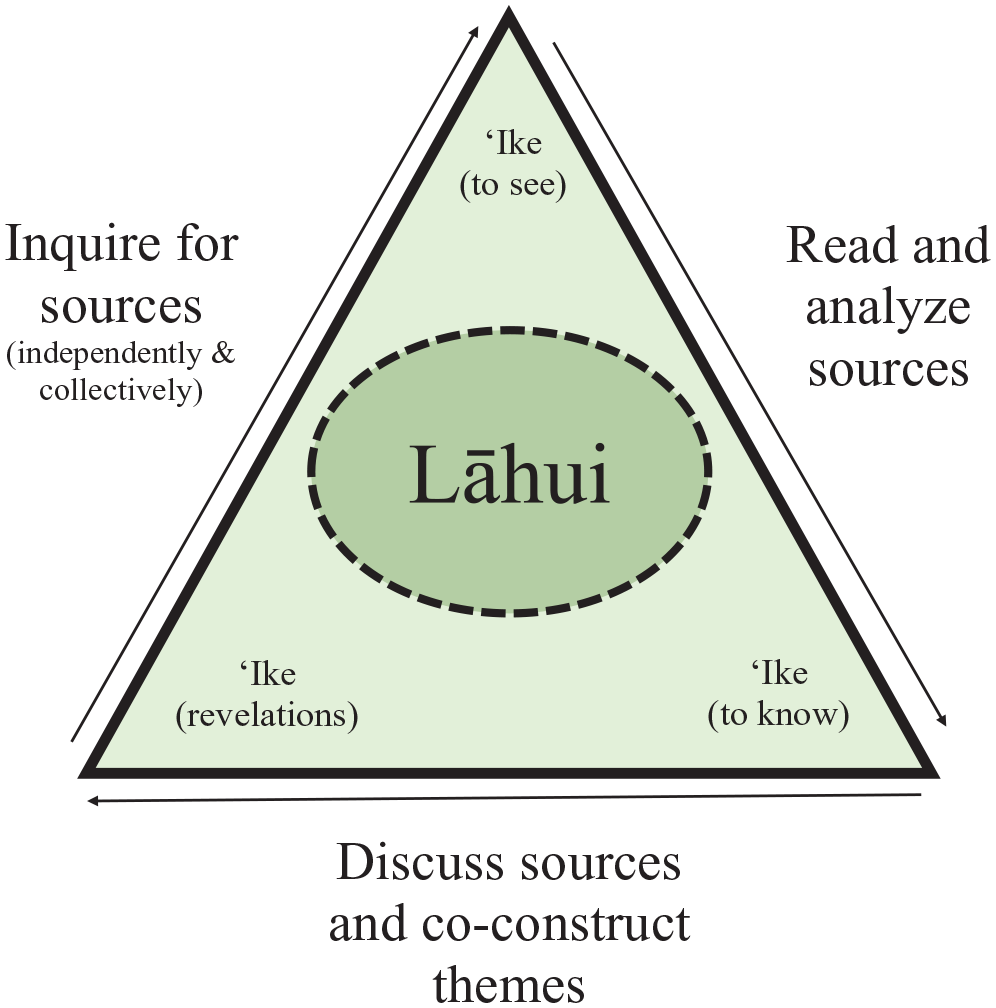
Kanaka ʻŌiwi Literature Review Methodology Model
Literature Search
Unlike colonial literature reviews, this paper’s literature search process began by connecting with Kanaka ʻŌiwi scholars who have studied Native Hawaiian CBE to hear their manaʻo (insight) on my project and its thesis on the liberatory capacity of self-determination, sovereignty, Ea, and Indigeneity for the Lāhui. In Fall 2020, I met with Erin Kahunawaikaʻala Wright and Brandon Ledward, who graciously emailed me a list of 87 CBE references, which served as the literature source from my personal Kanaka ʻŌiwi network. 10 To form a comprehensive snapshot of current scholarship, I coupled this list with literature obtained through independent searches of relevant databases and publications. The following 12 databases were selected for their breadth in education research: APA PsycINFO, EBSCO, Education Source, eScholarship, ERIC, Google Scholar, Hawai‘i Pacific Journal Index, JSTOR, Papers First, Proceedings First, and the ProQuest and WorldCat dissertation and theses databases. Using the list of CBE references, I also identified the following nine publications with peer-reviewed Kanaka ʻŌiwi-focused research: AlterNative: An International Journal of Indigenous Peoples; Anthropology of Education; Educational Leadership; Educational Researcher; Handbook of Indigenous Education; Journal of American Indian Education; Hūlili: Multidisciplinary Research on Hawaiian Well-Being; Race, Ethnicity, and Education; and Sociology and Social Research. I searched these databases and publications online using a combination of the following keywords: Native Hawaiian OR Hawaiian AND culture-based education OR culturally-relevant curriculum/education/teaching/pedagogy/schooling OR culturally-responsive curriculum/education/teaching/pedagogy/schooling. When combined with the list of CBE references, the literature search yielded 3,456 results, including duplicates.
Inclusion and Exclusion Criteria
To narrow these results systematically, I established inclusion and exclusion criteria and applied them to my independent searches through the identified databases and publications as well as the list of 87 references. This systematic literature search process is depicted in Figure 2. I identified relevant literature to review according to (a) publication date, using a period of historical significance (Hallinger, 2013) from 2007, the year that UNDRIP was published, to 2021, the year that I conducted this review; (b) focus on Native Hawaiians AND the pre-K–12 sector in the title or abstract; (c) publication type to include books, conference papers, dissertations and theses, peer-reviewed articles, and reports; and (d) the inclusion of “self-determination” AND “sovereignty” OR “Ea” in the main text, which I manually checked using the search function of the PDF or online versions of each identified result. Guided by two literature reviews that identify both self-determination and sovereignty as equally crucial concepts to contextualize the educational experiences of Native youth (Castagno & Brayboy, 2008; Khalifa et al., 2019), I purposefully chose this final inclusion criterion to assess (a) how scholars utilize self-determination AND sovereignty/Ea in the education field and (b) whether this utilization in Native Hawaiian CBE research increases the likelihood of positioning Kanaka ʻŌiwi as Indigenous. Potential literature sources were excluded from review if self-determination and sovereignty/Ea were only used as quotations or titles from another work. Additionally, due to my lack of proficiency in ʻŌlelo Hawaiʻi, I excluded two articles written solely in Hawaiian language, demonstrating a limitation in my current methodology, especially as more Kānaka scholars advocate for the dissemination of their written work in their ancestral language. 11
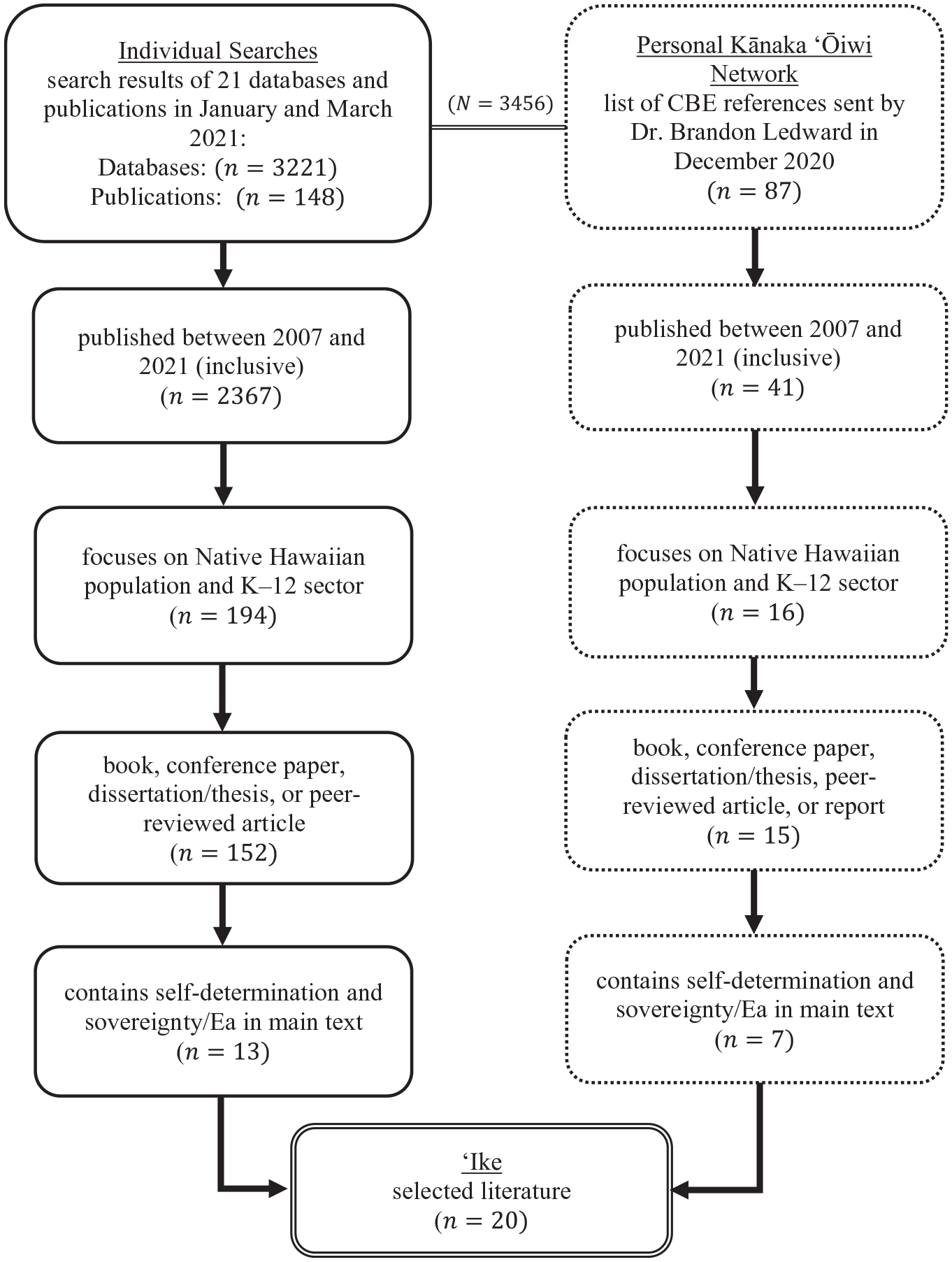
Flowchart of Systematic Literature Search Process
Through this literature search process, I identified and reviewed 20 pieces of literature. While this number is small in comparison to other literature reviews, it is quite extensive given this current review’s intentional focus on Kanaka ʻŌiwi, CBE, and Native-focused concepts. In fact, if I eliminated the first criterion bounding the publication date from 2007, only two works (Murakami, 2006 and Sing et al., 1999) would be added to the literature search process. Ultimately, neither are eligible to review because Murakami’s (2006) dissertation uses self-determination and Ea exclusively in quotations from other works, and Sing and colleagues (1999) do not explicitly state a focus on the pre-K–12 sector. Upon reflection of this review’s aim to uplift the potentialities of affirming Indigeneity in research, including more international journals on Indigenous education to the list of publications I searched may have further deconstructed the literature search process by de-centering U.S.-based publications. However, since I purposefully reviewed Dr. Ledward’s list of 87 CBE references to select publications that boasted higher frequencies of Native Hawaiian-focused scholarship, it is unlikely that I missed a significant number of literature from international publications specifically on Native Hawaiian CBE.
Significance of Current Review
At this point, I must note the sizable gap in Native Hawaiian CBE research that this literature review aims to fill. When “review" was included as a search term for the document title or publication type and combined with “Hawaiian” and “culture-based education” as keywords in APA PsycINFO, EBSCO, ERIC, and Google Scholar, there were zero hits. A similar search through the Review of Educational Research, a quarterly publication for literature reviews in education, also yielded zero reviews. In JSTOR, this keyword combination yielded 153 results, but none fit the current review’s inclusion criteria. In the Journal of American Indian Education, one review (Lee, 2015) fit most of the inclusion criteria, but it did not focus exclusively on Native Hawaiians, demonstrating the present significance of a comprehensive and systematic literature review on and for the Lāhui.
Lāhui-Centric Data Analysis
After identifying sources for this review, I conducted three stages of data analysis. To further ground this review in Hawaiian language and culture, I based this analysis of the 20 works upon the multifaceted flow of Kanaka ʻŌiwi ʻike according to Aluli Meyer (2008). I engaged a three-step process, which holistically represents the analytic method used to answer this review’s main research questions. Consequently, while the individual steps are not indicative of traditional western definitions of analysis, the ʻike acquired at each level becomes increasingly more complex, intentionally mirroring the transformation of knowledge into cultural wisdom (Aluli Meyer, 2008). Next, I explain each step in this analytic process.
Level One: Cataloging Objective ʻIke (To See)
The first level occurred after I identified my data corpus for this review but before I read the literature. At this stage, I cataloged objective ʻike about the 20 sources based on the following categories: author(s) and year, source title, source type, source publisher, and search method (Kānaka ʻŌiwi network, database, or publication). Then, I organized this information into Table 1 and noted how scholars connected their research on Native Hawaiian CBE to self-determination, sovereignty/Ea, the global Indigenous community, and decolonial pathways to praxis. For example, using the “source title” column of the literature table, I found 10 different ways to characterize a possible relationship between education and decoloniality, including “reclaiming, sustaining and revitalizing Hawaiian education,” “catalysts for transformative change in Hawaiian education,” and “preparing Native Hawaiian young adults to become change agents.” I also noted that two sources reference “sovereignty” in their titles, while four mention the term “Indigenous.” Interestingly, 12 of the 20 works use ʻŌlelo Hawaiʻi, and four draw upon metaphors like “we voyage for the earth” and “the seeds we planted,” reflecting Native Hawaiians’ relationality to ʻāina. This stage thus reflects ʻike that I obtained through basic observation rather than extensive experience. In this sense, the first level is indicative of external sight (Aluli Meyer, 2008).
Literature Table
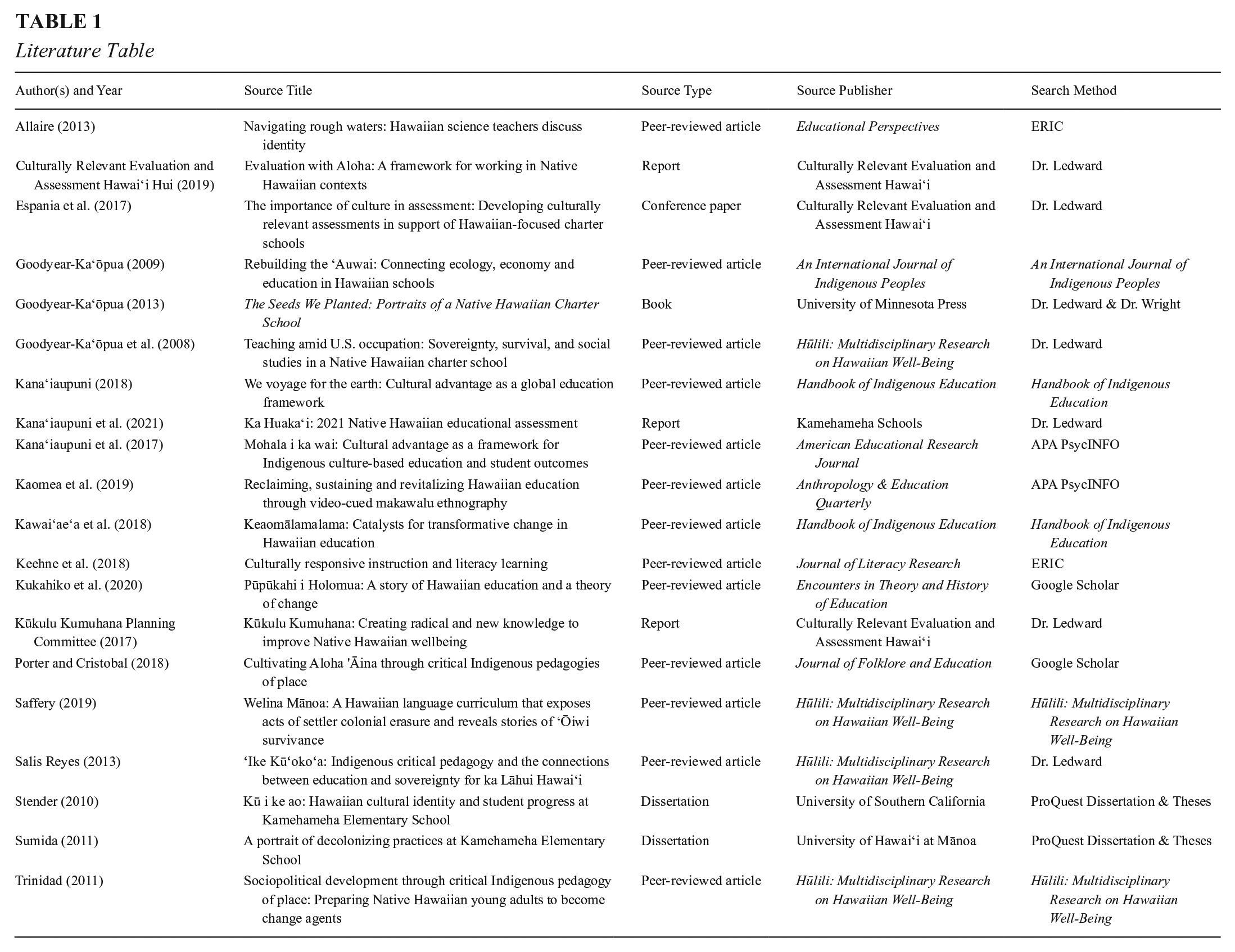
Level Two: Forming Subjective ʻIke (To Know)
After reading the literature, I analyzed the sources using an 11-question systematic literature review rubric (see Table 2) modeled after Harris and Patton’s (2019) summative content analysis rubric, which identifies and quantifies “certain words or content in text with the purpose of understanding the contextual use of the words or content” (Hsieh & Shannon, 2005, p. 1283). 12 Subsequently, key items on this review’s rubric that pertain to the first research question included: “How many times is self-determination mentioned in the text?” “Is it used superficially through minimal usage (e.g., one to two times; as a buzzword) and insufficient explanations, or extensively via clear definitions, examples, and real-world applications in Native Hawaiian CBE?” “How do the authors view or characterize self-determination?” I assessed the operationalization of sovereignty and Ea in a similar manner. For the second research question, I counted the number of times that decolonization, decolonial, and deconstruction appeared in the main text of the literature then evaluated whether these appearances empowered students to internalize and enact self-determination, sovereignty/Ea, Indigeneity, and praxis using rubric questions like, “In your opinion, do the authors explore pathways to internalize self-determination?” “Do they explore decolonial pathways to form identities as members of a global Indigenous community? How do you know?”
Systematic Literature Review Rubric
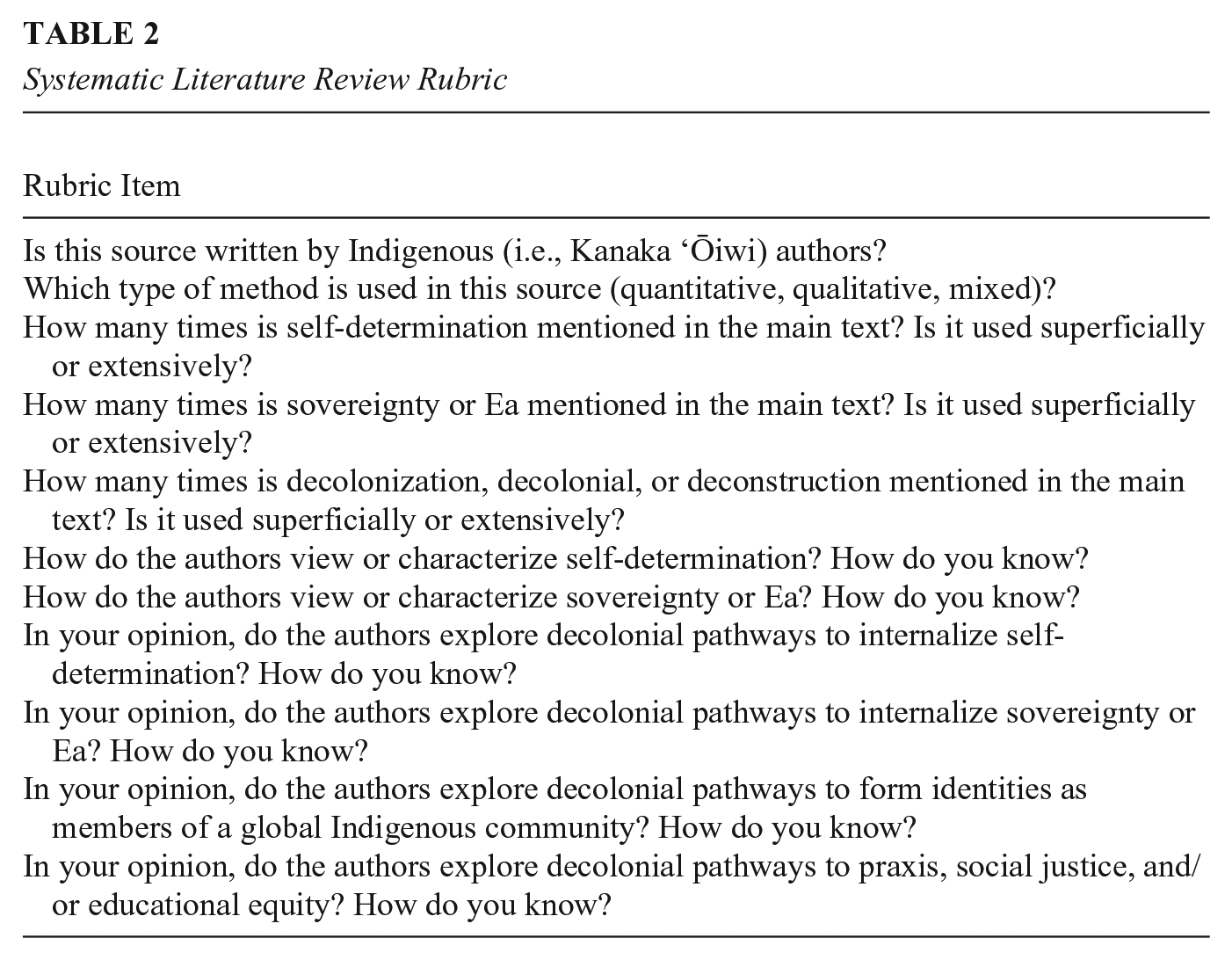
Once I organized my responses to the rubric’s questions in a spreadsheet, I conducted latent content analysis, which refers to the “interpretation of the context associated with the use of the word or phrase” in question (Hsieh & Shannon, 2005, p. 1285). Therefore, I sorted the literature into preliminary categories based on similarities and differences in the authors’ operationalizations of self-determination, sovereignty, and Ea. Additionally, I included a question on the literature review rubric about the authors, and subsequently coded each publication using positionality statements, author biographies, and websites to verify whether or not they are Indigenous/Kanaka ʻOiwi. This was a conscious decision to determine if the recent narratives on Native Hawaiian CBE, self-determination, sovereignty, and Ea are primarily driven by Indigenous scholars. Considering the data from the first level suggests some scholars recognize a transformation of Native Hawaiian CBE is necessary to decolonize education, it is important to know who is shaping recommendations in the literature and including—or ignoring—calls for Indigeneity and praxis. As a result, at this level, I used qualitative content analysis and primarily formed subjective ʻike through personal interpretations of the sources.
Level Three: Synthesizing Cultural ʻIke (Revelations)
Finally, the third level of analysis symbolized the formation of deeper wisdom through collective synthesis. At this point in the triangulation of meaning, ʻike operates at a cultural level to parallel the revelations that occur when learning becomes a spiritual and social experience (Aluli Meyer, 2008). As a Kanaka ʻŌiwi and a graduate of a Native Hawaiian CBE school, I remembered this experience involved listening to kūpuna, sharing moʻolelo, and learning moʻokūʻauhau ʻike (knowledge genealogy). Consequently, to reach this third level, I virtually met with 22 authors from January to May 2021 to discuss my interpretations of their scholarship and their current perceptions of the roles of self-determination, Ea, Indigeneity, and praxis in Native Hawaiian CBE. I sent an initial email to authors to introduce myself and request a virtual meeting, then scheduled a date to connect. For works written by multiple authors, I only emailed the first author initially, but if I did not receive a reply within a week, I contacted additional authors. In some instances, I met with multiple authors for the same source.
Most of these conversations were between 30 minutes to an hour in length and largely followed a “talk-story” interview method, defined as an informal, semi-structured discussion featuring pidgin (Hawai‘i Creole English) and localized jargon to share stories, experiences, and reflections that transcend western notions of time and place (Rogers, 2018). Like most Indigenous research methods, talking story with the authors included an acknowledgment of our relationality to one another, often by identifying common home communities and educational journeys (Wilson, 2008). Additionally, to affirm the humans behind the literature and to maintain good relations with other Indigenous Peoples and allies, I asked the authors to share the moʻolelo of how their publication came to be. 13 In doing so, I interwove a makawalu (multiple perspectives) discourse into these conversations to capture diverging and complementary viewpoints and to illuminate potential “influences on an author, on how a text may have been conceived, what conditions it was born into, how it is perceived in our time, and how it might be received and understood in the future” (hoʻomanawanui, 2019, p. 56). As a result, these moʻolelo added a contextual layer of meaning to these authors’ publications on Native Hawaiian CBE that would not have been captured through my independent analyses alone.
Since talking story is typically free-forming, each discussion varied in its structure and flow. However, the content was fairly similar, with the majority of time spent in conversation on variations of the following questions: “Does this review’s analysis of your operationalization of self-determination and Ea accurately reflect your personal understanding of the concepts in the publication?” “To what extent has this understanding developed or changed since you published this piece?” “What is the relationship among self-determination, Ea, decolonization, and Indigenous unity within Native Hawaiian CBE?” I placed a list of these questions in front of me, but I adapted its order based on the direction that the authors took in their responses. Furthermore, to imitate the informal nature of talking story, I did not record these conversations. Instead, I wrote verbatim notes on the authors’ answers and repeated key statements or phrases back to the authors to ensure I captured their sentiment accurately.
After talking story with these authors, I coded my notes for common themes on the various ways that authors defined, used, and applied self-determination and sovereignty/Ea in their research. I noticed that most of the authors’ perceptions of Native Hawaiian CBE did not change drastically over time, but the makawalu discourse did uplift opposing views on the concepts’ application for Kanaka ʻŌiwi, reflecting the ongoing sociopolitical debate within the Lāhui. Then, I compared the themes from my conversations to the preliminary themes that I formed independently. By comparing, contrasting, and layering these two sets of themes as responses to my research questions, I identified five categories, which formed the basis of the findings and discussion sections.
Lastly, I internally validated any assertions that I attributed to each author as well as the context in which I placed their words via email correspondence in May 2021. If an author disagreed on any part of the excerpt I shared, I revised the assertions accordingly, based on their feedback. For example, I added “market-based” to one scholar’s description of the U.S. settler colonial education system based on a request to highlight the relationship between the functioning of schools and the maintenance of U.S. capitalism. Through this practice, I invoked respect and care for the authors’ wisdom. Moreover, by completing this additional layer of analysis, the research process itself became a spiritual and social act: I connected with leading scholars shaping discourse on Native Hawaiian CBE and deepened my own connection to my culture through an affirmation of Kanaka ʻŌiwi values in research.
Toward a Kānaka ʻŌiwi Literature Review Methodology
In this review, I applied a multilayered approach toward my search and analytic strategies to conceptualize a multidimensional literature review methodology. I thus define a KanakaʻŌiwiLRM as an iterative framework that is (a) critical of literature gaps on Native Hawaiians as evidence of settler colonialism and academic hegemony and (b) Indigenous through its emphasis on Native Hawaiian voices and values in research. Inspired by the structural integrity and symbolism of a triangle as the wholeness of ʻike (Aluli Meyer, 2008), I envisioned a triangular KanakaʻŌiwiLRM model (see Figure 1) in which the individual methods are positioned along the triangle’s sides, the three-step analytic process is located in the triangle’s inner vertices in light green, and the Lāhui’s wisdom is situated as the overarching principle in the triangle’s center in dark green.
While I would like to contend that a KanakaʻŌiwiLRM is also radical in nature, I do not believe this review transgressed academic hegemony enough to receive such a characterization. Although Onwuegbuzie and Frels (2015) argue that adding observations or social media posts can create a high-quality review, I failed to include such forms of ʻike in my literature search. Furthermore, I followed the hierarchical practice of ordering authors on publications and did not contact all authors of the literature I reviewed. I accept any critiques on these limitations and assert that an ideal application of a KanakaʻŌiwiLRM includes non-traditional publication types and manaʻo from all contributors if possible. At present, this review does demonstrate an innovative application of online video conference tools to include community perspectives in rigorous research. Since I completed this review during the 2020–2021 academic school year, when most institutions transitioned to remote learning and work options, the virtual conversations represent the Lāhui’s creative problem-solving skills as we move toward a future where students and educators are increasingly familiar with “Zoom meetings.”
Nevertheless, this current review affirms that Kanaka ʻŌiwi research is a collective, multigenerational endeavor for respect and proper ethics. By elevating Hawaiians as empowered storytellers, a KanakaʻŌiwiLRM shifts the focus toward our wisdom and away from dominant, outsider narratives (J. Kaomea, personal communication, May 5, 2021). Thus, normalizing culture-based tools like a KanakaʻŌiwiLRM is crucial in asserting our self-determination and Ea over our philosophies in academia (W. Kekahio, personal communication, May 5, 2021). If we respectfully and properly seek wisdom using culturally-grounded research instruments, only then will we see a clear path toward the fields of knowledge that our ancestors have cultivated for us to harvest as we deconstruct colonial academic practices.
Findings
Self-Determination and Ea as Foundational Values
As hypothesized, self-determination and Ea were identified as foundational values of Native Hawaiian CBE curriculum design and pedagogy. Multiple educational frameworks and models positioned self-determination and Ea as the pillars of a CBE approach that benefits the Lāhui by privileging Native Hawaiian wisdoms in school settings (Culturally Relevant Evaluation and Assessment Hawaiʻi Hui, 2019; Kūkulu Kumuhana Planning Committee, 2017). For example, self-determination was associated with advocacy and described as a key element of a Hawaiian-focused learning curricula that challenges colonization in Hawai‘i’s traditional public schools (Espania et al., 2017). At a pedagogical level, self-determination was used as the focal points to transmit cultural knowledge through self-empowering strategies (Kanaʻiaupuni et al., 2017). Similarly, Ea was identified as an example of Native Hawaiian content knowledge; when applied to the design of transformative programs and projects, Ea produces “a curriculum of sustainability through agency and action” (Kukahiko et al., 2020, p. 208).
In essence, within this category, authors invoked Native Hawaiians’ inherent rights to dictate their survivance by perpetuating their ways of knowing and being. Although this operationalization recognizes the importance of self-determination and Ea as inherent rights that Kanaka ʻŌiwi possess, it does not necessarily establish a firm link for students to internalize the concepts, identify as Indigenous, or engage in praxis. The Kūkulu Kumuhana Planning Committee (2017, p. 13) asserts that “Ea is manifested in the intergenerational transmission of knowledge,” but there is no explication about how a student’s understanding of Ea through an Indigenous lens could possibly deepen social justice efforts within the Lāhui. While self-determination, sovereignty, and Ea were identified as necessary values to “activate an ethic of Aloha” predicated on love, justice, and sacrifice within culture-based assessments, the application to pre-K-12 classrooms do not mention connections with other Indigenous Peoples (Culturally Relevant Evaluation and Assessment Hawaiʻi Hui, 2019, p. 21).
Native Hawaiian Culture-Based Education as Manifestations of Kanaka ʻŌiwi Self-Determination and Ea
A second anticipated finding of this review is the characterization of Native Hawaiian CBE itself as a manifestation of Kanaka ʻŌiwi self-determination and Ea. This ʻike is evocative of Kanaʻiaupuni (2018) and Kanaʻiaupuni and colleagues’ (2017) contention that sustaining CBE approaches is an example of a Hawaiian self-determination that challenges societal oppression. Likewise, Saffery (2019) concluded that an ʻāina-based CBE approach is the Ea of our kūpuna because it constitutes a (re)animation and perpetuation of place-based practices within colonial systems. In her article, Salis Reyes (2013) contends that Indigenous critical pedagogy is a vehicle to disrupt colonial educational approaches through “the decolonization and indigenization of education” (p. 212). Therefore, since Indigenous critical pedagogy aims to “reclaim education as a space for resistance against colonization and Eurocentric hegemony” (p. 214), its existence is linked to Kanaka ʻŌiwi self-determination, sovereignty, and Ea.
Research on Native Hawaiian CBE schools also concluded that these institutions exhibit not only sustainable forms of Kānaka self-determination but also Hawaiian educational sovereignty (Espania et al., 2017; Goodyear-Kaʻōpua, 2009, 2013; Goodyear-Kaʻōpua et al., 2008). Furthermore, through this characterization of self-determination and Ea, Native Hawaiian CBE schools symbolize both the intersections of school-, community-, and state-level partnerships as well as the capacity to mobilize multiple communities to act for the Lāhui (N. Goodyear-Kaʻōpua, personal communication, February 1, 2021). However, in practice, some Native Hawaiian CBE schools may continue to operate as sites of Indigenous struggle and resistance due to federal pressure to comply to western norms for funding (Goodyear-Kaʻōpua, 2013; Keehne et al., 2018). While Native Hawaiian CBE may trigger the building of a decolonial education system that values self-determination, Ea, ʻāīna, and the Lāhui, ʻohana needs to be explored more as the locus of widespread decolonization (K. Kawaiʻaeʻa, personal communication, February 19, 2021). As I will assert later, this includes a redefinition of ʻohana that embraces the global Indigenous community, since none of the 11 works in this category critically explore pathways for students to internalize identities as Indigenous in their operationalization of self-determination and Ea.
Decolonial Pathways to Praxis as Educational Bridges
This review also discovered a conceptual application of self-determination and Ea that subsequently creates decolonial pathways to praxis. By recognizing that Native Hawaiian CBE schools are manifestations of self-determination and Ea, students may realize their own ability to dismantle oppressive systems through restorative and resurgent ʻāina-based practices (Goodyear-Kaʻōpua, 2013). Similarly, when links between and among self-determination, Ea, and Native Hawaiian CBE are established, students develop the ʻike to speak back to colonization using Kanaka ʻŌiwi ways of knowing (Porter & Cristobal, 2018; Saffery, 2019). When culture is viewed as an advantage to their education and identity, students form a critical awareness that motivates them to bridge their knowledge to solve community issues (Kanaʻiaupuni, 2018). In essence, when students learn about the historical context of self-determination and Ea as it pertains to community control over Kanaka ʻŌiwi education, they cultivate a sense of kuleana (right, responsibility) to address disparities afflicting their people (Trinidad, 2011). By exploring the potentiality of student-driven change as a result of engaging with a Native Hawaiian CBE that expresses Kanaka ʻŌiwi self-determination and Ea, these five pieces of scholarship offer practical ways for our youth to disrupt cycles of oppression and uphold community values in spaces where power struggles occur (A. Trinidad, personal communication, February 12, 2021). Since eight out of the 20 pieces of literature I reviewed do not mention decolonization, I contend that more scholars should consider identifying praxis as major goals of Native Hawaiian CBE.
Native Hawaiian Student Identity as a Direct Outcome
By naming self-determination and Ea as key concepts within Hawaiian community, Allaire (2013) argued that a Native Hawaiian CBE science curriculum that incorporates these terms can appeal to students’ Hawaiian identities and their pursuit of social justice (F. Allaire, personal communication, February 12, 2021). This conclusion is corroborated in Stender’s (2010) study, which positioned Ea as expressions of culturally-engaged Kanaka ʻŌiwi students that exist in the hearts and souls of our youth (R. H. Stender, personal communication, February 26, 2021). I argue that Kanaʻiaupuni and colleagues’ (2021) operationalization of self-determination as a meaningful element for the construction of a globally-oriented, critically-conscious Kanaka ʻŌiwi student identity helps us to realize the importance of searching for historical connections across groups in order to contextualize contemporary sociocultural and sociopolitical phenomena (Givens & Ison, 2022). Although the three works in this theme do not discuss pathways to Indigeneity through their operationalization of self-determination and Ea, I believe Kanaʻiaupuni and colleagues’ (2021) exploration of Hawaiian educational wellbeing through a global Indigenous lens softens the terrain for future scholarship on the connections between Native Hawaiian CBE and Indigeneity.
Student Self-Determination and Ea as Sociocultural Outcomes
In addition to identifying self-determination and Ea as foundations of Native Hawaiian CBE, this literature review found that those concepts are positioned as student outcomes of CBE. Scholars argued that an education grounded in ʻŌlelo Hawaiʻi and sustainable ʻāina philosophies empowered students to join the Lāhui’s movement for self-determination and Ea (Goodyear-Kaʻōpua, 2009, 2013). Furthermore, by participating in Native Hawaiian CBE that draws from Kanaka ʻŌiwi experiences, students self-determine their participation in their education and enact responsibility over their futures (Kanaʻiaupuni, 2018; Kanaʻiaupuni et al., 2017; Keehne et al., 2018; Trinidad, 2011). While Salis Reyes (2013) stated that this outcome occurs when students understand ʻIke Hawaiʻi (Hawaiian knowledge), Sumida (2011) emphasized a student’s sense of self-efficacy as a prerequisite for a sociopolitical self-determination that affirms the student’s control over her actions and choices. I believe Saffery’s (2019) characterization of student Ea as voice and active engagement bridges the two aforementioned pieces, for it is through their confidence and pride in their mother tongue that ancestral Ea is manifested.
Based on my independent analysis, I argue that Goodyear-Kaʻōpua (2013) and Salis Reyes (2013) discuss this possibility through an extensive operationalization of self-determination and Ea that contextualizes their application in a K–12 classroom using examples of student projects and perspectives. For example, Goodyear-Kaʻōpua (2013) recounts multiple moʻolelo of student agency during the early 2000s, when numerous students and alumni of Hālau Kū Māna, a Hawaiian focused charter school on O‘ahu, participated in marches near the state’s capitol to assert Native Hawaiian rights to educational sovereignty. She contends that the moments when these Kanaka ʻŌiwi youth raised “a collective Hawaiian voice not only by reciting memorized chants and lyrics but also by sharing information and discussing the substantive issues to which the marches were trying to bring attention,” they enacted Ea (Goodyear-Kaʻōpua, 2013, p. 212). From a pedagogical standpoint, Salis Reyes (2013) argues that ʻIke Kūʻokoʻa (liberating knowledge), a large-scale initiative to digitize Hawaiian language newspapers, represents an intentional effort to reclaim Hawaiian history and normalize ʻŌlelo Hawaiʻi. By incorporating student participation in the project through Native Hawaiian CBE schools and programs, this form of Indigenous critical pedagogy instills “a sense that they have the power to lend a hand in the continued building of” the Lāhui, thus signaling their individual self-determination and Ea (Salis Reyes, 2013, p. 222).
Decolonial Pathways to Indigenous Identities as a Missing Link
Despite the literature’s link between Native Hawaiian CBE and Kanaka ‘Ōiwi student identity, this review uncovered a lack of exploration of pathways to Indigenous self-identification. Only five of the 20 sources mentioned decolonization multiple times and provided concrete definitions and examples of the concept. Furthermore, about half of the sources used self-determination and Ea superficially; in these instances, the literature did not contextualize the concepts beyond translating Ea as “sovereignty,” or explain their significance to Native Hawaiian CBE. While most of the works discuss Indigenous worldviews, self-determination and Ea are not operationalized as prerequisites to Indigenous self-identification and decolonial pathways to praxis. Although Kanaʻiaupuni (2018) argued that applying a worldwide education framework to Native Hawaiian CBE informs student identities as members of a global community invested in preserving the earth, this conclusion is not reinforced by a comprehensive discussion of Ea beyond its capacity to help teachers and youth view educational power dynamics.
Surprisingly, I reached the same conjecture for the two literature sources that thoroughly operationalized self-determination, Ea, and decolonization. With 106, 97, and seven unique mentions of each respective term, Goodyear-Kaʻōpua (2013) clearly articulated these concepts’ significance for Native Hawaiian CBE. However, the book did not position self-determination and Ea as critical pillars for students to combat U.S. hegemony through Indigenous self-identification. Similarly, Salis Reyes (2013) extensively characterized self-determination and sovereignty as inherent rights of Indigenous Peoples, including Kanaka ʻŌiwi, but there is no explicit link between the concepts and Indigenous student identities.
A Kukui Tree Model of Native Hawaiian Culture-Based Education
Additionally, engaging a KanakaʻŌiwiLRM predicated on the values of ancestral wisdoms, talking story, and relationality between Kānaka and ʻāina resulted in an innovative approach to depict the relationships among the central concepts of this review. Through my conversations with 22 different scholars, I learned about their connections to land and their identities as community leaders, family members, allies, and change agents. I intentionally seek to honor their collaboration now by explaining the role that Native Hawaiian CBE plays in actualizing their vision of a (re)empowered Lāhui in the present and future. Drawing upon the notion of ancestral “wisdom maps,” which provide insight into Kanaka ʻŌiwi “experiences, relationships, and histories,” I use a metaphoric map of the literature to visualize the answers to this review’s research questions (Oliveira, 2019, p. 173).
The 20 pieces of literature are presented in a Native Hawaiian CBE kukui tree (Hawaiian candlenut) model (see Figure 3) that answers how educational researchers define, use, and apply self-determination and Ea and explore pathways for Indigenous identities and decolonial pathways to praxis. This model is purposefully based on a kukui tree to invoke its symbolism as Kanaka ʻŌiwi ʻike. The central parts of the tree translate to specific phases of engaging with Native Hawaiian CBE: self-determination and Ea represent both the aʻa (roots) and kukui nuts; Native Hawaiian CBE symbolizes the kumu (trunk); decolonial pathways to praxis and social justice form the lālā (branches); Native Hawaiian student identity is the lau (leaves); and decolonial pathways to Indigenous identities are the missing lepo (soil). I depict the discursive nature of this process through the tree’s naturalistic cycle of growth, decay, and rebirth. Next, I present the model’s six metaphorical parallels from this review’s co-constructed ʻike:
Self-Determination and Ea as Aʻa: These concepts represent the kukui tree’s aʻa, which tether the plant to the earth and form a foundation upon which life may grow. Self-determination and Ea are located at the base of the tree to reflect their position as the core wisdoms and values of Native Hawaiian CBE.
Native Hawaiian Culture-Based Education as Kumu: This particular operationalization of self-determination and Ea as the inputs and outputs of Native Hawaiian CBE parallels its representation in the model as the kukui tree’s kumu. The flow of energy and water from the aʻa to the kumu mirrors the movement of self-determination and Ea into the education system to seize power from U.S. institutions. The upward path out of the kumu reflects the progression of self-determination and Ea from educational values to the outward goals of a Native Hawaiian CBE that directs students toward nation-building and social justice (Keehne et al., 2018). Like the numerous rings that form the kumu’s structure, this operationalization of self-determination and Ea is multilayered.
Decolonial Pathways to Praxis as Lālā: Moving upward, these pathways to praxis represent the lālā of the kukui tree. Although each lālā varies in growth according to the amount of sun, water, and nutrients it receives, they collectively contribute to the tree’s structure, symbolizing the overall prominence of different forms of praxis for the Lāhui. Moreover, if we perceive the lālā as interconnected support networks that sustain the tree’s lau and hua (fruits), then it is clear that the efficacy of these pathways to student praxis depend on the interdependence of Kānaka youth on each other, their ʻohana, their communities, and ʻāina (M. Saffery, personal communication, March 5, 2021).
Native Hawaiian Student Identity as Lau: Upon a healthy lālā, numerous lau sprout, mirroring the operationalization of self-determination and Ea as concepts linked to identity. Since identity formation is fluid and responsive to contextual factors like time and place, we can visualize the natural process by which the nutrients from a decaying lau enrich the lepo and cycle back to the tree’s aʻa, signaling the dynamic process of identity formation (Horse, 2005; Kim, 1981).
Student Self-Determination and Ea as Kukui Nuts: I propose the blossoming of student self-determination and Ea corresponds to the growth of kukui nuts. While this is another central ʻike from nine works, this operationalization does not support the internalization of self-determination and Ea. I assert that more scholars should operationalize self-determination and Ea in a similar manner to imitate the growth of kukui nuts as symbols of a healthy tree. Consequently, I believe a comprehensive operationalization of self-determination, sovereignty/Ea, decolonization, and the global Indigenous community demonstrates the process by which kukui nuts return to the earth, nourish the tree’s aʻa, and help form the lepo, a crucial component of the model that is currently missing.
Decolonial Pathways to Indigenous Identities as the Missing Lepo: The absence of decolonial pathways to Indigenous identities symbolizes the missing lepo upon which the kukui tree rests. While the model currently depicts a healthy kukui nut tree, one can easily imagine a decaying, unstable tree in its place without sufficient nutrients from the soil. As a result, I contend that Indigenous self-identification must be explored within the Lāhui if we are to develop and maintain good relations with the global Indigenous community.
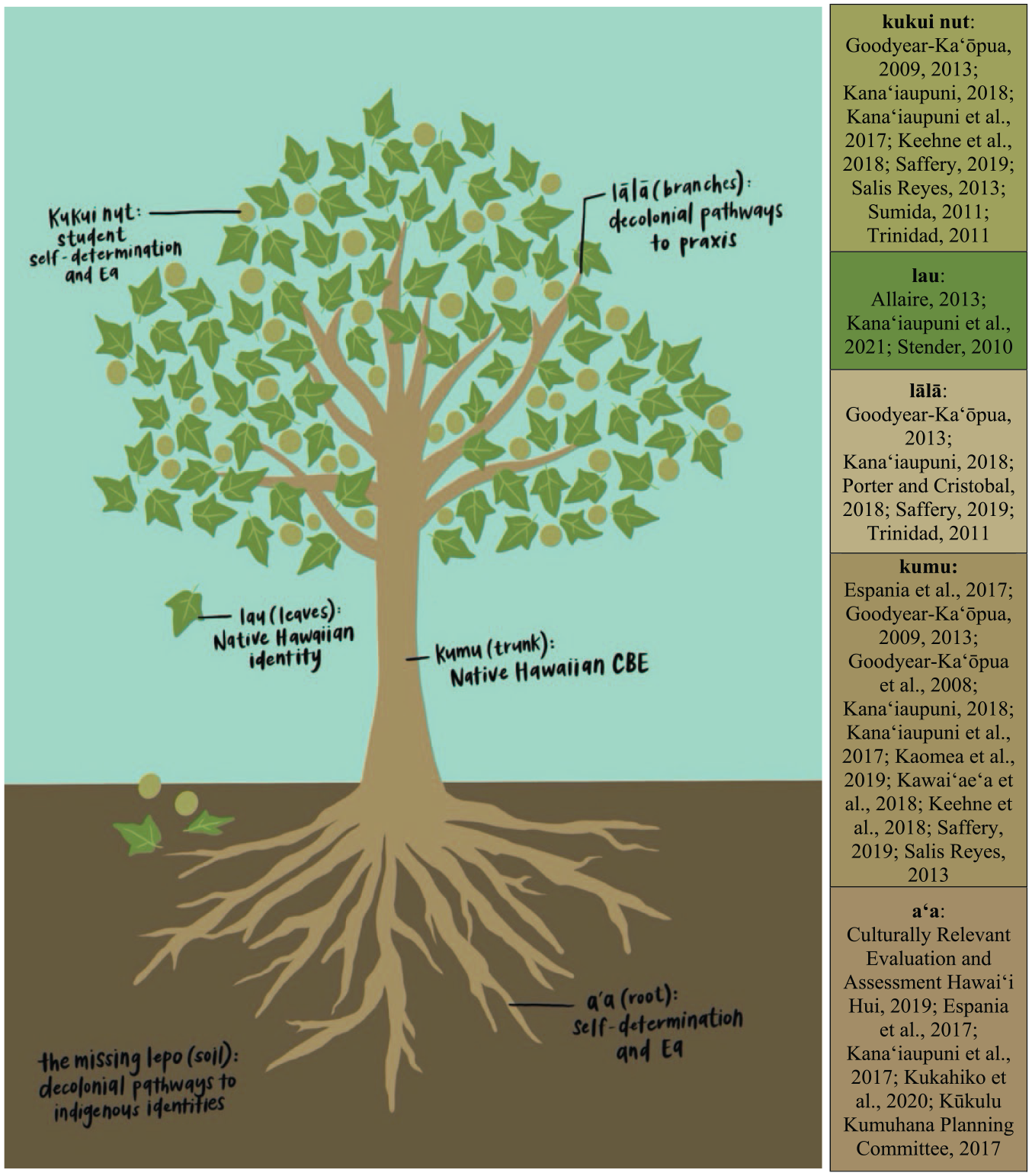
Native Hawaiian CBE Kukui Tree Model
Discussion: Nourishing Our Wisdom, Planting for Our Lāhui
The co-constructed ʻike found through a KanakaʻŌiwiLRM answered (a) how researchers operationalized self-determination and Ea in Native Hawaiian CBE scholarship and (b) the extent to which this operationalization cultivates students’ capacity to internalize self-determination, sovereignty/Ea, and Indigenous identities for praxis. This ʻike holds several implications, which deepen our understanding of their application for the present and future. This section is thus informed by the literature, the authors’ manaʻo, and my personal experiences attending a Native Hawaiian CBE school. I begin with a brief discussion of this review’s findings, then I contextualize the implications of this ʻike through critiques and recommendations for Native Hawaiian CBE school policy, teaching, and research.
Manaʻo on the Native Hawaiian CBE Kukui Tree Model
First, the literature reveals that self-determination and Ea are commonly operationalized as the foundations, student outcomes, and community manifestations of Native Hawaiian CBE. While this finding confirms a degree of consensus on the two concepts’ significance among Kanaka ʻŌiwi scholars, it does not corroborate a widespread familiarity of the terms within Native Hawaiian CBE schools or the Lāhui. In fact, among the 16 pieces that fit within the kukui tree model’s aʻa, kumu, and kukui nuts, only five (Culturally Relevant Evaluation and Assessment Hawaiʻi Hui, 2019; Espania et al., 2017; Kawai‘ae‘a et al., 2018; Kukahiko et al., 2020; and Kūkulu Kumuhana Planning Committee, 2017) are conceptual papers that provide generalizable pedagogical frameworks for Native Hawaiian CBE schools. If we analyze this short list according to the number of times that self-determination and Ea are mentioned in the main text, we are met with a stark discovery: only one paper (Kūkulu Kumuhana Planning Committee, 2017) provides extensive definitions and examples of both concepts. Thus, scholarly agreement does not automatically yield substantial circulation and understanding among practitioners, especially if self-determination and Ea remain superficially operationalized in research.
Second, this review found a gap across all 20 pieces of literature on decolonial pathways to Indigenous student self-identification. Indeed, every source refers to Indigenous Peoples and their distinct cultural worldviews in comparison to western philosophies, but none of the works explicitly call on Native Hawaiian CBE educators or students to consider the potentiality of self-identifying with the global Indigenous community as an indicator of a decolonial pathway to praxis—hence, the missing lepo. While scholars may intentionally avoid pushing an Indigenous agenda in research to ensure Kanaka ʻŌiwi can freely decide to self-identify as Indigenous (M. Saffery, personal communication, March 5, 2021), I argue that this lack of unity prevents collective action against colonization in the academy and U.S. society. Instead of fully recognizing the efficacy of a societal normalization of diverse Indigenous worldviews (D. K. Sang, personal communication, February 26, 2021), Native Hawaiian CBE schools silo Kanaka ʻŌiwi youth, thus creating spaces for Hawaiians to self-actualize community-specific visions while paradoxically reinforcing a colonial market-based education system that alienates the Lāhui (K. Kukahiko, personal communication, May 4, 2021). Therefore, this second finding suggests that a connection exists between a missing call to action for Indigenous self-identification in the literature and a hesitancy to endorse Indigeneity as a political statement. Before offering recommendations to address these current shortcomings of Native Hawaiian CBE, I first address an important critique and limitations of this review that emerged through my use of a KanakaʻŌiwiLRM and reflections on the co-constructed ʻike.
Unearthing Gaps in the Kukui Tree Model: Critiques and Limitations
Although my subjective interpretations of the literature led me to conclude that the majority of Native Hawaiian CBE scholarship superficially operationalized self-determination, my conversations uplifted a critique that the concept may be irrelevant for Kanaka ʻŌiwi. During my discussion with Goodyear-Kaʻōpua, who dedicated an entire chapter in The Seeds we Planted (2013) to contextualize the role of self-determination in the post-No Child Left Behind era, she shared that, if given an opportunity to revise the book, she would not use self-determination if the Lāhui no longer invokes it (personal communication, February 1, 2021). Indeed, some Kanaka ʻŌiwi perceive self-determination to be an “outdated” concept and rely solely on Ea to critique hegemony within the U.S. education system (N. Cristobal, personal communication, April 23, 2021). Furthermore, there are notable differences in the use of self-determination for researchers and practitioners. In some Native Hawaiian CBE classrooms, educators may teach synonymous concepts like “empowerment,” “choice,” and “kuleana” over self-determination (D. Espania, personal communication, May 9, 2021). For Au, “ownership” is her preferred term to explore student autonomy in Native Hawaiian CBE (personal communication, April 12, 2021), revealing a methodological limitation of this review due to my exclusion of alternative words for self-determination in my literature search.
While I believe this critique of self-determination exemplifies the hegemonic, settler colonial society’s repeated attempts to isolate Kanaka ʻŌiwi from the global Indigenous community, Goodyear-Kaʻōpua attributes this discordance to the sociocultural movement of language throughout history (personal communication, February 1, 2021). Here, I must admit that self-determination’s transformation from a western concept for nation-building, self-governance, and state opposition (Hemi, 2019) into a liberating principle for Indigenous Peoples to assert their independent political and international statuses certainly validates Goodyear-Kaʻōpua’s hypothesis. Yet, I also think her point behooves us to consider the linguistic reclamation that occurred when Indigenous Peoples invoked self-determination to address Indigenous education issues in the late 20th and early 21st centuries (Wiessner, 2012). It was no accident that Kanaka ʻŌiwi lawyer Mililani Trask, one of the primary authors of UNDRIP, operationalized self-determination as an inherent right to self-educate children in order to perpetuate Indigenous languages and cultures; education is undoubtedly crucial for survivance and nationhood. Hence, my intention in advocating for the use of self-determination in Native Hawaiian CBE is to uplift this contemporary shift in control over language away from settler colonial notions and toward Indigenous re-definitions.
Therefore, while I am cognizant of the critique that self-determination may not apply to the political and legal identities of Kanaka ʻŌiwi following the illegal overthrow of the Hawaiian kingdom (Hemi, 2019), I purposefully invoke this term within an education context. Although I would have liked to pair Ea with another critical term in ʻŌlelo Hawaiʻi like kūʻokoʻa (independence) in this review, I believe self-determination and sovereignty uniquely capture the complex nature of Indigeneity in ways that Native Hawaiian-specific terms and broad concepts like “empowerment” cannot accomplish if they do not recognize CBE as political (Salis Reyes, 2013). At present, I argue that viewing self-determination and Ea through an anticolonial Indigenous lens cultivates bridges that lead to Native resurgence. While perhaps “outdated” for a solitary Lāhui, self-determination has more to offer the global Indigenous community.
Visions of a Thriving Kukui Tree Model: Concluding Recommendations for a Radical Future
A notable outcome of engaging a KanakaʻŌiwiLRM is the collective power from crafting recommendations for a radical future through visions of a thriving kukui tree model that is rooted in nutritious lepo. Through my conversations with the authors, I have realized that one crucial step toward liberating Kanaka ʻŌiwi from the physical and epistemological impacts of white supremacy is to create “authentic system shifts” through criticality and Indigenization (K. Kukahiko, personal communication, May 10, 2021). While this is certainly a complex endeavor, the manaʻo of the authors and their scholarship direct our attention to the significance of nourishing our wisdom and planting these insights within our children for the Lāhui’s emancipation. I thus offer the following recommendations based on three domains—policy, teaching, and research—in which strategic shifts can occur in the present so that dominant, outsider systems infiltrating our schools can be thoroughly dismantled in the future.
Policy: Deepen the Aʻa
To spearhead this radicalization of Native Hawaiian CBE schools, I believe educators and community leaders should seriously consider incorporating self-determination, sovereignty, Ea, and the global Indigenous community into school policies. Because of the existing gap in decolonial pathways to Indigenous self-identification revealed by the literature, I urge Native Hawaiian CBE school leaders to contemplate the value of genuine Indigenous solidarity through explicit references in their protocols. If these institutions affirm Indigenous Peoples’ inherent right to self-determination and sovereignty in mission statements and school visions, then more Kanaka ʻŌiwi may become familiar with the concepts’ significance for the Lāhui’s physical wellbeing as articulated in UNDRIP (Kanaʻiaupuni et al., 2021). If Native Hawaiian CBE schools invoke community-driven models for discipline, grading, and wellness policies and intentionally link these procedures to global Indigenous efforts to dismantle colonial notions of achievement and success (Goodyear-Kaʻōpua et al., 2008), then Kanaka ʻŌiwi may internalize their capacity to effect change through Indigenous wisdoms. Metaphorically, I argue that cultivating decolonial pathways to Indigenous self-identification through school policies can develop a rich lepo and create ideal conditions for the kukui tree to deepen its aʻa and tether itself firmly to the earth.
Although endorsing this recommendation may generate significant challenges if key stakeholders are unfamiliar with self-determination, sovereignty, Ea, and the global Indigenous community, I believe this authentic shift can be effectively and sustainably implemented if opportunities for critical dialogue about these concepts are provided. Therefore, before revising institutional policies, school leaders should hold forums to ensure that all members can openly engage with the issue of superficial Indigenous solidarity together. For example, if workshopping the purpose statement of Mālama Honua Public Charter School (MHPCS), a K–8 Native Hawaiian CBE institution in Waimānalo, Oʻahu, input from the school’s faculty, staff, students, families, and community for manaʻo on how self-determination, sovereignty, Ea, and the global Indigenous community can fit into the policy should be reviewed. Moreover, as public charter CBE schools like MHPCS face pushback from the hegemonic education system regarding the validity of culture-based assessments as a substitute for standardized college entrance exams, it is also important to receive feedback and support from postsecondary representatives to craft policies that integrate CBE wisdom from all educational sectors (C. Hoe, personal communication, April 13, 2021).
I thus challenge school leaders to reflect upon the following questions before implementing this recommendation: What does it mean to invoke Indigeneity in school policies from Native Hawaiian and global perspectives? How can our policies disrupt colonial ideologies about our students’ potential for success and achievement through ʻIke Kūpuna (ancestral knowledge) and Indigeneity? What information needs to be scaffolded for community members to understand our operationalization of self-determination, sovereignty, Ea, and the global Indigenous community as decolonial concepts? By unpacking the nuances of these questions and their implications for school policies as a community, it is my firm belief that Native Hawaiian CBE schools will transform people’s consciousness and trigger a mass awakening of a critical and radical view of the world.
Teaching: Brace the Kumu
While schoolwide policies that explicitly designate Native Hawaiian CBE schools as manifestations of self-determination and Ea represent one major shift toward transforming the western education system, instructional practices must also clearly embrace Indigeneity. Indeed, students as young as kindergarten should be exposed to definitions and examples of Indigenous Peoples, self-determination, and sovereignty. 14 For instance, if teaching the story of Papahānaumoku (Earth Mother) and Wākea (Sky Father), educators can compare this moʻolelo to other Tribal creation narratives to validate Indigenous storytelling as tools for survivance and agency. Similarly, to educate students on their pilina (relationships) to ʻāina and praxis, instructors can highlight both the “Water is Life” movement at Standing Rock and the Kū Kiaʻi Mauna movement in Hawaiʻi. In essence, when Indigeneity is embedded throughout Native Hawaiian CBE, students can discover their voice and value, applying ʻIke Kūpuna to find actionable solutions to community and global issues. Consequently, these empowered voices come to symbolize an interwoven lei (garland) of hope connecting individual kukui nuts enriched by self-determination and Ea (S. Kanaʻiaupuni, personal communication, May 11, 2021). As a result, this lei effectively braces the kukui tree’s kumu to reinforce its growth and maturity over time.
By incorporating self-determination, sovereignty, Ea, and Indigeneity into schooling, a decolonial Native Hawaiian CBE emerges as a resisting force against the dominant power of whiteness throughout the education system. Under this radical model, all students can learn how to dialogue critically about racism, colonialism, and occupation by analyzing real-world problems as a collective. In doing so, teachers and students uplift Kanaka ʻŌiwi agency and responsibility to undo whiteness and erasure in our ancestral homeland and support similar efforts for the liberation of all Indigenous Peoples (Salis Reyes, personal communication, February 26, 2021). To pursue this decolonial vision, I offer the following questions to teachers for consideration: Which Indigenous wisdoms do I wish I learned in school? Whose stories are continuously silenced or ignored in curriculum? How can I honor and celebrate Indigenous languages and cultures while challenging western notions of U.S. and world history and other subjects? With these questions in mind, it is clear that a decolonial Native Hawaiian CBE approach enacts real-world change through Indigenous unity and empowers educators and students to critique and address societal issues together (A. Sumida, personal communication, April 26, 2021).
Research: Extend the Lālā
Despite the challenges of conducting research during the Covid-19 pandemic, this review proves that collaboration with the Lāhui is essential for anticolonial Kanaka ʻŌiwi scholarship that supports social justice efforts. Although engaging a KanakaʻŌiwiLRM adds a layer of labor to a project, we should pursue this work to demonstrate love and care within data analysis and dissemination practices for the Lāhui’s wellbeing (L. Watkins-Victorino, personal communication, April 16, 2021). Therefore, I assert that future research on the Lāhui must privilege Indigenous voices and narratives, paralleling the natural extension of the kukui tree’s lālā toward the sun for enlightenment and vibrancy. For scholars interested in grounding their literature review in ʻIke Kūpuna, I recommend reflecting upon the following questions: How can I enact nānā i ke kumu (look to the source) in research? How can I invoke Indigeneity in my work? Which colonial ideologies do I need to dismantle in order to uplift Indigenous worldviews?
Additionally, because this review uncovered a gap in empirical research focused on self-determination, Ea, and Indigeneity, I ask for empirical studies on the outcomes of teaching these concepts to youth. While I am currently finishing a qualitative pilot study on Kanaka ʻŌiwi students’ perception of their cultural identities, this literature review also revealed a need for participatory action research on this topic to advance social justice efforts. Thus, I offer the following questions for a potential youth participatory action research study: After engaging in formal instruction on self-determination, Ea, and the global Indigenous community, how do Kanaka ʻŌiwi high-school students come to perceive local and global issues affecting Indigenous Peoples? What individual and collective solutions do students offer to address these problems?
Ultimately, I hope to enact my own self-determination, sovereignty, and Ea and contribute to an extensive, anticolonial transformation of the Lāhui through my current and future work. By invoking justice, praxis, and unity in this review, it is evident that collaboration is a central element of my researcher identity, which strives to “go upstream against those who control the distribution” of power and privilege in society (P. Lee, personal communication, April 16, 2021). As this KanakaʻŌiwiLRM has demonstrated, it is deeply unsustainable and “un-Kānaka” to fight these systems alone. After coming to realize the depth of the pilina and kuleana that Indigenous Peoples carry with ʻāina and one another while conducting this literature review, I am confident that the Lāhui and the global Indigenous community’s survivance ensures I never have to.
Footnotes
Acknowledgements
The author would like to thank Dr. Jason Nunzio Dorio, students in UCLA School of Education’s 2020–2021 MA cohort, Dr. Daniel Solórzano, and the anonymous reviewers for their valuable comments on this publication’s numerous drafts. You greatly pushed my thinking about Native Hawaiian methodology and culture-based education. The author would also like to acknowledge Codie Conching for contributing her incredible artistic skills to bring the kukui tree model to life.
Glossary
ʻāina land
aʻa root
Ea sovereignty, rule, independence, leadership; breath, life
ʻike knowledge, revelations; to see, to know, to understand
ʻIke Kūʻokoʻa liberating knowledge
ʻike kūpuna ancestral knowledge
ʻohana family
ʻŌlelo Hawaiʻi Hawaiian language
hua fruit
Kanaka, Kānaka, Kanaka ʻŌiwi Native Hawaiian/s
kukui Hawaiian candlenut
kuleana right, responsibility
kumu trunk; teacher
kūpuna ancestors
Kūʻokoʻa independence, liberty, freedom
lau leaf
Lāhui Hawaiian nation, race
lālā branch
lei garland
lepo dirt, earth
makawalu lit. eight eyes, multiple perspectives
manaʻo insight
moʻokūʻauhau genealogies
moʻolelo Native Hawaiian stories, histories
nānā i ke kumu look to the source
pilina relationships

Notes
Authors
KOURTNEY KAWANO is a Kanaka ʻŌiwi (Native Hawaiian) doctoral student in the department of education at the University of California, Los Angeles, Moore Hall, 457 Portola Plaza, Los Angeles, CA 90095; email: