




Abstract
This systematic literature review examined the research on prior knowledge and its activation to ascertain how these terms are defined, what specific techniques have been empirically investigated, and the conditions under which prior knowledge activation facilitated students’ comprehension. Fifty-four articles met the inclusion criteria and revealed that the terms prior knowledge and prior knowledge activation were often vaguely defined. Further, 30 unique techniques for activating readers’ prior knowledge representing eight different categories were identified. Those categories were open-ended prompts, procedural or strategic supports during reading, visual representations, analogical reasoning, text alteration, augmented activation, extratextual activities, and spontaneous activation. Techniques meant to facilitate knowledge activation prior to reading were most common, although the prompting of students’ existing knowledge was beneficial during and after reading as well. Variability in the effectiveness of activation techniques was related, in part, to the amount, accuracy, and specificity of students’ knowledge. Based on the key findings identified in this review, recommendations for future inquiry are forwarded, including suggested definitions of prior knowledge and prior knowledge activation.
Keywords
As has been documented in theory (e.g., Anderson et al., 1977; Ausubel, 1968; Kintsch, 1998) and in the empirical research for decades (Baldwin et al., 1985; Bransford & Johnson, 1972; Pearson et al., 1979), prior knowledge guides readers’ comprehension of written language. In fact, Anderson and Pearson (1984) stated that reading comprehension entails “the interaction of new information with old knowledge” (p. 255), suggesting a bidirectional and continuous interaction between text content and individuals’ existing knowledge. Essentially, what readers know shapes their processing of written language and facilitates their memory for whatever new understandings they construct (McCarthy & McNamara, 2021). Particularly with the rise of cognitive orientations to learning and the articulation of schema theory and information-processing models in the 1970s and early 1980s (Atkinson & Shiffrin, 1968; Miller, 1956), there was an intense focus on prior knowledge and its effects on what students perceive, comprehend, interpret, and remember from what they read.
In essence, for these cognitively oriented theories, individuals’ existing knowledge serves as a base for subsequent learning and performance. Alexander and Murphy (1998) summarized this perspective in their review of research related to the American Psychological Association’s Learner-Centered Psychological Principles:
One’s existing knowledge serves as the foundation of all future learning by guiding organization and representations, by serving as a basis of association with new information, and by coloring and filtering all new experiences. (p. 26)
This very principle is core to Ausubel’s subsumption theory (1968), which holds that meaningful learning occurs when individuals incorporate new information into existing cognitive structures, a view that was in stark contrast to rote learning. Similarly, schema theory (Anderson et al., 1977) emphasizes the organization and access of knowledge in the mind of the learner. The role of readers’ background knowledge is likewise pivotal to Kintsch’s Construction Integration Model of Text Comprehension (1998), which focuses explicitly on the process of understanding texts and the essential and recurring interaction between the text content and the knowledge and experiences of the reader. This reciprocal relationship between readers’ extant knowledge and text information is influenced by authors’ abilities to communicate effectively with readers, as well as the readers’ recognition of authors’ arguments and messages. Even texts that are well crafted will require readers to infer, filling in gaps in the text to support comprehension (Kintsch, 1998).
After the early 1980s, alternative perspectives on learning and development became popular, such as sociocultural and social-constructivist theories (e.g., Lave, 1988; Rogoff, 1990; Vygotsky, 1991). With this shift in perspective, there was waning interest in individuals’ knowledge among literacy researchers—a trend that persisted for several decades (Alexander & Fox, 2019). Nonetheless, during that particular period, there were those who continued to study the effects of students’ knowledge base on their learning, especially learning from text (e.g., Alvermann et al., 1985; Carr & Ogle, 1987; Pearson & Dole, 1987). From this body of research, there emerged evidence that being able to draw on prior understandings and experiences generally aids students in remembering what they read (Pressley et al., 1989), forming appropriate inferences (Graesser et al., 1994; Kintsch, 2000), and seeing the relevance or significance of what was read (Jetton & Alexander, 1997).
The recognition of the power of prior knowledge can also be found in contemporary programs of text-based research including studies of content area reading (Hwang et al., 2021; Kim et al., 2021), reading development (Alexander, 2005, 2020a), multiple source use (Bråten & Strømsø, 2004; List & Alexander, 2019), refutational texts and knowledge revision (Kendeou et al., 2014), and the processing of multiple-medium or multimodal texts (Singer & Alexander, 2017; Van Meter et al., 2020). In recent years, the role that prior knowledge plays in reading comprehension has gained substantial traction among curriculum developers (Hirsch, 2006), literacy scholars (Knowledge Matters Campaign, 2022), and school leaders (Mathewson, 2019) who advocate for building content-specific knowledge deemed core to academic domains (Spelke & Kinzler, 2007). Further, propelled by declining reading performance in countries such as Australia, Finland, Iceland, Korea, the Netherlands, and New Zealand (Organisation for Economic Co-operation & Development, 2019) and by stagnant or lower reading scores in the United States (Ji et al., 2021), the development of students’ relevant knowledge base and their ability to utilize that knowledge effectively have become growing concerns (Willingham, 2017).
Even though the influence of readers’ background knowledge comes with substantial theoretical, empirical, and public support, there is far less attention paid to the activation and utilization of that knowledge (Hattan et al., 2015; Hattan & Lupo, 2020). It is certainly one thing to know that students’ existing knowledge base matters significantly to what they can comprehend and remember from written text, but quite another to provide students with strategies for drawing on that knowledge when needed. As such, it is imperative to examine techniques that serve to unearth students’ relevant knowledge during reading. For instance, although some readers may routinely activate prior knowledge while reading, many students need external guidance and support to make their existing knowledge accessible and connected to the textual content (Carr & Thompson, 1996; Hattan & Alexander, 2021; Hattan & Dinsmore, 2019; Lupo et al., 2019). Further, it has also been shown that even when students have relevant knowledge, they may not know how or when to use it during reading (Cain et al., 2004; Cain & Oakhill, 1999).
Thus, the necessity and importance of prior knowledge activation and its role in text comprehension raise important questions that have not been adequately investigated. For example, is there evidence that researchers referring to prior knowledge conceive of that concept similarly, or are there differences based on the correctness or specificity of that knowledge? Correspondingly, is there consistency in what researchers mean when they refer to knowledge activation, or does that concept vary in accordance with the nature of readers’ knowledge of interest to researchers? Moreover, what activation techniques have been studied, and how do those techniques reflect the complexity of knowledge? What techniques appear more or less effective when text comprehension is the desired outcome? Does the need for or the nature of knowledge activation change as learners progress in their schooling, reading ability, or their topic or domain knowledge? That is, are activation techniques more important with younger or less skilled readers, or with students who have less relevant knowledge upon which to rely? Further, what can be done when students’ topic or domain knowledge is limited, ill matched to the reading content, or simply inaccurate?
The question of how prior knowledge and its activation are defined matters if one is to judge the effectiveness of techniques meant to activate readers’ existing knowledge (Dochy & Alexander, 1995; Simonsmeier et al., 2022). In an effort to clarify the definition of prior knowledge, McCarthy and McNamara (2021) introduced the Multidimensional Knowledge in Text Comprehension framework, which posits that researchers should consider the amount, accuracy, specificity, and coherence of readers’ academic knowledge, including topic and domain knowledge, before reading.
To understand the importance of academic knowledge in reading, imagine a middle school teacher preparing their students to read Making Our Way Home: The Great Migration and the Black American Dream (Imani, 2020). As an aid to their comprehension, these students would benefit from first reflecting on relevant content they learned in their social studies classes about this historical period, ranging from the Civil War to the Great Depression, World War II to the Women’s Liberation Movement. However, students could also benefit from calling to mind what they learned in language arts about expository text structures (compare/contrast, problem/solution) to understand how the text is organized (Bogaerds-Hazenberg et al., 2020) or about reading strategies they might use to support their comprehension (Alexander et al., 2018; Palinscar & Brown, 1984).
Yet some researchers contend that activating only academic knowledge undervalues other forms of background knowledge and experiences that could scaffold students’ learning from texts, especially those whose subject-specific knowledge may be limited, or who are from culturally and linguistically diverse backgrounds (Hattan & Lupo, 2020; Ladson-Billings, 2000; Lee, 2007). In those instances, it may be necessary to focus on additional forms of knowledge during activation that draw from students’ life experiences and sociocultural resources—what Moll (2019) labels as funds of knowledge or what McCarthy and McNamara (2021) called personal knowledge. For example, when reading the Imani (2020) book, a teacher might consider other entry points to support students in comprehending the text. A student whose family members are involved in community organizing could apply that personal knowledge to grasp the concept of organized labor that Imani discusses. Students who have knowledge of music and pop culture can activate that knowledge to understand the importance of the Harlem Renaissance and how it led to the eventual emergence of soul music and hip-hop, as Imani described (2020). As these examples illustrate, it was crucial to investigate how researchers represented in this systematic review conceptualized prior knowledge and prior knowledge activation in their studies.
In addition to examining definitions of prior knowledge in the literature, there is also a concern regarding the depth and accuracy of students’ existing knowledge and the potential effects on comprehension and performance (McCarthy & McNamara, 2021). This has been a long-standing issue among knowledge activation researchers (Alvermann & Hynd, 1989), those investigating students’ ability to discern credible from noncredible sources (Breakstone et al., 2018), and researchers analyzing pretest to posttest knowledge gains (Simonsmeier et al., 2022). Thus, the current literature review considers the potential influence of activating inaccurate knowledge on students’ reading comprehension and activation techniques that specifically address students’ erroneous understandings.
It is the goal of this systematic review to investigate the aforementioned questions about prior knowledge and its activation for all phases of learning from text: prior to, during, and after reading. Although other reviews of knowledge have been conducted, these works either focused on forms of knowledge (Alexander et al., 1991; de Jong & Ferguson-Hessler, 1996) or on learning in general rather than on text-based learning specifically (Dochy et al., 1999). There has been no systematic review of prior knowledge since 1999 and no reviews that have expressly focused on prior knowledge and its activation in relation to reading comprehension. Therefore, to address this significant gap in current understandings, the following questions were pursued:
How are prior knowledge and prior knowledge activation defined and described in the literature?
What specific activation techniques have been empirically examined, and what are the key characteristics of those techniques?
How can the specific activation techniques be consolidated into categories based on their key characteristics? To what extent are these categories of activation techniques associated with more positive, neutral, mixed, or negative comprehension outcomes?
Method
Search Criteria
Systematic reviews entail a thorough search of the literature on the basis of clearly articulated parameters and the establishment of criteria to determine the inclusion or exclusion of identified works (Alexander, 2020b). For the current review, publications were limited to peer-reviewed empirical articles written in English. Several other inclusion criteria were established:
participants were students in Grades K–16;
an academic learning task requiring the processing of connected text (i.e., more than one sentence) was included;
the study needed to incorporate an explicit, intended activation of students’ prior knowledge (i.e., a prior knowledge activation technique); and
the knowledge activation technique implemented in the study and the resulting data were described in a manner that permitted us to analyze the results.
Search Procedure
For this systematic review, searches were conducted in the PsycINFO and ERIC databases using a title and abstract search. The following specific search terms were used: “activate prior knowledge,” “activate background knowledge,” “prior knowledge activation,” “background knowledge activation,” “access prior knowledge,” “access background knowledge,” “knowledge activation strategies,” and “knowledge activation.” These searches were not limited by year and resulted in an initial pool of 2,639 publications as of September 30, 2020.
Once the initial pool was constituted, the titles and abstracts of these articles were examined to determine their suitability for addressing the research questions. A total of 2,404 articles were excluded based on the aforementioned criteria, retaining 235 articles for more detailed evaluation. It should be noted that this large exclusion rate is primarily due to the exclusion of articles that examined the activation of neural networks, which was not the focus of this review. After evaluation, 48 studies were included. Next, the vitae of authors who wrote three or more of the identified articles were also examined (no additional articles were identified), as well as a journal hand search over the past 5 years for journals where four or more identified articles were published (two additional articles were identified). Additionally, a reference search of all included studies led to the identification of four articles. A total of 54 articles were included in this systematic literature review (see Figure 1). Of these 54 articles, 14 included two studies, for a total of 68 examined studies.
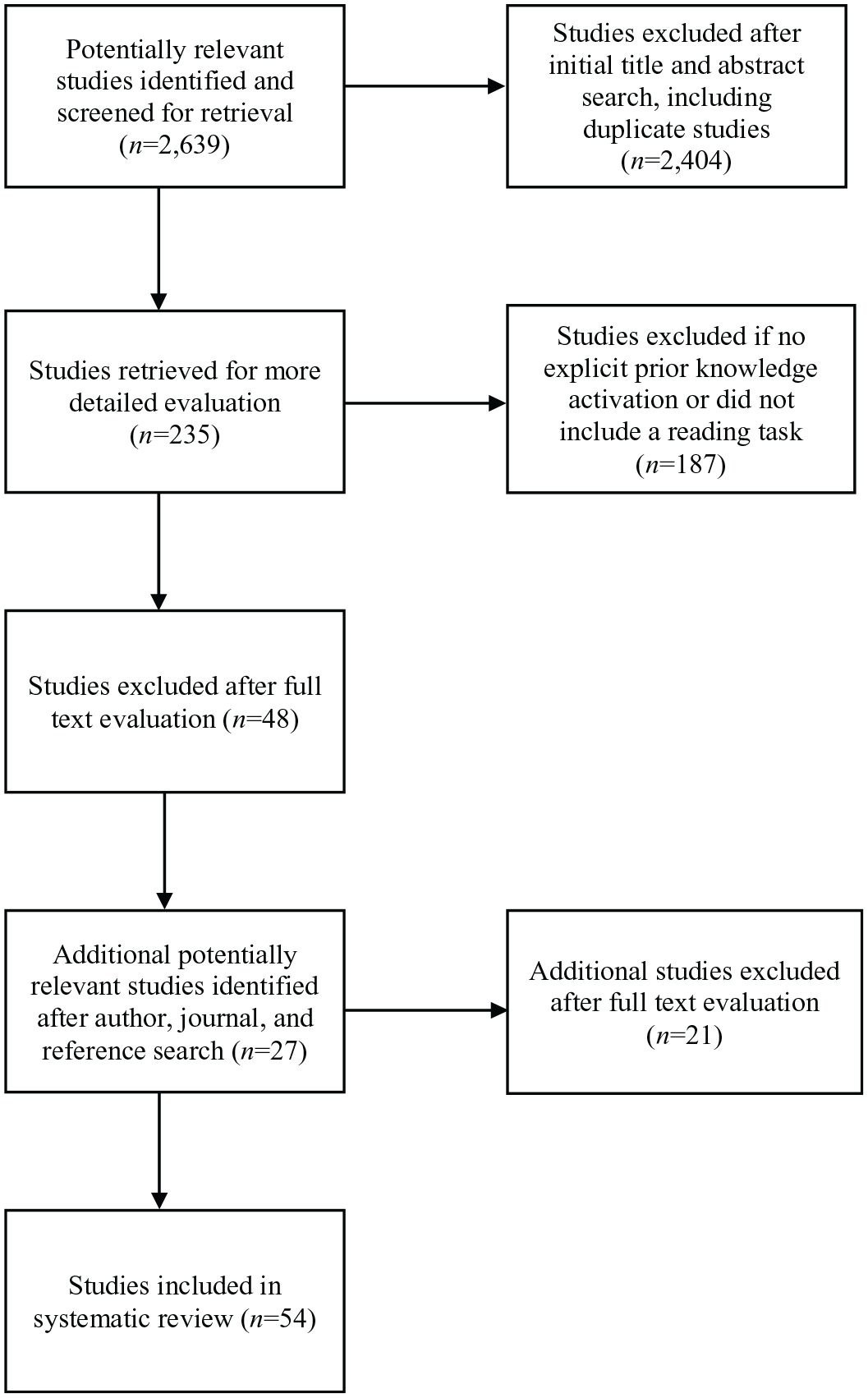
Process for systematic literature review.
Articles were excluded from the review if participants were in pre-Kindergarten (e.g., Roberts, 2013) or were adults who were not in college (e.g., Rogers & Patterson, 2007). This decision was driven by the need to ensure that participants were engaged in text-based learning. Additionally, the focus of the articles needed to be on student learning, rather than teacher learning. For example, Seidel et al. (2011) investigated the influence of teachers watching videos of themselves on the teachers’ pedagogical learning. The researchers did not examine whether those teacher outcomes translated into student learning, however. Therefore, this article was excluded from further analysis.
Further, the primary emphasis of this literature review was on the activation of students’ prior knowledge when reading expository or narrative connected texts, or texts that include more than one sentence. Therefore, studies were excluded if participants were asked to read a single sentence (e.g., Wood et al., 1994) or if they focused on a learning task that did not include text processing (e.g., Kaminski et al., 2013; Rietzschel et al., 2007; Wetzels, Kester, van Merriënboer, & Broers, 2011). For example, Budé et al. (2011) investigated the influence of tutor guidance on students’ learning of statistical concepts. Even though the intervention included the explicit activation of students’ knowledge during group discussions, participants were not required to read a text during the study.
Articles were excluded from this review if they measured prior knowledge but did not include a technique meant to activate students’ previous knowledge. For example, Baldwin et al. (1985) examined the influence of topic interest and prior knowledge on text comprehension, without explicitly activating prior knowledge at any point during the reading process. Additionally, articles were excluded when the means of prior knowledge activation was not sufficiently explained since it would not be possible to characterize or categorize the activation technique. In other words, if the authors stated that they activated learners’ prior knowledge but did not describe how that knowledge was activated, the article was excluded. For example, Guthrie et al. (1998) stated that using prior knowledge was part of a strategy instruction intervention but did not provide details regarding how participants’ knowledge was activated.
Coding and Analysis
Definitions
The first research question considered the definitions and descriptions of prior knowledge and prior knowledge activation present in the literature. The procedure used for coding followed a system employed by Murphy and Alexander (2000) and Dinsmore et al. (2008) where definitions are first coded based on whether they are (a) explicit, (b) implicit, or (c) no definition was offered. For explicit definitions, the authors explained the meaning of the terms directly. Explicit definitions were often signaled by authors using phrases such as “prior knowledge is conceptualized as. . .” (Gurlitt & Renkl, 2010, p. 408) or “schema activation is. . .” (Mannies et al., 1989, p. 121) and could be directly quoted using their words or phrases. The explicit definitions of prior knowledge were further analyzed to ascertain whether they matched the type of prior knowledge authors sought to activate.
In contrast, implicit definitions could not be directly extracted from the reviewed studies but had to be inferred from text. For this analysis, implicit definitions were broken down according to whether they were (a) conceptual, which occurred when “words or phrases alluded to meaning” of the key terms (Dinsmore et al., 2008, p. 397); (b) referential, when authors cited another article; or (c) operational, which included either a measure of prior knowledge or a technique that supported prior knowledge activation. Conceptual definitions differed from explicit definitions in that the authors did not directly signal that they were defining a term, but instead included descriptors or associated words that alluded to the characteristics of prior knowledge or prior knowledge activation. For example, researchers may have referred to content or topic knowledge somewhere in the manuscript, but did not state that those types of knowledge were how they defined prior knowledge. The coded categories were not mutually exclusive. For example, articles could be coded as having both conceptual and operational definitions.
Prior Knowledge Activation Techniques
Next, knowledge activation techniques, which represented formalized procedures intended to stimulate the unearthing of preexisting understandings, beliefs, or experiences, were examined. These techniques were coded in six ways: (a) the domain in which the reading took place (e.g., science), (b) the grade levels of the participants (e.g., middle school students), (c) whether inaccurate knowledge or misconceptions were addressed, (d) when the techniques were initiated (i.e., before, during, or after reading), (e) whether the techniques were undertaken independently or collaboratively, and (f) the category of the technique (e.g., open-ended prompts, visual representation). Some articles included multiple studies (e.g., Beker et al., 2016) or investigated more than one activation technique (e.g., Wetzels, Kester, & van Merriënboer, 2011). In such cases, each activation technique within the study was coded separately.
The first two codes were used to identify whether prior knowledge activation techniques have been empirically studied across domains and grade levels, or whether most of the techniques took place with undergraduate psychology students, for example. Identified domains included reading or language arts; science; social studies or history; psychology, statistics, or economics; and technology or media. Grade level bands included lower elementary (K through 2nd grade), upper elementary (3rd through 5th grade), middle school (6th through 8th grade), high school (9th through 12th grade), and college. Some studies asked participants to engage with texts across multiple domains or included participants from more than one grade level. In those cases, more than one code was given to the corresponding technique. Given the complexity of knowledge, techniques were also coded according to whether they addressed misconceptions.
The fourth and fifth codes were used to identify the nature of the activation techniques and were developed a priori based on theories of text comprehension. For example, Kintsch’s (1998) Construction Integration Model emphasizes the importance of continuous interaction between the reader and text, not simply before reading, but also during and after. Therefore, the techniques were coded as to whether they instigated knowledge activation before, during, or after reading, or at multiple times throughout the reading process. Further, although cognitivists (e.g., Kintsch) typically focus on activating individual knowledge, reading can also be a social practice (Street, 1984). In these collaborative reading environments, shared knowledge activation and meaning construction can take place (e.g., Allen, 2003; Andreassen & Bråten, 2011) via class discussions of texts, book groups, or even analysis of a common text within the work environment. Therefore, techniques were coded by whether students were asked to activate their prior knowledge individually, in pairs, or in a group environment.
Once the individual techniques had been charted, an inductive, data-driven approach was taken to group them into broader categories based on salient attributes, such as the mode of activation (e.g., questioning, altering the text). Ultimately, eight categories emerged from the data and several techniques were identified as belonging to more than one category.
Prior Knowledge Activation and Comprehension Outcomes
In addition to the aforementioned codes, each activation technique was coded according to whether knowledge activation had a positive, negative, neutral, or mixed effect on students’ comprehension in comparison to the other conditions in the study. Techniques were coded as positive if they were associated with a significant outcome for comprehension, whereas techniques were coded as negative if students performed significantly worse on comprehension outcomes or if there was a decrement in learning. Techniques were coded as neutral if there were no significant differences found between conditions, and they were coded as mixed if the technique led to different results across multiple outcome measures (e.g., one measure had positive results and another neutral or negative results). After this initial coding process, an inductive, data-driven approach was used to identify patterns between techniques that belong to the same category. Within each category, contributory factors were considered that may have led to these outcomes.
Interrater Agreement
To analyze the results, the first author developed the coding scheme and coded each study. She then trained two additional raters utilizing five example articles. The additional raters coded 13 (24%) of the articles for an interrater agreement of 98%. Codes that were included in interrater agreement were identification of domain; grade level band; whether misconceptions were considered; before, during, or after reading; individual, pair, or group activation; and positive, negative, neutral, or mixed outcomes. After coding each study, data were analyzed using a first-cycle, magnitude-coding procedure (Miles et al., 2014) to consider the frequency with which each code occurred in the data. The data-driven codes, which were utilized to establish categories of knowledge activation, were not included in the interrater agreement. Instead, the first and third authors collaboratively identified these categories for all included studies using a second-cycle, pattern-coding procedure (Miles et al., 2014).
Results and Discussion
How Are Prior Knowledge and Prior Knowledge Activation Defined and Described in the Literature?
The first research question guiding this investigation centered on the manner in which researchers defined prior knowledge or explicated what they meant by the activation of that knowledge. A summary of those results is presented first for prior knowledge before considering knowledge activation.
Prior Knowledge Defined
Explicit Definitions
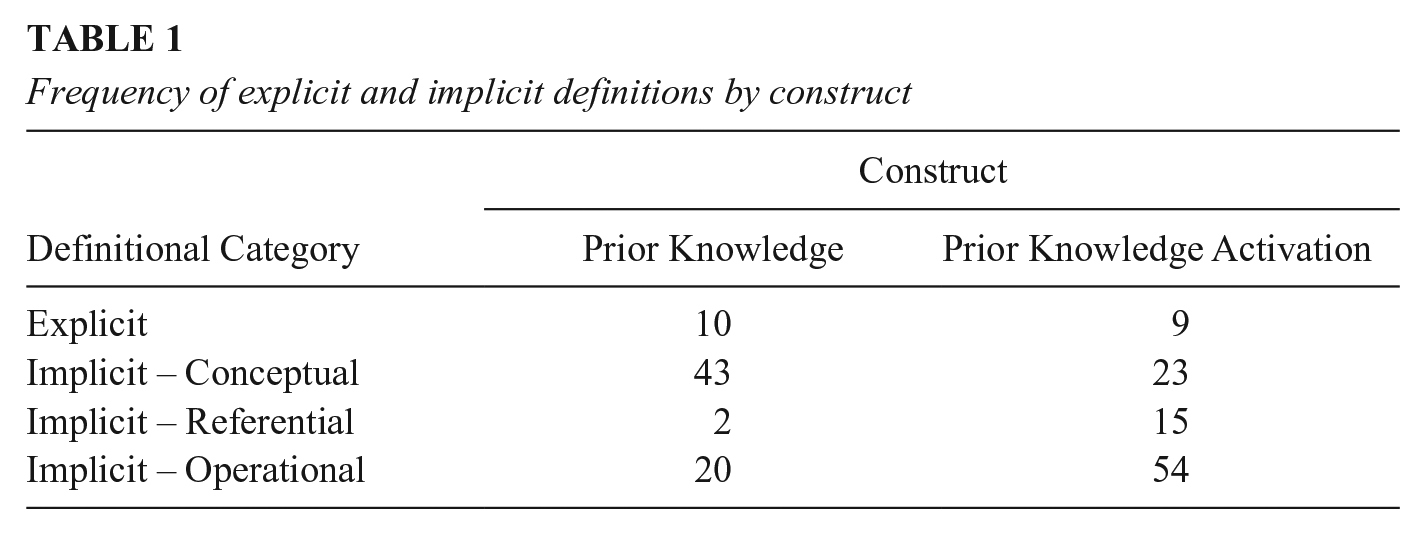
As displayed in Table 1, analysis of prior knowledge definitions revealed that only 10 of the 54 articles explicitly defined this term. (More details can be found in the Supplemental Materials Table S1 in the online version of the journal.) Of the 10 explicit definitions, 4 expressly defined knowledge as domain or topic-specific knowledge. For those four articles, the explicit definitions posited by the researchers aligned with the type of knowledge they expressly sought to activate. For example, Gurlitt and Renkl (2008, 2010) defined prior knowledge as content knowledge related to a domain. Consistent with that definition, these researchers asked participants to develop domain-specific concept maps for economics or science as a way to bring their relevant knowledge into awareness.
Frequency of explicit and implicit definitions by construct
Additionally, Gurlitt et al. (2012) defined prior knowledge as including domain-specific knowledge as well as other types of knowledge, such as general world, metacognitive, and sociocultural knowledge (Table S1). The researchers explained that advanced organizers could be structured in ways that help activate students’ concrete, domain-specific knowledge, as well as their more abstract, general world knowledge. Spires and Donley (1998) emphasized the importance of both domain and personal knowledge, stating that students should be encouraged to make personal connections to informational texts. These two forms of prior knowledge were considered in the activation technique the researchers used in their study, which involved elaborating on the text by directly relating the textual information to their own experiences.
The remaining six explicit definitions characterized prior knowledge more broadly. For example, Biemans and Simons (1996) defined prior knowledge as “all knowledge learners have” (p. 158). Hattan (2020) similarly forwarded a broad definition of prior knowledge as the “sum of what an individual knows” (p. 2). These broader definitions may have allowed for the consideration of readers’ lived experiences and acknowledged the many forms of knowledge that students bring to the act of reading. For example, Hattan and Alexander (2021) used relational reasoning prompts as a mechanism for knowledge activation. These prompts guided students to consider how the information in the text was similar, dissimilar, or completely distinct from what they thought they already knew or had experienced. In that study, the purpose was to encourage students to draw on their real-life experiences as they read highly unfamiliar texts about ancient Greece and Rome. For instance, students contrasted their own monotheistic beliefs with what they learned about Greek gods, thus leveraging their personal experiences to comprehend and remember the new information better.
Certain definitions of prior knowledge offered by researchers were so broad that they were not beneficial. For example, Khataee (2019) defined prior knowledge as “background knowledge,” which did not provide any clearer picture of the type of knowledge being studied. Additionally, this broad definition was misleading, since the researcher narrowly focused on activating topic knowledge related to the text. Thus, there was misalignment in the conceptualization and operationalization of prior knowledge in that investigation.
Implicit Definitions
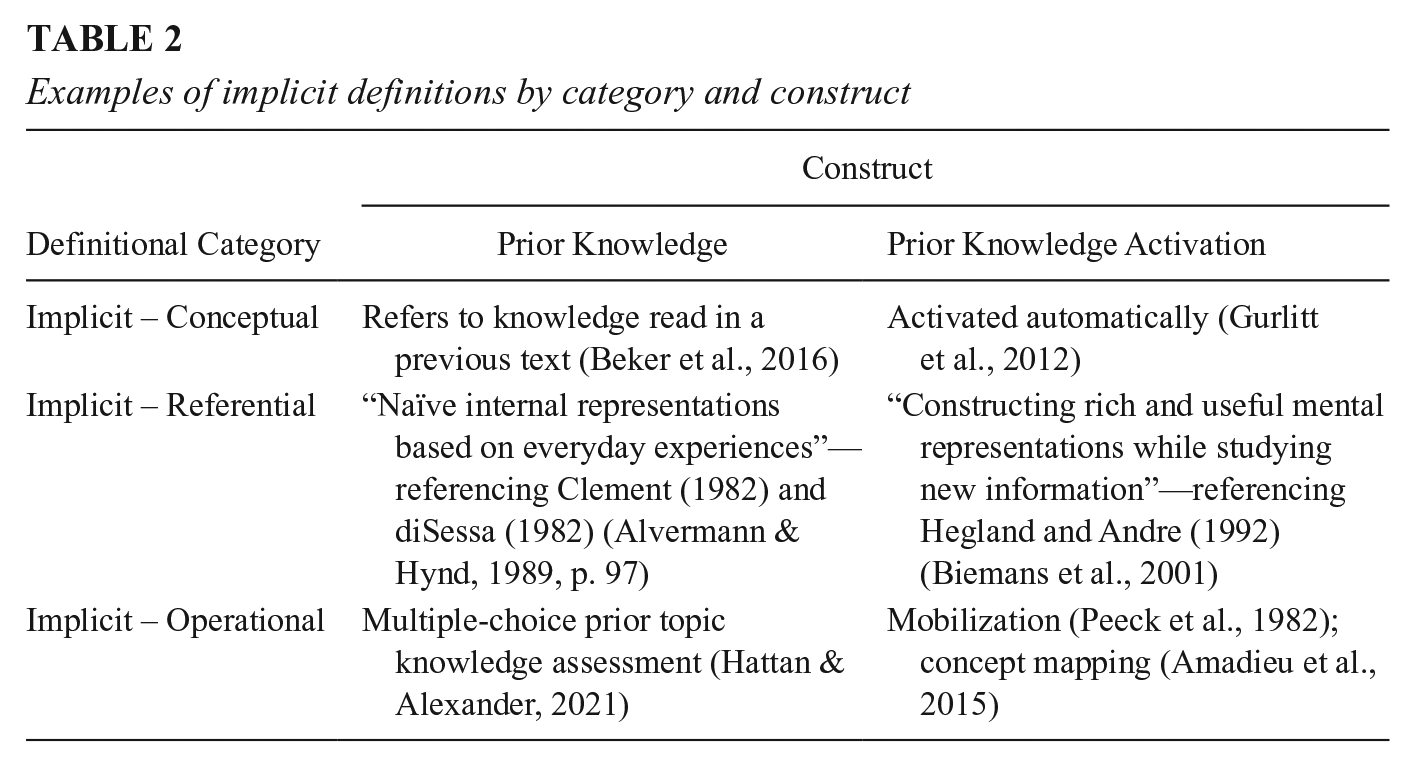
As shown in Table 1, most articles included in this review forwarded implicit definitions of prior knowledge, which were further categorized as conceptual, referential, or operational. (See Table 2 for examples of implicit definitions.)
Examples of implicit definitions by category and construct
Conceptual Definitions
Most articles (n = 43) reviewed relied on implicit conceptual definitions, where the intended meaning is inferred from the words or phrases researchers use throughout the document to talk about prior knowledge. These implied meanings largely focused on words such as content (e.g., Pressley et al., 1990), domain (e.g., Amadieu et al., 2015), or topic (e.g., Dole et al., 1991) to mark the type of knowledge considered. Although rare, other forms of knowledge were mentioned in researchers’ inferred conceptual definitions, such as prior metacognitive knowledge (Bannert et al., 2009; Bouffard-Bouchard, 1994); procedural and conditional knowledge (Andreassen & Bråten, 2011); genre knowledge (Stahl, 2008); knowledge learned from a previous text (Beker et al., 2016); or personal and experiential knowledge (Hattan & Dinsmore, 2019).
There were also researchers who referred to multiple forms of knowledge. For example, Schmidt et al. (1989) referenced explanatory knowledge, world knowledge, content-specific knowledge, and knowledge held by novices and experts. Similarly, Andreassen and Bråten (2011) mentioned content, topic, procedural, strategic, conditional, and relevant as types of knowledge that students may have. Researchers who mentioned multiple forms of prior knowledge often activated multiple types of knowledge in their studies as well. In some cases, the different knowledge types that were activated were directly compared to one another. For example, Kostons and van der Werf (2015) considered the relative benefits of mobilizing students’ metacognitive knowledge or their topic-specific knowledge on comprehension. They found that the activation of metacognitive knowledge led to positive comprehension results for students, whereas topic-specific knowledge had no appreciable effects on comprehension.
Only a few articles containing implicit conceptual definitions of knowledge encompassed the multidimensionality of students’ knowledge as described in the Multidimensional Knowledge in Text Comprehension framework (McCarthy & McNamara, 2021). For example, Schmidt et al. (1989) described prior knowledge as being either precise or imprecise. Correspondingly, Walraven and Reitsma (1993) stated that prior knowledge should be relevant, while Pressley et al. (1990) examined the influence of irrelevant knowledge to the comprehension task at hand.
Referential Definitions
There were two articles that included referential definitions of prior knowledge (Adams, 1982; Gurlitt et al., 2012). Referential definitions are those that explain a construct, such as prior knowledge, by citing a particular individual or source. Both Adams (1982) and Gurlitt et al. (2012) referred to Ausubel’s (1968, 2000) work as the conceptual grounding for the study of prior knowledge, emphasizing its stability in learners’ long-term memory.
Operational Definitions
Twenty of the 54 manuscripts were coded as containing implicit operational definitions of prior knowledge. In effect, authors of these 20 articles used researcher-developed measures of prior knowledge to assess participants’ knowledge before reading a text or before implementing a knowledge activation technique. The measures included multiple-choice (Adams, 1982; Wetzels, Kester, & van Merriënboer, 2011) or true/false questions (Hynd & Alvermann, 1986), or tests where the participants needed to apply their prior knowledge when completing a task (Alvermann & Hague, 1989). In all cases, the measures targeted the amount or accuracy of students’ topic or domain-specific knowledge that reflected the content of the texts to be read.
Prior Knowledge Activation Defined
Explicit Definitions
Nine of the 54 articles included explicit definitions of prior knowledge activation, which primarily emphasized the process of recalling previously learned knowledge (Table S2 in the online version of the journal). For example, Wetzels, Kester, and van Merriënboer (2011) stated, “If learners activate their prior knowledge, this knowledge is brought from long-term memory to working memory” (p. 16); and Hattan (2020) wrote, “This process of activating background knowledge entails calling forward from memory what one already knows relative to an experience, idea, or topic at hand” (p. 2). By comparison, Gurlitt et al. (2012) described activation as more than facilitating students’ recall of content covered in specific readings. Rather, these researchers emphasized the importance of integrating new knowledge into long-term memory as part of the knowledge activation process, and also stated that knowledge activation could occur automatically, rather than requiring external guidance. In contrast, Hattan and Alexander (2020) emphasized the need for external scaffolding for knowledge activation. They argued that, although there are instances when knowledge activation can occur instinctively or effortlessly, not all students activate relevant knowledge within the instructional environment or when attempting to comprehend a text.
Implicit Definitions
All 54 articles included an implicit definition of prior knowledge activation that made some mention of the purpose or operationalization of prior knowledge activation (Tables 1 and 2).
Conceptual Definitions
Twenty-three of the manuscripts included implicit-conceptual definitions of prior knowledge activation in their work, which focused on the purpose of knowledge activation, rather than the nature of knowledge activation per se. For example, several researchers stated that knowledge activation supports meaning making and knowledge construction (Andreassen & Bråten, 2011; Biemans et al., 2001). Others noted that it anchors new learning (Azevedo et al., 2007), signals the relevant or important parts of the text (Bråten et al., 2017), and is a prerequisite for knowledge integration (Beker et al., 2016). Additional conceptual definitions indicated that knowledge activation is something that occurs before reading. For example, Bråten et al. (2017) said that prior knowledge activation can help pique students’ interest prior to engaging with the text, and Lupo et al. (2019) signaled that knowledge activation occurs prior to reading.
Referential Definitions
Implicit referential definitions of prior knowledge activation occurred in 15 of the included articles and typically referred to specific learning theories. For example, Biemans et al., (2001) referred to constructivist learning theories when defining prior knowledge activation as “constructing rich and useful mental representations while studying new information” (p. 266). Additionally, Alvarez (1993) referenced Ausubel’s subsumption theory, whereas Peeck et al., (1982) quoted Mayer (1979) in describing assimilation theory.
Operational Definitions
In contrast to conceptual and referential definitions, implicit operational definitions of prior knowledge activation described specific techniques, such as mobilization or concept mapping. These definitions described assisting students in making connections between their existing knowledge and a learning task. Since the inclusion of a prior knowledge activation technique was required to be part of this systematic literature review, all 54 articles used a technique meant to facilitate prior knowledge activation and, as such, contained an operational definition. In many cases, the description of the activation technique was the only information that researchers provided about their definition of knowledge activation.
What Knowledge Activation Techniques Have Been Empirically Studied, and What Are Their Key Characteristics?
The second research question addressed the various types of knowledge activation techniques examined in the literature, as well as the characteristics of those techniques. Table S3 in the online version of the journal provides a summary of the techniques that were studied, including domain, participants’ grade levels, when the techniques were implemented, and if prior knowledge was activated individually or in pairs or groups. Across the 54 articles and 68 studies (14 articles included 2 studies), 88 prior knowledge activation techniques were investigated. However, some studies included multiple domains (e.g., science and social studies; Lupo et al., 2019) or students from more than one grade level (e.g., upper elementary and middle school; Risko & Alvarez, 1986). Of those 88 techniques, 30 unique knowledge activation techniques were identified (Table S4 in the online version of the journal). Many of these studies examined knowledge activation in a lab setting with undergraduate students, rather than in K–12 classrooms. Further, a notes column in Table S3 describes important nuances about the results (e.g., for techniques coded as mixed, which outcome measures had positive, negative, or neutral results), and an asterisk signifies studies that addressed misconceptions. Lastly, when effect sizes were reported, those data for each technique were provided (i.e., null, small, medium, or large).
Domains Addressed in Readings
The most common domain in which participants read was science (n = 36), followed by reading or language arts (n = 29); social studies or history (n = 23); psychology, statistics, or economics (n = 13); and media or technology (n = 2). These results demonstrate that knowledge activation techniques have been investigated across multiple domains. However, students were infrequently asked to activate knowledge about mathematics or the arts. The former may reflect the reliance on mathematical symbols over connected discourse, while the latter may reflect a dependence on visual content in the arts.
Although the published studies in this review did not typically include the actual materials students read, many researchers described those texts as being expository in nature. This was even true for the domain of reading/language arts, where participants frequently read passages on past or current events (e.g., Beker et al., 2016; Kiili et al., 2012). A few of the reviewed studies did not indicate whether participants read expository or narrative texts (e.g., Peeck et al., 1982). With few exceptions (Alvarez, 1993; Alvarez & Risko, 1989; Carriedo & Alonso-Tapia, 1995; Kaefer, 2020), participants infrequently read narrative texts. Therefore, the effects of knowledge activation during the processing of narrative texts is an underresearched area that should be further explored.
Grade Levels
Across the 88 investigated techniques, nearly half (48%) included undergraduate participants (n = 42). Although some studies investigated techniques across grade levels (e.g., Gurlitt & Renkl, 2008), fewer studies explored knowledge activation with high school (n = 20), middle school (n = 18), upper elementary (n = 20), and lower elementary (n = 2) students. These results illuminate a dearth of research on activation techniques for younger students. One potential explanation is that the stress in early grades is on acquiring foundational reading skills. Despite this paucity of research, elementary teachers are often encouraged to activate their students’ knowledge before reading.
Addressing Misconceptions
Nine articles addressed the issue of students’ misconceptions, all within the domain of science (e.g., Alvermann et al., 1985; Biemans et al., 2001). Misconceptions can influence students’ reading (Kendeou et al., 2014) and are particularly prevalent in science (Treagust, 1988). Researchers in the included studies addressed misconceptions through augmented activation, refutation texts, or analogical reasoning. Augmented activation is when students are told that what they are about to read may be different from what they already know (Alvermann & Hynd, 1989), refutation texts state and refute common scientific misconceptions (Alvermann & Hague, 1989), and analogical reasoning uses analogies as a tool to address misconceptions (Braasch & Goldman. 2010). However, misconceptions are different from irrelevant knowledge, which is knowledge extraneous to the text at hand, although not necessarily incorrect (Kaefer, 2020; Mannies et al., 1989).
In contrast to what others have reported (Alvermann & Hague, 1989; Kendeou et al., 2014), Pressley et al. (1990) found that activating students’ inaccurate information may not be detrimental to comprehension. However, general inaccurate information may not qualify as misconceptions. Therefore, students’ inaccurate prior knowledge may shift more easily than established scientific misconceptions. Further, Hattan and Alexander (2021) examined the use of relational reasoning prompts that asked students how their knowledge may be different from or in conflict with the social studies texts they were reading, which proved helpful to their comprehension. Again, misconceptions were not the focus of that study, but such structured prompts could support students in addressing either inaccurate or incomplete prior knowledge vis-à-vis text content.
Before, During, or After Reading
Overall, prior knowledge activation occurred primarily before reading. In fact, 47 of the 88 techniques solely addressed knowledge activation before reading, while 65 of the techniques included a prereading prompt, even if it was combined with during or after reading activation. Knowledge activation was initiated solely during reading in 19 of the techniques, while 28 techniques included during reading scaffolds in addition to before or after reading activation. There were 17 instances when postreading activation took place alongside before or during reading but only 1 instance when knowledge activation occurred solely after reading.
From a practical perspective, these results are not surprising, as teachers are often encouraged to activate students’ knowledge, typically topic-specific knowledge, prior to reading or engaging with course content (Hattan et al., 2015). However, as mentioned, the Construction Integration Model of Text Comprehension (Kintsch, 1998) emphasizes a continuous interaction between the reader and the text, suggesting the importance of also scaffolding students’ knowledge activation during or after reading. As such, the activation of prior knowledge during and after reading may support knowledge integration and learning from texts (Hattan & Lupo, 2020). This illuminates the importance of clearly delineating the process of knowledge activation, which should then map onto the knowledge activation techniques that are investigated in the studies.
Individual or Collaborative Activation
The vast majority of techniques required participants to activate their prior knowledge individually (n = 71), with fewer techniques supporting pair (n = 3) or group (n = 14) activation. Given that many studies took place in lab-like settings with undergraduate participants, this pattern is not surprising. However, reading is not only an individual pursuit, but also a social practice (Street, 1984). As such, more research is needed around how shared knowledge activation, in contrast to individual activation, influences readers’ overall comprehension of text or may either mitigate or exacerbate the inaccurate understandings that individuals hold relative to the topic or domain.
How Can Knowledge Activation Techniques Be Categorized? To What Extent Are Positive, Negative, Neutral, or Mixed Outcomes Associated With Those Categories?
In order to explore how knowledge activation was operationalized, categories were generated based on shared attributes of the 30 unique techniques included in this review. As displayed in Table 3, those techniques fell into eight categories: open-ended prompts, procedural or strategic supports during reading, visual representation, analogical reasoning, text alteration, augmented activation, extratextual activities, and spontaneous activation.
Categories and types of knowledge activation
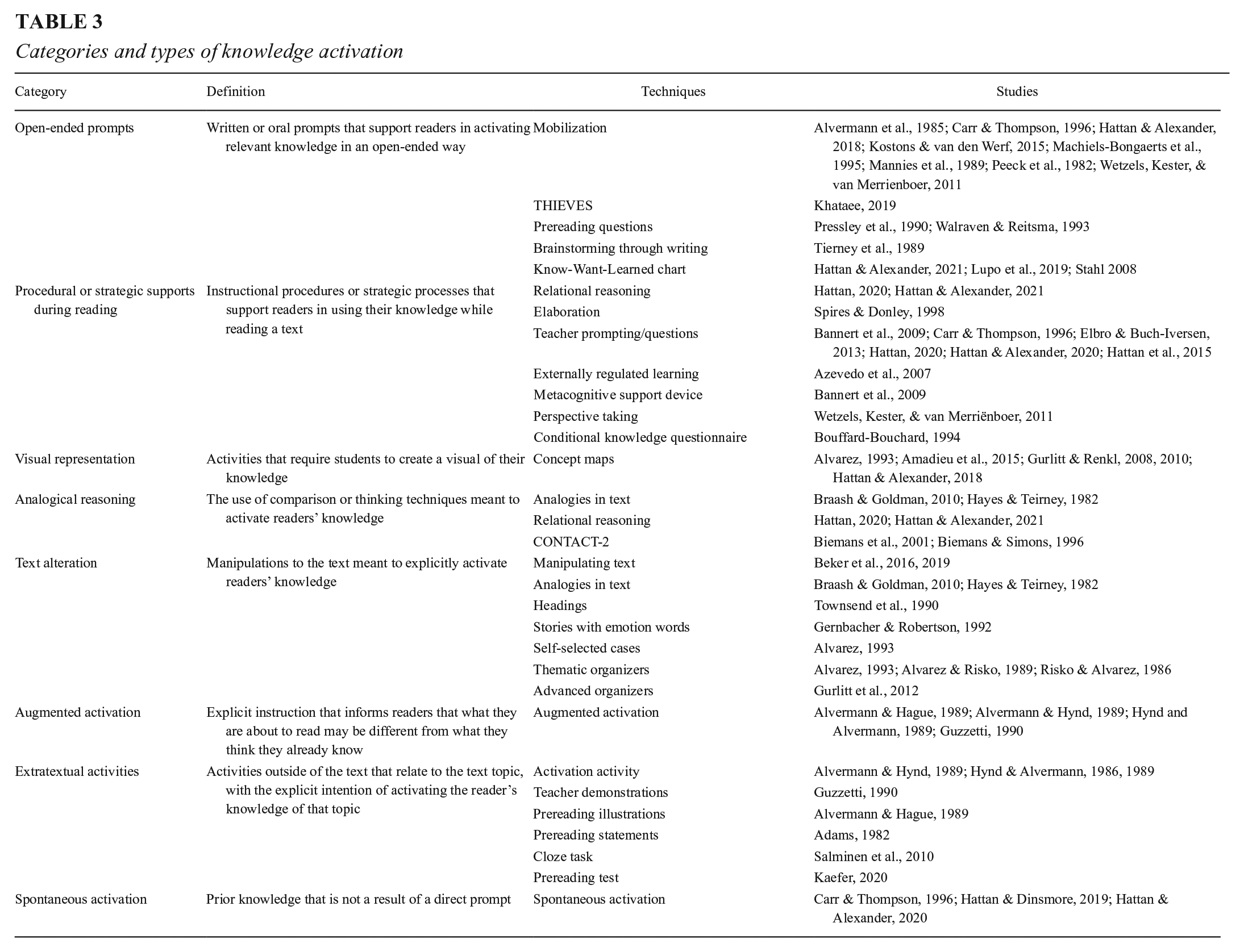
Although there is no explicit hierarchy to the derived categories, the following sections begin with the most common category: open-ended prompts. The second category, procedural and strategic supports, was similar to open-ended prompts in that they often included teacher questioning, but they differed from those prompts in that there were more explicit attempts to reinforce certain reading behaviors. The third through fifth categories dealt more expressly with how concepts connect to each other (i.e., visual, analogical reasoning, and text alteration). For example, visual representations helped students understand how their prior knowledge of concepts and subconcepts related to each other via concept maps; analogical reasoning supported students in considering how their prior knowledge may be similar to the text at hand; and text alteration is when the texts students read were manipulated in some way, sometimes prompting students to consider how a concept they presumably understood (e.g., tire pressure) could help them learn about a new concept (e.g., wind flow patterns).
The sixth and seventh categories described augmented activation and extratextual activities. These two categories are presented consecutively since the research regarding the effectiveness of extratextual activities was quite mixed, but the negative effects of extratextual activities could sometimes be mitigated with the use of augmented activation. Finally, information on spontaneous activation is presented, which has the least amount of empirical evidence and also requires less explicit prompting. All categories are more fully described below.
Beyond their categorization, the effectiveness of the techniques was also assessed. Specifically, each knowledge activation technique (n = 88) was coded according to whether it improved students’ reading performance or not. (See last column in Table S3.) For the 88 documented instances, 51 resulted in positive effects on readers’ learning or comprehension, whereas 15 demonstrated negative outcomes. Another eight cases reported no significant outcomes, and an additional eight recorded mixed outcomes depending on the outcome measure used. The remaining six instances were qualitative or exploratory studies that did not quantitatively assess the influence of activation on learning or comprehension.
Effect sizes were reported for 20 of the 88 instances of prior knowledge activation techniques. In some cases, prior knowledge activation was integrated into a larger intervention (Andreassen & Bråten, 2011). In those instances, the influence of the entire intervention on student learning was examined since the unique influences of prior knowledge activation could not be determined. To investigate the effectiveness of prior knowledge activation techniques on comprehension outcomes, patterns were identified within each of the eight categories in an effort to discern whether, when, how, and for whom the techniques facilitate comprehension.
Open-Ended Prompts
Open-ended prompts, which asked students to respond to questions by sharing everything they knew related to a question, were investigated in 23 of the 54 articles, making it the largest category. These prompts typically asked students to consider what they already knew about a particular topic. One exception was when students were asked to activate their knowledge of metacognitive strategies (Kostons & van der Werf, 2015). In most instances, open-ended questions were posed before reading; however, occasionally readers were asked to share what they knew after reading as well (Andreassen & Bråten, 2011). In this category, participants ranged from lower elementary school through college, and the domains included social studies, science, and reading. Across the studies, open-ended prompts occurred through individual written knowledge activation (Peeck et al., 1982), as well as via whole class (Dole et al., 1991), small group (Schmidt et al., 1989) or paired discussions (Kiili et al., 2012).
Analyses revealed that the effectiveness of open-ended knowledge activation varied by grade level, as well as the degree to which the prompts were collaborative in nature. For example, Hattan and Alexander (2021) found that individual, written knowledge mobilization did not support fifth- and sixth-grade students’ text comprehension in comparison to a more structured relational reasoning technique or a control condition. Yet researchers found that upper elementary and middle school students who responded to open-ended prompts via whole class, group, or paired discussions, experienced positive comprehension outcomes (Andreassen & Bråten, 2011; Bråten et al., 2017, Dole et al., 1991). Therefore, it is possible that the opportunity to discuss with peers may be particularly important for knowledge activation with upper elementary and middle school students.
Additionally, Stahl (2008) provided opportunities for lower elementary students to respond to open-ended prompts both individually and collaboratively via a Know-Want to learn-Learned (KWL) chart. However, in this study, KWL did not lead to improved performance on maze, vocabulary recognition, or free recall tasks. Perhaps due to their more limited experiences and background knowledge, younger students require more structured knowledge activation support to guide them in accessing relevant knowledge. Of course, additional studies are needed to explore possible reasons for those findings.
In contrast to mixed results for elementary and middle-school students, open-ended prompts appeared to facilitate text comprehension more consistently for high school (Martin et al., 1986) and undergraduate students (Hattan & Alexander, 2018; Pressley et al., 1990). However, although studies on high school students included both individual (e.g., Wetzels, Kester, & van Merriënboer, 2011) and collaborative (e.g., Lupo et al., 2019) knowledge activation, all researchers who investigated undergraduate students’ responses to open-ended prompts did so via individual writing and not discussion.
Two studies involving the use of open-ended knowledge activation with high school students had particularly interesting results. For one, Guzzetti (1990) reported no significant differences on application problems between high school students who activated their prior knowledge via group discussion and a control group. However, qualitative analyses of interviews revealed that while students often thought that they did not have any relevant prior topic knowledge about Boyle’s law, they, in fact, had prior experiences that they accurately related to the text topic. Additionally, Kiili et al. (2012) examined students’ talk while activating knowledge, reading, and writing a collaborative essay. Although the study did not include a comparison group, the researchers found five collaborative reading profiles, ranging from coconstructors to silent readers. These results suggested that high school students may have varying levels of comfort and different approaches to sharing their knowledge via open-ended discussion.
Techniques in the open-ended category also revealed differences depending on the level of students’ knowledge, although outcomes were not consistent. For example, Schmidt et al. (1989) found that open-ended small group discussions were beneficial for both 9th- and 10th-grade students. Yet the 10th-grade students, who were assumed to have more topic knowledge, produced more explanations than the 9th graders. In another study, Wetzels, Kester, and van Merriënboer (2011) compared written, open-ended mobilization to perspective taking, which asked students to examine a picture of a heart from the perspective of a blood vessel. They found that open-ended mobilization was more beneficial for high school students presumed to have lower topic knowledge, compared to undergraduate students assumed to have higher topic knowledge. The authors explained that mobilization allows students to “freely activate a set of concepts that are only loosely connected and have not yet developed into a coherent knowledge structure,” (p. 17) whereas perspective taking requires the activation of a particular schema.
Analysis of the outcomes also revealed that activating irrelevant or incompatible information prior to or during reading could hinder comprehension. For example, Mannies et al. (1989) found that mobilizing relevant information was helpful for middle school students’ free recall, whereas mobilizing irrelevant information impaired students’ comprehension. Collectively, these results support the idea that there may be a knowledge threshold for open-ended prompts to be useful (O’Reilly et al., 2019). That being said, for upper elementary and middle school students, peer discussions may help bridge the gap with collective knowledge activation. Yet, substantially more research is needed on lower elementary students’ knowledge activation, for whom this type of open-ended prompting, even when paired with discussion, does not yet appear to be useful for comprehension (Stahl, 2008).
Procedural or Strategic Supports During Text Processing
The next category of activation techniques involved targeting specific procedures or strategies during reading as a means of using students’ existing knowledge to enhance comprehension. Across 12 articles, an array of instructional procedures were used or strategic processes were reinforced. Some of the instructional procedures included supports a teacher would provide, such as teacher prompting or periodic questioning (e.g., Carr & Thompson, 1996; Hattan & Alexander, 2020) and providing written prompts (Hattan, 2020). Other techniques in this category involved procedures that a student is expected to carry out, such as the use of a metacognitive support device, which is a computer-supported prompt to think more deeply about their learning. For example, the computer might prompt students to think about what they want to learn from a text (Bannert et al., 2009). Another technique that students would engage in is completion of a conditional knowledge questionnaire in which students would reflect on their goals for reading, strategies they would use to help them achieve those goals, and strategies they would avoid that might hinder their text understanding (Bouffard-Bouchard, 1994). Lastly, students may engage in perspective taking during reading (Wetzels, Kester, & van Merriënboer, 2011). For example, students were asked to take the role of a blood cell traveling through the heart to better understand a text about how the heart works.
When compared to a control group not receiving any treatment, these procedural and strategic supports tended to positively affect comprehension and learning (Azevedo et al., 2007; Bannert et al., 2009; Elbro & Buch-Iversen, 2013; Spires & Donley, 1998). There were exceptions to this pattern, however. Two studies compared strategic or procedural supports to knowledge mobilization. Wetzels, Kester, and van Merriënboer (2011) found benefits for both perspective taking and mobilization; while Hattan and Alexander (2021) only found benefits for relational reasoning. Similarly, Carr and Thompson (1996) found that both teacher prompting and spontaneous activation had positive results on readers’ text comprehension.
Visual Representation
Visual representations required students to create a graphic display of their knowledge related to the text, and also provided opportunities for them to consider the relations between various concepts and subconcepts. Four articles in the current review examined students’ use of visual representations via concept maps. All four articles focused on high school or undergraduate students and primarily led to positive comprehension results for these older readers. When comparing visual representations to control groups or other forms of knowledge activation (Alvarez, 1993; Hattan & Alexander, 2018), concept maps led to significantly better text comprehension. However, results were more nuanced when considering the timing (e.g., before or after reading), the structure of visuals, and participants’ relevant knowledge.
For example, Amadieu et al. (2015) compared the development of concept maps before reading to after reading. Activating students’ knowledge after reading led to better performance on a multiple-choice comprehension assessment. To examine the structure of visual representations, Gurlitt and Renkl (2008) asked high school and undergraduate students to either create and label lines in a concept map, or label lines on an already created map. These researchers reported that high school students (who they assumed had less content knowledge) benefited from labeling provided lines. By comparison, undergraduate students (who the researchers assumed had more knowledge) benefited from creating and labeling lines. In addition to considering timing and structure, the measures used to assess students’ comprehension could lead to different effects depending on the outcome measure. For example, Gurlitt and Renkl (2010) assessed students’ comprehension with think-aloud protocols coded for elaboration, organization, and model construction, finding large effect sizes for model construction but not elaboration or organization.
Overall, these studies support the use of visual representations for activating students’ prior knowledge during text processing. However, more research is needed to determine at what point during the reading process visual representations are most beneficial. Additional research is also needed to determine the conditions under which visual representations can be effective activation techniques for younger to older students, and the amount of structural support that is optimal for students with different levels of relevant topic or domain knowledge.
Analogical Reasoning
Analogical reasoning, as a knowledge activation technique, supported students in making comparisons between their prior knowledge and the text content. This was done across six of the included articles, either by presenting an analogy to support students in understanding new information (Braasch & Goldman, 2010) or by prompting students to develop their own comparisons (Biemans et al., 2001; Hattan & Alexander, 2021). Most techniques that included analogical reasoning led to positive outcomes for students, such as relational reasoning prompts (Hattan 2020; Hattan & Alexander, 2021) and CONTACT-2 (Biemans & Simons, 1996). Also, the use of analogies in text lead to positive results for students who had sufficient domain or topic knowledge before reading (Braasch & Goldman, 2010; Hayes & Tierney, 1982).
Biemans et al. (2001) focused on continuous external support via a computer-assisted program using CONTACT-2. Fifth- and sixth-grade students were asked to activate their prior knowledge on physical geography by answering an idea question, defined as “a concrete problem that has to be solved by relating the central concepts of the corresponding training text” (p. 268), and were then prompted to compare and contrast their prior knowledge with new information that was provided in a text. The computer program continuously prompted students to apply and evaluate their understanding of the content by asking students to write down similarities and differences between their knowledge and the concepts in text, and then to revisit the idea question after reading. This process was intended to provide opportunities for students to modify their knowledge base as they read and reread the text.
However, as McCarthy and McNamara (2021) contended, the amount and specificity of students’ knowledge is important when judging the utility of analogical reasoning as an activation method. For example, Braasch and Goldman (2010) found that providing analogies in text tended to be beneficial for students who had some knowledge of tire pressure when presented with an analogy to explain wind flow patterns, but not those with little such knowledge. Further, students with more pertinent knowledge were less likely to espouse misconceptions when developing conceptual models of the text content. Additionally, while Hattan and Alexander (2021) utilized relational reasoning prompts that helped readers understand how their personal or world knowledge could be different from or in conflict with the text content, the students’ topic knowledge was still a significant predictor of comprehension.
Text Alteration
Text alteration, which took place in 10 of the included articles, occurred when researchers manipulated texts for the explicit purpose of supporting knowledge activation. In other words, researchers changed the content of texts in ways they thought might facilitate students’ knowledge activation and text comprehension. For example, text alteration was accomplished by manipulating the text to explain inconsistent information (Beker et al., 2019); using analogies in text (Braasch & Goldman, 2010); focusing on headings (Townsend et al., 1990); developing stories with emotion words (Gernbacher & Robertson, 1992); or including self-selected cases (Alvarez, 1993), thematic organizers (Alvarez, 1993; Alvarez & Risko, 1989; Risko & Alvarez, 1986), or advanced organizers (Gurlitt et al., 2012).
Overall, altering texts led to positive comprehension outcomes for elementary students (Risko & Alvarez, 1986) through undergraduates (Beker et al., 2016). For example, thematic organizers (Alvarez, 1993; Alvarez & Risko, 1989; Risko & Alvarez, 1986), which prompted upper elementary, middle school, high school, and undergraduate students to activate previous experiences related to the theme of a story, consistently led to positive outcomes. For this activation technique, researchers added details to the text, such as comparing and contrasting the jobs of detectives and scientists, and then provided statements for students to agree or disagree with during reading (Alvarez & Risko, 1989). Additionally, Alvarez (1993) used cases in which high school students explored how to solve a problem related to the text. In this study, students chose cases to read based on their interests. The cases were developed to include a problem-oriented task meant to connect content to real-life situations and, in doing so, provided opportunities for students to activate their topic and personal knowledge.
Mixed results were reported when researchers altered texts to consider relevant versus irrelevant information or misconceptions. For example, Beker et al. (2016) found that texts modified to include compatible versus incompatible sentences led to faster reading times for undergraduate students but did not lead to better recall. However, in a subsequent study, Beker et al. (2019) had upper elementary and middle school students read texts that either did or did not explain certain inconsistencies. The authors found that students who read texts containing inconsistent information had poorer performance on multiple-choice, open-ended, and application questions. Conversely, students who read texts that explained inconsistencies in content comprehended better. Also, as noted, including analogies in text facilitated comprehension only for students with sufficient topic knowledge (Braasch et al., 2010; Hayes & Tierney, 1982). In contrast to the overall trend for this category, one text alteration resulted in no appreciable change in comprehension performance. Specifically, embedding headings in the text to prompt knowledge activation did not improve undergraduates’ comprehension even though the students thought the headings helped (Townsend et al., 1990).
Augmented Activation
Augmented activation, which involves alerting students that what they are about to read may differ from what they think they know about a topic, was investigated in four articles focused on the domain of science. This instructional technique was developed in response to experimental studies on knowledge activation in the mid-1980s (Alvermann et al., 1985; Hynd & Alvermann, 1986), which found that activating misconceptions hindered students’ reading comprehension. Augmented activation was designed to alert students to the fact that they may hold erroneous beliefs about a given science topic prior to reading, and this approach generally led to positive comprehension outcomes. For instance, Alvermann and Hague (1989) told the undergraduates in their study to “be sure to pay attention to those ideas presented that may be different from your own” (p. 199). The comprehension performance of students in the augmented activation group was then compared to outcomes for those in an activation-only group. Participants in the augmented activation group outperformed students in the activation-only group.
These findings suggest that augmented activation may heighten readers’ awareness of incongruent information, which may aid them in reconciling their prior misunderstanding against the new and more scientifically accurate content. However, the three studies that demonstrated facilitative effects of augmented activation were conducted with undergraduate students (Alvermann & Hague, 1989; Alvermann & Hynd, 1989; Hynd & Alvermann, 1989). In contrast, an augmented activation study involving high school students found no significant differences for comprehension between the treatment and control conditions (Guzzetti, 1990). Therefore, more research is needed to consider the conditions (e.g., readers’ age or academic domain) under which augmented activation facilitates readers’ comprehension.
Extratextual Activities
The techniques included in this specific activation category involved the use of some extratextual activity or experience meant to instantiate or trigger students’ knowledge for the upcoming reading. For example, Guzzetti (1990) included teacher demonstrations where the instructor placed a balloon inside a glass jar, students watched as air pressure decreased and the balloon volume increased, and then students discussed their reactions to the experiment to activate their knowledge. Additional activities employed prereading illustrations (Alvermann & Hague, 1989), incorporated prereading statements via anticipation guides (Adams, 1982), included pretests that were explicitly meant to activate students’ prior knowledge (Kaefer, 2020), or used a cloze task procedure (Salminen et al., 2010). In all but one of eight studies in this category (Kaefer, 2020), the participants were high school students or undergraduates.
Analysis of techniques revealed that there is a fine line between activating background knowledge via extratextual activities and building background knowledge before reading. In fact, both of these processes could occur at the same time. For the purposes of this literature review, extratextual activities were identified as activating prior knowledge if the researchers’ intentions were explicit. Yet some studies utilized techniques that focused on building background knowledge before reading, without the express purpose of activating knowledge. For example, in Dole et al. (1991), in an effort to prepare students to read a text, teachers read scripts to students with information that they did not know. Similarly, in Lupo et al. (2019), teachers built relevant knowledge through the use of videos, PowerPoints, and other activities. Although it is possible that knowledge was activated in these and other similar situations, that was not the primary purpose of the instructional method. Thus, this literature review only classified techniques as knowledge activation if the activity was designed with the clear purpose of activating students’ knowledge during the reading process.
The activation activities populating this category led to mixed results for learning and comprehension. For instance, extratextual activities in several studies led to negative outcomes for undergraduates (Hynd & Alvermann, 1986), unless knowledge activation was augmented (Alvermann & Hague, 1989; Alvermann & Hynd, 1989). There was one study that reported positive effects for treatment groups over the control condition, whether augmented activation was included or not (Hynd & Alvermann, 1989). In that study, students were asked draw and describe the path that a marble would take if it were shot off a table. Another article included in this category by Salminen et al. (2010) introduced the same extratextual activity to students in all study conditions, making it impossible to ascertain the effects of that activation activity on reported outcomes.
For the one investigation that focused on younger readers, Kaefer (2020) examined kindergarten students’ recall or inferential comprehension when they were (a) administered a topic knowledge pretest, (b) provided with relevant information, or (c) given irrelevant information prior to reading. Although there were no significant differences between groups for recall questions, students administered the pretest or provided with relevant information significantly outperformed students who were given irrelevant information on the inductive inferencing task. However, follow-up analyses revealed that knowledge activation seemed to facilitate comprehension only for students who had substantial prior topic knowledge, further complicating the question as to when it might be useful to activate knowledge via topic-related activities versus building students’ knowledge.
Spontaneous Activation
The category of spontaneous activation included three studies in which students were not expressly directed to reflect on their existing knowledge prior to reading. Rather, these studies may have involved a method, such as think-alouds, that required students to share their thinking while reading. Some portion of what students verbalized as they thought aloud could refer to what they know or have experienced relative to the text content. For example, Hattan and Dinsmore (2019) asked upper elementary students to think aloud while reading science and social studies texts. The researchers found that there was no relation between the frequency at which students referred to their prior knowledge and experiences and their comprehension performance. Hattan and Alexander (2020) analyzed the discourse occurring in an upper elementary classroom during reading instruction for the amount and quality of solicited and unsolicited prior knowledge activation. These researchers found that unsolicited or spontaneous knowledge activation occurred in about one-third of students’ knowledge activation utterances. Finally, Carr and Thompson (1996) compared spontaneous activation to experimenter activation by means of open-ended prompts for upper elementary and middle school students with and without learning disabilities. These researchers reported that students in the experimenter activation condition had higher comprehension scores than students in the spontaneous activation condition, although those differences were not significant. Based on these studies, spontaneous activation did not translate into strong, positive effect on students’ comprehension or learning.
Overarching Trends for Activation Categories
The results across the eight knowledge activation categories highlight the fact that there are many different ways to support students’ contemplation on what they know or have experienced. Yet in the analyzed body of research, knowledge activation seemed to have been predominantly operationalized as techniques that occur in the prereading phase of text processing, often in the form of written or oral question prompts. The mixed results that were noted for studies within each category suggested that the overall effectiveness of knowledge activation techniques is predicated on students’ age, the amount and accuracy of their relevant knowledge, as well as the degree of scaffolding afforded. Nonetheless, even younger students with limited topic or domain knowledge have personal and experiential knowledge that can support comprehension and learning if suitably activated before, during, and after reading. As the data extracted on the positive, neutral, mixed, and negative effects of studies within the activation categories illustrated, many of the techniques implemented were better for students’ comprehension and learning than leaving them to their own devices.
Conclusions and Implications
This systematic literature review led to important findings about students’ prior knowledge and its activation within the context of learning from text. Those findings pertain to the conceptualizations of prior knowledge and knowledge activation that populate this literature, the characteristics of knowledge activation techniques that have been empirically investigated, the broader categories of techniques that were identified from these characterizations, and notable patterns within the activation studies associated with significant improvements in students’ comprehension. Given the resurgence of interest in students’ existing knowledge on their comprehension (Hattan & Lupo, 2020), it is timely to scrutinize the literature on what we know about prior knowledge and its activation. Before revisiting the major contributions of this review for deepening understanding of prior knowledge and its activation, below is an overview of the specific parameters of this undertaking.
Delimitations
As with any investigation, there are constraints that we imposed on this systematic review that must be acknowledged. For one, although reading outcome measures were included in Table S3, the current review did not critically analyze those assessments. Future reviews may explore how students’ learning or comprehension was contingent on the type of technique used to activate their existing knowledge, but also on the manner in which their comprehension or learning was measured. It may also be beneficial to explore the rationale for knowledge activation provided to students, along with the exact procedures, explicit directions, and ongoing supports that accompany each technique. Additionally, the current review specifically focused on knowledge activation within the context of reading. Yet the influence of prior knowledge is not solely relegated to reading or to the comprehension of text but is presumed to shape all forms of learning (Alexander & Murphy, 1998; Ausubel, 1968, 2000). Thus, an exploration of knowledge activation in contexts where comprehension of texts is not the primary focus seems warranted.
Finally, although this review considered students’ grade levels, it did not examine the contexts in which the selected studies took place (e.g., rural, urban); nor did it consider participants’ linguistic backgrounds, ethnicities, or socioeconomic status. Unfortunately, most of the included studies provided scant information about the participants, especially those that targeted undergraduate students. Recent calls to offer richer histories or personal narratives for study participants (Willis, 2015) suggest that future research on prior knowledge activation need to delve into contextual differences and learner characteristics if the goal is to understand when, where, and for whom knowledge activation is a catalyst for improved comprehension and learning.
Key Findings and Proposed Responses
Despite the aforementioned delimitations, there were important insights garnered from this review that can inform both educational research and guide instructional practice. These insights pertain to the nature of prior knowledge and its various manifestations that play a role in learning from texts. These findings also speak to the categories of techniques that can be employed within the learning environment to prompt students to bring their relevant knowledge to the forefront when engaged in reading. Further, this systematic review afforded a glimpse into the conditions under which prior knowledge activation had the desired effect of improving students’ comprehension or learning performance. Finally, as would be expected from any such review, critical gaps in the research were identified. Below is a summary of key findings as well as subsequent steps that might be pursued in future research.
Definitions and Descriptions of Prior Knowledge and Prior Knowledge Activation Were Often Unclear
There is a paucity of explicit definitions for prior knowledge and prior knowledge activation within the empirical literature. Although definitions and descriptions could be inferred from many articles, given that prior knowledge encompasses many types of knowledge, such as topic, personal, cultural, or conditional knowledge, researchers should inform the consumers of this research as to what they precisely mean by the term, as well as what specific forms of prior knowledge they have chosen to target. Definitions of prior knowledge and its activation may influence the types of knowledge and knowledge activation that are investigated in empirical work, which could in turn influence the knowledge readers draw upon, thus influencing their overall comprehension. Therefore, as a domain in inquiry, it may be helpful for text comprehension researchers to operate with a more precise understanding of prior knowledge and prior knowledge activation per se, as well as clarity regarding the particular forms that are the centerpiece of their particular studies.
Prior Knowledge
Although explicit definitions of prior knowledge were limited in this body of research, below is a working definition extracted from this review of the literature and the theoretical pieces referenced:
Prior knowledge can be understood as the sum of individuals’ existing knowledge, including personal, domain, topic, strategic, social, cultural, and linguistic knowledge (Alexander et al., 1991; Hattan & Lupo, 2020). Further, individuals’ existing knowledge extends beyond academic knowledge to knowledge of self and the world outside the classroom. Moreover, individuals’ prior knowledge affects their learning and development even when it is incomplete or inaccurate.
By acknowledging the scope and nature of individuals’ knowledge bases, educational researchers and practitioners may be better equipped to assist all students to use their wealth of knowledge during text processing. This shift may be particularly important for students who may have limited domain or topic knowledge but possess experiential knowledge upon which they can draw to support their text understanding (Hattan & Lupo, 2020). However, as stated by McCarthy and McNamara (2021), it is important to recognize that the amount, specificity, accuracy, and coherence of readers’ prior knowledge matters. This may be relevant when the focus is on building subject-matter knowledge.
Prior Knowledge Activation
This review revealed that researchers primarily defined prior knowledge activation operationally. In other words, researchers most often described certain procedures that are presumed to prompt students to call forth their understandings or experiences and to connect that knowledge to the task or text at hand rather than providing a definition for what they mean by prior knowledge activation. Perhaps researchers believe that the meaning of prior knowledge activation is well established; however, this review of the research demonstrated that prior knowledge activation was taken up differently across studies. Further, a broad array of techniques were identified across eight different categories, thus illustrating that how a researcher defines activation can vary. As such, based on the various categories and ways of activating knowledge identified in this literature review, a proposed working definition of prior knowledge activation for reading is:
How individuals or groups intentionally or unintentionally draw on their background knowledge and experiences in order to comprehend or learn from texts. This process can occur explicitly before, during, or after reading through external prompts, cues, or tasks, or automatically without external prompting.
Students’ Individual Differences Influenced the Effectiveness of Knowledge Activation Techniques
Within the reviewed literature, individual differences, such as grade level or amount of prior knowledge, influenced the effectiveness of knowledge activation techniques. For example, younger students seemed to benefit from more structured knowledge activation prompts, as opposed to open-ended scaffolds (e.g., Gurlitt & Renkl, 2008; Hattan & Alexander, 2021). However, additional research on prior knowledge activation with elementary students is needed, with special attention to developmental differences as well as the amount of support that may be needed. In the meantime, researchers can guide practitioners to consider their students’ initial knowledge levels and other individual difference factors to tailor activation techniques to their students. As such, researchers can help educators understand the different types of techniques that support prior knowledge activation, such as visual representations, analogical reasoning, or during reading activities, with the goal of being able to teach students to activate and use their knowledge independently. Future research could more deeply investigate which prior knowledge activation techniques work best for which situations and students, in an effort to support teachers’ selection of appropriate instructional scaffolds for a variety of learning tasks. Additionally, researchers could investigate how teachers select knowledge activation techniques when reading a variety of texts, to better understand what text, task, reader, or contextual factors guide their decision making.
Knowledge Activation Appeared Beneficial at All Phases of Reading
The current literature review revealed that before-, during-, and after-reading activation techniques were beneficial for students’ comprehension, yet during-reading supports seemed to be particularly useful. Given that prior knowledge activation has been conceived as a bidirectional and continuous process that should occur throughout reading (Kintsch, 1998), this finding is consistent with current theories and understandings of the reading process. However, classroom instruction typically focuses knowledge activation efforts before reading, rather than throughout the reading process (e.g., Hattan & Alexander, 2020), and therefore this finding has the potential to shift instructional practices. Future studies could continue to investigate prior knowledge activation throughout the learning process and consider supporting knowledge activating across multiple phases of reading (e.g., before and after reading). Additionally, since most studies included expository texts, future studies could further explore whether activating prior knowledge during all phases of reading is also beneficial while reading narrative texts.
Collaborative Knowledge Activation Supported Students’ Comprehension
The vast majority of techniques (81%) focused specifically on the activation of an individual’s prior knowledge. Yet there is evidence that activating students’ prior knowledge in groups or pairs is beneficial for students’ comprehension (e.g., Andreassen & Bråten, 2011; Carriedo & Alonso-Tapia, 1995). Activating knowledge collectively provides opportunities for students to learn from one another and collaboratively discuss their prior understandings (Lupo et al., 2019). Thus, both researchers designing studies and practicing educators can consider studying and using collaborative knowledge activation techniques to support students’ learning from texts.
Students’ Potential Erroneous Understandings or Misconceptions Need to Be Addressed
Studies that explicitly examined the activation of students’ misconceptions found that doing so could hinder comprehension (e.g., Alvermann et al., 1985). This finding is not surprising, especially considering previous work investigating science misconceptions (e.g., Lombardi & Sinatra, 2012). Yet there are promising instructional supports, such as augmented activation, text alteration, and teacher prompts, that can help students confront and reconcile their erroneous understanding or misconceptions before and during reading.
However, it is also important for educators to recognize when students’ responses signal a true misconception, rather than a different perspective that is shaped by their cultural background and life experiences. For example, Ballenger (2004) initially thought her students did not understand a particular story. Yet after learning about their cultural heritage, she realized that their understanding of the text was influenced by their culture, which led to a different, albeit logical, interpretation. In other words, students may comprehend a text differently as a result of their lived experiences and funds of knowledge (Moll, 2019). This is an equity issue as researchers continue to investigate knowledge activation and misconceptions, since some minoritized communities and forms of knowledge may be excluded from the texts and ideas that are typically studied (Ladson-Billings, 2000). Further, researchers must consider how they evaluate readers’ comprehension and whether the assessment allows for varied cultural understandings of texts.
Final Thoughts
Overall, this review revealed that prior knowledge activation can optimize students’ learning and comprehension through the use of a wide range of techniques. The effectiveness of these techniques are influenced by how and when readers’ knowledge is activated and the amount and accuracy of learners’ knowledge. Findings from this systematic literature review clearly demonstrate that a broad array of knowledge activation techniques have been empirically investigated and that most led to positive learning outcomes for students. Therefore, prior knowledge activation is a crucial component to help maximize learning and understanding from texts and should not be diminished in conversations that focus predominantly on knowledge building to support comprehension. As such, educators and researchers need to be clear about how they define prior knowledge and its activation, acknowledging when and why conceptualizations are either broad or narrow in scope. Further, as educators and researchers broaden their definitions, they can also consider the vast array of techniques that support students’ learning from and understanding of texts.
Supplemental Material
sj-docx-1-rer-10.3102_00346543221148478 – Supplemental material for Leveraging What Students Know to Make Sense of Texts: What the Research Says About Prior Knowledge Activation
Supplemental material, sj-docx-1-rer-10.3102_00346543221148478 for Leveraging What Students Know to Make Sense of Texts: What the Research Says About Prior Knowledge Activation by Courtney Hattan, Patricia A. Alexander and Sarah M. Lupo in Review of Educational Research
Supplemental Material
sj-docx-2-rer-10.3102_00346543221148478 – Supplemental material for Leveraging What Students Know to Make Sense of Texts: What the Research Says About Prior Knowledge Activation
Supplemental material, sj-docx-2-rer-10.3102_00346543221148478 for Leveraging What Students Know to Make Sense of Texts: What the Research Says About Prior Knowledge Activation by Courtney Hattan, Patricia A. Alexander and Sarah M. Lupo in Review of Educational Research
Supplemental Material
sj-docx-3-rer-10.3102_00346543221148478 – Supplemental material for Leveraging What Students Know to Make Sense of Texts: What the Research Says About Prior Knowledge Activation
Supplemental material, sj-docx-3-rer-10.3102_00346543221148478 for Leveraging What Students Know to Make Sense of Texts: What the Research Says About Prior Knowledge Activation by Courtney Hattan, Patricia A. Alexander and Sarah M. Lupo in Review of Educational Research
Supplemental Material
sj-docx-4-rer-10.3102_00346543221148478 – Supplemental material for Leveraging What Students Know to Make Sense of Texts: What the Research Says About Prior Knowledge Activation
Supplemental material, sj-docx-4-rer-10.3102_00346543221148478 for Leveraging What Students Know to Make Sense of Texts: What the Research Says About Prior Knowledge Activation by Courtney Hattan, Patricia A. Alexander and Sarah M. Lupo in Review of Educational Research
Footnotes

Authors
COURTNEY HATTAN is an assistant professor of elementary literacy education in the School of Teaching and Learning at Illinois State University, Normal, IL, USA; e-mail:
PATRICIA A. ALEXANDER is a distinguished university professor and the Jean Mullan Professor of Literacy in the Department of Human Development and Quantitative Methodology at the University of Maryland, College Park, MD, USA; e-mail:
SARAH M. LUPO is an assistant professor of literacy in the middle, secondary, and mathematics department in the College of Education at James Madison University, Harrisonburg, VA, USA; e-mail:
References
Supplementary Material
Please find the following supplemental material available below.
For Open Access articles published under a Creative Commons License, all supplemental material carries the same license as the article it is associated with.
For non-Open Access articles published, all supplemental material carries a non-exclusive license, and permission requests for re-use of supplemental material or any part of supplemental material shall be sent directly to the copyright owner as specified in the copyright notice associated with the article.
