




Abstract
Objective:
A broad range of tasks have been used to classify individuals with ADHD with reading comprehension difficulties. However, the inconsistency in the literature warrants a scoping review of current knowledge about the relationship between ADHD diagnosis and reading comprehension ability.
Method:
A comprehensive search strategy was performed to identify relevant articles on the topic. Thirty-four articles met inclusion criteria for the current review.
Results:
The evidence as a whole suggests reading comprehension is impaired in ADHD. The most prominent effect was found in studies where participants retell or pick out central ideas in stories. On these tasks, participants with ADHD performed consistently worse than typically developing controls. However, some studies found that performance in ADHD improved when reading comprehension task demands were low.
Conclusion:
Results suggest that performance in ADHD depends on the way reading comprehension is measured and further guide future work clarifying why there are such discrepant findings across studies.
Keywords
Reading comprehension is a dynamic process that requires a variety of interacting factors to be successful. Yet most models of reading agree that the endpoint of the process is understanding what is being read. There are a number of steps involved in achieving this goal. At a basic level, readers must first visually process the words. Next, they are required to identify each word within a text and its meaning (Mimeau et al., 2018) and combine this information using rules of syntax to form meaningful sentences. Finally, they must integrate the components of each sentence to make inferences about the text. These processes are referred to as word-level, sentence-level, and text-level knowledge, respectively (Cain, 2009; Perfetti et al., 2005). All of these levels of processing interact with the readers’ conceptual knowledge, allowing them to develop an integrated representation of a text, also referred to as a mental model (Johnson-Laird, 1983).
Originally proposed by Gough and Tunmer (1986), the Simple View of Reading is a widely used theory of reading comprehension that suggests reading consists of two distinct components: word recognition (decoding) and language comprehension. It proposes that Reading Comprehension is the product of Decoding and (spoken) Language Comprehension. The view does not deny that reading comprehension is a complex activity that involves a host of higher order mental processes. Rather, it theorizes that the complexities involved in reading comprehension can be broken down into two distinct parts and that these two parts are of equal importance (Hoover & Gough, 1990). This view suggests that successful reading comprehension cannot occur unless both decoding, and language comprehension abilities are strong (Hoover & Gough, 1990), and either ability alone is not sufficient. Thus, under this view, difficulties in reading comprehension can be explained by three basic types: poor decoding, poor language comprehension, or weaknesses in both areas. Indeed, a vast body of literature has validated this view of reading (Catts et al., 2005, 2015; Chen & Vellutino, 1997; Chiu, 2018; Kendeou, Savage et al., 2009; Kendeou, Van Den Broek et al., 2009). However, more recent work has found that decoding and language comprehension are not the only component skills involved in reading comprehension, for instance, fluency and non-verbal reasoning have also been shown to be important predictors of reading comprehension skill (Kershaw & Schatschneider, 2012). Other recent work has found that the role of language comprehension in reading comprehension becomes much more pronounced above elementary school (Foorman et al., 2018, 2020) and therefore, the Simple View of Reading should be re-interpreted to account for the powerful role of language comprehension over decoding in older school-aged children.
Proficiency in reading comprehension acts as an important precursor to higher-order component skills such as math reasoning (Imam et al., 2013), and vocabulary knowledge (Oakhill et al., 2003), both of which contribute to academic success. Thus, poor reading comprehension can have significant consequences beyond reading (Cain, 2009). Unfortunately, not all individuals develop the skills necessary to be a successful comprehender. Research suggests that certain developmental groups are at a greater risk of experiencing academic difficulties as a result of poor reading comprehension, such as ADHD (Biederman et al., 2010, 2012; Bussing et al., 2010, 2012). ADHD is a prevalent developmental disorder, affecting 5% to 10% of school-age children (5th ed.; DSM–5; American Psychiatric Association [APA], 2013) and approximately 2% of adults (Fayyad et al., 2017). Individuals with ADHD are characterized by developmentally inappropriate levels of inattention, impulsivity, and hyperactivity (APA, 2013).
Individuals with ADHD also present with comorbid conditions that can negatively impact aspects of functioning. Upwards of 40% to 60% of children with ADHD are reported to have comorbid language disorders (Bruce et al., 2006; Cohen et al., 1993; Hagberg et al., 2010; Oram et al., 1999; Sciberras et al., 2014) and approximately 25% to 40% present with comorbid reading disorders (August & Garfinkel, 1990; Dykman & Ackerman, 1991; Willcutt & Pennington, 2000). It is therefore no surprise that, despite not being listed as a core deficit in ADHD, difficulties related to reading comprehension have been reported in the literature (Biederman et al., 2010, 2012; Brock & Knapp, 1996; Flory et al., 2006; Lorch et al., 2004; Miranda et al., 2006). Even in the absence of comorbid reading and language disorders, core symptoms associated with ADHD, including distractibility, difficulties concentrating, and an inability to focus, may prevent these individuals from picking up on important details that could impact reading comprehension skill. Relatedly, difficulties linked to working memory that are apparent in ADHD (Friedman et al., 2017; Miller et al., 2013; Yeari et al., 2019) can impact their ability to recall story information and form new connections between story ideas.
Although limited, research that has examined the association between reading comprehension and ADHD diagnosis has produced inconsistent findings. Some research has reported broad-based reading comprehension weaknesses (Brock & Knapp, 1996; Ghelani et al., 2004; Stern & Shalev, 2013), while others have demonstrated that only certain aspects of reading comprehension are impacted (Miranda et al., 2006). There is considerable debate over the method in which reading comprehension is assessed (Cain & Oakhill, 2006), and how this might impact the classification of reading comprehension difficulties in ADHD (Miranda et al., 2006). Across studies, a broad range of tasks have been used to measure reading comprehension, making it difficult to determine whether group differences are a result of true reading comprehension difficulties or methodological differences. Although more than a dozen academic achievement batteries are used to evaluate reading comprehension skill, only about half are used extensively (McGrew, 1999). Some of the most common assessments of reading comprehension include the Kaufman Assessment Battery for Children (Story Completion subtest, K-ABC; Kaufman, 1983), the Kaufman Test of Educational Achievement (Reading Comprehension subtest, K-TEA; Kaufman & Kaufman, 1985), the Peabody Individual Achievement Test—Revised (Reading Comprehension subtest, PIAT-R; Markwardt, 1989), the Woodcock-Johnson Psychoeducational Battery—Revised (Reading Comprehension subtest, WJ-R; Woodcock et al.,1989), and the Wide Range Achievement Test (Word Reading and Sentence Comprehension subtests, WRAT-3; Wilkinson, 1993). These achievement tests examine reading comprehension and reading skill in various ways, ranging from multiple-choice comprehension questions to fill in the blanks type questions. Some research has found that individuals with ADHD perform worse than typically developing (TD) controls when required to identify the central ideas in a story (Brock & Knapp, 1996; Miller et al., 2013; Yeari et al., 2019) and missing key words in a passage (Voigt et al., 2017). Other work has found that individuals with ADHD are successful in answering literal and inferential questions about a passage, but struggle with recalling story content (Miranda et al., 2006). Thus, performance differs depending on how reading comprehension is measured, where certain tasks classify individuals with ADHD as poor comprehenders, and others do not.
In addition to the method used to assess reading comprehension, specific task demands may also impact performance in ADHD. Individuals with ADHD may be at a disadvantage if tasks measuring reading comprehension require greater attention or compete for attentional resources. For example, text presented in print may minimize distractibility compared to text presented on a computer screen. Indeed, recent work has demonstrated that students with ADHD struggle to understand text that is presented digitally, but perform similar to TD controls when it is presented in print (Ben-Yehudah & Brann, 2019). Additional work has shown that performance is hindered when individuals with ADHD are required to read long texts (Cherkes-Julkowski et al., 1995) and read silently rather than aloud (Ghelani et al., 2004). On the other hand, it has been suggested that individuals with ADHD may have an advantage when written rather than spoken text is used to measure aspects of comprehension because there is more control over the pace of delivery (Aaron et al., 2002).
In sum, the available literature investigating reading comprehension in ADHD presents a mixed picture. Further exploration into how individuals with ADHD perform on a range of reading comprehension tasks is therefore warranted in order to draw firm conclusions about the nature of their reading comprehension abilities. To our knowledge, no work to date has summarized the evidence available on this topic. The primary aim of this review was to gain a more thorough understanding of reading comprehension abilities in ADHD by summarizing a broad range of research on the topic. More specifically, it was of interest to answer a two-part question: (1) how individuals with ADHD perform on reading comprehension tasks relative to TD aged-matched controls, and (2) which reading comprehension tasks are most problematic for individuals with ADHD. These aims were achieved by conducting a scoping review with a focus on studies that use a range of reading comprehension tasks across all ages. Scoping reviews are an emerging and well accepted method to provide a comprehensive overview of a potentially diverse body of literature (JBI, 2015). The aim of a scoping review is to provide scope, or coverage, that can help identify knowledge gaps, clarify key concepts, identify the types of available evidence, or examine how research is conducted on a topic (JBI, 2015). As a result, the goal of these reviews is to qualitatively summarize the evidence available on a broad topic. Unlike a systematic review, scoping reviews are not meant to interpret study findings, report on results, or address specific questions regarding appropriateness, feasibility, or effectiveness of a certain practice or measure (JBI, 2015). Also, rather than provide implications for practice scoping reviews set the stage for future focused reviews that examine related topics more narrowly and answer specific questions about the literature available on a topic. Given that no research to date has summarized this literature and various tasks have been used to assess reading comprehension abilities in ADHD, a scoping review seems like the ideal approach.
Method
The most up-to-date guidelines for conducting a scoping review were followed to achieve this goal. To better characterize the reading comprehension abilities in individuals with ADHD, this review compiled a broad range of data provided by the existing literature on the topic, as prescribed in the Joanna Briggs Methodology for Scoping Reviews (JBI, 2015). Further, the review was formatted in accordance with the Preferred Reporting Items for Systematic Reviews and Meta-Analyses Extension for Scoping Reviews (PRIMSA-ScR; Tricco et al., 2018). The objectives, inclusion criteria, and methods of analysis of this review were pre-specified and prospectively pre-registered to the Open Science Framework website (https://osf.io/7y8n6/).
Search Strategy
A preliminary search was carried out to evaluate the volume of literature available as well as determine whether a review on the topic had already been done. Relatively few articles on ADHD and reading comprehension were identified and therefore, to provide a descriptive overview, it was determined that no publication date restrictions would be set, and all age groups would be included in the review. A second, more complex search that included additional databases and refined search terms was then performed with the assistance of a research librarian on October 15th, 2020. The trained librarian consulted in designing and refining the final search and database selection. Broad search terms were used to gather a list of articles relevant to the topic in two electronic databases: PsycINFO (OVID) and ERIC. The search terms included “attention deficit hyperactivity disorder,” OR “ADHD,” OR “attention deficit disorder,” AND “reading,” OR “reading comprehension” OR “text comprehension” OR “sentence comprehension” OR “passage comprehension.” The first three terms were chosen to capture all studies referencing ADHD, including those dating back to when ADHD was referred as attention deficit disorder. The remaining terms were chosen because they aligned with the most common terminology used in previous studies on the topic that were identified during the preliminary search. No limits were applied in the search within the two selected databases. All studies included in the review must have met the following inclusion criteria. All studies were required to be empirical and published in a peer-reviewed journal. They were required to be written and published in English before late 2021, the anticipated completion of the review. Studies were required to include a group of participants with an ADHD diagnosis confirmed by either a clinical professional or standardized assessment. ADHD was defined as inappropriate degrees of inattention and/or hyperactivity-impulsivity, in accordance with the APA manual (APA, 2013). Studies included in the review were therefore required to have participants that matched this definition. The aim of the present review was to examine how symptoms related to ADHD impact performance on reading comprehension tasks and therefore, studies that included participants with ADHD with comorbid disorders were excluded. Studies were also required to have a TD, age-matched comparison group, and at least one behavioral measure of reading comprehension. In the present review, reading comprehension was defined as the ability to process and understand written text. Studies were therefore required to include comprehension measures that assessed some form of text comprehension. Such measures could include, but were not limited to literal comprehension, inferential comprehension, or recalling story content, all within the written domain. Studies that assessed reading ability or reading achievement through a composite reading score and/or required participants to listen to a story were excluded.
Sources of Evidence Selection
After removing duplicate articles, two trained reviewers independently screened and reviewed the titles and abstracts identified through the selected databases, in accordance with the JBI guidelines. Covidence, a screening and data extraction tool for conducting scoping reviews (Covidence Systematic Review Software), was used to manage the results at each screening stage. Both reviewers (KP and CM), were doctoral students in Psychology with background knowledge on the topic and were thoroughly trained on the pre-defined inclusion criteria for the review prior to starting the process. Reviewers participated in an initial reliability run on a small number of articles to evaluate their proportion of agreement and determine whether additional training was necessary. During this reliability run, they reviewed the titles and abstracts of 10 articles independently and then discussed any discrepancies they encountered (n = 1). Following the reliability run, the two reviewers discussed the inclusion criteria a second time and proceeded with independently reviewing the titles and abstracts for the full sample of articles, resulting in the exclusion of 544 articles. All disagreements during this stage (n = 22) were resolved through the involvement of a third reviewer (LB), also a Psychology doctoral student. Following the title and abstract screening, the reviewers met to discuss the discrepancies that occurred and performed a reliability run on another 10 articles independently. No discrepancies occurred during this second reliability run. Following this, they proceeded with the full-text screening of the selected articles (n = 50). All articles that were excluded at this stage were mentioned, along with reasons for exclusion (see Supplemental Material). Any discrepancies that occurred during the full-text screening process (n = 2) were again resolved by a third reviewer (LB). At this stage, 19 articles met the inclusion criteria for the review.
Once the final articles were decided on, reference lists from the selected articles were searched for additional relevant articles that matched the inclusion criteria (n = 8; Alloway et al., 2010; Åsberg et al., 2008; Gremillion & Martel, 2012; Miller et al., 2015; Miranda et al., 2017; Renz et al., 2003; Semrud-Clikeman et al., 2000; Willcutt et al., 2005) These articles were screened in the same manner as described above, with the exception that a different trained reviewer (KH) who was also a doctoral student in Psychology assisted in the screening phases. One additional article that was mentioned in an article excluded during the full-text screening phase was deemed relevant and included in the review (Miranda et al., 2006). After the inclusion of these 9 additional articles, 28 articles met the inclusion criteria for the review.
An additional search was performed on May 31st, 2021 to determine whether additional key papers were published since the time of the initial search. A total of 14 articles were identified in the two electronic databases. These articles were screened in the same manner as described above and no discrepancies occurred between the two reviewers (KP and CM) during the screening process. During the title and abstract screening stage, 13 articles were excluded, leaving one article that met the inclusion criteria for the present review (Yeari & Lavie, 2021). The reference list from this article was searched and no relevant articles were identified. All articles, including reasons for exclusion are mentioned (see Supplemental Material). Additionally, during this follow-up search, one systematic review that examined reading interventions for students with or at risk of ADHD was identified (Stewart & Austin, 2020). Importantly, this review differs from the present review in that it was systematic in nature and explored the effects of reading intervention strategies for children with or at risk of ADHD. In contrast, the present scoping review aims to characterize the reading comprehension abilities and challenges in individuals with ADHD across ages. After the inclusion of the Yeari and Lavie (2021) paper, 29 articles met the inclusion criteria for the review.
A total of five studies included comorbid samples when looking at reading comprehension in ADHD. These studies met all other pre-defined inclusion criteria but were initially excluded for including comorbid samples. Although the aim of this review was to examine how ADHD traits specifically impact reading comprehension performance, estimates suggest that 68% to 89% of individuals with ADHD also meet criteria for another DSM diagnosis (Sobanski, 2006). Thus, in a parallel review we also considered five additional studies that included comorbid samples were therefore included in the present review (Åsberg et al., 2008; Kofler et al., 2019; Lewandowski et al., 2013; Li et al., 2009; Miller et al., 2013). After the inclusion of these five additional articles, a total of 34 articles were included in the final review. See Figure 1 for an illustration of the scoping review process.
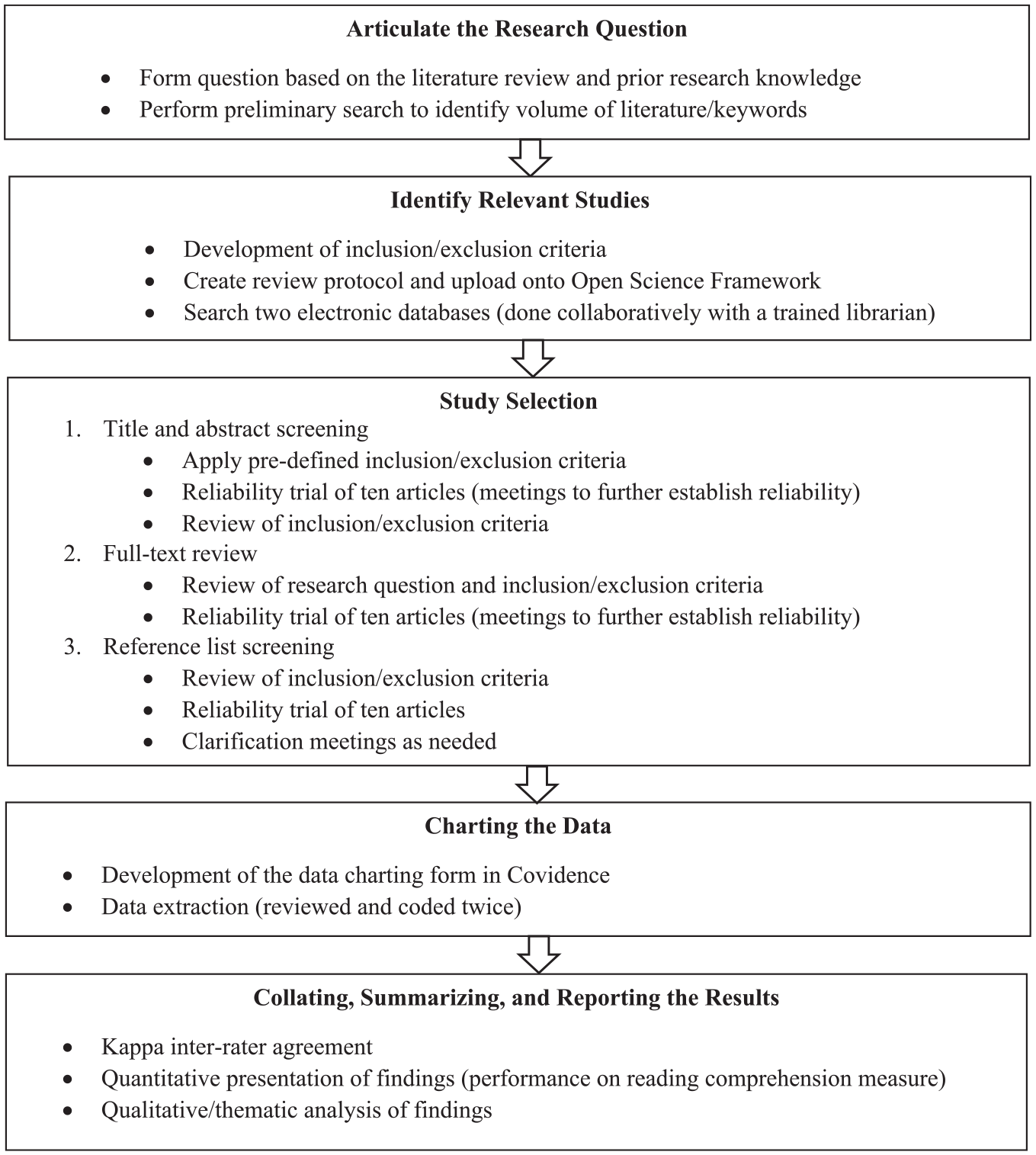
Flow diagram of the scoping review process adapted from Cunningham et al. (2017).
Data Charting Process
Data from the selected articles was charted in Covidence by the primary author of this review using the following headings: general information, methods, and results. General information included the following information: title, author(s), and year of publication. Methods included the following information: study aim(s), study characteristics from ADHD and TD groups including sample size, mean age, age range, gender, language status, confirmation of ADHD diagnosis (task/measure used), ADHD medication, reading measure(s) used, description of reading measure(s). Results included the following information: ADHD versus TD performance on reading comprehension task, type of test statistic (analysis of variance/t-test), group difference statistic(s). Conclusions included the following information: summary of findings, other important details. Each article was scanned individually for all relevant information mentioned above. Once this was complete and the data were charted, each article was reviewed a second time by the same reviewer to ensure all relevant information was reported correctly. One study (Kroese et al., 2000) did not report a group difference statistic but did provide additional statistical information (i.e., mean performance and standard deviation) that allowed for a calculation of group differences on the reading comprehension task. Each study was categorized based on the type of reading comprehension task used. For example, studies that required participants to recall information after reading a story were coded under story recall and those that required participants to fill in the blanks of missing story details were coded under cloze procedure. Studies that examined more than one type of reading comprehension skill were coded under each type of reading comprehension task used. Each study was carefully examined twice by a trained reviewer (KP) to ensure that the reading comprehension task(s) were categorized correctly. No discrepancies occurred during this stage between the two reviewers.
Results
Quantitative and qualitative findings were reported in the present review. Reading comprehension tasks, number of studies evaluating each skill, and type of skill implicated in each task are outlined in Table 1. Descriptive information for each study is provided in Table 2 and performance summaries for each study are outlined in Table 3. Qualitative summaries are provided based on the reading comprehension tasks used for each study. The selection process and number of articles removed by exclusion at each review phase are presented in Figure 2.
Reading Comprehension Tasks and Type of Skill Implicated in Each Task.
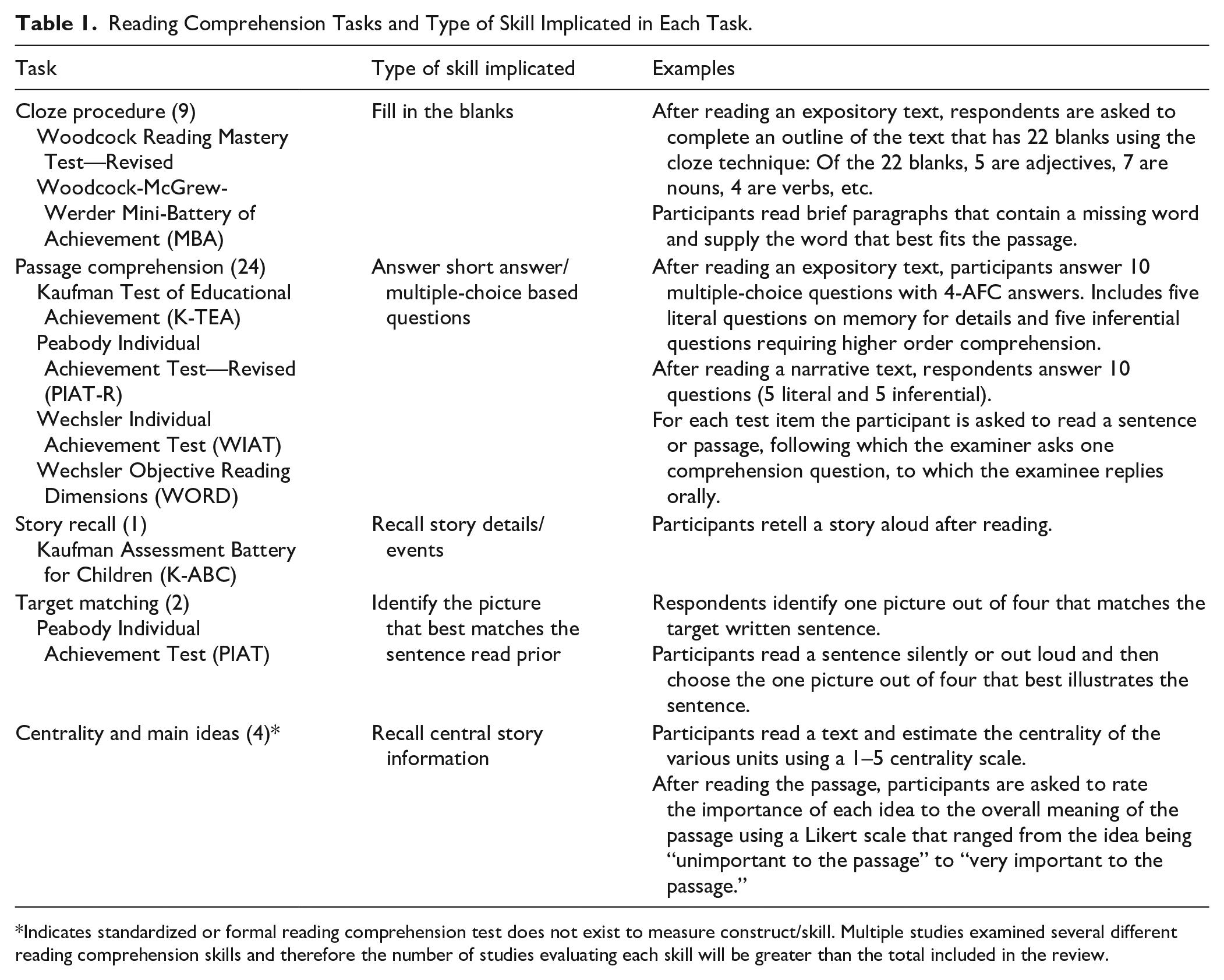
Indicates standardized or formal reading comprehension test does not exist to measure construct/skill. Multiple studies examined several different reading comprehension skills and therefore the number of studies evaluating each skill will be greater than the total included in the review.
Summary of Descriptive Statistics for Each Included Study (n = 34).
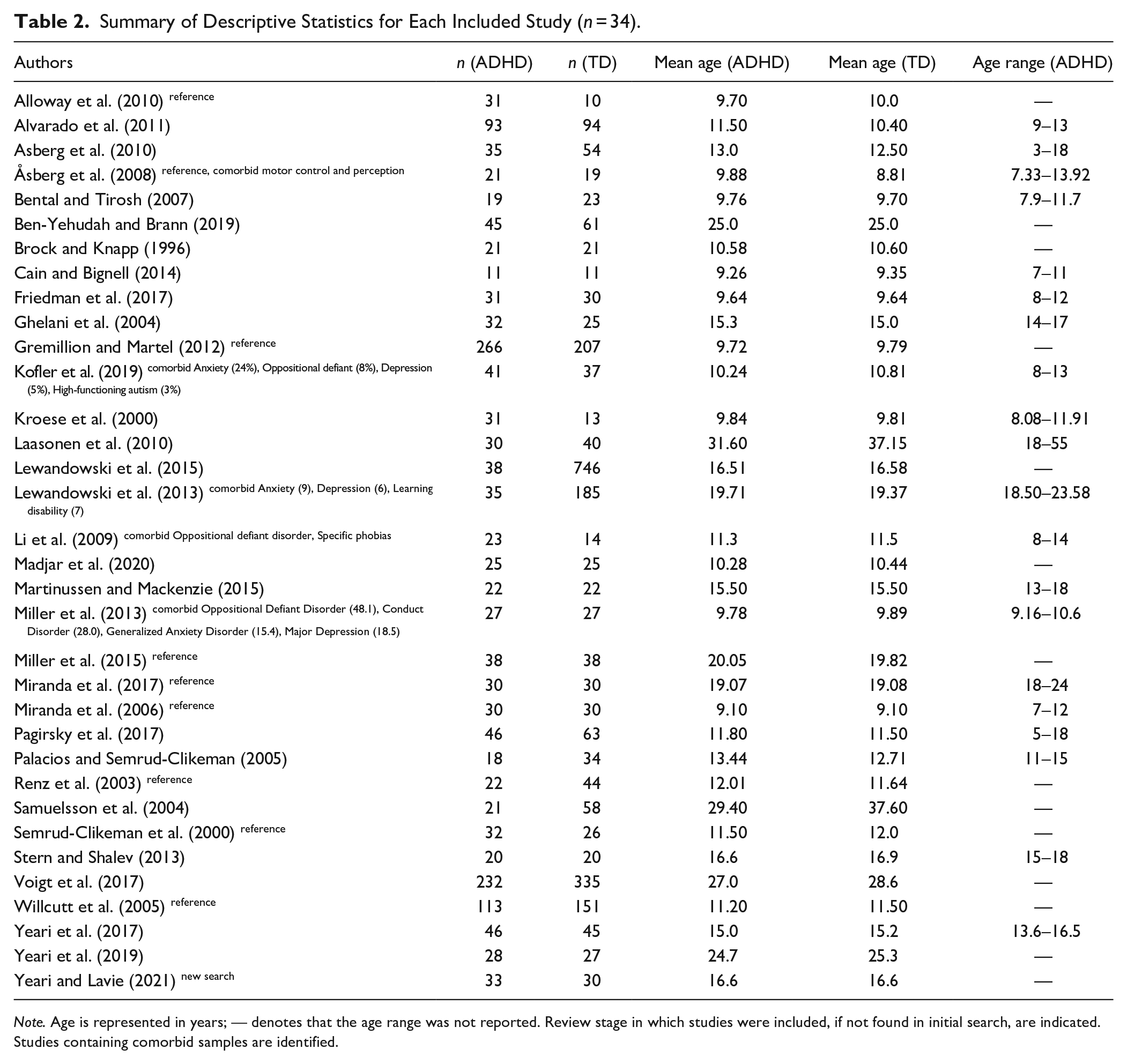
Note. Age is represented in years; — denotes that the age range was not reported. Review stage in which studies were included, if not found in initial search, are indicated. Studies containing comorbid samples are identified.
Summary of Studies Comparing ADHD to TD Individuals on Reading Comprehension Tasks (n = 34).
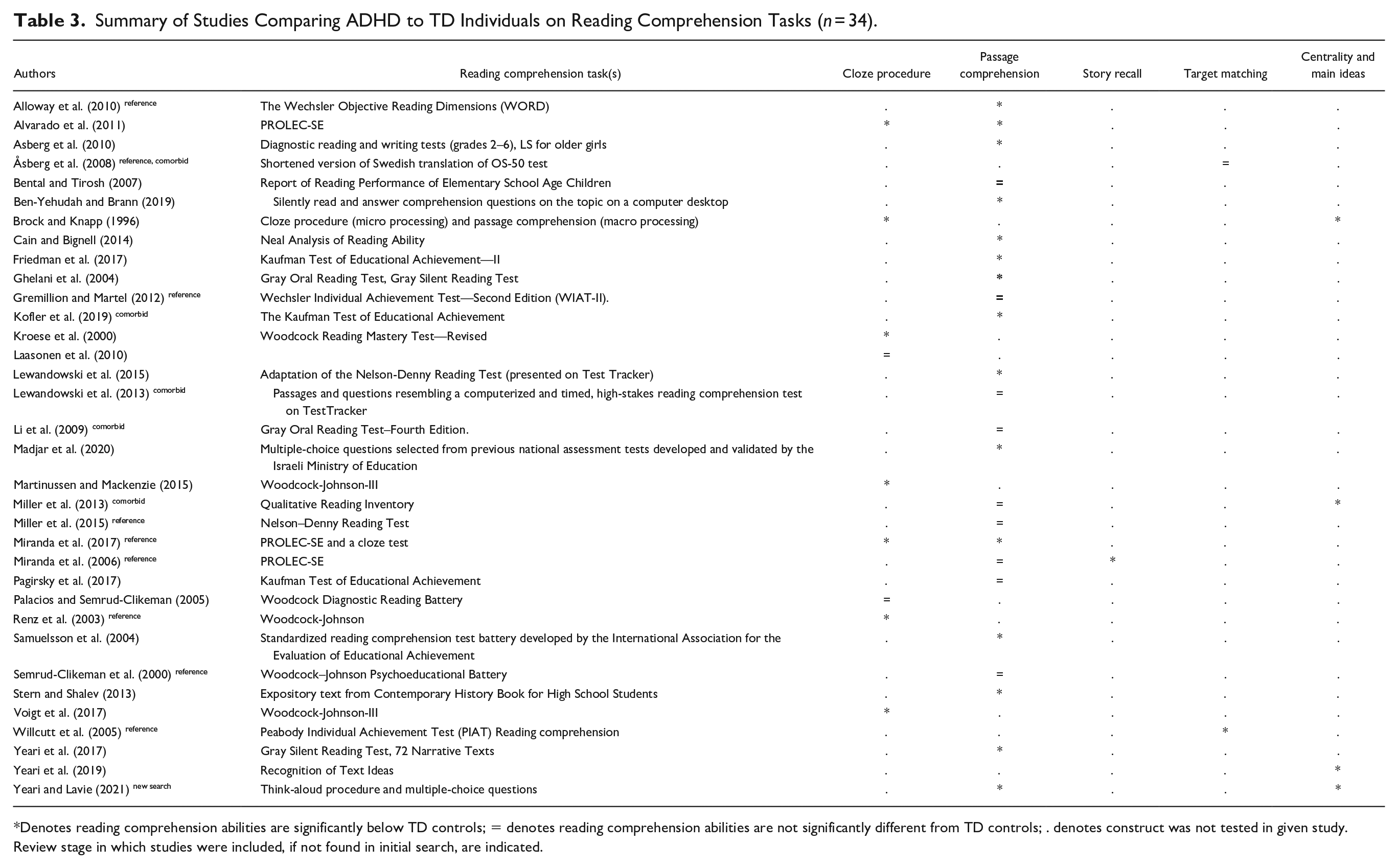
Denotes reading comprehension abilities are significantly below TD controls; = denotes reading comprehension abilities are not significantly different from TD controls; . denotes construct was not tested in given study. Review stage in which studies were included, if not found in initial search, are indicated.
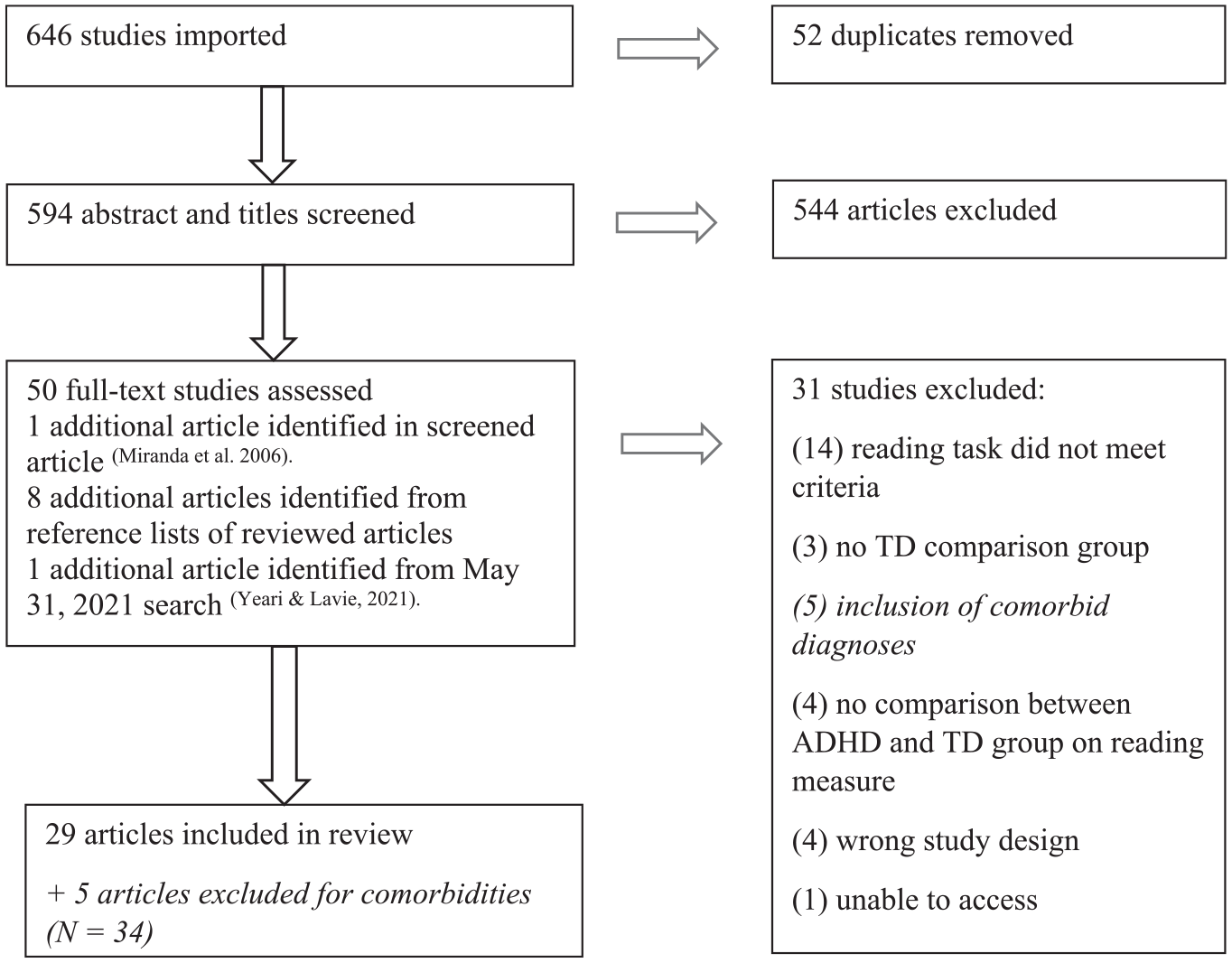
PRISMA flowchart illustrating the process for the selection of included articles.
The kappa statistic was used to determine interrater reliability between the two reviewers during the title and abstract, and full-text screening stages. The interrater reliability for the title and abstract screening stage was moderate (κ = .57), suggesting good agreement beyond chance. To address these discrepancies and improve reliability, reviewers met to discuss any uncertainties throughout the screening process as well as involved a third reviewer at all stages. For the full-text review stage, interrater reliability was considerably higher (κ = .84), suggesting that there was high agreement between the two reviewers beyond chance.
Cloze Procedure
The term “cloze” is derived from the word “closure” which relates to completing a structure by filling in a missing gap. A typical cloze procedure involves substituting various words from a passage with underlined blank spaces (Taylor, 1953). The lines used to replace the words are equal in length to the deleted words and the reader must then fill in the blank spaces with words that are appropriate in the context of the passage. The task is designed so that readers must understand the entire passage in order to fill in the missing words. Brock and Knapp (1996) compared the reading comprehension abilities of 10-year-old (on average; no age range reported) children with and without ADHD using a cloze procedure and found that despite having similar performance on tasks measuring word identification, decoding skills, reading speed, receptive vocabulary, and background knowledge on the passage topic, children with ADHD performed significantly worse than TD children on the cloze task. Similarly, Kroese et al. (2000) found that although children between 8 and 11 years of age with ADHD performed within the standardized average on the cloze task, they still demonstrated reduced performance relative to TD children. A number of other studies provide support for impaired performance on the cloze task in individuals with ADHD (Alvarado et al., 2011; Martinussen & Mackenzie, 2015; Miranda et al., 2017; Renz et al., 2003; Voigt et al., 2017) with one study showing that 27-year-old adults (on average; no age range reported) with ADHD scored nearly 5.5 grade levels (12.5 vs. 18.0 grade equivalent) below TD controls on the task (Voigt et al., 2017).
Fewer studies have found ADHD performance on the cloze task to be comparable to controls. Palacios and Semrud-Clikeman (2005) explored the relationship between reading comprehension, phonological awareness, and externalizing behaviors in a group of children and adolescents between 11 and 15 years of age with ADHD, oppositional defiant disorder, and typical development. The authors administered a traditional cloze procedure and found that even after controlling for verbal and nonverbal intelligence, the ADHD group demonstrated comparable performance to the TD controls on the task. Laasonen et al. (2010) evaluated reading comprehension abilities in adults between 18 and 55 years of age with and without ADHD by administering a modified version of the cloze task. Instead of identifying missing words, readers were expected to identify incorrect words within a passage. Adults with ADHD were just as fast and accurate as the control group at identifying incorrect words. Further, the two groups did not differ on the number of errors they made while searching for incorrect words. Miranda et al. (2017) also used a modified cloze procedure to examine whether performance differed between a group of adult males between 18 and 24 years of age with and without ADHD. The modified task was intended to measure a broader range of abilities related to recall and inference making (Miranda et al., 2017). Participants were instructed to silently read a text, then fill in the gaps in an outline of the text they read. Similar findings emerged, where individuals with ADHD demonstrated comparable performance to controls.
Passage Comprehension
Another method used to assess reading comprehension involves asking a series of open-ended, or multiple-choice format questions following a passage reading. The aim is to evaluate a reader’s ability to recall and comprehend as much of a passage as possible by asking questions that often assess literal and inferential comprehension. Literal comprehension questions must be answered with the aid of memory as these elements are often directly stated in the text whereas inferential questions are indirect and require the reader to make inferences. Inferential comprehension questions can therefore only be answered if the reader understands the text. Studies that have used this method to measure reading comprehension in ADHD have produced somewhat mixed findings. Several studies have provided evidence to suggest that individuals with ADHD struggle to accurately answer comprehension questions (Alloway et al., 2010; Alvarado et al., 2011; Asberg et al., 2010; Ben-Yehudah & Brann, 2019; Cain & Bignell, 2014; Friedman et al., 2017; Ghelani et al., 2004; Kofler et al., 2019; Lewandowski et al., 2015; Madjar et al., 2020; Samuelsson et al., 2004; Stern & Shalev, 2013; Yeari & Lavie, 2021; Yeari et al., 2017) while a fewer number of studies found performance to be comparable to TD controls (Bental & Tirosh, 2007; Gremillion & Martel, 2012; Lewandowski et al., 2013; Li et al., 2009; Miller et al., 2013, 2015; Miranda et al., 2006; Pagirsky et al., 2017; Semrud-Clikeman et al., 2000). To complicate things further, one study reported that participants with ADHD perform worse than TD controls on literal, but not inferential comprehension questions (Miranda et al., 2017).
Alvarado et al. (2011) examined reading competency and metacognitive strategies in children between 9 and 13 years of age with and without ADHD. Reading comprehension was measured by having children answer five literal and five inferential comprehension questions after reading a text. In this study, children also completed a modified cloze procedure, similar to that used by Miranda et al. (2017). Overall, children with ADHD demonstrated lower reading comprehension scores compared to the control group. Interestingly, the authors found that after controlling for reading comprehension, sex, and age, the groups significantly differed in metacognition. Thus, when reading comprehension abilities were matched in the two groups, individuals with ADHD still demonstrated lower metacognitive skills, particularly in areas related to planning. The authors suggest that deficits in executive function may therefore be a core factor contributing to poor reading comprehension in ADHD. In line with this, Friedman et al. (2017) examined the contribution of working memory and orthographic conversion on reading comprehension abilities in 8- to 12-year-old children with ADHD. In this study, orthographic conversion was defined as the ability to translate visually presented words into spoken words. Children were required to read passages that increased in complexity, and then orally respond to a series of literal and inferential comprehension questions. Boys with ADHD demonstrated greater reading comprehension deficits than TD boys. Mediation analyses further revealed that working memory and orthographic conversion separately, and collectively, mediated ADHD related reading comprehension difficulties. The authors suggest that children with ADHD may benefit from interventions focused on improving working memory and orthographic conversion processes. Lewandowski et al. (2015) also had participants read passages that increased in complexity. Questions that followed also ranged in difficulty, including the level of inference required to answer correctly. The authors found that 16-year-old students (on average; no age range reported) with ADHD did not differ from TD controls in how quickly they read the passages, or in the total number of items attempted. However, they did demonstrate significantly lower reading comprehension accuracy relative to controls. Importantly, the authors note that the differences observed were modest and should therefore be interpreted with caution. Samuelsson et al. (2004) found that 29-year-old (on average; no age range reported) adult males with ADHD were less accurate than TD controls in answering comprehension questions despite having comparable phonological, spelling, and word decoding skills. Even after controlling for background variables that may impact reading comprehension, such as age, socioeconomic status, education level, parents’ book reading, and number of books at home, there was still a significant difference between the groups in reading comprehension. Similarly, Yeari and Lavie (2021) found that after controlling for individual differences in decoding, 16-year-old (on average; no age range reported) adolescents with ADHD were less accurate and slower than TD controls at answering integrative and inferential multiple-choice questions. Yeari et al. (2017) also found evidence to suggest that 15-year-old (on average; no age range reported) adolescents with ADHD have difficulties generating predictive and explanatory inferences and in retaining relevant information about a text.
Ben-Yehudah and Brann (2019) examined the impact of print versus digital texts on reading comprehension performance in 25-year-old adults (on average; no age range reported) with and without ADHD. Participants read a series of texts presented either digitally, or in print with no time constraints. Following this, they answered 10 multiple-choice questions that evaluated literal and inferential comprehension. Overall, participants with ADHD were less accurate in answering questions compared to TD controls. Interestingly, further analyses revealed that the ADHD group performed significantly worse than the TD group on the reading comprehension task when text was presented digitally; however, performance was comparable between the two groups when text was presented in print form. The ADHD group also spent significantly more time reading when text was presented in print compared to TD controls. The authors suggest that increased time spent reading in the print condition had a positive impact on learning for the participants with ADHD, such that their reading comprehension scores matched that of the TD group.
Madjar et al. (2020) examined whether reading with background music improves reading comprehension abilities in children 10 years of age (on average; no age range reported) with and without ADHD. Children were grouped into one of four conditions (no music, calm music without lyrics, calm music with lyrics, and rhythmic music with lyrics). Those assigned to the no music condition read a short text aloud without background music and those in the music conditions did the same while music played in the background. Following this, they answered five multiple-choice questions that assessed their understanding of the text. In the no music condition, children with ADHD were less accurate at answering questions than the TD group. However, in the music conditions, accuracy significantly improved in the ADHD group, but declined in the TD group. Specifically, children with ADHD showed improved performance that was comparable to the TD group in the no music condition when calm music (with or without lyrics) was played during the reading comprehension task. The authors therefore suggest that background music has the potential to improve reading comprehension abilities in children with ADHD.
Oher studies have demonstrated that individuals with ADHD are able to answer comprehension questions about a text just as accurately as TD controls (Bental & Tirosh, 2007; Miller et al., 2013, 2015; Miranda et al., 2006; Pagirsky et al., 2017). A study by Miller et al. (2015) examined how extended time impacted reading comprehension in 20-year-old (on average; no age range reported) adults with and without ADHD. Participants were divided into three-time groups. The first group was given 15 minutes to read a passage and complete a series of multiple-choice questions. The second group received 22.5 minutes, and the third group received 30 minutes. The ADHD and TD groups did not significantly differ in the number of items correctly answered or attempted at 15 minutes. However, independent t-tests revealed that the ADHD group answered significantly more questions correctly and attempted more items at 22.5 and 30 minutes than the TD group at 15 minutes.
Story Recall
In story recall tasks, participants are expected to read grade-appropriate stories, then retell them aloud. Only one study has examined reading comprehension abilities using a story recall task in children between 7 and 12 years of age with ADHD (Miranda et al., 2006). Other studies have used recall tasks, but their analysis of comprehension differs by focusing on higher level comprehension that relates to identifying main story ideas (Brock & Knapp, 1996; Miller et al., 2013; Yeari et al., 2019), instead of story structure recall. Miranda et al. (2006) recorded children retelling a story they read earlier, then analyzed the recordings by calculating the overall number of propositions, and number of propositions by category (introduction, event, internal response, action, and outcome and resolution) accurately recalled. The authors found that children with ADHD were not able to recall story content as well as TD controls. Specifically, they remembered significantly less information from the story that focused on the introduction, events, and the actions carried out by the protagonist.
Target Matching
In target matching tasks, participants are asked to read a sentence silently or out load and then choose one picture out of four that best illustrates what was described in the sentence. The PIAT is the most widely used test that employs target matching to measure a child’s understanding of what is read. Only two studies used this type of task, and reported contradictory findings with respect to ADHD-group performance (Åsberg et al., 2008; Willcutt et al., 2005). However, for both studies, reading comprehension ability was not the primary focus. Rather, these studies focused on working memory, executive function, processing speed, as well as component reading and language skills in ADHD and other diagnostic groups. Åsberg et al. (2008) examined whether memory functions and verbal and performance IQ were differentially related to word and sentence reading in children between 7 and 13 years of age with ASD, ADHD, and TD. Children in the ADHD group had deficits in attention, as well as motor control and perception (also referred to as DAMP; deficits in attention, motor control, and perception). No significant differences were found between the ADHD and TD groups on sentence reading comprehension, although the authors noted a non-statistically significant trend toward lower performance in the ADHD group (p = .09). Conversely, Willcutt et al. (2005), who aimed to examine the neuropsychological profiles of 11-year-old children (on average; no age range reported) with ADHD and reading disability, found that there were significant differences in reading comprehension between the ADHD and comparison groups.
Centrality and Main Ideas
Centrality refers to the ability to pick out the most important, or central ideas in a story. The reader makes stronger connections between the ideas in a story that are closely related, and weaker connections between ideas that are less important, also referred to as peripheral ideas (Miller et al., 2013). Readers with centrality deficits have greater difficulties retaining and recalling the central ideas of a story compared to those without a centrality deficit (Brock & Knapp, 1996; Miller et al., 2013; Yeari & Lavie, 2021; Yeari et al., 2019). Four studies have examined whether individuals with ADHD have difficulties recalling central, or main ideas in a story, and all suggest performance is impaired compared to controls.
Miller et al. (2013) measured centrality by recording 9- and 10-year-old children’s retellings of a story after reading it aloud, followed by scoring the number of important, or central ideas children recalled. The authors found that children with ADHD showed a centrality deficit. That is, they recalled significantly less central than peripheral information compared to controls. Interestingly, in a regression analysis, the authors found that after controlling for word reading ability, working memory, as measured by a composite score from a sentence span and counting span task, significantly predicted participants’ ability to recall central ideas. A mediation analysis further revealed that working memory significantly mediated the relationship between ADHD symptoms and the ability to recall central ideas. The authors suggest that difficulties in ADHD may therefore be related to deficits in working memory, where individuals with ADHD struggle to update their mental representations and form connections between new and existing ideas. Similarly, Brock and Knapp (1996) had 10-year-old children (on average; no age range reported) with and without ADHD read a passage, then recorded the number of main ideas they could identify in the text. The authors found that although both groups performed similarly on tasks measuring word identification, decoding, and word knowledge, children with ADHD were less accurate in identifying the main ideas of the text than TD controls.
Yeari et al. (2019) defined centrality as the extent to which an idea is important for the overall understanding of the text, and the extent to which understanding would suffer if the idea was missing. The authors measured the ability to recall and recognize central and peripheral information in three texts. Centrality estimates were also collected through a questionnaire where participants were presented with parsed text units and required to estimate the centrality of each unit on a scale. The authors found that 24-year-old adults (on average; no age range reported) with ADHD were able to recall significantly fewer central units of information than the control group. However, they were just as good at recognizing central, versus peripheral information and estimating centrality for various units of information. A regression analysis further revealed that working memory capacity uniquely contributed to the ability to recall central ideas in ADHD, with marginal significance. Adults with ADHD had specific difficulties retrieving central ideas that they were able to successfully identify, attend to, and store in long-term memory (Yeari et al., 2019). The authors suggest that the ability to recognize, but not recall, central ideas could be explained by difficulties retrieving information that is available in long-term memory.
Yeari and Lavie (2021) also examined the centrality deficit in 16-year-old (on average; no age range reported) adolescents with ADHD; however, this study differed in that they examined text processing while reading using a think-aloud procedure. In this procedure, readers are asked to state aloud whatever comes to mind after reading a passage. Think-aloud responses were classified into categories that reflected either deep-level processing or surface-level processing. Responses that reflected deep-level processing included connecting inferences, elaborate inferences, predictions, and metacognitive comments. Responses that reflected surface-level, or less-efficient text processing included text repetitions, paraphrasing, free associations, and evaluative comments. In addition to the think-aloud procedure, the authors had participants recall the texts in the same order they were read and answer a series of multiple-choice comprehension questions. Using this procedure, the authors were able to examine the quality of text processing in adolescents with ADHD during reading, as well as the text-level deficits that underly poor reading comprehension after reading. Attention control, single word reading accuracy and speed (decoding skills), and nonverbal intelligence were measured. Compared to controls, adolescents with ADHD generated fewer responses that reflect deep-level processing and focused on central, compared to peripheral text ideas. A regression analysis further revealed that, after controlling for attention control, decoding skills, and nonverbal intelligence, participants’ proportions of deep processing responses significantly predicted their performance on the recall task as well as accuracy on the comprehension questions. The authors suggest that these findings demonstrate how the quality of text processing during reading affects the quality of text comprehension after reading. Together, these findings suggest that individuals with ADHD have difficulties with reading comprehension because they employ less efficient strategies that focus on surface-level text information while reading. As a result, these individuals construct low-quality text representations because they tend to process text in isolation and fail to establish accurate connections between text ideas.
Discussion
This scoping review aimed to clarify the nature of reading comprehension abilities in ADHD. Specifically, it examined how individuals with ADHD perform on reading comprehension tasks relative to TD controls, and which tasks are most problematic for individuals with ADHD. To achieve these goals, we examined and summarized 34 articles that used a range of reading comprehension tasks across age groups. Qualitative summaries were provided for studies based on the reading comprehension task used, resulting in four broad categories: cloze procedure, passage comprehension, story recall, and centrality and main ideas. Although performance varied across reading comprehension tasks, the evidence as a whole suggests that reading comprehension abilities are impaired in ADHD, with more than half of the studies examined in the review demonstrating this finding. Importantly, findings suggest that participants with ADHD struggle more consistently on tasks that require open-ended responses or present high cognitive demands. However, they can perform at a level similar to TD peers when tasks are modified, or task demands are not too high. Overall, these findings suggest that the task used to measure reading comprehension matters and can have an impact, whether good or bad, on performance in ADHD.
Studies using the cloze procedure to measure reading comprehension in ADHD yielded somewhat mixed findings. Overall, the evidence from these studies suggests that individuals with ADHD perform worse than TD controls on traditional cloze tasks but demonstrate comparable performance on modified versions of these tasks. Two studies examined in this review used a modified cloze procedure (Laasonen et al., 2010; Miranda et al., 2017), one that had participants identify incorrect words within a passage, and one that had them identify missing words within an outline of a passage. The ADHD and TD groups did not differ in accuracy in either studies. One explanation for these findings is that the modified tasks were tapping into aspects of reading comprehension that are not measured in traditional cloze tasks and not affected in ADHD. An alternative, but related, explanation is that because the information presented during these modified tasks varies from what is presented during typical cloze tasks, participants with ADHD were able to make better use of this information to identify incorrect and missing words more accurately.
Findings from studies that used comprehension questions to measure reading comprehension in ADHD also varied. Some studies found that individuals with ADHD are just as accurate as TD controls in answering comprehension questions; however, a greater number of studies found the opposite to be true. Despite having poorer performance overall, some studies demonstrated that, similar to the cloze task, accuracy in ADHD can improve when task modifications are introduced. Specifically, accuracy improved for individuals with ADHD when they received additional time to answer comprehension questions, had text presented in print form (Ben-Yehudah & Brann, 2019), and listened to calm background music (with or without lyrics) during the task (Madjar et al., 2020). These findings suggest that when tasks are modified for comprehensibility, individuals with ADHD can answer comprehension questions with similar accuracy to TD controls.
The above findings demonstrate that modified versions of reading comprehension tasks can lead to improved performance in ADHD. It is possible that modifications reduce cognitive load during reading comprehension, leading to improved performance in ADHD. The question remains whether poor performance on reading comprehension tasks are indicative of comprehension deficits in ADHD or difficulties related to the task itself. Further, if comprehension deficits exist, it is unclear whether these are related to problems with encoding or recalling the information after the fact. These questions are beyond the scope of the present review; however, the above findings do provide convincing evidence to suggest that scoring poorly on a comprehension task might not indicate that participants with ADHD are unable to comprehend the text itself. Rather, these individuals struggle with certain aspects of how reading comprehension is being measured.
Only one study examined reading comprehension using a story recall task, and performance was found to be impaired in children with ADHD (Miranda et al., 2006). Children with ADHD not only struggled to remember particular elements of a story, but also struggled with organizing and structuring their narrations of stories. Although an important contribution to the present review, additional studies are needed to confirm whether these findings are replicable and whether similar difficulties would be observed in older participants with ADHD.
Only two studies examined reading comprehension using a target matching task and conflicting findings were reported. Åsberg et al. (2008) found that children with ADHD had equal performance to controls at identifying pictures and their written descriptions, while Willcutt et al. (2005) found the opposite. Åsberg et al. (2008) included children with deficits in attention, as well motor and coordination (DAMP). However, reading comprehension performance was not found to be impaired in this sample. Willcutt et al. (2005) included participants who only met the criteria for ADHD, however, a portion of their sample also had deficits in reading and spelling achievement. Despite not meeting the full criteria for reading disability, the authors note that these deficits suggest that a subset of their ADHD sample had subclinical manifestations related to reading disability. The results from these two studies should be interpreted with caution, and similar to story recall tasks, additional studies are needed to draw firm conclusions about performance in ADHD. Regardless, the findings suggest that reading and spelling difficulties often associated with ADHD are more likely to impact reading comprehension, at least on target matching tasks, over motor or coordination deficits.
A total of four studies examined reading comprehension using tasks that measured participants’ ability to identify central story ideas, and all four identified weaknesses in ADHD. That is, individuals with ADHD were less accurate than TD controls in identifying the central or main ideas of a story. Interestingly, one study found that individuals with ADHD had difficulties recalling, but not recognizing central ideas (Yeari et al., 2019). These findings suggest that reading comprehension weaknesses in ADHD may stem from difficulties related to recall, not encoding. Further, two of these studies highlighted the role of working memory in recalling central ideas (Miller et al., 2013; Yeari et al., 2019) and how deficits in this area might explain poor performance in ADHD. The authors suggest that because individuals with ADHD must allocate greater resources to sustaining attention during reading tasks, less resources are allocated to skills that aid in higher-level comprehension, such as connecting and recalling main ideas. It is also possible that while reading a story, individuals with ADHD struggle to inhibit irrelevant or competing information and as a result, fail to identify connections between central ideas. Another possible explanation for poor reading comprehension in ADHD, as suggested by Yeari and Lavie (2021), is that these individuals employ low quality processing strategies while reading that prevent them from constructing a high-quality representation of the text.
A total of five studies examined reading comprehension in ADHD and comorbid diagnoses (Åsberg et al., 2008; Kofler et al., 2019; Lewandowski et al., 2013; Li et al., 2009; Miller et al., 2013). Comorbid diagnoses included motor control perception (Åsberg et al., 2008), anxiety, oppositional defiant disorder, depression, specific phobias (Kofler et al., 2019; Lewandowski et al., 2013; Li et al., 2009; Miller et al., 2013), and high-functioning autism (Kofler et al., 2019). One study examined reading comprehension using centrality and main idea estimates and found performance in ADHD to be impaired (Miller et al., 2013) while another used a target matching task and found performance in ADHD to be intact (Åsberg et al., 2008). Three out of the five studies that included comorbid samples examined reading comprehension using a passage comprehension task, and only one found performance to be impaired (Kofler et al., 2019). Importantly, this study included children with ADHD and comorbid high-functioning autism. Several studies have revealed that children with autism exhibit reading comprehension (Brown et al., 2013; Castles et al., 2010; Flores & Ganz, 2009; Huemer & Mann, 2010) and language comprehension and production difficulties (Hudry et al., 2010, 2014; Parks et al., 2020). It is therefore possible that these deficits, coupled with those related to ADHD including distractibility, difficulties concentrating, and an inability to focus, could have led to poorer reading comprehension performance overall. As previously mentioned, symptoms related to ADHD alone can negatively impact reading comprehension performance. Symptoms related to autism could further compound these difficulties, and explain why Kofler et al. (2019) found reading performance to be impaired and the other studies did not. The above findings align with several other studies included in the review that have demonstrated comparable performance between ADHD and controls on passage comprehension tasks (Bental & Tirosh, 2007; Gremillion & Martel, 2012; Miller et al., 2015; Miranda et al., 2006; Pagirsky et al., 2017; Semrud-Clikeman et al., 2000). Overall, performance on passage comprehension tasks varies across studies, and this pattern of variability appears to hold true for both pure and comorbid samples of ADHD.
The present review included a wide age range of participants with ADHD, with the youngest participant being 3 years of age and the oldest 55 years of age. Despite this, no clear age trends in reading comprehension performance were observed. That is, children, adolescents, and adults with ADHD all showed reduced performance compared to TD controls on reading comprehension tasks. For example, among the studies that used the cloze procedure, performance in children (8–11 years of age) was found to be worse than TD controls in one study, and the same held true for adolescents (aged 13–18 years) in another. Similar findings emerged for passage comprehension tasks, where one study that included children (9–13 years of age), and another that included adults (25 years of age) found performance to be worse in ADHD compared to that of TD controls. Thus, performance on the same measures did not appear to change from childhood to adulthood for those with ADHD.
Findings from the present review and systematic review identified in the most recent search by Stewart and Austin (2020) are complementary. The present review offers a summary of reading comprehension abilities in ADHD, highlighting where these individuals tend to struggle most, while the systematic review by Stewart and Austin (2020) offers evidence for strategies that are most effective in improving reading outcomes in this population. Importantly, the present review found that individuals with ADHD demonstrated reduced performance on all tasks that required them to summarize or identify main story ideas and these skills were the focus of many reading interventions identified in the recent systematic review. Together, these findings inform where interventions aimed at improving reading comprehension outcomes in ADHD should continue to focus their efforts.
Limitations
This review has a number of potential limitations worth noting. First, in an attempt to improve replicability, the present review did not include gray literature (e.g., dissertations, unpublished studies). Indeed, several dissertations were screened in the first stage of this review that met the pre-defined inclusion criteria. Some of these studies were later identified as being published and subsequently included in the present review. The inclusion of unpublished work may have reduced concerns related to publication bias as well as created a more balanced view of the available evidence. However, the inclusion of gray literature can raise additional concerns that are important to note. Unpublished literature might be of lower methodological quality since methods and reporting are not as heavily scrutinized. Another concern relates to researchers’ willingness to provide access to papers and data. Studies with more favorable results might be handed over more readily which could bias the findings of a review. Finally, unpublished studies may have a greater impact when the research in a particular area is limited but overall, research has demonstrated that the inclusion of unpublished work rarely influences the conclusions of a review (Hartling et al., 2017; Vickers & Smith, 2000). Second, the decision to include only English text articles may have led to the exclusion of relevant publications as well as presented a biased view of the literature. Research has suggested that the impact of including non-English articles on review findings varies depending on the topic (Hartling et al., 2017). For example, reviews on complementary and alternative medicine are more impacted by the exclusion of non-English articles (Pham et al., 2005) while those related to psychiatry, rheumatology, and orthopedics have been shown to produce similar results to reviews with no language restrictions (Egger et al., 2003). Although 86% of journals are published in English (Jackson & Kuriyama, 2019), this does not indicate that non-English publications are of lower quality. The decision to include non-English articles should be made depending on the topic area as well as the volume of evidence available. Third, although not a limitation of the review itself, a large portion of studies that met the inclusion criteria for the present review included only male participants or participants enrolled in post-secondary education. These limitations may impact the interpretation of the results and make it difficult to generalize findings to the broader ADHD population. Thus, while not practicable in the present scoping review the inclusion of gray literature, non-English articles, and studies that contain more diverse populations may eventually yield a more comprehensive perspective.
Lastly, another limitation of the present review concerns the exclusion of additional keywords related to academic achievement. Terms related to academic achievement were omitted during the final search. Several studies within the ADHD and reading comprehension literature have examined general academic abilities, with reading comprehension being one of these abilities. Our search did yield several key studies that did not examine reading comprehension exclusively but included it as a measure which allowed for the inclusion of these articles in the review. For example, several studies included in the review were primarily interested in working memory, academic achievement, spelling ability, or test-taking performance. It is possible that our initial search may have overlooked additional investigations in which reading comprehension was one of several academic domains examined. Despite this, the keyword “reading” was used and searched throughout both selected databases. As a result, any articles that included the key terms “ADHD” and “reading” at any point throughout the article were captured with our search. We therefore believe that our search was sufficient in capturing the studies that included a reading comprehension measure that matched our pre-defined inclusion criteria. However, to improve comprehensibly, future studies may wish to amend the search parameters to include keywords that specifically include academic achievement.
Conclusions
Difficulties related to reading comprehension can have a cascading impact on higher-level skills that contribute to academic success. It is therefore necessary to better understand these abilities in ADHD in order to mitigate difficulties that can arise as a result of poor reading comprehension. This is the first review to examine the literature available on this topic with the aim of better understanding the nature of reading comprehension abilities in ADHD. The literature indicates that in general, individuals with ADHD have impaired reading comprehension abilities. However, they tend to struggle more reliably on tasks that are less structured, or present high cognitive demands. These findings suggest that stronger evidence for an ADHD deficit may depend on the extent to which reading measures capture higher order test comprehension processes, such as identifying main ideas. Importantly, some studies in this review found that performance can improve in ADHD on at least some comprehension tasks if task demands are not too high. These findings suggest that participants with ADHD may not be poor comprehenders overall, but rather experience difficulties with certain elements of how reading comprehension is measured.
Implications for Further Research
Almost all studies included in the review instructed participants with ADHD to discontinue their stimulant medication days prior to testing, and on the day of testing. However, they varied in the amount of time they asked participants to discontinue their medication prior to testing with some requesting as little as 12 hours (Madjar et al., 2020), and others requesting upwards of 24 (Alvarado et al., 2011; Friedman et al., 2017), and 48 hours (Miranda et al., 2017). Despite these differences, the above-mentioned studies all found evidence for impaired reading comprehension in ADHD. Future research should consider the impact of stimulant medication, including the duration it is discontinued prior to testing on reading comprehension performance in ADHD. Such research could investigate whether reading comprehension deficits are greater in non-medicated individuals, or whether deficits are reduced in those taking medication.
Importantly, passage comprehension was the most widely used assessment for reading comprehension, occurring in 24 of the studies included in this review. Research has repeatedly shown that students with ADHD benefit from additional time to complete tests at all levels of education (Bolt & Thurlow, 2004; Brown et al., 2011; Lewandowski et al., 2007) and the findings from the present review further support this notion. Testing accommodations are not only common (Bolt & Thurlow, 2004), but often crucial to how individuals with ADHD demonstrate what they know and perform on tests (Bolt & Thurlow, 2004; Brown et al., 2011; Shaw & Lewis, 2005). Importantly, researchers have found that reading passages can be especially difficult for students with ADHD (Cahalan-Laitusis et al., 2006). For instance, one study found that some students with ADHD were not able to finish reading passages and answering related questions about the passage, even with extended time (Cahalan-Laitusis et al., 2006). These students, who also struggled with reading-based learning disabilities, took up to 20 minutes to read through one passage, leaving them with insufficient time to answer passage questions and move onto the next reading passage (Cahalan-Laitusis et al., 2006). Extended time, especially for reading related tasks, is therefore one of the most important accommodations that can be given to individuals with ADHD. Indeed, whether multiple-choice or short answer type questions are administered, time restrictions on passage comprehension assessments can be one of the biggest hurdles that exist for students, with or without ADHD (Lewandowski et al., 2007). However, the ability to answer comprehension-based questions accurately in a timely manner is required for most formal educational and/or occupational assessments. A meta-analysis of the 18 studies should therefore be undertaken in future reviews to examine how students perform on a reading comprehension measure that has significant real-world applicability.
Another potential avenue for future research is to perform a more structured review that can assess some of the methodological limitations identified here. For example, a systematic or meta-analytic review could be used to investigate the construct validity of reading comprehension tasks, as well as evaluate whether the tasks used are sensitive enough to capture difficulties in ADHD, if any. Further, given that co-occurring conditions are common in children with ADHD, future systematic or meta-analytic reviews could examine how comorbid diagnoses in ADHD contribute to poor reading comprehension. Only five studies that met our inclusion criteria included comorbid samples. A broader sample of children with other clinical disorders would maximize the external validity and generalizability of research findings. Such studies could examine potential neurocognitive contributions to poor reading comprehension and how specific comorbid diagnoses may hinder reading comprehension more than others. In turn, effective treatment strategies could be implemented not only for those with ADHD, but with other diagnoses that further reading comprehension challenges. These questions are beyond the scope of the current review, which is meant to provide an overview of the available literature rather than address specific questions regarding the appropriateness or effectiveness of reading comprehension measures. More importantly, a minimum of 10 studies per construct are recommended for accurate calculations in meta-analytic reviews (Borenstein et al., 2021) and therefore, additional research will be needed on this topic (particularly for story recall and target matching tasks) before such a structured review is possible. Although a future systematic review of the literature is warranted, some challenges will exist for future researchers looking to explore this topic. Worldwide, there is large variability in ADHD prevalence rates that is the result of differences in methodological and diagnostic criteria among studies (Polanczyk et al., 2007), rather than geographic location. Prevalence rates can vary from approximately 3% to 8% when different methodological criteria, such as the presence or absence of a functioning impairment, are applied (Polanczyk et al., 2007). High rates of comorbidity and heterogeneity in ADHD complicates things further. For a systematic or meta-analytic review to be possible, the same criteria must be used to diagnose ADHD and the same construct must be used to measure reading comprehension across studies. Otherwise, comparisons between performance across studies are not feasible.
Two studies in the present review measured reading comprehension in ADHD using two different tasks and found that performance was impaired for one task, but not the other. Perhaps an important question for future research is why the same group of participants can demonstrate such contrasting performance on tasks intended to measure the same ability. The appropriateness of the cloze task in assessing reading comprehension has been of particular interest to researchers. Some suggest that the task is a measure of word recognition, rather than reading comprehension (Francis et al., 2005; Keenan et al., 2008; Nation & Snowling, 1997). Unlike other reading comprehension tasks, studies have found that most of the variance in a cloze task can be accounted for by word decoding skills (Francis et al., 2005; Nation & Snowling, 1997). Other researchers have suggested that because of the fill-in-the-blank format, cloze tasks are poor at assessing a readers overall understanding of the text and may be measuring knowledge differences, rather than comprehension difficulties (Miller et al., 2013). Additional work is therefore needed to determine whether it is appropriate to continue using the cloze task as a measure of reading comprehension in all populations, not only ADHD.
Another area of interest for future work is to investigate what factors contribute to reading comprehension difficulties in ADHD and whether these differ across age. Future studies could investigate whether comprehension difficulties in ADHD can be explained by working memory, word decoding, language, attention, or a combination of all these processes and whether this differs as a function of age. In line with this, researchers could investigate when these difficulties arise during reading, for example, whether it is early on, when they are required to identify words, or later, when they must integrate various components of a text and derive meaning. Although no clear age trends were observed in the current review, there is growing evidence of developmental changes and the use of cognitive skills needed for reading comprehension as children age and reading abilities become more complex. As children age, different component skills may become more important for reading and ADHD-related reading deficits may change as a result. For example, research has shown that decoding and comprehension are component skills for successful reading in younger children, while in addition to decoding and comprehension, orthographic skill and processing speed are component skills in older children (Aaron et al., 1999). Other studies have found that the contribution of language to predict reading comprehension increases in the primary years, while the contribution of decoding decreases (Foorman et al., 2018). Examining how these component skills change over time, specifically in ADHD, is an important area for future work. A re-interpretation of the Simple View of Reading formula could be applied here, where reading comprehension abilities can be estimated from decoding and language comprehension abilities, while considering that language comprehension may have a greater contribution as children age. This practical application could save time spent on assessment where only two measures, instead of all three are necessary. This decrease in assessment time would be especially useful when looking at ADHD samples. The above investigations could provide insight into why reading comprehension is impaired in ADHD and at what point these individuals are struggling in order to better identify where interventions should be focused.
Supplemental Material
sj-docx-1-jad-10.1177_10870547211068047 – Supplemental material for The Task Matters: A Scoping Review on Reading Comprehension Abilities in ADHD
Supplemental material, sj-docx-1-jad-10.1177_10870547211068047 for The Task Matters: A Scoping Review on Reading Comprehension Abilities in ADHD by Kaitlyn M.A. Parks, Christine N. Moreau, Kara E. Hannah, Leah Brainin and Marc F. Joanisse in Journal of Attention Disorders
Footnotes
Declaration of Conflicting Interests
The author(s) declared no potential conflicts of interest with respect to the research, authorship, and/or publication of this article.
Funding
The author(s) received no financial support for the research, authorship, and/or publication of this article.

Supplemental Material
Supplemental material for this article is available online.
Author Biographies
References
Supplementary Material
Please find the following supplemental material available below.
For Open Access articles published under a Creative Commons License, all supplemental material carries the same license as the article it is associated with.
For non-Open Access articles published, all supplemental material carries a non-exclusive license, and permission requests for re-use of supplemental material or any part of supplemental material shall be sent directly to the copyright owner as specified in the copyright notice associated with the article.
