




Abstract
This systematic literature review examines research on U.S. professional development (PD) in which practicing teachers are asked to engage explicitly with race and racism. Using Kennedy’s PD theories of action, this review examines 64 studies published from 1981 to 2019 and analyzes race-related PD goals, pedagogical approaches, and documented outcomes of PD. The body of scholarship shows an array of PD program goals, often-limited pedagogical explicitness and detail, and descriptive and developmental outcomes. Recent scholarship has centered racial-equity-oriented teachers and teachers of Color and identified PD characteristics associated with positive outcomes. Extant literature has seldom directly documented PD transfer and incorporation in schools or documented PD impact on students. Areas for future research include further leveraging scholarship on change processes including teacher learning and PD effectiveness, documenting teacher development beyond PD sessions, probing affordances of different PD settings and formats, and examining how PD ultimately impacts student experience.
Keywords
Researchers in the United States have long studied teachers’ learning about diversity, inequality, and race (Hollins & Guzman, 2005; Ladson-Billings, 2001; Nieto, 1992; Picower & Kohli, 2017; Zeichner, 1993). Increasingly, prekindergarten through 12th grade (P–12) leaders have been turning to a specific activity less understood by researchers: inservice professional development (PD) for practicing teachers explicitly addressing race and racism. Such PD is increasingly common and contested at the current moment. Inservice PD explicitly addressing race and racism with practicing teachers remains a relatively underexplored area of study. This systematic review thus synthesizes research on racial-equity PD (the concept researchers have used most often) in P–12 schools to assess what research has revealed about inservice PD explicitly addressing race and racism with practicing teachers.
Teachers of all racial identities often exit teacher education programs feeling ill equipped to teach in culturally and racially diverse schools (Hollins & Guzman, 2005; Kohli, 2018; Picower, 2012). Antiracist and culturally relevant (Ladson-Billings, 1995) teacher development requires ongoing reflection and support over the course of educators’ careers (Ladson-Billings, 2001; Picower, 2012). Researchers have identified several critical areas of attention for PD and other efforts, including (a) limited educational opportunities and daily harm experienced by students of Color (Kohli et al., 2017); (b) “demographic and democratic imperatives” (Achinstein & Ogawa, 2011, p. 3) for White teachers, specifically, and schools, generally, to better serve students of Color; (c) developing the racial literacy of White students (Schniedewind, 2005); and (d) supporting and retaining teachers of Color (Kohli, 2018, 2021). PD addressing race and racism has become more significant recently, as many educators have been attempting to reckon with enduring racial inequality following Summer 2020 protests against anti-Black racism while groups of predominantly White parents and politicians have been seeking to restrict PD addressing race and racism (Pollock et al., 2022).
Three core contentions from scholars underlie the research throughout this review addressing racial-equity PD: (a) racism plays a role in society and school experiences (e.g., Bonilla-Silva, 1997; Kohli et al., 2017), (b) teachers’ conceptions of race and racism and their racial identities influence their teaching through the beliefs and practices they hold and enact (e.g., Michael, 2015; Milner, 2015), and (c) focused attention via PD on the role of race and racism in teachers’ work is needed to address racial inequality (e.g., Casey & McManimon, 2020; Kohli et al., 2015). Thus, this review positions teachers, informed by their racial identities, as actors contributing to and resisting structural racial inequality in schools, with PD as one way to address this responsibility.
Purpose and Aims
Historically, research addressing diversity, equity, and race has examined preservice, often White, teachers’ learning, whereas some recent reviews have addressed the experiences of teachers of Color (e.g., Kohli et al., 2017) and equity-oriented PD with practicing teachers (e.g., Parkhouse et al., 2019). For example, Hambacher and Ginn (2020) found over 70% of research across their review of “race-visible teacher education” (p. 329) had focused on preservice teachers. I undertook the present review because I was unable to locate a systematic review of inservice PD explicitly focused on race and racism.
Among much necessary research and PD that have aimed to support more racially equitable schools, this review addresses scholarship with particular characteristics related to PD learning and researchers’ PD analysis. First, this review prioritizes research on structured PD programs and teachers’ PD learning amid many possible learning experiences. For example, scholarship addressing educators’ experiences in action research and school reform efforts, teacher union organizing, and school or district ethnographic scholarship that did not primarily focus on a structured inservice PD program was omitted. Next, this review focuses explicitly on race and racism amid many bodies of work that have aimed to advance racial equity in schools. Such work includes research addressing social justice education, multicultural education, culturally relevant pedagogy (CRP), and more. Despite the significance of these traditions, researchers have found PD and scholarship citing such work have not necessarily addressed race and racism specifically (Kohli et al., 2017; Milner, 2017; Sleeter & Delgado-Bernal, 2004). Patterns of race evasiveness and silence on issues of race, racism, and racial identity (Bonilla-Silva, 2006; Jupp et al., 2019; Pollock, 2004) further suggest an explicit focus on race and racism may be required when attempting to engage such experiences and issues. This review then includes scholarship in which structured inservice PD itself was researchers’ central focus, educators’ PD learning (as documented by researchers) explicitly addressed race and racism, and researchers’ analysis and findings directly addressed teachers’ race and racism-specific learning.
This review includes 49 articles, nine book chapters, and six books detailing 42 unique PD programs engaging U.S. P–12 educators from 1981 to 2019, asking the following pertaining to goals, pedagogies, and outcomes:
What goals does inservice PD explicitly addressing race, racism, and racial identity aim to achieve with practicing teachers?
What pedagogies, informed by what scholarship or theory, are used in PD addressing race, racism, and racial identity with practicing teachers?
What PD outcomes are most common among PD efforts addressing race, racism, and racial identity with practicing teachers?
Before addressing these questions, I conclude this section by addressing my positionality as a researcher, clarifying what researchers mean by “racial equity,” and defining key terms used throughout the review. 1
I am a White male from an upper-middle-class background and am the product of predominantly White, suburban schools. My own interrogation of White supremacy began with the works of Dr. James Cone and Black liberation theology and continued as a teacher in Baltimore learning from students and community organizations. As a teacher at a predominantly Black high school, I engaged in racial-equity PD using Singleton’s (2014) Courageous Conversations About Race and have attended other forms of PD outside of schools (e.g., the White Privilege Conference). Later as an instructional coach, I witnessed the limits of one-off PD and the promise of integrating coursework, sustained PD, and instructional coaching. I am committed to research and PD that support the well-being and self-determination of communities of Color; take accountability for active processes of White racial domination (Leonardo, 2004); and address my own complicity and ongoing learning as a White male researcher engaged in antiracist scholarship.
Historical Overview and Key Terms
Professional development explicitly addressing race and racism traces back in part to desegregation workshops following the Brown v. Board of Education rulings and Title IV of the Civil Rights Act of 1964 (Carney, 1979). Since the 1970s researchers have documented PD (also referred to as “training,” “workshops,” “staff development,” or “inquiry groups”) addressing race and racism using a range of concepts including multicultural education, social justice education, equity, antiracism, and racial literacy.
Analysis of PD scholarship from the 1960s through 2019 led to bounding this review beginning in 1981 for two reasons. First, two syntheses of relevant inservice PD literature were published around that time (Carney, 1979; Smylie & Hawley, 1982). Second, Washington (1981) made the first reference to “antiracism” to describe PD, representing a paradigmatic shift in PD and research from being a part of legally mandated desegregation orders premised on “an appreciation for diversity” and the development of “positive human relations sensitivities and skills” (Redman, 1977, p. 205) toward attempting to address racism and racial inequality more explicitly. By the mid-1990s, researchers were connecting the concepts of racism and antiracism with the now-common concept of equity to analyze PD efforts. As Lawrence and Tatum (1997a) stated, “The aim of antiracist pedagogy is equitable education for students from all racial and cultural groups” (p. 164).
The quest to address racial inequity in PD is the most common frame that appears across the scholarship in this review. Scholarship has included general calls for addressing “the structural dimensions of racial inequity in schooling and achievement” (Vaught & Castagno, 2008, p. 96) and “inequities in society and the relationships among equity, power, and racism” (Allexsaht-Snider, 1996, p. 103). More specific calls, such as intervening in “inequitable graduation rates” (Kohli et al., 2018, p. 19) harming students of Color and supporting Black teachers as they “navigate through the racial inequity they encounter working in schools” (Mosely, 2018, p. 268), position this work as addressing racial inequity while working toward racial equity for Black, Indigenous, Latinx, Asian American, and Pacific Islander students, teachers, and communities.
“Racial equity” is an important and common concept used to study the targeting and redistribution of opportunities and resources to support Black, Indigenous, Latinx, Asian American, and Pacific Islander students, educators, and communities. Simultaneously, this review recognizes how racial equity can elide the interconnected nature of systems of domination and oppression (Crenshaw, 1991) and be insufficient when examining, for example, issues of political sovereignty and language reclamation foundational to justice for Indigenous nations, communities, and students (McCarty & Lee, 2014). “People of Color” and “teachers of Color” are also limited shorthand phrases referring to a vast and complex set of experiences, identities, oppression, and resistance within and among Black, Indigenous, Latinx, Asian American, and Pacific Islander communities.
This review understands racism, most comprehensively, as structural. A structural understanding of racism refers to how U.S. schools exist in a hierarchical, “racialized social system” core to U.S. society (Bonilla-Silva, 1997). Racism is “a political system” or “power structure” (Mills, 2007, p. 3) that is contemporary (i.e., not simply a historical vestige), dynamic (i.e., adapting across time and context), and interconnected with other systems of domination (e.g., colonialism, patriarchy, capitalism; Bonilla-Silva, 1997; Crenshaw, 1991; Wolfe, 2006). Thus, race is a “social construct that artificially divides people” into dominant and subordinate social groups based on “characteristics such as physical appearance (particularly color), ancestral heritage, cultural affiliation, cultural history, ethnic classification, and the social, economic, and political needs of a society at a given period of time” (Wijeyesinghe et al., 1997, p. 88). Further, racial identity (also ethnic/racial or ethnoracial identity) refers to “a multifaceted constellation of one’s feelings, thoughts, and attitudes related to membership in an ethnic/racial group” (Yip, 2018, pp. 170–171), including the various meanings people ascribe to their racialized experiences and the externally ascribed process through which society and others view and treat (i.e., racialize) individuals. Racial identity is a context-dependent process, as nationality, local demographics, language, gender, and other factors influence how individuals are racialized, and in turn, how individuals develop and negotiate their own racial identity. Finally, PD refers to “structured professional learning that results in changes in teacher practices and improvements in student learning outcomes,” most often through providing “built-in time for teachers to think about, receive input on, and make changes to their practice by facilitating reflection and soliciting feedback” (Darling-Hammond et al., 2017, pp. v–vi). This review understands structured to mean collective, recurring, and purposeful learning experiences. In the context of this review, collective means research examines the learning of multiple people engaged in a group effort, recurring means PD met multiple times, and purposeful indicates PD included a coherent program or set of experiences intended to support teacher learning.
Method
A systematic review establishes a review protocol to ultimately “extract, analyze, and synthesize data” (Xiao & Watson, 2019, p. 102) across all relevant studies. To be included in this review, research must have detailed and analyzed the learning of U.S. P–12 practicing teachers, as opposed to students, administrators, counselors, social workers, and efforts outside of the United States (e.g., Hynds et al., 2011). Next, research must have centrally addressed PD itself while empirically examining educators’ experiences and learning in in-person structured inservice PD efforts as opposed to studies involving preservice courses and field placements, research that did not observe PD, PD conducted entirely online, or a single PD session. Further, the inservice PD studied must have explicitly focused on the significance of race in teachers’ work, manifestations of racism or racial inequality in schools, and teachers’ own racial identity. For inclusion in this review, at least two of these aspects must have been a central focus of both PD learning and researchers’ analysis of PD. Concepts such as “diversity,” “cultural awareness,” and “critical reflection” or aims such as “supporting minoritized students,” particularly when not further defined in the context of PD learning, can leave researchers unclear on if and how PD learning addressed race and racism specifically. PD may have addressed such learning, but for inclusion in this review, research must have analyzed race- and racism-specific learning explicitly. Further, analysis foregrounding a range of issues including curriculum and pedagogy, supporting multilingual learners, PD characteristics such as teacher collaboration, or broader analysis of concepts such as teacher activism were omitted from this review. Finally, research must have been published in a peer-reviewed academic journal (n = 49), as a chapter in an edited book (n = 9), or book (n = 6) between January 1, 1981, and December 31, 2019. Theses, dissertations, conference proceedings, and research reports were not included. Using the Boolean indicator “or,” I searched all combinations of the following:
terms describing teachers (i.e., teacher* or educator*),
terms describing inservice teacher learning (i.e., professional development, staff development, inservice professional development, inservice training, inquiry group, and professional learning community), and
terms addressing racial equity (i.e., race, racism, racial identity, racial inequality, racial equity, racial literacy, multicultural education, social justice education, culturally relevant pedagogy, antiracism, and Whiteness).
I used a range of phrases and concepts for the final two terms and opted to include books and book chapters in this review to include a greater number of relevant sources.
I began this systematic review using ERIC, Education Source, and Academic Search Complete to conduct Boolean searches using these terms. I first reviewed abstracts and excluded articles (in order of frequency) due to (a) calling for PD and more research on PD while not studying teachers’ experiences and learning in PD; (b) studying PD not centrally and explicitly focused on race, racism, and/or racial identity; (c) analyzing preservice experiences; (d) examining PD in contexts outside the United States; and (e) offering conceptual or theoretical reflections absent analysis of actual PD. I then read each of the remaining 137 results in full. Google Scholar was subsequently used to locate additional sources. Finally, I used reference lists and ancestry searches, as database sources (e.g., Blaisdell, 2018a; Young, 2011) referenced other related articles as part of larger research projects and additional studies not captured by databases (e.g., Grant & Grant, 1985; Washington, 1981). The total sample of 64 sources included 32 from databases, 21 from ancestry searches, and 11 from Google Scholar (see Figure 1). All 64 studies included were empirical in the sense scholars conducted primary research examining real-time PD experiences of educators and supported findings with data drawn from PD.
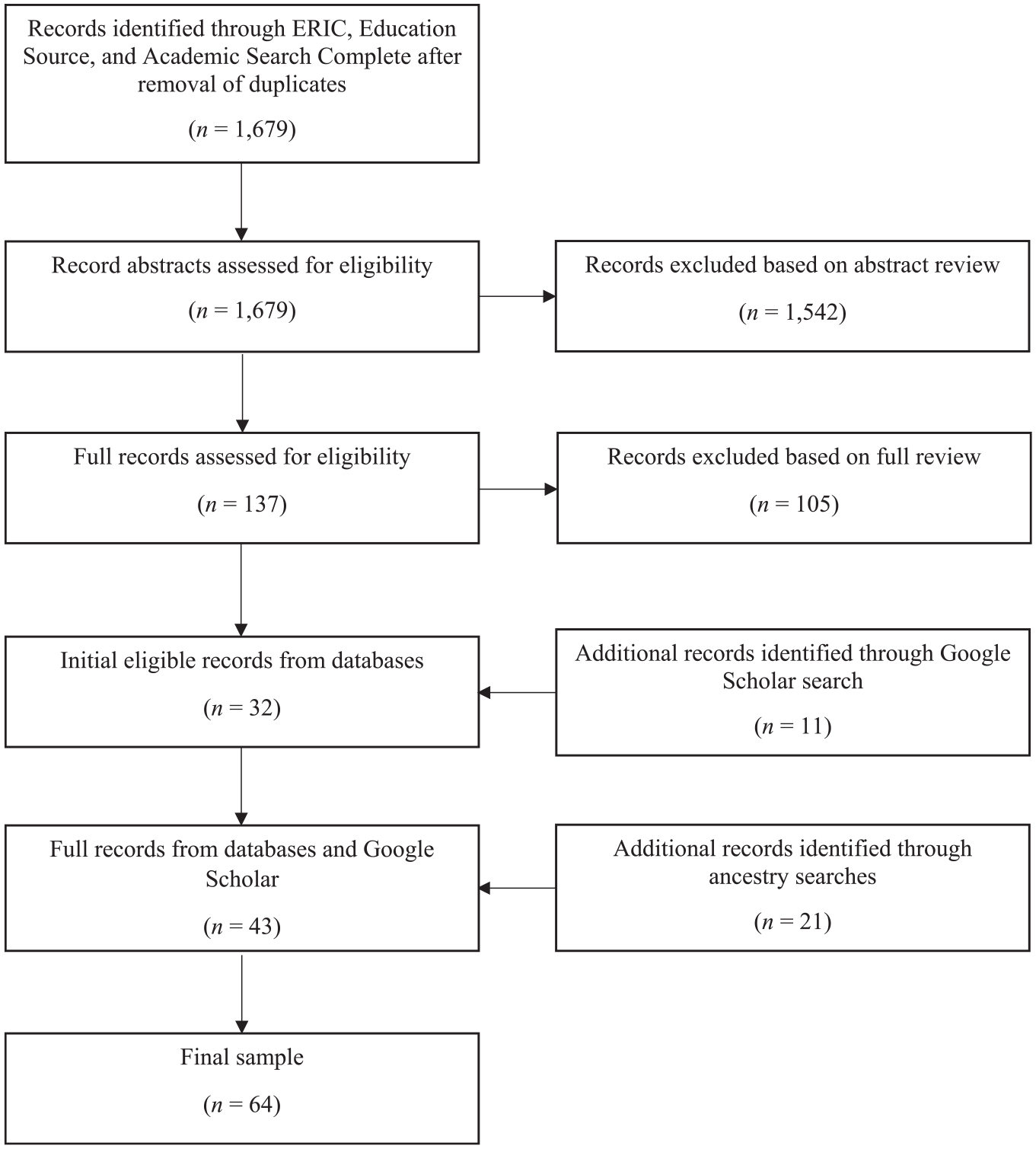
Flowchart summarizing record selection process for review inclusion.
Two tables were constructed to support analysis across the scholarship. Articles were annotated, and a first table was constructed around the following: participants, facilitators, setting, research question(s), theoretical approach, aims, findings, implications, and conception of PD. A second, more specific table was generated in alignment with the research questions and Kennedy’s (2016) PD theories of action. I now detail this approach to studying PD in the context of this review.
PD Theories of Action
For this review, I used Kennedy’s (2016) PD theories of action approach to synthesize racial-equity PD literature. Kennedy argued what organizes different approaches to studying PD (including differing conceptions of teaching and teacher learning, various PD features, and a range of outcome measures) are PD “theories of action,” including “a central problem of practice” (p. 946) and a pedagogical approach to addressing that central problem. Kennedy (2016) explained:
A theory of action includes two important parts. First, it identifies a central problem of practice that it aims to inform, and second, it devises a pedagogy that will help teachers enact new ideas, translating them into the context of their own practice. (p. 946)
Following Kennedy, I understood the “central problem” among the articles reviewed to be the “goals” or race-specific change hoped for by PD. This change might be, for example, efforts to support and sustain teachers of Color amid racially hostile school climates (e.g., Kohli et al., 2018). Like Kennedy, I define pedagogy as PD providers’ approach to learning intended to help educators enact race-specific change.
I used Kennedy’s (2016) theory of action to add to the field’s understanding of core teacher learning and development elements embedded in racial-equity PD by surveying consensus and questions across this scholarship. Rather than attempting to build a single standardized theory of action for racial-equity PD or minimize the role of teacher agency in teaching (Philip et al., 2019), I used this lens to draw attention to many potential theories of action valuable to researchers and practitioners.
Kennedy’s (2016) PD theory of action, however, is a technical-rational orientation to PD whereby understanding the learning design of teachers’ practice-focused development is central. Such an orientation to PD can fail to consider how teacher learning and change represent both a learning problem and a political problem (Cochran-Smith, 2004) and can produce top-down, “antidialogical PD” experiences (Kohli et al., 2015, p. 17). Furthermore, in an environment of increased national attention to issues of race and racial inequality, it is important to also leverage scholarship that considers external factors shaping racial-equity PD contexts: partisan politics, district context and demographics, support among school and district leaders, parent advocacy, and more. Sociocultural theory (Nasir & Hand, 2006) and research addressing diversity-oriented organizational change (Kalev et al., 2006) have offered important scholarship necessary for constructing a more complete understanding of the multifaceted nature of racial-equity PD activity.
Researchers have argued teachers’ professional growth generally involves nonlinear, iterative processes of reflection and enaction across multiple domains, including “the personal domain (teacher knowledge, beliefs and attitudes)” and “the domain of practice (professional experimentation)” (Clarke & Hollingsworth, 2002, p. 950). The Freirean notion of praxis—“reflection and action directed at the structures to be transformed” (Freire, 2012, p. 126)—situates this process in the context of power and inequality. Racial-equity-oriented reflection addresses a range of awareness, beliefs, and dispositions related to teacher and student identities, curricula, pedagogy, care for students, discipline, relationships with families, deficit narratives about communities of Color, broader relationships among racism, capitalism, colonization, Indigenous sovereignty and self-determination, cisheteropatriarchy, ableism, and schooling as social reproduction (e.g., Hollins & Guzman, 2005; Ladson-Billings, 2001; McCarty & Lee, 2014; Nieto, 1992; Teranishi, 2002; Valenzuela, 1999). Lived experience, particularly for teachers of Color, and preservice learning tasks such as critically considering what constitutes good teaching (Feiman-Nemser, 2012) often catalyze this reflective process prior to inservice PD. Such reflection requires deep interrogation, developing educators’ sociopolitical consciousness, and guarding against checklists prioritizing “what to do” at the expense of more foundational shifts in “how we think” (Ladson-Billings, 2006, p. 30; see also Hyland, 2009).
How does racial-equity-oriented reflection influence enactment in classrooms and schools? This question is significant because addressing manifestations of racial inequality, improving the experiences of students and teachers of Color, and building the racial literacy of White teachers and students ultimately includes addressing everyday practices. This question is further important because teachers must translate PD reflection into their classroom contexts amid existing systems of practice (Kennedy, 2016) and school cultures. Roberson et al. (2013) conceived of this relationship as transfer, describing:
For most organizational training efforts, successful performance during the training session is not the final goal. Instead, the primary concern is the positive transfer of training—the extent to which the learning generated during a training experience transfers to the job and leads to meaningful changes in work performance. (p. 353)
Scholars directly considering race and racism have further articulated this relationship. Duncan-Andrade (2004) framed this relationship as “the transition from critical awareness to transformative pedagogy” (p. 343), and Milner (2015) suggested building “knowledge and awareness . . . is perhaps a first step to a much more complex process of building practices” (emphasis added; p. 159).
In addition to translating PD learning into school and classroom contexts, PD transfer is complicated by what Kennedy (2016) referred to as “the problem of enactment” (p. 947). Kennedy (2016) argued, “Teachers can learn and espouse one idea, yet continue enacting a different idea, out of habit, without even noticing the contradiction” (p. 947). This reality is particularly salient with equity-oriented learning, as researchers find teachers may rate equity-oriented PD highly but not shift their practices (McAllister & Irvine, 2002; Sleeter, 1992a, 1992c; Washington, 1981) and may engage in fewer antiracist practices than their PD reflections suggest due to school-level factors (Lawrence, 2005; Picower, 2011, 2012). Likewise, White teachers may condemn racism and verbalize awareness of inequality while failing to take action to disrupt racial inequality (Vaught & Castagno, 2008; Yoon, 2012; Young, 2011). I return to consider racial-equity-teacher-development processes throughout the review. In what follows, I summarize the landscape of racial-equity PD and then proceed to address the three questions central to this review.
Findings
Researchers across this review drew on critical race theory more than any other theoretical orientation. Researchers drew on critical race theory to provide context related to race and racism (e.g., referencing DeCuir & Dixson, 2004), as a methodology (e.g., referencing Cook & Dixson, 2013), and as a lens for analysis (e.g., referencing Harris, 1993). Not surprisingly, then, researchers most often described racism as structural (Bonilla-Silva, 1997). Scholars pointed to the overrepresentation of White teachers in the teaching force (National Center for Educational Statistics, 2021); specific harm experienced by students of Color (e.g., referencing Ford et al., 2008); specific harm and heightened attrition experienced by teachers of Color (e.g., referencing Ingersoll & May, 2011); deficits of a predominately White teaching force (e.g., referencing Gay, 2000); and broader patterns of disinvestment, standardization, and market-based reforms as warrant for PD.
Researchers used qualitative methods, almost always participant observation and interviews; researchers also used surveys, written reflections, focus groups, audio and video recordings of sessions, and online discussion posts to capture participants’ PD reactions, reflections, and development. Only three studies (i.e., Donaldson, 1997; Grant & Grant, 1985; Washington, 1981) reported findings using quantitative measures to assess PD learning. When studying educators of Color, researchers most often documented experiences of Black and Latinx educators; less frequently experiences of Asian American, Pacific Islander, or multiracial educators; and very seldom experiences of Indigenous educators.
PD most often took place through inquiry groups serving local educators or university courses, school-based sessions, and independent institutes. Notably, participation in PD was almost always voluntary. Among sources specifying participant numbers, the median number of participants detailed in researchers’ findings was nine teachers. Multiracial groups of facilitators often led PD, but also individual people of Color—particularly women of Color—and White women, facilitated PD. Facilitators held various positions inside districts (e.g., teachers and school or district administrators) and outside of districts (e.g., university faculty, graduate students, and nonprofit staff) with researchers also facilitating and/or participating in 30 of the 42 unique PD initiatives studied.
Race-Specific Change in Racial-Equity PD
Among the knowledge, skills, commitment, and other factors necessary for advancing racial equity in schools, the first question addressed in this review was: what race-specific change is hoped for in PD explicitly addressing race, racism, and racial identity with practicing teachers? PD studied hoped (a) to grow teachers’ awareness of the significance of race and the impact of one’s own racial identity in supporting students (n = 26); (b) to interrupt specific racialized patterns (n = 19); (c) to develop and retain racial-equity-oriented teachers, specifically teachers of Color (n = 10); and (d) to effect specific shifts in beliefs or dispositions related to teaching (i.e., the importance of antiracist pedagogy; n = 9).
Growing Awareness
The most common race-specific change pursued by PD across this review was growing the awareness of groups of teachers who were predominantly White about the significance of race and racial identity. Researchers studied the theme of raising awareness using varying language with a similar focus: realizing, recognizing, exploring, and examining. Researchers sought to raise awareness around racial identity, teacher practices, interpersonal racial bias, reproduction of racial inequality in schools, and specific teaching approaches promoting racial equity. As with each subsection throughout the findings, research citations included are not exhaustive (see Table 1 for more detail on each study).
Racial-equity-PD participants, setting, goals, pedagogical approaches, and outcomes 2
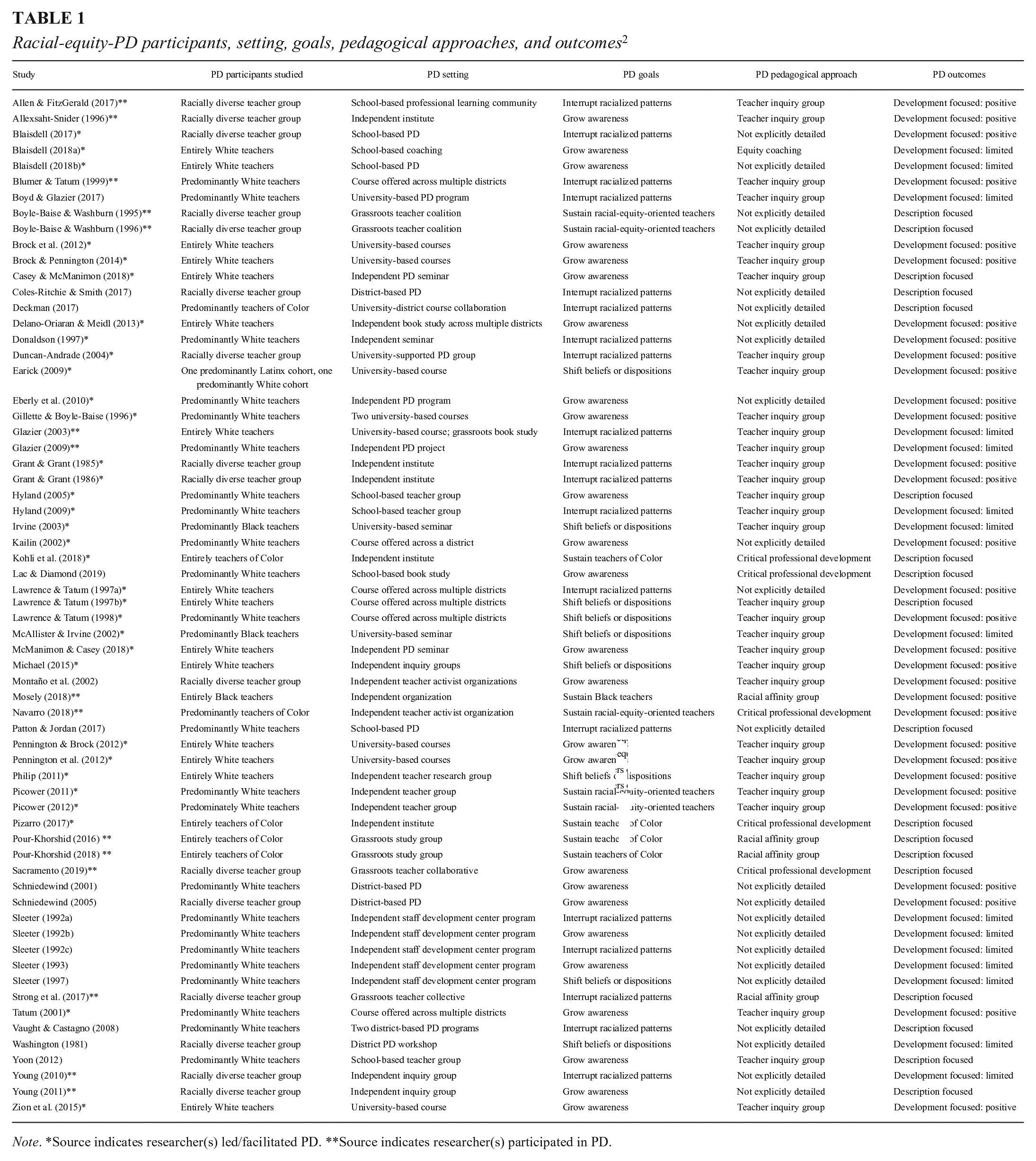
Note. *Source indicates researcher(s) led/facilitated PD. **Source indicates researcher(s) participated in PD.
First, scholars such as Brock et al. (2012), Delano-Oriaran and Meidl (2013), Lawrence and Tatum (1997a), and Tatum (2001) examined PD attempting to raise White teachers’ awareness of their racial identity. Delano-Oriaran and Meidl (2013) addressed the process of White teachers coming to understand their racial identity and the social construction of Whiteness. Tatum (2001) documented teachers examining “their own sense of ethnic and racial identity and their attitudes toward other groups” (p. 53), and Brock et al. (2012) supported teachers to “explore their own situated identities with respect to race” (p. 276) while making connections to their literacy instruction.
Hyland (2005), Kailin (2002), and Lac and Diamond (2019) studied PD attempting more broadly to raise teachers’ awareness about how schools reproduce racial inequality. Hyland (2005) summarized, “The seminar was focused on examining race in the context of the Woodson School and how racism in general was perpetuated in schools and society” (p. 436). Lac and Diamond (2019) analyzed how teachers, influenced by initial principal support, grappled with “the tensions of working for equity in racially diverse schools” (pp. 60–61). Kailin (2002) termed the goal of PD “racism awareness” whereby teachers “interrogate the impact of systemic or structural racism on the individual as well as on our social and cultural institutions” (p. 126).
Gillette and Boyle-Baise (1996) and Sacramento (2019) examined PD attempting to increase teachers’ awareness related to race and racism in the context of multicultural education and ethnic studies. Gillette and Boyle-Baise (1996) examined the development of awareness and knowledge connected to multicultural education through initial PD efforts and a subsequent coalition formed by teachers with support from Boyle-Baise. Sacramento (2019) examined the process of educators’ developing “critical collective consciousness” (p. 168) in the context of PD engaging ethnic studies teachers.
Scholars also documented PD attempting to raise teachers’ awareness regarding teacher practices, specifically practices related to discipline and interacting with parents. Schniedewind (2005) described supporting a racially diverse teacher group “to reflect on the developmental impact of race and whiteness on their consciousness and practice” (p. 283). Deckman (2017) studied patterns in how early-career teachers “construct and interpret classroom moments” (p. 7) hoping to develop teachers’ awareness related to “disciplinary infractions, along lines of race” (p. 3). Eberly et al. (2010) studied the development of awareness about race and difference by analyzing “how cultural communities’ ethnotheories influence practice” (p. 28) in the context of teachers’ interactions with parents. Using words like “explore,” “promote,” “recognize,” and “examination,” scholarship in this subsection included 26 articles addressing the development of racial awareness. These efforts included White participants primarily and used many forms of PD witnessed across this review from school-based book studies to university courses.
Interrupting Racialized Patterns
The next most common PD goal found across the literature was interrupting racialized patterns among teachers (i.e., behavior, interpersonal) and in schools (i.e., opportunity distribution, institutional). Across these efforts (n = 19), researchers discussed general patterns documented across literature and, less often, specific local patterns to note trends PD then addressed. The first pattern PD studied sought to disrupt was a persistent silence about race among White teachers. Collectively, these researchers described desired change in terms of shifting “the traditional nature of teacher discourse” (Boyd & Glazier, 2017, p. 135) in environments that typically “do not create space for these discussions” (Coles-Ritchie & Smith, 2017, p. 174; see also Glazier, 2003; Hyland, 2009). Boyd and Glazier (2017) were particularly pointed about this desired change, detailing that PD aimed to challenge “the traditional nature of teacher discourse whereby comfortable collaboration reigns supreme” by fostering conversations marked by “participants challenging one another and engaging jointly to reach solutions to problems of practice” (p. 135).
Second, the PD studied attempted to address specific manifestations of institutionalized racial inequality, including the disproportionately low percentage of teachers of Color, racial divides by position in schools (e.g., White leaders and support staff of Color), racialized achievement patterns, care for students of Color, and curricular patterns. According to Patton and Jordan (2017), the goal of PD was “to challenge racism in the [school] environment through several initiatives” (p. 82), including, for example, improving the treatment of Black staff members at the school. Vaught and Castagno (2008) studied two similar district-level PDs in which interrupting a pattern related to “the racialized achievement gap” (p. 98) was the focus whereas Blumer and Tatum (1999) aimed to “examine the role of racism in the underachievement of students of colour” (p. 255) across a district. Allen and FitzGerald (2017) studied PD attempting to develop “cultural care” for students of Color, specifically aiming to “assist in the formation of positive [student] relationships” and “develop a greater [educator] cultural competence” (p. 11) addressing issues related to racism and equity.
Duncan-Andrade (2004), Grant and Grant (1985, 1986), and Sleeter (1992a, 1992c) studied racialized patterns related to curricula and pedagogy: teachers’ collectively planning curricula addressing students’ lived experiences as youth of Color growing up in poverty (Duncan-Andrade, 2004); patterns related to “how teachers are able to analyze and make their curriculum more multicultural” (Grant & Grant, 1985, p. 29); and which students teachers call on in class, if and how teachers engage parents, and if and how teachers revise curricula (Sleeter, 1992a, 1992c). Finally, Young (2010) worked with educators to “transform the [CRP] theories learned into a viable pedagogical tool” by working to “establish a common understanding of the theory to implement it effectively in classroom practice” (p. 250).
Using phrases like “changed the nature of traditional teacher discourse” and “address the racialized achievement gap,” research on PD seeking to address racialized patterns of behavior, treatment of colleagues, and opportunity provision for students included 19 articles. Like the first set of awareness-related goals, this second set of goals included a variety of PD forms from small, school-based teacher groups to district-wide initiatives; yet, unlike the previous section, PD often engaged a racially diverse group of teachers.
Developing and Retaining Racial-Equity-Oriented Teachers, Specifically Teachers of Color
The next race-specific change hoped for in PD was developing and retaining racial-equity-oriented teachers and specifically teachers of Color (n = 10). Five sources (i.e., Boyle-Baise & Washburn, 1995, 1996; Navarro, 2018; Picower, 2011, 2012) in this subsection supported racially diverse teacher groups. Among studies of racially diverse teacher groups, Navarro (2018), for example, documented a Los Angeles–based teacher inquiry group intended to “sustain and enhance their [social-justice-oriented teachers’] practice in high poverty urban schools during the current era of neoliberal reform” (p. 338).
The remaining five sources detailed PD that supported teachers of Color or Black teachers specifically. Among studies of spaces dedicated to teachers of Color, Pizarro (2017) described the goals of the Institute for Teachers of Color—a 3-day summer institute—as “1) community building, 2) racial justice healing, and 3) praxis-oriented tools for confronting and transcending the racial matrix” (p. 152). Kohli et al. (2018) detailed the change as supporting the “critical, intersectional, and racial literacies” necessary for sustaining teachers of Color and equipping them to “transform the educational opportunities of students of Color” (p. 18).
Pour-Khorshid (2016, 2018) examined teachers’ experiences in the Healing, Empowerment, Love, Liberation, and Action collective—“a California grassroots social justice critical study group created exclusively for people of color” (Pour-Khorshid, 2016, p. 16). Pour-Khorshid (2016) detailed the goal as working
to identify the strengths and assets we [teachers of Color] bring to the profession, while also planning and workshopping ideas on how to teach about and nurture these capitals [the six capitals from Yosso’s (2005) community cultural wealth model] in our practice and personal lives. (p. 19)
Mosely (2018) founded and researched the Black Teacher Project, a project with sites in New York City and the San Francisco Bay area, arguing, “supporting Black teacher sustainability requires more than the latest instructional technique” (p. 280). The Black Teacher Project attempts to provide Black teachers with the “knowledge, skills and community” to “thrive in their work” (p. 268).
Using phrases such as “identify the strengths and assets we [teachers of Color] bring to the profession” and “sustain and enhance their practice,” research in this subsection included 10 sources, notably almost all published since 2011. Unlike previously reviewed efforts often focused on White educators that have occurred in schools or through university courses, efforts in this section all took place through independent or grassroots spaces established for the purpose of sustaining educators of Color and, less frequently racial-equity-oriented White teachers—evidence “traditional” forms of institution-driven PD has not been meeting the needs of many educators of Color and racial-equity-oriented educators more generally.
Shifts in Specific Beliefs or Dispositions
The next race-specific change hoped for in PD was changing teachers’ beliefs or shifting dispositions about a discrete topic (n = 9), such as why antiracist classroom pedagogy is important. “Beliefs” and “dispositions” are broad descriptors for a range of intended shifts but are largely consistent with how researchers detailed PD goals. For example, Earick (2009) examined “beliefs,” whereas Philip (2011) examined “conceptual change,” and Brock and Pennington (2014) examined “dispositions.”
Philip (2011) aimed to support conceptual change where teachers had moved from “focusing on individual choices, thus blaming students and their families” (p. 322) toward beliefs reflecting “systemic processes of inequity” (p. 304). Earick (2009) sought to change teachers’ beliefs related to an “acceptance of racial realism,” an “accountability for our group [racial] identity,” and taking “action grounded in racial realism” (p. 100). Washington (1981) studied changes in teachers’ “multicultural education attitudes,” addressing “teachers’ opinions about the concepts of school desegregation and multicultural education and the impact of these concepts on educational practice” (p. 188), whereas Sleeter (1997) examined the relationship between multicultural education and teachers’ mathematics instruction. McAllister and Irvine (2002) attempted to shift educator beliefs about the importance of empathy with the goal of developing culturally responsive educators, and Lawrence and Tatum (1997b, 1998) examined White educators’ beliefs about how their White racial identity had impacted their values and choices as educators. Michael (2015) sought to develop “racial competence” among White teachers, addressing, for example, learning “to notice and analyze racial dynamics as they occur” and “to raise race questions about oneself and one’s practice” (p. 5).
Using words and phrases such as “shift,” “change,” and “how thinking changed and shifted,” research in this subsection included nine articles. Each of these efforts took place through university-facilitated courses or outside programs or institutes (e.g., the CULTURES [Center for Urban Learning Teaching and Urban Research in Education and Schools] program) and almost all were facilitated (at least in part) by researchers themselves. These trends suggest when researchers plan and lead PD (often through courses or institutes they establish), PD expectations and focus may be more targeted around specific key shifts in educator beliefs and dispositions.
Having reviewed various PD goals, the following section examines the pedagogies PD providers used to attempt to facilitate desired race-specific change. Although research was often clear on the race-specific changes hoped for in PD, research was less detailed about pedagogical approaches used to support these changes.
Pedagogical Approaches to Racial-Equity PD
The second question addressed in this review was: according to researchers, what pedagogies are used in PD addressing race and racism with practicing teachers? Russ et al. (2016) argued, “It is only by being intentional about the models of learning involved in teacher learning that we can truly answer the question ‘How do teachers learn to teach?’” (p. 393). Documenting and analyzing racial-equity PD learning models is particularly important given the complex nature of equity-oriented teacher development. Prior findings suggest the question of how teachers learn is particularly pressing, as scholars have argued there is “scant research about the process by which teachers develop a cross-cultural competence that enables them effectively to teach diverse students in their classrooms” (McAllister & Irvine, 2000, pp. 3–4).
A framework researchers have termed “critical professional development (CPD)” (Kohli et al., 2015) subsumes a range of pedagogies documented by researchers across this review (n = 40). Researchers have identified two specific approaches aligned with CPD—teacher inquiry groups and racial affinity spaces—and documented equity coaching as a final, less common pedagogical approach. In addition to these pedagogical approaches, scholarship reviewed often did not detail how an explicit pedagogical approach informed PD design and teacher development (n = 23). This review examined scholarship for a description and application of theory on teacher learning (i.e., how teachers learn) and/or PD (i.e., how PD facilitates teacher learning and the transfer of learning) informed by prior research. This review did not consider overviews of PD activities, assignments, or texts to constitute an explicit theory of teacher learning or PD. Overviews of activities were common but often did not detail how a particular pedagogical approach shaped PD planning and learning, and if and why a particular pedagogical approach was selected in light of a particular PD goal. This trend seemingly demonstrates the need for more detailed research on how educators learn about and act on learning related to diversity, race, and racism (see Parkhouse et al., 2019).
Critical Professional Development
Critical professional development is a PD framework recently formalized by scholars (Kohli et al., 2015) with roots in Freirean pedagogy (Freire, 2012), teacher inquiry and research (e.g., Cochran-Smith, 2004), and teacher activism (e.g., Montaño et al., 2002; Picower, 2012). Contrasting CPD with traditional, top-down PD, Kohli et al. (2015) wrote,
Critical professional development follows the tenets of dialogical action: it is designed to provoke cooperative dialogue, build unity, provide shared leadership, and meet the critical needs of teachers. CPD engages teachers in political analysis of their role as educators in the reproduction or resistance of inequality. (p. 11)
Kohli et al. (2015) offered four principles: (a) “cooperation and authentic dialogue”; (b) “unity through an intentionality of community building”; (c) “organization of shared power”; and (d) “cultural synthesis where the needs and perspectives of students, communities, and teachers were centered over the interests of leaders” (p. 14). Nine more-recent efforts, including all of those studying PD in the Black Teacher Project, the Institute for Teachers of Color, and the Healing, Empowerment, Love, Liberation, and Action collective, explicitly used CPD as an approach to PD design and teacher learning. Researchers have found CPD offers opportunities for connection and solidarity among racial-equity-oriented teachers; “an intellectual bridge” (Navarro, 2018, p. 348) between critical theory and practice; collective theory building grounded in lived experiences (e.g., Pour-Khorshid, 2016, 2018); and validation, motivation, and reinforcement often absent in schools and other PD settings.
Though not all researchers in this section analyzed PD pedagogies by invoking CPD explicitly, researchers across this section documented two specific pedagogical approaches consistent with CPD: teacher inquiry groups (or critical teacher inquiry groups) and racial affinity spaces. This review positions both in the broader CPD framework due to shared characteristics and because researchers do so themselves. Navarro (2018), for example, stated, “Recent literature has identified critical inquiry groups as a type of critical professional development (CPD)” (pp. 338–339).
Teacher inquiry groups
Consistent with the tenets of CPD, teacher inquiry groups are built around individual teacher agency, collective support among members, and connecting critical theory with practice through dialogue and reflection. Cochran-Smith (2004) elaborated, “Inquiry is an intellectual and political stance rather than project or time-bound activity” (p. 12), positioning teacher inquiry groups as collectives in which “all participants have to own their complicity in maintaining oppression and have to grapple with their own failures to produce the kinds of changes they may advocate” (p. 13). Researchers have specifically used orientations such as small teacher learning communities (Yoon, 2012), structured dyads and support groups (Allexsaht-Snider, 1996), critical civic inquiry (Zion et al., 2015), critical race dialogue (Sacramento, 2019), discourse communities (Boyd & Glazier, 2017; Glazier, 2003, 2009), teacher research groups (Philip, 2011), working groups (Kohli et al., 2018; Pizarro, 2017), critical inquiry projects (Picower, 2011, 2012), critical inquiry groups (Duncan-Andrade, 2004; Hyland, 2009; Michael, 2015; Navarro, 2018; Young, 2010), and teacher activist groups (Montaño et al., 2002) to analyze teacher inquiry.
Across these studies, researchers have documented catalysts for learning such as experiential activities and simulations (e.g., Brock et al.’s [2012] Kirundi lesson or McAllister and Irvine’s [2002] bafa bafa game); lectures from expert researchers addressing issues of racial equity (e.g., Sleeter, 1992c); racially diverse parent panels (e.g., Eberly et al., 2010); “cultural-immersion experiences” (Irvine, 2003, p. 80; McAllister & Irvine, 2002); student surveys (Philip, 2011); action research projects (Michael, 2015; Zion et al., 2015); patterns noted during classroom observations (Michael, 2015); and texts detailing critical approaches to understanding race and racism (e.g., Singleton’s [2014] Courageous Conversations About Race) to introduce new perspectives, knowledge, and concepts. Researchers subsequently documented inquiry processes and tools used in PD, primarily to address racialized experiences and identity (e.g., critical autoethnographies and Helms’ [1995] theory of White racial identity development) and power and oppression (Yosso’s [2005] community cultural wealth framework and Freirean pedagogy [Freire, 2012]) to extend and apply teacher inquiry using a range of reflective questions on both the personal and classroom levels.
Philip (2011) built on diSessa’s (2008) work using a pedagogical orientation that recognizes “deep learning requires learning in many contexts” (diSessa, 2008, p. 45) while probing specifics of learning in and across these contexts (i.e., student survey findings, teacher research group discussions, and a visit to a nearby affluent school). Earick (2009) grounded the pedagogical approach in Richardson and Anders’s (2005) four components of belief change while engaging teachers in reflection and conversation grounded in analysis of classroom artifacts and teacher reflection journals. Grant and Grant (1985, 1986) borrowed from Chin and Benne’s (1969) work, integrating three types of change (i.e., empirical-rational, power coercive, and normative re-education) into a sequential, three-step PD process (i.e., awareness, appreciation and acceptance, and affirmation) informed by prior findings related to multicultural education. Allexsaht-Snider (1996), building on Weissglass’s (1991) work, analyzed PD in terms of a “support group structure that facilitated teachers’ analysis and sharing of life histories” (Allexsaht-Snider, 1996, p. 115). Yoon (2012) applied previous work on small teacher communities (e.g., Grossman et al., 2001) to examine a small teacher community engaged in conversation and reflection using a book-study approach, and Brock and Pennington (2014) used Diez’s (2007) incremental, community-focused view of dispositional change to analyze such change among three White teachers.
Racial affinity spaces
Researchers identified racial affinity spaces—“spaces of support, learning and healthy career development that are culturally responsive to a specific racialized group who experiences the consequences of institutional racism in particular ways” (Mosely, 2018, p. 270)—as another pedagogical approach consistent with CPD. This review revealed racial affinity groups are undertaken outside of schools, most often seek to support teachers of Color, center critical theory such as Ginwright’s (2015) healing-centered approach to trauma, and engage lived experiences of oppression and resistance through testimonios (e.g., Pour-Khorshid, 2018) and other narrative forms. Three sources examined efforts that exclusively used racial affinity groups with teachers of Color (Mosely, 2018; Pour-Khorshid, 2016, 2018), whereas one effort (Strong et al., 2017) included teachers of Color and White teachers. Strong et al. (2017) explained racial affinity groups were created “out of necessity, due to the void of such spaces in teacher education programs and professional development” (p. 137) while explaining their importance for sustaining a racially diverse teaching force and supporting White teachers “to more effectively interrupt racist practices in schools” (p. 137). Racial affinity groups represent an increasingly common PD approach meriting further attention (Warren-Grice, 2021).
Equity Coaching
The final pedagogical approach, equity coaching, appeared in one source. In work with teachers at “City Elementary,” Blaisdell (2018a) documented classroom-based “equity coaching” informed by research on teacher coaching (e.g., Devine et al., 2013). Blaisdell (2018a) argued, “The dialogue and reflection—the powerful questions [used in other coaching contexts]—in equity coaching focus specifically on racism and whiteness” (p. 164). As a “coach,” Blaisdell observed teachers at least once, debriefed with each teacher following observations, and used notes from observations to inform broader equity discussions and work at “City” in professional learning community, equity team, and staff meetings.
Overall, this review revealed an absence of detailed descriptions of pedagogical approaches (n = 23); approaches described in research were generally consistent with the tenets of CPD (n = 40) and took shape most often through teacher inquiry groups, racial affinity spaces, and equity coaching (n = 1). Though some studies (e.g., Philip, 2011) and concepts (e.g., Diez’s [2007] work on incremental dispositional change) used across this review demonstrate how research on learning and teacher growth can bolster PD analysis, research inconsistently engaged directly with learning theory (Russ et al., 2016), and analysis of specific learning moments in PD (e.g., Philip & Gupta, 2020) is somewhat limited. Although this trend applies to research on other forms of PD (Russ et al., 2016), it may be of specific importance in the context of racial-equity PD given the complex process inherent in racial-equity-related teacher learning. Without more detail, future researchers may be left wondering which pedagogical approaches and strategies support application and teacher development outcomes and if and how PD pedagogies model the culturally relevant, constructivist pedagogies hoped for in P–12 classrooms (Casey & McManimon, 2020; Kohli et al., 2015).
Further, racial-equity PD pedagogies documented in research have provided opportunities to reflect on new ideas, concepts, and experiences as well as opportunities for verbal and written reflection connecting new learning to classroom enactment, including discussing curricula, texts, projects, and lessons, and better supporting students of Color more generally. Pedagogies have less often engaged evidence of classroom enactment as a catalyst for ongoing learning by including such artifacts and evidence as sources of learning in PD as opposed to something addressed after or outside of PD. Revising authentic artifacts (e.g., unit and lesson plans, discipline-related policies and forms); reflecting on student work and student data; and providing cycles of classroom-based feedback, reflection, and adjustment (see Darling-Hammond et al., 2017; Desimone, 2009) have been documented relatively infrequently across this review and may further support teacher learning and development. PD pedagogies are considered further in the Discussion and Directions for Future Research sections.
Racial-Equity-PD Outcomes
This section addresses the third and final research question: according to researchers, what outcomes are most common among PD efforts addressing race, racism, and racial identity with teachers? Like previous research (Bezrukova et al., 2016) on diversity-focused training outcomes, researchers across this review documented four broad areas: cognitive learning, attitudinal/affective learning, behavioral learning, and participant reactions. Researchers across this review primarily drew on PD discussion, PD engagement (e.g., collective solidarity, resistance, silence), written reflections (i.e., questionnaire and journal responses and course assignments), and interviews to examine teachers’ cognitive and affective shifts; PD discussion and PD engagement to address, directly, PD session behaviors, and PD discussion and written reflections to examine, indirectly, shifts in teachers’ classroom behavior; and PD discussion, PD engagement, and written reflections to assess reactions to PD.
This review organized outcomes across the literature into three general areas: (a) description-focused research documenting common patterns in educators’ experiences and reactions to PD; (b) development-focused research showing limited outcomes altering educators’ awareness, discourse patterns, analysis of racism, or practices; and (c) development-focused research showing positive outcomes altering educators’ awareness, analysis of racism, or practices. Description-focused research typically examined PD dynamics, participants’ experiences in PD, or patterns in responses to PD learning, whereas development-focused research typically detailed development over the course of PD addressing more specific research questions often involving predetermined areas of development. This review differentiates between descriptive and developmental findings not because teacher development did not occur across all PD studied (it often did), but because researchers documented outcomes by drawing attention to different aspects of PD and, less often, due to a large breadth of outcomes with limited detail related to teacher development (e.g., “issues such as evangelistic vision, well-informed leadership, boat-rocking activism, empowering self-enhancement, and bond-building support arose”; Boyle-Baise & Washburn, 1995, p. 354). Eighteen description-focused articles documented various experiences and reactions across teachers’ experiences, 15 development-focused articles revealed limited PD outcomes, and 31 development-focused articles demonstrated positive PD outcomes.
Description-Focused Outcomes: Experiences in, or Responses to, PD
Researchers described dynamics related to PD itself as outcomes, including administrators ending PD due to educator pushback. Patton and Jordan (2017) and Lac and Diamond (2019) both described cases published in the Journal of Cases in Educational Leadership. These articles detailed how school principals ended PD addressing race and racism initiated by an assistant principal, because White teachers expressed discomfort with PD conversations (Patton & Jordan, 2017), and ended teacher-initiated PD because the Advanced Placement coordinator and administrators felt attacked by PD discussions (Lac & Diamond, 2019).
Other studies reported trends in the PD experience itself or participants’ reactions and responses to PD as outcomes. Deckman (2017) described two themes emerging from PD: teachers of Color often engaged in “race-ing management” or sharing “stories that read race into incidents in such a way as to reveal latent racial dynamics,” whereas White teachers often engaged in “managing race” or sharing “narratives about deescalating racial tension or reproaching transgressors of racial colorblindness” (p. 1). Hyland (2005) detailed takeaways by synthesizing four central metaphors that predominantly White teachers invoked to explain what it means to be good teachers for students of Color (e.g., “a good teacher of students of color is an intercultural communicator”; p. 446). Vaught and Castagno (2008) and Young (2011), building on critical race theory scholarship, described and analyzed how teachers’ conceptions of racism as an “individual pathology” (Vaught & Castagno, 2008, p. 96) undermined racial-equity PD efforts, with Young (2011) describing “four personae of racism” (i.e., “the conscious perpetrators, the unconscious perpetrators, the deceived perpetrators/activists, and the enlightened perpetrators/activists”; p. 1443) across participants (see also Sleeter, 1993). Coles-Ritchie and Smith (2017) noted teachers’ racial identities influenced their PD engagement, teachers identified and discussed experiences of racism in elementary schools, and teachers appreciated the dedicated and “open space” (p. 177) to address race in PD using Courageous Conversations About Race. Casey and McManimon (2018) described three fears experienced by White educators navigating commitments to antiracist praxis: “fears of harming existing relationships, fears of getting it wrong, and fears of not doing enough” (p. 78). Finally, multiple sources (e.g., Navarro, 2018; Pour-Khorshid, 2016, 2018) described the transformative impact of CPD spaces dedicated to supporting critical teachers committed to racial justice and to supporting teachers of Color specifically, finding participants experienced groundedness, authenticity, healing, and “critical camaraderie” (Pour-Khorshid, 2018, p. 324), and “felt validated and inspired to teach for social justice” (Navarro, 2018, p. 351).
Development-Focused Outcomes: Limited Outcomes
Development-focused research finding limited outcomes (n = 15) comprised the next set of outcomes. Blaisdell (2018b) studied efforts aimed at “developing the racial literacy needed to better intervene in daily discourses and practices that perpetuate white supremacy” (p. 332) and showed largely negative outcomes with the White teachers studied, pointing to the detrimental impact of White teachers with limited racial literacy on White colleagues with greater racial literacy. Boyd and Glazier (2017) found persistent “comfortable collaboration” as opposed to the desired outcome of “critical colleagueship” (p. 135) between teachers engaged in conversations about race. Conversations about race were consistently shorter in duration, had less discursive uptake, and displayed greater depersonalization (e.g., talking generally without including individual teachers as actors), and did not show improvement over the length of the PD course. Both Washington (1981) and Sleeter (1992a, 1992c) concluded PD was received favorably by many participants due to practical workshops addressing classroom practices, but “the overall impact of the training as measured by the pre-and posttests was very negligible” (Washington, 1981, p. 188), and similarly, “observable changes in classroom teaching were limited” (Sleeter, 1992c, p. 142). Finally, McAllister and Irvine (2002) documented how despite teachers connecting empathy to their practices, “only 3 of the [34] teachers focused on practices that addressed institutional or reconstructivist issues such as unequal school resources, issues of racism, tracking, and unfair discipline procedures” (p. 441).
Development-Focused Outcomes: Positive Outcomes
Thirty-one research efforts analyzing a specific developmental process over the course of PD showed positive outcomes. Ten studies found evidence of positive outcomes supporting teachers of Color or racially diverse teacher groups, whereas the remaining 21 articles in this subsection documented evidence of positive outcomes studying predominantly White groups of teachers. Mosely (2018) found, over the course of PD, teachers ultimately decreased their feelings of isolation and increased their racial literacy, whereas Schniedewind (2005) documented how teachers of Color engaged in more of the following because of PD: (a) “active support for students of color,” (b) “educating all students about stereotyping and addressing white privilege,” and (c) “challenging institutional racism” (p. 281). Although results differed across four posttest activities, Grant and Grant (1985, 1986) found positive overall results demonstrating participants incorporated multicultural education concepts into their analysis of assignments and lesson plans and subsequent revisions to both. Montaño et al. (2002) documented “increased politicization of their [teacher] pedagogy and curriculum content” that “enabled them to offer their students multiple perspectives on curriculum content” (p. 270).
The remaining studies in this subsection showed evidence of positive outcomes in the context of supporting White teachers or predominantly White groups of teachers. Schniedewind (2001) found PD helped a predominantly White group of teachers integrate multicultural education into the fabric of teaching, add support for students of Color, and advocate for program and policy changes at the school and district levels, whereas Blaisdell (2017) documented teachers increased “access to curriculum for low-level students” (p. 120) through heterogeneous groups and identified racialized discipline patterns reducing learning opportunities for students of Color.
Lawrence and Tatum (1997a) found over half of the 84 teachers in their study took (self-reported) antiracist actions as a result of PD, such as working to transform curricula to better reflect the diversity of their students. Blumer and Tatum (1999) documented that PD and school action plans developed in PD led to curriculum committees revising curricula, system-wide goals addressing antiracism, and a committee addressing African American student achievement specifically. As a result, “the academic achievement of African American students increased, attendance increased, suspensions decreased and entry into higher-level courses at the high schools increased” (Blumer & Tatum, 1999, p. 265). Finally, the continuance of racial-equity-PD learning and the creation of subsequent racial-equity PD opportunities in local contexts appeared to be a positive “outcome” of racial-equity PD (see Boyle-Baise & Washburn, 1995, 1996; Donaldson, 1997; Kohli et al., 2018; Navarro, 2018).
Research on 16 PD programs in this subsection provided sufficient detail to begin to connect positive outcomes to specific pedagogical approaches or activities. This notable set of findings provide researchers and practitioners a sense of what pedagogical approaches and choices may work to support specific outcomes. First, Allexsaht-Snider (1996) found groups of racially diverse participants built around the “analysis and sharing of life histories” (p. 114) using structured support groups and partner dyads resulted in teachers feeling increasingly comfortable discussing race and racism with one another and with students. Similarly, Pennington and Brock (2012) documented how a “supportive yet critical community of teachers” (p. 246) used critical autoethnography to “critique their White identity and connect their understandings to each other as colleagues and to their classroom teaching” (p. 245). Likewise, Gillette and Boyle-Baise (1996) found requiring reflection and resubmission of initial course assignments helped predominantly White teachers move from superficial descriptions of life events and identities to deeper analysis grappling with “the limits of their experiences” and reconsidering “tacit beliefs” (p. 280).
Researchers connected PD learning deliberately structured across multiple contexts and often through experiential activities drawing attention to social and linguistic differences to the development of positive outcomes. These outcomes included belief change regarding how structural causes contribute to inequity (Philip, 2011) and dispositional shifts among White teachers regarding the salience of White racial identity (Brock et al., 2012; Brock & Pennington, 2014; Pennington et al., 2012). Philip (2011) linked the transformation of a White teacher’s beliefs about student engagement and success to PD through which learning occurs “over time and across many contexts, particularly contexts that are initially seen as different by the learner” (p. 327). Philip identified learning via student surveys, a trip to a nearby affluent community, and teacher reflections on classroom practices combined with learning and conversation in a teacher research group as contributing to shifts in a teacher’s beliefs. Brock et al. (2012) and Pennington et al. (2012) identified four productive learning experiences, all of which were “embodied in one way or another” (Brock et al., 2012, p. 285) and engaged teachers’ senses and emotions: a Kirundi lesson (a lesson led by coauthor Ndura exclusively in Kirundi, a language spoken primarily in Burundi), a privilege checklist, a privilege walk, and the use of counternarratives from people of Color (Brock et al., 2012). Based on teachers’ responses to these activities, they argued this approach led to two White teachers recognizing “the role their White identity and White privilege played in their teaching and how it positioned them as White teachers teaching in schools of colour” (Brock et al., 2012, p. 290). Zion et al. (2015) connected student-led action research projects and increased classroom conversations about inequality to White teachers’ own sociopolitical development relative to understanding systems of oppression and harms experienced by students of Color.
Earick (2009) further found learning activities with a concrete focus related to racial inequality and racial identity—inventorying classroom books and posters for racial and ethnic representation, and “critical racial incident logs” where teachers “documented racial incidents that happened in their classroom”—supported White and Latinx teachers as they “shifted their system of beliefs from the perception that they were [already] practicing RET [racially equitable teaching] and made them identify the ways to begin the process of applying the tenets of RET” (p. 114; regarding curricula, see also Navarro, 2018; Picower, 2011, 2012).
This body of research also suggests sustained PD duration and designing PD to meet pre-assessed needs likely support positive teacher outcomes. Research indicates PD linked to positive results in the development of a specific outcome engaged teachers over a long period of time and for a significant amount of time (e.g., a 2-week summer institute followed by monthly meetings throughout the year). Michael (2015) stated, “Change requires a depth of engagement that cannot be broached without a sustained process” (p. 121). Researchers additionally pointed to preliminary needs assessments or pre-interviews in planning and designing racial-equity PD that supports positive outcomes (Eberly et al., 2010; Lawrence & Tatum, 1998; Young, 2010).
Discussion
Having reviewed findings related to the goals, pedagogies, and outcomes of racial-equity PD, this review now addresses conclusions from across the literature. Historically, research on racial-equity PD has documented institution-driven forms of PD, such as university courses or school-based sessions, often focused on building the racial consciousness of White teachers or groups of racially diverse teachers addressing specific racialized patterns. Researchers have continued to document White teachers engaged in sustained antiracist interrogation and action (e.g., McManimon & Casey, 2018; Pennington & Brock, 2012) and obstacles to such interrogation and action: (a) persistent deracialized reflection and analysis (Hyland, 2009; Sleeter, 1992b; Yoon, 2012), (b) the negative influence of racially illiterate and resistant White teachers on school-based racial-equity work (Blaisdell, 2017, 2018b; Hyland, 2009), (c) conceptions of racism as an “individual pathology” (Vaught & Castagno, 2008, p. 96; Young, 2011), and (d) a lack of support among White administrators (Lac & Diamond, 2019; Patton & Jordan, 2017).
Researchers more recently studied PD organized by independent organizations, activist groups, and grassroots teacher groups. Such PD included racially diverse, ideologically aligned teacher groups focused on critical analysis of schooling, redesigning curricula, and reconsidering other aspects of teaching and learning. Researchers documented experiences of solidarity, reinforcement of critical reflection and analysis of classroom practice, accountability among participants, and increased agency as individuals connected to local equity-oriented coalitions and broader social movements (Boyle-Baise & Washburn, 1995, 1996; Montaño et al., 2002; Navarro, 2018; Picower, 2011, 2012; Sacramento, 2019). PD specific to teachers of Color often addressed similar aspects in addition to directly addressing the racialized experiences (e.g., racial battle fatigue and isolation) and resistance of teachers of Color navigating experiences of racism in schools (Kohli et al., 2018; Mosely, 2018; Pizarro, 2017; Pour-Khorshid, 2016, 2018). Researchers’ increased focus on the experiences of teachers of Color, most often Black and Latinx, points to the importance of asset-based PD that engages and affirms the racialized experiences and unique strengths of teachers of Color using supports such as Yosso’s (2005) community cultural wealth framework and Ginwright’s (2015) healing-centered approach to trauma. Finally, researchers identified racial literacy as a common yet context-dependent PD concept; Mosely (2018) documented this area for support and study with Black teachers, Kohli et al. (2018) and Pizarro (2017) with teachers of Color more broadly, Coles-Ritchie and Smith (2017) with a racially diverse teacher group, and Blaisdell (2018b) with White educators.
Returning to Kennedy’s (2016) PD theories of action, this review demonstrates research could be more explicit about racial-equity PD theories of action to analyze evidence-based relationships between racial-equity PD goals, pedagogical approaches, and outcomes. Studies of racial-equity PD less often documented teacher development over time in connection to “a central problem of practice” (Kennedy, 2016, p. 946), and researchers inconsistently detailed how an explicit pedagogical approach informed PD design and influenced outcomes. A range of factors appear to have shaped this trend.
Developmentally, some PD programs, particularly those engaging predominantly White teachers, offer introductory “Racism 101” (McManimon & Casey, 2018, p. 395) PD addressing initial awareness-focused goals. Research on such PD programs has not always analyzed development around specific problems of practice, instead perhaps assuming initial reflection and awareness building are prerequisites for such changes. Further, equity-oriented teacher development cannot be reduced to a single, predetermined practice and cannot be prescribed uniformly across teachers and contexts (Philip et al., 2019). Necessarily, goals for racial-equity-related development are perhaps too multifaceted for reducing desired outcomes of PD to development on a single practice. Although addressing classroom-level patterns of disproportionate discipline harming students of Color, for example, ultimately requires concrete and observable shifts in practice, addressing such change requires growth on many dimensions. In terms of research design and detail, researchers have sometimes used racial-equity PD as a site of analysis for a range of issues and dynamics related to race with only limited analysis of how specifically PD supported teacher development addressing race, racism, and racial identity in connection to problems of practice (see Kennedy, 2016). The independent nature of some recent PD organized outside of schools also can make it difficult to study or assess changes in teacher practices over time. Finally, with over one-third (n = 23) of the articles included in this review not detailing an explicit pedagogical approach and the significant yet broad nature of CPD approaches (described as a “framework” for PD), it can be difficult to connect outcomes to pedagogies and further conceptualize the “complex process of building practices” (Milner, 2015, p. 159) the field seeks through racial-equity PD experiences. Research across this review pointed to emerging equity-oriented PD theories of action that include centering teachers’ agency and political analysis (Kohli et al., 2015) through context-dependent conceptions of teaching that recognize multiple dimensions of equity-related development and resist reducing development to decontextualized best practices (see Philip et al., 2019). Explicitness from researchers regarding such theories and data collected across contexts (Philip, 2011) and over time will likely support future scholarship addressing such theories.
Scholars, then, have consistently drawn attention to the harms of concrete actions and practices reproducing racial inequality across schools as warrant for racial-equity PD, while less often directly examining teachers’ engagement on these actions and practices in school contexts. Hollins and Guzman (2005) similarly found studies of learning in preservice settings relied “primarily on self-reported data rather than on direct observation or documentation” (p. 490) and studies that ultimately “did not examine the extent to which candidates were able to plan and execute instruction that had a positive impact on diverse students’ learning” (p. 510). Research across this review often did not prioritize observation and documentation beyond PD sessions, similarly leaving some uncertainty about the ultimate school- and classroom-level impacts of PD, including factors that mediate teachers’ racial-equity-oriented development: mandated curricula, school climate, support from school leadership, and ideology among school peers (Allen & FitzGerald, 2017; Blaisdell, 2018b; Michael, 2015; Navarro, 2018; Picower, 2012).
Classroom teaching and learning specifically appear to merit greater attention. Kohli et al. (2015) argued “it is important for future research to follow teachers who attend CPD [and all PD] into the classroom to see how it actually impacts teaching and learning” (p. 22); to date, researchers seldom have. Researchers have relied heavily on teachers’ self-reported actions drawn from PD discussion, written reflections, and interviews, perhaps missing opportunities to collect insight from classrooms and address student experiences and outcomes. Fewer than 10 sources across this review reported observing classroom teaching, only two sources (Blaisdell, 2018a; Michael, 2015) detailed developmental conversations with teachers based on classroom observations, and only one study (Blumer & Tatum, 1999) presented evidence of impact on student experience and/or outcomes in connection with PD.
This review also revealed, even as researchers have argued racism is structural, researchers’ PD analysis has often focused on individuals’ awareness, attitudes, and discourse patterns, perhaps missing opportunities to make connections to collective patterns reproducing racially stratified schools and districts (echoing this argument, see Picower, 2012; Roberson et al., 2013; Zeichner, 1993). Vaught and Castagno (2008) stated, “There is an inherent and problematic tension in attempting to address a systemic and structural problem (in this case, the achievement gap) solely through individual transformation” (p. 98). Relatively few researchers addressed principals, district office staff, or district leaders—key groups ultimately necessary for changing school and district-wide policies and practices—in PD analysis. This review showed school administrators play a pivotal role in establishing and sustaining racial-equity PD (Coles-Ritchie & Smith, 2017; Patton & Jordan, 2017), and school administrators, even when initially supportive of PD, may suspend PD when it questions local opportunity patterns (Lac & Diamond, 2019) or White teachers push back against PD (Patton & Jordan, 2017).
This review included several limitations. Research often included a relatively small group of “willing” educators and detailed a relatively small number of unique PD programs disproportionately informed by programs analyzed repeatedly across multiple sources. This review also omitted research addressing promising interventions reducing manifestations of racial inequality that did not include an in-depth analysis of teachers’ PD learning related to race, racism, and racial identity (e.g., Ahram et al., 2011). Finally, it is necessary to acknowledge PD alone is likely insufficient for impacting organizational patterns and outcomes (Kalev et al., 2006; Roberson et al., 2013) and can function as one of many “never-ending gradualist reforms” (Dumas, 2018, p. 43) that fail to redress racial inequality and anti-Black racism.
Directions for Future Research
This review concludes with potential directions for future research, voiced in support of this crucial body of scholarship. Theoretically, future scholarship may benefit from further engaging research on change processes, including continuing to address how equity-oriented teacher growth is similar to and different from more technical forms of teacher development and more directly considering PD effectiveness and organizational change scholarship. In their review of multicultural education PD, Parkhouse et al. (2019) found, “studies caution against assuming that raising awareness of diversity and inequities will naturally lead to transformed teaching practices or that teachers will develop culturally responsive lessons without specific guidance on how to connect cultural assets to their curriculum” (p. 451). Scholarship on teacher change, PD effectiveness, and organizational change may provide greater insight into change processes aimed at such transformation. Research design also may deserve attention. A deeper understanding of the “complex process of building [equity-oriented] practices” (Milner, 2015, p. 159), including how district and school factors mediate the incorporation and sustainability of PD learning, may require data gathered from sustained observation of classroom and school settings in addition to PD session settings. Sustained analysis beyond PD sessions will also likely add to scholarship addressing the integration of racial-equity PD and other racial-equity-oriented initiatives, including school-based equity teams, central office efforts to attract and retain teachers of Color and revise curricula, and the work of district equity directors and departments.
Research on PD settings and formats represents another fertile avenue for future work. Considering a continuum ranging from institutional settings (i.e., school-based PD sessions led by district staff) to community settings outside schools (i.e., groups built around teacher and community needs), researchers can continue to probe which PD settings are more conducive to different racial-equity-related needs and goals. Likewise, considering a continuum ranging from multiracial whole-group spaces to separate spaces dedicated to the experiences and needs of different racialized groups, researchers may continue to examine which configuration of settings best supports educators’ individual and collective needs. In a time when institution-driven forms of racial-equity PD (i.e., districts prioritizing and even requiring racial-equity-PD participation) are both increasingly common and contested across U.S. P–12 settings, considerations related to setting, format, and participation warrant attention.
Finally, PD providers and researchers have often framed the need for and goals of racial-equity PD in terms of supporting students of Color, yet data addressing this outcome has been very limited. To date, researchers have shown little evidence of how and to what extent racial-equity PD supports the affirmation, critical consciousness, and achievement of students of Color. Bottiani et al. (2018), in the context of their review of literature on PD addressing CRP, similarly found, “Defining and operationalizing the more distal, student-level outcomes theorized to be affected by inservice CRP interventions requires attention” (p. 380; see also Hollins & Guzman, 2005). Limited student-focused data and related insights are a significant issue with implications for PD learning; research design; support for racial-equity PD; and, most significantly, improving the experiences of students of Color.
This review of literature on inservice PD explicitly addressing race and racism with practicing teachers found 64 sources published from 1981 to 2019. Four sets of PD goals, two pedagogical frameworks and related approaches, and descriptive and developmental findings were documented. Building on the important works herein, areas for future research include further leveraging research on teacher learning and PD effectiveness, considering how research design might directly document classroom transfer and enactment, further analyzing issues related to PD setting and format, and assessing potential student-level impacts of racial-equity PD.
Footnotes

Notes
Author
ANDREW MATSCHINER is a doctoral candidate in the Department of Education Studies at UC San Diego, California, 9500 Gilman Dr, La Jolla, CA, 92093; email: