



Abstract
This review examines the concept of organizational routines and its potential for investigating educational initiatives in practice. The studies in our review revealed three different approaches to routines: (1) examining organizational routines as entities, (2) (also) examining conversational routines, and (3) examining the internal structure of organizational routines. Current definitions, operationalizations, and examinations can lack clarity and validity. At present, the concept of organizational routines not only holds potential but is also ambiguous. To bolster the potential of the concept, two working definitions of organizational routines are formalized that best allow researchers to investigate initiatives in practice. These working definitions are needed to create clarity regarding the concept and for it to be able to deliver on its promise for providing meaningful and relevant information on how new initiatives actually work and unfold in practice.
Improving schools through educational initiatives requires effective initiatives and the knowledge about how to bring about those results in practice (Bryk, 2015). Practice refers to “the coordinated activities of individuals and groups in doing their ‘real work’ as it is informed by particular organizational or group context” (Cook & Brown, 1999, pp. 386–387). To research new initiatives in practice thus involves investigating how they actually get used (Spillane, 2012) and how people perform in relation to the new initiative in the course of their ongoing everyday work (Farley-Ripple et al., 2018), as well as how the new initiative then relates to instructional changes or organizational learning (Coburn & Turner, 2011). How initiatives unfold in specific settings is important, as studies have continued to show that the particulars of the context matter and influence the effectiveness of interventions (Kraft et al., 2018; Sheridan et al., 2019), and there is a long history of literature that shows how the “grammar of schooling” change how reforms unfold in schools (Hubbard & Datnow, 2020; Tyack & Tobin, 1994).
Calls to attend to initiatives in practice have not sparked sufficient response though (Bryk, 2015; Van Driel et al., 2012). For example, McChesney and Aldridge (2019) showed, when reviewing different professional development (PD) models, that the context is rarely taken into account. To address this gap, various concepts and frameworks have been proposed to enable educational researchers to see how initiatives unfold in practice. For example, using the behavioral theory of the firm, the decision-making process surrounding the introduction of a new initiative would be examined (Cyert & March, 1963). A possible explanation of the challenges involved for initiatives to be maintained and developed could be that individuals can have different, potentially conflicting goals and past behavior and decisions will influence the new decision-making process. Additionally, normalization process theory, originating in health care, can be applied (May & Finch, 2009). It offers a tool, focusing on four mechanisms (coherence, cognitive participation, collective action, and reflexive monitoring), to evaluate whether educational initiatives fail or succeed to become normalized in specific settings (Wood, 2017). Another way to examine how new educational initiatives unfold is by examining the initiative through the lens of organizational routines, which is the focus of this review. Several landmark articles have proposed using the concept of organizational routines as a tool to examine educational initiatives in practice (Coburn & Turner, 2011; Farrell & Coburn, 2017; Horn & Little, 2010; Peurach & Glazer, 2012; Spillane, 2012). Organizational routines are generally defined as “repetitive, recognizable patterns of interdependent actions carried out by multiple actors” (Feldman & Pentland, 2003, p. 95). This focus on patterns of action in organizations makes routines a suitable lens for researchers interested in understanding what happens in practice. Accordingly, some education literature has adopted the concept of organizational routines to examine initiatives such as professional learning communities (Huguet et al., 2017), data use (Hubers et al., 2017; Spillane, 2012), lesson study (Wolthuis et al., 2020; Wolthuis et al., 2021), and instructional rounds (Hatch et al., 2016) in practice.
Spillane (2012) offers both pragmatic and conceptual reasons to use the concept of organizational routines to examine educational initiatives, in his case data use, in practice. From a pragmatic standpoint, “organizational routines play an important role in school-level efforts to transform work practice in response to standards and high-stakes accountability” and “they have featured prominently in external efforts to transform work practice in schools” (pp. 116–117). From a conceptual perspective, the concept of organizational routines also has several affordances. First, routines direct attention to the interactions among school staff, getting us beyond behavior or even the actions of any one individual (Spillane, 2012). Second, routines focus attention on patterned rather than unique occurrences. Focusing in these patterns of interaction is important, as this is critical to both understanding how initiatives are used in practice and how efforts to transform practice turn out (Spillane, 2012). In particular, Organizational routines are a useful unit of analysis for studying data use [and other educational initiatives] because they focus our research on standard ways of doing things in the school and how, if at all, these standard ways of doing things change in response to initiatives. In this way, routines center our attention simultaneously on both change and constancy in practice. (Spillane, 2012, p. 117)
However, the concept is not without its complications. Organizational research has leveraged the notion of routines productively for decades, where they have long been used as a way to study how (new) ways of working are created, maintained, and developed and how organizations learn and change (Becker, 2004; Nelson & Winter, 1982; Stene, 1940). At the same time, within the organizational literature, the concept was long plagued by ambiguities, leading to various contradictions in the literature (Becker, 2004). What authors have called “routines” often refers to slightly different things. According to Becker (2004), the ambiguity of routines makes it difficult to get a good grasp of what routines are and . . . also diminishes the explanatory power of the concept of routines, and has slowed down progress in understanding how precisely the concept of routines fits into theories of organizational change. (p. 643)
These conceptual difficulties have led to methodological and empirical issues, because if researchers cannot adequately examine routines, their conclusions about them might not be warranted.
Within educational research, a similar ambiguity around the concept can be observed. Organizational routines have gained ascendance in the field of educational policy analysis (Farley-Ripple et al., 2018; Resnick, 2010; Spillane et al., 2011), but its specification has become less clear as the concept has become more widely used. To determine whether and how the concept of organizational routines is a useful and productive option among other theories and frameworks, clarity on its definition, operationalization, and corresponding methodology are necessary. In this review, we aim to aid to such clarity by providing an overview of the current literature using the concept of routines. We show that different definitions and operationalizations of the concept also have emerged in educational research. Routines also refer to different “things.” Researchers have described and observed routines at different levels of analysis and with different terminology, leading to confusion about what routines precisely entail. An additional value of this study lies in a description and analysis of how organizational routines have been examined, to see whether investigations have been valid and whether the concept has delivered on its potential. This review examined triangulation (method, theory, and data source) and member checking across the studies, revealing both the potential and limitation of the concept for studying educational initiatives and exposes some of the strengths and weaknesses in current research practice. To bolster the potential of the concept, two working definitions of organizational routines are formalized, based on the insights provided by this review, which best allow researchers to investigate educational initiatives in practice. First, organizational routines can be approached as entities. In this approach, researchers need to operationalize what it entails for an initiative to be a (1) repeated, (2) recognizable pattern of interdependent actions, (3) carried out by multiple actors. Second, organizational routines can be approached by focusing on their internal structure. Here, the general script of the routine (ostensive aspect) and its specific performances (performative aspect) are examined. In this approach, the ostensive aspect needs to be considered as (1) the general script; (2) the formal design in the school in terms of tasks, roles, and structures; and (3) the subjective understanding participants have of the initiative. These working definitions will enable educational researchers and policy actors to use the concept in such a way that it can best deliver on its promise for providing meaningful and relevant information on how new initiatives actually work and unfold in practice.
Theoretical Framework
Organizational Routines in Organizational Literature
As the concept of organizational routines has a long tradition in organization research, literature from this field can help examine the differences within educational research regarding how the concept has been described and observed. In our analysis of the concept of organizational routines, we focus on the concept itself in our theoretical framework. Our interest lies in exploring the richness of the concept, which is detailed in various studies in organization research (Becker, 2004; Parmigiani & Howard-Grenville, 2011; Pentland & Feldman, 2005). Closely focusing on the descriptions of the concept in organization research allows us to later on determine what educational research has added or adjusted in its use of the concept of organizational routines. Below we discuss how the concept has been defined and operationalized in the organizational literature, the main findings from different approaches to the concept, and the methodological issues in applying the concept.
Definitions and Operationalizations
One important distinction is between the different levels at which routines are analyzed. There are two levels, namely, (1) routines as entities or (2) the internal structure of routines (Pentland & Feldman, 2005). When routines are treated as entities, they are considered a “black box,” as their internal structure is not examined. These different approaches to routines translate into different definitions of routines as well. When routines are examined as entities, they are generally defined as “repetitive, recognizable patterns of interdependent actions, carried out by multiple actors” (Feldman & Pentland, 2003, p. 95). Researchers who examine the internal structure also define these aspects. Routines consist of two parts, which are called the performative and the ostensive aspects. The ostensive aspect captures the structure of the routine and the performative captures its specific performances. The ostensive aspect is defined as the “the ideal or schematic form. . . . It is the abstract, generalized idea of the routine, or the routine in principle” (Feldman & Pentland, 2003, p. 101), whereas the performative aspect is defined as the “specific actions, by specific people, in specific places and times” (Feldman & Pentland, 2003, p. 101).
Another element often connected with organizational routines is artifacts. They are seen by some as tangible objects, separate from organizational routines, that may be specific to certain routines (e.g., Carayannis et al., 2017). By contrast, others consider artifacts as integral to routines, potentially equivalent to human actors in producing patterns of action (e.g., D’Adderio, 2011). Thus, researchers see artifacts as indicators of the ostensive aspect (Feldman & Pentland, 2003) or see artifacts and actors as interconnected (Jarzabkowski et al., 2016), such that artifacts are indicators of both the ostensive and the performative aspects (Pentland & Feldman, 2008).
Key Findings
In organizational research, studies that examine routines as entities are interested in different research questions than those studies that examine routines’ internal structure. As a result, key findings between studies vary. For example, studies that examine routines as entities focus on the outcomes of routines and explore how routines play a role in organizational learning (Parmigiani & Howard-Grenville, 2011). Those that explore the internal structure are interested in how routines themselves operate. Studies from this approach have showed how routines change and remain stable, how artifacts influence routines, how people influence routines, and how routines succeed or break down (Parmigiani & Howard-Grenville, 2011). Organizational research indicates that how routines are approached matters for the kinds of findings that can be produced when applying the concept and that different approaches to the concept serve different research interests (Parmigiani & Howard-Grenville, 2011; Pentland & Feldman, 2005). This raises the question whether and how both approaches to routines are suitable for investigating educational initiatives and what specific research questions about educational initiatives in practice each approach can answer.
Methodological Issues
The concept of routines is also plagued by empirical issues (Becker, 2004; Pentland & Feldman, 2008). It can be challenging to examine routines. It can be unclear where and when routines begin and end, as they can be distributed over space and time. As such, when researchers do not know the specific routines beforehand, member checking can be needed to ensure that the routines they identify are correct. Member checking entails actively involving the research participant in checking and confirming the results (Birt et al., 2016). Member checking can reduce the potential of researcher bias and contribute to the credibility of findings. To investigate how studies apply the concept of routines therefore includes an investigation of when and how member checking is done.
Moreover, because routines involve multiple participants and can be distributed within and between organizations, different data sources and multiple methods of data collection are often required to gain a comprehensive understanding of the routine (Parmigiani & Howard-Grenville, 2011). Therefore, to capture routines well, triangulation needs to be applied. In turn, this means that to discuss and critique the methodological quality of studies applying the concept of routines, triangulation needs to be examined. Triangulation is a powerful way of demonstrating concurrent validity, and various types of triangulation exist that all contribute to the methodological quality of investigations of routines (Campbell & Fiske, 1959; Cohen et al., 2011). Three types of triangulation are especially important for organizational routines. These are method triangulation, data source triangulation, and theory triangulation (Denzin, 1978; Patton, 1999).
Method triangulations involves the use of multiple methods of data collection about the same phenomenon, such as interviews, observations, and documents. Regarding routines, people often use physical artifacts such as checklists and written procedures to capture (a part of) the routine. However, this does not always suffice. Feldman and Pentland (2008) illustrate this with an example: “A service establishment posts a sign that says, ‘The customer is always right.’ When challenged, employees will usually dismiss the sign as irrelevant to the particular case” (p. 14). Therefore, multiple methods of data collection are needed to investigate the routines. When they all point toward the same results, this increases the confidence that the data capture the routine.
Data source triangulation involves the collection of data from different types of people, which includes different individuals and groups to gain multiple perspectives and validation of data (Carter et al., 2014). Because routines are distributed, they can involve various people performing different tasks and roles within the routine. All participants will therefore have (slightly) different perceptions of the routine, so that “the challenge here is finding the thread—the narrative connection—that allows us to identify actions as part of a whole and to identify a diverse set of activities as a coherent flow” (Pentland & Feldman, 2008, p. 289). Data source triangulation is therefore required to ensure that the routine is comprehensively captured and can be identified.
Theory triangulation means that different theories are used to analyze and interpret data. For the purpose of this review, we examine theory triangulation specifically with the aim of investigating the potential and the limits of the concept of organizational routines. A comparison of studies that rely only on the concept of routines with studies that add additional theory can show what the concept of routine can and cannot explain. The limits of the concept become visible when we consider in what cases additional theory needs to be incorporated.
The Current Study
This review study is concerned with investigations of educational initiatives in practice that used the concept of routines. Whether the concept of routines in education can make good on its promise for exploring educational initiatives in practice depends on a variety of aspects. To investigate the potential and limits of the concept and the current strengths and weaknesses within current research practice, we will explore the definitions, operationalizations, key findings, and validity of investigations of routines. The research questions addressed in this review study are the following:
Method
Literature Review
The PRISMA (Preferred Reporting Items for Systematic Reviews and Meta-Analyses) protocol outlined by Moher et al. (2015) provided a foundation for the work of this systematic review. We determined how the educational research literature has referred to organizational routines by surveying key articles and conducting a pilot search. We found that both “organizational routines” and “routines” have been used. To capture the application of organizational routines by various studies, we relied on both a wide search for the term routine and a narrower search for articles that used the specific term organizational routine. As depicted in Figure 1, we then searched the ERIC, PsycINFO, and Web of Science databases for the period from 2010 to 2020. We chose to start our search from 2010, as this was the publication date of the first of the three landmark articles on routines (e.g., Coburn & Turner, 2011; Horn & Little, 2010; Spillane, 2012) within educational research. After several trial runs, the focal searches featured the queries [(“organizational routin*”) OR (“organisational routin*”) OR (routin*)] and [(“school”) OR (“education”)]. Our search strategy produced a pool of 977 publications.
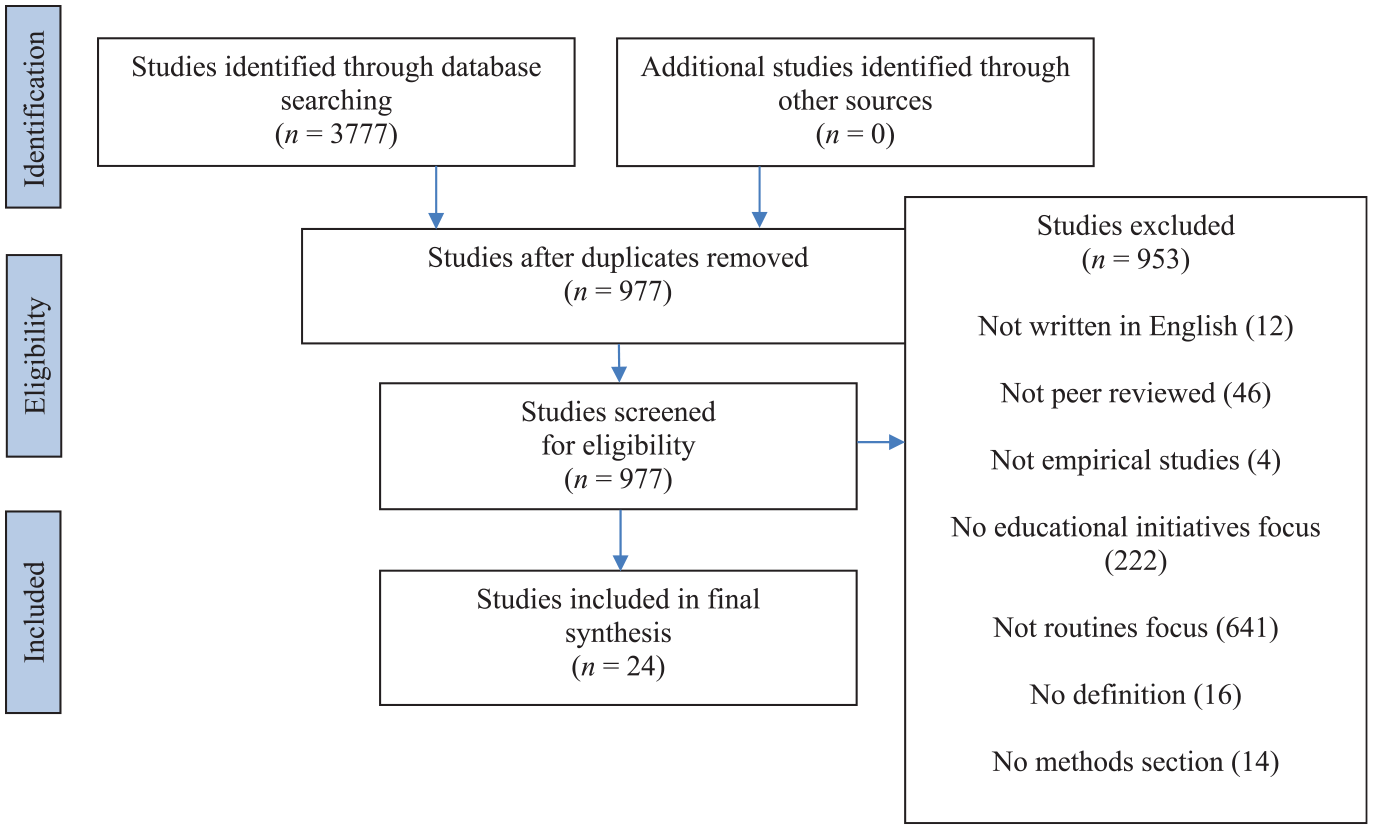
PRISMA (Preferred Reporting Items for Systematic Reviews and Meta-Analyses) flow diagram detailing identification, screening, and inclusion of studies. Adapted from Moher et al. (2009).
Inclusion Criteria for Articles
In reviewing the abstracts of these 977 publications, we applied several inclusion criteria. Articles had to (1) be written in English; (2) be peer reviewed; (3) not a conceptual paper; (4) pertain to PD, educational reform, school improvement, or policies for new educational initiatives regarding PD, school improvement, and educational reform; (5) focus on routines; (6) define and operationalize routines; and (7) have a methods section. For example, because studies had to pertain to new educational initiatives, the following studies using the concept of routines were excluded: a study on student discipline routines (Diamond & Lewis, 2019), a study on student classroom placement routines (Park et al., 2017), and a study on organizational routines as manifestations of legal standards (Ottesen & Møller, 2016). The application of these five inclusion criteria left us with 24 studies for the analysis.
Coding Process: Phase 1
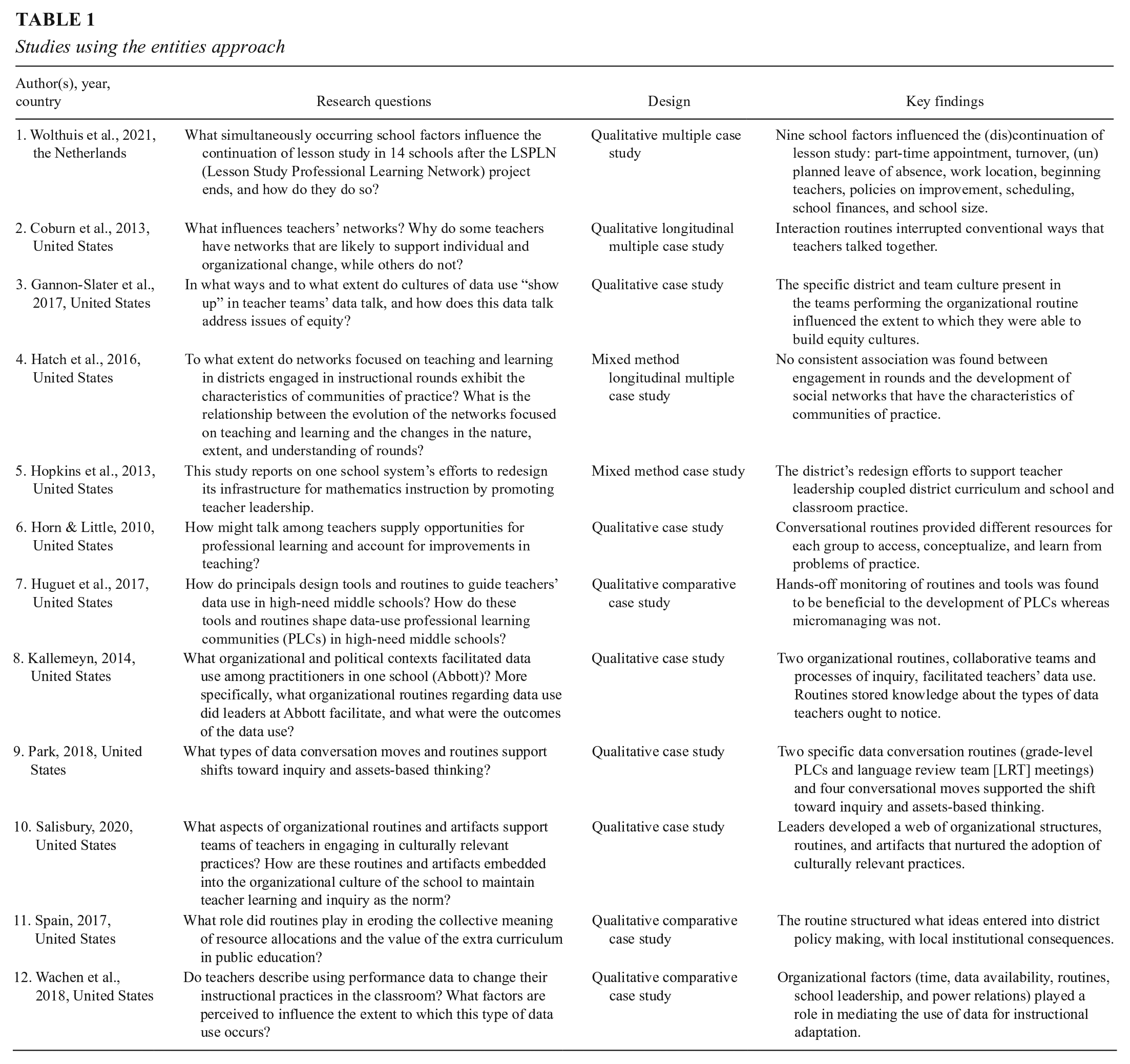
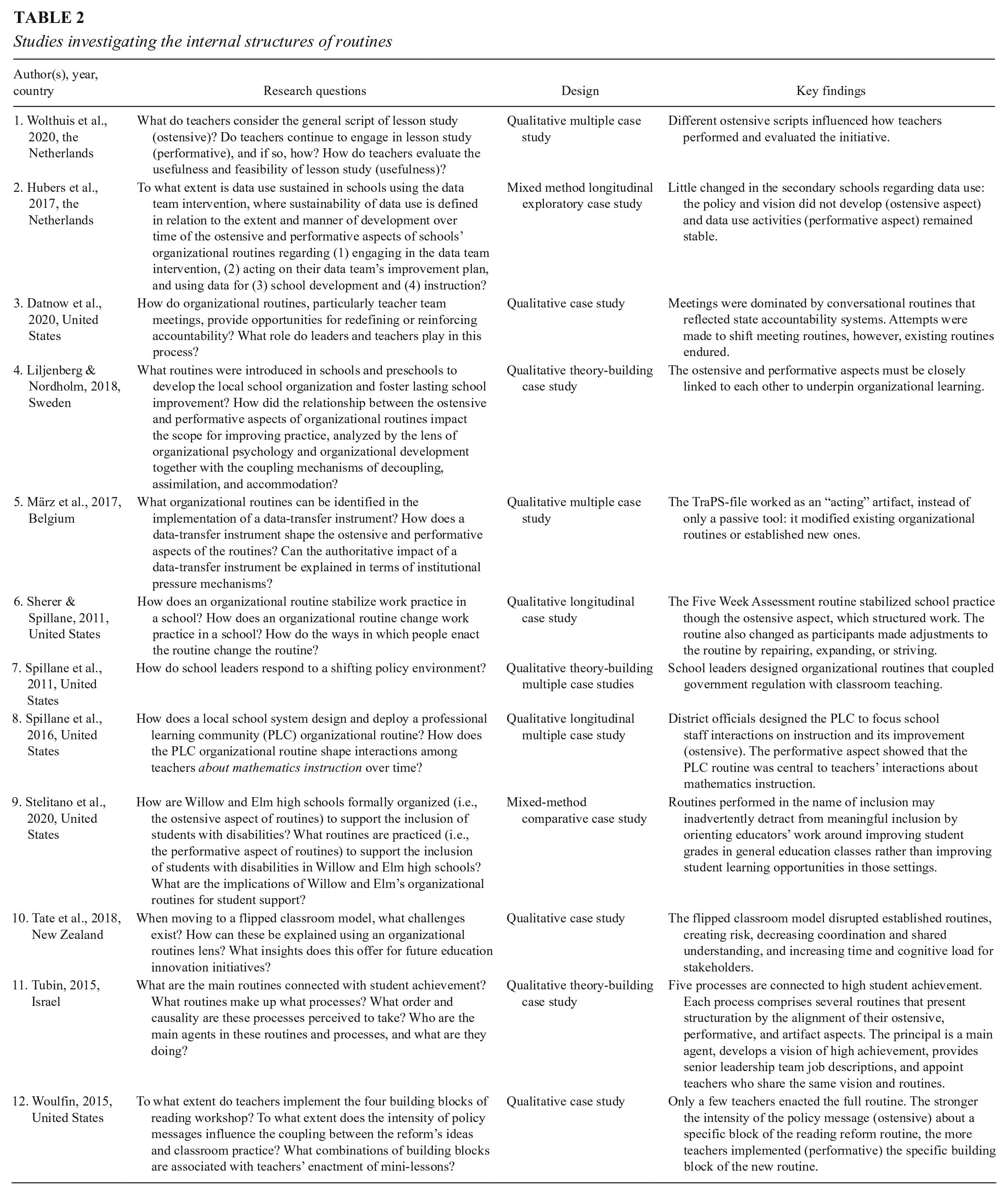
The review involved a two-phase, iterative coding process. In Phase 1, our focus was on collecting descriptive information about each article, as expected within a systematic review. All abstracts and studies were read to identify the location of the study, the research questions, and the research method used in the study (qualitative, quantitative, mixed method). Summaries were generated according to these categories (shown in Tables 1 and 2). Studies were predominantly conducted in North America (n = 17), followed by Europe (n = 5), Southeast Asia (n = 1), and the Middle East (n = 1). Most of the studies reviewed used qualitative methods (n = 20), and the remaining four studies employed a mixed-method design. No quantitative studies were present.
Studies using the entities approach
Studies investigating the internal structures of routines
Coding Process: Phase 2
Phase 2 of the coding process was conducted to answer our three specific research questions. The coding process was designed to make the following explicit:
Level of analysis (e.g., entities or internal structure)
Definitions and operationalizations
Key findings
Validity of investigations of routines
Studies were coded both deductively and inductively. The initial coding of definitions and operationalizations was cyclical, iterative, and inductive, examining the different levels of analysis, definitions, and operationalizations found in the studies. Based on these findings, we fine-tuned codes to organizational routines, conversational routines, conversational moves, ostensive aspect, performative aspect, and artifacts. To investigate the validity of investigations we used a coding scheme addressing (a) member checking, (b) method triangulation, (c) data source triangulation, and (d) theory triangulation (Birt et al., 2016; Carter et al., 2014). Member checking was determined by investigating whether and how studies reported on member checking. Method triangulation was determined by investigating what kinds of data were collected and how to examine routines. Data source triangulation was determined by investigating if and how different groups were approached to collect data. Theory triangulation was examined by investigating the theoretical framework studies used to interpret the data. Central to this examination was identifying whether and how studies relied exclusively on the concept of organizational routines or added additional theory. For each study, we selected and summarized sentences in relation to the definition and operationalizations of routines, the key findings, and the validity of the examination of routines. Throughout the data analysis process, the research team consistently shared and critically discussed their tentative interpretations. Tables 1 and 2 show the descriptive information of the studies, the level of analysis of routines, and the key findings. In Supplemental Appendix 1 (available in the online version of this article), findings regarding the validity of the examinations of routines are summarized per study.
Results
How and at What Level Are Routines Defined and Operationalized?
Level of Analysis
Regarding the first research question, concerning the levels at which routines were examined, we found that of the 24 studies, 12 examined routines at the level of entities (see Table 1) and 12 at the level of the internal structures (see Table 2). In the former, the internal structure of the routine (the ostensive and performative aspects) was relatively undefined or not examined. In the second approach, these were taken into consideration and the focus was on how the internal structure of the routine interacted with each other. To illustrate the difference between these approaches, we take the example of two studies that examined the same initiative (a PLC) at different levels, considering how the initiative was described through the lens of routines. Park (2018) examined a PLC from an entities approach. She gave a broad outline of the PLC routine as “a cycle of three meetings facilitated by the instructional coach. Each meeting lasted for an hour and occurred approximately every 6 weeks” (p. 631). The general steps that teachers go through during each phase of the cycle were also given. By contrast, Spillane et al. (2016) examined the internal structure of the PLC routine. The general structure of the routine was also given: The “PLC routine focused on grade level teams, with teachers mandated to collaborate weekly for 45 minutes, often with the participation or presence of subject-matter specialists (e.g., instructional coaches) and school principals” (p. 106). Subsequently, the internal structure was also addressed. The focus was on both the intended design (ostensive aspect) of the PLC routine and the actual performances of the PLC (performative aspect). The design intent for the PLC was to promote interactions among teachers about instruction that enables their learning from and about instruction. The performative aspect of the routine examined whether and how this actually occurred in practice. Because the level of analysis has implications for the definition of routines, we discuss research question two for each level of analysis separately.
Definitions and Operationalizations of Routines as Entities
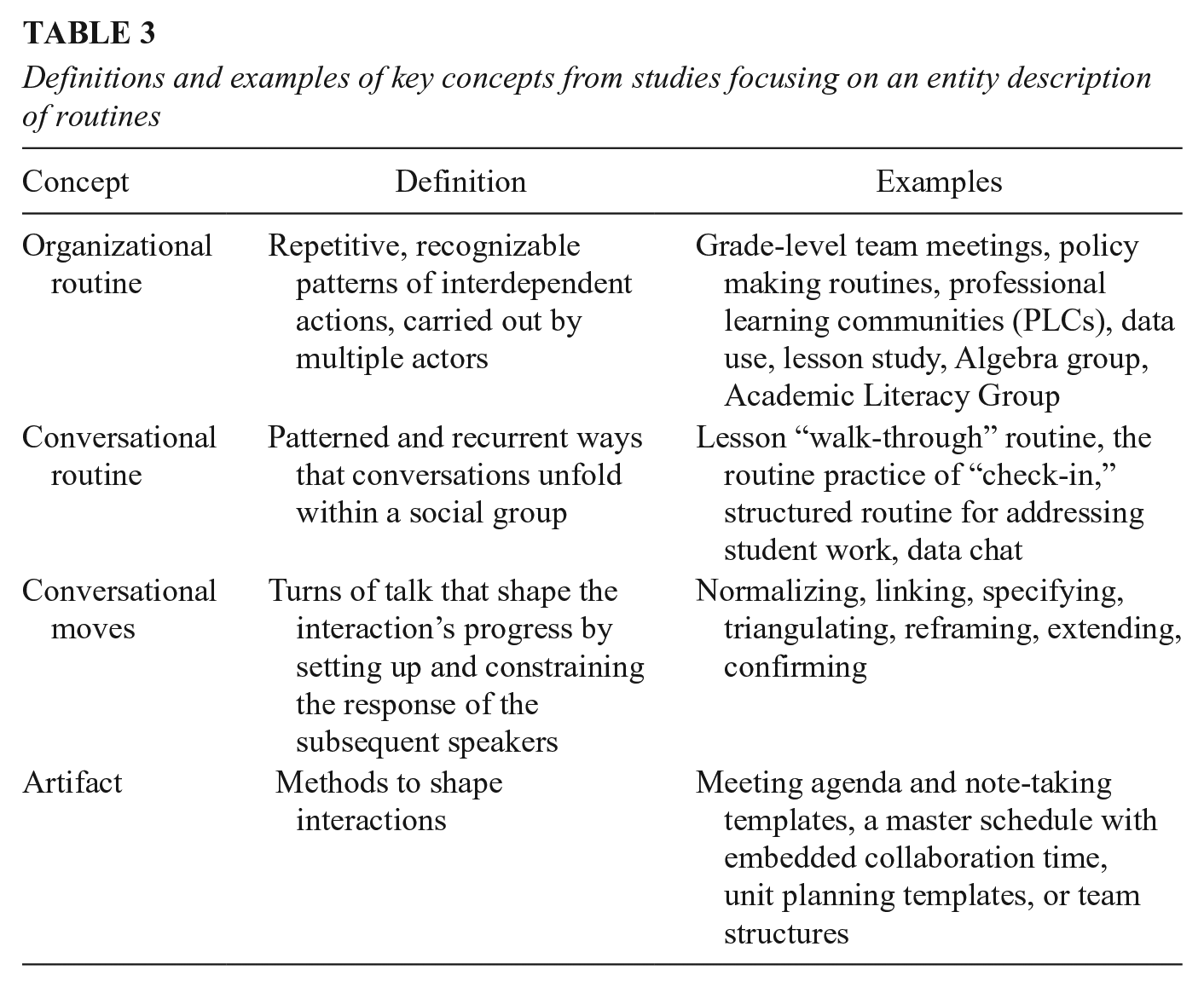
Within the 12 studies that described routines as entities (see Table 3 for an overview), we found that almost all researchers focused on routines as patterns of interaction, thereby specifying the types of patterns that they focused on. However, studies operationalized routines differently. Two takes on routines were found: one that focused on the patterned ways of working within an organization and one that focused on the patterned ways of interacting. The concept was applied (implicitly or explicitly) at two different levels of analysis, namely, at the meso level (as an organizational routine) and at the micro level (as a conversational routine). In some cases, studies focused only on the meso level, in others both were explored. As such, studies that approached routines as entities were in some cases found to make use of different notions to explore what occurred during the routines. Because they did not use the ostensive and performative distinction, but instead adopted a focus on conversational routines and moves, we found that the educational research literature employs a different terminology for exploring the internal structure of routines.
Definitions and examples of key concepts from studies focusing on an entity description of routines
Organizational routines
Most studies that focused on organizational routines operationalized the concept by referring to the specific initiative. Those studies operationalized routines as, for example, grade-level team meetings and policy-making routines (Gannon-Slater et al., 2017), or as externally designed routines such as instructional rounds (Hatch et al., 2016), or as locally designed routines such as PLCs (Hopkins et al., 2013). In those cases, researchers defined routines using the general definition of “repetitive, recognizable patterns of interdependent interactions, carried out by multiple actors” (Feldman & Pentland, 2003, p. 95). One study (Wolthuis et al., 2021) further specified the concept to the specific routine, determining what each aspect of the concept, (1) repeated, (2) recognizable patterns of interdependent actions, (3) carried out by multiple actors, involved for the educational initiative under investigation. For example, repeated was operationalized as “Schools decide to repeat lesson study in their own setting after the LSPLN ends [and] Schools have plans to repeat lesson study the next year with the pilot groups and potentially to form more groups” (Wolthuis et al., 2021, p. 3). Multiple actors were operationalized as “Schools gather participants for lesson study groups in their own schools [and] Schools have collective participation during lesson study meetings” (Wolthuis et al., 2021, p. 3). Such a translation of what the general definition of organizational routines entails for the specific initiative enriches the concept’s potential use in examining how the initiative unfolds in practice.
Conversational routines
In addition, studies also could (either explicitly or implicitly) define and operationalize routines at the micro level with regard to conversations. Here, routines were operationalized as, for example, “a structured routine for addressing student work” that occurs within a PLC (Huguet et al., 2017, p. 382). The application of the concept of routines to conversations originated with Horn and Little (2010). They took the definition of organizational routines and subsequently added two new concepts: conversational routines and conversational moves. Conversational routines involve “patterned and recurrent ways that conversations unfold within a social group. Routines are constituted by moves, turns of talk that shape the interaction’s progress by setting-up and constraining the response of the subsequent speakers” (Horn & Little, 2010, p. 184). The conversational routines Horn and Little (2010) investigate are a walk-though routine and a check-in routine, which occurred during organizational routines, in this case an academic literacy group and an algebra group. For example, the Academic Literacy Group consisted of several English teachers who met weekly. The conversational routines of the lesson walk-through: Accommodated the group’s agreement to handle initial lesson planning through a division of labor, with one or two teachers taking a lead in each curriculum unit; it principally entailed the planner’s descriptive account of the lesson design, activities, and materials. (p. 190)
The conversational moves occurred during these conversational routines. Examples were normalizing, linking, and specifying. Normalizing involved “moves that defined a problem as normal, an expected part of classroom work and teacher experience” (Horn & Little, p. 192). Both conversational moves and conversational routines took place within organizational routines. Horn and Little (2010) distinguished between the meso- and micro-level routines, where organizational routines occur at the meso level and conversational routines and moves at the micro level.
After this reconceptualization was introduced, there was an increased focus on conversations (e.g., Coburn et al., 2013; Huguet et al., 2017; Park, 2018; Salisbury, 2020). However, the terminology introduced by Horn and Little (2010) was not consistently applied, making it difficult to understand whether and how terms differ from each other and from the concept of organizational routines. For example, Park (2018) applied the reconceptualization of conversational routines to grade-level PLCs and a language review team, and used the term conversational moves to refer to patterns such as triangulating, reframing, extending, or confirming. What Horn and Little (2010) conceptualized as an organizational routine was now conceptualized as a conversational routine. A grade-level PLC was seen as a patterned and recurrent way that conversations unfold within a social group, rather than a repetitive, recognizable pattern of interdependent actions, carried out by multiple actors. Coburn et al. (2013) gave the general definition of organizational routines, which they then termed routines of interaction, and operationalized them as, for example, reflecting, task analysis, and goal setting. These operationalizations resemble what Horn and Little (2010) termed conversational moves. Salisbury (2020) introduced a different distinction: organizational structures and organizational routines. The first was defined as “a configuration of activities that is characteristically enduring and persistent; the dominant feature of organizational structure is its patterned regularity” (p. 129). Organizational routines, in his study, entailed “recognizable interactions between colleagues that occur regularly over time” (Salisbury, 2020, p. 129), which was more in line with what Horn and Little (2010) termed conversational routines. Overall, we found that educational research has applied the concept of organizational routines to examine interactions and conversations, but in various—and sometimes conflicting—ways.
Artifacts
The study by Salisbury (2020) was the only one in this group to also examine artifacts. Artifacts, in that study, were not defined, but were framed within the study’s focus on interactions. They “represent a method to understand how leaders shape interactions when they are absent” (p. 130). Artifacts were operationalized as meeting agendas and note-taking templates, a master schedule with embedded collaboration time, unit planning templates, or team structures (Salisbury, 2020).
Commonalities between all entity-oriented studies
Most studies, apart from Wolthuis et al. (2021), were interested in how routines influence or shape interaction, but they investigated this at different levels of observation. Some studies examined how routines, at organizational level, bring people together in specific configurations and with specific knowledge and skills (e.g., Hatch et al., 2016; Hopkins et al., 2013). Others (also) examined how, at a conversational level, routines structure how interactions proceed. For example, in one study, a “structured routine for addressing student work” within a PLC was found to be useful for structuring the interaction (Huguet et al., 2017). Within conversational routines, moves can provide insight into why conversations do or do not produce certain results, such as learning opportunities (Horn & Little, 2010) or creating shifts that move teams toward an inquiry stance (Park, 2018). However, the different definitions and operationalizations reveal ambiguity around the constructs. The literature would benefit from consistent terminology to maximize the potential of (the adaption of) the concept of routines in order to provide a robust body of work on these different levels of analysis of routines (and moves). To support clear application of these constructs we provide an overview of the concepts, definitions, and examples (see Table 3).
Definitions and Operationalizations of the Internal Structure of Routines
Twelve studies examined the internal structure of routines. Conceptually, all but one study described routines at the meso level. Only Datnow et al. (2020) also examined the internal structure of conversational routines. As this was the only study to do so, the definition and operationalization using in this study were treated separately from the studies that examined the internal structure of organizational routines.
The Internal Structure of Conversational Routines
Datnow et al. (2020) investigated both organizational routines (such as teacher team meetings and lesson study) and conversational routines. The organizational routines are approached as entities but for conversational routines the internal structure is investigated, namely, their formal goal (ostensive) and what actually occurred during the conversations (performative). For example, examining one conversational routine showed that Ostensively, teachers were supposed to look at the standards (particularly those deemed most critical) and work together to plan instruction that would be used annually. Performatively, however, conversations continued to focus on which topics were most important to cover for SBAC [Smarter Balanced Assessment Consortium] rather than on how to teach them. (p. 121)
Datnow et al.’s (2020) examination of the internal structure of a conversational routine showed overlap with examining the conversational moves within them. Conversational routines set up structures for interaction, while the moves revealed how the conversations actually unfolded. Similarly, the ostensive aspect of a conversational routine prescribed the structure in which conversations should unfold, whereas the performative aspect showed how conversations actually did unfold. However, rather than introducing new terms for the concept of organizational routines, Datnow et al. (2020) capitalized on what the concept of routines has to offer, namely, an exploration of the dynamic between its internal structures.
The Internal Structure of Organizational Routines
The other 11 studies examined organizational routines. Some investigated externally designed routines, such as data use (Hubers et al., 2017) and lesson study (Wolthuis et al., 2020). Locally designed routines that were investigated included the Five Week Assessment routine (Sherer & Spillane, 2011; Spillane et al., 2011), study hall routines (Stelitano et al., 2020), speed team meetings, and pedagogical cafes (Liljenberg & Nordholm, 2018). Two studies operationalized routines in a classroom setting, though differently. One examined a newly designed classroom routine, namely, a reading reform routine (Woulfin, 2015). Instead of examining the new teaching initiative (flipping the classroom) through the organizational routines lens, one study investigated what this new initiative did to existing organizational routines for teaching, such as a traditional routine for essay preparation (Tate et al., 2018). Organizational routines were defined rather similarly across the studies. Most authors referred to the general definition by Feldman and Pentland (2003). However, the definitions and operationalizations of the ostensive, performative, and artifact aspects reveal that beyond the initial consensus on the definition of organizational routines, ideas about the internal structure of routines differed (for an overview, see Table 4).
Definitions, operationalization, and examples of key concepts from studies focusing on the internal structure of organizational routines
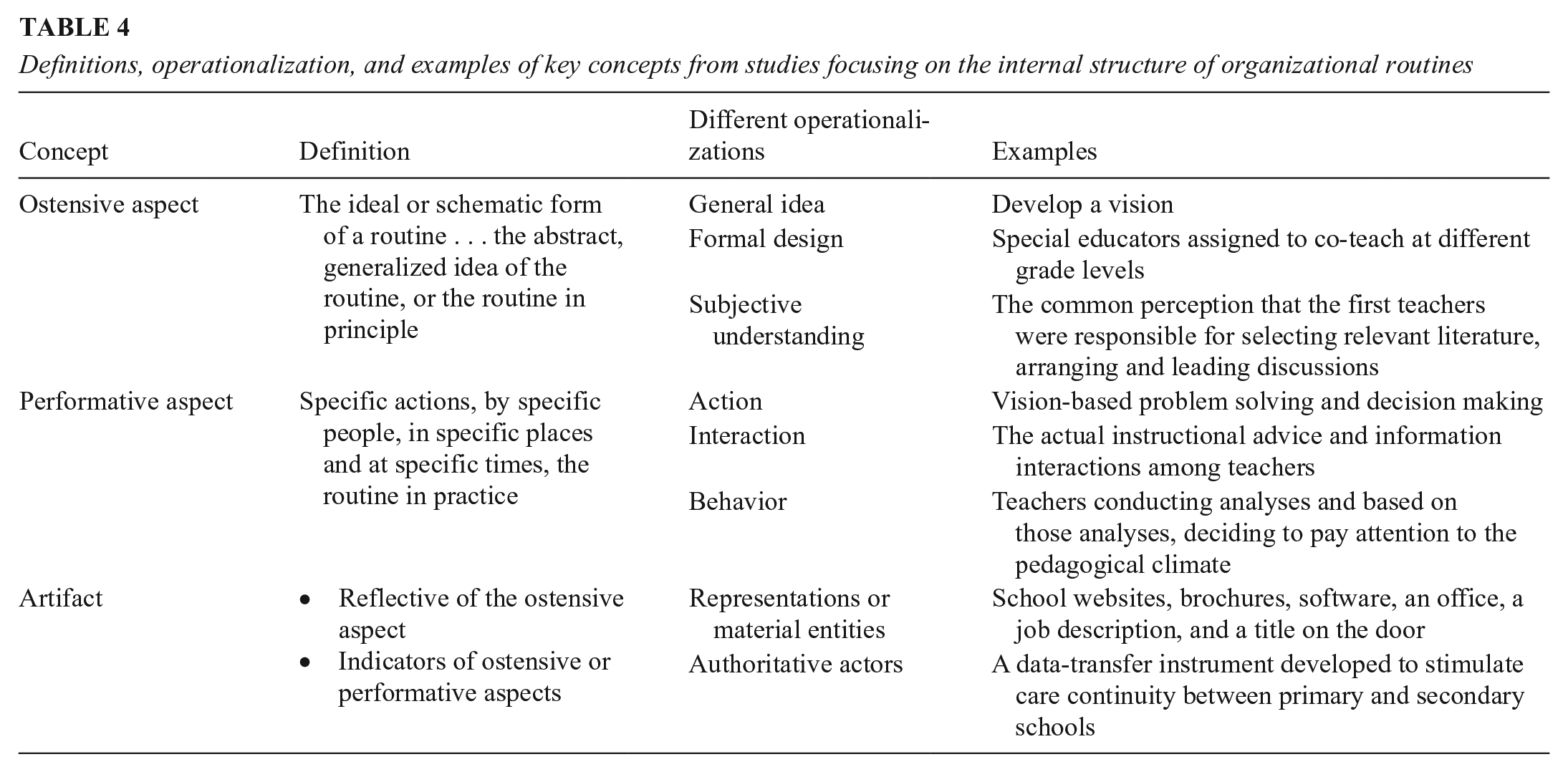
Ostensive aspect
Most studies defined the ostensive aspect by explicitly quoting Feldman and Pentland (2003, p. 101), who referred to “the ideal or schematic form of a routine . . . the abstract, generalized idea of the routine, or the routine in principle.” However, studies differed in how this was operationalized, namely, as the general idea, formal structure, or subjective understanding. As Table 4 shows, each of these views conveys a different notion of what the ostensive aspect is. When the ostensive aspect was seen as the general idea, the overall blueprint for the routine was examined, and the ostensive aspect was operationalized as, for example, “develop a vision” (Tubin, 2015) or the different steps of the Five Week Assessment routine (Sherer & Spillane, 2011).
When the ostensive aspect was understood as part of the formal structure of the organization, researchers investigated how schools design routines, such as what roles, task, and organizational structures are set up. Here the ostensive aspect reflected “the designed organization including formally designated positions, chains of command, departments, programs, and formal organizational routines” (Spillane et al., 2011, p. 588), as well as designed structures for (new) ways of working. Similar to other formal structures, the ostensive aspect codifies how work is formally arranged. For example, Stelitano et al. (2020) examined both schools’ formal design to aid students with disabilities and the performative aspects of routines related to how the formal design was implemented in practice. The operationalization of the internal structure of a routine thus described “special educators . . . assigned to co-teach at different grade levels [ostensive] and . . . co-taught instruction looks different for different teachers [performative]” (Stelitano et al., 2020, p. 547).
When the ostensive aspect was operationalized as a collective narrative of subjective or shared understanding of the routine, researchers investigated how the general script of the routine was actually understood and interpreted by participants. On that view, “[T]he ostensive aspect is not per se about written rules or procedures—since for many routines they simply do not exist—but encompasses actors’ understandings regarding this routine” (März et al., 2017, p. 442). An ostensive aspect of a pedagogical café routine might be operationalized, for example, as follows: “The common perception was that the first teachers were responsible for selecting relevant literature for teachers to read, and for arranging and leading discussions at the pedagogical café” (Liljenberg & Nordholm, 2018, p. 696).
The interpretation of the ostensive aspect as the general script stays close to the definition of the ostensive aspect found in organizational research. However, studies in education were found to adapt and further specify the ostensive aspect when investigating educational initiatives, namely, by examining the formal structures of initiatives and the subjective understandings of the initiatives.
Performative aspect
The 11 studies defined the performative aspect as “specific actions, by specific people, in specific places and at specific times. It is the routine in practice” (Feldman & Pentland, 2003, p. 101). As Table 4 shows, what the patterns of routines consisted of, or, in other words, what the specific performative aspect was, differed. Three notions were found regarding what the patterns consisted of (1) actions, (2) behavior, and (3) interactions. This led to different operationalizations of the performative aspect of routines. For example, the performative aspect was operationalized as actions involved vision-based problem solving and decision making (Tubin, 2015). When seen as interactions, the performative aspect was operationalized as the actual instructional advice and informational interactions among teachers that occurred in practice (Spillane et al., 2016). Seen as behavior, the performative aspect was, for example, operationalized as teachers conducting analyses and, based on those analyses, deciding to pay attention to the pedagogical climate (Hubers et al., 2017). This shows that not just the ostensive aspect referred to different things; the performative aspect was interpreted differently as well.
Artifacts
Three studies also examined artifacts, but did so differently (see Table 4). First, artifacts were seen as separate from routines and as indicators of the ostensive aspect (Tubin, 2015). Here, artifacts were operationalized as school websites, brochures, software, an office, a job description, and a title on the door. Second, artifacts were seen as indicators of both the ostensive and performative aspects and as having a potentially substantial influence in shaping the internal aspects of routines (Liljenberg & Nordholm, 2018; März et al., 2017). Here, artifacts were, for example, operationalized as a data-transfer instrument developed to facilitate and warrant the continuity of educational care when pupils make the transition from primary to secondary education (März et al., 2017).
The first (Tubin’s) approach aligns with early work on routines, which presented artifacts as representations or material entities that can cue performance, mostly as indicators of the ostensive aspect (Feldman & Pentland, 2003). The second approach matches more recent work that has closely scrutinized artifacts and their influence. Here, artifacts are indicators of both ostensive and performative aspects (Feldman & Pentland, 2008; Jarzabkowski et al., 2016).
Overall, as with the description of routines as entities, the internal structure of routines (ostensive aspect, performative aspect, and artifacts) entailed different things for different researchers. Similar to findings for studies that examined routines as entities, we view these different interpretations of the aspects of routines as a potential strength of the concept, as they each capture an important dimension of routines, and each can be of use depending on the particular research aims. However, as in the previous section, the variety of operationalizations creates ambiguity and inhibits researchers from building on each other’s work. Therefore, we have untangled the different definitions and operationalizations of routines and artifacts used in the studies, given each approach a specific term (e.g., general idea, formal structure, and subjective understanding), and illustrated each aspect with examples (see Table 4).
Key Findings About Educational Initiatives Using Organizational Routines
Different levels of analysis of routines led to different key findings on educational initiatives. First, studies that examined routines as entities mostly showed how routines can coordinate people and bring people together in specific arrangements. Routines, therefore, influence how the interaction between people proceeds. Routines were found to change norms, beliefs, and culture, because they can normalize specific values. For example, routines can create a shift toward learning and equity (Park, 2018), support teacher leadership (Hopkins et al., 2013), lead to a deprivatization of teacher practice and adoption of culturally relevant practices (Salisbury, 2020), and potentially stimulate networks with characteristics of communities of practice (Hatch et al., 2016). Studies in this group showed that while organizational routines set up structures of interaction that can change norms, beliefs, and cultures, it is the specific conversational routines and moves that are pivotal for the actual change in norms and values. Only Wolthuis et al. (2021) used the routines as entities approach to examine how an initiative unfolded in practice, to investigate whether and how schools continued with an initiative after a university project ended and how the specific school factors in each of the 14 schools influenced this process.
Studies that examined the internal structure of routines focused on how routines themselves operated. Studies showed how initiatives change and stabilize, break down and succeed, and how artifacts and people influence routines. Investigation of the internal structure allows researchers to compare how routines are intended with how they are performed, revealing how initiatives unfold in practice. For example, this focuses attention on how initiatives are designed or understood and what actually happened regarding the initiative. Studies that focused on the internal structure were able to show, for example, whether and how data use initiatives were sustained in different schools (Hubers et al., 2017). In addition, Stelitano et al. (2020) showed whether and how schools set up routines for students with disabilities and whether these actually led to inclusive practices. Moreover, Woulfin (2015) showed how consistently teachers implemented a reading reform within their classrooms. Studies also gave insight into how artifacts can influence routines (Liljenberg & Nordholm, 2018; März et al., 2017; Tubin, 2015) and how people can influence routines (e.g., Sherer & Spillane, 2011; Tubin, 2015; Wolthuis et al., 2020).
The findings also showed different operationalizations of the ostensive and performative aspects, which indicates that the concept is versatile. However, the versatility does complicate building a knowledge base, as studies gained insights on different “things” regarding the ostensive and the performative aspects.
Different approaches to artifacts mattered for how much insight studies gained. For example, Tubin (2015) considered what artifacts connected to various routines might lead to greater student achievement. In her study, the analysis of artifacts did not go beyond identifying which artifacts were connected to which routines. In contrast, studies that examined artifacts in relation to the internal structure of routines were able to gain more insight into how artifacts and routines operated in practice and whether artifacts were able to fulfill the goal they were designed for (Liljenberg & Nordholm, 2018; März et al., 2017). Importantly, examining artifacts as integral to routines also provided insight into how the routines operated. For example, Liljenberg and Nordholm (2018) examined ostensive ideas about artifacts (such as the idea that using tools and templates would make it easier to evaluate a project) together with how artifacts were used in practice (performative) that revealed that teacher teams used artifacts differently. As such, when investigating how educational initiatives unfold in practice, seeing artifacts as connected to both the performative and the ostensive aspects is most useful.
How Valid Are Organizational Routines Investigated?
To answer the second research question, we examined member checking and triangulation (method, data source, theory) for all 24 studies (see Online Supplemental Appendix for an overview). We found no notable differences between studies that investigated routines as entities or investigated the internal structure; therefore, all studies are treated together. Below, findings for each element are reported separately.
Member Checking
Member checking is especially important when researchers examine locally designed or informal routines. When routines are highly structured, such as lesson study or instructional rounds, it is much easier to know what to focus on, as the routine is already identified beforehand. However, when researchers do not know beforehand which routines to look for, member checking can provide valuable confirmation of whether the (entire) routine has been captured.
Only six out of the 24 studies employed member checking (Datnow et al., 2020; Gannon-Slater et al., 2017; Hatch et al., 2016; Park, 2018; März et al., 2017; Woulfin, 2015). A reason for the lack of member checking can be the specific focus of our review. As we selected studies that focused on new initiatives, the routines under examination were often externally designed. When, for example, schools start with new initiatives such as data use, lesson study, PLCs, and instructional rounds, repetitive, designed patterns of interdependent actions are presented to schools, and are therefore much more recognizable and easier to distill for researchers. Studies that did incorporate member checking generally investigated existing, locally designed routines in the schools, making it more important for the researchers to check whether they accurately comprehended the routine. For example, Park (2018) investigated which data use routines and conversational moves supported a shift toward inquiry thinking. As the routines and moves were not known beforehand, Park checked with her participants whether she had accurately identified them.
Method Triangulation
Of the 24 studies, the majority (n = 16) used multiple methods of data collection. Therefore, most studies engaged in method triangulation (Patton, 1999). Studies used between one and four of the following methods of data collection: interviews (22 studies), observations (14 studies), documents (11 studies), and surveys/questionnaires (5 studies). No link was found between how routines were defined and operationalized and what types of data were collected. Studies that engaged in method triangulation well often incorporated a variety of interviews, documents, and observations to examine routines. These different types of data all provide ways to search for convergence in determining findings. Documents were used, for example, to examine the general idea, formal design, or the views of leadership on how routines are intended for the school (Hubers et al., 2017; Liljenberg & Nordholm, 2018; Spillane et al., 2011). Observations were used to investigate how routines were performed in specific situations (Park, 2018; Spillane et al., 2011), and interviews could reveal how people considered the script of a routine (März et al., 2017; Wolthuis et al., 2020). Studies that examined routines as entities and had thorough method triangulation also incorporated these three methods of data collection. This suggests that a combination of documents, interviews, and observations is required to adequately examine initiatives through the lens of routines, both form the entities as from the internal structure approach.
When studies used only one way to collect data, it can be questioned whether the routine was comprehensively understood. This was especially the case for the five studies that relied solely on interview data to examine how routines were intended and performed (Liljenberg & Nordholm, 2018; Spillane et al., 2016; Tate et al., 2018; Wolthuis et al., 2020; Wolthuis et al., 2021) or on the conversations within routines (Wachen et al., 2018). Interviews alone might not have been able to provide sufficient insight into the routines, as people are notoriously bad at predicting and reporting what they do (Jerolmack & Khan, 2014). In particular, researchers should not rely on self-reports alone when they want to uncover what actually happens during specific performances. Researchers who only used interviews did take care to note that their data provided insight into, for example, academics’ preferences regarding performances of a routine (Tate et al., 2018) or stressed that they concern teachers’ reported performed actions of a routine (Wolthuis et al., 2020). Nevertheless, when researchers aim to understand what actually happened, method triangulation with observations is important for valid inferences to be drawn about the specific performances of the initiative. Two studies only conducted observations to examine the conversations within routines (Gannon-Slater et al., 2017; Horn & Little, 2010). These two studies were less liable to the aforementioned problems, as they gained direct access to what occurred during the performance (in these cases, specifically the conversations) of the routines.
Transparency on how (much) data are collected
Across the studies, transparency on how (much of) each type of data were collected differed considerably, regardless of whether routines were examined as entities or in terms of their internal structure. The more detailed studies were about the nature and amount of the data collected, the more valid their investigation was of routines. For example, document collection was described with different degrees of specificity. Tubin (2015) only reported, “documentation related to the students’ achievements was gathered” (p. 647). By contrast, Salisbury (2020) gave the number of collected documents and a detailed list of examples: “162 documents, such as course syllabi, meeting minutes, meeting PowerPoints, student work samples, and lesson plans” (p. 123).
Regarding the amount of data collected, considerable variation was also found. For example, Tate et al. (2018) aimed to gain insight into teaching routines within one university and interviewed 11 people. Spillane et al. (2016) examined a PLC routine within a school system and interviewed 33 people. By contrast, Sherer and Spillane (2011), investigated one organizational routine in one school and conducted 219 interviews. In the first two examples, the number of interviews is rather low (especially as interviews were the only method used in both studies) to gain an understanding of the routines within the overall university or school system.
Moreover, the studies that examined the internal structure of routines did not always specify what type of data was collected for what aspect. For example, in the study by März et al. (2017), where the internal structure was an explicit part of the research questions, the authors did not discuss how data were collected for each aspect. This diminished validity and made it difficult to see how empirical claims were supported. Studies that provided these details were found to have much more valid applications of the concept. For example, Sherer and Spillane (2011) specified how data were collected. They reported, We collected data on the performance of the routine in particular times and places (observations of leader and teacher practice, meeting observations) as well its ostensive aspect (artifacts, interview descriptions of the routine, and observations of leaders describing the routines to outsiders). (p. 622)
Subsequently, this provided greater clarity in interpreting the results for the ostensive and performative aspects.
Overall, studies varied in how comprehensively they incorporated method triangulation. To increase and ensure validity through method triangulation, studies should use a variety of different methods of data collection (such as documents, observations, and interviews) and detail the characteristics of the data that are collected (such as what kinds of documents are investigated and what is observed). Moreover, method triangulation for routines requires researchers to detail how collected data links to the routine, especially when the internal structure is examined.
Data Source Triangulation
Data source triangulation involves the collection of data from different types of people (Carter et al., 2014). Generally, the number of data sources needed to examine a routine will depend on the specific routine. When routines involve school- or district-wide practices in which different participants are involved, combining the perspectives of the different (and distributed) people will be necessary to capture the routine comprehensively. In other cases, routines might be much more specific to groups of individuals, for example, grade-level meetings that only involve teachers teaching in the fourth year or initiatives designed specifically for math teachers. Most studies in this review collected data from different sources, which means most researchers examined routines from the perspective of different participants. Some exceptions were found in studies that collected data from one subset of participants, indicating that the distributed nature of routines was not always taken into consideration by researchers and only a limited perspective on routines was sometimes gained.
On average, studies used three different types of data sources, such as teachers, school leaders, and facilitators, but in some cases (many) more. For example. Liljenberg and Nordholm (2018) used only interviews to examine what organizational routines schools implemented for improvement, but they did conduct these interviews with four different types of people: nine school leaders, 65 teachers, 49 preschool teachers and eight student health representatives.
In some cases, no data source triangulation was done. For two studies, the only data sources were groups of teachers who were observed during meetings (Gannon-Slater et al., 2017; Horn & Little, 2010). Wolthuis et al. (2020) interviewed only the teachers who took on the role as facilitator within a lesson study routine (n = 21). The other lesson study participants were not interviewed, nor was additional staff (such as the principal or school leaders). This potentially provided limited insight into the lesson study routine. Interviewing other teacher participants and school leaders could have contributed to a more comprehensive understanding of the routine from different perspectives.
Theory Triangulation
Theory triangulation can show the potential strengths and limitations of the concept of routines. We compared studies that used only the concept of routines with those that added additional theory. This made it is possible to see what the boundaries of the concept are in terms of examining new initiatives. Overall, we found applying the internal structure approach to routines holds great potential to provide in-depth insight into how the new initiative itself operates and unfolds in practice. Only one study that used the routines as entities approach was able to examine how an initiative unfolded in practice. When studies were also interested in how the wider context influenced the routine or how conversations within the routine unfolded, additional theory or reconceptualization needed to be added. This shows the limits of the concept. Routines provide a tool to explore how ways of working unfold at the meso level, but offer fewer tools to explore the influence of the wider (macro level) context or the specific conversations within routines (micro level). Within the 24 studies, five studies used only the concept of organizational routines (all five used the internal structure approach) and 19 added additional theories or reconceptualizations of routines.
Internal structure
The benefit of the internal structure approach lies in its ability to compare how routines are intended with how they are performed. This reveals how initiatives unfold in practice: how initiatives are designed or understood and what actually happens regarding the initiative. Studies that explored the dynamics of the internal structure of routines were able to explore how initiatives, as organizational routines, change, remain stable, break down or succeed, how artifacts influence and connect to routines, and how people influence routines.
For example, organizational routines change when adjustments are made during their performance that can lead to incremental changes. People performing the routine might engage in repairing, expanding, or striving (Sherer & Spillane, 2011). When routines do not produce the intended outcome, people can make changes to repair an organizational routine. When the outcomes of a routine create new problems, people can expand the organizational routine. Finally, when people see room for improvement, they sometimes strive to change the routine (Feldman, 2000; Sherer & Spillane, 2011). Routines can also change when people modify the ostensive script of the routine. Wolthuis et al. (2020) showed that teachers modified the general script of the lesson study routine, which was in turn connected to which phases of the lesson study routine they performed.
Organizational routines can also stabilize. The ostensive script can structure the work, and the routine can remain in place in a school even after the initial instigator of the routine leaves. For example, the ostensive script can sustain a principal’s vision and strategies for instructional improvement after the principal leaves (Sherer & Spillane, 2011). Ostensive scripts can continue to structure and stabilize work practices, focusing and framing interactions in the school in particular ways, such as around instruction and student performance. However, such stability can also be detrimental, if it leads to inertia and rigidity. Tate et al. (2018) argued that ostensive scripts lead to inflexibility, such that an established, ostensive script of teaching constrained any changes to a new script involving an innovative teaching routine (i.e., flipping the classroom). Because ostensive scripts linked to timetabling, room booking, and managing online learning software were strongly entrenched, a new initiative routine that altered these elements was unable to achieve effects.
Consideration of the internal structures of routines also allowed for investigation of how new initiatives break down or succeed (Hubers et al., 2017; Liljenberg & Nordholm, 2018; Stelitano et al., 2020; Tubin, 2015; Wolthuis et al., 2020; Woulfin, 2015). For example, Hubers et al. (2017) found that schools struggled to develop organizational routines for data use, even during and after participating in a PD program for that purpose. They especially struggled with the ostensive aspects, as displayed, for example, in their limited or absent policy and vision for data use. The performative aspects appeared to develop to some extent, though sometimes through data misuses. Overall, the dynamic of the internal structure of routines clarified the process by which schools failed to sustain their use of data (Hubers et al., 2017).
Routines as entities
Most studies that examined routines as entities focused on the outcomes of initiatives and therefore did not gain insights into how the initiative itself unfolded. Routines as entities, in these studies, often remained a static construct, merely used to identify a specific initiative. The richness of the lens of organizational routines as repeated, recognizable patterns of interdependent actions carried out by multiple actors was not capitalized on. The one exception in this group was Wolthuis et al. (2021), who examined routines as entities and showed how the initiative itself unfolded in practice. This study did focus on the continuation of a lesson study initiative as a repeated, recognizable pattern of interdependent actions carried out by multiple actors. The focus was on the routine itself and how the specific context (in terms of school factors) influenced how the lesson study initiative could be continued in schools after a project ended.
Organizational and conversational routines and moves
Studies taking the entity approach that examined organizational routines and added a focus on conversational routines or moves showed that the entity approach to routines was insufficient to investigate how conversations within routines unfold. In this approach, routines can capture the repeated practices where teachers meet, and how important structures for interaction are set up within the school that allow for teachers to come together and interact. Yet, to understand how these routines, or the conversations therein, produce certain results, more was needed: both conversational routines and artifacts were applied to reveal how patterned interactions actually led changes.
For example, two studies examined the role routines play in maintaining or changing inequities in educational opportunity (Park, 2018; Salisbury, 2020). Here, the concept of routines did not provide insight into how change occurs. Instead, this came from the analysis of the conversational moves. For example, Park (2018) showed that specific organizational routines (in her case, PLCs and language review teams) can normalize teacher collaboration and data use school-wide, but that specific conversational moves were enacted within routines, which showed how changing norms and values actually happened (Park, 2018). One such conversational move would reframe deficit thinking to build student learning assets, such that “when a teacher expressed concern or frustration about ‘low students’ or attributed low academic performance to ability or motivation, leaders who employed this move redirected the conversation to highlight the specific learning skills that students did exhibit” (Park, 2018, p. 635). These conversational moves needed to occur during conversations within the routine, for the routine to be able to shift norms, beliefs, and culture, such as moving teams toward an inquiry stance and an asset-based approach to student learning.
While studies that aimed to investigate the micro-processes within organizational routines used the notions of conversational routines and moves, the study by Datnow et al. (2020) applied the internal structure approach to investigate the micro-processes. This study showed that investigating the internal structure enables researchers to examine how conversations unfold. The benefit of using the internal structure approach to conversational routines is that researchers can build on the body of work that exists on the dynamic between the ostensive and performative aspects to understand how these interact and do or do not produce certain results.
Additional theory or framework
Studies that added additional theory revealed the limits of the concept of routines: namely, it does not provide the tools to explore the wider context in which the routine is set. Studies added various theories to examine how routines connect to their context, such as coupling theory (Liljenberg & Nordholm, 2018; Spillane et al., 2011; Woulfin, 2015), structuration theory (Tubin, 2015), and social network theory (Coburn et al., 2013; Hatch et al., 2016; Stelitano et al., 2020), or made reference to frameworks related to the organizational and political context (Kallemeyn, 2014; Wachen et al., 2018) or school factors (Wolthuis et al., 2021).
For example, coupling theory shows how school leaders design new routines to couple government regulations with classroom practice (Spillane et al., 2011) or how the intensity of policy messages influences how teachers implement new reading reform routines in their classrooms (Woulfin, 2015). Woulfin (2015) explained that while routines allowed her to examine repeated actions, this concept provides fewer tools for examining the linkages between the policy environment and activities within an organization. Similarly, Wolthuis et al. (2021) used the concept of routines to explore how an educational initiative that had been carried out four years in a Professional Learning Network was continued in the 14 participating schools after the Professional Learning Network ended. Here, the concept of routines allowed researchers to gain insight into the enacted initiative, while the framework of school factors was used to explore how the organizational context in each school influenced whether and how the initiative was continued. Other studies placed the concept of routines itself in a broader organizational and political framework. For example, several studies (e.g., Kallemeyn, 2014; Wachen et al., 2018) applied the framework developed by Coburn and Turner (2011) to capture the various elements that can influence data use routines. These studies showed that routines were important for the data use initiatives, as they structured whom people interact with, around which topics, and in what ways. However, to understand how data were used, the notion of routines itself was not sufficient. Time, access to data, leadership, norms, and power relations were other dimensions of the organizational context that influenced how the routines unfolded.
Key Findings on Triangulation
Overall, the validity of the investigations of routines varied. In particular, the more methods of data collection and data sources, used the richer and more valid the investigation of routines was. Regarding methods of data collection, conducting observations of routines was found to be especially relevant to gain insight into how routines were actually performed. In addition, the stronger examinations of the concept of routines took care to detail what kinds and how much data they collected and how the collected data related to the concept. Regarding data sources, the strongest examinations of routines collected data from various participants in the routine to overcome the partial view on routines that each specific participant offers (Pentland & Feldman, 2008). Studies that do not engage in method and data source triangulation run the risk of collecting an incomplete picture of the routine. For example, without observations or documents, the question can be raised how comprehensively the formal structures and specific performances of the initiative are understood, for example. In addition, without including all participants in the routines as data sources, important pieces of the script of routines can potentially be left out.
Discussion
In the beginning of this article, we noted that the concept of organizational routines has been proposed as a potentially useful tool to examine how new initiatives unfold. At the same time, we raised the question to what extent there are ambiguities and methodological issues around the concept in educational research and to what extent applying organizational routines can make good on this promise for investigating educational initiatives in practice. We found that routines can provide researchers with a useful lens to examine what goes on within educational settings regarding new initiatives. At the same time, researchers defined and operationalized routines differently, thereby creating ambiguity around what routines are and limiting the potential to build a collective knowledge base, and studies varied in how valid the concept was investigated.
The studies in our review revealed three different approaches to routines: (1) examining organizational routines as entities, (2) (also) examining conversational routines, and (3) examining the internal structure of routines. When routines were treated as entities, most studies focused on the outcomes of specific routines, which meant that this approach was not useful to explore how the initiative itself developed in practice. Some studies reconceptualized organizational routines as conversational routines and moves. Here, new concepts and terms were used to explore how the initiative, or the conversations therein, actually unfolded. However, the concept used to explore conversations departed from organizational routines. Conversational routines and moves do not capture a patterned way of working in an organization, but a patterned way of conversing. Therefore, these routines become something slightly different, although connected with the original concept of organizational routines. Only Wolthuis et al. (2021) specifically examined the routine itself as an entity by operationalizing and investigating the specific elements of routines (repeated, recognizable pattern of interdependent actions, carried out by multiple actors). This showed whether and how the initiative (in this case, a lesson study initiative) unfolded in school practice. This approach to routines did not shed light on the connection between the intended and performed initiative (the ostensive and performative aspects). However, it did allow an examination of how the wider organizational context (in this case, school factors) influenced whether and how the initiative unfolded in schools. As such, this specific approach to routines as entities has potential for studying (the influence of the organizational context on) how initiatives unfold in practice. Investigation of the internal structure of organizational routines also offered a valuable tool for examining educational initiatives in practice, as it looks at both the intended routine and its actual performance. The contrast between how initiatives are formally organized and subjectively understood and how they are actually performed shows why initiatives change and stabilize in educational settings, how participants and artifacts influence initiatives, and how initiatives break down or succeed. In addition, theory triangulation revealed the strengths and limits of the concept. We found that organizational routines present a useful lens to explore how an initiative itself unfolds in practice, but offers fewer tools to connect how the initiative unfolds with the macro and micro level. Studies that did engage in these links added additional frameworks, theories or concepts, such as coupling, sensemaking, or conversational routines. As such, this review shows both the potential and the boundaries of the concept of organizational routines.
The findings of this review have multiple implications for the use of the concept of organizational routines. Below, we highlight some of the most important.
Clarifying Definitions and Operationalizations
Routines—depending on how well they are defined and operationalized—can be a messy or a versatile construct. Findings revealed that within educational research, researchers referred to different things and operationalized various activities as routines. Specifically, we found that studies defined and operationalized routines at different levels. Each level had its own difficulty.
When routines were treated as entities, they were defined and operationalized as both organizational and conversational routines and moves, without always clearly distinguishing between or explaining the differences between these. We recognize the value of examining the conversations that occur within routines. Conversational routines and moves are a reconceptualization that can enrich and assist the concept of organizational routines. However, the literature can benefit from clarifying the differences and connections between these different notions. This review has aimed to provide that clarity.
Operationalizations of the ostensive and performative aspects varied in the educational research. Specifically, whether the ostensive aspect was seen as the general idea, formal design, or subjective understanding of the routine mattered for what part of the routine researchers focused on. Each operationalization shed light on a relevant aspect of initiatives. As such, one implication for future researchers interested in the internal structure of routines is to consider each operationalization when examining initiatives. Beyond the most straightforward operationalization of the ostensive aspect as the general idea of a routine, researchers should examine its formal design as its subjective understanding.
Routines were mostly used to examine patterns of action in districts, schools and conversations, and less within classrooms. A possible explanation could be that another concept exists for classroom practices that predates the uptake of the concept of organizational routines in the educational literature, namely, signature pedagogies (Golde, 2007; Shulman, 2005). Signature pedagogies consist of a surface structure, deep structure, and implicit structure (Shulman, 2005), elements that show resemblance to the internal structure of organizational routines. Two studies did explore classroom routines (Tate et al., 2018; Woulfin, 2015), which indicates that the concept does have potential for investigating how initiatives unfold at the classroom level.
Lack of Attention to the Role of Artifacts
Our review showed a notable lack of attention to the role of artifacts in connection with routines. Neither those that studied routines as entities nor those examining their internal structure sufficiently detailed how artifacts functioned in relation to routines. That is, many studies examined tools, but only four defined and linked artifacts to routines (Liljenberg & Nordholm, 2018; März et al., 2017; Salisbury, 2020; Tubin, 2015). Extending research on artifacts and their effects on what routines do and how they operate would be useful, considering their important effects on how initiatives develop (Bell & Linn, 2000; Thorne, 2003). For example, for PLC routines, artifacts shape local practices, legitimate interactions among staff, and reinforce program coherence (Halverson, 2007). Moreover, there has been an important approach unfolding at the intersection of organizational theory and learning sciences that also underscores the importance of artifacts (Bray & Russell, 2018; Ogawa et al., 2008). The CHAT-IT model, which combines cultural historical activity theory and institutional theory, considers mediating artifacts “which connect subjects to others and to their contexts, thus mediating social interaction, communication, action, and, ultimately, activity” (Ogawa et al., 2008). In this sense, this theory overlaps with the approach taken by März et al. (2017), who also incorporated institutional theory in their artifact analysis. There is great potential for future research to connect with this literature and to build insight into how artifacts influence organizational routines in education.
Potential to Study How Equity Is Promoted and Inhibited
Studies in our review indicated that the concept of routines offers a useful tool to investigate how organizations, as meso-level social structures, sustain structural inequities (Datnow et al., 2020) and also how these can be changed (Salisbury, 2020). While beyond the scope of our review, a study by Diamond and Lewis (2019) showed how applying the concept of routines can be used to explore how organizations maintain inequities. Focusing on discipline routines, they found a difference between “how rules and regulations are supposed to be enforced (ostensive aspect) and how they are enforced in practice (the performative aspect)” (p. 842). Specifically, the rules, while typically written as if they were neutral and fair, were undermined by the social meaning of race in social interaction. During the performance of the routine, the inequalities were reproduced, showing how “attending to this aspect is essential to understanding experiences of students within them and challenging racial disproportionality that often results” (Diamond & Lewis, 2019, p. 845). Together, these studies indicate that the concept of organizational routines also holds great promise to further our insight into racialized organizations, the notion that organizations are racial structures that reproduce (and challenge) racialization processes (Ray, 2019).
Validity of the Investigations of Organizational Routines
We examined how valid investigations of routines were in terms of triangulation and member checking (Birt et al., 2016; Carter et al., 2014). To some extent, the validity of investigations of routines will depend on the type of routine under investigation. Particularities of routines can increase or lessen the need to pay attention to gathering insights from many different data sources or necessitate member checking. At the same time, some general insights can be drawn from the studies in this review on what contributes to a valid investigation of routines. First is using multiple methods of data collection. Our review underscored how the ostensive and performative aspects of routines offer a useful lens on initiatives (Spillane, 2012). Given the centrality of specific performances and the rich insights that examining them provides, we stress that researchers should aim to include observations as a method of data collection (Parmigiani & Howard-Grenville, 2011). Additionally, the most valid and rich investigations of routines took care to detail how data were collected for the (parts) of the routine, what kinds of data, and how much. Future research should take care to detail, for example, what is observed and for how long. Theory triangulation showed the potential and limits of organizational routines. The internal structure of routines provides a tool to examine how new initiatives themselves unfold in practice, yet provides less of a means to examine how the wider context influences how the initiative unfolds. Data source triangulation showed that when applying the concept of routines, it is important that researchers know what people are involved in the routine and are engaged in collecting the perspectives of different participants. Member checking seems especially important when researchers are interested in discovering relevant routines not known beforehand. In contrast to externally designed initiatives for which the intended structure or script is drawn up, locally designed routines can require member checking to ensure that the understanding of the routine is complete.
Working Definitions of Organizational Routines as Entities and as Having an Internal Structure
When heeding calls to explore educational initiatives in practice, both levels of analysis of organizational routines should be used, but each in specific ways. When researchers approach routines as entities to study initiatives in practice, they should focus not on the outcomes of the initiative, but on the initiative itself. This entails operationalizing the three distinct elements of the definition with regard to the initiative under investigation, namely, (1) repetitive, (2) recognizable pattern of interdependent actions, (3) carried out by multiple actors. Operationalizing “repetitiveness” for initiatives can entail thinking about whether and how schools intend to repeat the initiative by examining the school documents for plans and questioning the school leaders for their ideas about its continuation. Operationalizing “recognizable patterns of interdependent action” requires thinking about what kinds of patterns of actions the initiative entails, how these unfold, and what is needed for people to be able to do well (e.g., in terms of scheduling and credit for time investment). Operationalizing “multiple actors” involves, for example, how participants in an initiative are recruited and how attendance during meetings related to the initiatives proceeds (Wolthuis et al., 2021). Approaching routines as entities does not shed light on how the internal dynamics play a role in how an initiative unfolds. However, it can still reveal much about initiatives as they play out in school practice, such as whether and how schools aim to repeat the initiative, whether and how the initiative is enacted, and whether and how people are recruited and attend meetings for the initiative.
When researchers focus on the internal structure of routines, the concept offers a useful tool to explore the internal dynamics of how routines unfold. When this approach is taken, researchers should move beyond the general script of the routine to also examine the ostensive aspect, as (1) the formal design of the routine and (2) the subjective understanding of the intended design by participants. The formal design shows how schools set up routines in terms of structures, roles, and tasks. Investigating the (mis)alignment between the formal design and the actual performances provides in-depth insight into how initiatives actually unfold in practice (Spillane et al., 2011; Stelitano et al., 2020). Similarly, examining how participants understand the formal design is important, as people’s subjective understanding was shown to be connected with whether and how they (were willing to) perform (parts of) the routine (Wolthuis et al., 2020). Both approaches to routines described above allow researchers to examine how new initiatives change and remain stable, succeed or break down, how artifacts connect with and influence initiatives, and how people influence initiatives.
Limitations
One limitation of this review is that we did not examine how other assumptions influence approaches to organizational routines. Various theoretical and methodological ideas could have shaped researchers’ uses of the concept. For example, implicit notions about teacher PD or views on implementation could shape researchers’ applications of the concept (e.g., Quinn & Kim, 2017; Wolthuis et al., 2020), which in turn might determine how the studies are framed. Hubers et al. (2017) examined data team routines from a fidelity perspective, but Wolthuis et al. (2020) tested the implementation of lesson study routines from a local adaptations perspective. In the former case, data teams need to be implemented faithfully, and no changes to routines are allowed. A local adaptations perspective on lesson study instead allows for changes to routines, as long as core features are maintained. Examining such assumptions was beyond the scope of our review, as well as difficult for a literature review, because most authors only implicitly indicated their views. Other methods might be more useful to examine underlying, implicit assumptions held by researchers that might shape their use of the concept, such as contacting and interviewing the researchers directly.
We also focused this review specifically on examining new educational initiatives in practice, while the concept of organizational routines also has been applied to established ways of working, such as student discipline routines (Diamond & Lewis, 2019), student classroom placement routines (Park et al., 2017), and organizational routines as manifestations of legal standards (Ottesen & Møller, 2016). Our findings, limited to the use of organizational routines in the context of new educational initiatives, thus might not be applicable to other research domains, such as examining established ways of working in schools. We made this choice consciously, noting the relatively limited focus on new educational initiatives in practice, in an attempt to explore an underexposed topic, but further research could complement educational initiatives too.
Conclusion
This review explored whether the current applications of the concept of organizational routines make good on its promise for shedding light on how initiatives unfold within educational settings. The concept was shown to offer a potentially useful option for researchers to examine what actually occurs regarding an initiative in practice. However, current definitions, operationalizations, and examinations can lack clarity and validity. At present, the concept of routines not only holds potential, but is also ambiguous. To bolster the potential of the concept, two working definitions of organizational routines were formalized which best allow researchers to investigate initiatives in practice. First, organizational routines can be approached as entities. In this approach, researchers need to operationalize what it entails for an initiative to be a (1) repeated, (2) recognizable pattern of interdependent actions, (3) carried out by multiple actors. Second, organizational routines can be approached by focusing on their internal structure. Here, the general script of the routine (ostensive aspect) and its specific performances (performative aspect) are examined. In this approach, the ostensive aspect needs to be considered as (1) the general script; (2) the formal design in the school in terms of tasks, roles, and structures; and (3) the subjective understanding participants have of the initiative. These working definitions are needed to create clarity regarding the concept and for it to be able to deliver on its promise for providing meaningful and relevant information on how new initiatives actually work and unfold in practice.
Supplemental Material
sj-pdf-1-rer-10.1177_00346543211051424 – Supplemental material for The Concept of Organizational Routines and Its Potential for Investigating Educational Initiatives in Practice: A Systematic Review of the Literature
Supplemental material, sj-pdf-1-rer-10.1177_00346543211051424 for The Concept of Organizational Routines and Its Potential for Investigating Educational Initiatives in Practice: A Systematic Review of the Literature by Fenna Wolthuis, Mireille D. Hubers, Klaas van Veen and Siebrich de Vries in Review of Educational Research
Footnotes

Authors
FENNA WOLTHUIS is a postdoctoral researcher at the Department of Educational Sciences, Grote Rozenstraat 3, 9712 TG Groningen, the Netherlands; email:
MIREILLE D. HUBERS is an assistant professor at the University of Twente, Department of Educational Science, PO Box 217, 7500 AE Enschede, the Netherlands; email:
KLAAS VAN VEEN is professor of educational studies at the Department of Teacher Education, University of Groningen, Grote Kruisstraat 2/1, Groningen 9712 TS, the Netherlands; email:
SIEBRICH DE VRIES is an assistant professor at the Department of Teacher Education, University of Groningen, Grote Kruisstraat 2/1, Groningen 9712 TS, the Netherlands; email:
References
Supplementary Material
Please find the following supplemental material available below.
For Open Access articles published under a Creative Commons License, all supplemental material carries the same license as the article it is associated with.
For non-Open Access articles published, all supplemental material carries a non-exclusive license, and permission requests for re-use of supplemental material or any part of supplemental material shall be sent directly to the copyright owner as specified in the copyright notice associated with the article.
