




Abstract
Prior studies report racial and gender gaps in the rates at which assistant principals (APs) ascend to the principalship, but data limitations raise uncertainty about the origins of these patterns. Using an administrative data set from a southeastern U.S. urban school district (2014–2022), we examine whether female and non-White APs apply for the principalship at the same points in their careers as their male and White counterparts, respectively. Only 36.8% of all APs submit an application for the principalship, and only 24.1% of APs of color apply, meaning non-White APs are less likely than White APs to ever apply for a principalship. Despite equivalent application rates, women APs tend to have more experience before they submit their first application than do male APs.
Researchers, practitioners, and policymakers alike have warned of an impending shortage of principals and called for increased attention to the principal pipeline (see e.g., Doyle & Locke, 2014; Mendals, 2016; Levin et al., 2019; Whitaker, 2003). Effective and diverse principals are critical to school improvement efforts, but the waning supply of qualified principals has been elevated as a crisis in school management (Bryk, 2010; Grissom et al., 2021). However, a preponderance of research in the area of principal career pathways, pipelines, and diversity has been descriptive of patterns that become evident after the promotion process has already taken place (e.g., Joy, 1998; Mendals, 2016; Myung et al., 2011). Prior articles indicate that researchers are often unable to ascertain much about the pool of candidates or when individuals in that pool apply to principal vacancies, resulting in a “black box” regarding the “selection and production” of school leaders (Davis et al., 2017, p. 235). To address the gap in the literature particularly regarding the composition of the pool and application behaviors from that pool, we used an administrative human resources data set from a large southeastern American state, which spans 2014 to 2022, to investigate the characteristics of assistant principals (APs) who are most likely to apply for principal vacancies. We focus this article on the question of which APs apply for principal vacancies and when they do so. We therefore address the following research questions:
Research Question 1: What are the characteristics of APs who apply to principal vacancies (e.g., race/ethnicity, sex, years of experience)?
Research Question 2: What is the likelihood that any AP applies to a principalship given their individual and school characteristics?
Research Question 3: To what extent are there gaps by race or gender in the timing of an AP’s first application to principalships?
Our main findings include identification of systematic differences in who applies to the principalship based on race and gender, and we find that women APs tend to have more experience before they submit their first application to the principalship than do male APs. We also find that fewer principals of color ever apply for a principalship and that women of color APs wait the longest to apply relative to their White or male counterparts. We find that not all APs are pursuing the principalship, as evidenced by the number of candidates who never apply for that role. Only about one-third (36.8%) of all APs submit an application for the principalship, and that number is even smaller for APs of color (24.1%), meaning non-White APs are less likely than White APs to ever apply for a principalship.
Review of Relevant Literature
Assistant Principals: Assistant or Apprentice?
Research and policy regarding the assistant principalship have focused on three main themes: principal pipelines and other leadership pathways (Bastian & Henry, 2015), levers to enhance performance among aspiring educational leaders (Liebowitz & Porter, 2022), and efforts to identify, place, and retain effective leaders in schools (Perrone, 2022). More specifically, there tend to be two perspectives regarding the function of the AP. The first is that the role constitutes a steppingstone in the pathway toward a principalship, whereas an alternative perspective is that an AP role is not just a career stage but for some, the culmination of a career (Bartanen et al., 2021). APs constitute the largest talent pool from which principals are drawn but “50-60% of individuals who become APs never become principals” (Bartanen et al., 2021, p. 376).
The number of APs has grown steadily for the last quarter-century and, in turn, so has the number of principals who previously held assistant principalships (Goldring et al., 2021). Many principals report that their experiences as APs were valuable and helped enhance their leadership capacity (Fuller et al. 2018; Turnbull et al., 2016). However, the AP role is highly context-dependent and as a result, may be poorly defined (Kwan & Walker, 2012; VanTuyle, 2018) because APs’ responsibilities are assigned by principals and vary among schools, communities, and even days of the week (Williams et al., 2023). Gates and colleagues (2019) suggested that districts seeking to bolster equity-centered leadership should consider different professional development opportunities for principals than for APs, lending further credence to the notion that these are distinct leadership roles and therefore worthy of distinct attention, cultivation, and development.
Diversity in School Leader Pathways
Because there is evidence of systematic bias in current systems of principal preparation (Tran, 2023), a number of K–12 education research studies focus on diversifying pathways to school leadership (e.g., Fuller & Young, 2022; Goldring et al., 2021; Templeton et al., 2021). Female APs, for example, had more teaching experience than did male APs prior to becoming principals, yet they still took longer to be promoted to the principalship (Bailes & Guthery, 2020). A similar pattern emerged for APs of color: Relative to their White counterparts, they were less likely to be promoted and also faced longer times to promotion. Black and Latino/a graduates of leadership preparation programs were found to be more likely to be APs than principals within 5 years of graduation, whereas White candidates were more likely to be principals than APs (Fuller et al., 2016). Researchers report hat the assistant principalship is a potential lever for enhancing both the diversity of school leaders and the capacity of schools to meet diverse students’ needs (Goldring et al., 2021). Relatedly, Weiner et al. (2022) conducted 20 interviews with Black female principals and found that opportunities were racialized at the point of candidate consideration because they were Black, job interviews engaged questions that centered on problematic stereotypes of Black women, the hiring process was murky, and the school-level recommendations for hiring seemed disconnected from superintendents’ hiring decisions. Templeton and colleagues (2021) delved further into this inquiry and conducted a QuantCrit analysis of Black teachers’ career pathways on route to the principalship. They found evidence of persistent challenges and systematic racism that obstruct the pathways of aspiring Black principals; in fact, fewer than 1% of Black teachers in the sample became principals in the 19-year span of the study.
Fuller and colleagues (2016) elaborated on their results by saying that districts appear to be legitimately inclined to increase the diversity of principals and APs but that their reticence to actually hire diverse candidates results in continued discrimination against candidates of color who aspire to school leadership. A systematic review of principal selection and recruitment (Lee & Mao, 2023) summarizes much of this body of work by suggesting that although there are abundant studies of relational demography among school leaders, there is little in the literature that speaks to the nature of policies and practices associated with recruitment, selection, and placement of principals.
It is likely in these policies and practices that racism, misogyny, and intersectional bias persist and continue to prevent qualified educators from reaching the highest levels of school leadership (Weiner et al., 2022). Relatedly, data limitations in each of these studies contribute to the uncertainty—and to some degree, confusion—about best action steps regarding the origin of these patterns. It is unclear whether female APs and APs of color apply on the same timeline as their male or White counterparts.
Who Can Be a Principal?
Research has established a great deal about the varied roles of APs and the degree to which they support the instructional capacity and human resources in schools (e.g., Hausman et al., 2002; Skiba et al., 2011; Sun, 2011). There is also substantial evidence about the differential experience of the principal pipeline depending on the candidate’s race and gender. APs of color are less likely than their White counterparts to be promoted to principalships, and both women and people of color are likely to experience delays to a principal promotion relative to their White and male counterparts (Bailes & Guthery, 2020). Other recent research (e.g., Crawford & Fuller, 2017) finds that White educators in Texas were significantly more likely to become principals within 10 years of obtaining principal licensures than were Black and Latino educators. Several prior article that examined the teacher- or AP-to-principal pipeline with promotion as the main variable of interest indicated that researchers are unable to know when candidates apply to principal vacancies (e.g., Grissom & Keiser, 2011) because they are limited to observing extent administrative data (e.g., Bartanen et al., 2021). Although these studies have substantiated our understanding of which kinds of individuals advance to the principalship, several limitations persist: specifically, information about the unobservable pool of candidates who attempt to advance to the principalship by applying to principal vacancies. The objective of this study is to examine whether there are gendered and racialized patterns of when an AP applies to the principalship for the first time, providing clarity around the principal pipeline. In this study, we are able to address the previously unaddressed question—Which APs applied for principal positions? —so we can see exactly how diverse the applicant pool was and how the timing of the application process sorted that pool.
Social Barriers: Stereotypes and Societal Discrimination
Sociological theory suggests that descriptive stereotypes are deeply held societal beliefs that subtly shape individuals’ views of “normal” traits for groups of people (e.g., viewing women as helpful or men as decisive; Manzi et al., 2024). Descriptive stereotypes suggest that specific groups are one way. Prescriptive stereotyping takes place when those traits are mapped onto positions in the workforce such that certain behaviors are believed to be appropriate for certain groups of people, which then function as either gendered or racialized norms. Prescriptive stereotypes inform behaviors about what members of a stereotyped group should or should not do. Societal discrimination is the way in which the attitudes and beliefs in society about race and gender can limit the opportunities for individuals on a systematic level in society (e.g., Dowd, 1979). It is not any one person or firm that explicitly denies opportunities to individuals in a direct case of discrimination; rather, societal discrimination is the culmination of society’s views on groups of people that creates additional barriers and results in systematic discrimination. These theories may be useful for understanding patterns of application and how to shift organizational practices and arrangements in service of more diverse leadership candidates.
Setting and Data Sources
Prior literature has established the challenges of specifying the pipeline for promotion because researchers tend to only see who is promoted out of a pool of applicants as indicated in staff files as rank change that only follows successful applications for promotion (Grissom et al., 2019). To address this knowledge gap, we examine application data of APs who are eligible to apply for a principalship. We are therefore able to cast some light into the “black box” and to identify who is in the pool of APs in any year and patterns regarding when they apply for a principalship.
Data and Variable Definitions
We use an administrative human resources data set from a large urban school district in a southeastern American state, which spans the 2014–2015 to 2021–2022 school years. Our data set includes the human resource records of 1,121 AP observations with complete in-district records from first hire as a teacher to the point at which they applied for promotion; 308 of these records are unique individuals who are first-time APs in this district. The APs in this study have a master’s degree and possess principal licensure because those two criteria comprise the district’s required credentials for a principalship. 1 Our outcome variable of interest is “applied to principalship.”
In an effort to pinpoint significant comparative differences across subgroups of APs, we measure the number of years to first application in two different ways based on previous studies that have used various definitions of experience. We define “total educational experience” as one’s total years of experience in the district, inclusive of teaching and AP experience. We define “AP e”perience"’ as the number of years of administrative experience in the AP role with this district. Given prior findings about women and people of color delayed in assistant principalships relative to men and White people, we tested the influence of different kinds of experiences on the likelihood of applying to the principalship. The data also include observable characteristics, such as race, gender, total years of experience, current role, and role applied for within the district.
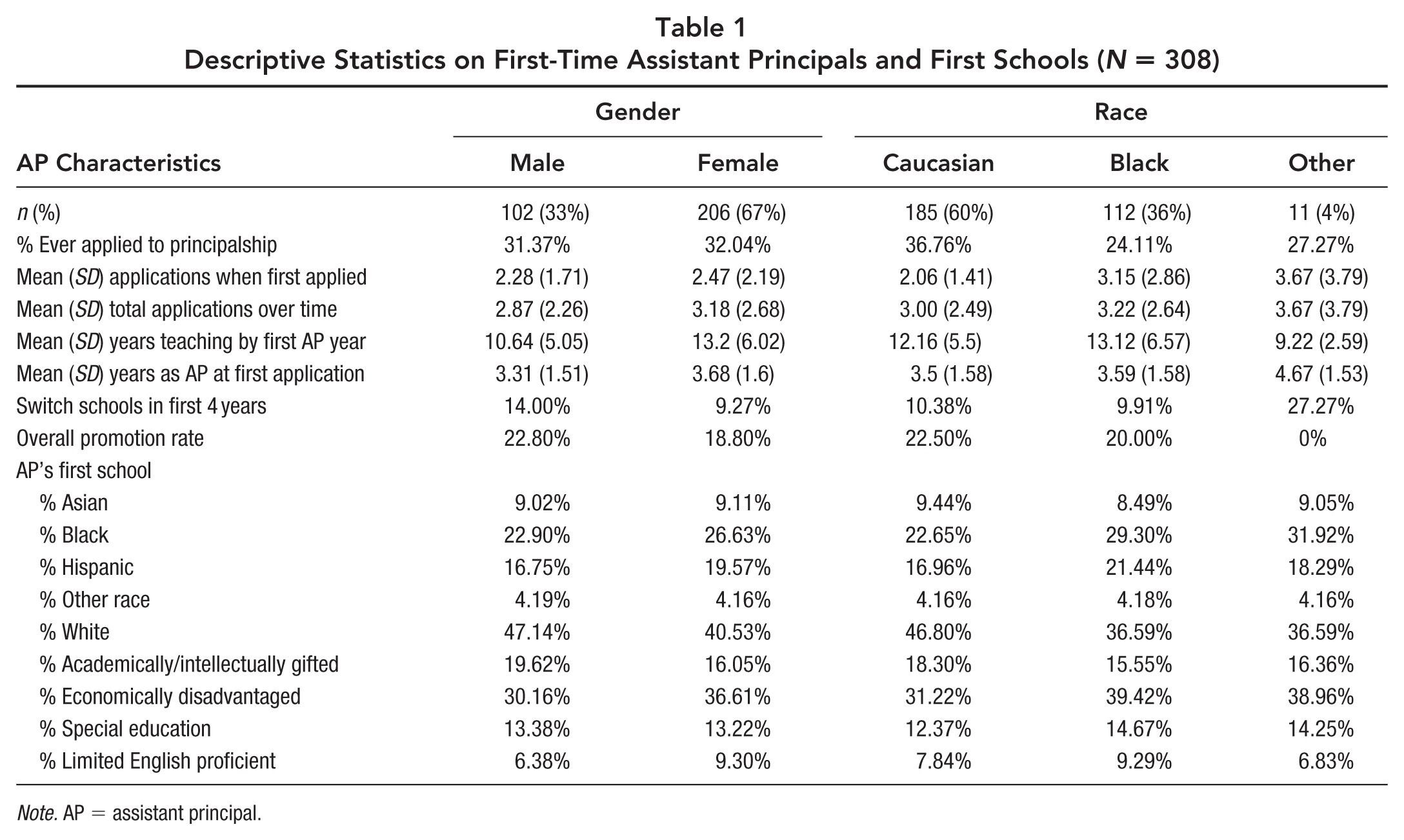
In this district, 67% of APs are female, and 33% are male; 60% identify as White, 36% as Black, and 4% as other races (Table 1). Importantly, this district has a more diverse teacher workforce than does the state as a whole, in which about 77% of the nearly 100,000 teachers are White and about 52% of the students are non-White (EdTrust, 2022). An average school context for an AP in our data set is composed of 36% to 46% White students, 22% to 32% Black students, 16% to 21% Hispanic students, and 8% to 9% Asian students. Table 1 also delineates the typical school context for APs of varying races and genders, and we show that White and male APs tend to work in school contexts with higher proportions of White and gifted students but smaller proportions of students who experience economic disadvantage or have limited English proficiency.
Descriptive Statistics on First-Time Assistant Principals and First Schools (N = 308)
Note. AP = assistant principal.
Methods
The following section elaborates on the two approaches we used to estimate the overall probability of an individual AP applying for a principalship (logistic regression) and then the timing of their first application (survival analysis). We explore how much, if at all, delays in applying for promotion are associated with gender or racial/ethnic differences when APs apply to the principalship holding other factors constant.
Analytic Approaches
We first use logistic regression to estimate the overall likelihood of an AP ever applying to a principalship and estimate both race and gender effects to determine whether all candidates are equally likely to apply. Using the standard notation for logistic regression in Singer and Willett (2003), we estimated the overall likelihood of the binary outcome that an individual would apply to the principalship.

Our outcome variable of interest is
Once we ascertained the overall likelihood of an AP applying at any time in the duration of the data set, we employed survival analysis to examine the timing of their first application and whether the timing varied by race or gender. Although prior research has employed discrete time-hazard models for analysis of educator career paths to leadership (e.g., Davis et al., 2017), we chose a Kaplan-Meier model because of its ability to estimate a survival analysis probability for each time period. Kaplan-Meier survival analysis estimates the probability of application using varying risk to subgroups across all time periods, which allows the event risk to change over every time period, as opposed to other survival analysis methods, such as Cox, that fix probability over all time periods (Allison, 2014).
Results
Descriptive Analysis
Most APs never apply to a principalship
Research Question 1 centers on the characteristics of APs who apply to principal vacancies. However, we find that the majority of APs in our data set did not, in fact, seek promotion by applying to a principalship (which comports with Bartanen et al., 2021). Despite all of the APs having earned both principal licensure and a master’s degree, we find that only a third of all APs apply for a principalship, and for Black APs, only 24% applied to a principalship. That is, 12% fewer Black APs than White APs apply for a principalship.
Women tend to have more total experience than men before first application
There is a significant difference in the total years of experience between the average male and female candidate who applies for promotion to principal. We find that female APs have an average of 13.2 years of teaching experience; in contrast, male APs have an average of 10.6 years of teaching experience before they apply for promotion. We also see from the descriptive statistics that most APs who apply for a principalship remain APs for just over 3 years. However, despite having more teaching experience on average, when candidates first apply for promotion, women have an average of 3.68 years of AP experience and male APs have 3.31 years of AP experience. Women have, on average, more total experience (16.1 years) than their male counterparts (13.7 years) by the time they first apply to a principalship. This is a statistically significant difference (Welch two-sample t test) of 2.4 years (p < .001; Figure 1).
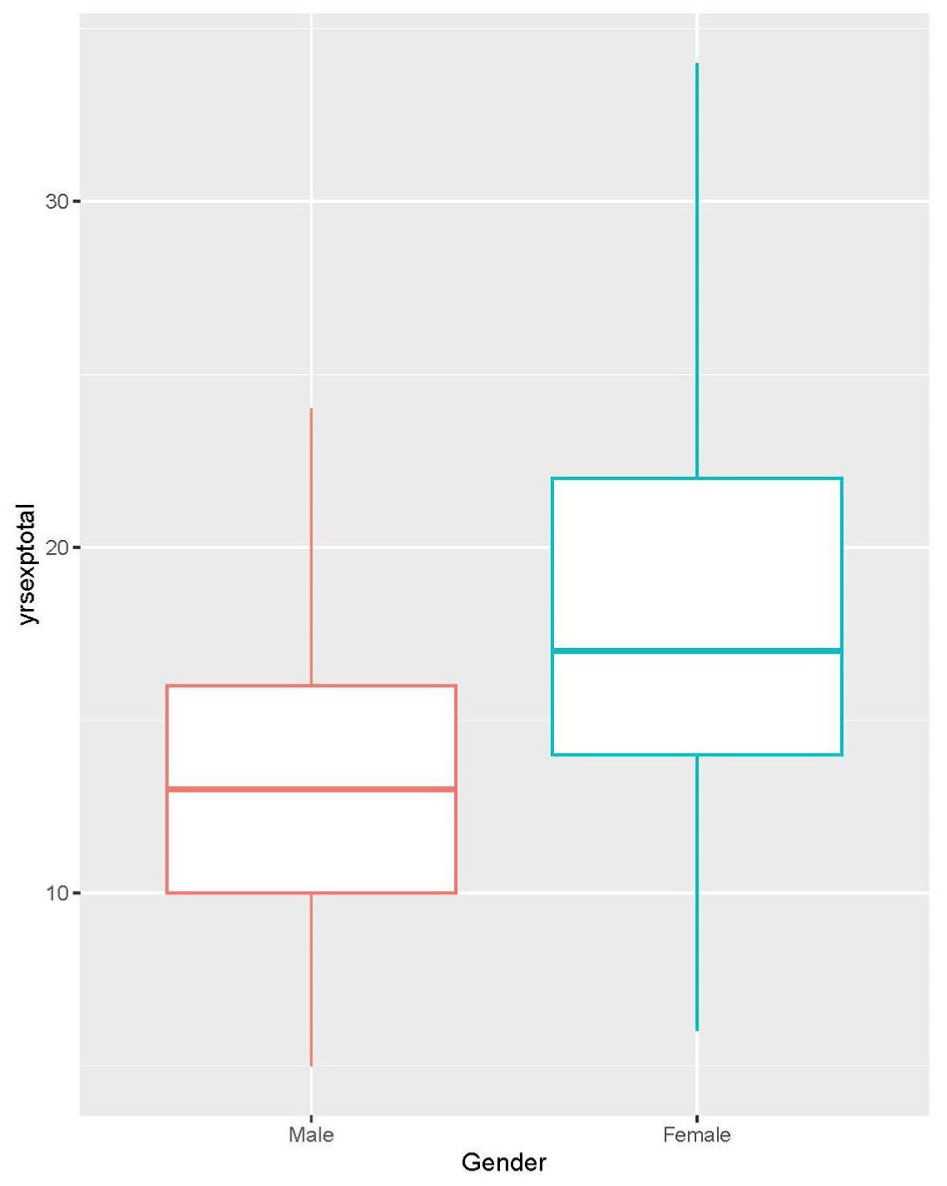
Average experience for male and female assistant principals.
Logistic Results
APs of color are less likely to ever apply to a principalship
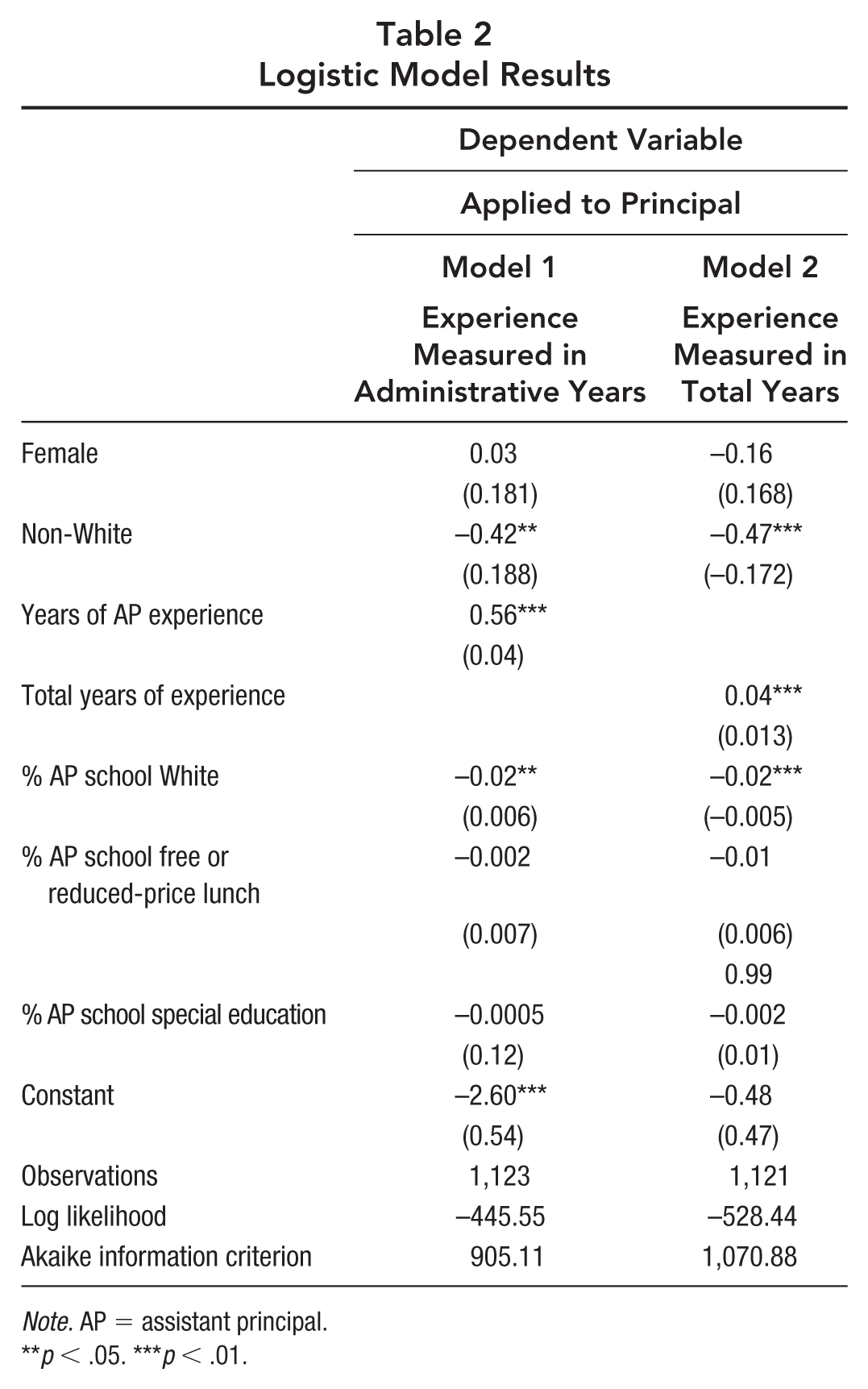
To address Research Question 2, which examines the overall likelihood that a female AP in the district ever applies for a principalship, we conducted a logistic regression analysis. The dependent variable in this model is a binary outcome of either applied or did not apply to a principalship. When controlling for the aforementioned variables, our results indicate that there is no statistical association between the gender of the AP and the likelihood that they applied for a principalship in the district over the course of our study (Table 2).
Logistic Model Results
Note. AP = assistant principal.
p < .05. ***p < .01.
However, we did find strong associations between the likelihood that an AP applies to a principalship and their race. We find that APs of color are 66% less likely than White APs to apply to a principalship. Although we cannot make causal inferences, we conclude that overall, APs of color are less likely than their equivalently qualified White counterparts to apply to a principalship when controlling for their current school context and previous experience.
Survival Analysis Results
Although logistic regression allows us to estimate the likelihood that an AP ever applies for a principalship, we employed survival analysis to address Research Question 3. Specifically, for those APs who do apply, we assessed whether there is a statistically significant difference in the timing of their first application for a principalship by gender, race, or the intersection of both gender and race. Using survival analysis, we estimated the probability that female APs and APs of color would apply for the principalship and compared that probability to that of their equivalently experienced and credentialed White or male counterparts. The full results are reported in Appendices A through C (available on the journal website) and list the likelihood in every time period after the first event (e.g., first application was submitted) for that subgroup took place, so the likelihood that a candidate applies is reported by year and by their subgroup for everyone who has not applied in a previous time period.
Men and White APs apply sooner than do women or APs of color
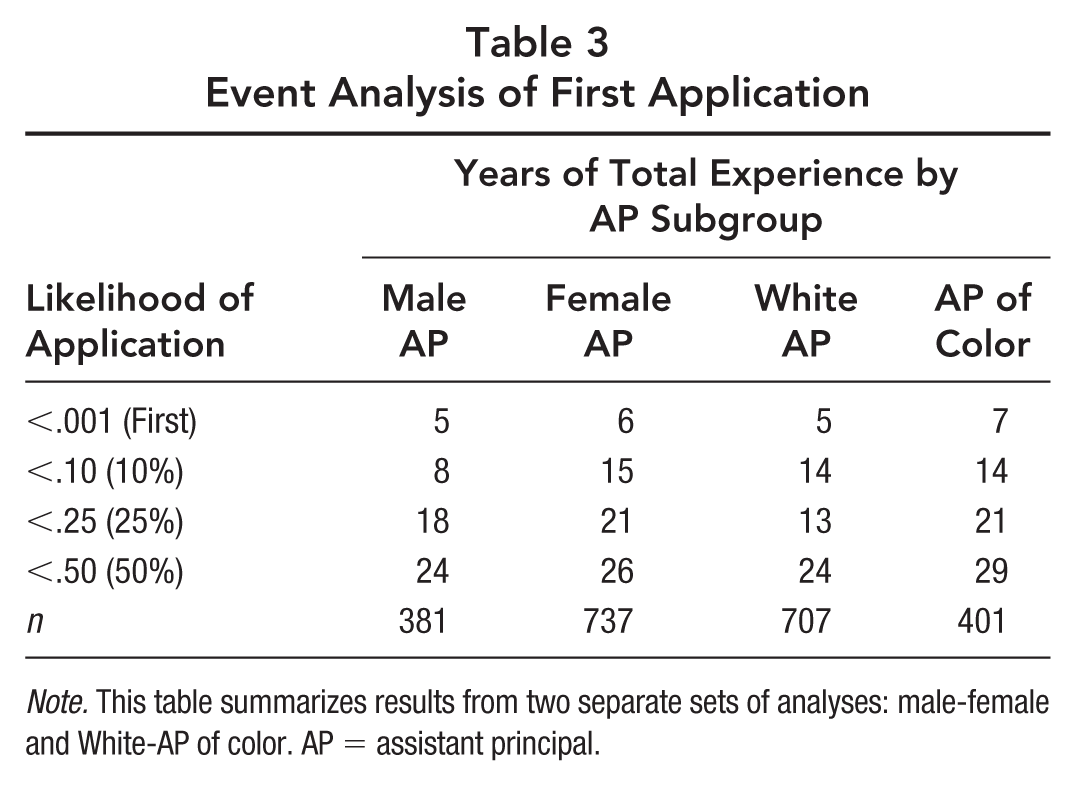
When we compare all male and female APs using survival analysis, we find that there are statistically significant differences between when men and women first apply. Table 3 illustrates the probability that an AP applies and number of years of total experience that an AP reaches before submitting their first application to the principalship. In Table 3, we present a comparison of the number of years each subgroup waits to submit the first application (likelihood < .001) and how many years until each subgroup reaches the threshold of 10% applying, 25% applying, and 50% applying for the first time.
Event Analysis of First Application
Note. This table summarizes results from two separate sets of analyses: male-female and White-AP of color. AP = assistant principal.
Comparing male and female APs, we find that the first male AP started applying for promotion to the principalship in their fifth year of total experience and that female APs start applying in their sixth year. Table 3 also shows that men are statistically significantly more likely to submit their first principal application in the early years of their career despite having less total experience and that women tend to submit their first applications later in their careers when they have more total experience and continue applying for a principalship for a decade longer than their male peers (for full results see Appendix A, available on the journal website). Therefore, although we did not find a gender difference using logistic regression in the overall likelihood of applying, we did find a significant delay in the timing of their first application and the duration of their persistence using survival analysis.
In a separate and subsequent survival analysis, we examined the timing of the first application for White APs and APs of color using survival analysis (Appendix B, available on the journal website). We find that there is a statistically significant difference between when APs of color apply to the principalship relative to their equivalently qualified and less experienced White colleagues. We find that the first White AP applies to the principalship in their fifth year of experience and that the first AP of color applies in their seventh year of experience (Appendix B, available on the journal website). This reiterates our logistic findings, where we found non-White APs were less likely to ever apply to the principalship. We were, however, unable to compare APs in individual racial subgroups (i.e., Asian, Hispanic) due to the small numbers of applicants of varying races, and so our findings are only a comparison between White APs and all APs of color combined.
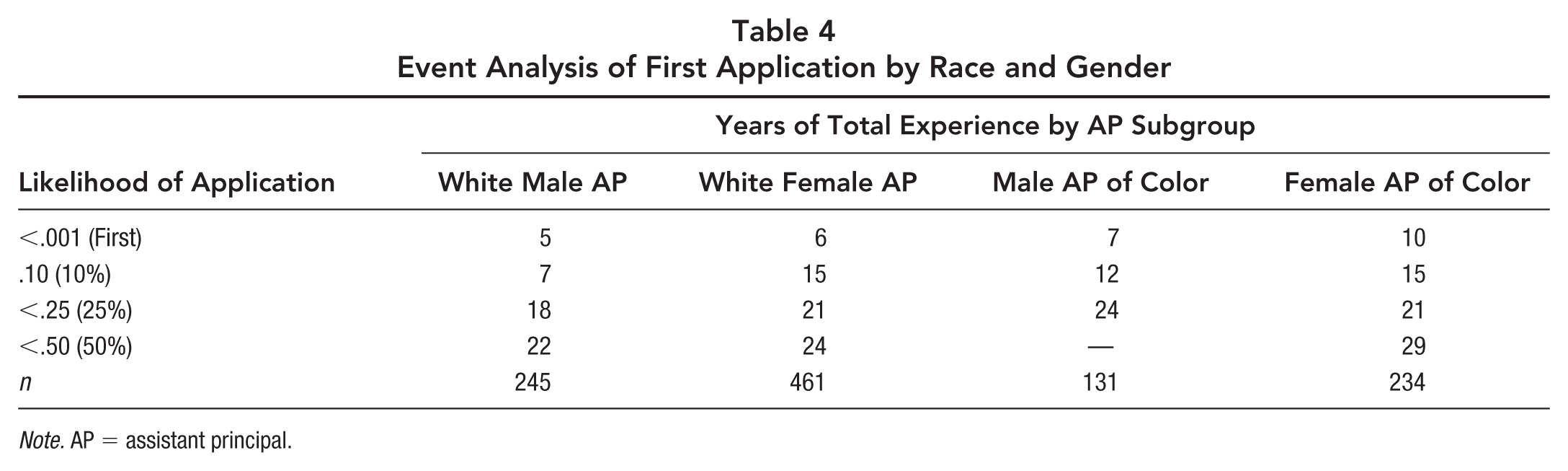
Finally, we tested the intersectionality of race and gender and the possible multiplicative effect on the probability an AP applies over time (Appendix C, available on the journal website). We find that there are statistically significant differences when comparing race and gender on how long APs wait to submit their first application to the principalship.
Table 4 presents the probability that an AP applies for a principalship, compared across race and gender. Survival analysis further reveals the initial delay in applications for APs of color and reveals the disparity of timing in the first submission. The first White male AP applies after 5 years of total experience with the district, and the first female of color AP does not apply until she has 10 years of experience. Additionally, we could not calculate the year in which male APs of color are submitting an application at a rate of 50% or higher because they never reach that threshold. We find that there are gendered and racialized differences between when APs are qualified to apply for the principalship and when they submit their first application. Qualified, experienced women and people of color wait; men and White candidates apply.
Event Analysis of First Application by Race and Gender
Note. AP = assistant principal.
Limitations
Our data are limited to a time and relatively small locale—2015 to 2022 in one southeastern state—which may, in turn, limit the generalizability of the study to other districts with different demographics or in very different locales. This district has a screening process through which every prospective principal candidate must progress as part of an application to the principalship. Based on the description of this process on the district’s website, there are at least two points at which candidates either depart the process or receive feedback in advance of the next step. Our data do not allow us to see any details about candidates’ progression through this process or other candidate characteristics (e.g., readiness, efficacy, performance evaluations, number of attempts); instead, we have access only to whether individuals ultimately submit an application to a principalship.
Additionally, our analysis was limited in a few ways. Because we cannot observe years of teaching experience prior to AP experience for individuals who advance from teacher to AP in another district, we could not classify them with certainty as first-time APs, which prompted their exclusion from the data. We were also unable to discern who declined promotion across all years of applications and chose not to leave their AP roles. Finally, we are limited by potentially missing additional variables in the form of social networks and familial care responsibilities that are likely exerting an unobservable influence on the outcomes we measure in this article. It is likely that there are social factors, such as dependent care, that may be more incumbent on one group of APs than others and may explain why women in particular wait longer to apply.
Discussion and Implications
Preparing and Retaining APs
Our first—and perhaps most striking—result from Research Question 1 is that a preponderance of APs do not apply to a principalship at all: Only about a third of all APs with requisite qualifications in the focal district applied for a principalship, and that number is further reduced to about 25% among APs of color. This suggests that there are likely APs who want to stay in that role and that districts should find a way of identifying, supporting, and retaining those leaders. APs perform a number of critical functions in schools, and a long-term AP can contribute to overall organizational stability (Bailes & Guthery, 2020). This also has implications for our broader conceptualization of an AP as a unique career stage and leadership role rather than merely an apprenticeship or assistantship for a future principal role. Leadership roles and tasks associated with assistant principalships vary widely and often shift depending on school needs and principals’ direction, but preservice and in-service training for APs is inconsistent at best (Johnston et al., 2016; Shakir et al., 2023) and often geared more toward the principalship than the AP. It stands to reason that some APs may be satisfied with that role, but others may perceive a disconnect between their day-to-day work—which may include instruction, discipline, logistics, and student affairs—and the work of the principalship, in turn prompting them not to apply (Moyer & Goldring, 2023).
Our analyses do not, however, allow us to discern exactly why APs of color are less likely to apply for principalships than are their White counterparts. However, extant research offers some rationale for why this might be the case: Principals of color tend to be assigned to schools with challenging working conditions, tend to be isolated, are more likely to be demoted, and may be held to higher or different standards than are White principals (Bailes & Guthery, 2025). What remains in question is the district’s process for sorting and evaluating candidates who enter the pool of principal applicants.
Implications for Research
However, there are also likely to be APs who may aspire to career advancement but do not apply in spite of the fact that they possess equivalent credentials and experience relative to the APs who do apply and who are ultimately promoted to principalships. Such perceptions are formed in a particular landscape of hiring and promotion. Part of ongoing inquiry must attend to the district’s processes for sorting and prioritizing applicants and communicating about which APs are likely to become principals or how aspiring leaders assess and communicate their own readiness for promotion. In these cases, districts may benefit from reconfiguring the ways in which they assess and communicate regarding APs’ readiness for the principalship, especially if those configurations reduce the formation of stereotypes and subsequent societal discrimination. Moreover, we are curious about the influence of school level on applications and hiring decisions. That is, a subsequent study would benefit from the inclusion of school level as a contextual variable given the different rates at which women, in particular, become principals in elementary and middle schools versus the rates at which men become principals in high schools (Bailes & Guthery, 2020). We recommend that researchers take up these questions in order to understand how candidates’ perceptions of their own candidacy shape their career trajectory. In particular, qualitative inquiry across multiple districts may yield—in conjunction with ongoing quantitative analyses of human resource records—more information about individuals’ choices to apply to principalships (or not) and how they perceive their own readiness, the districts’ likely responses to their applications, and the ways in which candidates synthesize information from their school and district supervisors in order to make career decisions.
Experienced Candidates Delay Applying
Our other findings in response to Research Question 1 are consistent with prior studies that document delays in career promotion between men and women and between White and non-White APs with equivalent qualifications or credentials. We find that the candidates in the applicant pool are not equally experienced. Although they tend to be equivalently credentialed (e.g., a master’s degree, principal licensure, and requisite number of years of experience), women APs in the pool tend to have more experience than men in the pool in terms of both years of teaching and years of administrative (AP) experience. Even so, women wait longer to apply to the principalship, and women of color wait the longest of any group to apply.
Implications for Policy
Conventionally, women and people of color might wait for a “tap” (Myung et al., 2011) from a trusted colleague or supervisor who confirms their readiness for a new role and prompts them to apply. However, in absence of a tap, we infer that putting oneself forward may be risky because it involves exposure to and conflict with the prescriptive and descriptive stereotypes held by those with decision-making power. In order to reduce ambiguity regarding who is ready or eligible for promotion to a principalship, districts might implement several policies to prompt a broader and more diverse pool of applicants to the principalship. First, districts might implement systematic, nonbinding nudges at specific career points that prompt any eligible AP to consider an application in the next cycle. Those time points might include any or all of the requirements for a principalship: completing a master’s degree, a principal licensure, 5 years as an AP, or all of the above. Districts might also use existing school administrator evaluation systems to identify APs who are currently effective leaders. Automated invitations might be dispatched for APs who are effective or exceptional in their leadership regardless of whether a supervisor or district leader has noticed, nudged, or tapped them. This automation might systematize taps and reduce the ways that individual bias and homophily shape the pool of potential principals.
Men and White APs Apply Soonest
Finally, we find in response to Research Question 3 that female APs wait longer than their male counterparts to apply for principal positions when observed over time rather than the overall likelihood. Women APs tend to apply to principalships less often than men even when equivalently qualified. Women of color APs are delayed from promotion the longest relative to their White or male peers. Studies of race and gender discrimination examine nearly every aspect of the human resource process that moves an individual from candidacy to principalship: applications, evaluations (Gegenheimer & Goldring, 2024), promotions (Fuller et al., 2018), and demotions (Bailes & Guthery, 2025). Descriptive studies of principal pathways have identified similar findings over time: Women and people of color experience denied or delayed promotions even when they are equivalently or better qualified than their male or White peers (Bailes & Guthery, 2020). These findings have been identified in Texas, Missouri, North Carolina, Pennsylvania, and Tennessee across school level, socioeconomic contexts, and urbanicity (Grissom et al., 2019). Our study has implications for practitioners who are charged with evaluating and hiring principals, namely, in how they source and evaluate talent.
These findings suggest two things may be happening: APs who are women and people of color may be responding to meaningful information that is informally communicated to them about the likelihood of their promotion prospects in that school system and that district. Second, the district’s response in hiring and placing predominantly White male principals may serve as a self-fulfilling prophecy relative to candidates’ expectations of who will be promoted in that district. Descriptive and prescriptive stereotypes may be embedded in this process so that diverse candidates delay or withhold their own applications despite appropriate qualifications and districts respond to a more homogeneous pool by hiring more homogeneous principals. However, it is hard to distinguish which candidates are holding back and which may be held back by the district’s current communication and hiring processes. It is important, however, to resist blaming minoritized candidates whose reticence may reflect the culture and climate within which they make a decision to apply to a principalship. It may be that these observed patterns of applications suggest a response to nonobservable information from the district about whose qualifications or candidacy are valued on route to the principalship.
Implications for Practice
Thus, a final recommendation for practice may be to connect with current APs when there are principal vacancies in their buildings. Internal principal hires are more likely to be from minoritized groups and to work in schools with larger proportions of students of color and are less likely to turn over than are external hires (Pendola & Fuller, 2021). Districts could utilize AP academies and similar professional learning pathways that offer promise as a tool to effectively recruit and retain diverse individuals for principalships (Booker-Dwyer et al., 2023; Gurley et al., 2015). Not only might this be a tactic for diversifying the principal corps but perhaps also a way to enhance retention efforts that are a national concern (Miller, 2013).
Conclusion
This area of educational leadership research has recently grown very rapidly, but most studies in this vein are descriptive and ex post facto. They assess outcomes that have already taken place: The candidates have already acceded to the principalship or not. This study extends on a descriptive body of literature that finds that women and candidates of color are likely to wait longer to apply to the principalship than their equivalently qualified White male peers. We find that that pattern extends to applications and not just to promotions.
Our findings raise questions about some prevailing thinking regarding the career pathways of school leaders. The first is that APs want to be principals. We find that in fact, a very small proportion of APs pursue the principalship, as evidenced by applications for that role. The second is that APs are equivalently experienced and qualified. We find that although APs might hold similar credentials (often those required for a principal licensure), there is tremendous variation in both instructional (teacher) and leadership experience among applicants. The third is that given the composition of the teaching workforce, gender and racial diversity must already exist within the pool of assistant principals, and the challenge lies in identifying strategies to hire diverse APs into principal positions. We also find this to be untrue: Although sitting APs are more diverse than sitting principals, we find that the sorting starts in the application behavior of current APs—many female and non-White APs are not even in the pool to be hired for a principalship. And so the question remains: Are APs of color and women held back by structural inequities, or do they find themselves holding back from applying despite their potential to lead as principals? Whether they are held back, holding back, or both, we continue to experience the consequences of delays to diversifying school leadership.
Supplemental Material
sj-pdf-1-edr-10.3102_0013189X251401543 – Supplemental material for Ready but Waiting: The Role of Gender, Race, and Experience in Principal Applications
Supplemental material, sj-pdf-1-edr-10.3102_0013189X251401543 for Ready but Waiting: The Role of Gender, Race, and Experience in Principal Applications by Sarah Guthery, Lauren P. Bailes and Elc Estrera in Educational Researcher
Footnotes

Financial support was provided by the University of Oklahoma Libraries’ Open Access Fund.
Notes
Authors
SARAH GUTHERY, PhD, is an associate professor at the University of Oklahoma, 820 Van Vleet Oval, 227A, Norman, OK 73019;
LAUREN P. BAILES, PhD, is an associate professor at the University of Delaware, 113 Willard Hall Education Building, Newark, DE 19716;
ELC ESTRERA, PhD, is the director of data strategy and analytics at the Wake County Public School System, 5625 Dillard Drive, Cary, NC 27518;