




Abstract
Racial inequalities in education may be exacerbated by teachers’ lack of confidence about working with students from racial and ethnic backgrounds different to their own. Although intergroup contact experiences typically enhance people’s self-efficacy about navigating cross-group interactions, very little work has explored such trends among teachers. Across two cross-sectional studies and one preregistered repeated measures experiment (N = 1,608), we reveal that (a) White teachers’ interracial contact experiences predicted a stronger sense of self-efficacy about cross-race engagement; (b) White teachers generally showed a preference for working in a majority-White school compared to a majority-Black school, but this bias was attenuated by teachers’ interracial contact experiences; and (c) the link between cross-race friendships and desire to work in the majority-Black school was mediated by a greater sense of self-efficacy.
Keywords
Few people would question that educators work—often under challenging conditions—to facilitate learning, improve students’ life prospects, and promote social equity (Richardson & Watt, 2006). Yet racial inequalities in educational systems and outcomes are pervasive, with some groups of students consistently outperforming others even after controlling for a range of other student characteristics, such as socioeconomic status and behavior (Strand, 2011). Indeed, compared to the average White student in the United States, the average Black student in the United States receives markedly lower grades across all subjects and levels of K–12 schooling (Nation’s Report Card, 2023) and is around 3 times more likely to be suspended or held back a year (Shores et al., 2020), contributing to unequal outcomes in education and beyond.
Evidence suggests that features of the U.S. education system can disadvantage students from minoritized racial and ethnic groups. Geographical segregation coupled with an aversion among many teachers to the prospect of working in diverse settings (Boyd et al., 2013; Doyle & Easterbrook, 2024) may make racial and ethnic minority students disproportionately likely to be taught by lower quality teachers (e.g., those who performed worse on certification exams and have fewer years of experience; Goldhaber et al., 2015; Knight, 2020); this may, in turn, have significant impacts on students’ educational and later life outcomes (Hanushek, 2011). Moreover, the fact that teachers tend to have similar levels of implicit bias to the general population (Starck et al., 2020) may consequently influence their assessment practices (Anderson-Clark et al., 2008; Doyle et al., 2023), disciplinary actions (Okonofua & Eberhardt, 2015), interactions with students (Goudeau et al., 2023), and school preferences (Doyle & Easterbrook, 2024). Together, these trends suggest that despite their best intentions, teachers, like most of us, may unintentionally be biased in ways that reinforce racial inequality in education (Starck et al., 2020). We propose that this may be in part because White teachers 1 —like most White Americans—tend to have limited experience engaging across racial lines (Public Religion Research Institute, 2016), which can contribute to a lower sense of self-efficacy for teaching students from diverse racial and ethnic backgrounds (Doyle et al., 2024; Geerlings et al., 2018; see also Turner & Cameron, 2016). In this article, we present two cross-sectional studies and one preregistered experiment that examine how teachers’ interracial experiences shape their confidence about working with students from racial and ethnic minority backgrounds and their propensities to do so.
Intergroup Contact: A Framework for Understanding Teacher-Student Relationships
Decades of research on intergroup contact (see Allport, 1954; Pettigrew, 1998) offer strong evidence that greater contact experiences between members of different groups can reduce intergroup biases, ease intergroup anxieties, and enhance confidence about navigating cross-group interactions (Brown & Hewstone, 2005; Pettigrew & Tropp, 2006; Turner & Cameron, 2016). Such salutary intergroup outcomes are especially likely to emerge when the contact involves close relationships across group lines, such as cross-group friendships (Davies et al., 2011; Tropp & Pettigrew, 2005).
Although considerable research has examined contact effects in school settings (e.g., Pettigrew & Tropp, 2006; Schofield, 1995), most of this work has focused on interracial relations among students (Rucinski, 2022; Tropp et al., 2022), with little research focusing on the implications of interracial contact for how teachers feel about engaging with students from racial and ethnic backgrounds other than their own. Some notable research exceptions from Europe suggest that teachers’ intergroup experiences may be linked to more positive feelings about students from different religious and refugee backgrounds (Prentice, 2023; Rissanen et al., 2015).
Relatedly, scholars have begun to highlight confidence in contact as a crucial pathway to achieving desired intergroup outcomes among students (Bagci et al., 2020; Turner & Cameron, 2016) yet without comparable attention among teachers. In our research, we focus specifically on teachers’ interracial contact experiences and how these may shape their confidence about engaging with students from diverse racial and ethnic backgrounds given that teachers’ confidence in their ability to form positive relationships with students is a strong predictor of their teaching self-efficacy (Hajovsky et al., 2020). Lending some initial support, experimental research in the UK—where socioeconomic biases are prevalent in education (Doyle & Easterbrook, 2024)—revealed that teachers reported less desire to work at a school in a socioeconomically deprived community, compared to a more socioeconomically average school, even when other school characteristics commonly associated with neighborhood context (e.g., salary, attainment, and school climate; Ruiz et al., 2018) were held constant. However, this bias against teaching in the socioeconomically deprived school was diminished among teachers who reported greater prior contact with people experiencing financial hardship (Doyle et al., 2024). Moreover, these effects were mediated by teachers’ stronger feelings of self-efficacy about being able to meet challenges associated with working in a diverse and low-income community.
The present research seeks to replicate and extend these initial findings by testing how teachers’ interracial contact experiences may contribute to greater feelings of self-efficacy and greater desire to work in more racially and ethnically diverse schools in the racialized context of the United States. Across three studies, we focus on the responses of White teachers, who comprise approximately 80% of the teacher workforce in U.S. public schools (National Center for Education Statistics, 2023). First, we present two survey studies with large samples of White teachers from across the United States (Study 1) and from a major urban school district in the northeastern United States (Study 2); across both studies, we examine teachers’ interracial contact experiences as predictors of their reported self-efficacy about engaging with students from diverse racial and ethnic backgrounds while controlling for a broad range of school, classroom, and teacher characteristics that could serve as potential confounds. Then, in a preregistered, repeated measures experiment (Study 3), we manipulate the racial diversity of schools to assess their desirability to teachers, and we investigate how teacher preferences vary as a function of interracial contact experience. Finally, we test whether associations between teachers’ interracial contact experiences and school preferences are mediated by their reported self-efficacy.
Study 1
Method
Participants and procedure
Data came from self-identified White K–12 teachers as part of a nationwide survey conducted in 2016 by Teaching Tolerance (now learningforjustice.org) and Perception Institute (perception.org). Teachers who accessed Teaching Tolerance materials during the 2015–2016 academic year were eligible to participate, and a random set of these individuals was invited via email to complete an online survey. Of the 1,187 K–12 teachers who completed the survey, 912 (79.5%) self-identified as White. Self-reported characteristics of these White teachers and the schools and classrooms in which they were teaching are provided in the left column of Table 1.
Characteristics for Samples of White K–12 Teachers From Studies 1 Through 3
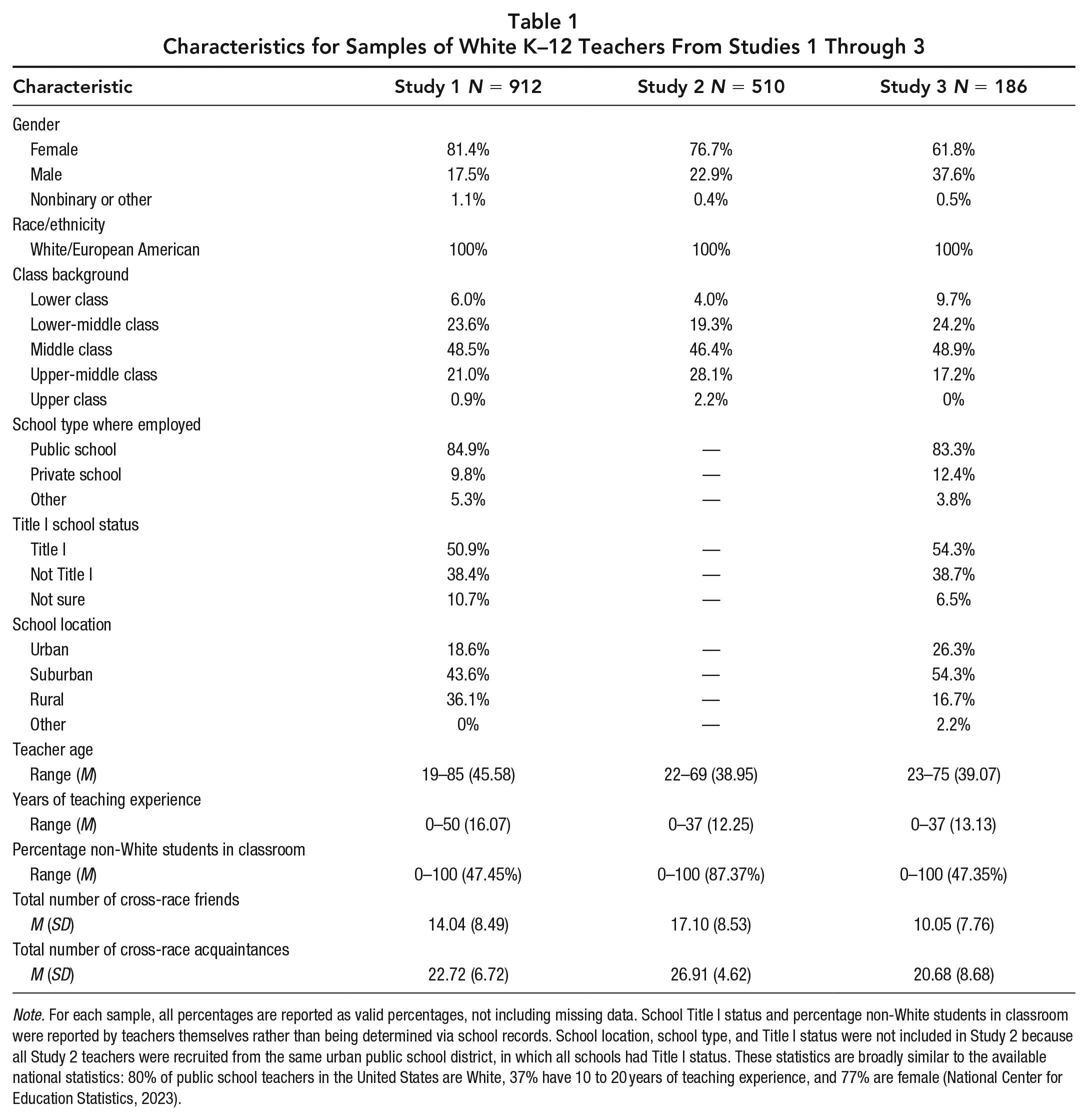
Note. For each sample, all percentages are reported as valid percentages, not including missing data. School Title I status and percentage non-White students in classroom were reported by teachers themselves rather than being determined via school records. School location, school type, and Title I status were not included in Study 2 because all Study 2 teachers were recruited from the same urban public school district, in which all schools had Title I status. These statistics are broadly similar to the available national statistics: 80% of public school teachers in the United States are White, 37% have 10 to 20 years of teaching experience, and 77% are female (National Center for Education Statistics, 2023).
Measures of key variables
Teachers’ interracial contact was assessed using two sets of three items adapted from prior research (Tropp & Pettigrew, 2005). These sets of questions asked teachers to report how many Black, Latino, and Asian people they know, at least as acquaintances (Set 1), and would consider to be friends (Set 2). Scores on each item ranged from 0 to 10 or more; responses to each set of three items were summed to create overall scores for teachers’ cross-race acquaintances and friends that varied between 0 and 30 (acquaintances: M = 22.71; friends: M = 14.04). 2
Teachers’ self-efficacy about engaging with students from diverse racial and ethnic backgrounds was assessed using four items, including “I am confident that I have the ability to develop positive relationships with students from racial and ethnic backgrounds different from my own.” Responses to the four items ranged from 1 (strongly disagree) to 7 (strongly agree), and they were averaged to create a composite score (α = .88).
Measures of control variables
Indicators of school, classroom, and teacher characteristics were included as statistical controls in data analysis. Full details of these demographic characteristics and their descriptive statistics are provided in Table 1.
Other statistical controls included teachers’ explicit and implicit racial prejudice. Explicit racial prejudice was assessed using three items through which teachers indicated their feelings toward Black, Latino, and Asian people on scales ranging from 1 (very cold) to 7 (very warm); responses to these three items were recoded so that higher scores would correspond with greater prejudice and averaged to create a composite score (α = .92). Implicit racial prejudice was assessed using a race-based implicit association test (IAT; Greenwald et al., 2015), with “Black” and “White” as the category labels and “Good” and “Bad” as the valence labels. These indicators were included to account for the well-established association between contact and racial attitudes (Pettigrew & Tropp, 2006) when examining links between contact and teachers’ self-efficacy.
Two control measures were included to account for the possibility that teachers’ concerns about being seen in a positive light might have biased their reports of self-efficacy. The first measured motives to control racial prejudice, and it consisted of two items assessing teachers’ desires to act in nonprejudiced ways to avoid social disapproval (Plant & Devine, 1998; Spearman-Brown coefficient = .81). The second measured social desirability, and it consisted of three items tapping teachers’ self-presentational concerns (Crowne & Marlowe, 1960; α = .70).
Teachers’ prior participation in diversity training (single item) and perceptions of school support (α = .89) were also added as controls because they might shape reports of self-efficacy. Precise wordings and descriptions of control measures are provided in the online supplementary materials.
Results and Discussion
Initial correlations showed that teachers with more cross-race acquaintances reported having greater numbers of cross-race friends, r = .60, p < .001. Teachers with greater numbers of cross-race friends and acquaintances also reported less explicit racial prejudice, rs = –.19 and –.16, p < .001, greater proportions of non-White students in their classrooms, rs = .19 and .23, p < .001, and greater self-efficacy about relating to students from diverse racial and ethnic backgrounds, rs = .28 and .16, p < .001.
An ordinary least squares (OLS) linear regression was conducted to examine the interracial contact measures as predictors of teacher self-efficacy in relating to diverse populations of students in their classrooms. Additional variables entered simultaneously into the regression model as statistical controls included school and classroom factors (school setting, school type, school Title I status, 3 estimated percentage of non-White students in classroom), teacher characteristics (i.e., age, gender, social class background, years of teaching experience, prior diversity training), and teacher beliefs and attitudes (i.e., perceived school support, explicit racial prejudice, motives to control prejudice, social desirability).
Results of the regression model are summarized on the left side of Table 2. Of central importance, greater numbers of cross-race friends—but not cross-race acquaintances—uniquely and significantly predict teachers’ greater self-efficacy about engaging with students from diverse racial and ethnic backgrounds, with an effect size of Cohen’s f 2 = 0.047. It is also noteworthy that the positive link between teachers’ interracial friendships and self-efficacy was present while accounting for explicit racial prejudice, motives to control prejudice, and many other statistical controls. Furthermore, we conducted a comparable regression in which teachers’ implicit racial prejudice (IAT score) was also statistically controlled; this analysis yielded virtually identical results (see left side of Table S1 in supplementary materials available on the journal website).
Predicting White K–12 Teachers’ Efficacy About Relating to Students From Diverse Racial and Ethnic Backgrounds (Studies 1 and 2)
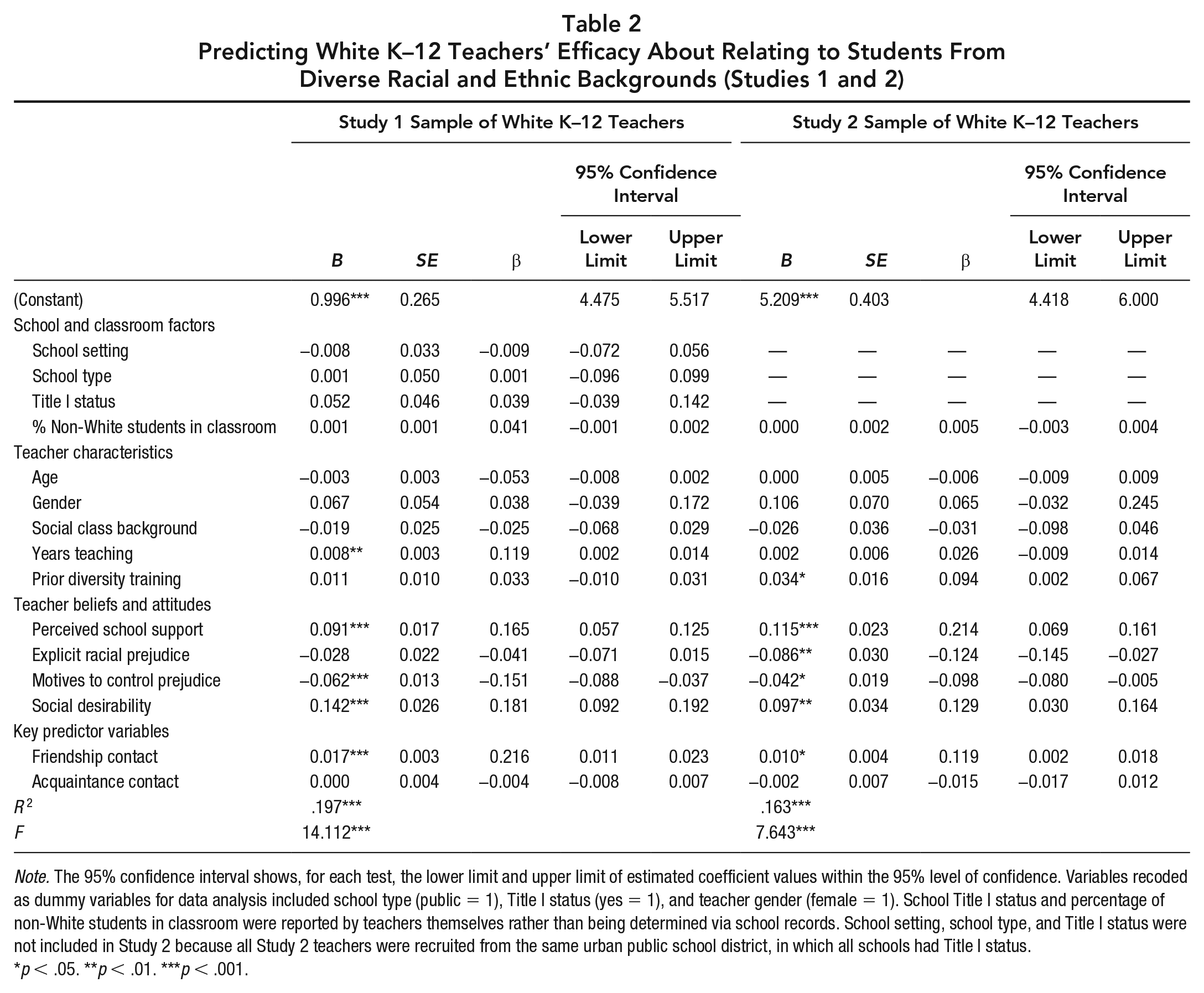
Note. The 95% confidence interval shows, for each test, the lower limit and upper limit of estimated coefficient values within the 95% level of confidence. Variables recoded as dummy variables for data analysis included school type (public = 1), Title I status (yes = 1), and teacher gender (female = 1). School Title I status and percentage of non-White students in classroom were reported by teachers themselves rather than being determined via school records. School setting, school type, and Title I status were not included in Study 2 because all Study 2 teachers were recruited from the same urban public school district, in which all schools had Title I status.
p < .05. **p < .01. ***p < .001.
These findings are consistent with our expectation that teachers’ interracial contact experiences contribute to their feelings of self-efficacy about engaging with students of different racial and ethnic backgrounds in their classrooms. It is worth noting that cross-race friendships (but not cross-race acquaintances) uniquely and significantly predicted teachers’ self-efficacy, suggesting that contact quality (rather than quantity) may be driving this association. A particular strength of Study 1 is that it drew survey responses from a large sample of White K–12 teachers who together represent teachers from a broad range of educational contexts across the United States. However, the sample was drawn from a population of teachers who had accessed materials related to diversity in education (via Teaching Tolerance) and who subsequently elected to participate in the online survey. We therefore conducted a second survey study with teachers from a single public school district in the hope of replicating our findings while keeping contextual factors associated with geographic region and school district constant.
Study 2
Method
Participants and procedure
Teachers were recruited from a large, urban public school district in the northeastern United States. According to district records (from 2018–2019, when the study was conducted), more than 80% of students enrolled were non-White, and more than 70% were economically disadvantaged, such that all schools in the district had Title I status. Principals from 100 of the district’s 125 schools granted permission for us to contact teachers in their schools; all K–12 teachers in these schools were invited via email to participate in an online survey. Of the 1,013 K–12 teachers who completed the survey (23% of those in the district), 510 (50.3%) self-identified as White; self-reported characteristics of these White teachers and of the schools and classrooms in which they teach are provided in the middle column of Table 1.
Measures
Teachers’ interracial contact experiences were assessed in a manner identical to Study 1, with teachers’ reported numbers of cross-race acquaintances and cross-race friends varying between 0 and 30 (acquaintances: M = 26.91; friends: M = 17.10). Items used to assess teachers’ self-efficacy about engaging with students from diverse racial and ethnic backgrounds were also identical to those in Study 1 (α = .90; efficacy: M = 6.33), as were the indicators used to assess school, classroom, and teacher factors entered as statistical controls in Study 1.
Results and Discussion
As in Study 1, teachers with more cross-race acquaintances reported having greater numbers of cross-race friends, r = .50, p < .001. However, unlike Study 1, only number of cross-race friends (but not cross-race acquaintances) corresponded with lower explicit racial prejudice, r = –.09, p = .05 (acquaintances: r = –.05, p = .27), and significantly greater self-efficacy about engaging with students from diverse racial and ethnic backgrounds, r = .16, p < .001 (acquaintances: r = .08, p = .09). Neither number of cross-race friendships nor number of cross-race acquaintances correlated significantly with reported proportions of non-White students in teachers’ classrooms, r = –.03, p = .48 and r = –.06, p = .17, respectively.
Next, an OLS linear regression examined the interracial contact measures as predictors of teachers’ self-efficacy about engaging with diverse classrooms of students while controlling for the same school, classroom, and teacher factors entered as statistical controls in Study 1. Results of the regression model are summarized on the right side of Table 2. Once again, we observe that greater numbers of cross-race friends uniquely and significantly predict teachers’ greater self-efficacy in relating to diverse learners in their classrooms (effect size: Cohen’s f 2 = 0.014). Moreover, as in Study 1, a comparable regression analysis that included teachers’ implicit racial prejudice (IAT score) as an additional control variable yielded virtually identical results (see right side of Table S1 in supplementary materials available on the journal website).
Study 2 replicates the main findings of Study 1 but with a sample of teachers from a single urban school district. Inspection of means from the two studies suggests that teachers in Study 2 (from a large urban school district) tended to report greater numbers of cross-race friends and greater proportions of non-White students in their classrooms compared to teachers in the national sample from Study 1. This replication gives us some confidence that our findings can generalize to different samples of White teachers across the United States. The consistency of the findings while controlling for numerous variables associated with teachers, classrooms, and school contexts that could have conceivably accounted for the observed associations is clearly a strength of these two studies.
Nonetheless, these studies rely only on correlational survey data and teachers’ self-reports; as such, the first two studies cannot speak to potential causal effects regarding how teachers feel about working in racially diverse schools or to whether teachers’ interracial contact experiences can help to attenuate biases that may contribute to disparate educational outcomes for students from different racial backgrounds. We therefore designed an experimental third study that aimed to test (a) the implications of interracial contact on teachers’ desire to work in schools whose student populations had been manipulated to vary in racial proportions and (b) whether links between teachers’ interracial contact experiences and school preferences might be driven by feelings of self-efficacy.
Study 3
Study 3 was designed to replicate and extend findings from Studies 1 and 2 using experimental procedures. Our preregistered hypotheses (see: t.ly/UOD-D) stated that White teachers in the United States would show a stronger preference to work in a school with a small (vs. large) proportion of racial minority students but that this preference should be attenuated among teachers reporting greater interracial contact, in part because their greater levels of contact experience would correspond with greater reports of self-efficacy.
Methods
Participants and procedure
Using a research design similar to prior studies (Doyle et al., 2024), we aimed to recruit 200 participants after exclusions. Initially, 224 K–12 teachers from the United States were recruited via Prolific in 2023 to take part in a short online study about school preferences. In accordance with preregistered exclusion criteria, 15 teachers who did not identify solely as White American were excluded from the main analyses, as were 23 teachers who spent less than 30 seconds reading and responding to questions about the two target schools. This resulted in a final sample of 186 teachers (see Table 1 for full sample breakdown). A post hoc power analysis revealed .99 power for the main effects. Analysis of the full sample with no exclusions yielded similar results to those reported in the following and can be found in Tables S2 and S3 of the supplementary materials available on the journal website.
After providing consent, teachers were presented with advertisements for teaching positions in three different schools as part of a repeated measures research design. These schools were described as offering the same salary and being a short distance from participants’ homes. Each advertisement followed a standard format including a short job description and information about student achievement and demographics (for full advertisements, see supplementary materials available on the journal website). The target schools—a “majority-White” school and a “majority-Black” school—were identical in student achievement and demographics with the exception of the racial proportions of the student populations (e.g., 81% White vs. 81% Black, respectively) and varied only slightly in (matched) wording on the job descriptions. To distract participants from similarities between target schools, we included a third (nontarget) school that varied from the two target schools in all respects. The target schools were presented first and last, using counterbalancing to mitigate potential order effects, with the nontarget distractor school presented in between. After completing school desirability and self-efficacy measures in relation to each school and reporting on their interracial contact experience and demographic characteristics (see Measures in the following), participants were thanked and debriefed.
Measures
School desirability was assessed by asking teachers three questions: how happy they would be to teach in the school, how much they would like to teach in the school, and how likely they would be to apply for a job in the school (1 = not at all, 7 = very). The three items were averaged to create a composite desirability score for each school (α = .94).
Self-efficacy was assessed using four items asking teachers how much they felt they had the skills, knowledge, and confidence to overcome challenges working in each school and how much they felt they could make a difference at the school (1 = not at all, 7 = very much). The four items were averaged to create a composite self-efficacy score for each school (α = .87).
Teachers’ interracial contact was measured using the same items as Studies 1 and 2, with which we determined numbers of Black friends and acquaintances (Ms = 3.63 and 7.50, respectively) and all cross-race friends and acquaintances (Ms = 10.05 and 20.68, respectively) reported by each teacher. Given that the experimental manipulation was based on proportions of White and Black students, we focus on teachers’ reported numbers of Black friends and acquaintances. Analyses using teachers’ reported numbers of cross-race friends and acquaintances as predictors for self-efficacy are provided in the supplementary materials available on the journal website.
Teachers also completed measures of the same school, classroom, and teacher characteristics as in Studies 1 and 2 (see Table 1) and the same measures of social desirability and motives to control racial prejudice.
Results and Discussion
In line with previous research (e.g., Boyd et al., 2013), a one-way analysis of variance (ANOVA) using the afex package in R (Singmann et al., 2015) revealed that teachers showed a preference for working in the majority-White school (M = 4.91, SD = 1.27) compared to the majority-Black school (M = 4.31, SD = 1.55), F(1, 185) = 31.82, p < .001, Cohen’s d = 0.42.
Interracial contact as moderator of school desirability
Similar to prior studies, teachers’ reported numbers of Black friends and acquaintances correlated significantly, r = .53, p < .001. In what follows, we describe moderation of teachers’ school preferences by their reported number of Black friends; however, findings relating to number of Black acquaintances were quite similar and are provided in the supplementary materials (Tables S4–S6 and Figure S1) available on the journal website. We specified a mixed-effects model to test for moderation—with within-subjects condition (coded 0 = majority-White school vs. 1 = majority-Black school) nested within individuals—predicting desire to work in each school and how much school desirability was shaped by teachers’ reported number of Black friends. Thus, the model included a Level 1 main effect of condition, a Level 2 main effect of having Black friends, and a cross-level interaction between these two variables. ANOVA tests with Type III sums of squares were used to detect interaction effects, and a summary of regression estimates is provided in Table 3.
Full Multilevel Regression Output for Study 3
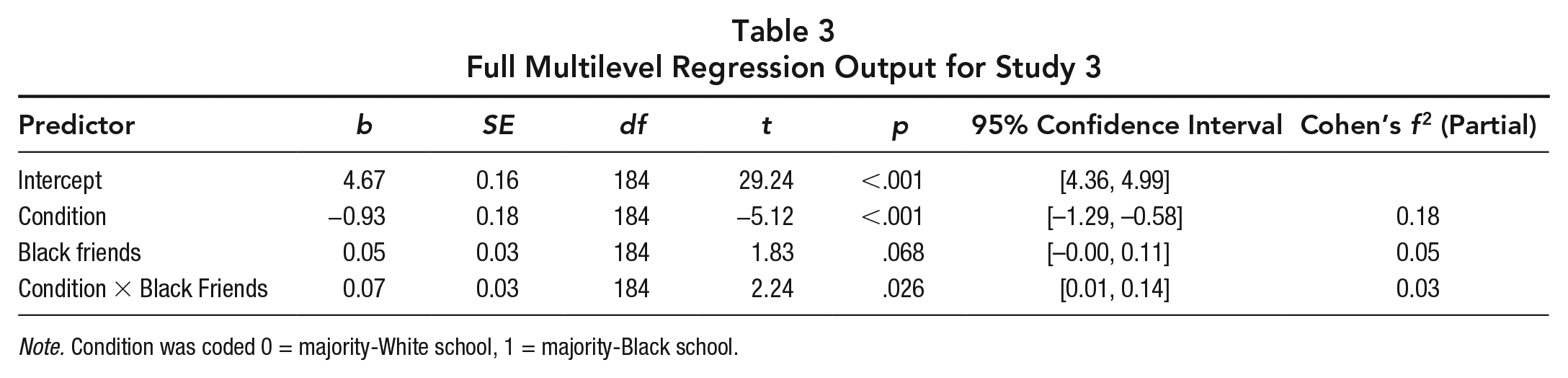
Note. Condition was coded 0 = majority-White school, 1 = majority-Black school.
There was a significant interaction between condition and teachers’ reported number of Black friends, χ2(1) = 5.08, p = .024 (f2 = 0.03). Simple effects revealed that greater numbers of Black friends corresponded with a significantly greater desire to work in the majority-Black school, b = 0.12, p < .001, but only marginally with desire to work in the majority-White school, b = 0.05, p = .068 (see Figure 1 and Table S4 in the supplementary materials available on the journal website).
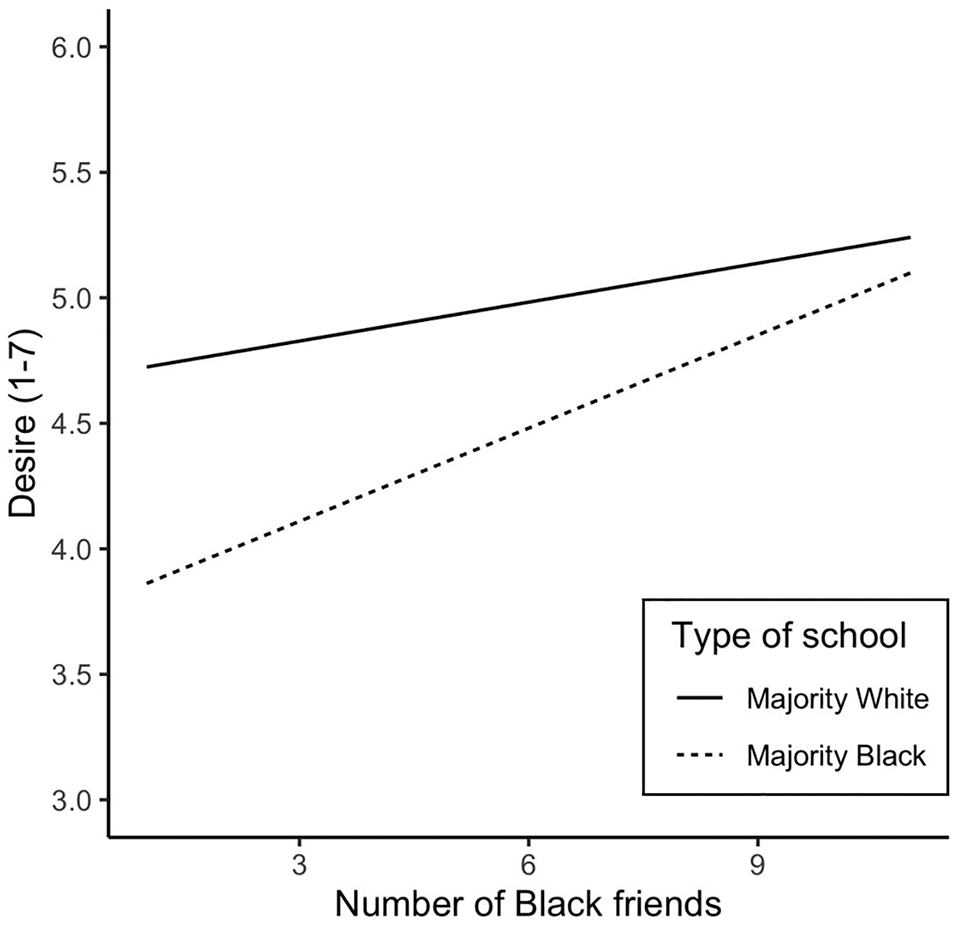
Desire to work in a school with majority-White versus majority-Black student population in relation to number of Black friends in Study 3.
The moderation effects remained almost identical, χ2(1) = 5.70, p = .017 (f2 = 0.03) when controlling for the school, classroom, and teacher characteristics noted in Table 1 as well as for number of Black acquaintances and the social desirability concerns and motives to control prejudice noted in Studies 1 and 2. Supporting our predictions, biases in school preferences associated with high Black student proportions were more likely to be attenuated among teachers who reported greater numbers of cross-race friendships, beyond a wide range of school and teacher characteristics—including, notably, teachers’ estimated percentages of non-White students in their classrooms.
Linking school desirability to teachers’ contact experience: the role of self-efficacy
Overall, teachers reported greater self-efficacy about working in the majority-White school (M = 5.55, SD = 1.13) compared to the majority-Black school (M = 5.07, SD = 1.29), F(1, 185) = 44.48, p < .001, Cohen’s d = 0.39. Still, the greater the number of Black friends teachers reported, the stronger their sense of self-efficacy about working in the majority-Black school was, r = .33, p < .001.
We specified a structural equation model to test whether the link between cross-race friendship and school desirability would be mediated by self-efficacy. We focus here on results for teachers in the majority-Black school condition due to the significant simple effects reported previously; mediation analyses for teachers in the majority-White school condition are provided in the supplementary materials (see Figure S2) available on the journal website.
The model showed a significant indirect effect of cross-race friendship on desire to work in the majority-Black school via increased self-efficacy, b = 0.08, β = 0.18, SE = 0.03, z = 4.11, p < .001 (see Figure 2). The inclusion of this mediation path rendered the direct effect of interracial friendship contact nonsignificant, b = 0.04, β = 0.09, SE = 0.03, z = 1.37, p = .172. This model supports the hypothesis that self-efficacy mediates the relationship between teachers’ interracial friendship contact and their desire to work in the majority-Black school.
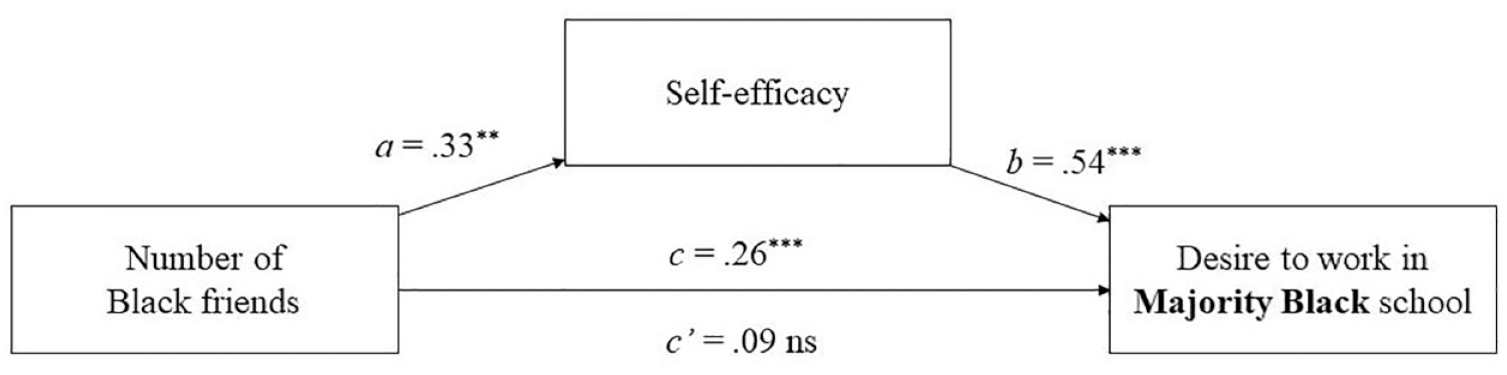
Self-efficacy mediates the link between teachers’ interracial friendship contact (number of Black friends) and desire to work in a majority-Black school in Study 3.
Thus, replicating and extending findings from our prior studies, Study 3 supported our preregistered hypotheses by demonstrating that (a) White American teachers generally report less desire to work in schools serving a majority-Black (vs. majority-White) student population, (b) this bias in White teachers’ school preferences is moderated by their levels of interracial friendship contact, and (c) the positive link between teachers’ interracial friendship contact and desire to work in majority-Black school settings is mediated by a stronger sense of self-efficacy about working with diverse learners in their classrooms.
General Discussion
Intergroup contact research has often shown encouraging effects (Pettigrew & Tropp, 2006), yet there has been scant research examining how teachers’ interracial contact experiences may shape their teaching preferences and practices in multiracial environments. Across three well-powered, U.S.-based studies, using survey and experimental methods and open-science practices, the present research shows how White teachers’ interracial contact experiences may contribute to greater feelings of self-efficacy and greater desire to work in more racially diverse schools.
Drawing on two large samples of White teachers, Studies 1 and 2 revealed that teachers’ interracial friendship contact corresponded with a stronger sense of self-efficacy about engaging with students from racial and ethnic backgrounds other than their own. In Study 3, a preregistered experiment demonstrated that White teachers showed a preference for working in a majority-White compared school to a majority-Black school even when all other aspects of the school were held constant. Importantly, however, this bias in school preferences was moderated by teachers’ interracial friendship contact: The more Black friends teachers reported having, the more they expressed a desire to work in the majority-Black school; this trend held even when controlling for self-presentational concerns associated with teachers’ self-reports, such as motives to control prejudice and social desirability. Moreover, the relation between teachers’ reported cross-race friends and desire to work in the majority-Black school was mediated by their greater sense of self-efficacy for meeting challenges associated with working in such a setting (see also Doyle et al., 2024). Across all studies, we observed comparable patterns of findings with and without controlling for a broad range of teacher and school characteristics, including the reported proportions of non-White students currently in teachers’ classes. Thus, our findings suggest that teachers’ interracial contact experiences outside of the classroom have the potential to shape how they relate to diverse learners inside their classrooms.
Although results for cross-race friendships were highly consistent, results for cross-race acquaintances varied somewhat across the three studies. In the two nationwide samples (Studies 1 and 3), greater numbers of cross-race acquaintances corresponded with greater teacher self-efficacy, similar to the observed associations between teacher self-efficacy and number of cross-race friends. However, among teachers from a single urban school district (Study 2), we did not observe a significant association between reported cross-race acquaintances and self-efficacy. Inspection of the means in Table 1 suggest that, on average, teachers in Study 2 reported more cross-race acquaintances and substantially larger proportions of non-White students in their classrooms relative to teachers from the other two studies. It is possible that by virtue of working in a diverse metropolitan area, teachers in Study 2 had grown largely accustomed to racial and ethnic diversity in their local environments (Anderson, 2011), thereby rendering cross-race acquaintances less meaningful for predicting their self-efficacy.
More broadly, however, our contention that greater interracial experience is likely to help teachers feel more efficacious and more confident about engaging with students in racially diverse classrooms falls in line with prior work suggesting that greater prior contact experience should correspond with greater confidence about engaging in future intergroup contact (Bagci et al., 2020; Turner & Cameron, 2016). Indeed, consistent with expectancy-value models of achievement (Wigfield & Eccles, 2000), we suggest that the more experience teachers have interacting across racial lines, the more they will have positive expectations for future cross-race interactions and for social interactions more generally. This may help explain why teachers’ greater interracial contact experience was also associated with a slightly stronger sense of self-efficacy about working in the majority-White school in Study 3, although this association was not as strong as for the majority-Black school (see Figure S3 in the supplementary materials available on the journal website).
Why do such associations between teachers’ interracial contact experience and self-efficacy matter? Teachers are tasked with providing an equitable education to all their students regardless of background, yet teachers often report lower relationship quality with children whose racial backgrounds differ from their own (Battey et al., 2018; Saft & Pianta, 2001). Admittedly, our studies focus only on White K–12 teachers in the United States—a context in which most teachers identify as White—even though students of color now comprise more than half of all students in U.S. public schools (National Center for Education Statistics, 2024). Like most White Americans, White teachers are likely to have limited experience interacting with people from other racial backgrounds (see Public Religion Research Institute, 2016). Moreover, few teachers start their careers with a strong sense of efficacy about working with students from diverse racial backgrounds: Indeed, only about 30% of teachers sampled reported feeling well prepared to teach in racially diverse classrooms based on their training (National Comprehensive Center for Teacher Quality, 2008). Thus, even well-intentioned teachers may not always feel well equipped to navigate racial and ethnic differences in their classrooms (Studies 1–3), which could potentially lead to avoidance (Study 3), low expectations for student conduct (Santiago-Rosario et al., 2021), or even consideration of harsher disciplinary options (Godsil et al., 2017), all of which could contribute to perpetuating educational inequalities.
As such, our findings strongly suggest that it would be beneficial for teacher education programs to actively encourage cross-racial engagement during training to enhance trainees’ self-efficacy and motivation to work with people from diverse groups (Doyle et al., 2024). Along with diversifying the teacher workforce, teacher programs could focus more explicitly on skill building in terms of engaging with and across lines of difference (Tropp & Rucinski, 2022), especially for teachers in training with limited prior interracial experience. Such efforts may involve classroom strategies that help teachers to build trusting relationships with diverse learners (Gay, 2018), navigate classroom discussions about race effectively (Tropp & Rucinski, 2022), and provide constructive feedback across racial divides (Yeager et al., 2014). We recommend that future research continue to explore how interracial contact experience may shape teaching preferences and practices across more diverse samples of teachers and in relation to skill-building coursework and practice in teaching education programs.
Although we have discussed the strengths and limitations of each study, we also wish to highlight some overarching considerations for future research. First, we acknowledge that the contact measures used in the present research focus only on reported cross-race friends and acquaintances; nonetheless, prior research suggests that contact experiences can vary widely in both intimacy and valence and on other dimensions (Hayward et al., 2017). We therefore recommend that teachers’ self-efficacy and school preferences be examined in relation to a broader array of interracial contact experiences in future work. Second, in the present research, we focused on White teachers in the United States because they are vastly overrepresented in the teaching workforce and because prior research suggests they may exhibit biases that contribute to educational inequalities. However, future research should examine if and how cross-race contact may shape the self-efficacy and school preferences of teachers from other racial and ethnic backgrounds. Third, our findings were primarily based on self-report measures, which can be susceptible to socially desirable responding (although we did control for this in our models). It would be beneficial for future research to examine similar associations to those reported here but using measures that are not direct self-report measures from teachers themselves, such as, for example, student reports of their experiences (e.g., Ialuna et al., 2024). Finally, although we observed similar patterns of findings across all studies even when controlling for explicit and implicit racial prejudice, we cannot yet firmly determine causality regarding the association between teachers’ interracial contact and their self-efficacy about teaching in diverse classrooms. An alternative possibility is that holding anti-racist beliefs (see McKamey, 2020) may lead teachers to engage in more interracial contact. Future research might therefore employ longitudinal models to examine causal relations between White teachers’ interracial contact and anti-racist beliefs and how these variables may independently or jointly predict teachers’ self-efficacy. Still, on the whole, our research suggests that interracial contact may contribute meaningfully to bolstering White teachers’ confidence about working in racially diverse classrooms, which could have downstream consequences for their efforts to promote educational equity for all students.
Supplemental Material
sj-pdf-1-edr-10.3102_0013189X251322791 – Supplemental material for Examining How White Teachers’ Interracial Contact Experiences Shape Their Self-Efficacy and School Choices
Supplemental material, sj-pdf-1-edr-10.3102_0013189X251322791 for Examining How White Teachers’ Interracial Contact Experiences Shape Their Self-Efficacy and School Choices by Lewis Doyle, Linda R. Tropp and Matthew J. Easterbrook in Educational Researcher
Footnotes

Notes
Authors
References
Supplementary Material
Please find the following supplemental material available below.
For Open Access articles published under a Creative Commons License, all supplemental material carries the same license as the article it is associated with.
For non-Open Access articles published, all supplemental material carries a non-exclusive license, and permission requests for re-use of supplemental material or any part of supplemental material shall be sent directly to the copyright owner as specified in the copyright notice associated with the article.
