




Abstract
Education has long been an area of political debate in the United States, with politicians and policymakers advocating for distinct societal and/or individual purposes of K–12 education. In this article, we examine the public opinion on the purpose of education, and we explore whether this political divide on the purpose of education is also represented in the broad public opinion. For a sample 19,032 U.S. respondents, we test whether citizens’ partisanship corresponds with their opinions on seven educational purposes. We observe that the public opinion represents a multifunctional view on education and that some but rather small differences relate to partisanship. We frame these findings in the existing literature and postulate avenues for further research.
Keywords
Education has long been marked by political disputes, with enduring debates over issues such as student testing, prayer in schools, sex education, and school choice (e.g., Ravitch, 2013; Sowell, 2020). Although political quarrels in education have been frequent, Houston (2022, p. 2) noted that they “have seldom been explicitly partisan.” However, partisanship among politicians and policymakers in the United States is on the rise (Baldassarri & Park, 2020), and the debate over education has further intensified to also include fundamental issues such as the basic goal(s) of education.
Although it is important to observe that the purpose of education has historically been a contested area among political elites (Labaree, 1997; Rothstein & Jacobsen, 2006), it looks as if it has made a comeback. A noticeable, recent example is Florida’s 2022 Stop W.O.K.E. Act (later renamed the “Individual Freedom Act”). According to Florida Governor Ron DeSantis, it is important that K–12 education does not instill a warped view of history but is a place where children are “learning the real history. You’re learning the real facts. . . . It’s not going to be done in a way to indoctrinate students with whatever modern agenda someone may have” (G. Allen, 2022). Although the act promptly ran into legal challenges (G. Allen, 2024), it is an illustration of how educational purpose started to (re)emerge as a salient issue in U.S. politics and policymaking. Today, educational purpose arguments can be found at the apex of many policy decisions and initiatives given that education has developed into one of the major battlefields in America’s ongoing culture wars (Mervosh & Hwyward, 2021). For example, Republican and Democratic elected officials have clashed over whether and why particular topics, including critical race theory or gender issues, should or should not be covered in the classroom (Sawchuk, 2021, 2022) and the banning of certain books from school libraries and curricula (Harris & Alter, 2023). A common theme in these disputes is that they stress what is being taught in schools and to what end is just as essential as the question of how to ensure an effective education for children. Hence, although various dimensions and topics related to education can be the focus of polarization research, this study specifically examines the political divide concerning the purpose of education.
Some investigations have observed how school parents seem to diverge in terms of what they think children should learn at school along Democratic and Republican lines. For instance, Horowitz (2022) found that Democratic and Republican parents of K–12 students display widely different viewpoints on what should be taught about topics such as slavery and gender identity, which echoes positions in policy initiatives such as DeSantis’s Stop W.O.K.E. Act. Although specific issues, such as gender identity, are not equivalent to the overall purpose of education, the divergence on such issues may still indicate broader differences regarding views on the purpose of education between Democrats and Republicans. Horowitz, for example, also found that Democratic and Republican parents significantly disagree on how much influence different actors (e.g., school boards and other parents) should have when it comes to what their own children are learning in school. This recognition of who is setting the agenda and thus, ultimately contributing to the socialization that occurs via education, is distinctly connected to educational purpose.
Recognizing the growing salience and politicization of the purpose of education among Republican and Democratic public officials, this article reports our investigation into whether this partisanship perspective translates to the broader population by examining how the American public perceives the purpose of education. Starting from the observable increase in polarization in the United States (Ploger, 2024), we examine the extent to which Republican and Democratic citizens differ in their views on seven distinct purposes of education.
Specifically, in this article, we address two key questions:
Research Question 1: What are citizens’ opinions regarding the purpose of education in the United States?
Research Question 2: Do these opinions differ significantly between Republicans and Democrats?
Answering these questions is important for several reasons. First, because education is increasingly becoming a wedge issue among U.S. political elites and policymakers, it is essential to investigate if this expanding polarization also manifests itself among the general population. Second, citizens’ opinions and perceptions of the purpose of education matter because they are likely to shape how politicians, policymakers, and interest groups choose to frame, strategize, and communicate messages to their constituents. Because public officials depend on public support to be elected (or reelected), it is also rational to assume that they are highly attentive to public opinions on key issues, such as education. Third, although we focus on seven educational purposes, these purposes potentially relate to other elements that are central in political campaigns, such as school funding adequacy, the degree of secularism in education, or educators’ autonomy in teaching methods. Finally, empirical research about citizens’ views regarding the purpose of education “has largely been overlooked in the existing literature” (Busemeyer & Guillaud, 2023, p. 123) Hence, assessing public opinion is an important tool for researchers wanting to better comprehend the current landscape on the topic of the purpose of education, from which new ideas, insights, and research questions can be developed.
For this study, we rely on a large representative survey of 19,032 U.S. respondents in 2022. We seek to answer our research questions with descriptive quantitative analyses (Research Question 1) and multivariate regression analysis (Research Question 2). Our results indicate that respondents rate all seven purpose dimensions high, suggesting that citizens have a multifunctional view of education. Moreover, we find that Democrats and Republicans have rather similar opinions on the purpose of education except regarding two dimensions. Democrats consider teaching children how to fix social problems as more important, and Republicans consider teaching specific values related to moral character or religious virtues as more important.
The Different Purposes of Education
The education of children is an essential component of society that serves multiple purposes (D. Allen & Reich, 2013; Biesta, 2009; Labaree, 1997). It is through education that children, by learning core academic subjects such as math and English, obtain the tools they need for economic success and a meaningful professional life. Moreover, it is an important arena for teaching children how to be good citizens in a democratic society and how to interact with other people both by making new friends at the playground and through cooperation on joint academic projects. However, the various purposes of education are not given, nor is the order in which they should be prioritized (Biesta, 2009).
Scholars have attempted to classify different purposes of education from a philosophical perspective. Two such classifications can be found in Biesta (2009) and Labaree (1997). According to Biesta, education can be perceived to perform three different but noncompeting purposes: (a) qualification (knowledge and skills necessary for specific tasks, including political literacy and citizenship), (b) socialization (the transmission of norms, values, and traditions and social interaction skills), and (c) subjectification (prompting those being educated to become more autonomous and independent in their thinking and ways of acting).
Labaree (1997) focused on the public versus private nature of education and explored three different purposes of education: (a) democratic equality (preparing students to take on the full responsibilities of citizenship and the promotion of relative equality), (b) social efficiency (teaching young people the competencies they need to succeed in the workforce), and (c) social mobility (creating means for individuals to get a competitive advantage in the struggle for desirable social positions).
As shown previously, there have been seminal steps toward a theoretical understanding of the various purposes of education. However, research is lacking that examines these purposes of education empirically. A study by Busemeyer and Guillaud (2023) analyzed survey data from eight Western European countries concerning the purpose of K–12 education and found that socioeconomic factors and ideological leanings shape individual opinions concerning the purpose of education. In particular, they found that individuals who lean toward the political left are more inclined to perceive education as a goal in its own right rather than as a means to equip the younger generation with practical skills for the job market.
We chose the classifications developed by Biesta (2009) and Labaree (1997) to identify the main criteria for distinguishing different purposes of education. Herein, we used these two classifications as a foundation for a seven-fold classification of the purposes of education. We focus thus on fundamental purposes of education, and we build on Biesta and Labaree to operationalize organizational purposes as not mutually exclusive and/or competing with each other. Table 1 outlines and summarizes the seven purposes of education.
The Seven Purposes of Education
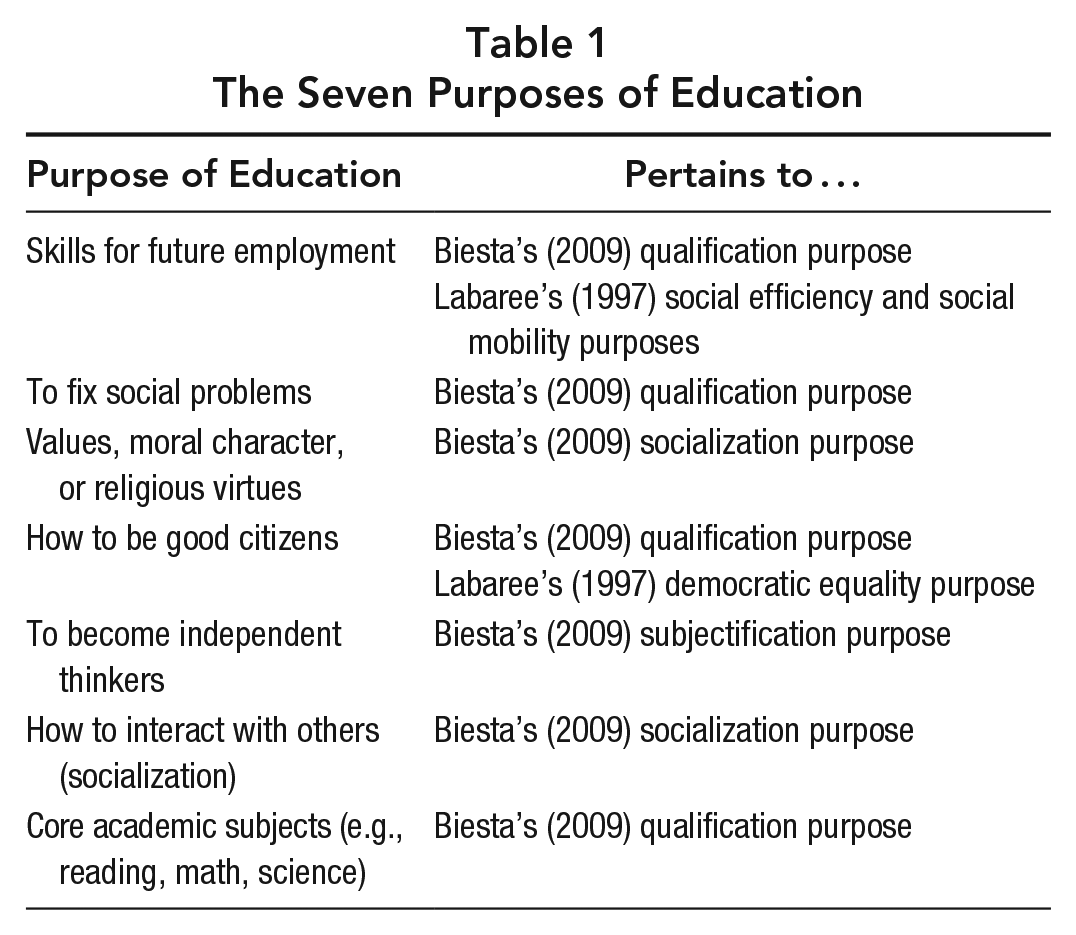
In what follows, we briefly outline each of the seven purposes used in our study. Because the existing literature on the purpose of education does not say much concerning potential differences between individuals identifying as Democrats or Republicans, we test the null hypothesis that there is no difference in each dimension. However, when some literature might give a prior insight regarding differences between Democrats and Republicans, we have integrated this into the discussion on the purpose dimension in question.
The purpose “core academic subjects (e.g., reading math, and science)” falls within Biesta’s (2009) qualification purpose. From a political point of view, this dimension is at the core of the debates about testing, a prevalent topic in the United States over the past decades (Rothstein & Jacobsen, 2006). Arguably, conservatives have tended to perceive testing as a means to improve schooling across America to a greater degree than liberals and thus tend to favor a more content-focused approach to curriculum and instruction (Ravitch, 2010).
The purpose “to become independent thinkers” corresponds to the subjectification purpose identified by Biesta (2009). Arguably, classical liberal values focusing on the rational autonomy of the individual are aligned with a more holistic, child-centered approach to learning, with an emphasis on critical thinking, creativity, and problem-solving (Franklin-Hall, 2022).
The purpose “skills for future employment” pertains to the economic and human capital dimension of education discussed both by Biesta (2009; qualification purpose) and Labaree (1997; social efficiency and social mobility purpose). It views education as a means for adapting young people to the demands of the occupational marketplace. According to Labaree, the view that education should train the productive individuals of the future is at the core of a majority of educational addresses delivered by politicians and policy reports, such as A Nation at Risk (The National Commission on Excellence in Education, 1983).
The purpose “how to interact with others (socialization)” is part of the socialization purpose described by Biesta (2009). Arguably, the importance of this purpose was put to a test during the COVID-19 pandemic when school closure forced children out of the classroom to conduct their education in front of computers in their homes. Moreover, this purpose is at the core of the homeschooling debate because opponents often argue that homeschooling can hinder children’s social development by isolating them from the broader community (Kunzman & Gaither, 2020).
The purpose “how to be good citizens” relates to Biesta’s (2009) qualification purpose and Labaree’s (1997) democratic equality purpose. D. Allen and Reich (2013) pointed out that education for democratic citizenship is part of an American tradition that has flowed in and out of American policy discussions. For instance, in a 1930 essay, Eleanor Roosevelt ([1930] 2008) argued that education’s primary goal should be to cultivate citizens. This idea resurfaced in the 1960s but later faded from political discourse (Labaree, 1997). Still, even A Nation at Risk, primarily focused on education’s economic impacts, emphasized shared education’s role in a democratic society (The National Commission on Excellence in Education, 1983).
The purpose “values, moral character, or religious virtues” can be understood as the promotion of shared morals and virtues in society or as the fostering of children into specific religious groups or moral communities. Regardless, it falls within the socialization purpose discussed by Biesta (2009). According to Gordon (1999), the view that education should teach fundamental moral values is a classical conservative opinion (see also Ciuk & Jacoby, 2015; Enders & Lupton, 2021).
The purpose “to fix social problems” relates to Biesta’s (2009) qualification function because it focuses on providing pupils with the means to achieve a specific task in society after finishing school. It is adjacent, albeit more instrumental and specific, to the citizen purpose in that it focuses on education as something that helps society at large. Grossmann and Hopkins (2015) suggested that conservatives typically express skepticism about government intervention in social problems, implying that Republicans may also be more skeptical about teaching children how to address social problems.
Method
To answer the research questions, we draw on data obtained from the EdChoice general population tracking poll. In 2022, approximately 2,200 individuals from the general U.S. population responded to an online survey conducted in English each month (EdChoice, 2023). The questionnaire contains a wide range of questions related to education and the education system. In the supplementary materials, available on the journal website, we have added information on sampling, the exact wording of the questions used for this study, and a discussion on a ranking- versus rating-based approach to question design. We pooled all the monthly data from 2022 and used a subsample of respondents for which there were no missing values for any of the variables in this study. This resulted in a sample size of 19,032 respondents.
Dependent Variables
The dependent variables that we use are seven items—one for each purpose explained previously—where the respondents are asked to rate how important each item is for students to learn in school. Half of the respondents were asked about kindergarten to eighth grade (K–8 grades) and the other half about high school (9th–12th grades). This question could be answered for each of the seven purposes of education: (a) skills for future employment; (b) to fix social problems; (c) values, moral character, or religious virtues; (d) how to be good citizens; (e) to become independent thinkers; (f) how to interact with others; and (g) core academic subjects.
The perceived importance was rated with a 5-point Likert scale using the following response options: 1 = not at all important, 2 = not that important, 3 = somewhat important, 4 = very important, and 5 = extremely important. Hence, because we use a rating-based approach—and not a ranking-based approach—we focus our interpretation on the assessment of distinct educational purposes and elaborate in our discussion section how alternative measures can provide complementary insights on related education topics in future research.
Independent Variable and Other Control Variables
Our main independent variable is a categorical variable that measures the respondents’ political partisanship (Republican, Democrat, or Independent). In the supplementary materials, available on the journal website, we report an additional regression using political ideology (liberal, conservative, and moderate) as the main independent variable. In line with other studies (e.g., Lupton et al., 2020), results of this additional analysis are highly consistent with the results reported in this article.
We also include the question type, either K–8 grades or high school (9th–12th grades), as an independent variable because we analyze responses for the seven purposes across both education levels. This additional independent variable gives an insight into how purposes are perceived differently for these two education levels.
Our model also includes several background variables that control for preferences regarding the purpose of education. Income is accounted for by a categorical variable: low income (<$35,000), middle income ($35,000 to <$75,000), and high income ($75,000+). Moreover, the model includes binary variables for the respondent’s sex (male, female), educational attainment (college degree or more, no college), and if the respondent is a parent (not a parent, parent). Moreover, generation is measured by a categorical variable: GenZers (1997–2012), Millennials (1981–1996), GenXers (1965–1980), and Baby Boomers (1946–1964). We also include a geographic categorial variable for whether the respondent lives in an urban area, suburban area, small town, or rural area. Finally, we include a categorical variable for race/ethnicity: White, Black, Asian, and Native American; a dummy variable measured whether people have a Hispanic background.
Results
Descriptive Statistics
Figure 1 reports the mean scores and 99% confidence intervals for each of the seven items measuring how important citizens consider each educational purpose to be; purposes are ranked—top to bottom—from highest to lowest overall mean score. Core academic subjects is the purpose with the highest mean score (4.480), which indicates that citizens, on average, consider this purpose to be in between very important and extremely important for students to learn. The purpose with the lowest mean score is to fix social problems. This purpose has a mean score of 3.504, which means that the average citizens’ opinion on this purpose is in between somewhat important and very important. The remaining purposes fall between these two mean scores, with all but values, moral character, or religious virtues scoring of at least 4.0. This suggests that all purposes are on average but to various degrees considered important for children to learn in schools, supporting a multifunctional view of education.
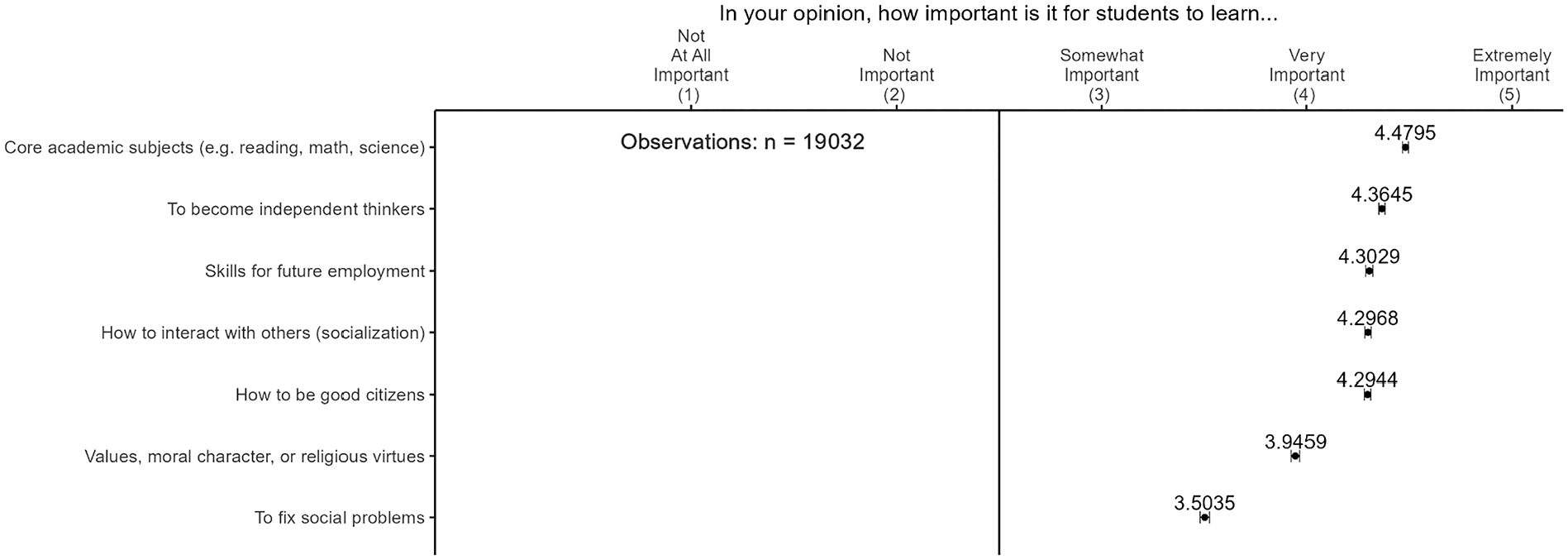
Overview of purposes’ averages (ranking based on average importance: highest average at the top).
Figure 2 shows the differences in mean scores for each of the seven purposes broken down by partisanship. Figure 2 shows relatively high consensus across political viewpoints on the purpose of education, particularly for the five highest rated purposes. However, the two remaining purposes stand out in terms of partisan differences. Republicans prioritize values, moral character, or religious virtues more highly, whereas Democrats place greater importance on fixing social problems as a purpose of education. Thus, the descriptive analysis indicates that political partisanship does matter on certain items, but its impact is relatively small compared to the overall agreement on the high importance of all seven purposes. Nevertheless, we conclude this based on our rating-based approach, in which we built on the theoretical assumption that educational purposes are fundamentally not in competition with each other.
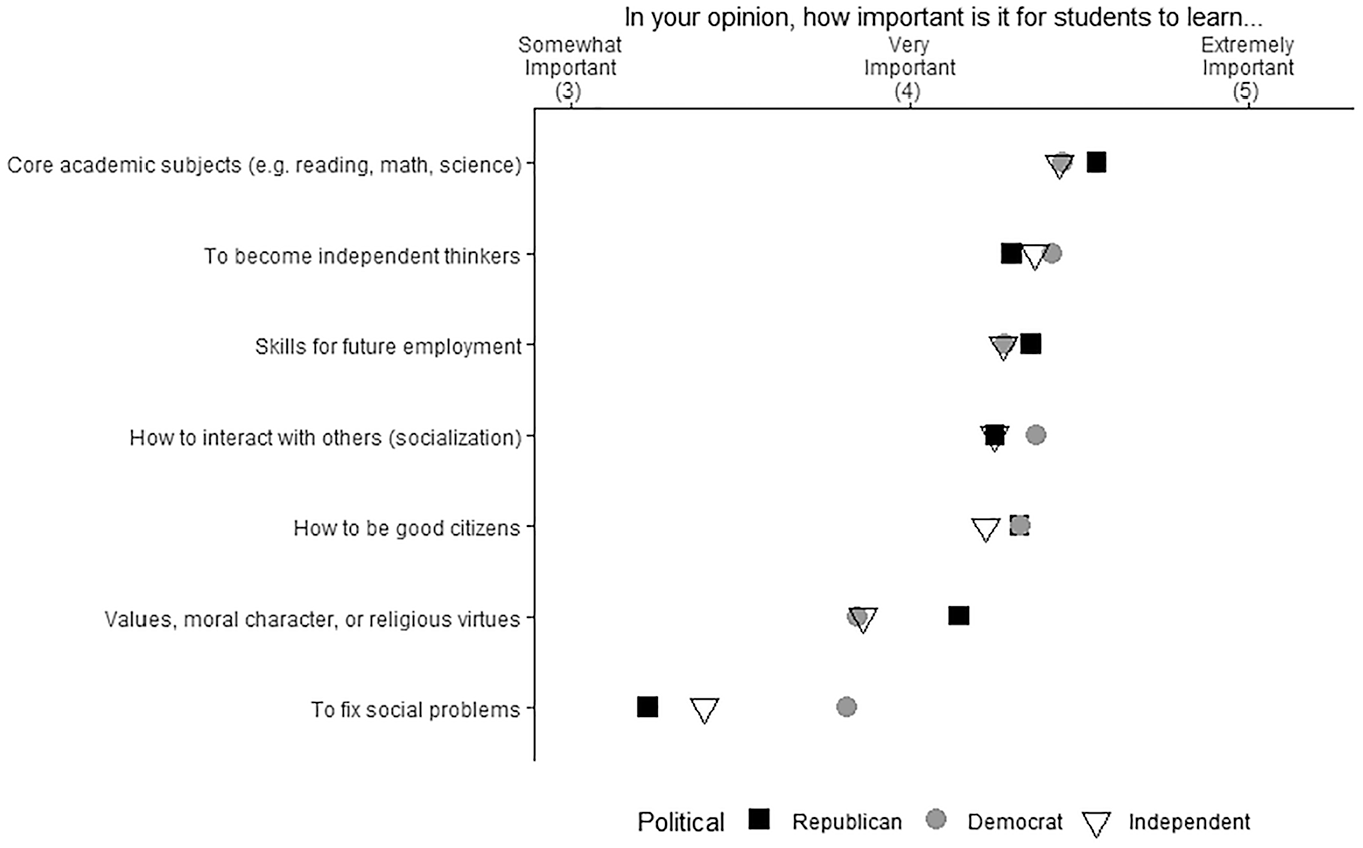
Overview of ranked purposes averages, split up based on political partisanship.
Linear Regression Models
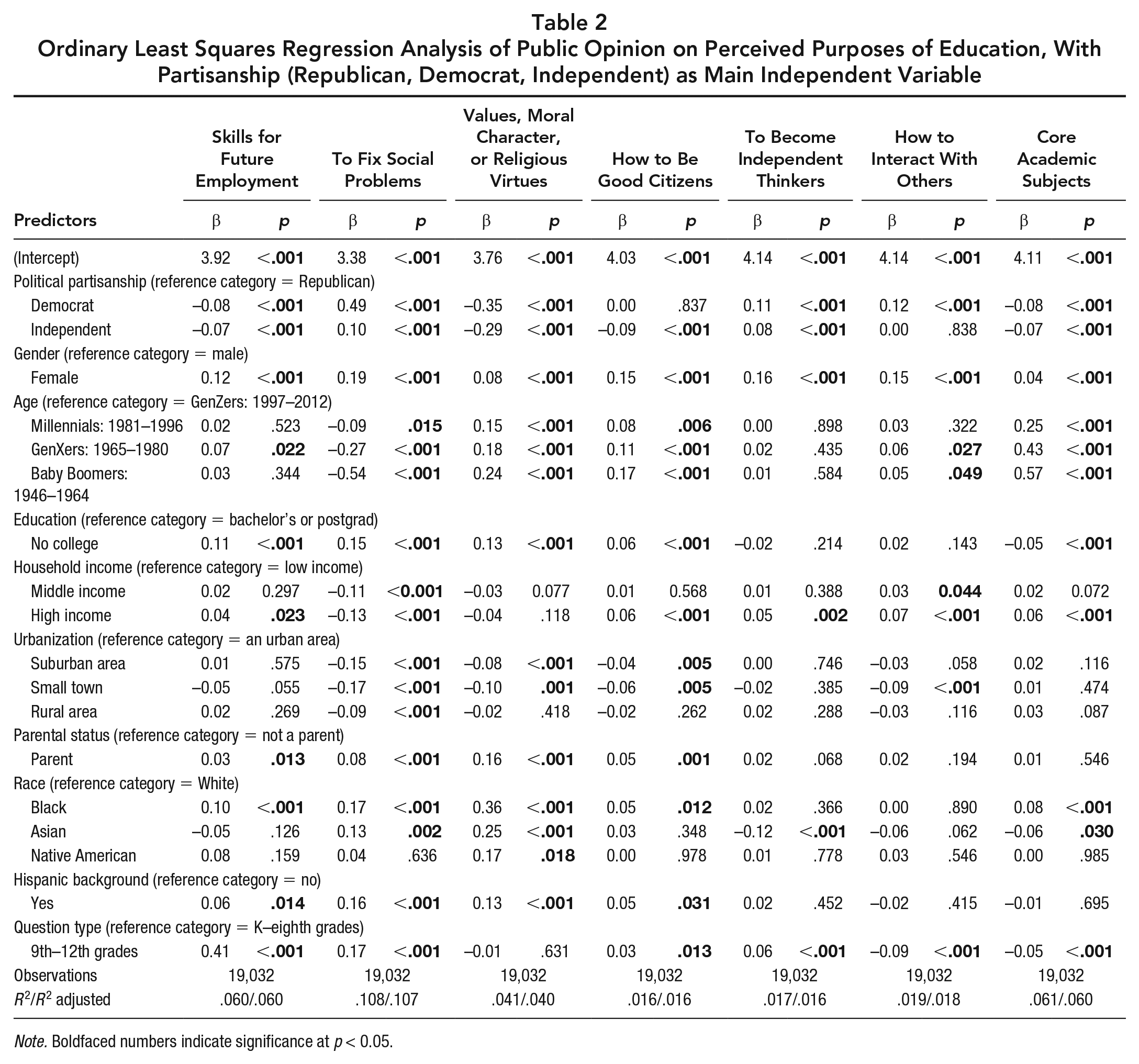
Seven linear regressions were used to test if partisanship explains how important respondents considered each of the seven purposes of education to be. Table 2 presents the relationship between the independent and control variables and each of the seven purposes of education. The supplementary materials, available on the journal website, report additional robustness analyses. For example, we also estimated these models (a) without control variables, (b) using ideology rather than partisanship as our main independent variable, and (c) under ordered probit assumptions (and combinations of these three alternations). The overall results of these additional robustness analyses confirm the findings of the ordinary least squares regressions reported in Table 2.
Ordinary Least Squares Regression Analysis of Public Opinion on Perceived Purposes of Education, With Partisanship (Republican, Democrat, Independent) as Main Independent Variable
Note. Boldfaced numbers indicate significance at p < 0.05.
Controlling for other observable characteristics permits us to isolate the association between political partisanship and the various purposes of education.
Confirming the findings from the descriptive analysis, the regressions show that there are differences between how important Republicans versus Democrats consider the seven purposes to be. However, these differences—in terms of effect sizes—are relatively small.
The two purposes with the most pronounced differences between Democrats and Republicans (β > ±0.30) are to fix social problems and values, moral character, or religious virtues. Democrats consider to fix social problems as significantly more important than Republicans (β = 0.49, p < .001). Conversely, Republicans place greater importance on values, moral character, or religious virtues compared to Democrats (β = –0.35, p < .001).
Concerning how to be good citizens, we find no difference between Democrats and Republicans (β = 0.00, p = .837). Regarding core academic subjects (β = –0.08, p < .001) and skills for future employment (β = –0.08, p < .001), we find only very small differences between Democrats and Republicans, with Democrats considering these purposes as slightly less important. Turning to the item to become independent thinkers, we find that Democrats consider this purpose as slightly more important than Republicans for children to learn at school (β = 0.11, p < .001). Lastly, we find that Democrats consider teaching children how to interact with others as slightly more important than Republicans (β = 0.12, p < .001).
Most of the time, respondents self-classified as Independents in terms of political partisanship differ from Republicans in the same way as Democrats. However, for the purpose how to interact with others, Independents are more like Republicans than like Democrats (i.e., no significant difference between Republicans and Independents: β = 0.00; p = .838). For the purpose how to be good citizens, Democrats and Republicans do not significantly differ, whereas Independents consider the purpose slightly less important (β = –0.09; p < .001).
In sum, although there are variations in views on the purpose of education linked to political partisanship, the small effect sizes indicate that these differences are slight compared to the overall agreement in the sample that all purposes are considered important.
Concerning the control variables, a few observations are worth mentioning. First, women are ranking all purposes slightly higher than men. Second, neither being a parent, the income of the respondent, nor if the respondent went to college or not predicted to any large extent the considered importance of the various purposes of education. Third, the largest differences in opinions between different generations are found for the purposes to fix social problems and core academic subjects. Younger generations regard to fix social problems as a more important purpose of education than older generations, and the core academic subjects purpose shows the opposite effect. Fourth, regarding differences in opinions based on residential areas, fix social problems emerges as the most divisive purpose of education. Respondents from suburban areas (β = –0.15, p < .001), small towns (β = –0.17, p < .001), and rural areas (β = –0.09, p < .001) consider this purpose as considerably less important than respondents from urban areas. Fifth, regarding race/ethnicity, Black and Asian respondents consider both fix social problems and values, moral character, or religious virtues to be more important compared to White respondents. For Native American respondents, the only significant difference compared to White respondents is that they place slightly greater importance on values, moral character, or religious virtues (β = 0.17, p = .018). When comparing respondents with a Hispanic background to those without, we find that individuals with a Hispanic background consider fixing social problems and values, moral character, or religious virtues to be more important than non-Hispanic respondents. Finally, the estimates for the control variable on the type of education (K–8 grades vs. 9th–12th gradees) show that people in general consider the purposes of education to be similar for K–8 and high school. However, the purpose skills for future employment is an exception. Respondents consider this item considerably more important for students in high school to learn (β = 0.41, p < .001).
Discussion and Conclusion
We started this article with the observation that even though K–12 education has long been politically fraught, current disagreements and the political polarization among U.S. elected officials and policymakers appear to have amplified. This polarization is not just about instrumental issues but increasingly about the purpose that education should serve in society. Given the divergence among political representatives, we wanted to turn attention to citizens’ opinions regarding the purposes of education and examine if citizens who identify as Republicans or Democrats are also exhibiting substantial differences in their views concerning this topic.
Drawing on survey data from a large U.S. nationally representative sample (N = 19,032), we analyzed seven distinct, noncompeting purposes of education. Our findings show the respondents, Republicans and Democrats, rate all seven purposes relatively high, indicating a multifunctional view of K–12 education. In other words, our data suggest that most citizens share the opinion that education should serve multiple distinct purposes. This finding is important because it illuminates that few citizens look at education as defined by a single or narrow objective. Hence, it nuances (to some extent) the picture frequently portrayed in the public debate and media that culture wars in the United States are causing an abyss between citizens concerning fundamental issues, such as education (Houston, 2021; Shapiro et al., 2021). Our findings thus complement and expand on prior research indicating how university students often have a much more nuanced perception of the purpose of education than what is commonly suggested (Brooks et al., 2021; Trinidad et al., 2021). Moreover, even when citizens and politicians are confronted daily with partisan polarization on topics such as student testing, prayer in schools, sex education, and school choice, the apparent high uniformity in public opinion on the overall purposes of education could form a basis to build on for reducing dysfunctional polarization that harms the maintaining and development of a good educational system (Houston, 2021; Shapiro et al., 2021).
Differences between Democrats and Republicans regarding the purposes of education were small for most purposes examined. For the five purposes with the highest average scores in the full sample, we found no or only minimal partisan differences (β < ±0.15). However, for the two purposes that are scored on average lowest in the general population and in each of the subsamples based on the partisanship divide (see Figure 2), we observed significant differences: Democrats considered teaching children how to fix social problems as significantly more important than Republicans, and Republicans prioritized teaching children values, moral character, or religious virtues as significantly more important than Democrats. The differences in these two purposes are certainly worthy of attention. Obviously, how individuals define or operationalize notions such as “social problems” or “moral character” are likely to differ, and there is no way to get deeper into these distinctions in our current data. Still, the idea that education should aim to prepare students to alleviate problems appears to align with what many would consider core liberal and progressive viewpoints. Specifically, it has been argued that conservatives harbor inherent skepticism toward using government intervention to tackle social issues and that liberals often prioritize policies addressing systemic issues, such as income inequality, racial justice, and environmental concerns (Grossmann & Hopkins, 2015). Consequently, liberals might to a larger degree perceive schools as platforms to create awareness and promote solutions to social problems from a young age. This difference might relate to the fact that Democrats and Republicans often display different views and beliefs when it comes to root causes of enduring social problems (e.g., slavery and other forms of oppression, economic inequality). For example, in a 2022 Pew Research Center study, close to two-thirds of Republican parents say slavery is a key part of American history; however, they do not consider slavery to be a factor significantly shaping the contemporary problems facing Black people in the United States (Horowitz, 2022). Conversely, seven of 10 Democratic parents want schools to emphasize that the legacy of slavery is still a key component influencing the position of Black people in today’s society (Horowitz, 2022).
The elevated emphasis among Republicans to teach children values, moral character, or religious virtues is also in alignment with prior findings. In studies on differences regarding value preferences between Republicans and Democrats, moral traditionalism has been identified as a value that is consistently ranked higher among Republicans (Enders & Lupton, 2021). It has also been claimed that divergent views on the importance of moral traditionalism are a key explanation for diverging opinions on topics at the core of the American “culture war” (Ciuk & Jacoby, 2015). This includes recurring issues in current debates on what should or should not be taught in schools, including gender issues and gay rights. Regarding the role of religion, more Republican parents indicate they see a place for religion in education, including public school, whereas a majority of Democratic parents do not (Horowitz, 2022). One possible implication is that Republican parents and voters will continue to advocate for more public money to support religious elements in K–12 education, especially given a recent U.S. Supreme Court decision allowing for more public funding of religious entities (Chung, 2022) and state legislators approving the creation of religious charter schools (Mervosh, 2023). Another possible implication is that Republican parents will increasingly gravitate toward educational options outside of the public education system (e.g., private schools or homeschooling), look for hybrid options that allow parents to have more direct input into certain areas of a child’s education, or increasingly favor school choice mechanisms, such as educational savings accounts or school voucher program.
This study has some limitations, which in turn pinpoint interesting avenues for further research. We applied a rating-based approach where each purpose could be given any score in the survey regardless of how important other purposes are considered by respondents. This has the advantage that perceived importance of purposes is operationalized separately for each of the seven purposes, and we could report seven unrelated regression analyses. Hence, rather than having respondents directly rank the purposes, we were able to compare how the same set of independent variables influenced each purpose separately. With a ranking approach, (e.g., Ciuk & Jacoby, 2015), our findings could be complemented and verified with a direct comparison from respondents in combination with an adjusted analysis method. Moreover, considering that resources and time are limited, education policy needs to make choices regarding which purposes of education are most important for schools to strive for. That is, when respondents would rank the different purposes—for example, within limited budgets and little information on these budgets (Willems & Andersson, 2024)—complementary information provides an additional insight into trade-offs required in the real world and/or public support for particular prioritization rules.
We started our study based on the observation of an inherent assumption in scientific and practitioner literatures on the polarized partisan divide on various aspects of education. For this, we have built on other studies without conducting our own additional systematic investigation into (a) what politicians have been arguing concretely (e.g., were their arguments focused on fundamental aspects, such as educational purposes, or on related or derived elements, such as need for more funding, level of secularism, or autonomy for teachers) and (b) the contexts and timing of these arguments (e.g., in campaigns or in media outlets, before or after elections). Hence, another fruitful avenue for future research includes using longitudinal data to examine changes over time regarding the purpose of education and other related aspects and evaluate how this is—or is not—related to concrete political debates and the communicated arguments by particular politicians in debates and campaigns.
In sum, our study is a part of a much bigger puzzle on the partisan beliefs on various aspects of education. We call for more related studies to elaborate with more data, more variables to be tested, and combining it with concrete text analysis of political communications.
Supplemental Material
sj-pdf-1-edr-10.3102_0013189X251314808 – Supplemental material for The Purposes of Education: A Citizen Perspective Beyond Political Elites
Supplemental material, sj-pdf-1-edr-10.3102_0013189X251314808 for The Purposes of Education: A Citizen Perspective Beyond Political Elites by Ebba Henrekson, Fredrik O. Andersson and Jurgen Willems in Educational Researcher
Footnotes

Notes
Authors
References
Supplementary Material
Please find the following supplemental material available below.
For Open Access articles published under a Creative Commons License, all supplemental material carries the same license as the article it is associated with.
For non-Open Access articles published, all supplemental material carries a non-exclusive license, and permission requests for re-use of supplemental material or any part of supplemental material shall be sent directly to the copyright owner as specified in the copyright notice associated with the article.
