



Abstract
A recent study published in Educational Researcher by White (2023) examined superintendent gender gaps. This work required 4 years of internet searches to identify and match superintendent names with each of the roughly 13,000 school districts in the United States. Although this study provided important insights into the superintendent gender gaps, the study is unable to examine gaps for females of color or the long-term career pathways of superintendents. The lack of a national longitudinal superintendent dataset has meant researchers and policymakers have limited insights into superintendent racial and gender gaps, turnover rates, experience, and career pathways to the superintendency. Drawing on data from the Texas State Longitudinal Data System, we offer several findings to provide a glimpse of what could be accomplished with a longitudinal dataset. Policymakers, school boards, search firms, and communities will fail to understand the full range of challenges and opportunities to diversifying and strengthening the superintendent workforce until such a dataset exists and is accessible to researchers and other interested parties.
Introduction
Superintendents play critical roles within their districts and communities, yet no individual or organization, including the U.S. Department of Education, has created a national longitudinal dataset tracking superintendent demographics and turnover. The lack of longitudinal data has not stopped speculation about superintendent demographic trends and the pathways to the superintendency (Superville, 2023). Attempts to track superintendent demographics and turnover have been minimally effective. For example, the American Association of School Administrators (AASA) annually surveys superintendents but suffers from low response rates of between 10% and 15% (Thomas et al., 2022). Recent research published in Educational Researcher by White (2023) highlighted the need for a national database. White’s study was made possible by a painstaking effort to collect the first and last name of every superintendent in the United States over 4 years through web searches and then ascribe gender primarily based on superintendents’ publicly stated pronouns and prefixes. While this research provided critical evidence about the superintendent gender gap, the study could not examine other relevant variables such as race, age, experience, and time to superintendent ascendency due to data limitations.
Qualified superintendent candidates from diverse backgrounds may never make it to the superintendency or will confront significant delays if policymakers, school boards, search firms, and other interested entities cannot fully understand and evaluate trends in the workforce. A national longitudinal superintendent database is needed and can enable descriptive analyses that shed light on workforce trends to further inform policy and practice (Loeb et al., 2017). Thus, to bolster support for a national longitudinal superintendent database, this commentary presents a set of findings relying on data from Texas demonstrating the power of large longitudinal datasets for superintendent research. Texas has 5.4 million students and 1,204 districts that reflect nearly 10% of the nation’s superintendents and students. In what follows, we describe the Texas State Longitudinal Data System (SLDS) followed by several findings that shed new light on gender and racial dynamics within the superintendency. We conclude with a brief discussion of implications and next steps for policymakers and researchers.
Data and Method
This policy brief leverages the Texas SLDS to provide a detailed statewide analysis of the superintendent workforce between academic school years 2010–11 through 2020–21, focusing on the transition between principal and superintendent. While almost half of all superintendents in the 2020–21 workforce served in the principal role within the past 10 years of their career, the number of roles and total school years that take place between those two career milestones varies widely across individuals and contexts. Given prior work highlighting disparities in educator career ladders (e.g., Kim & Brunner, 2008), we assess the number of years it takes each superintendent to reach the superintendency, starting from the first time they served as principal, focusing on differences by superintendent race/ethnicity, gender, and district characteristics. The state has so few superintendents who identified as American Indian or Alaska Native, Asian, Native Hawaiian or Other Pacific Islander, or Two or More Races that they cannot be included in the study due to research policies protecting the anonymity of superintendents (DeMatthews et al., 2023). Additionally, the Texas Education Agency only provides male or female as options when reporting gender.
Texas Superintendent Demographics
Nationally, the racial and gender makeup of the superintendent workforce, particularly intersectional identities, remains unclear. The Texas SLDS enables researchers to accurately assess these demographics. For example, in 2020–21, 73% of the superintendents in Texas were male and 79% were White, which reflects significant overrepresentation compared to the student population (51% female; 27% White). While Texas’s student population is 53% Hispanic, only 13% of superintendents are Hispanic. Only 4% of Texas superintendents are Hispanic females. Black students make up approximately 13% of the student population yet only 6% of superintendents are Black and 2% are Black females. These findings indicate gender, racial, and racial and gender gaps exceed those found in the teacher or principal workforce, where only slightly more than half of teachers (57% ) and principals (58%) were White. Additionally, whereas White males represented 58% of all superintendents in Texas in 2020–21, only about 20% of all principals were White males during the 2020–21 school year (DeMatthews et al., 2023).
A Closer Look at the Superintendent Workforce Over Time
A national longitudinal dataset would allow researchers to know the intersectional identities of superintendents and study longitudinal hiring trends to better understand progress in efforts to diversify the superintendent workforce. Statewide data from Texas show that racial diversity and gender parity in Texas has grown slightly over the past 11 years. In 2010–11, only 20% of superintendents were female, and only 10% were Hispanic, compared to 27% and 13% in 2020–21. A closer look at pathways into the superintendency sheds additional light on contributing factors to these gaps.
Superintendents serve in various leadership roles prior to reaching the superintendency, but the most common prior role among Texas superintendents is school principal. Specifically, among the 2021 group of superintendents, 28.7% were superintendents throughout the entire study period while 27.4% served at some point as deputy or assistant superintendent. Nearly half (47.9%) served as principals and 13.8 % served as assistant principals during the time frame of our study. Note, these are not mutually exclusive categories, so a superintendent can be counted in multiple prior roles. To disaggregate findings by race and still adhere to Family Educational Rights and Privacy Act requirements, we analyze only those superintendents from the 2020–21 cohort who served as principal between 2010–11 and 2019–20.
Figure 1 provides evidence that males and White principals ascend to the superintendency in fewer years compared to female leaders and leaders of color. For superintendents in the 2021 cohort, only 26% of females, as opposed to 35% of males, made the transition to superintendent from principal within 3 years. Instead, nearly half of female superintendents from the 2021 cohort who served as a principal during the study period ascended to the superintendency within 7–10 years compared to only 30% for male superintendents. Additionally, only half of Black and Hispanic superintendents took fewer than 6 years to transition from the principalship to the superintendency compared to nearly 70% for White superintendents (Figure 1). Figure 2 provides evidence that inequities remain present at the intersection of race and gender. For example, White males were the most likely to ascend to the superintendency within 3 years (37%) and the least likely to ascend to the superintendency in 7–10 years relative to all other groups. Compared to Hispanic females, a larger proportion of White females ascended to the superintendency within 3 years; however, a smaller proportion of White females ascended to the superintendency within 3 years than that of Hispanic males. Few Black females and Black males made the transition to superintendent from principal within 3 years. Additional descriptive analyses, available upon request, show principals generally transition to the superintendency in fewer years within rural and smaller school districts and in districts serving high percentages of low-income students; however, racial and gender-based disparities noted earlier persist.
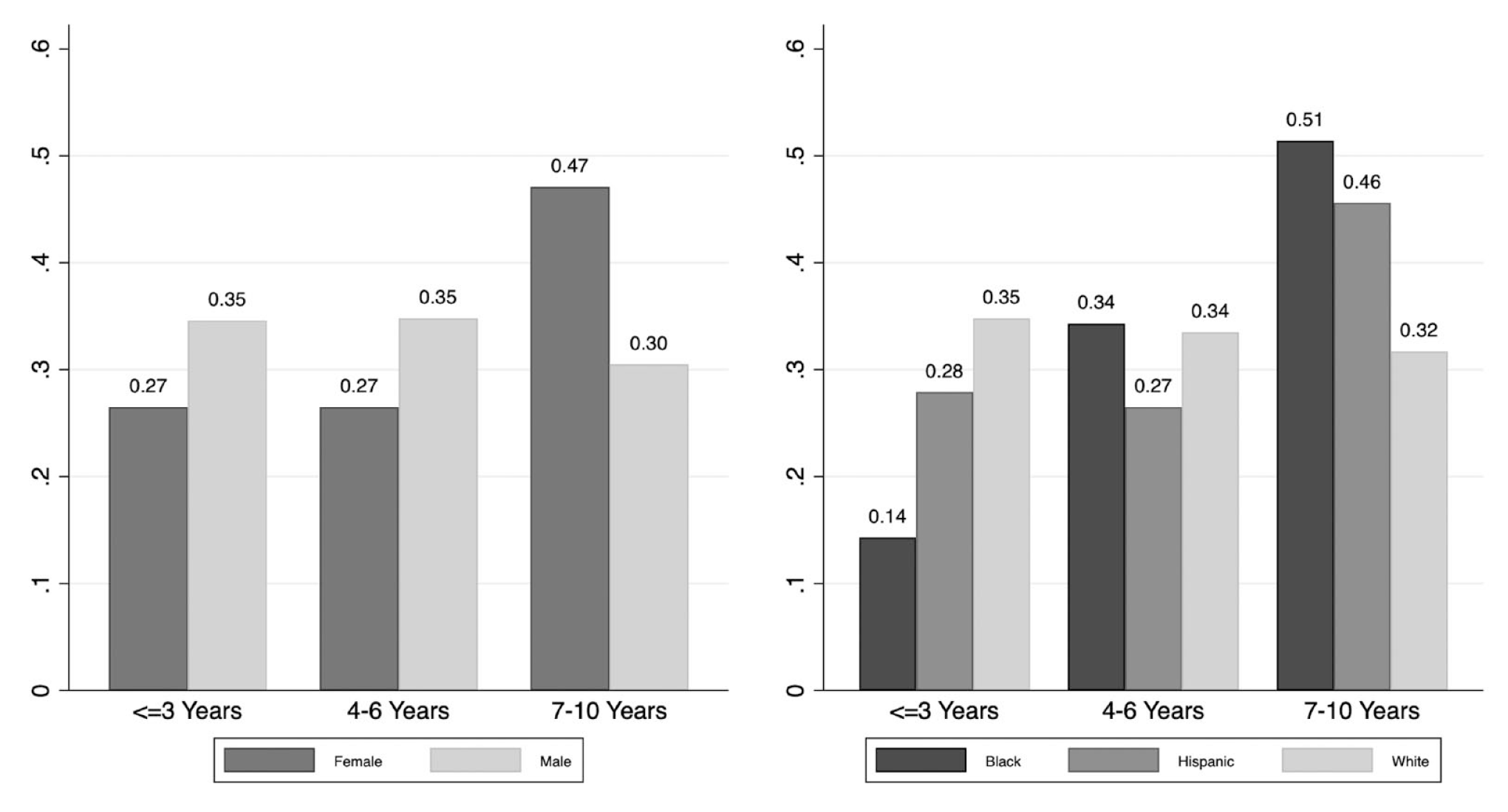
Variation by gender and race in promotion to superintendent from principalship.
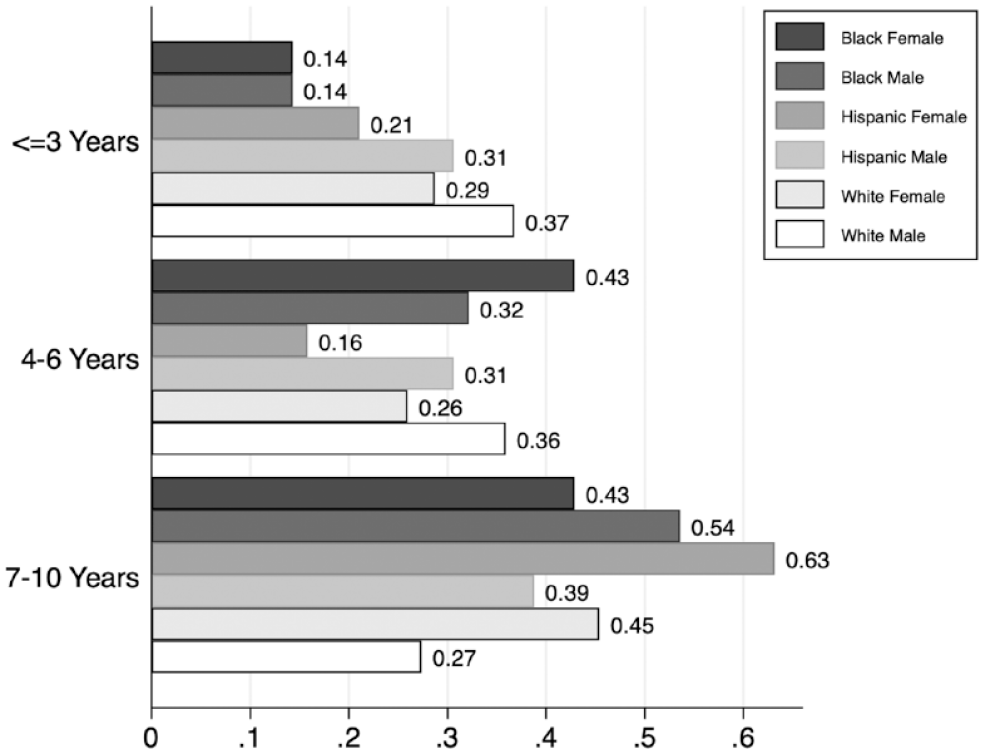
Variation at the intersection of gender and race in promotion to superintendent from principalship.
Discussion
The results shown here highlight important disparities in the superintendent pipeline over the past 11 years that shed light on the lack of racial diversity and gender balance. Larger racial and gender gaps within the superintendent workforce as compared to the principal workforce have varied causes, including differences in promotion patterns, suggesting that boards and search firms should expand efforts to review all qualified applicants rather than recruiting within networks. Gaps may also be caused by limited opportunities for superintendent leadership development among females and people of color. The sample findings we present provide a glimpse of what could be more closely examined with a national longitudinal superintendent dataset. With such a dataset, additional research could examine demographic trends by locale and geographic regions, the relationship between superintendent demographics and the racial and socioeconomic student demographics within districts, the average age of turnover and retirement trends, multiple pathways to the superintendency, prior experiences of superintendents (high school versus elementary school principal experience), turnover rates, salary and certification trends, and drivers for superintendents moving districts. While a national longitudinal database may lack certain information since some states do not report applicants or a set of finalists (e.g., Texas), it would still provide important insights for policymakers seeking to promote diverse talent and eliminate barriers to accessing the superintendency as well as unnecessary and unwanted instances of turnover. These analyses would provide national and state superintendent associations, school boards and search firms, and communities with important data to help diversify and retain high-quality superintendents.
