




Abstract
Educators increasingly recognize the importance of students’ learning orientations, but relatively little is known about how these mindsets vary across and potentially shape educational settings. We use nationally representative data to document contextual variation in mathematics orientations in U.S. high schools. We find systematic variation in orientations between differentiated course levels within school, suggesting orientations are more a feature of proximate instructional contexts than general school climate. Between-course variation in orientations is comparable to analogous sorting on demographic characteristics and not primarily explained by prior achievement. Measures of individual learning orientations at scale hold promise for understanding collective educational contexts.
Keywords
Orientations to learning, such as expectations of success or growth mindset, provide a foundation for students’ motivation, resilience, and academic success (Dweck, 2006; Eccles & Wigfield, 2002). In addition to differences between individual students, these constructs may also reflect important aspects of the collective context of learning (Loeb et al., 2019). Contexts in which teachers and peers support desirable learning orientations may improve students’ educational outcomes, especially for disadvantaged groups (e.g., Muenks et al., 2020). However, we know relatively little about systematic variation across learning contexts, and a critical open question is whether individual orientation measures can indicate context differences at all (Duckworth & Yeager, 2015). If orientations vary across local contexts, this has theoretical implications relating to segregation and tracking, methodological implications for how we can characterize contexts, and practical implications for understanding the contours of learning environments throughout the education system.
We address three fundamental questions about contextual variation in learning orientations for one critical subject and period—mathematics at the start of high school. First, do orientations vary systematically across local educational contexts, meaning that students are sorted into settings with distinguishable differences in orientations? Second, to what extent are contextual differences in learning orientations explained by differences in prior academic achievement? Because orientations and achievement are related, contextual variation in motivation may follow well-established differences or may reflect a unique dimension of local educational experiences. Third, to what extent do learning orientations differ between course levels within schools? Recent research on school-level variation misses potentially critical differences within schools, especially between the different levels in the hierarchical curriculum, which shape many aspects of the learning environment (Chmielewski et al., 2013; Oakes, 1985). In addressing these questions, we consider that the answer to each may differ for specific types of academic orientations. For instance, orientations most related to instructional experiences, such as expectations for success, may vary most across contexts, differ most between courses within schools, and be most related to achievement differences.
To address these questions, we draw on a novel nationally representative data set, and we focus on orientations toward mathematics (expectations of success, interest, anxiety, and growth mindset), which are important for STEM pathways and are hypothesized to vary between differentiated mathematics courses within schools. By describing systematic variation in these measures, we reveal features of the between- and within-school differences that students experience in their learning environments across the United States.
Data and Methods
We use data from the National Study of Learning Mindsets (NSLM), collected from ninth grade students in 76 public high schools in the 2015–2016 school year in the United States (Yeager, 2019). The NSLM is uniquely suited to describing school and course variation in social-psychological orientations because it collected several related measures, it is a nationally representative sample of regular public high schools, and it collected large samples of students within schools (in most cases a census of the cohort), facilitating within-school investigation. 1
We focus on mathematics because (a) this subject serves as a critical gateway for later educational success, including college-readiness; (b) previous research documents important variation in mathematics-specific learning orientations; and (c) the sequential structure of content may create unique local learning contexts. As part of the NSLM survey, students reported their mathematics course level. Most students in the sample reported being in “Regular Algebra” (54%). We report results for this level, below this level (9%), and above this level (37%). Students also answered survey questions about mathematics: their expectations of success, interest in the subject, anxiety about mathematics, and whether mathematics ability is a fixed characteristic (as opposed to a growth mindset orientation).
To characterize orientations across schools and mathematics courses, we focus on the school- and course-level variance components from multilevel models of individual observations nested within courses and schools. 2 To assess whether variation is explained by differences in prior achievement, we consider both an unconditional model and one with prior achievement as a covariate. To assess mean course-level differences within schools, we regress school mean-centered measures on indicators for math course levels. Full details of the sample, models, and results are presented in the supplementary materials available on the journal website.
Results
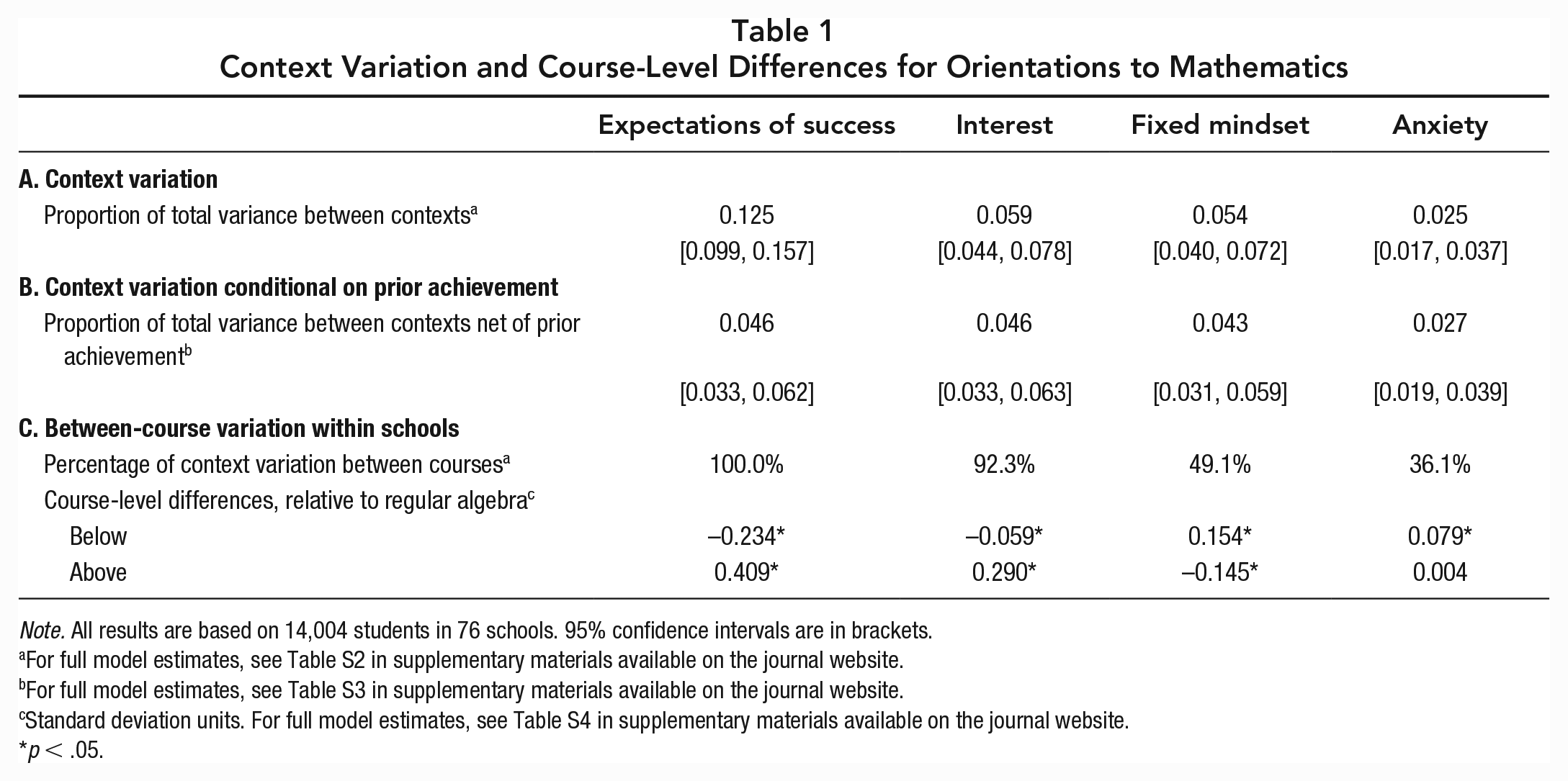
In answer to our first question, we find detectable contextual variation for each of the orientation measures (Table 1, Panel A). Of the total variation in the individual measures, up to 13% of the variation is between courses and schools, with estimates statistically significantly greater than zero. The degree of contextual variation differs across contexts, however; expectations of success are most clustered in contexts (13%); interest (6%) and fixed mindset (5%) are moderately so; and anxiety is least differentiated across contexts (3%). For comparison, the analogous estimates are 28% for prior achievement and 31% for racial background (see supplementary materials available on the journal website), suggesting that mathematics learning orientations context variation is between one tenth (anxiety) and one half (expectations of success) as large as well-documented differences associated with school racial segregation or academic tracking.
Context Variation and Course-Level Differences for Orientations to Mathematics
Note. All results are based on 14,004 students in 76 schools. 95% confidence intervals are in brackets.
For full model estimates, see Table S2 in supplementary materials available on the journal website.
For full model estimates, see Table S3 in supplementary materials available on the journal website.
Standard deviation units. For full model estimates, see Table S4 in supplementary materials available on the journal website.
p < .05.
Second, we find that most of the context differences in orientations we observe are independent of differences in prior achievement (Table 1, Panel B). Adjusting for prior academic achievement has a negligible impact on the relative variation between contexts in most cases, and although achievement explains half of the large context variation for expectations for success, significant residual variation remains. This suggests that the composition of the peers in students’ local mathematics learning environments is distinguished by learning orientations in addition to academic achievement. Aggregate learning orientations can add to our understanding of such contexts.
Third, much of the context variation in learning orientations is between course levels within schools (Table 1, Panel C). This is especially true for expectations of success and interest; over 90% of context variation is between courses, suggesting these orientations are closely tied to instructional grouping but not to general school climates. By contrast, a majority of the (smaller overall) context variation in anxiety is between schools. Finally, fixed mindset varies similarly between courses and within schools. This means that the peer orientations a student will experience depends both on school climate and local course, as represented in Figure 1.
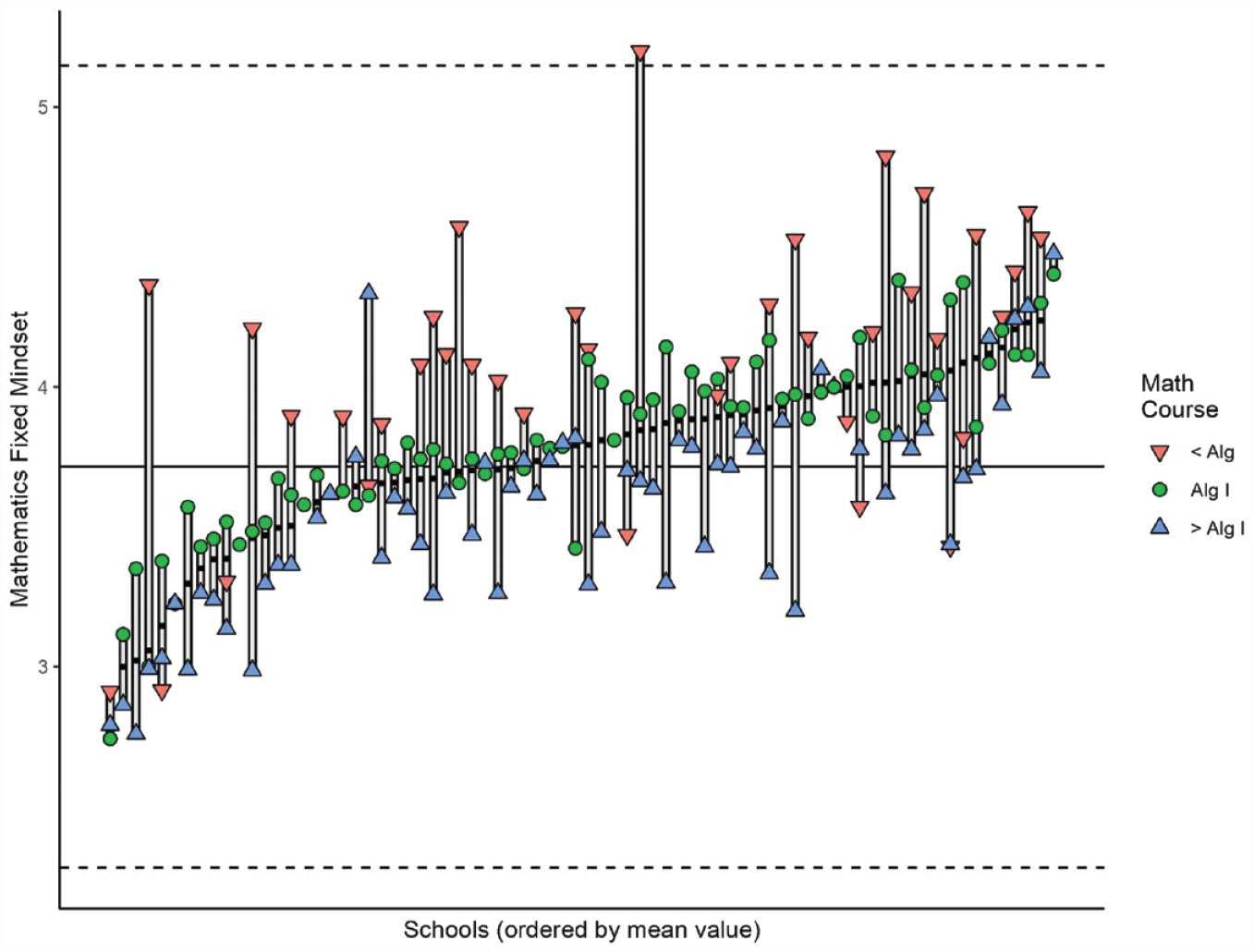
Mean mathematics fixed mindset across schools and courses.
Given the importance of the course-level context, it is notable that patterns for mean course differences also vary across orientations (Table 1, Panel C). For expectations of success and interest, there are differences between all levels, but these are most pronounced in high-level courses (0.41 SD and 0.29 SD higher than regular algebra, respectively), meaning that these are particular features of peers in advanced classes. By contrast, mathematics anxiety is only a distinguishable feature of lower-level courses (0.08 SD higher than regular algebra, on average). Finally, fixed mindset differences cut similarly across all levels, with similar differences between lower versus regular courses (0.15) and high versus regular courses (–0.14).
Discussion
As educators and researchers increasingly measure and respond to students’ individual orientations to learning, this also provides opportunities to learn about the variegated contexts of learning. Our results demonstrate that context differences are distinguishable for several dimensions of learning orientations while highlighting the practical challenge that most of the observed variation is within contexts. The fact that most context variation is within schools supports skepticism about using these measures to identify general school climates (Duckworth & Yeager, 2015), but a school-level focus misses most contextual variation students experience; we must consider the differences related to local instructional settings. Furthermore, these differences are not explained by academic achievement, suggesting that aggregate learning orientations define unique aspects of curricular tracking (Oakes, 1985).
What are the practical implications of these results? These descriptive patterns do not speak to specific instructional practices, but they do suggest two general implications. The first is the value of collecting consistent information on students’ orientations to learning. Individual educators undoubtably gauge and respond to the learning orientations of the students they work with, but systematic information can be used to monitor meaningful dimensions of learning environments. Second, we should focus attention on the qualitative differences that exist between different courses within schools beyond traditional measures of academic performance. Because such differences likely vary across schools and over time, local educators should monitor and respond to these context differences. Many schools and districts already collect relevant individual student information that our results suggest can be used as a starting point.
These patterns also point to three important questions about context and learning orientations. First, to what extent do these results in high school mathematics apply to other levels of schooling and other subjects? Second, where do contextual differences in orientations come from? Identifying specific influences, such as previous experiences and the ways that students are selected for courses, is a key to understanding how to improve learning environments and where to target attention. Third, (how) do contextual differences in learning orientations matter for students’ own motivation and future educational success? Interacting with peers with different outlooks may shape students’ own conceptions and also how they respond to other features of school. Future research will need to carefully isolate these effects from the other differences between courses.
Supplemental Material
sj-pdf-1-edr-10.3102_0013189X231177671 – Supplemental material for Context Variation in U.S. High Schoolers’ Mathematics Orientations
Supplemental material, sj-pdf-1-edr-10.3102_0013189X231177671 for Context Variation in U.S. High Schoolers’ Mathematics Orientations by Paul Hanselman and Jenny Buontempo in Educational Researcher
Footnotes

Notes
Authors
References
Supplementary Material
Please find the following supplemental material available below.
For Open Access articles published under a Creative Commons License, all supplemental material carries the same license as the article it is associated with.
For non-Open Access articles published, all supplemental material carries a non-exclusive license, and permission requests for re-use of supplemental material or any part of supplemental material shall be sent directly to the copyright owner as specified in the copyright notice associated with the article.
