



Abstract
Very little is known about the complaint investigation process in the Office for Civil Rights, despite its scope and reach. We examine key parameters (number and types of complaints received, types of resolutions, average time of resolution) of civil rights complaints nationwide over a 20-year period (1999–2019). We find that 10%–40% of all districts receive at least one discrimination-related complaint each year. We also find that complaints are filed at significantly higher rates in large districts and districts with a high percentage of Black students, even after controlling for other structural factors, such as average socioeconomic status and locale.
Keywords
Protection of students from discrimination on the basis of sex, race/ethnicity, and disability, although enshrined in law, needs active enforcement from federal agencies. As such, the Office for Civil Rights (OCR) plays an integral role in identifying, addressing, and preventing discriminatory policies and practices through multiple enforcement activities, including the investigation of civil rights complaints (Lewis et al., 2019). Although the data-monitoring function of OCR (e.g., Civil Rights Data Collection) is well known, we know much less about the complaint process, despite its scope and reach.
In our national longitudinal data set, we find that roughly 41% of all school districts have received at least one civil rights complaint against them between 1999 and 2019. Indeed, in our panel, 10%–40% receive at least one complaint each year. Many school districts have multiple complaints, many of which involve various civil rights statutes.
Through a Freedom of Information Act request, we sought information on all OCR complaints filed against school districts between January 1, 1999, and December 31, 2019. In this data set, we compile information on the nature of the complaint, the associated civil rights law (including the specific section of the statute), the outcome of the complaint, the time for resolution, and the school district identifier. As a preliminary look at this data set, we ask (a) what are the trends and patterns in complaints filed over the last 20 years, and (b) what are the structural district and neighborhood factors that drive the likelihood of a school district receiving a discrimination-related complaint?
Methods and Results
After creating the complaint data set, we link that database with other publicly available information on structural factors—specifically, the Common Core of Data—at the district level. Building on limited existing analyses, (e.g., Groeger & Waldman, 2018; Perera, 2021), we first carry out a descriptive characterization of the patterns and trends in the number and types of complaints received, the number of investigations carried out, the various complaint outcomes across time, and the time associated with each complaint.
Preliminary results, presented in Figure 1, show that disability-related complaints form the single-largest majority of complaints filed against districts in our sample, closely followed by complaints related to race and then sex. In 2016, OCR received a significant number of complaints (6,157 Title IX complaints related to athletics) that were filed by one individual (U.S. Department of Education, 2016). Although we are unable to determine which complaints were filed by this one individual, we include a sensitivity analysis (see Table A3 in the Online Appendix) that accounts for this outlier by dropping 2016 from the analysis; our baseline results are robust.
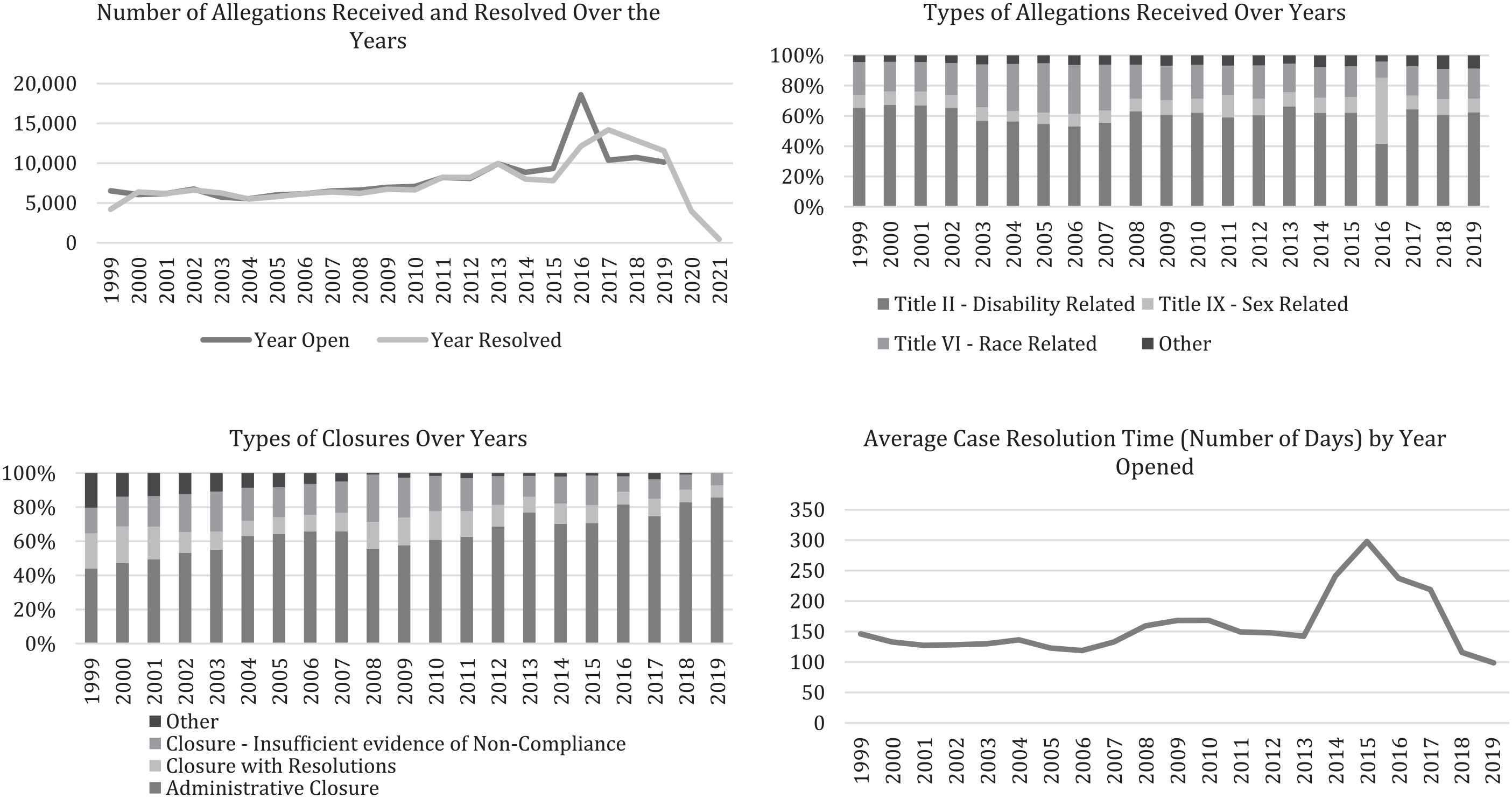
Descriptive characteristics of K–12 civil rights complaints filed in the United States between 1999 and 2019.
Trends also reveal that a large number of complaints are administratively closed before moving further into the process; this administrative closure is more frequent in the later years of our analytical sample time, loosely coinciding with political regime changes and related changes in approaches to complaint investigations. More specifically, an increase in resolution time corresponds with the Obama administration’s systemic approach designed to address root causes of discrimination, while the Trump administration aimed to close complaints as quickly as possible (see the Online Appendix for more context).
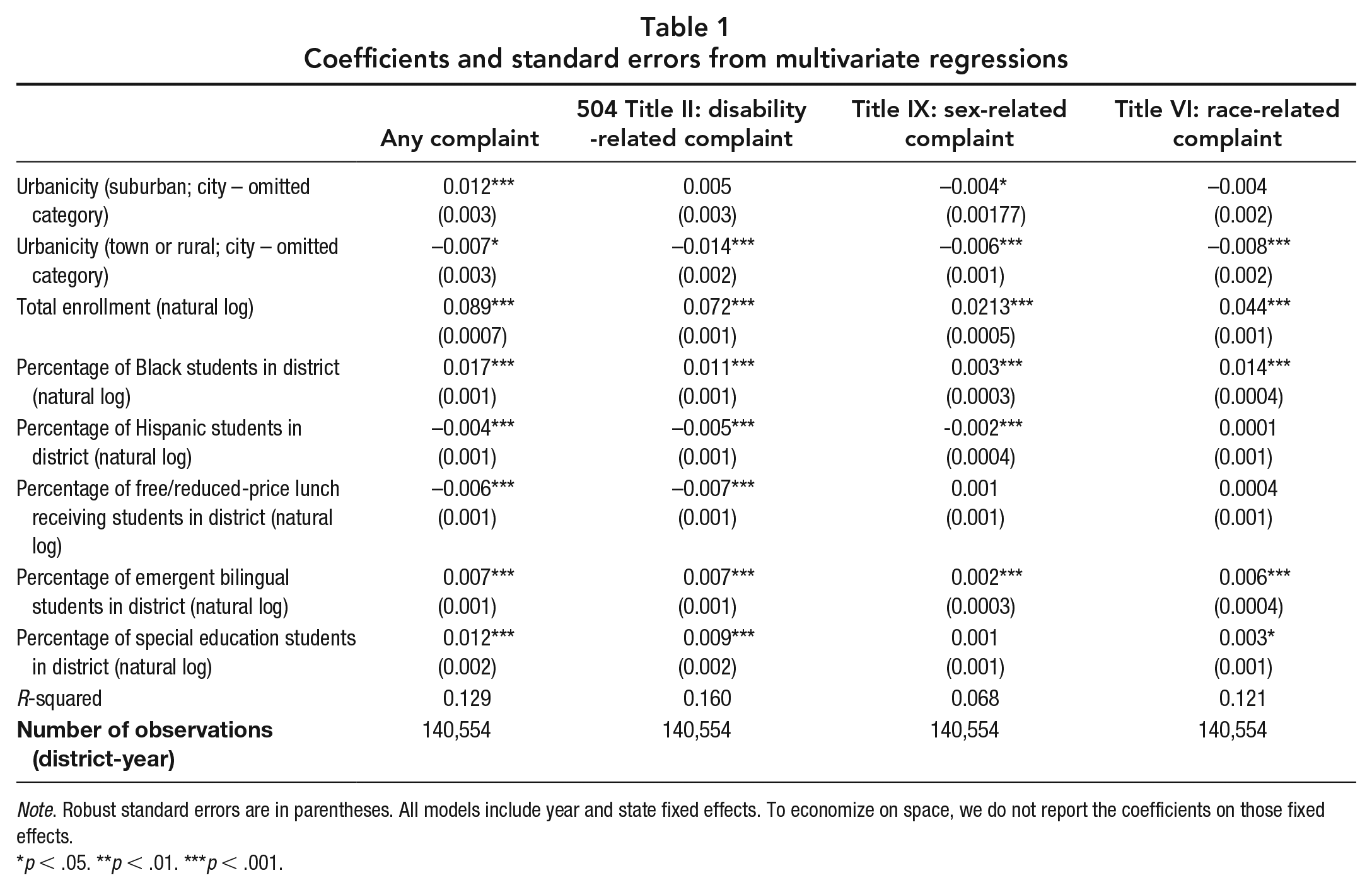
Second, we explore associations between various structural, district-level factors and the likelihood of a district receiving a complaint (a) overall and on the basis of (b) sex, (c) disability, and (d) race/ethnicity. Because districts received multiple complaints that often span civil rights statutes, we collapse the complaint-related data to the district level. We create four binary outcomes (any complaint, disability-related, sex-related, and race-related) to indicate whether a district received a discrimination-related complaint (Yes = 1, No = 0) in each year. We then regress each binary outcome on a vector of district-level covariates to explore the structural factors associated with discrimination and educational disparities in past research (see the Online Appendix for more details on the measures used). We present these regression results in Table 1.
Coefficients and standard errors from multivariate regressions
Note. Robust standard errors are in parentheses. All models include year and state fixed effects. To economize on space, we do not report the coefficients on those fixed effects.
p < .05. **p < .01. ***p < .001.
Overall, structural factors—specifically, the overall size (measured by the size of student enrollment) and segregation 1 in the district—are significantly associated with the likelihood of a district receiving a discrimination-related complaint. Indeed, we find that a 10% increase in the percentage of Black students in a district is associated with an approximately 0.16 percentage point increase in the probability of receiving a complaint. 2
Of note and concerningly, although the strength of association in terms of magnitude between segregation (specifically, Black student body composition) and likelihood of complaint is higher for race-related discrimination complaints, this pattern is also observed across other forms of complaints, even after adjusting for several other structural factors, such as socioeconomic segregation (percentage of students in the district receiving free/reduced-price lunch) and other inequities affecting minoritized students (e.g., percentage of Emergent Bilingual students and those receiving special education), locale, secular time trends, and other time-invariant, state characteristics.
We also find similar patterns when we examine the associations between the structural factors and (a) the number of complaints filed in districts and (b) the likelihood of complaints scaled for student enrollment (per 1,000 students). Our results are robust to several alternative specifications (see the Online Appendix for results from these supplemental analyses).
Discussion
OCR’s complaint investigation process represents a significant policy lever for reducing educational disparities. Past research clearly shows that segregated districts, specifically where Black students are overrepresented, face other systemic inequities, such as higher race-based discipline gaps, disparities in special education identification, higher grade retention, and reduced access to advanced placement and gifted and talented programs (Gopalan, 2019; see the Online Appendix for additional resources). Similarly, we find that such districts face a much higher likelihood of experiencing discrimination-related complaints. Although a complaint is not the same as a violation, our findings relate to the fact that discrimination is systemic and institutional in nature and that systems of oppression and discrimination (racism, sexism, ableism, and so forth) are interlocking (e.g. Crenshaw, 2017).
Several researchers have relied upon CRDC data. However, a systematic analysis of a nationwide, longitudinal data set of all civil rights complaints is virtually nonexistent. Existing analyses examine complaints within a single state, review a specific type of complaint, cover a shorter time period than our study, or do not combine data sets to examine structural predictors of civil rights complaints (e.g., Groeger & Waldman, 2018; Perera, 2021; Worthington, 2017).
Studying complaints dismissed on substantive 3 or nonsubstantive grounds, 4 in addition to findings of noncompliance or violations, relates directly to OCR’s interpretation and enforcement of the law within a given time frame (e.g., within and across presidential administrations) and can broaden our understanding of the complaint process as a mechanism to promote equity. We recognize that the complaint process does not capture all instances of discrimination, thereby underestimating civil rights violations. This could be due to underreporting, inequities in access, disenfranchisement, or resolution through other means, such as informal district-level processes or litigation (e.g., Rhode, 2001).
By making this data set publicly accessible (Gopalan & Lewis, 2022), we hope to encourage scholars to analyze and link it with other relevant data sets to further our understanding of systemic discrimination, the impact of the complaint process—including state- or region-level differences in complaint investigations and resolutions—areas of underreporting, and policy changes between presidential administrations. Most importantly, understanding this arm of OCR’s work is critical to promoting equity and protecting students’ civil rights (Scott et al., 2020).
Supplemental Material
sj-pdf-1-edr-10.1177_0013189X221130056 – Supplemental material for K–12 Civil Rights Complaints: A Nationwide Analysis
Supplemental material, sj-pdf-1-edr-10.1177_0013189X221130056 for K–12 Civil Rights Complaints: A Nationwide Analysis by Maithreyi Gopalan and Maria M. Lewis in Educational Researcher
Footnotes

Notes
Authors
References
Supplementary Material
Please find the following supplemental material available below.
For Open Access articles published under a Creative Commons License, all supplemental material carries the same license as the article it is associated with.
For non-Open Access articles published, all supplemental material carries a non-exclusive license, and permission requests for re-use of supplemental material or any part of supplemental material shall be sent directly to the copyright owner as specified in the copyright notice associated with the article.
