




Abstract
The presence of armed police officers in schools has sparked considerable policy debate and demands for reform. Thus far, much of the debate has centered on an empirical analysis of school resource officers rather than school police officers and their impact on particular student populations, especially those burdened by their greater vulnerability to punitive interactions such as detention and arrest. In this article the authors show that an examination of the data reveals that interactions between students and police follow distinct patterns with respect to race and geographic space. The authors use the “sociospatial dialectic” method to explain why certain student populations are most vulnerable to negative interactions with school police within particular spatial settings. Oral history interviews with 120 Black students in a large urban public school district reveal two self-reinforcing pathways: (1) soft coercion, when care and courtesy meet preemptive criminalization to produce punitive policing, and (2) shielding, when referrals to school police officers by school personnel shift blame onto students and invite the use of punitive policing without care. These findings underscore the racialized and contextually specific nature of school policing’s social and spatial processes for Black students in low-income communities.
The presence of armed police officers in schools has recently sparked considerable policy debate as demands for school districts to defund and dismantle police departments have increased. These demands grow from an awareness that negative interactions between police officers and Black students, in particular, have increased in lockstep with the growth of police presence in low-income Black high schools (Harper & Temkin, 2018; Musu-Gillette et al., 2018). Existing data show that Black students are more likely than any other racial and ethnic student group to be detained, cited, or arrested by police officers in school (Allen et al., 2018; U.S. Department of Education, Office for Civil Rights, 2019). Several studies have shown that these patterns are the by-product of decades of social policy decisions that have contributed to mass incarceration and the infamous “school-to-prison pipeline” (Kupchik & Monahan, 2006; Meiners, 2007; Wald & Losen, 2003).
In calls to reform the multiple pathways by which youth enter the criminal justice system (also known as the school-to-prison pipeline; Rios, 2011; Stuart, 2016), many states and localities have focused significant attention on the need to reduce school suspensions, expulsions, and disciplinary referrals (Fedders, 2018). Much of the debate has been centered on the costs and consequences of the presence of law enforcement officers in schools. Some have argued forcefully that school-based law enforcement is essential for ensuring school order and safety (Bratton & Howard Smith, 2018; French-Marcelin & Hinger, 2017). However, the debate is ongoing. As public awareness that school policing often has devastating consequences for Black students, and communities, becomes more widely understood, the need for empirical research investigating the impact of law enforcement in schools is more pressing (Legewie & Fagan, 2019; Meiners, 2007; Nolan, 2011).
According to the U.S. Commission on Civil Rights (2019), a growing number of school districts throughout the nation either employ school resource officers (SROs) or have created their own police departments with school police officers (SPOs) to address their safety and security needs. For the former, an individual school or school district enters into a contract, or memorandum of understanding, with a local or county law enforcement agency to hire SROs temporarily or permanently to a K–12 campus (Canady et al., 2012). For the latter, a school district creates and runs its own independent police department and hires SPOs as employees of the district (Morgan et al., 2014).
Although contemporary analyses of “school policing “ (a term used loosely to describe both SROs and SPOs) have focused on the social and spatial patterns related to SROs’ practices (Curran et al., 2019), relatively few studies have attempted to parse the mechanisms and factors that shape and structure interactions between students and SPOs (Morgan et al., 2014). Closer examination of school policing practices reveals that deployment of law enforcement has been most common in low-income Black neighborhoods and schools serving large numbers of Black students (Curran, 2016; Nance, 2019). Although mass shootings—argued by some scholars to explain the rise in school-based policing (Javdani, 2019; Kupchik & Bracy, 2009)—have most often occurred in predominantly White rural and suburban schools (Heitzeg, 2009; Noguera et al., 2015), these are not the communities that have experienced the greatest increase in police presence. Given the limitations of previous research on school policing, there is a need for a more robust empirical analysis on the impact of SPOs on communities and student populations that have been subjected to the greatest number of punitive interactions.
The goal of the present study addresses this gap in the literature using qualitative interview data with 120 Black students from a large urban school district in Los Angeles. Specifically, we examine Black students’ sociospatial experiences with school policing practices in neighborhoods and schools with high concentrations of Black people. We also explore what a sociospatial analysis of school police interactions reveals about how anti-Black racism interacts with historic structural racism and persists in the post–civil rights period. Building on Soja’s (2019) sociospatial dialectic, we believe that this form of analysis holds vast potential to explain the structural dynamics underlying Black students’ vulnerability to negative interactions with school police in low-income Black schools.
We begin by describing the growth in school policing across U.S. public schools, followed by an analysis of the patterns of police-student interactions and how these correspond to race and geographic space. We contextualize these features within the research literature on the emergence of the carceral state (Garland, 1990; Hinton, 2016; Lytle-Hernandez et al., 2015) and the ongoing, ever present reality of anti-Blackness, a phenomenon that has been well documented throughout U.S. history (Du Bois, 1899, 1935/2007; Hartman, 2007; Tillet, 2012). These dynamics we find are particularly evident in the Los Angeles Unified School District (LAUSD), which employs the largest school police force in the country. To explain the deployment and use of SPOs in predominantly Black spaces, we draw upon structural racism and critical race spatial analysis (CRSA) to theorize how school policing interactions play out over time and across different spatial contexts. Next we present our research methods and findings, and we conclude with implications for policy, practice, and future research.
Literature Review
Expansion of School Policing
Surveillance and security measures in U.S. public schools have dramatically expanded over the past three decades (Curran et al., 2020). Today, 48% of public schools have police presence at least part time, up from 36% in 2003 and 1% in 1975 (Diliberti et al., 2019). Many scholars attribute the increase in police presence to the mass shootings that occurred at Columbine High School and other schools in the 1990s (Rocque, 2012). Most mass shootings, however, have occurred in predominantly White rural and suburban schools, while the expansion and deployment of sworn police officers to schools has occurred mostly in urban areas (Curran et al., 2019). Indeed, studies show that school police are most likely to be present in low-income, predominantly Black schools (Musu-Gillette et al., 2018). Nationally, approximately 85% of Black students attend schools at which law enforcement officers are present, the highest percentage among all racial and ethnic groups (U.S. Commission on Civil Rights, 2019).
Law enforcement officers in schools are typically deployed in two manners. The first and the most common method is through the use of SROs. Many SROs undergo training for how to work in schools and perform specific job duties that encompass more than just law enforcement, such as teaching and counseling as part of the triad model of the National Association for School Resource Officers (Travis & Cook, 2005). In contrast, independent school police departments typically follow the traditional organizational structure of a local or county police department and are funded by and accountable to the school district superintendent, board of trustees, and/or their designees (McKenna & White, 2018). The LAUSD, which is the focus of the present study, runs the largest school police force in the nation. However, as we show in the following section, the deployment of punitive interactions with students tends to be concentrated at schools in South Central Los Angeles, where the vast majority of residents and the student population are low-income Black and Latinx. Understanding how SPOs are used in these schools is the topic we explore in greater detail.
Race, Neighborhoods, and School Policing
Although there has been a general trend toward hiring more SPOs at schools throughout the nation, research suggests the geographies where school policing occurs are largely linked to the racial and socioeconomic composition of schools and communities (Curran et al., 2019; Nance, 2014; Welsh & Little, 2018). For many Black students, negative interactions with law enforcement officers are increasingly part of the developmental ecology of Black adolescence. National data show that Black students represent 27% of K–12 students referred to law enforcement and 31% of students subjected to school-related arrests, despite constituting 16% of the national student population (U.S. Department of Education, Office for Civil Rights, 2019). Existing data also shows that Black students are more likely than any other racial and ethnic student group to be detained or arrested by police officers in school settings (U.S. Department of Education, 2019). Not unlike the geographically concentrated nature of mass incarceration (Sampson, 2012), low-income Black communities and schools are more likely to experience punitive school police interactions (Allen et al., 2018).
Several scholars have attributed punitive policing practices and the increase in police shootings both to the availability of video cameras on cell phones and the emergence of the carceral state. The carceral state has been used to capture the ways in which law enforcement policies tend to reinforce social and spatial boundaries, correlated with race and class, and contribute to the phenomenon of mass incarceration (Alexander, 2018; Garland, 1990; Goffman, 2009; Lytle-Hernandez, 2017). Such policies work in concert with structural racism to deepen and concentrate social isolation, marginalization, and economic depression in poor, racially segregated Black neighborhoods (Alexander, 2012; Sampson & Morenoff, 2006; Wilson, 1987). The combined effect of these factors reinforces the markers of residential racial segregation by signifying which populations and communities must be policed.
To a large degree, analyses of the carceral state have excluded an analysis of schooling and the ways in which law enforcement operates in racially segregated Black communities. Some scholars have pointed out that school policing policies have the effect of extracting resources for police services that might otherwise be used for counseling, social services, and a wide variety of community needs (Garver & Noguera, 2012; Rattan et al., 2012; Skiba et al., 2011). This prioritization of funding for police services over other pressing educational needs has far-reaching educational, social, and economic implications. For example, the racially concentrated nature of school policing likely increases the possibility of future generations’ incarceration (Calmore, 1995; Jackson, 1985; Massey & Denton, 1993; Wilson, 1987). As evidenced by previous empirical analysis, school policing plays a significant role in reproducing racial inequality, stratification, and residential segregation (Huq, 2017)
Research on the role of school policing in reproducing racial inequality highlights officers’ multifaceted roles, which include, but are not limited to, maintaining discipline, mentoring, teaching, educating (typically about the dangers of gangs and drugs), and providing informal counseling (Higgins et al., 2019; Jackson et al., 2018). Critics have pointed out that activities associated with maintaining discipline often result in police intervening in areas they are unqualified to address, such as students experiencing trauma or mental illness. It has been argued that the use of discipline in such cases represent a significant overreach of discretionary decision making embedded within policing and the larger criminal justice system (Hirschfield, 2008). These processes contribute to the preemptive and excessive criminalization of low-income students of color through increased levels of referrals to school police and subsequent citations and arrest, particularly for minor noncriminal infractions (Fisher & Hennessy, 2016; Homer & Fisher, 2020; Kupchik, 2010; Na & Gottfredson, 2013; Theriot, 2009).
To explain and distinguish different enforcement models responsible for police-student interactions, researchers describe three types of contemporary practices that fall along a policing continuum from care to punitive punishment (Herbert et al., 2017; Rios et al., 2020; Stuart, 2016). The first model, referred to as mano suave, describes policing that prioritizes crime prevention and improves relationship building and community relations between individuals and police (Rios et al., 2020). The second model, termed mano dura, describes law enforcement’s punitive practices toward crime prevention, often experienced by recipients as tough and intrusive (Rios et al., 2020). The third model is a hybrid of the first two; it relies on both punitive and what might be thought of as “soft” police practices (Rios et al., 2020). Building on Rios et al. (2020), we explore how these models may be located within a continuum of school policing of Black students in low-income Black neighborhoods and schools.
Regardless of the approach to policing that is officially adopted in low-income urban communities, SPOs are often implicated in activities that further marginalize the residents and students they are hired to serve. Unlike SROs, SPOs are typically used to carry out policing activities on school campuses and are also responsible for patrolling the surrounding areas of the school (Los Angeles Unified School District, 2014). This often means that SPOs cite and arrest nonstudents in the community even though they may be deployed to service schools. For low-income Black students who are often subjected to an array of environmental and economic hardships, the role the police play in maintaining order at school and in the community by “keeping a lid” on the frustrations and conflicts that may arise in impoverished neighborhoods is often problematic and conflictual (Anderson, 1990; Lerman & Weaver, 2004). Education research shows that higher proportions of enrolled Black students (Curran, 2016; Skiba et al., 2014; Welch & Payne, 2010) and students in poverty (Losen & Skiba, 2010) are positively correlated with rates of school disciplinary infractions. Similarly, research on policing conducted in low-income Black communities shows that high arrest rates are a by-product of the relationship between local police and the social and economic conditions present in these communities (Gilmore, 2007; Kupchik & Monahan, 2006; Rios, 2011; Stuart, 2016). This research further suggests that social and spatial dynamics of school policing have the potential to further strain interactions between students and law enforcement, as well as relationships between police and the community more generally (Bell, 2017; Bruch & Soss, 2018; Weaver & Geller, 2019).
Moreover, previous work on law enforcement in school reveals that SPOs are most frequently called upon to address internal threats connected to students themselves, as opposed to external threats that could potentially endanger students (Fisher et al., in press). Existing studies also show that the presence of school police significantly increases the likelihood that punitive disciplinary measures will be used against students (Bruch & Soss, 2018; Shedd, 2015). This occurs even for incidents that previously were not treated as crimes, such as arguing with a teacher or fighting between students. Furthermore, research on SROs suggests the impact of their presence on schools that have acquired a reputation for discipline problems (Curran et al., 2019). At such schools, students who are regarded as being “at risk” for academic failure are typically more likely to be subjected to negative interactions with school police. One limitation of these studies is the limited focus on school police interactions with students, their costs and benefits to enhance school order and safety, and whether police-student interactions can be interpreted as a direct by-product of the state’s efforts to control and contain subjugated populations under community-police tactics (Davis, 2003; Gilmore, 2007; Wacquant, 2009). Our hope is that a sociospatial analysis will shed new light on the dynamics of police-student interactions.
The Persistence of the Carceral State and Anti-Blackness
To contextualize the growth of school policing across U.S. public schools, theorizations on the role of the carceral state are helpful for understanding the interaction between spatial isolation and structural racism and the phenomenon of racial criminalization. Rabaka (2010, p. 308) argued that the “interconnections and intersections of white supremacy [and anti-Blackness] within the criminal justice system and seemingly neutral social institutions” must be used to understand the role of policing in low-income, Black communities. Dumas and ross (2016) described anti-Blackness as “not simply racism against Black people [but also] a broader antagonistic relationship between blackness and (the possibility of) humanity” (p. 429). Their definition of anti-Blackness is helpful because it draws our attention to the enduring perceived threat and disdain held in many segments of American society toward Black people and their humanity. Hartman (2007) reminds us that the very idea that Black people should be treated with the rights and respect afforded to other human beings has been influenced “by a racial calculus and a political arithmetic that were entrenched centuries ago” (p. 6). The pervasive and endemic ideology of White supremacy and anti-Blackness help explain how and why the institutionalization of the carceral state continues to be tied to anti-Blackness. These ideological tendencies are in turn imbued throughout America’s most powerful social institutions, including schools and the criminal justice system. It also helps explain why policies that might appear to be “race neutral” are applied to particular bodies, namely Black bodies, frequently in a harsh and punitive manner (Du Bois, 1899; Dumas & ross, 2016; Epp et al., 2017; Foucault, 1977; Hinton, 2016).
Since the 1960s and its aftermath, the carceral state has emerged as a common and pervasive organizing feature of urban life and has functioned as an impediment to racial equity throughout the United States (Alexander, 2012; Davis, 2003; Lytle-Hernandez et al., 2015). The result is a carceral network of social institutions responsible for diluting political and economic power, redistributing financial resources, and (re)producing multiple forms of raced and gendered exploitation inscribed inside contemporary practices of capitalism for those impoverished communities and individuals of color (Gilmore, 2007; Mogul et al., 2011; Ritchie, 2017; Turner & Beneke, 2020). By framing the carceral state in this way, we focus on the social and spatial dimensions of school policing as it unfolds over time and becomes prominent in low-income communities and the Black students within them (Annamma, 2018). Less explored are the social and spatial mechanisms that shape and structure school policing. In the following section, we document how the sociospatial experiences of Black students are influenced by school policing practices in neighborhoods with high concentrations of low-income Black residents.
Theoretical Framework
Two complementary theories help establish an understanding of anti-Black racism in the post–civil rights period as well as Black students’ sociospatial experiences with school policing practices in high-poverty neighborhoods in Los Angeles. First, structural racism (Bonilla-Silva, 1997; Feagin & Elias, 2013) emphasizes the interaction of multiple institutions (e.g., macro-level systems, social forces, and ideologies) in an ongoing process of perpetuating racialized outcomes related to school policing (powell, 2007). Structural processes are embedded in the ways American capitalism has operated within urban areas and helps explain how racial inequality has been “institutionalized” through race-neutral policy formulations (Carmichael & Hamilton, 1967). Deindustrialization and housing policies such as redlining have worked in concert with zoning policies and bank lending practices to shape the political economy of Black, low-income, urban communities (Alicea & Noguera, 2020; Bonilla-Silva, 1997; Emirbayer & Desmond, 2015; Feagin, 2000; powell, 2007). In more recent years, these forces have propelled gentrification, racial displacement, and the emergence of subsequent racialized geographies of policing.
Although poor Black neighborhoods bear the brunt of school policing incidents (Allen et al., 2018), Black students are more likely to live and attend school in areas of concentrated disadvantage that lack key physical, social, and material resources (Annie E. Casey Foundation, 2019). They are also more likely to attend poor-performing, underresourced schools at which counselors, nurses, and lab equipment are scarce but police and security officers are plentiful (Center for the Transformation of Schools, 2021). Partially as a result of the greater police presence, they are also more likely to be subject to police stops, detentions, citations, and arrests (Legewie & Fagan, 2019). Existing data consistently shows that Black students are subject to higher rates of referrals to law enforcement and school-related citations and arrests (U.S. Department of Education, Office for Civil Rights, 2019).
The frequency of such incidents suggests that violent school police interactions with Black students are more than the mere result of a few “bad apples” engaging in improper conduct toward children. Rather, the nature and frequency of police-student interactions can be interpreted as the by-product of decades of social policy decisions that have contributed nationwide to mass incarceration and the infamous “school-to-prison pipeline” (Heitzeg, 2009; Kupchik & Monahan, 2006; Wald & Losen, 2003). Such structural processes frequently adhere to a distinct geographic pattern. Low-income Black communities, frequently referred to as “ghettos,” face significant hardships related to environmental hazards, a dearth of health, nutritional, and recreational supports and services, and disproportionate amount of punitive policing (Annie E. Casey Foundation, 2019). Often referred to as “the racialization of space,” the combination of these forces is responsible for the reproduction of marginalization of racial identity (Calmore, 1995; Capers, 2009; Lipsitz, 2007; powell, 2007). We apply this analysis of structural racism to explain how inequitable school policing policies and practices become racialized, and interacts with place-based neighborhood policing to produce devastating effects in low-income Black communities and for Black students.
A second theoretical framework, CRSA, centers the racialized and place-based patterns described above as a growing component of the developmental ecology of Black adolescence. Increasingly, preparation for negative interactions with SPOs reinforce the recurring social, spatial, and historical dynamics of Black youth identity within low-income Black communities (Vélez & Solórzano, 2007). Informed by critical race theory and W.E.B. Du Bois’s conceptions of the racial hierarchy of the American social landscape, CRSA examines “the role of race and racism in geographic and social spaces and work[s] toward challenging racism and all forms of subordination within these spaces, particularly those within and connected to schools” (Vélez & Solórzano, 2007, p. 1). CRSA suggests that Black students’ adolescent development and educational opportunities, more broadly, are shaped by the racialized, “structural[,] and institutional factors [that] divide, constrict and construct space” across community-school contexts (Morrison et al., 2017, p. 20). We posit that the involvement of SPOs with Black students at schools in low-income Black communities serves as an important process in the social construction of identity for Black students. In such schools, teachers’ referrals of students to school police, local police involvement in school discipline and in enforcing laws, and community norms that have been designed to “contain and control” the Black population (Wacquant, 2001) result in interactions between police officers and students that reinforce stereotypes and historic inequities (Curran et al., 2019).
CRSA applied at the micro level, at which systems of power have the potential to shape the community-school contexts in which students learn and live, demonstrates how geographies are racialized and how this then affects students’ positions within the wider political economy. CRSA is helpful as a theoretical tool and framework because it helps us understand how race and space interact to condition and shape the lived experiences and identities of Black students. Through everyday interactions with SPOs, schools emerge as sites of power and domination, rather than sources of opportunity and support, as enduring structural conditions contribute to poverty and carceral expansion (Lipsitz, 2011; Shedd, 2015; Simon, 2017). In this way social stratification and inequality are dynamic processes that are reinvigorated through social interactions between Black students and police and neighborhood ecologies. These in turn shape the ways many Black students grow and develop (Lipsitz 2011; Massey & Denton, 1993; Noguera, 2003; Shedd, 2015). By incorporating an analysis of the political and economic processes that reinforce social isolation and economic marginalization, we gain new insights into how neighborhood conditions influence the formation of Black student identities in low-income neighborhoods (Lipsitz, 2011; Massey & Denton, 1993).
Taken together, structural racism and CRSA help show that Black students’ experience of school police interactions are not simply a place-based inquiry across community-school contexts but are embedded in multilevel social systems of power and domination imbued by larger structural conditions and the political economy to produce racialized outcomes. Together, these contribute to the ongoing marginalization of low-income neighborhoods and Black students within them (Bell, 2017; Shedd, 2015; powell, 2008; Lipsitz, 2011)
Data and Methods
Informed by structural racism and CRSA, our oral history research methods and qualitative analyses illustrate the utility of racial-spatial place inquiry to examine the following research questions: (a) What are Black students’ sociospatial experiences with school policing practices in neighborhoods and schools with high concentrations of Black people? and (b) What does a sociospatial analysis of school police interactions reveal about how anti-Black racism persists in the post–civil rights period? Details on the oral history methodology can be found in Online Appendix A (available on the journal website).
Participants
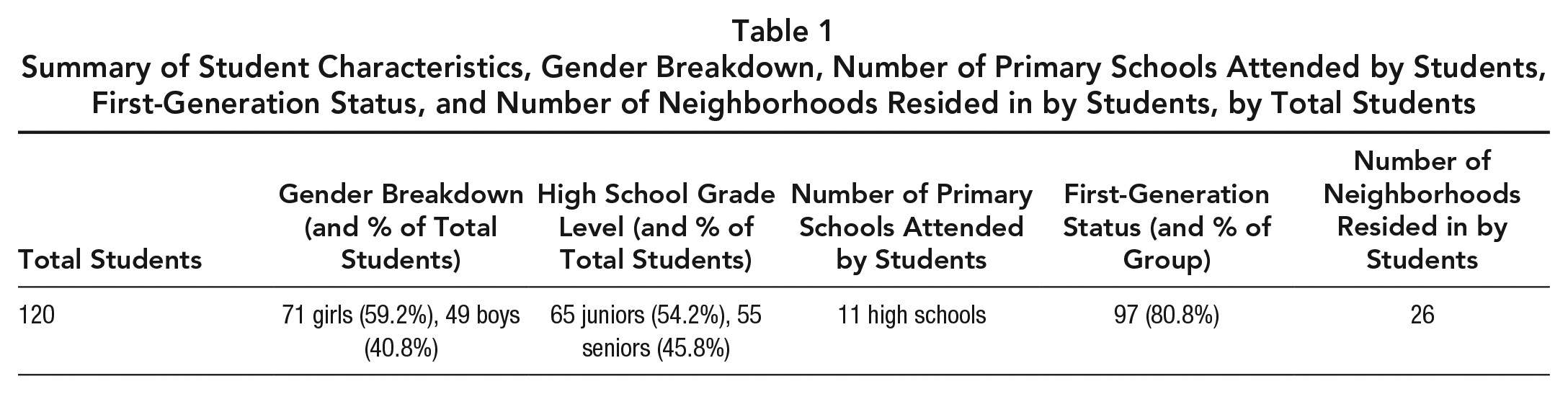
Our analyses draw on 120 in-depth oral history interviews with Black 11th and 12th grade students from LAUSD and across 26 different neighborhoods in South Central Los Angeles. These interviews were collected as part of a larger research project of more than 190 oral histories on Black and Latinx residents’ experiences residing in areas of concentrated disadvantage and aggressive policing and incarceration in Los Angeles. Using a purposeful snowball sampling technique, Black high school students were recruited from two social justice community-based organizations in Los Angeles. Details on these organizations can be found in Online Appendix B (available on the journal website). Given the study’s aims, students self-identified for the study or were recommended by either organization’s program staff. Eligible students identified as Black or African American, attended school in LAUSD, and resided in neighborhoods with high concentrations of low-income Black residents. The final sample included 50 high school Black students who self-identified as boys (42%) and 70 Black students who self-identified as girls (58%). Sixty-five youth (54%) were rising seniors, and the remaining 55 (46%) were rising juniors (Table 1). See Online Appendix C and Table 4 (available on the journal website) for more details on where students attended school and resided at the time of the study.
Summary of Student Characteristics, Gender Breakdown, Number of Primary Schools Attended by Students, First-Generation Status, and Number of Neighborhoods Resided in by Students, by Total Students
Interviews were conducted in person on site at the two community-based organizations or at a convenient public location. All interviews were conducted in two sessions, each lasting between 60 and 90 minutes. A semistructured interview protocol was created to help guide the discussion of all interviews, allowing students to set their own parameters and voice their own experiences (see Online Appendix D, available on the journal website, for further discussion). All interviews were audio- and video-recorded. The recordings were transcribed verbatim and entered into ATLAS.ti software for qualitative analysis.
District Context
LAUSD is the second largest school district in the country and home to the largest school police force in the United States. The Los Angeles School Police Department (LASPD) also represents the fifth largest police department in Los Angeles County and the 14th largest in the state of California (Los Angeles School Police Department, 2020). Although the city is racially and socioeconomically diverse, and several of its neighborhoods have been rapidly gentrifying (Delmelle, 2019), 7.5% of the students served by the public schools are Black and Latinx (Los Angeles Unified School District, 2021). The overwhelming majority of these are low-income students. Existing LASPD data show that Black students are disproportionately more likely than any other student group to be arrested and cited by SPOs (Allen et al., 2018). Moreover, one in four of those arrested are elementary or middle school aged (Allen et al., 2018). Several low-income Black communities and schools are subject to the heaviest concentration of school police interaction (Allen et al., 2018).
Because of this study’s focus on the relationship between school policing in predominantly Black neighborhoods, we concentrate our analysis on understanding how LAUSD’s policies and practices of school policing affect students at schools in South Central Los Angeles. We provide an overview of these policies and practices are presented in Online Appendix E (available on the journal website).
Analysis of Student Interviews
We used a multistep deductive and inductive methodological process to analyze the interviews (Bogdan & Biklen, 2003; Emerson et al., 1995). First, we engaged in deductive coding and thematic analysis. Informed by our theoretical framework, this analysis led to creation of a coding dictionary on the basis of the broader domains of Black students’ sociospatial experiences with school police; the second step followed an inductive coding process. We alternated between interview transcripts and engaged in open coding of transcripts (Charmaz, 1990). Enabling more focused coding line by line, we were able to clarify and identify more specific and recurring themes and patterns for each major domain (Charmaz, 1990; Emerson et al., 1995).
During this process, we collaborated with a diverse team of eight research assistants. Together, we created, shared, and reviewed conceptual and theoretical research in memos. These memos were completed during and after the coding process as an intentional strategy to make sense of final themes and to ensure interrater reliability. This multistep coding process revealed two important themes: (a) the meaning-making assessments of the SPOs’ multifaceted roles and policing tactics and (b) the racialized and spatial interactions with SPOs across community-school contexts. We determined that these steps were complete once we reached data saturation with the specific themes and patterns we discovered. Frequencies were created for each theme, including the level and severity of Black student involvement with school policing (Online Appendix F and Table 5, available on the journal website).
When examining the 120 interviews with Black students, we established trustworthiness and validity during data collection and analysis using four methods (see Online Appendix G, available on the journal website, for a detailed description). This process included triangulation, extended engagement in the field during interviews, constantly searching for disconfirming evidence in each interview, and participant checking (Creswell & Miller, 2000). All names used throughout the present study are pseudonyms. We discuss the study’s limitations in Online Appendix F (available on the journal website).
Findings
Consistent with prior research, Black students are overrepresented in school arrests and citations in Los Angeles (see Table 2), just as they are in national data (U.S. Department of Education, Office for Civil Rights, 2019). Los Angeles neighborhoods with the highest concentration of school police arrests and citations are predominantly poor, racially segregated Black and Latinx neighborhoods located in the South Central region. This area has the highest Black population percentage (38%) and is home to many predominantly poor, racially segregated Black and Latinx neighborhoods and schools (Los Angeles Times, 2021).
Race/Ethnicity Breakdown for LASPD Data and LAUSD for 2014 to 2017
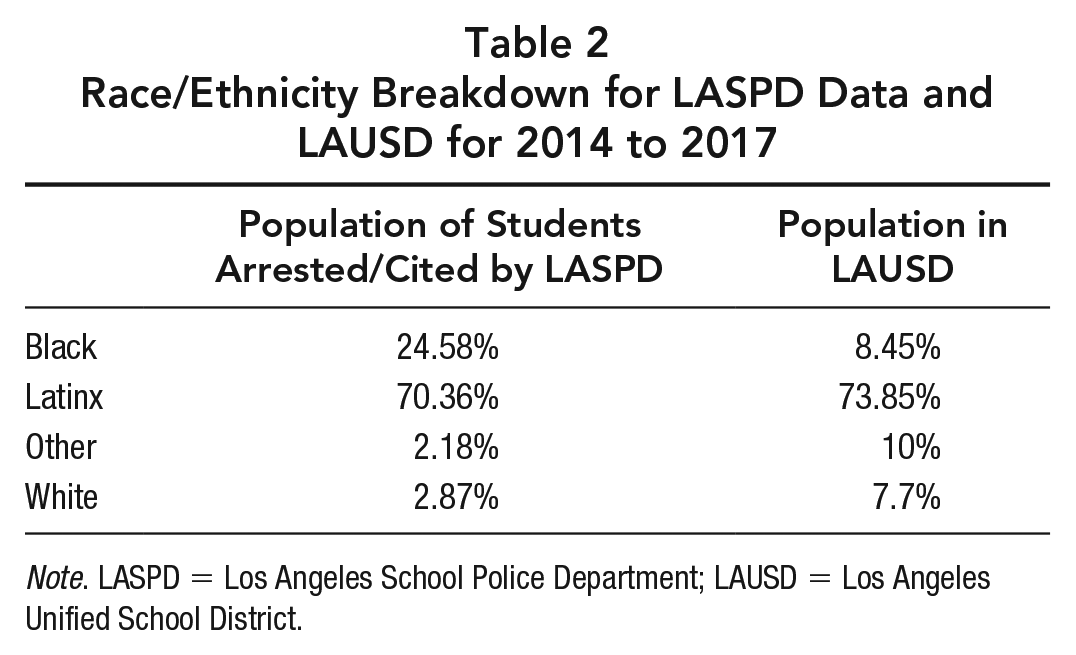
Note. LASPD = Los Angeles School Police Department; LAUSD = Los Angeles Unified School District.
The oral histories shared by Black students from neighborhoods and schools with high concentrations of low-income Black people reveal the social and spatial meaning of school policing, as well as Black students’ early and everyday encounters with officers across school-community contexts. Below, we use Black students’ testimonies to explore school policing practices and procedures in Los Angeles.
A Fully Loaded Cost Accounting of the School Policing Continuum
Black students shared many stories of their early and everyday encounters with SPOs. These interactions in school validated Black students’ existing understanding of community policing whereby the police often engaged in the dual and contradictory roles of care, education and support, as well as punitive social control strategies. This combination results in what scholars refer to as the legitimacy policing continuum (Rios et al., 2020). Legitimacy policing refers to a “shifting continuum by which officers deploy strategies to appear caring and legitimate in the public eye while continuing the legacy programs of racialized punitive social control and surveillance in marginalized communities” (Rios et al., 2020, p. 67). Care and courtesy often involve officers’ voicing or conveying a positive intention at the onset of contact with policed individuals, whereas punitive social control is the negative outcome that may result when students are perceived as violating rules or engaging in some form of infraction. Negative interactions with the police can include but are not limited to the use of arbitrary searches, explicit language, verbal insults, handcuffing, arrest, citation, arbitrary referral to other criminalizing institutions., or physical force by police (Rios et al., 2020).
In analyzing the data obtained from the oral history interviews, we found two types of patterns with respect to how Black students experience school policing, what we call “a fully loaded cost accounting of legitimacy policing continuum” (Painter, 2021; Rios et al., 2020):
Soft coercion, as when Black students come into initial contact with SPOs in school or within the surrounding neighborhood and experience the full continuum of care, courtesy, and punitive social control, which are driven by preemptive criminalization by officers.
Shielding, as when Black students are referred to SPOs by teachers or other school personnel, which facilities shifting the blame onto students and the denial of personhood and innocence through the half continuum of solely punitive policing by officers.
The contradiction between the care and courteous versus punitive policing was apparent through school police interaction with Black students in neighborhoods with high concentrations of low-income Black residents. A total of 66% (n = 67) of our Black student interview sample who were stopped and questioned (n = 101) by SPOs experienced resulting arrests. An additional 29% (n = 30) were issued citations (see Online Appendix D, available on the journal website, for a more detailed discussion). Black students initially describe SPOs’ care and courtesy tactics as well intentioned. For example, one female student told us that “they want to get to know us, our family, and needs of the school and community.” Another male student said, “officers become part of the community. They are cool, a resource we can use to deal with potential outside threats to our safety.” Other Black students, such as one 10th grade male student said, “they assume roles similar to that of teachers, mentors, role models, and counselors.” He went on, “they do whatever it takes to get the who’s who to learn about a students’ reputation at school and where they live.”
Soft Coercion
With Black students, however, the caring and courtesy tactics often take on a different form. Most Black students describe the tactics as harmful, manipulative, and coercive. They are not only building positive trusting and mentoring relationships to “protect the school, staff and students from unknown and future threats to safety,” but several students reported that these caring and courtesy tactics are used to preemptively criminalize students. Information about where students lives, whom they associate with, their family histories with policing and incarceration, and overall reputations on campus and around the surrounding neighborhood informs the ways SPOs interact with Black students. As James, a Black student who attended school in South Central Los Angeles, shared, After being late to school, I found myself in a whirlwind of dialogue with the police officer about structural racism, mental health resources, questions about my mother and siblings. I felt a sense of care in a [school] where there was little. However, this was all under the deficit guise that I was poor and from the hood and a criminal or soon to be one. Eventually I found myself face down on the floor, after being pushed to the ground by my officer for not wanting to engage in further conversation about. I hurt my arm . . . a search of my home was conducted as well as a CPS [Child Protective Service] Investigation.
Many students experienced what they described as the disingenuous nature of school of the caring and courtesy practices exhibited by SPOs. Several students told us that although LAUSD SPOs often offer counseling and support, they also use their ability to extract personal information from students to preemptively criminalize them. We describe this as a form of soft coercion that is part of the full legitimacy policing continuum. Several Black students described interactions with school police that begin with care and courtesy but ended in aggressive policing practices such as formal citations or arrests for relatively minor infractions of school rules. Examples include a student’s being referred for disruptive behavior, profanity, and skipping class. In many cases students described how the full legitimacy policing continuum started with the pretense of counseling and led to a high level of disciplinary intervention (e.g., suspension, expulsion, arrest). It is important to note that the discretion available to SPOs allows their interactions with Black students to be imbued with social control and surveillance, practices that are disproportionately aimed at Black students.
For example, Victor, a Black student born and raised in South Central Los Angeles, placed blame on the school, the district, and the city for providing school police with the means to act independently, with no accountability, and take on multiple manipulative and oppressive roles to control Black, Brown and all students of color . . . and especially those from disadvantaged neighborhoods which is most of us.
Karl, another long-time South Central resident who attends school in the area and encountered early involvement with school police at age 8, expressed common doubts about the extent and sources of soft coercion enforcement methods supported by the full legitimacy policing continuum (Rios et al., 2020): the officer is doing more than what [is required and] needed. . . . I don’t need a mentor or a fake ally who tries to be cool with me while they are patrolling the campus, offering me advice and information about summer programs . . . only to later turn the interaction into gathering information and questioning me about a potential crime or school incident.
Karl went on to note the impact of these enforcement methods: The officer preaches the same message, that he only wants to best for [students], that he’s protecting us, that’s why he’s so hard on us . . . but then [he] is comfortable with questioning me for something I ain’t do . . . keeping me out of class and labeling me as student who is always speaking to the police like I’m some snitch . . . it’s as if he expect that Black students are always up to something bad and it’s his goal to us, the ones supposedly doing all crime, before it happens.
Still, it is a matter of common perceptions and experience among Black students in neighborhoods and schools with high populations of low-income Black people that there are “always punitive measures” when it comes to Black students’ interactions with school police. There is less certainty and agreement, however, about SPOs’ protective rationale. How Black students perceive the school police is one thing, but how they are consistently treated is another. Many Black students describe the coercive agreement and unspoken motives underlying school police interactions. Sherry, a Black 12th grader who has spent her entire K–12 education in South Central, put it this way: I feel forced to greet and fellowship with police in my school daily. . . . It’s a norm, they come up to you, ask you questions, follow you as if they are some school monitor, then they turn around and try to be your friend, ask you about family, about other kids in school . . . then turn around and ask to search your backpack or smell your hands as if I carry drugs.
Other students, however, are less surprised by the disingenuous and coercive motives of school police offer because of the similar patterns across the community-school context. Peter, an 11th grade Black student who recently transferred high schools in South Central, shared, School police do what they have to do to build relationships with us, that’s their first motive and its expected . . . because in places like our school and neighborhood it’s not common for legit relationships to happen . . . for people to actually care for you outside of the classroom and oftentimes that’s can’t even be expected for certain students. . . . These relationships [built by school police] are for their own benefit . . . they want information on who’s who and where things happen like fights and dice games.
The optics of caring relationships presented by SPOs was a central theme of confusion and concern among Black students experiencing soft coercion. What provided many students hope was that school police officers acted in accord with how every other school admin treated poor Black and Latino students . . . low expectations, inauthentic and shifting care, and a high regard for pushing us out to fit the stereotypes that so commonly were associated with low-income South-Central students and families,
said Keenan, who has lived and attended school in South Central for all of his life except for 5th grade. Harsh treatment was described by the Black students we interviewed, even when SPOs had knowledge of the many challenges students might face in their lives. As 12th grader Noreen described, The fact that the officer has taken some much time to get to know unfortunately does not work in favor. It’s as if the officer has a case file of all the problems we’ve dealt with, and the solutions to these problems, yet still resorts to their manual to cite and arrest students at any moment that aligns with what’s in the file.
Ross, an 11th grader enrolled at a large public school in South Central, provides an example: I’m from a certain neighborhood in South Central where gangs exist by mere association of where you live and the colors you wear. The officer knows this. If I wear a certain color, or if I am seen “stationary” after school, I’ve been questioned and cited, not to mention handcuffed and arrested for my presence at an afterschool fight.
Knowledge about a student’s history and behavior can be even more “debilitating” when it is used against students who are referred to school police by teachers and school admin. As Rodney, an 11th grader who attends school and lives in South Central, said, After running away from the scene of a fight, the referral from my school administrators made it easy for [the school police offer] to accuse me, silence me, search me, and arrest me with no consideration of my innocence because of the information shared that it was gang-related and I so happen to be from a neighborhood “known” for gangs.
A similar experience happened to Frank, a 12th grader, who was kicked out of the class for sleeping: I found myself questioned, searched, then pushed up against the wall by the police office because of silence, or what he considered as “continued disorderly” behavior and not obeying school rules based on the information shared by the teacher.
Many students believe that referrals to school police made them an “easy target” for punitive social control without any care or courtesy.
Shielding
Some students acknowledge that the extent and severity of referrals to school police are often compounded by punishment that shields teachers from teaching and moves police officers to police first without second thought about what students have going on or even why the student is supposedly misbehavior . . . because sometimes the curriculum is not relevant or the teacher struggles with teaching.
This is how Tierra, a 12th grade Black student who attended school in South Central Los Angeles, described a practice we called “shielding” as we analyzed what we heard from the students. We use the term shielding, because often Black students are referred to SPOs by teachers or other school personnel and subsequently experience a denial of personhood and innocence, because they object to the lack of education and support they receive in the classroom. When a teacher who has difficulty teaching a class refers a student they perceive as noncompliant or disruptive to a police officer, a learning issue becomes transformed into a criminal offense. Peter (the student quoted above), points out how racial and cultural stereotypes of criminality are used as the true “marker for punishment and a lack of concern from school police officers.”
Eric, an 11th grader enrolled at a large public school in South Central, describes a similar process: It’s a lose-lose. I get called on by school staff or the teacher who deems me not worthy of any school support. The police arrived to control me and threaten me. If anything escalates between us, I risk being cited or arrested. Oh, and I’m getting suspended from school too.
Eric’s comments illustrate how school personnel can shield educators from taking responsibility for teaching. Their reliance on punitive social control measures is an escape valve they can rely upon to avoid addressing the educational issues that undermine the learning environment. Like many other Black students who attend schools and live in South Central Los Angeles, many of the teachers who serve them are inexperienced and unprepared for teaching effectively in urban classrooms. Eric describes the approach that schools take to addressing student needs as the beginning of mass incarceration and the larger criminal justice system for those of us who choose school rather than a life in the streets. That’s what school policing is. It’s the entry way, someone placed on us by teachers and staff, down a horrible path of losses.
Eric shares the harms of these practices “as something we can’t even escape. Police in schools. Police in our neighborhoods. Police liaisons in our classrooms, that’s what I call the teachers. Police everywhere we go.” Eric is convinced that Black students who attend school and reside in South Central have two options: The best-case scenario for Black and Brown students is that you get through a day without your learning interrupted or your drive to and from school delayed by being stopped by the school police or even handcuffed . . . the worst-case scenario is what I witnessed, my peers yanked out of the classroom, thrown to the floor, physically restrained, and arrested . . . all it takes is one interaction before you are forever a target for policing, that is, if you haven’t already received that stamp from where you live. I’m half stamped, always guilty by association so I use my privilege as an AP [Advanced Placement] and honor student to turn my relationships with the assigned police office and every other staff member into ones that benefit me and my community by sharing positive news.
Eric paints a common dilemma experienced by Black students who attend school and reside in South Central: either on the radar of school police and other school personnel as someone “predelinquent” or prone to misbehave or under the radar “but with the potential for being policed” (Sojoyner, 2016). Often underdiscussed but shared by Black students are the benefits of relationships with police officers who have not turned punitive. For example, Eric shared how he capitalized on his AP status to build a relationship with the police. Similarly, Kendell, a 12th grade Black student who recently moved to South Central, shared the “mutual benefit to students of having school police as mentors, coaches and teachers.” Kendell noted, “there’s some positives that come with having a relationship with the police at school . . . there’s a layer of added safety and trust, and there’s the power to shift the narrative about who’s the target.” The value of building positive supportive and mentoring relationships with SPOs was echoed by several Black students, particularly for the benefit of feeling safer on campus, addressing threats, and having a resource to confide about harmful neighborhood conditions. King, an 11th grade Black student, described leveraging officers’ caring and courtesy practices for the purposes of building a “community support network”: I can rely on the police to advocate on my behalf when I’m accused by teachers or school staff of something so small . . . like disrupting the class or posing as a threat. My relationship with the office works in favor of getting a mentoring talk instead of an arrest.
Frankie, another Black student, shared that the school police provided an added layer of protection “from the surrounding violence in the neighborhood near the school.” Frankie added that because of her relationship with an SPO, she could “always count on letting him know about situations at home and how that would impact how she’s feeling or behaving at school,” despite knowing that this went beyond the typical role of police. “What’s most important is that he listened,” shared Frankie.
These positive and supportive relationships that some Black students hold with officers were corroborated by more than a few Black students. James, a 12th grade Black student and long-time South Central resident since the age of 2, noted how he “could always count on the officer to check in, ask about my well-being and if I need anything during the right times.” James suspected that since the officer was from the same residential neighborhood where James lives, there was some cultural understanding of the environmental conditions and challenges faced by many Black students in South Central. Overall, the care, courtesy, and punitive continuum evidenced by Black students’ interactions with SPOs in highly concentrated neighborhoods and schools of low-income Black people demonstrates the complexity of policy reform and actual policing practiced in educational settings. Some Black students shared that they benefited individually and collectively from SPOs who demonstrate caring and courtesy. Despite these positive remarks, it is important to note that the overwhelming majority of Black students we interviewed experienced or witnessed the counterproductive or trust-breaking aspects of punitive social control.
How are we to understand and explain the combination of soft coercion and shielding tactics embedded within school policing practices and interactions in Los Angeles? What do these day-to-day policing practices and interactions, in the midst of disproportionate rates of school police infractions facing Black students as well as those facing neighborhoods that are composed predominantly of low-income Black and Latinx residents, reveal about our understanding of the persistence of anti-Black racism in the post–civil rights period? The answer lies within the interaction of school policing’s social and spatial processes within the physical, social, and material vulnerability of low-income Black neighborhoods and schools in South Central (Gilmore, 2006; Hinton, 2015; Mogul et al., 2011; Ritchie, 2017). This connection is inscribed within contemporary practices of school policing, by way of historical processes related to racial segregation and to structural forces that are directly tied to the evolution of capitalism and that help explain the shifting policing tactics, as well as the continued web of punishment, racialization, and repression experienced by many Black students in low-income neighborhoods across South Central Los Angeles (Rios et al., 2020; Turner & Beneke, 2020).
Discussion
Understanding the consequences of school policing in neighborhoods and schools with high populations of low-income Black people must be central to the study of social stratification, racial inequality, and the interaction between educational institutions and the criminal justice system. However, despite considerable debate over the costs and consequences of school policing, namely its benefit to enhance school order and safety, past studies have neglected to take proper accounting of two research pathways. The first is SRO interactions with particular student populations, especially those burdened by the most historical vulnerability to punitive interactions such as detention and arrest (Curran et al., 2019, 2020; Fisher & Hennessy, 2016; Fisher et al., 2020; Homer & Fisher 2020; Kupchik, 2010; Na & Gottfredson 2013; Owens, 2017; Turner & Beneke, 2020). The second is those encounters involving SPOs who are a part of school districts’ independent school police forces (Morgan et al., 2014). Evidence also shows that very little is known about school policing’s spatial and social processes that link the community-school context to Black students’ outcomes of police encounters (Annamma, 2018).
In this study, we attempt to expand the existing body of scholarship on school policing. Using oral history interviews with 120 Black students from community-school contexts with high populations of low-income Black people, we document how and why school policing practices tend to reproduce racial-spatial outcomes through the application of method referred to as a “sociospatial dialectic” (Peterson & Krivo, 2010; Soja, 2010). Our qualitative findings indicate that SPOs frequently shift tactics to legitimize their presence in schools. In this way, policing is characterized by a “continuum by which officers deploy strategies to appear caring and legitimate in the public eye while continuing the legacy programs of racialized punitive social control and surveillance in marginalized communities” (Rios et. al., 2020, p. 67). This dual role has mixed consequences for Black students in racially marginalized communities and schools. Although some Black students described supportive relationships with SPOs, many others told us about the devastating impact of their encounters with school police despite their stated goals of mentorship, relationship building, and using community policing as a vehicle for school safety.
Findings from this study suggest a need for more focus in future research on the substantial influence that the racialization of community-school context has upon school policing (Arum, 2000; Curran et al., 2019). For example, Shedd’s (2015) analysis reveals the critical role place plays in shaping youths’ perceptions and interactions with criminal surveillance systems and police across community-school contexts. Shedd found that communities and schools with the highest proportions of Black residents were also the communities and schools subject to the highest student reports of increased police contact and perceptions of injustice. Similarly, Curran et al.’s (2019) analysis of SRO involvement in school discipline and how it is shaped by their context reveals SROs responsiveness to agency and district policy. Important features of the ecological context are often included in the memoranda of understanding between law enforcement agencies and school districts. These memoranda of understanding also shape how principals and teachers frequently attempt to involve school police in disciplinary matters with students (Curran et al., 2019). The ecological and place-based features of community-school context documented in this study indicate that the ways in which SPOs shift tactics, and the ways in which school personnel involve in school police in discipline matters, are often focused on controlling Black students in neighborhoods and schools with high population of low-income Black people. As a result, Black students are “policed” both within and outside of schools in ways that ultimately perpetuate and maintain systems that reinforce the domination and power over of poor students and poor communities of color.
Our findings attempt to expand on previous scholarship in two ways. First, this study accounts for two types of pathways Black students’ experience school policing, what we call “a fully loaded cost accounting of legitimacy policing continuum” (Painter, 2021; Rios et al, 2020). This includes “soft coercion,” when Black students come into initial contact with SPOs in school or within the surrounding neighborhood and experience the full continuum: care, courtesy, often followed by punitive social control. These practices are often driven by preemptive attempt at criminalization of Black student by officers. We also describe “shielding,” a process that occurs when Black students are referred to SPOs by teachers or other school personnel and experience a denial of personhood and their rights as students through the half continuum that is focused on automatic punitive social control by officers when students are referred for classroom disruption. We use the term shielding because the practice shields educators from their responsibility to ensure that the learning needs of students are met.
Previous research on these topics has focused exclusively on neighborhood policing or the role of SROs in school. It has paid limited attention to the complex dynamics of school police forces and the officers who are assigned to K–12 schools in Black communities. As SPOs in Los Angeles are distinct from SROs and nonsworn officers, through their organizational structure and expansive roles, documenting the impact of school-based law enforcement more broadly in Los Angeles (or even SROs elsewhere) allows to comprehend the full impact of school policing faced by Black students in schools with high populations of low-income Black people. A focus on school policing’s social and spatial processes, including those instances in which students are referred to police by school personnel, moves us closer to a fully loaded accounting of the costs of school policing on Black students, and a recognition of how the policing continuum is legitimized.
CRSA offers an analytical tool for explaining how the continuum is rooted in a socio-spatial dialectic (Annamma, 2018). For example, studies show that some of our nation’s most pressing social challenges—including concentrated poverty, joblessness, violence, environmental hazards, and incarceration—are disproportionately concentrated in poor, racially isolated, Black and Latinx neighborhoods (Massey & Denton, 1993; Sharkey, 2013). Considerable evidence also suggests the powerful role of racialized policing and geography in these very communities (Fagan et al., 2010; Wilson, 1987). In most of academic analyses, Black children and adolescents are shown to experience the greatest share of police contact in these same oppressed neighborhoods (Lerman & Weaver, 2004). Beyond research on the various social processes that contribute to school police interactions, very little is known about how spatial and social processes inform each other to influence profound variations in school policing across community-school contexts as well as the link these patterns to Black students’ outcomes of police encounters (Annamma, 2018; Soja, 2010).
Second, this study draws on timely and critical sociospatial dialectic methods (Soja, 2010) that involve in-depth oral histories with Black students. These methods were specifically developed to resolve racial-spatial ideas, which are applicable to understanding the larger ecological dynamic between Black students and school police (Peterson & Krivo, 2010; Soja, 2010). These methods empathize the unremedied structural barriers in poor Black communities and schools that play a central role in perpetuating and reproducing racial inequality and marginalization (Annamma, 2018; Curran et al., 2019; powell, 2008). Our findings support extant scholarship on this phenomenon in that we show it as part of an ecological dynamic in reproducing racial inequality, racial stratification and residential racial segregation (Arum, 2000; Carnoy & Levin, 1986; Curran et al., 2019; Huq, 2017). Theories of structural racism and CRSA echo what have long been observed regarding racialized social systems working together to reinforce and perpetuate the marginalization of particular neighborhoods and schools and undermine the educational experiences of Black students.
Future research should aim to use these methods to capture and assess the potential of community and school support networks to combat negative interactions between the SPOs and Black students. In this way we can move beyond critique of the problem to identifying ways in which to resist the processes through which racial subordination is reproduced. Our study would also benefit from in-depth quantitative analysis of school policing for Black students across community-school contexts (e.g., Black, White, and gentrifying neighborhoods and schools), so that comparisons can be made (Allen, forthcoming). Finally, research aimed at extracting the perspectives of SPOs (Ghavami et al., 2021) is needed to further understand how individuals who often have a history in the neighborhoods and schools where they work, can become agents of oppression because of the roles they occupy. Further quantitative analysis in the school policing field, such as the use correlated variables (e.g., poverty, density) can also be used to explain variance in disparities that may be evident in different schools, for better understanding the role of race and space.
Findings presented in this study suggest that the community-school context is crucial for understanding school police interactions and practices with Black students in Los Angeles. Our results demonstrate the persistence of anti-Black racism in the post–civil rights era by viewing school policing as a central racialized institution, among schools and neighborhoods. This conceptualization is consistent with recent work by Bell (2020) and Wacquant (2001), who regard policing as a “located institution” that is used to maintain control in low-income Black communities and that serves as a lens through which individuals make meaning of places. What can be gleaned from our study is school policing acts as its own racialized located institution that emerge out of (a) a complex interaction among the demographic and spatial characteristics of students, teachers, school police, and the social organization of school interpersonal communities and (b) the institutional environment around schools, in the surrounding communities that school police are responsible for patrolling (Arum, 2000). School personnel and SPOs follow established local policies and procedures similar to the work of Curran et al. (2019), and students must navigate these rules, which vary by spatial and demographic context (Gordon, 2020; Sampson & Bartusch, 1998; Wilson, 1968). One important implication is that students’ backgrounds and school-community context interact with policing to influence the outcomes of police-student encounters through a complex racial-spatial and temporal process of exposure (Peterson & Krivo, 2010).
Together, our findings enhance our understanding of the neighborhood and school impacts of school policing and suggest the need for greater structural investment in programs that prevent and/or mitigate the harms of Black students’ school policing interactions. To gain a better understanding of the complexities underlying school policing disparities, policy and practice must be attended to in a much more fulsome way through law enforcement practices and interactions in school. The structural features and processes of punitive and coercive school policing tactics produce a punitive environment for Black students in poor Black communities and schools. As previous research suggests, explicitly acknowledging race, racism, and its perceived influence on policing models can lead to improved outcomes when tied to actual policy reform and practice (Carter et al., 2014; Howard, 2010).
Conclusion
Recently, the role of the police in American cities, particularly in predominantly Black communities, has become the subject of considerable controversy. In the wake of several high-profile police killings of unarmed Black citizens, numerous disturbing violent arrests of Black students in the media, and a vast amount of data documenting racial disparities in school discipline, calls for defunding the police have rapidly come to include our nation’s schools (Welsh & Little, 2018).
LAUSD has taken important steps toward reforming school safety to support students and address long-standing issues of racial equity. Examples include hiring climate coaches at every K–12 school and creating safety alternatives such as safe routes and passages programs (Los Angeles Unified School District, 2020). However, these programs as well as alternatives to school policing require financial resources and adequate accountability systems to support their success. The continued existence of school police within LAUSD, in addition to these programs, runs contrary to the stark racial-spatial patterns of arrests and citations, in addition to the structural racism that exists in and around schools. In alignment with community organizers across Los Angeles, the solution is to fully defund and eliminate LASPD as well as remove all police from LAUSD schools. Instead, the district should invest heavily in student mental health and wellness supports and positive safety initiatives (The Strategy Center, 2021).
Our study serves to legitimize how the policing continuum is rooted in a sociospatial dialectic that informs Black students’ with SPOs. In doing so, we demonstrate the need for further policy and practical change immediately. Once we begin to reestablish school policing tactics based solely on courtesy, trust, and community-building strategies that operate independently from punitive racialized practices, only then we can reimagine school order and safety as by-products of larger social structures and ultimately turn vicious webs of punishment into caring and ultimately nonessential ones.
Supplemental Material
sj-pdf-1-edr-10.3102_0013189X221095547 – Supplemental material for A Web of Punishment: Examining Black Student Interactions With School Police in Los Angeles
Supplemental material, sj-pdf-1-edr-10.3102_0013189X221095547 for A Web of Punishment: Examining Black Student Interactions With School Police in Los Angeles by Terry Allen and Pedro Noguera in Educational Researcher
Footnotes

Authors
References
Supplementary Material
Please find the following supplemental material available below.
For Open Access articles published under a Creative Commons License, all supplemental material carries the same license as the article it is associated with.
For non-Open Access articles published, all supplemental material carries a non-exclusive license, and permission requests for re-use of supplemental material or any part of supplemental material shall be sent directly to the copyright owner as specified in the copyright notice associated with the article.
