




Abstract
Civil courage refers to the behavior where people actively intervene to protect a victim in a concrete situation of injustice despite the risk of becoming a victim themselves. To act with civil courage, one requires competencies that relate to prosocial values as well as the physical and social ability to act. In this context, this brief reports the opinions of 2,046 respondents—representatives of Germany with respect to age, gender, and region—on what, according to them, are the best contexts for learning civil courage. “At home and/or from family” as well as “through volunteering” are considered the most suitable contexts to learn civil courage. In contrast, television, social media, and the internet are considered the least supportive contexts.
Keywords
Civil courage (Zivilcourage) is defined as the behavior that a person exhibits when helping someone else at the risk of substantial personal disadvantages (Greitemeyer et al., 2007; Rate et al., 2007). Examples of civil courage include cases where people help the victim by speaking up against the victim’s bullies, perpetrators, or harassers. However, this intervention may result in these people becoming victims themselves. For instance, Greitemeyer et al. (2006) report how, in 2001, a small group of young Turks intervened when about 20 neo-Nazis attacked a Greek citizen. However, by saving the victim from extreme and life-threatening violence, they became—while clearly outnumbered—the new targets of the neo-Nazis’ violence until police forces were informed and could stop the violence (Kosog, 2010). Similarly, Galdi et al. (2017) describe in their article how, in 2015, an Indian woman who wanted to bring a man to the police station for harassing her was not helped by any of the numerous bystanders. Inherent to this bystander effect, many observers are likely able to identify ongoing injustice as well as the need for someone to intervene. Nevertheless, the risk of very personal negative consequences—such as being injured themselves or being involved in cumbersome legal procedures afterward—prevents people from actually intervening in concrete situations (Galdi et al., 2017). Taking this into consideration, civil courage requires not only competencies that relate to prosocial values, such as social justice, fairness, sharing, or protecting others, but also concrete competencies to intervene when needed, such as the ability to act with confidence and react to other people’s behavior impactfully. Therefore, civil courage relies on the combination of internalized social norms and concrete competencies to act when needed. Such norms and competencies are the output of different learning processes over one’s life span, which can occur in a broad range of contexts, including formal, nonformal, and informal education (Romi & Schmida, 2009).
Therefore, the goal of this brief is to provide insights into how citizens believe that various educational contexts contribute to creating more civil courage. In doing so, this study not only contributes to the growing debate that civil courage is important, and thus should be developed, but also explores citizens’ implicit theories on the contexts in which people can learn to act with civil courage. Such a descriptive approach of citizens’ shared insights—or implicit theories—does not capture the actual and proven causal effects of the specific learning contexts on particular skill sets. To create such concrete insights, more elaborate and targeted, but also more complex, research designs are needed. However, in the context of this brief and relying on the notion of collective intelligence (Epp, 2017), a description of citizens’ implicit theories has several advantages for agenda-setting, both with respect to further research avenues and educational policy development. From a research perspective, a first set of propositions can be developed based on these results with respect to the relative importance of learning contexts as well as the complementarity or substitutability of various learning contexts for civil courage. Moreover, citizens’ implicit theories on how societal processes work are relevant in terms of how they act and engage in particular behaviors (Greitemeyer et al., 2007; Tabernero & Wood, 1999). Hence, documenting citizen’s implicit theories on learning contexts is the first step not only in documenting common knowledge but also in explicating shared citizens’ cognitions, which can be built on to introduce effective policy measures to affect citizens’ behaviors (Boyne et al., 2004). Concretely surveying a representative sample of citizens approximates a democratic representation, which is relevant to developing policy guidelines that are well received by citizens (Epp, 2017).
At the center of civil courage is—when a situation occurs—a trade-off that each individual has to make between safeguarding a social norm and facing the risk of substantial personal harm. However, this trade-off may be very intuitive and spontaneous (Halmburger et al., 2017). Various educational contexts, including formal teaching and informal learning by doing, can contribute to internalizing the values and capabilities that are required to act spontaneously and intuitively.
Data and Setting
The data for this brief—from 2,046 respondents—were collected in an online survey (November 2020) in Germany, assisted by a professional panel provider (Qualtrics Panels). Data, descriptive statistics, and research protocol are available at https://osf.io/3fu4p/. Respondents were invited and selected to participate based on the representativeness criteria for age, gender, and region (Bundesland). Respondents were rewarded through the rewarding system of Qualtrics Panels (ESOMAR [European Society for Opinion and Market Research] approved), with about 60 panel points for around 12 to 15 minutes, where 60 panel points approximately equate to about €2.50 to €3.00.
In the survey, respondents were provided with a definition of civil courage based on the descriptions in Greitemeyer et al. (2007) and Rate et al. (2007). Respondents read the following: Civil courage is defined as: Courage shown by a person by representing human and democratic values (e.g., human dignity, justice, helping people in need) in public (e.g., towards authorities, superiors, strangers or perpetrators, regardless of possible personal social and physical consequences).
Subsequently, the respondents were asked, “Where can people learn civil courage? Please indicate what you think are the best ways for people to learn to show civic courage.” This could be answered with a 9-point numbered scale from −4 to +4; verbal labels were added to the extreme options, namely, “Not at all” (−4) and “Very much” (+4). The learning contexts that respondents could rate were (1) “through volunteering,” (2) “in sports organizations,” (3) “in youth movements,” (4) “in school,” (5) “in extracurricular activities,” (6) “at home and/or from family,” (7) “from friends,” (8) “from television,” (9) “from the internet,” (10) “from social media,” and (11) “in professional organizations.” The order of these items was randomized for each respondent.
Additional demographic variables were also studied: educational level, migration background, and occupation; for those who indicated “employed” (42.18%), the sector of employment was asked.
Results
Figure 1 reports the mean values and 95% confidence intervals for each learning context; items are ranked according to these mean values. The scale’s middle option is indicated with a vertical line. The 95% confidence intervals of the mean values reported here do not include this middle-scale option (“0”). Respondents assess that “at home and/or from family” (mean = 2.35) and “through volunteering” (mean = 2.18) are the strongest contexts to learn civil courage. Still on the positive side but significantly less strong are “in sports organizations” (mean = 1.85), “in extracurricular activities” (mean = 1.80), “in school” (mean = 1.69), “in professional organizations” (mean = 1.66), “from friends” (mean = 1.60), and “in youth movements” (mean = 1.55).
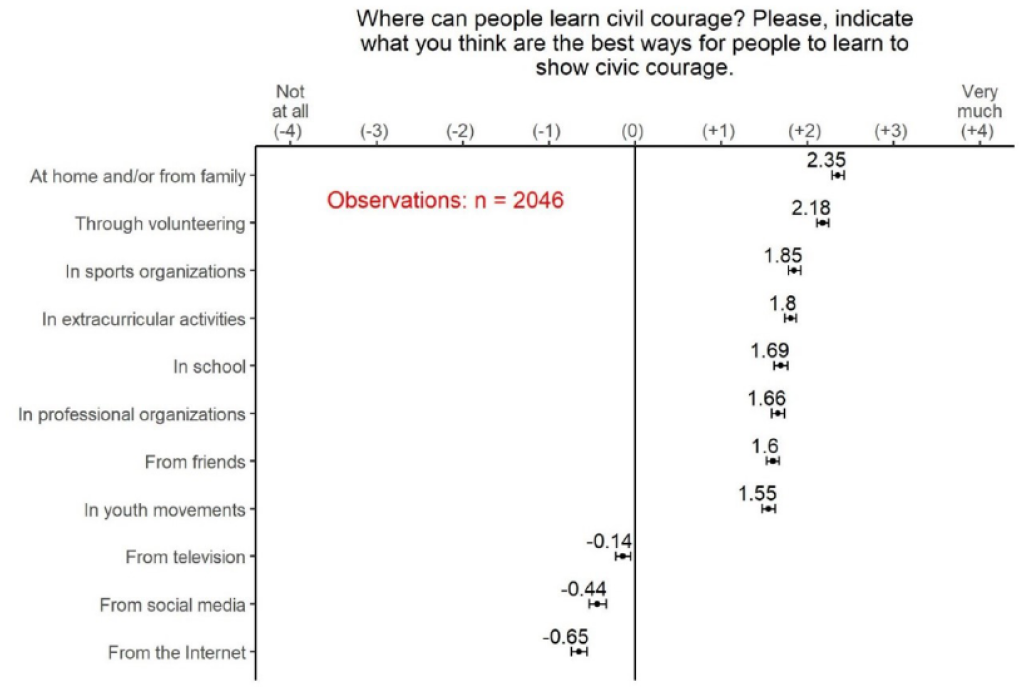
Learning contexts ranked from the highest to the lowest with respect to citizens’ opinions on their potential for civil courage learning—mean values and 95% confidence intervals.
The following three contexts are scored on the negative side of the scale: “from television” (mean = −0.14), “from social media” (mean = −0.44), and—most negative—“from the internet” (mean = −0.65). The mean values for these three most negative contexts significantly differ from each other, still showing substantial variation.
When analyzing these results for various respondent groups, several clear differences are visible. For example, Figure 2 shows that no substantial age differences exist in opinions for the learning contexts that are rated on the positive side of the scale. However, clear differences exist for social media, F(3, 2042) = 11.04, p < .001, and the internet, F(3, 2042) = 24.42, p < .001, where younger people assess the potential of these learning contexts as less negative.
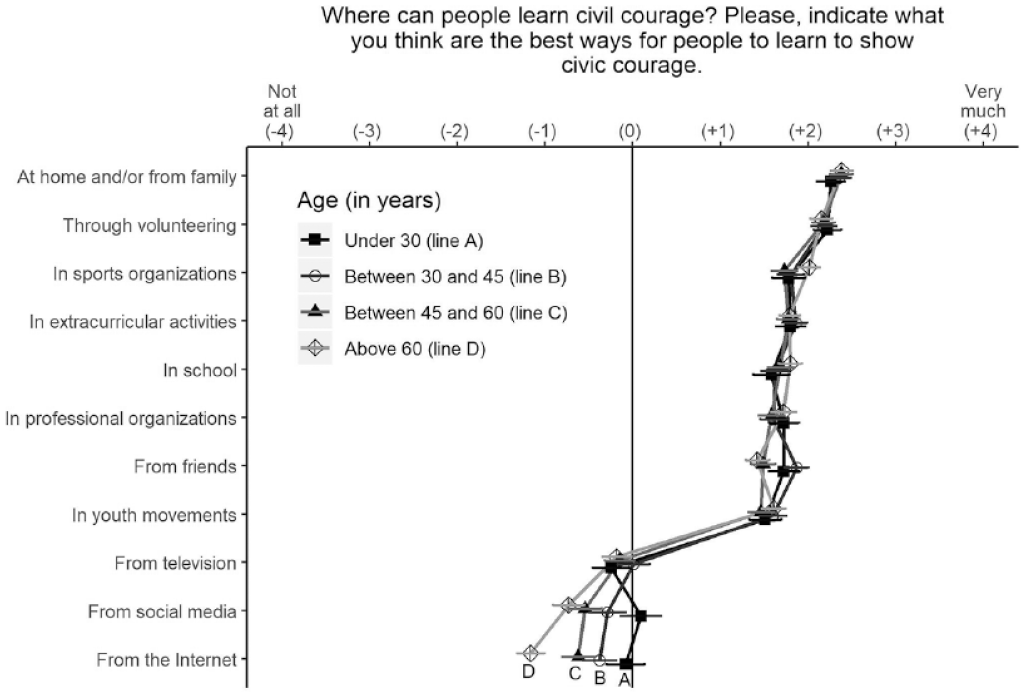
Learning contexts ranked from the highest to the lowest with respect to citizens’ opinions on their potential for civil courage learning—four-group distinction based on age categories.
Moreover, woman are slightly, but significantly, more positive compared with men on the potential for civil courage in all learning contexts, especially about “at home and/or from family,” F(1, 2044) = 22.40, p < .001; and “from social media,” F(1, 2044) = 10.20, p < .01. People working in the nonprofit sector are more positive—compared with employees of the public and private sectors—regarding the potential of extracurricular activities, F(2, 860) = 4.714, p < .01; and employees of professional organizations, F(2, 860) = 3.53, p < .05. The opinions are similar (i.e., no significant differences with substantial effect sizes) for respondents with different education levels. Migrants also have the same opinions as nonmigrants, except for “from social media,” F(1, 2044) = 9.08, p < .01; and “from the internet,” F(1, 2044) = 19.19, p < .001, where they score significantly higher. However, this difference is mainly visible among first-generation migrants, as compared with second-generation migrants.
Conclusion and Further Research
In summation, civil courage is believed to be learned in a broad variety of contexts, with family/home and volunteering as the contexts with the strongest learning opportunities. This can help policymakers, scholars, and educational leaders in setting priorities, for example, through family support and/or encouragement for volunteering programs, to increase civil courage values and competencies. Moreover, as multiple contexts are believed to be relevant, combinations of learning contexts could be developed and evaluated as (1) ways to reach civil courage more efficiently and effectively and as (2) valuable alternatives when, for example, the family or volunteering contexts are missing for some groups in society.
Therefore, this descriptive analysis of citizens’ implicit theories is a valuable—but only a first—step, as it documents common but widespread assumptions on where civil courage can be learned. However, as these preliminary insights are based on shared and abstract implicit theories from citizens, further theorization and testing is necessary on how particular actions in specific learning contexts—and particular combinations of them—can influence concrete moral, educational, and societal outcomes.
These data report citizens’ opinions from Germany. Despite the fact that Germany has an educational system, with both formal and nonformal components, that is comparable with those of many other countries, differences likely exist with respect to different built-up training capacities on the particular topic of civil courage, as well as different educational, policy, and media attention given as far as the advancement of civil courage is concerned. As a systematic cross-country analysis does not exist yet, further research can evaluate whether similar implicit theories exist in other countries. In case differences exist, further evaluation is necessary to explain these differences. This would additionally provide valuable insights on what determines different levels of civil courage.
