




Abstract
Educational research is repeatedly confronted with the question of its relevance. Current interpretations of relevance narrowly focus on outcomes and impact of research. In this essay, we propose an alternative, ontological conceptualization of relevance, arguing that more is at stake than outcomes and impact. We characterize the ontology of education and learning in terms of people’s meaningful movements in an always changing world and propose that relevance of educational research resides in what we call “ontological synchronization”—continuous attunement to what is happening and matters at hand, and what future is being generated, including what values and judgments researchers themselves perpetuate in society. Such synchronization, we conclude, hinges on a disciplinary and ethical commitment to principles of actuality and generativity. We discuss what such conceptualization of relevance implies for educational research.
Keywords
Teachers, students, parents, policymakers, and other professionals care about education as the key to better positions for young and old in a more just society. Educational research is expected to inform scientifically the ongoing debates about good education and learning through life, in particular within the current polarized world (The Politics of Learning Writing Collective, 2017). At the intersection of disciplines such as educational studies, educational psychology, learning sciences, and related developmental, behavioral, social, subject-specific, and organizational disciplines, educational research has become an established domain. The great expectations, however, come with recurring concerns about its relevance (e.g., Farley-Ripple et al., 2018; Gutiérrez & Penuel, 2014; Snow, 2016). We see various criticisms, for example, that research findings are not considered useful, applicable, generalizable, or replicable (Broekkamp & van Hout-Wolters, 2007; Kim, 2019; Makel & Plucker, 2014; Vanderlinde & Van Braak, 2010).
The complaints illustrate what we, as educational researchers from Europe and North America, see as a tendency in many quarters of educational research: judging the relevance of research on the basis of its outcomes and its local or lasting societal impact. The same orientation on effects is evident in the reviews of research proposals and publications. Research can have a societal impact, but it is, we argue, not a suitable guiding principle for achieving or judging relevance. Impact is namely a rather empty notion: It focuses on what happens with outcomes, and disregards what research findings are or should be about in the first place. It is possible that research has a major impact but perhaps a contested one. For example, Hattie’s (2009) synthesis of meta-analyses has become very popular, but the literature abounds with criticism of his approach and undesirable consequences (Bergeron & Rivard, 2017; Terhart, 2011). Another example is the research on learning styles that has also had a significant societal impact. However, most researchers contest the concept of learning styles and lament the assessment industry founded on it (Kirschner & van Merriënboer, 2013; Pashler et al., 2008). One can also imagine a research project where results are negative or not ready for dissemination. The wisest decision then may be not to try and have an impact on education. With the current focus on impact, one has to be strong in resisting this call as the primary basis for judging relevance—especially if one has promised mountains in the original research proposal.
We do agree that our field struggles with a relevance problem, but it is more fundamental than disappointing outcomes or impact. Relevance can be defined as “relation to the matter at hand” (Merriam-Webster, n.d.). Accordingly, this essay proposes a conceptualization of relevance of educational research in terms of its ontology, that is, in terms of the key matters that our field is about and researchers’ relationship with those matters. Our ontological perspective leads us to raise the following questions: What is the nature of learning? What happens and matters when it comes to education in current societies? How do we as educational researchers identify, respond to, and intervene in what happens and matters in education and processes of learning throughout life? By asking these questions, we join critical discussions on ontology in our field (e.g., Bang & Vossoughi, 2016; diSessa & Cobb, 2004; O’Connor & Penuel, 2010; Packer & Goicoechea, 2000; Roth, 2018; Säljö, 2002). In line with Barad (2007), we take ontology to include epistemology and axiology, meaning that a consideration of ontology inherently involves questions such as: How do we come to know and what are consequences of knowledge? What values and perspectives do we communicate, and how do we come to these values? An answer to this last question requires that we attend to our particular locations as scholars in social and economic systems, networks of power, history, and other positionings that sociologists of science and critical scholars have noted shape our standpoints in research.
We see it as an ethical obligation of our profession to come up with a view on what makes research relevant and worth doing, even when not yet clear how useful findings or products will be or how much impact research will have. As professionals we need to have a proper perspective on the nature and purposes of educational research (cf. Winch, 2001). The conceptualization of relevance that we offer in this essay does not take sides as to what form of research is more relevant; it is not meant to suggest particular research topics or methodologies but to offer an approach for educational scholars to explicitly address the question of what is relevant research. To ground our proposal, the next sections first summarize our ontological claim about the nature of learning and education. We argue that education and learning are specific kinds of historical and moving phenomena and pinpoint what potential harm to relevance we see in the field when not taking this moving nature into account. Inspired by critical perspectives in philosophy and the sociology of science, we propose an approach that we call ontological synchronization. This approach entails adhering to two principles: actuality and generativity, where the first entails staying attuned to what is happening and matters in the present and presence of people, and the second entails staying aware of what future is being suggested for people in settings and societies, including in research.
An Ontology of Meaningful Movements in Motion
We propose that what is key in the ontology of education is the human and natural world as it is and is becoming. Educational research is concerned with an ontology in motion—with transitions over time, which can be as small as learning a new word, as long and wide as collective development of practices across generations, and as large as a global transition to online education due to the outbreak of a pandemic. The meaning of such transitions resides in people’s own movements. These movements are defined, more specifically, by people acting from particular positions in the world (e.g., an institutional position as student or teacher) with certain purposes defined by themselves (e.g., as students wanting to become a doctor) and for them (e.g., by educational standards) with emergent potential in the future (visualized as a simplified timeline in Figure 1).
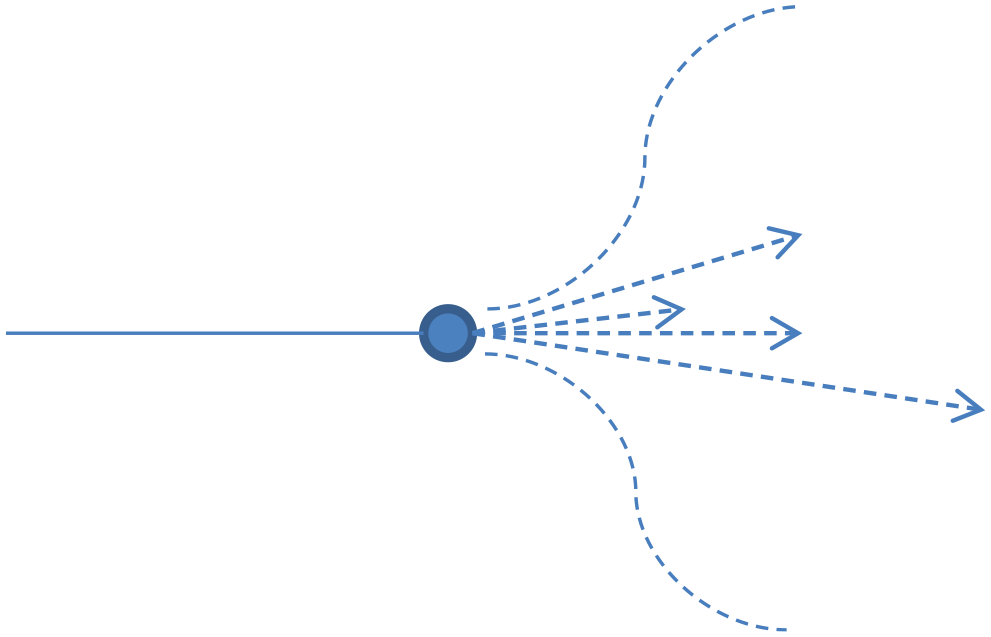
An ontology of meaningful movement in motion in perspective of irreversible time (horizontal line), with a past-present position in and of world (dot), future-oriented purposes (dotted arrows), and emergent potential (dotted lines representing an open space with new possibilities).
The idea of learning and education as concerning meaningful movements in motion (which we abbreviate as MMM) along with multiple positions, purposes, and emergent potential (PPP) is our synthesis of many scholars’ and our own views. For example, both Dewey (1915/2013, 1916, 1938) and Vygotsky (1980) described learning and development as a process starting from particular positions (e.g., a child of a specific age, with certain interests and capacities, located in some family situation, within a larger social system that is stratified in certain ways) and always moving into specific animated directions (e.g., through guidance of parents or teachers). These directions can be more or less motivated and deliberate (cf. Lave, 1996), but in all cases they have purposes; they are meaningful simply because they are informed by individual and collective histories (i.e., as experienced, remembered, reimagined) and valued by people and societies with historicity and more or less anticipation in mind (cf. Bruner, 1990).
Education thus is a normative practice and inherently political; its ideal form and organization can differ and develop per institution, per society, and over time, depending on underlying societal motives and purpose (Biesta, 2015; Dewey, 1915/2013). Like several contemporaries in psychology and philosophy (e.g., Mikhail Bakhtin, William James, George Herbert Mead), Dewey and Vygotsky stressed that, despite individuals’ and societies’ motives, outcomes are ultimately open. The essence of education as a space for learning and development is precisely that it can bring persons something new of their own. Rather than a process of change with a predefined endpoint then, learning is movement from a position with purposes, where potential is per definition open (PPP).
The notion of potential fits the idea of learning as unfolding over time with the world (cf. Bakhtin, 1981, 1993; Dewey, 1916), being possibly expansive (cf. Engeström, 2015). This unfolding nature of learning indicates how it is not only about meaningful movement (e.g., a process of learning taking place in or across contexts and practices; Akkerman & Bakker, 2011; Gutiérrez, 2008) but also meaningful movement in motion (Akkerman & Niessen, 2011; Bang, 2020). Here, the term “motion” refers to the ongoing and irreversible process of transition in time-space locations, continuously leading to new (im)possibilities emerging in, between, and around people (Bakhtin, 1981, 1993; James, 1890/1983) and with more or less continuity in directions over time (cf. Akkerman & Bakker, 2011; Akkerman & Meijer, 2011). As McDermott and Pea (2020) write, learning is “the work people do while reflexively reorganizing a past reaching into a future” (p. 105). Put more concretely, learning is not only a spotting and achieving some place on the horizon, as in “I hope to become an astronaut and travel to the moon” but movement to a horizon that already changes along with any movement toward it: Already while traveling to the moon, humans face and create new conditions and aspirations (e.g., visiting Mars, leaving Earth).
Along with people, institutions, and societies that look forward to what they intend or hope to become, educational researchers also look forward and anticipate. They typically investigate whether and how individuals or collectives reach an intended learning goal, a qualification, or aspired position in society, with a premise that such new positions will allow them to do things they were not able to do before. Frequently, researchers follow herein the logics (including purposes) of people in particular positions, of particular settings (e.g., school, leisure practice, workplace), institutions (educational ones, companies), or of programs and policies more broadly (e.g., on talent, digital literacy, inclusiveness, community engagement). They are also embedded within networks of powered relations with other individuals, organizations, and institutions. This shows how educational research itself is part of the ontology: It identifies in its own present and context what seems to matter for the future of people and societies.
The Challenge of Objectifying Meaningful Movement in Motion
Although looking forward along with society appears to ensure relevance of educational research, objectification of processes—the act of turning them into a defined object to be studied—puts relevance at risk. Objectification of processes immediately narrows down the future as already anticipated by educational stakeholders or researchers in terms of some desirable direction, rather than taking movements to be something occurring naturally in people and the world, continuously across time and space, also independently of research and in potential alternative and emerging directions than might be intended or foreseen by an intervention, setting, or researcher’s hypothesis. Arguably, objectification of processes is necessary to be able to attend to change and particular developments (e.g., drop-out of students in higher education programs, achievement gaps over summer), but this always communicates assumptions and values about most logical or ideal trajectories (e.g., an assumption of singularity and linearity in program commitment or of learning as continuous progression).
The problem at stake is that educational research often portrays objectification as a neutral act, as if researchers can study whatever situation or process as a given object and then study the object dispassionately. Consider, for example, how Pashler et al. (2009) referred to this expectancy, writing “we were commissioned by Psychological Science in the Public Interest to assess, as dispassionately as we could, the scientific evidence underlying practical application of learning-style assessment in school contexts” (p. 106). Any suggestion of neutrality, as repeatedly argued in various disciplines, is artificial but also problematic and possibly harmful. In the next section, we claim it overlooks that the object of research is about people and a world ingrained with perspectives that might run against the way the researcher starts viewing and studying individuals and settings. In the subsequent section, we claim that suggestions of neutrality ignore how researchers are themselves subjects of the objects of research, that is, already informed and positioned by society in particular ways. Appeals to neutrality obscures the normative nature of all research, as well as the stances and perspectives that scholars always bring. Summarizing, objectification comes with the risk of disregarding both the human and moral nature of research. After elaborating on our claims in the next two sections, we propose a way toward ensuring relevance of research.
How the Object Frames Developing People in Changing Societies
From the perspective of a PPP ontology, objectification of meaningful movement takes place in a normative space: It rests on a particular logic defining the initial positions of the groups and individuals being studied, the purpose to which their movements are or should be oriented, and the potential that is anticipated to emerge from these movements. In one project, we investigated how high-school students in a talent program for science, technology, engineering, and mathematics (STEM) developed their initial interests in this domain toward STEM studies and careers. We thus rendered these students already in a specific way with the setting and emerging STEM policies and programs in society in mind (Akkerman & Bakker, 2019). Yet youth themselves may have other views about the positions they have or ought to have, with also other than academic and career motives that drive their actions (e.g., more pressing aims related to health, family, or religion). In fact, adolescents we have been following in this and other interest projects all reported to have multiple academic, leisure, and family interests they equally valued in making balanced study and career decisions (e.g., Vulperhorst et al., 2020).
Although the logics by which researchers start their research can be justified by departing from societal intentions in a targeted setting or intervention or any plausible theory following from argumentation or previous research, these logics are inherently partial and particular, and so may conflict with alternative ways of viewing who people are or what they should strive for. Educational research continuously brings judgments about people, linked to the labels assigned to them upfront (e.g., students, teachers, or experts; Packer & Goicoechea, 2000) but frequently also by qualifying them distinctively as average, exceptional, problematic, or ideal cases (cf. Valencia, 2010), with notions such as mainstream, talented, amotivated, resilient, marginalized, or “at risk” students, drop-outs, knowledgeable teachers, or adaptive experts (Hilt, 2015; Horn, 2007; Svensson et al., 2014). In doing so we centralize particular positions and purposes over others, subtly accepting or reinforcing the value and potential assigned to these through research.
In contrast, with an ontology of meaningful movements in mind, we can see the world as driven by many logics informing what, how, and why people live their lives in particular directions. At the level of personal ecology, not only educational settings but also family, peers, and neighborhoods create positions, purposes, and project futures along with ideas about how to engage in school, subjects, how to make educational, vocational, or alternative choices. At the societal level, educational institutions, leisure clubs, and companies form infrastructures with different ideas about who their students, teachers, and employees are or should become (see our STEM career example). Also materials, our own body, and nature call to act in specific ways, their mere presence and conditions for example already asking us to take care of them (e.g., climate change). Although pushed and pulled by many logics (ontology as “polylogic”), people are agents making their own sense of self and world. It means that people are always unique in their own responses and always more than what others can see as their unique position (Akkerman & Niessen, 2011; Akkerman & van Eijck, 2013). And it means they can as much comply to as disregard or oppose what they are offered or expected to do, with capacity moreover, to imagine and create things or find position, purpose, and potential not yet laid out for them.
In light of such polylogic, creative, and moving ontology, any objectification of people within an expected or intended process of learning and development is particular and partial, hence potentially unjust (e.g., Bang & Vossoughi, 2016). But even the very notion of justice requires attention to multiplicity. For example, as Hilt (2015) showed in the context of inclusive education policies, inclusion of those who are excluded also comes with a paradoxical form of exclusion in “being included,” creating an aggregate positioning of individuals. As illustrated elsewhere in the context of collaborative research, space for multiplicity and diversity of positions at collective level appears always in tension with multiplicity and diversity in positions at individual level (Akkerman et al., 2012), challenging open dialogue not only between some “We’s” or “I’s,” but between many “I’s in We’s,” and many “We’s in I’s” too. The challenge that comes with objectification also reflects in research on educational infrastructure. Consider the plethora of labels for settings we study or help to design such as “STEM programs,”“problem-based education,” “communities of practice,” “professional development schools.” Research here risks overlooking not only what, how, and why settings became the way they are (see Cole, 2016, for a historical account of an educational design) but also what involved educators and students, in their everyday, multivoiced and intergenerational practices and selves make and take of it.
The particularity and partiality in objectification of people and settings not only shows the normative space in which research takes place, they also become consequential as they inform the methods used for following, mapping, and evaluating movements, including decisions about what parts of people’s lives and settings are rendered visible and what parts thus left invisible. Relying on its approach, research is used to conclude and evaluate whether purposes and anticipated potential of people and settings are reached. Educational research frequently comes with suggestions or claims about “what works,” sometimes in quite definite ways informing longer-term decisions related to programs and policies.
The question is whether the partial perspectives allow researchers to make such bold and durable claims. Returning to our STEM project, we discovered how much we could have missed by focusing only on targeted STEM interest development. By recentering on participants’ life-wide perspectives, for example, we came to different conclusions about interest pursuits, no longer seeing those who chose other disciplinary directions as “deviating” or “disappointing” cases, nor viewing this as evidence for the STEM program having been ineffective. Recognizing how adolescents were seeking their own, oftentimes hybrid, positions and purpose across various disciplines and other life domains showed how they can be rendered successful cases in their own respects (Akkerman & Bakker, 2019; Vulperhorst et al., 2020).
Awareness of the particularity and partiality of research perspectives also asks for a more critical stance toward the wish to control learning that educational research often portrays (Biesta, 2015; Engeström, 2011). We see this wish in expectations about interventions to achieve intended outcomes “in” people, with striking linearity in its causal reasoning (Akkerman & Bakker, 2019). We see it in the wish to predict people’s beliefs, behaviors, or pathways, and in the premise of replicability studies. Researchers often express disappointment when their models explain little variance, when conditions show no significant differences or small effect sizes only or when, in the case of replicability studies, findings across studies conflict (Herrington & Maynard, 2019; Kim, 2019; Lortie-Forgues & Inglis, 2019; Makel & Plucker, 2014). Noteworthy is how researchers often blame the methods used, questioning, for example, the reliability or internal validity of used operationalizations and measurement techniques, whereas findings may as well show the problem with an initial assumption of a stable, generalizable, and predictable ontology (cf. Sfard, 2008); see, for example, Lemons et al. (2014) for a contextual-historical interpretation of declining effect sizes in randomized controlled trial research in the context of reading programs.
A moving ontology will inevitably lead to varying findings across people and will find replication over time to be variable as well. People and societies change, along with entire knowledge bases, technologies, networks, institutions, professions, motives for and even conceptions of learning and education. Of course, at social, cultural, and ecological levels, the world does not necessarily change with rapid pace; it has also stability and even stubborn systemicity through its historicity, relationality, and natural environment.
Scholars have argued that the educational sciences, with other social sciences, have been too strongly oriented to the natural sciences or adopted dualist views of science, along with ontological assumptions about people as interchangeable elements to be studied objectively and not speaking back (e.g., Flyvbjerg, 2001; Packer & Goicoechea, 2000). With such orientation, it appears even desirable to select people for research and render them neutral; throughout the research process we may begin seeing people as tokens of some kind, then purposefully or randomly sample persons, groups, and settings as participants for our study, refer to them as successful or unsuccessful data deliverers in our measures of something (i.e., with missing values or attrition over time), and ultimately as common or deviating data points to be included or excluded (i.e., “outliers” or “exceptional cases”) in the categorical aggregations or statistical patterns researchers aim to end up with (see also Gutiérrez & Rogoff, 2003; Flyvbjerg, 2001; Smedslund, 2009). Call it a casino effect of changing money into coins, with the effect of losing any sense of the harm in spending and potentially losing the coins. This dehumanizing casino effect is noteworthy as educational research judges about people and their futures. To bring back the focus on the human and moral nature of educational research requires, as we argue next, also a consideration of ourselves as already positioned in and part of what we study.
How the Object Reflects the Researchers’ Own Logics and Position in Society
As long argued in the sociology of science, researchers are not neutral observers but participants in systems bringing distinctive and observable disciplinary perspectives into what, how, why, and whereto they study what they study (e.g., Flyvbjerg, 2001; Knorr-Cetina, 2009; Latour & Woolgar, 2013; Star, 2010). To see the moral significance of this, let us first stress that, by defining some phenomenon or topic as object of study, researchers become the subject of it, committing their own (often scarce) time and resources to it, legitimating the object of study, granting with scientific interest and authority its way of viewing and evaluating people and world, and as argued above, ultimately leaving consequential traces for others to say “research has shown that . . .” The question now is what logic a researcher follows as a subject in this process of objectification. Here, the ontological position of the educational researcher matters.
As mentioned, educational research is typically oriented at present concerns and hopes for the future, and therefore already informed by what is at stake in society. Researchers frequently follow ideas and intentions of some setting, program, or policy, sometimes with explicit references to needs for knowledge expressed by stakeholders (O’Connor & Penuel, 2010). With this tendency, it is not surprising that educational research is organized largely according to the infrastructure it studies. Epistemic cultures (Knorr-Cetina, 2009) in the form of special interest groups, conferences, and journals devote their agenda to specific institutionalized sections of the educational infrastructure, targeted, for example, at specific educational institutions, levels, school subjects, particular academic disciplines, or at “informal,” “professional,” or “life-long” learning as domains of life apparently distinctive from formal schooling (Lave, 2012). Such structure of research practices shows how researchers not only individually but also collectively commit to studying particular parts of learning and education. Despite having advantages such as specialization and advancement of knowledge in the field, such longer term participations and positions of researchers bring additional risks related to objectification.
Once settled in a domain and perspective or thriving along with some emerging field in society, researchers may feel to have enough ground and argument to pursue a line of research in this direction. This risks overlooking one’s own role in making a deliberate decision for such a line of research, along with avoiding taking responsibility for one’s perspective and the “categorical platforms” it stands by (Säljö, 2002). Consider, for example, how the educational and parallel research infrastructure also misses things. The strong focus in educational research on institutions, subjects, disciplines, and levels of education, even though seemingly comprehensive when summing up the parts, also renders invisible what is in between or outside these sections, including all the horizontal and vertical movements that “students” and “professionals” make in and beyond schools and work. Reviewing relatively recent literature on transitions and boundary crossing (Akkerman & Bakker, 2011; Bronkhorst & Akkerman, 2016), we discovered how much can be at stake precisely in such transitions, with people experiencing not only continuities but also discontinuities in who they ought or want to become. The wide emphasis now placed on the need for more person-centered, agent-based, and intraindividual research seems a way for the field to overcome what it lost in its segmented logics: people as whole persons for whom learning and development are not necessarily bounded by the buildings and time periods in which we educate and study them (e.g., Akkerman & van Eijck, 2013). But the risk of working in fragmented ways based on existing streams and standards of research remains. Inequity is obviously the more persistent and untackled problem in education that, as convincingly argued by Nzinga et al. (2018), is and will also remain largely invisible, simply already for as long as educational research continues striving for samples of participants that allow enough “statistical power” for the intended analyses.
Ontological Synchronization With Actuality and Generativity as Disciplinary Principles
So far, we have argued that the educational research domain does not stand or operate outside society, as the impact discourse may suggest; it is a practice both oriented at and itself nested within society. Hence, ensuring relevance is not about researchers (re)establishing some relation to society as, in an ontological sense, relationality is already there; rather, it is about the quality of and movement in the relationality: Researchers staying in touch with what is happening and what matters in society. We have described how any objectification can put relevance to risk: Any objectification to some extent ignores MMM as it may simplify or disregard matters that yet have real human and moral consequences. It may also create blind spots and lack of accountability of researchers in the values and perspectives of stakeholders they then possibly (re)produce and perpetuate.
What then ensures relevance? Educational research is concerned with a moving ontology. Accordingly, we propose that relevance requires ontological synchronization: a continuous dialogical attunement to how people, settings, and their societal landscapes meaningfully move forward. Attunement does not imply sameness at some endpoint (Akkerman et al., 2012) but an ongoing process of engaging, listening, and responding with the willingness to listen and respond again. It is polyphonic, rather than involving synchrony to a “single note”; like musicians in an ensemble playing together, attunement can include harmony, dissonance, and syncopation (Klemp et al., 2008).
This continuous effort comes in different shapes. It already begins before research does, and does not end when a project ends. Before research, the question is already what themes we tend to orient ourselves to and with what kind of assumptions and categories. The challenge is to be able to reconsider what matters, not holding fast to previous conclusions about urgent problems, topics of research, or appropriate methods for the sake of their existence or accumulation of knowledge. We start with the premise that the world and matters at stake are changing. Research therefore can always benefit from “pre-scenery” work, sensitizing periods to (re)consider what is at hand in various societies, domains, practices, or places before making plans or search for funding. During research, and for as long as ongoing, the challenge seems more subtle, with attentiveness to the justness of the approach taken and flexibility to change it when needed, especially when a topic, sample, category, concept, measure, or the relation to participants appears to be doing some injustice to what happens and matters. After research, wherever research is considered to end, be in terms of a project, some funding, a partnership, a concluding educational design, materials, publications, one cannot claim insights and findings to be final, as if they have durable value and validity per se. Accordingly, when referring to or building on previous research, one has to account for its situated nature not only in terms of its contextual specificity (as has been stated already frequently in situated learning, sociocultural and cultural psychological traditions) but also in terms of its historical specificity (cf. Bang, 2020; Biesta, 2020; Lemons et al., 2014). This implies nuancing “what works” into “what once worked ‘for whom, when, where, how and for what purpose’ and with what kind of expansive possibilities” (cf. Engeström, 2015; Philip et al., 2018).
An example of ontological synchronization during research can be seen in a study by Vossoughi and Escudé (2016) of children’s learning within making activities and how skilled adults supported that learning as part of a partnership between a science museum and an afterschool program. Concerned that initial consent to be videotaped is not enough, the authors established a protocol for giving young people agency in the moment with respect to whether they wished to be videotaped or not. More than just asking consent, about being videotaped, the authors allowed youth participants to codetermine when and how to be studied with the aim of ensuring “political accountability and transparency” to people in communities that are typically surveilled through research, rather than partners in it (Vossoughi & Escudé, 2016, p. 46). The researchers also attuned to the educators during the analysis, subjecting their own positions to critique by discussing observations in weekly curriculum meetings with staff.
The ontological synchronization we propose suggests a different kind of educational research than one guided by a logic of impact and so deserves more elaborate discussion. We see at least four challenging implications. For one, ontological synchronization implies shifting from an ahistorical social science to one that is per definition historical, that is, intentionally adaptive to the way phenomena appear and manifest in specific epochs, with participants as well as ourselves as related historical actors (Bakhtin, 1981, 1983; Biesta, 2015; Gutiérrez & Jurow, 2016).
A second, related, implication is the need to understand micro-genetic manifestations of learning and development as life-wide and life-long processes that cannot be meaningfully understood in defined samples and limited periods of observation only. A historically meaningful analysis of learning and development, we suggest, always requires temporal framing, including ontogenetic time frames (i.e., accounting for people’s life span) and sociogenetic time frames (i.e., accounting for developments in social groups, ecologies, and cultures; Cole, 2016). Such broader genetic perspectives are essential for sensing and understanding where positions, purposes, and potential meaningfully shift over time as well as identify where new, more distal phenomena emerge that begin to shift more subtly the actual conditions and future orientations of people and settings, local or global (e.g., new purposes and potential related to climate change, robotics, quantum computers, fake news, or of course, but still unthinkable at the time of first submission, the invasive COVID-19 pandemic that suddenly changed educational conditions for everyone on the planet).
A third implication concerns our relation to the people we study and associated research ethics. Throughout this essay, we have stressed how educational research is a fundamentally human endeavor; the object of educational research concerns subjects (Akkerman & Meijer, 2011; Roth, 2018), people with wider lives and own perspectives, whom we study, about whom we make claims, and for whom research may have long-term consequences. But along with studying people, there is also a more immediate presence and relation involved between researchers and participants, as subjects-to-subjects. People are not just selected, they are invited into research as participants (cf. Paris, 2011; Patel, 2015), and research depends on participation: It requires participants’ time, energy, willingness to listen, to respond, and to reveal themselves in some way, hence compliance to our motives, rationales, and approaches. It is in this immediate way that research ethics stretches far beyond technical and epistemological issues of informed consent, privacy, data storage, and transparency in reports. It includes an ethical consideration of how familiar we are with whom we study, with their positions and conditions, hence also of what is our own cultural-historical positionality (Nzinga et al., 2018). It includes a more direct consideration of how transparent we are to participants about the theme, our perspectives, the claimed relevance, the stakes that others have in the research findings, and of how we give back findings and conclusions. The immediacy of the relation also deserves a deliberate decision about how to acknowledge participants’ voices, for example, in what to share, how to interpret what has been shared, what is relevant in it, or even the relevance of research. We might consider opening up any research for nuance and critique “by those for whom we design and study” (O’Connor & Penuel, 2010, p. 10).
A fourth implication of ontological synchronization relates to how we aim for and deal with the impact of research. A polylogic and moving ontology calls for caution with impact promises or claims. One could have an upfront desire for a large and lasting impact of theories and findings, but their consequence can be hard to oversee. Of course, theories and findings may continue to be relevant, even for centuries. They may also have short yet relevant lives or only much later come to matter. As epistemic products, theories, concepts, and findings are sense-making tools for scientists and societies; they can be rediscovered, rephrased, or repurposed in relation to new conditions and observations, and so their meaning and value will be dependent on use and context. Researchers can always “talk back” when theories and findings are overgeneralized or distorted in science and society, if concepts travel too far from their original intent (cf. Star, 2010), or if findings are used as durable evidence disregarding gradual or radical changes that ask for reinterpretation or reconceptualization. In contrast to theoretical, descriptive, and explanatory research, where impact depends on afterthought and re-action, intervention research establishes impact already in the immediate relation and collaboration with participants and local settings. For example, action research, design research, and transformative methodologies (Engeström, 2011; Gutiérrez & Jurow, 2016) are used to change educational practice during the research in direct and formative relations and collaborations with participants and institutions. Whereas such close relation allows to sink in the contexts and perspectives of people, it may also challenge the researcher to maintain a polylogic view and own disciplinary perspective (e.g., with awareness of power and stakes involved, or attentiveness to those not sitting at the table). We therefore think that ontological synchronization is challenging for all research.
By spelling out the implications of ontological synchronization, we certainly do not want to suggest it rarely happens. The contribution we intend to make in this essay is to highlight this process and point to the challenge of engaging in it with care and moral consciousness, that is, with conscience (con-science literally means “with science”). Ontological synchronization with conscience, we propose, hinges on two disciplinary principles: actuality and generativity.
The principle of actuality means attentiveness to the present and presence of the people and settings that we study. Committing to this actuality principle shall lead a scholar to consider humanity, historicity, agency, multiplicity, and contingency in people’s meaningful movement in motion (cf. Roth, 2018; Smedslund, 2009). This implies questioning and checking how PPP logics in research relate to people’s lives at a particular point in time (e.g., Svensson et al., 2014). In a school-based study on math learning and achievements, for example, one might consider what are other participations, conditions, processes, and expectancies of a child? What in life is a child him or herself most concerned with? How does mathematics fit into that picture?
Or, to synchronize such questions with the COVID-19 time after first writing this article: What does it mean for us to report “achievement gaps” all over the world? There seems to be a tendency to reorient and redesign educational systems so as to repair whatever “backlog” we conclude some might suffer. We need even here be careful! How much, for example, have we as field looked at and listened to what students did concern themselves with or realize and learn while not in “formal” education? Though sitting still at home, they meaningfully moved in quite a radical sort of motion and so likely learned in many ways too: about the world, about science and all the disciplines that claimed to know how best to grapple with this virus, about their neighborhoods, about their relatives and themselves. This at least deserves a question about what school, work, and academic achievement itself has come to mean for people. Actuality then is not primarily about identifying topical themes but about subordinating and opening up one’s epistemological and axiological perspective to the ontology of people’s wider lives as they are and are always becoming anew. Such a principle not only allows more valid interpretations of findings about people, but it also brings necessary caution in making suggestions for people based on findings.
The principle of generativity means responsivity to what future is in the making, in the sense of care about what is given life and put into the world with potential to develop further, although in unpredictable ways. The value of generativity, with responsivity and care for the future, has been stressed in other domains, including in social discourse, psychosocial development, and social change (Bakhtin, 1981; Erikson, 1980; Magatti, 2017). In the context of educational research, it is about responsivity to what possibilities and impossibilities in positions, purposes, and emergent potential are (re)produced by and for people, including what sorts of interpretations and conditions scientific work coproduces along the way (cf. Säljö, 2002; Sfard, 2008; Lave, 2012). Ontologically then, generativity moves beyond determining effects of targeted processes of learning. It includes care about what significance learning has for people’s further lives while unfolding. When it comes to studying education and learning settings, generativity reflects even wider care about the significance of potentially lasting structures for current and next generations.
Committing to the principle of generativity implies that scholars question any PPP logic in terms of what kind of lives and world it values and suggests before imposing it uncritically on people and settings. This calls for envisioning the most actualized and expansive versions of our perspectives. It demands imagining that publics will make sense of or act on the world in ways inspired or informed by our work, although from many different standpoints. For example, imagine what kind of future world and potential we suggest by focusing on academic performance versus on well-being, on the measurable versus tacit aspects of learning, by distinguishing people in terms of race, class, gender, cultural dominance or levels and types of motivation? The principle of generativity urges us to sense and make sense responsibly, which should include disciplinary freedom by which scientists may always sensibly deviate from common societal logics or persons’ own perspectives on themselves; note here how relevance goes beyond what is talked about, and so is not limited to current awareness. Raising awareness of current logics, possible alternatives and emerging potential is one of the many ways in which educational research can be actual and generative, and thus relevant, even though the impact may not be so immediate or notable.
